On July 29, 2019, the United States Court of Appeals for the Third Circuit in Philadelphia struck another blow to the frayed Venezuelan-American relationship. Enforcing a $1.2 billion international arbitration award, the court ruled that the Canadian company Crystallex could seize the assets of Citgo Petroleum Corporation, the de facto U.S. subsidiary of the Venezuelan state-owned oil company PDVSA (Cleary Gottlieb Reference Gottlieb2019). The biggest winner of the day, however, was not the Canadian company but the New York-based hedge fund Tenor Capital Management. Tenor had invested $76 million in the suit with the goal of bringing and winning a massive claim against Venezuela (Hals Reference Hals2018). When Crystallex won the award, Tenor was promised an $800 million-dollar pay day, a ten-fold return on its investment (ibid.).
Crystallex brought its claim against the Venezuelan government under the complex international investment regime governing foreign direct investment. Comprised of over 3,000 legal agreements known as Bilateral Investment Treaties (BITs), the regime gives multinational corporations the ability to sue their host government in a neutral venue. These newfound property rights were supposed to check arbitrary government interference, curb geopolitical tensions, and usher in a groundswell of foreign investment. In line with the academic research, the Crystallex example indicates that results have been mixed. Instead, the dispute highlights how the regime is generating new distributional consequences as international law has turned into a speculator’s game. By paying the legal fees of a claimant, or by buying up their equity, third-party funders are able to bet on the outcomes of Investor-State Dispute Settlement (ISDS). How and why did the investment regime become an investment vehicle? More generally, when and why do regimes evolve to generate unintended, often pathological, consequences?
Integrating insights from the sociology of fields into work on regime complexity (Alter and Meunier Reference Alter and Meunier2009; Fligstein and McAdam Reference Fligstein and McAdam2012), we argue that institutional change often results as actors from different fields span them. Fields encompass local social orders, in which a set of actors engage in regularized relations with each other based on commonly held beliefs and understandings about how institutions function. Governance systems such as international regimes are embedded within such fields—their use functions are naturally shaped by field dynamics. Actors from distinct fields bring with them ideas and templates from their native fields (Sending Reference Sending2015; Kalyanpur and Newman Reference Kalyanpur and Newman2017, Seabrooke and Tsingou Reference Seabrooke and Tsingou2020). As they become more involved in the day-to-day operation of the regime, collaborating with members of the target regime, these actors come to restructure its basic function along the ideas and principles that animate their native social orders and professions. Such cross-field interactions, then, can have significant consequences for the operation of the target regime.
Specifically, we argue that the links between actors from financial and international law fields have led the investment regime to take on a new role. In the absence of clear rules surrounding who can put up the money to make international arbitration possible, financial professionals have filled the void. As hedge funds in the finance field and lawyers in the international law field sought to reinvent themselves after the 2008 financial crisis, they teamed up to develop the “third-party finance” industry. Using their respective skill sets, they transformed ISDS into a better’s game where investors have a chance to reap large rewards. Industrial firms are natural winners in this system as well—they are able to better manage their risk by taking litigation off their balance sheets, alleviating shareholder pressure. This leaves governments and taxpayers, largely in the developing world, left on the hook for such claims.
Empirically, we shed light on unanticipated consequences of the investment regime. As existing work on the regime’s operation focuses on the immediate government-business relationships, it suffers from potentially important biases by omitting the presence of third-party funders. If cases are driven by investor return rather than firm-specific losses, this could profoundly shape the number of cases filed, the types of complaints, and the efficiency of the dispute resolution process. More generally, it demonstrates the way in which financialization has extended well beyond traditional economic sectors, reconfiguring the practice of international law. Our findings compliment important work by Katharina Pistor (Reference Pistor2019). In Code of Capital, Pistor argues that law is central for financialization as it creates the institutional foundations to turn a resource into revenue generating form. We examine how the same conceptual tools that have transformed home mortgages and corporate debt into securities are now applied to the legal process itself.
The theoretical analysis has a number of lessons for political science scholarship more broadly. First, it builds on work recognizing that financialization is not a discrete domestic or international process but instead involves relations spilling over at the transnational level (Nölke and Perry Reference Nölke and Perry2007; Kalyanpur Reference Kalyanpur2018). Considerable work on neo-liberalism has noted the ways in which financialization has transformed domestic and international governance in relative isolation from each other. We suggest how innovations at the domestic level—third-party finance—shape international governance—the investment regime—with potential spillovers for domestic political debates over international investment (Farrell and Newman Reference Farrell and Newman2014). Second, we bridge literature on regime change and the sociology of fields, elevating the role that social relations can play in reinterpreting institutional purpose and thereby fundamentally alter the functioning of an international regime. Important work in comparative and international political economy focuses on the internal politics of professions—here we highlight how politics and coalition formation can span ontologically distinct professions. In this vein, we push field theory to look beyond internal dynamics and underscore the important role that field interdependence can play as a vector of change.
The Investment Regime in Motion—Frivolous lawsuits and Third-Party Finance
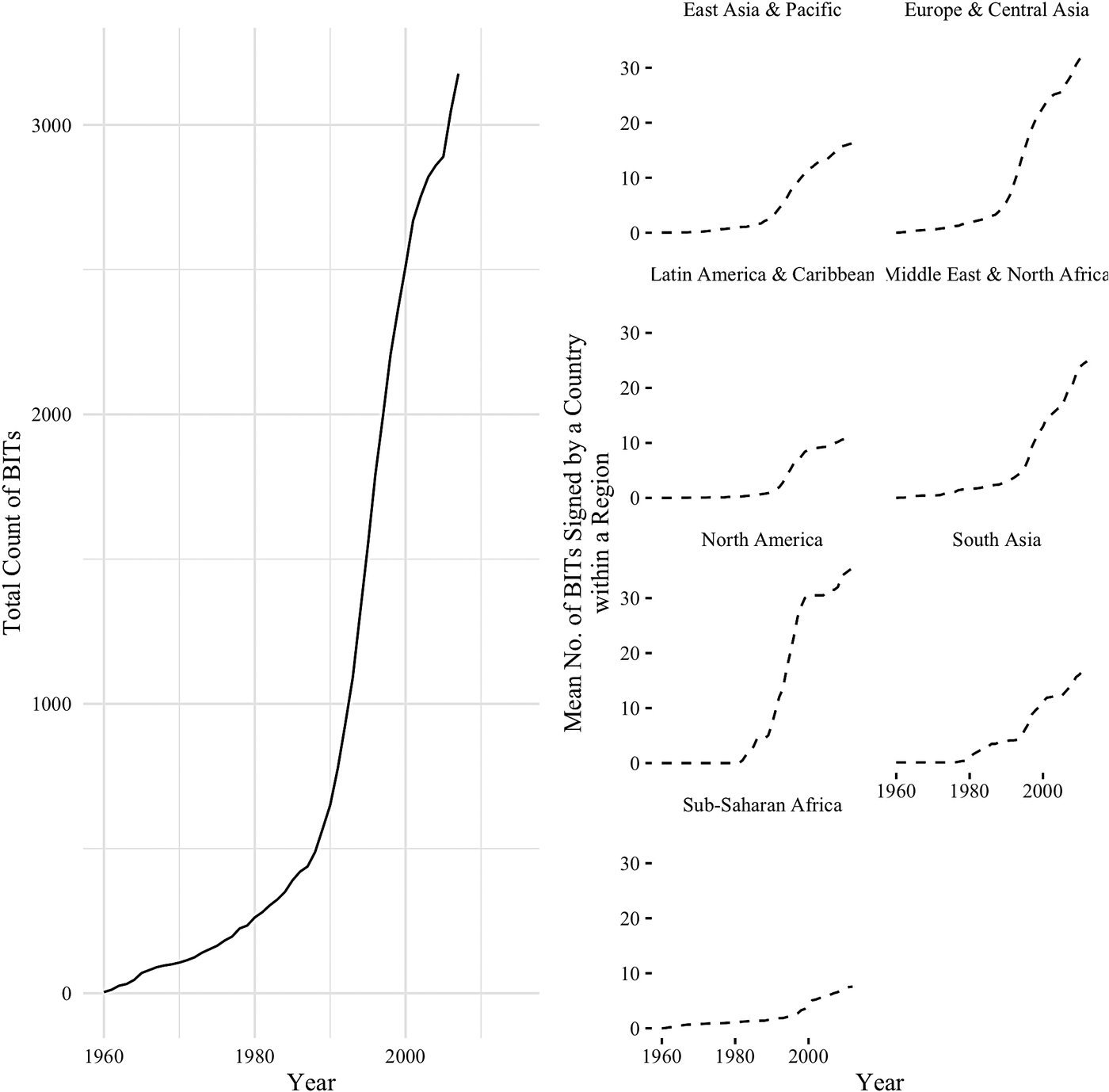
Rather than operating through a single focal institution, the International Investment regime is an assortment of acronyms. Starting in the 1960s, states began signing Bilateral Investment Treaties (BITs), which set out to protect foreign investments from state predation. By providing foreign firms the option to initiate arbitration claims against their host government, at neutral venues set up by organization like the World Bank, firms could be confident their investments would be secure. The primary goal was to promote real investments in manufacturing and production capacity, in sectors with substantial fixed costs, rather than to catalyze growth in foreign financing. These treaties took on a new level of popularity once states began to liberalize their capital accounts and sought new avenues for development. Globally, the regime is constituted by over 3,000 BITs (figure 1), formalizing the notorious Investor-State Dispute Settlement (ISDS) mechanism, which encompasses the body of law governing foreign direct investment.Footnote 1 Despite the fact that the economic value of BITs/ISDS is still contentiously debated (Allee and Peinhardt Reference Allee and Peinhardt2011; Poulsen Reference Poulsen2015), ISDS has made its way into a host of bilateral and multilateral trade treaties, most famously in the now defunct Trans-Pacific Partnership. While the regime sought to promote economic development by mitigating expropriation, ISDS cases now frequently target government regulations, with third-party funders providing the financial means to change the logic of the regime.
The growth of the international investment regime
Source: World Economics and Politics Dataverse
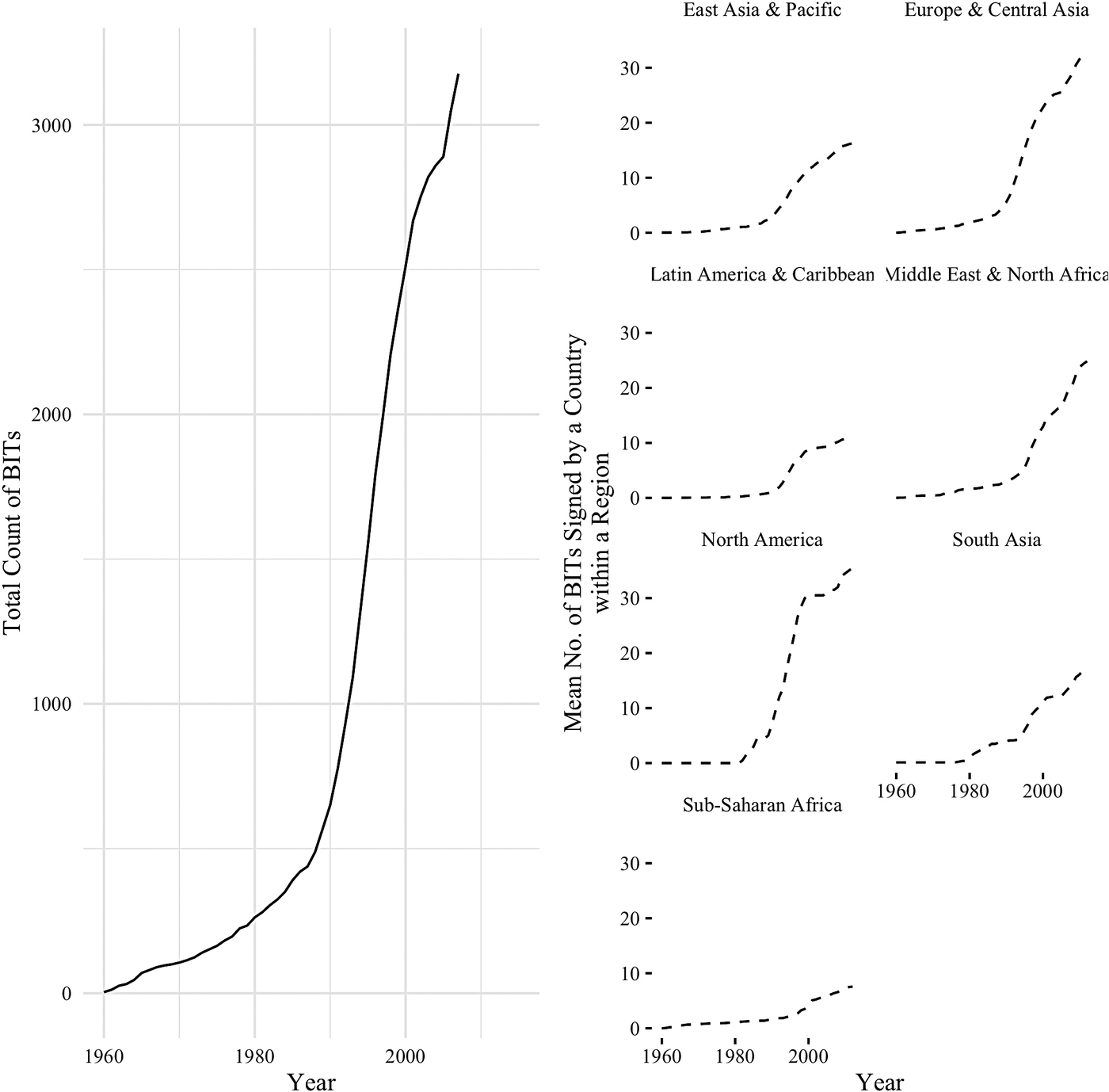
The Evolution of the Regime
This exponential growth of the investment regime has now come to haunt governments as they are subject to claims that they did not imagine could fall under these treaties (Poulsen Reference Poulsen2015). While there were only a handful of cases a year in the 1990s, over 1,300 have now been filed (PluriCourts Investment Treaty Arbitration Database). The majority of these cases are not about direct expropriation—as BITs were nominally designed to guard against—but instead challenge government regulations that usually seek to improve social welfare (Pelc Reference Pelc2017). BITs regularly contain clauses that bind governments to maintain the investment climate, which have been interpreted broadly by arbitration panels to include the regulatory environment.Footnote 2 Swedish multinational Vattenfall infamously brought several claims against Germany when the country decided to phase out nuclear energy as part of its climate change mitigation plans. Argentina has come under an onslaught of ISDS cases related to the policy measures the country was forced to take as it battled a financial crisis. Even if these cases eventually fail, they have the potential to “chill” regulation that is being considered by other governments as the latter may fear that new rules will be challenged.Footnote 3
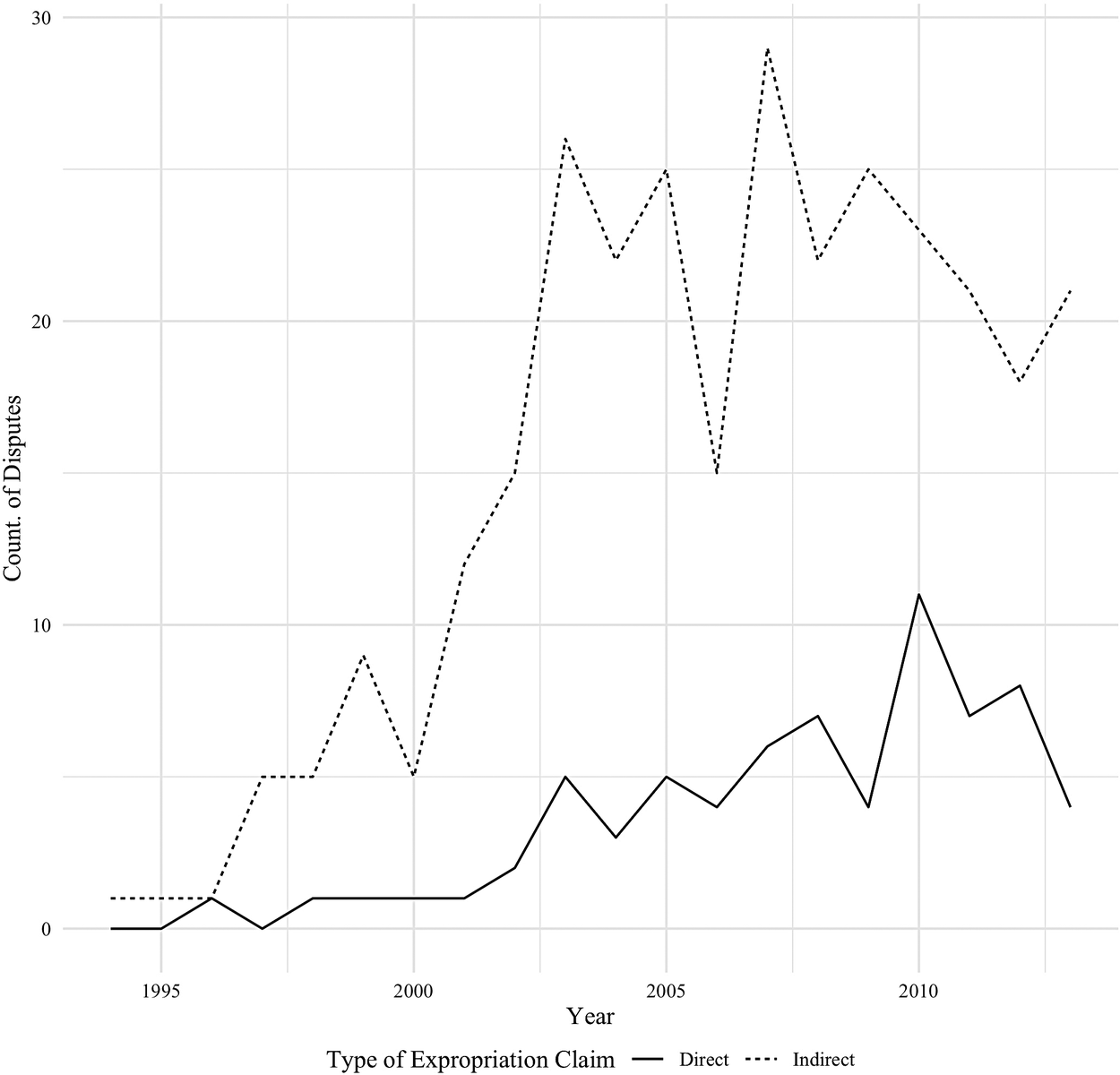
As the number of disputes steadily rose in the 2000s, the largest gains came in the indirect expropriation/regulatory vein (figure 2). These “frivolous” suits are more likely to be brought against democratic governments with low levels of development, the claimants appear less willing to settle, and are armed and ready to publicize the dispute to further harm host states (Pelc Reference Pelc2017). At the same time, Wellhausen (Reference Wellhausen2019) finds that most investors are willing to re-invest in a state once they’ve resolved a claim, strongly countering the notion that the violations were real deal breakers for the company.

New Actors and New Distributional Politics
While the recent IPE research sheds important light on new types of cases and their consequences, it primarily focuses on the interactions between industrial firms and host governments. But the last decade has seen a new type of actor—third-party finance (TPF)—enter the international investment regime. TPF is generally made up of a range of financial entities who “invest in litigation by providing finance in return for a stake in a legal claim” (Garcia et al. Reference Garcia, Gargne, Cho, Santosuosso, Scarlett and Thrasher2018). Some of the major players include publicly traded Burford Capital and privately held Calunius Capital, who trace their development to soon after the Great Recession, with their partners coming from the conventional financial and legal world. Third-party funders generally invest in commercial litigation and private arbitration, but the investment regime’s legal asymmetries, which stack rights in favor of claimants, makes ISDS a growing part of their portfolios. TPF activity has been facilitated by a number of countries loosening their financing restrictions, with Australia kicking off the trend, coupled with the lack of legal clarity in BITs on the potential role of third parties (Garcia et al. Reference Garcia, Gargne, Cho, Santosuosso, Scarlett and Thrasher2018; Dafe and Williams Reference Dafe and Williams2020). The process generally works as follows: third parties agree to front the legal costs of an ISDS claim in exchange for a 30%–50% share of a settlement or an award. Alternatively, funders buy up claims or directly purchase equity in a company that could have a substantial legal claim and use their voting rights to push for the case to move forward.
Given the opacity of the ISDS disclosure rules, and the preference for funders to stay anonymous as long as possible, it is difficult to assess exactly how prevalent a role they play in the international investment regime. But estimates make it clear that they have quickly become a structural feature in the investment regime. Some of the first journalists to bring serious attention to these new dynamics estimate that three-fifths of ISDS cases appear to have been funded by third parties (Corporate Europe Observatory 2012). A task force commissioned by the International Council for Commercial Arbitration estimated in 2018 that the international market for funding was over $10 billion and expanding quickly (International Council for Commercial Arbitration 2018). A major funder noted that in one year their firm was approached to participate in twenty-eight out of the thirty-four active ISDS cases (Dafe and Williams Reference Dafe and Williams2020, 5–6).
At least twenty different governments have been involved in cases against claimants backed by TPF.Footnote 4 Some of these cases such as Crystallex v. Venezuela, where Tenor Capital Management could gain 70% of the Canadian company’s $1.2 billion claim, appear to fit into the conventional expropriation category. A number of others instead fall under the more (morally) ambiguous regulatory/indirect expropriation. Colombia could be on the hook for $764 million based on a TPF-backed case related to the expansions of its conservation laws. When Romania withdrew from a mining project with Gabriel Resources, siding with domestic environmental protection groups, the TPF-supported company filed a claim worth $3.2 billion. OECD governments are not immune here—Eskosol, with Italian and Belgian shareholders, brought a claim against Italy after the country altered its feed-in-tariff schemes for its energy sector. Unlike the cases against Romania and Colombia, Italy’s actions are likely to slow their climate change mitigation efforts, illustrating the financial, rather than normative, logics driving ISDS investors.
Why has the international investment regime taken on this unexpected turn? Part of the answer surely stems from the fact that firms have learned more about how these treaties work, and how broad and imprecise they actually are (Tucker Reference Tucker2018; Calvert Reference Calvert2018). But this does not help explain where this newfound understanding came from or why a new set of actors can effectively profit off the regime at the expense of governments. To make sense of the shift in the investment regime, it is useful to consider the ways in which it is part of a larger financialization process that has affected many traditional economic domains.
The Financialization of International Law
As Epstein (Reference Epstein2005) notes, “Financialization refers to the increasing importance of financial markets, financial motives, financial institutions, and financial elites in the operation of the economy and its governing institutions, both at the national and international level.” Although important cross-country differences remain (Maxfield, Winecoff, and Young Reference Maxfield, Winecoff and Young2017), various qualitative and econometric studies illustrate the spread of both complex financial arrangements and financial logics across the nominally advanced industrial countries. Too-big-to-fail banks have replaced manufacturing as the engines of growth across much of the West, with credit creation moving out of the highly regulated enterprises into the hands of the multiple intermediaries constituting the shadow banking sector (Helgadóttir Reference Helgadóttir2016). The net result is an increase in economic inequality and the constant fear of financial tail risks.
While research recognizes how financialization has reconfigured a variety of social institutions (Mabbett Reference Mabbett2020), and even altered the demands of democratic politics (Chwieroth and Walter Reference Chwieroth and Walter2019), the literature has paid limited attention to the way that the legal sphere has also been financialized (Davis and Kim Reference Davis and Kim2015; Dafe and Williams Reference Dafe and Williams2020). Contingency fees and the funding of non-financial law suits by financial firms have become the norm across countries ranging from Australia, to Singapore, to the United States (Hensler Reference Hensler2010; Steinitz Reference Steinitz2011). It is now common practice for funders to receive the first payout from an award or settlement, rather than the firm or individuals that are the actual claimants, and we regularly see the returns for the latter become a marginal percent. For example, in an intellectual property case brought by security company Deep Nines, the firm only received $800,000 from a $25 million lawsuit after its funder took home $11 million (Sheridan Reference Sheridan2016). The latter represented a 27% return on investment for the hedge fund’s initial eight- million-dollar loan. The fund even went on to sue Deep Nines for settling at a sum below their expected return.
TPF is not just impacting the ability of parties to bring claims or creating new ways for funds to line their pockets. The presence of outside money generally shifts the power dynamic by increasing the leverage of a claimant vis-à-vis the defense. James Rogers of law firm Norton Rose Fulbright explained the general effects of TPF on arbitration:
I was involved in a somewhat unusual +5 year case where the threat of funding led dramatically to settlement … We eventually had four arbitration awards in hand that we were getting ready to enforce and we were preparing another round of claims … The threat of funding confirmed our client’s persistence and, within a month confirming that we had engaged funders, the Chinese party agreed to settle. It was a very powerful tool.
(Sharp and Marsh Reference Sharp and Marsh2017)While originally forbidden by many common law systems, numerous states have removed restrictions on “third-party finance” in the name of empowering claimants that do not have adequate resources to attain justice.Footnote 5 The little guy going up against a deep-pocketed corporation has been used as a poster child for why changes to century-old doctrines were necessary (Santosuosso and Scarlett Reference Santosuosso and Scarlett2018). Instead, we now regularly see the speculator bully governments, as finance’s reach extends well beyond its sector into the courts that make industry possible.
ISDS is a particularly attractive arena to financialize because of both its legal and investment properties. The regime is designed to give only private actors standing with no substantial recourse for governments—there is limited risk of a countersuit as would be a standard fear in private litigation. These are investors who, at the end of the day, are fundamentally interested in the huge returns that ISDS promises. The high-end cost estimate for an ISDS case is roughly eight million dollars (Commission Reference Jeffery2016). The average claim for an “indirect expropriation” is $1.1 billion as calculated by Pelc (Reference Pelc2017, 570), and these claims have a success rate just above 20% over the past decade (Pelc Reference Pelc2017, 580). If we assume that third-party funders share half the return with the claimant while still paying the full legal costs, the expected return across five cases would be almost fourteen-fold. To put that in perspective, the S&P500 gained roughly three-fold over the past decade. There is obviously substantially more risk involved with ISDS than a standard equity investment, particularly because capital will be tied up for years due to the significantly less liquid market. But that is steadily evolving in the funder’s favor. For example, Burford recently invested $13 million in Teinver v. Argentina. It then sold that interest on the secondary market for $107 million, leading to a $94 million profit (Garcia Reference Garcia2018). All this took a handful of months.
The Burford example also highlights that financialization is not restricted to the deal itself. As Buzzfeed reported:
Attracted to ISDS by the staggering sums in play, financiers have created an increasingly sophisticated marketplace around the claim itself. “We try to look at all of the different ways you can make money out of this,” said Peter Griffin, a London-based lawyer and consultant who works with companies and funders … “One of the attractions for some of these folks,” Griffin said, is anonymity: “They kind of hide behind the entity that’s suing.”
(Hamby Reference Hamby2016)The interest in the claim is securitized, allowing the third-party players to enter and exit when they choose. It has even reached the point where multiple legal claims are being pooled and sliced into different risk bands with rights to returns then sold off, in a fashion mimicking mortgage-backed securities.
How did financialization come to transform international investment law? Work on financialization more generally tends to highlight three complementary approaches. Micro-studies focus on the development of new calculative devices or technologies as central to the ability of finance to flourish—developments in modeling and measuring risk have changed the internal process and cultures of corporations (Besedovsky Reference Besedovsky2018). Others stress the rise of a shareholder value ideology shifting publicly traded firms away from productive long term investments, into boosting dividends in the short run (Davis Reference Davis2009). Finally, research shows how the state has been intertwined with the financialization process. Krippner’s (Reference Krippner2011) agenda-defining work illustrates how the push toward deregulation of credit in the United States was driven by the state trying to solve its own legitimacy crises. At a more instrumental level, recent scholarship documents a convergence of interests from conventionally opposing political coalitions toward greater growth of financial markets (Pagliari, Phillips, and Young Reference Pagliari, Phillips and Young2018; Pagliari and Young Reference Pagliari, Young, Philip, Daniel and van der Zwan2020; Witko Reference Witko2016), especially as we see the state reliant on private market actors to perform their fundamental governance goals (Gabor and Ban Reference Gabor and Ban2016).
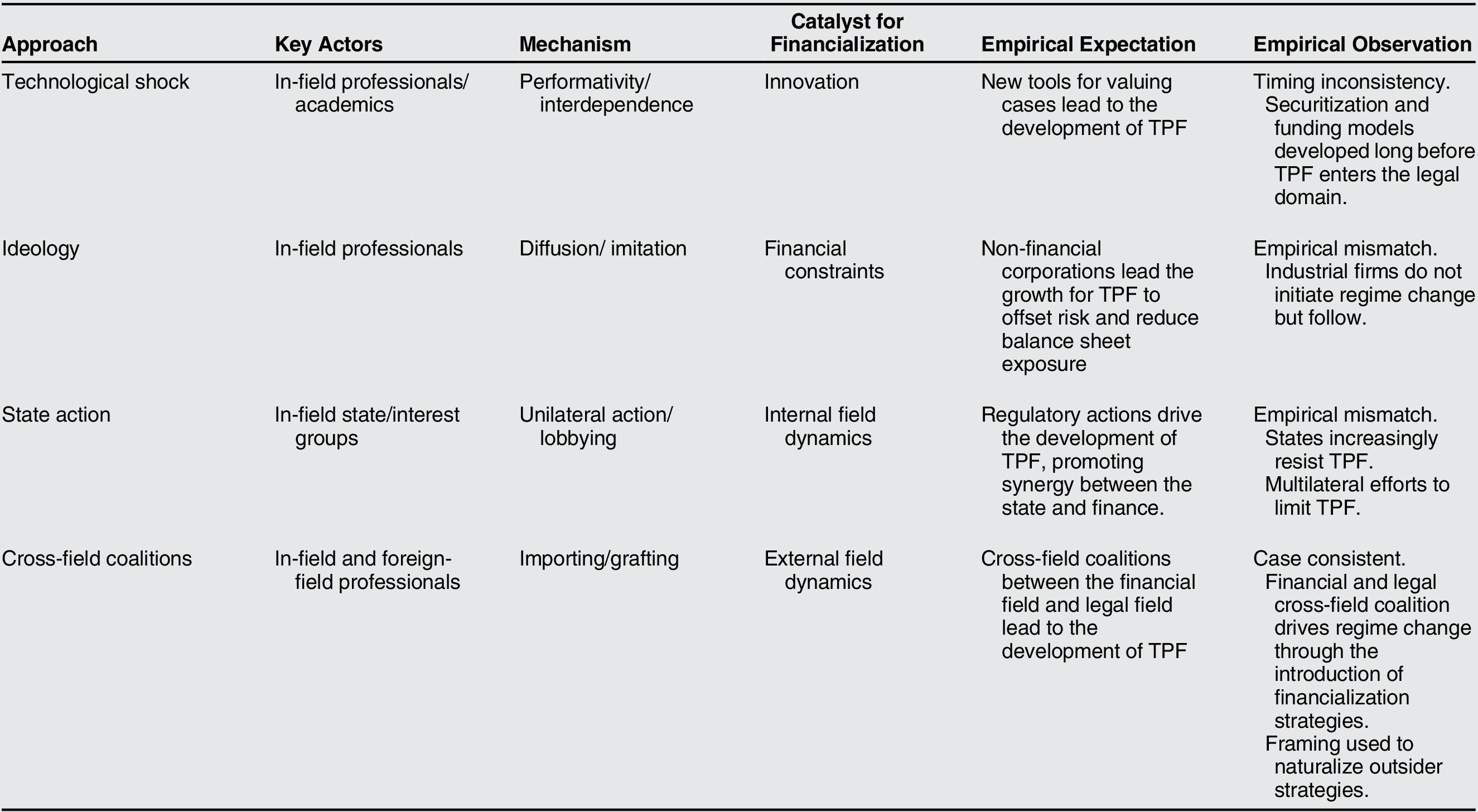
Each of the three approaches can shed important light on the rise of TPF but each has its own limitations. New ways of measuring the value of cases and the probability of success were surely needed for the growth of the industry, but the legal knowledge required to develop these tools are unlikely to be found within the conventional financial industry. Rather than the creation of new models, however, the innovation would require combining financial and legal knowledge. Moreover, the other foundational technologies for financialization, such as the securitization process, have existed for quite some time. The growth could instead be driven by non-financial corporations that have internalized views on shareholder-value looking for new ways to manage their balance sheets and thereby create new streams for dividends. But again the timing is inconsistent as those pressures existed for more than two decades before the growth of TPF. The growth of the industry could be read as the result of state-led changes to the regulatory environment, or simply due to the increases in liquidity following the 2008 crisis, but it is unclear how the state has benefited from these changes. Rather than integrating the fates of private actors and the state, TPF has created a new set of contentious disputes between transnational finance and national public authorities.
In sum, existing accounts of financialization provide general enabling conditions for the shift in the international investment regime as actors over the years have developed new risk technologies and political support for the overall financialization process. That said, they have more difficulty identifying how such technologies entered the regime or came to redefine its functions.
Regime Change through Field Interaction
Regimes, in political economy and international relations, are generally defined as the set of formal and informal rules that guide and shape behavior. In addition to a set of institutions, regimes are inevitably animated and populated by individuals. The wave of research on “regime complexity” highlights how multiple organizations and institutions often claim authority over an issue area (Alter and Meunier Reference Alter and Meunier2009)—these dynamics are frequently driven by the bureaucrats, firms, and civil society groups seeking to implement their own agendas (Green Reference Green2013).
We start from the premise that these actors, their social world, and practices influence the ways in which regime rules and principles are deployed and function. Even when in conflict, regime operators often share similar backgrounds, educational experience, and even geolocation (McNamara Reference McNamara1998; Weaver Reference Weaver2008; Seabrooke and Henriksen Reference Seabrooke and Henriksen2017). For example, governors of international trade live in New York, London, or Geneva; come armed with JDs from a few select universities; and have work experience in a handful of corporate law firms specializing in international trade, which helps them to navigate the complex world of anti-dumping, non-tariff barriers, and product standards. Shared expertise and social interactions are what allow regimes to function, as actors must be able to communicate in an often silently agreed upon manner to design and operate the institutions that eventually constitute a regime.
Building on scholarship in the sociology of organizations, we argue that regimes and their corresponding governance institutions are embedded within particular field dynamics. Fields encompass local social orders, in which a set of actors engage in regularized relations with each other based on commonly held beliefs (Fligstein and McAdam Reference Fligstein and McAdam2012; Zietsma et al. Reference Zietsma, Groenewegen, Logue and (Bob) Hinings2017). Actors within a regime develop their own practices, based off their field and professional expertise, which provide the means to coordinate their behavior and deal with problems efficiently in their specific context (Pouliot Reference Pouliot2008; Seabrooke and Henriksen Reference Seabrooke and Henriksen2017). These include developing procedures like the process that will decide what eventually becomes a rule, or how disputes can be resolved, and informal norms like what will be on an agenda or what needs to be discussed behind closed doors. Fields not only facilitate cooperation but also shape the way in which cooperation is practiced (Sending Reference Sending2015). We assume that the combination of actor backgrounds and routinized social interaction generally hold regimes together and lay the basis for the global governance of an issue.
Considerable scholarship on fields suggests that dominant actors are well positioned to resist changes to governance institutions (Fligstein and McAdam Reference Fligstein and McAdam2012; Zietsma et al. Reference Zietsma, Groenewegen, Logue and (Bob) Hinings2017). Such actors within the field will try to further their own goals, creating the regime that best serves their interests or provide them more autonomy, while blocking changes that could upset a beneficial status quo. This political activity will follow the policymaker’s professional experience and the field’s practices. The purpose of the regime, as institutions become locked in or even as innovations occur via feedback loops or bricolage, generally remains constant due to the field premises actors use to operate the regime (Pouliot Reference Pouliot2008; Kalyanpur and Newman Reference Kalyanpur and Newman2017). When change does occur, it often results from contestation within a field as exogenous shocks, for example, shift the balance of power between dominant actors and potential rivals.
Recent work on field dynamics, however, suggests that field interaction may serve as an underexplored pathway for institutional and therby regime change (Furnari Reference Furnari2016; Landy Reference Landy2015). Policymakers or non-state actors that come from an alternate field have their own, relatively distinct expertise, social roles, and backgrounds. Their preferences for how to solve problems or how to take advantage of new opportunities are conditioned by their own local norms and understandings about social behavior (Landy Reference Landy2015; Sending Reference Sending2015). For example, those with legal backgrounds will often look for how to exploit precedents, while others that come from financial backgrounds are more likely to look for how to outsource governance to the market or aim to understand how rules provide new grounds for securitization and arbitrage. This resonates with a large body of work across political economy that illustrates how actor backgrounds can lead them to interpret the same set of information in different ways (McNamara Reference McNamara1998; Ban, Seabrooke, and Freitas Reference Ban, Seabrooke and Freitas2016). We argue, then, that the use and practice of international regimes may shift as actors from an outside field begin to interact with the constitutive institutions.
Given the interdependence of economic activity today, actors from analytically distinct fields may interact. Sometimes such interaction is forced due to crisis but more often interaction occurs by choice due to how behavior in one economic realm reshapes resources in other domains (Furnari Reference Furnari2016). For example, regulators of international securities firms coordinate with banking professionals that may lie outside their traditional governance regime due to the ways investments banks have altered their business practices over the past three decades (Newman and Posner Reference Newman and Posner2018). Environmental regulators frequently cooperate with private authorities that set rules around electronics as the latter’s production has spillover effects for a host of sectors (Green Reference Green2013). Policymakers, be they experts on trade or investment, work in the same professional networks including the same corporate firms or in the same International Organization host city. This creates brokerage opportunities for them to graft their practices on to another field and expand their professional jurisdiction (Evans and Kay Reference Evans and Kay2008). The entrance of actors with a different field background and view on the role of rules and norms can then act as a pathway for international institutional change.
In other words, regimes are often more embedded in broader social fields than is typically theorized, creating the space for actors from distinct fields to learn from and create coalitions with actors that span them (Seabrooke and Tsingou Reference Seabrooke and Tsingou2020). These interactions have the potential to change regime function as “foreign” actors, when analyzing a problem in the targeted regime, respond by using their own toolkit to reinterpret rather than simply follow the rules. They import their dominant norms and graft the practices from their field on to the target governance institutions.
But this grafting cannot occur wholesale. The target regime has its own norms and practices. The foreigners will require local collaborators because whether or not the ideas and practices are localized will depend on how they resonate with internal practices. As scholarship on the sociology of translation has shown, new practices need to be edited to fit the local field’s context, particularly in a fashion that compliments the identities and material interests of dominant actors in the target regime (Sahlin and Wedlin Reference Sahlin and Wedlin2008; Djelic and Sahlin-Andersson Reference Djelic and Sahlin-Andersson2006). Translating or grafting will be more effective when local actors are already familiar with the fundamental contours of an idea or practice (Acharya Reference Acharya2004; Ban Reference Ban2016). As Ban (Reference Ban, Seabrooke and Freitas2016) has shown, examining the localization of neoliberal ideas, such reinterpretation inevitably results in variations in how the same practice or idea is implemented across different political contexts.
We expect that actors are generally in search of expansion opportunities as they are looking for ways to increase their status, control, and economic potential across fields that are linked to their core home field. We draw on a variety of complementary sociology literatures to identify conditions when this is likely to be most successful.
First, in line with work by Abbott (Reference Abbott2005) on linked ecologies, we expect that institutional change will be more likely when actors from different fields are able to find opportunities that benefit both groups and will then create a coalition to lobby for change. Linked interests allow “foreign” actors to combine resources and use the expertise of their local collaborators from the regime they are trying to change as the basis for their political power. In the absence of such a coalition, actors from outside the field will have to pay huge startup costs to even understand the formal and informal status quo, leaving them with limited opportunities to exploit or alter the target governance institutions. Part of why regimes are generally stable is precisely because they involve specialized, hard to absorb skills and field-specific capital. Actors with different preferences are rarely able to venture in and alter the logics of the regime in the absence of a cross-field coalition.
Second, coalitions will be more likely to form when the players from outside the targeted regime are already powerful players in their home field (Abbott Reference Abbott2005). One can have all the expertise and ideas about how to change a governance institution for someone’s benefit but if you are going to free ride through the change process, your potential collaborator is unlikely to want to join forces. Then, altering a potentially complementary regime is likely only an option for players who have already marshalled their own resources and proven themselves as actors capable of doing future institutional work. The ability to provide strategic resources to the local actors is essential because it will facilitate the translation process.
Finally, these coalitions are likely to form when a field is in crisis and the need for new professional opportunities is acute (Fligstein and McAdam Reference Fligstein and McAdam2012). When times are good, professionals are focused on finding ways within the field to maximize their territory in fear that others may take over the institution. But a loss of status or profits pushes actors in a field to look beyond their status quo for new opportunities to compensate for the crisis induced change. While numerous scholars argue that an exogenous shock can produce institutional change, our expectation is that shocks in neighboring, linked fields are likely to bring about regime change.
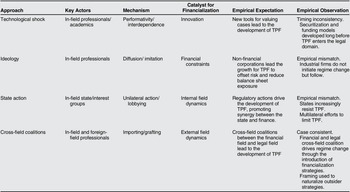
As our goal is theory development we conduct an initial plausibility probe of our framework’s usefulness, examining how a cross-field account can explain why the international investment regime has financialized. To clarify, our theoretical outcome of interest is regime change, while our empirical outcome of interest is financialization. Macro theoretical approaches to international regime change broadly align with mid-range approaches that seek to account for financialization. The development of new technologies has the ability to upset the status quo by increasing international interdependence (Cerny Reference Cerny1994; Garrett Reference Garrett2000), as we’ve seen in prior financialization accounts. Ideological changes amongst the professional class, usually following a collapse in a regime’s functioning, has led to the development of new institutions (McNamara Reference McNamara1998; Nölke and Perry Reference Nölke and Perry2007). State action, particularly by major powers, is often regarded as the central cause of changes to international regimes, as states try to enforce their own domestic preferences and win distributional conflicts (Drezner Reference Drezner2008; Kalyanpur and Newman Reference Kalyanpur and Newman2019). To enhance the assessment of our approach’s value, we then contrast our argument with standard accounts of regime change in the literature (table 1).
Four approaches to regime change: What explains the financialization of the investment regime?
Field Interaction and Third-Party Funding in the Investment Regime
The investment regime is a useful case for our argument as it involved a regime populated primarily by international legal professionals (Tucker Reference Tucker2018; St John Reference John and Taylor2018). Here we trace how the professional ecosystem changed following the 2008 crisis, having important consequences for the function and use of the regime. Financial professionals saw the regime not as a way of compensating for weak property rights but instead as a way to increase compensation to investors. The case offers preliminary evidence of our described mechanisms, highlighting how financial actors were able to boost the number of cases being filed, increasing lawyer billable hours, and generating valuable resources to build coalitions with the legal community. Financial actors, then, deployed cross-regime grafting to educate the traditional investment community on the possibilities of third-party finance and, in turn, the financialization of ISDS.
The Great Recession as Catalyst
TPF has become a structural feature of the ISDS landscape, with funders attracted by the huge returns that require relatively limited early investments as well as the new terrain for business expansion. In contrast to arguments highlighting the role of new technology, the potential for high returns has always been true with ISDS and financialization practices such as securitization had existed for some time so it inevitably begs the question as to why it took so long for the trend to emerge. As per our expectations, a shock in neighboring fields acted as the catalyst.
Observers of the industry, be it advocates or critics, all generally pinpoint the 2008 financial crisis as a key turning point (Norton Rose Fulbright Reference Fulbright2016; International Council for Commercial Arbitration 2018; Dafe and Williams Reference Dafe and Williams2020). A crisis outside the legal sphere led foreign actors to seek arbitrage opportunities: the recession motivated big financial investors to start looking for new avenues to extend their influence and boost their profits. The ideal opportunities from a financial perspective would not only be those that provide high returns but also those that are generally going to be uncorrelated with a declining market. ISDS goes one better as legal claims tend to get a boost from crises. Governments may be forced to nationalize industries or put in new unforeseen regulatory measures, which could then fall under the broad scope of a BIT violation.
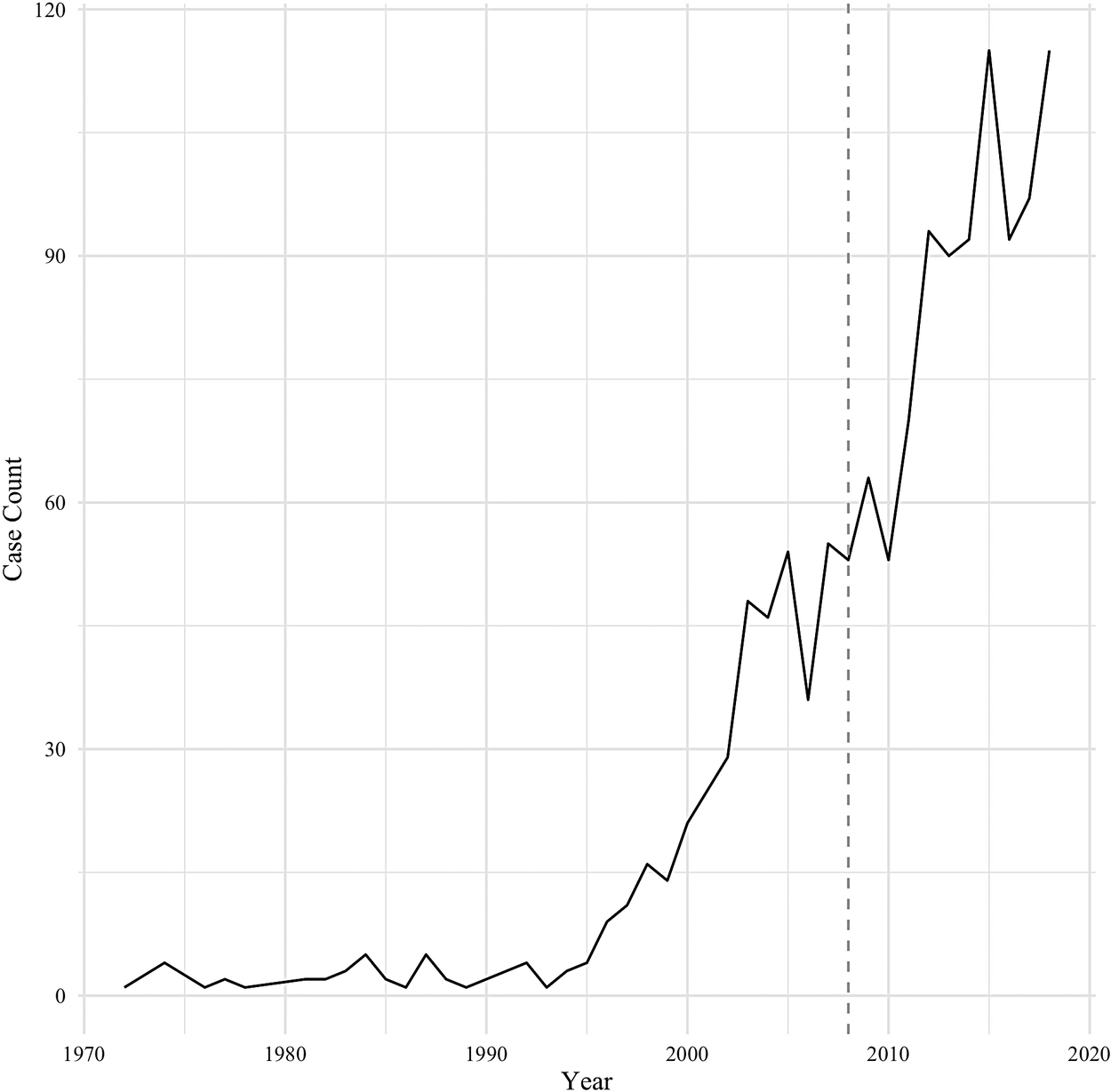
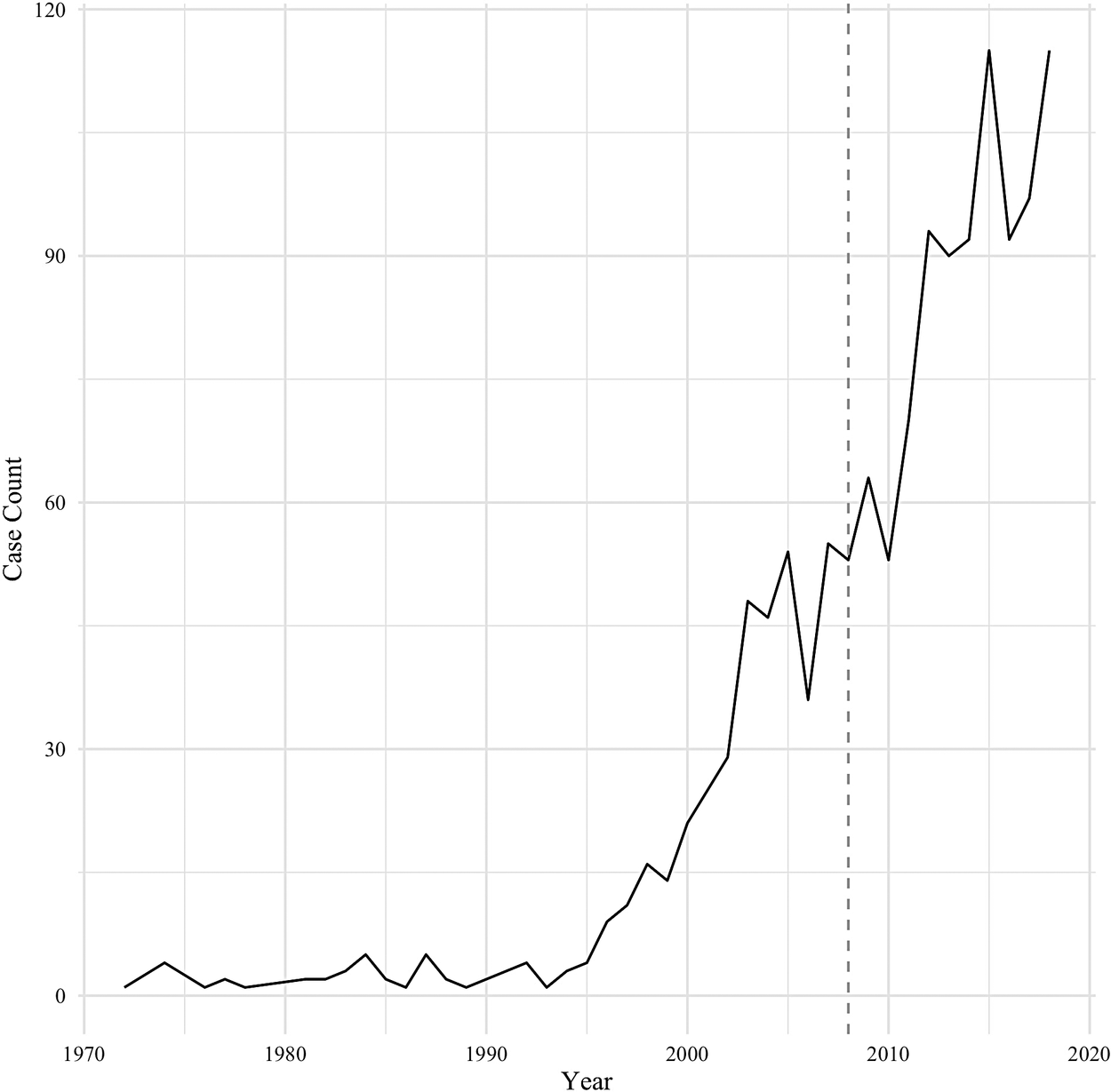
Funds like Burford, while gaining ground pre-crisis, then saw a surge of money coming their way. Richard Fields, CEO of Juridica Capital Management summarized the situation: “When the recession started to bite, the phones started ringing off the hook” (Glater Reference Glater2009). James Tyrell, a partner at Squire Patton Boggs who appears to regularly counsel both Burford and Juridica, affirmed that the uptick in interest was the search for new forms of yield: “There’s a lot of money out there that’s looking to find a home” (Corporate Europe Observatory 2012). As TPF generally became more popular post-crisis, the financialization of ISDS followed. Claims were on the rise in the 2000s as more countries signed BITs and firms learned of their new global property rights. But the post crisis-era saw a substantial uptick in claims, as depicted in figure 3. Considering most firms would have significantly fewer internal resources to spend on legal fees given the global crisis, the trend suggests the important role that TPF may be playing in changes to the use of the regime overall.
The number of ISDS cases by year
Note: Sharp increase since the financial crisis coinciding with the rise of TPF
Source: PluriCourts Investment Treaty Arbitration Database
Bringing in Actors from the Investment Regime
But even if actors in a different field spot a new opportunity, in line with our expectations, they need to be able to make links with established players to take advantage of it. They need collaborators with expertise who understand the local field practices. Once again, the 2008 crisis primed the legal community to take part in the new TPF schemes. When such a big shock affects the economy, business needs to quickly cut costs. One of the first routes is to get rid of expensive law firms kept on retainer. At the same time, economic decline generally reduces the amount of work law firms need to do for their big corporate clients. Major mergers and acquisitions dry up and companies are not looking to issue new bonds or stock. The bread and butter of big law is thrown off the table, unsettling professional trajectories. As the New York Times reported, “Juridica outlined some of the motivations for both law firms and companies to look for outside funding in its 2008 annual report: ‘Traditional sources of hourly billing in the corporate and transactional business have diminished, leading law firms to cut lawyers and staff at a rate never seen in the modern legal market.’” (Glater Reference Glater2009). Armed with capital waiting to be deployed, third-party funders could directly help fill these gaps, providing the necessary gains for effective cross-field coalitions between foreigners and collaborators.
The decline in earnings then conditioned lawyers to look for ways to boost the number of cases they were working on, and TPF provided an effective new route. The crisis also forced many industry professionals to look for innovative lines of work to keep billing hours up but also to raise their profiles in the industry—increasing your caseload during market turbulence is a particularly attractive status signal. The likes of Burford and Juridica were able to poach a number of lawyers from the investment regime, offering lucrative and interesting work.
Lawyers are an essential ingredient to running an effective TPF firm. They have the tacit legal knowledge to assess whether or not a case is likely to be a winner and to gauge what an effective settlement would be. This is a conventional, if often informal, practice that lawyers conduct throughout their client engagements. The other important feature is to manage the financial outlays for each case against the different expected time frames for return—a standard task in portfolio management. Rather than the creation of de novo financial technologies, as per a standard technological shock argument, the financialization of ISDS required the combination of practices from different fields.
But the lawyers are not just key to picking the optimal cases to invest in. Underscoring the importance of social dynamics, they also serve as the entry point into the professional networks vital to the investment regime. Selvyn Seidel is the founder and CEO of the TPF fund Fullbrook Management. But he cut his teeth as a former partner at New York legal giant Latham & Watkins. He has openly stated that his ties to law firms “have been a big help to us” (Corporate Europe Observatory 2012). Mick Smith is the head of Calunius but in his previous professional life was a partner at Magic Circle firm Freshfields Bruckhaus Deringer. He is on record saying that “the relationships I made there are still important and they’re my first port of call” (Corporate Europe Observatory 2012). Adrian Chopin, another former legal partner (at Allen & Overy), and now head of Bench Walk Advisors, summarized the social nature of the market: “it’s still a chummy market … everyone knows everyone” (Strickler Reference Strickler2017). In other words, pre-crisis legal networks laid a foundation for the eventual growth of TPF.
The publicly traded Burford Capital is now the biggest player in the broader TPF industry: in 2018 the fund invested more than a billion dollars in the full gamut of legal cases. Heralded for its corporate diversity measures, Burford was the fastest growing stock in all of the London Stock exchange until it came under attack by short sellers who questioned the underlying viability of the TPF business model. The fund was started in 2009 by Christopher Bogart and Jonathan Molot. Bogart rose to prominence at Big Law behemoth Cravath, Swaine & Moore before taking on several legal and executive functions at Time Warner. Molot, a Georgetown Law professor, was one of the earliest proponents of TPF and founded Litigation Risk Solutions LLC as a consulting firm for the first players trying to financialize the law. They now serve as chief executive officer and chief invest officer, respectively.
The rest of Burford’s leadership team is a mix of established financial and legal professionals. Three traditional finance veterans from major American and British firms and a former director of Credit Suisse constitute the bulk of the team. It is rounded off by a legal technology expert. The litigation finance department, at the time of writing, is fifty-five people strong with close to 70% coming from the legal regime and 30% from the financial world. They encompass the elite of both professions. Lawyers were formerly employed in senior positions at major firms like Debevoise, Herbert Smith, Freshfields, and Fried Frank. Portfolio managers and risk analysts came directly from big Wall Street banks like Morgan Stanley, JP Morgan, and Bank of America. Burford’s constitution is a microcosm of the larger industry patterns. Of the thirty-five other third-party financing firms we were able to identify, each was helmed by either a veteran of the litigation or investment industry, with the core leadership teams often comprised of individuals with skillsets from the two complimentary regimes.
The 2008 crisis pushed investors into new lines of business as they searched for different forms of yield. The litigation funding market, and ISDS in particular, presented the ideal opportunity to use the funds, but traditional financial players needed collaborators with the legal credentials and connections in order to break in. The links with law firms and specifically bringing in partners from firms that were also searching for new business in a crisis environment then lead to the rapid development of the new industry. But with the tools and networks cemented, they would still need to find willing participants. Financialization provided the opportunities for TPF to alter corporate strategy and the broader investment regime.
Getting Claimant Buy-In
TPF players working on private litigation or public law cases use a David and Goliath framing to naturalize their work. They provide the capital for small struggling firms whose rights have been violated by a foreign leviathan. In this way, they argue that they are both promoting access to justice and making the marketplace for law more efficient (Santosuosso and Scarlett Reference Santosuosso and Scarlett2018). Their rigorous screening processes mean that cases with the least legal merit will be discarded. TPF employ legal advisors to find potential claimants and inform them of their rights and the potential harm that has been done to them.Footnote 6 They not only provide the resources necessary for the claim to proceed but also may motivate firms to bring suit.
This public-facing narrative embeds the financialization process within legitimate norms of the broader legal sphere. Using access to justice rhetoric, which is well established in the legal field (Cappelletti and Garth Reference Cappelletti and Garth1977), allows funders to combat criticism that they are motivating frivolous lawsuits or drumming up legal claims. The ICCA task force (2018, 42) reviewing industry trends, however, suggests a more targeted focus on a “relatively small volume of very large commercial disputes and portfolios.” In a set of focus groups organized as part of the task force deliberations, the participants concluded that “it is misplaced to assert that for these kinds of non-impecunious claimants third-party funding is necessary for access to justice” (International Council for Commercial Arbitration 2018, 237). In a review of such framing strategies, Santosuosso and Scarlett (Reference Santosuosso and Scarlett2018, 3) came to a cynical conclusion that “proponents of TPF in the ISDS context have hijacked this rhetoric to justify speculation on investment claims with far-reaching financial implications for disadvantaged and developing states.”
At the same time, TPF players pitch their value differently towards incumbent players within ISDS who they need to team up with. As we expect, financialization is reframed in order to fit the interests of incumbents in the legal field. For the lawyers, as detailed in the previous section, the process promises an increased caseload and status within the legal world. For claimants, TPF can resonate with an existing set of ideas and practices that have been triggered by prior waves of financialization.
Just as the 2008 crisis cut into law firm profits, it also left conventional industrial firms struggling. Reducing legal costs by diminishing reliance on big law was one path, but so was internal downsizing. As the firm Borden Ladner Gervais reported, this was a new opening for TPF: “Following the 2008 financial crisis, corporate legal budgets contracted, allowing the arbitration and litigation finance industry correspondingly to expand” (Chiasson and Parsons Reference Chiasson and Parsons2013).
But these non-financial corporations did not drive the growth of the market, as an ideological account of regime change would expect. They did not have the means or the knowledge to fully develop TPF even if they had the incentives. Instead the cross-field coalitions, which we argue led to the financialization of ISDS, needed to effectively pitch their practices by showing how they resonated with local needs. This sentiment was echoed by a District of Columbia-based lawyer when discussing the growth of the broader TPF industry. Without the links between the investment regime actors and the finance professional network, information asymmetries would have stymied growth:
In the last few years, companies are saying “we don’t have the money in our budgets” or “we don’t want to deduct the money from our bottom line,” he told BNA. We tell them we’ll take the case on partial, not full contingency. We tell the company they need to find additional funding sources to share the risk. Some already know about third-party funders. We let others know about the funders.
(Lindeman Reference Lindeman2010)Once TPF entered the space to promote its use, increased financialization helped facilitate the new practices. The rise in shareholder value has ushered in the belief that companies need to maintain as much flexibility as possible, minimizing any long-term financial commitments. As ISDS, and litigation claims in general, can take several years of proceedings, the incentives created by these local norms opened the space for TPF. The risk management and securitization promised by TPF coincided with the local context but the frame of TPF needed to be edited. Christopher Bogart of Burford Capital stresses this change as one of the key drivers of the industry, countering the more public sanguine David and Goliath rationale: “Litigation finance isn’t just used when claimants can’t pay, as a matter of necessity; it is increasingly used proactively, as a tool of choice. It can be far more efficient for corporations to pay for legal fees and expenses by moving them off their own balance sheets” (Norton Rose Fulbright Reference Fulbright2016).
This added flexibility provides companies possible payouts while limiting the money needed upfront. When a company is taking on a state but has a TPF arrangement, they are able to use their capital in a more versatile way. The value provided by risk mitigation was stressed by Ruth Stackpoole-Moore of Harbour Litigation: “Another benefit is that by taking funding for the costs of litigation the claimant will only end up paying these from the proceeds of a successful conclusion; in the event of a loss, there is no recourse to the claimant. The financial risk of an adverse outcome is passed to the funder, thereby removing the financial downside of commencing litigation” (Norton Rose Fulbright Reference Fulbright2016).
Moreover, research on general financialization patterns illustrates a large change in internal cultures for publicly traded firms. As finance’s place in the global economy rose, so did the value and input of Chief Financial Officers (Zorn Reference Zorn2004). The shift helped trigger the broader acceptance that all firms needed to be more heavily involved in the risk management business. This has been a key selling point for third-party financers, who argue that their role is just another form of the broader management changes that have helped firms deal with uncertain, volatile business environments. It is exactly what firms like Calunius express in order to also financialize the law. “Financial risks arising from other sources (interest rates, foreign exchange, etc.) are routinely managed by well-run businesses by hedging. The CFO will say: Why should dispute risk be any different?” Blackett Reference Blackett2017). The norms developing within corporations prior to the great recession provided another tool for actors from “foreign” fields to sell the value of their product. As the ICCA task force concludes, “While historically third-party funding was considered an option of last resort for financially distressed claimants, funders are today increasingly encouraging corporate entities with strong balance sheets to use dispute finance as an alternative to tying up their own capital in litigation or arbitration. The idea and advantages of off-balance sheet litigation and turning in-house legal departments into profit centres are well-established” (International Council for Commercial Arbitration 2018, 42).
At the same time that TPF has been pitching its money to the legal and corporate communities, there is mounting tension between the growing use of TPF and government support for such efforts. On top of creating increased incentive for the cross-field coalitions to form, awards from ISDS need to be enforced through domestic courts. If TPF were not allowed within a jurisdiction, it could risk the award never being paid out. This fits within some of the state-led logics of regime change. But those laws were reformed well before the substantial growth of TPF firms, suggesting that they did not play an active role in lobbying for change. More importantly, state approaches typically find strong synergies between the gains from financialization for the private sector and the state. Instead, TPF shows how financialization can actually exacerbate contentious dynamics between select corporations and governments. The conventional approach would struggle to explain this, especially as we now see intergovernmental cooperation, most notably via the United Nations Commission on International Trade Law (UNCITRAL), which is attempting to regulate the industry’s role in ISDS. Rather than benefiting from the financialization of international law, states are in many ways trying to rewind the clock. At least twelve different state representatives brought up concerns regarding TPF at the UNCITRAL Working Group sessions in 2018 (Roberts and Bouraoui Reference Roberts and Bouraoui2018). A representative from Nigeria articulated many of the reasons why states are inevitably frustrated with the status quo:
We noted the argument that third party funding will provide access to justice for SMEs who may lack funds. Essentially, in our experience, we find that third party funders are attracted by the high level claims, the perceived finality of awards, and the enforcement regime. But it still raises a moral, ethical, policy issues. Why a total stranger who has suffered no injury should be allowed to benefit from the injury caused to others. In our view the danger of the third party funding is that funders are not known to BITs. It poses real challenges including the possibility of encouraging unmeritorious claims, the possibility of discouraging settlement and the risk that the funders may put their own interests ahead of that of the claimant.
(Roberts and Bouraoui Reference Roberts and Bouraoui2018)To summarize, the financial crisis created the need for institutional investors and hedge funds to find new form of yield and professional meaning. With so much capital in search of new investment vehicles, the huge returns and legal ambiguity of ISDS presented a new business opportunity. Financiers with a different perspective on sources of financial investment realized the potential to arbitrage international law. These foreigners found willing collaborators in the legal regime as lawyers were also in search of new professional career ladders and revenue streams. Financial professionals used the local network to attract legal talent, who would also then serve as a means to propagate the new practice to their old firms and clients, translating the practice through legal frames. Traditional corporate clients who were suffering from financialization pressures were then lured into the mix so that they could maintain flexibility. The way the ISDS regime is embedded in a broader financial economy, and the links across fields, has now led international law to become a tool of speculation that counters many of the initial aims of its designers.
Conclusions
The international investment regime has increasingly been turned into an investment vehicle. Third-party financiers underwrite firm suits against governments in return for a cut of potential awards. Given that the investment regime was initially created to guard against unnecessary expropriation, this is certainly a major shift in the use of the regime and its function. Addressing such unintended consequences of international regimes continues to plague theories of international affairs (Barnett and Finnemore Reference Barnett and Finnemore1999).
We offer one important channel to explain these contradictions and tensions. In particular, we argue that regimes do not exist in isolation but are embedded in larger social dynamics. This synergy is not just about the formal rules or institutions but also the individuals that populate regimes. Here we draw on research on the sociology of fields to argue that these people bring their native practices and routines to any given setting. In other words, they will see and use the regime through the lens of their home field, translating and reinterpreting practice accordingly.
We then demonstrate how financial actors came into contact with the international investment regime following the 2008 financial crisis. They found a set of legal actors in need of material and status resources at the same time that they themselves sought out new means of economic return and business entrepreneurship. The result was the growth of the third-party finance industry and the eventual financialization of ISDS. In many ways, the phenomenon is a natural extension of field interaction from a previous era. As Dezaley and Garth (Reference Dezalay and Garth1996) showed, lawyers from different legal domains fought to turn commercial private arbitration into a serious revenue generator and status resource. Now a similar class of individuals were primed for innovation, and cross-field coalition building, following the 2008 financial crisis.
The ISDS regime has been substantially more politicized in recent years as cases turned toward “frivolous” regulation-related disputes. IPE scholars have argued that this shift is driven by attempts to deter governments from adopting similar rules that could hurt the bottom lines of industrial firms. But these models treat the situation as a set of bargains between industrial firms and the state without factoring in TPF. The rise of these new players suggests that the regulatory turn could instead be a result of financiers seeking new sources of profit. Speculators, unlike their industrial partners, have no need to maintain any long-term relationships with host governments—they can be more aggressive in their dealings. TPF in ISDS then skews the distributional effects of the regime away from states and the participating firms toward the financial class. These dynamics appear to be accelerating with the COVID crisis (Simson Reference Simson2020).
In addition to shedding light on the shifting political dynamics of the regime, we also raise key normative questions. As has been shown in the domestic literature on financialization, the financial community can start a process of self-reinforcement (Pagliari and Young Reference Pagliari, Young, Philip, Daniel and van der Zwan2020), which undermines objectivity and benefits insiders. As Corporate Europe Observatory (2012) explains:
These close networks raise a long list of potential conflicts of interest. For example, where arbitrators are also lawyers at firms that funders work closely with, or when arbitrators also sit as counsel in another case financed by the same funder. More likely still, arbitrators may have former partners that are now executives of third-party funders. In fact, some funders and law firms are owned (in part or full) by the same parties. These potential conflicts of interest seriously call into question the ability of arbitrators to evaluate a case impartially, fearing the consequences.
None of this is to say that states are powerless (Roberts Reference Roberts2010; Gertz Reference Gertz2018). Numerous governments have cited the unfair playing field created by the growth of third-party finance arrangements, using the controversial optics as their own rhetorical cudgel. Some appear to have benefited from the financialization process. Famously, the Bloomberg Foundation anti-tobacco campaign provided funds to Uruguay to fight arbitration claims filed by smoking giant Phillip Morris (Brekoulakis and Rogers Reference Brekoulakis and Rogers2019, 7). There are, however, inherent limits to the way states and their citizens could gain, as the investment regime does not provide them recourse for abuses by corporations. At best, TPF can act as a form of insurance (Guven and Johnson Reference Guven and Johnson2019, 8–11). Moreover, there are several academic and intergovernmental bodies working to detail policies that would create clarity around the rules of TPF, with UNCITRAL and ICSID actively considering new measures. The fact that some states have been willing to simply exit agreements has increased the salience for these new proposals. A critical next step is to understand how the losers from field interaction choose to respond, and whether they can diminish the legitimacy and effectiveness of the foreign actors.
Importantly, these changes are not simply restricted to the ISDS regime. TPF is increasingly used across a host of international legal terrain and the financialization of ISDS is part of this broader process. It is a regular feature of private commercial litigation and arbitration, where the rules for TPF have also recently liberalized as countries compete to bring more cases into their jurisdictions. They have been key actors funding civil suits seeking compensation for the negative consequences of resource extraction and even part of divorce proceedings involving Russian oligarchs (Segal Reference Segal2018). Future research should then examine how TPF has differed across these domains in terms of uptake and distributional consequences. The massive liquidity boost provided by TPF could help provide weak economic players new resources, but it could also exacerbate inequalities as the ISDS case suggests.
Theoretically, we push scholars to think about cross-field interactions as a vector of regime change. A growing body of scholarship in political economy emphasizes the internal politics of professions (McNamara Reference McNamara1998; Seabrooke and Henriksen Reference Seabrooke and Henriksen2017; Ban and Patenaude Reference Ban and Patenaude2019). Helgadóttir (Reference Helgadóttir2016), for example, underscores the role that (academic) economists have played in shoring up the shadow banking sector after the financial crisis, facilitating the growth of financialization through informal financial channels and redistributing risk to public actors like central banks. Our analysis indicates a need to factor in how professions across fields can create coalitions that alter regime practices and, with it, governance dynamics. Empirically, cross-field coalitions, for example, have transplanted financialization norms outside of traditional economic domains into international law. While our theoretical ambitions are naturally limited by the single case study, work in other areas suggest the potential to generalize our findings. Sending (Reference Sending2015), for example, demonstrates how the regime for global population governance transformed from focusing on development to reproductive health as actors from the health field entered an arena long dominated by economists.
Our framework also builds important connections to legal realist scholarship on transnational legal orders (TLO). The TLO approach collapses the distinction between domestic and international law, drawing attention to the myriad interactions between lawyers, bureaucrats, and institutions (Whytock Reference Whytock2009; Halliday and Shaffer Reference Halliday and Shaffer2015; Kahraman, Kalyanpur, and Newman Reference Kahraman, Kalyanpur and Newman2020). We hope this article will push scholars who analyze transnational law in political science and legal academia to continue working on identifying the coalitions that develop, and the new economic opportunities that emerge, as the individuals that occupy one TLO interact with those in neighboring fields. For example, transnational litigation is an increasingly popular strategy for combatting climate change. We could understand better its rise by paying attention to how professionals in the conventional legal regime have partnered with activists and scientists in the environmental regime to develop a growing body of cases that provides lawyers more business and increases the strategic toolkits of civil society actors and corporations alike. As governments are the most frequent respondent in climate litigation, in line with the effects of TPF in ISDS (Nachmany et al. Reference Nachmany, Fankhauser, Setzer and Averchenkova2017), cross-field interactions may be curtailing the autonomy of the state.
Ultimately, we contribute to research demonstrating the far-reaching consequences of financialization. While international relations scholars have increasingly turned their attention to how this process has shaped global financial stability, we show how financialization has had a much more structural transformation outside the issues traditionally associated with finance or corporate decision making, influencing the working of international institutions. In our case, international law has been transformed into a profit center, in which the benefits can be shifted to third-party investors and the risks can be hedged against. This technology has been used across a host of domestic and international arenas. More generally, we call for political scientists to take a broader perspective on the role of financialization for global politics.