


INTRODUCTION
Despite dramatic changes across the world in women's access to education, employment, healthcare, and political participation over the past two decades, progress has been uneven (World Bank 2012). Promoting gender equality has proven especially challenging in countries with long-standing cultural traditions that sustain discrimination against women in all sectors of life. Even if there is enough political will to implement policies aimed at empowering women in such contexts, such policies often prove insufficient to change deeply ingrained gender stereotypes.
In this study, we examine whether development programs that mandate women's community participation can improve women's status in societies characterized by female repression. Specifically, we exploit a randomized field experiment conducted in 500 villages in Afghanistan to measure the effect of a development program that has special provisions aimed at promoting gender equality. These provisions include the establishment of a gender-balanced village development council, equal participation of men and women in the elections for the council and in the selection of development projects, as well as a requirement that at least one project is prioritized by women. Using survey data covering over 13,000 male and female respondents from these villages, we explore how this development program affects attitudes and outcomes pertaining to women's role in family life, the village community, and society more broadly.
The setting for the experiment is of particular interest not only due to long-standing cultural practices in Afghanistan, which exclude women from economic, social, and political activity, but also due to the state of heightened insecurity, which imposes further constraints on female mobility. Despite the efforts of the national government and foreign donors to improve the lives of Afghan women over the past 10 years, development indicators for women in Afghanistan remain among the worst in the world. According to the Thomson Reuters poll, in 2011 Afghanistan was ranked as the most dangerous country in the world for women.Footnote 1
In this context, the introduction of gender-balanced village development councils and the mandated involvement of women in council elections and project selection were considered to be a radical but necessary means of ensuring that women were not excluded from decisions concerning the use of community resources. As such, the intervention represents a “hard test” of whether a community driven development initiative can promote women's empowerment. The effectiveness of the intervention also has broader implications for the general class of interventions designed to promote the engagement of women in economic, social, and political activity in challenging environments.
The study finds that the program increased female participation in village governance, community life, and economic activities, while also increasing support for female participation in village decision-making. However, we observe no effects on the division of intrafamily decision-making or on attitudes toward the general role of women in society. The results are robust to controlling for measures of income and progress in development project implementation, suggesting that the effect of the program is not entirely driven by the infusion of resources. Consistent with expectation, we also find that the effect of the program on attitudes varies with both education and age: it is stronger for more educated and younger men and women. The effect is in turn weaker for women who are already influential in the village, as proxied by level of female land ownership.
We offer two explanations for why the intervention has notable effects on women's community and political participation, but a more circumscribed impact on individual attitudes on the role of women in the household or broader society. First, given the general cultural context in rural Afghanistan, women are faced with stringent household restrictions that may constrain the effect of such a development intervention. This interpretation is consistent with Field, Jayachandran, and Pande (Reference Field, Jayachandran and Pande2010) who find that business training benefited both lower caste and upper caste Hindu women, but not Muslim women who face higher social restrictions. Second, it might simply be too early to observe all the effects (two years after the start of the program) given the amount of time that deep social changes require. Studies of long-term effects of electoral quotas (Beaman et al. Reference Beaman, Duflo, Chattopadhyay, Pande and Topalova2009) find time variance in effects, lending credence to the rather intuitive explanation that changes affecting conservative core family values and general societal attitudes toward women would require considerably more than a two-year exposure to the program.
The article starts off with the relevant literature, followed by background information on the setting and a description of the experiment. It then lists the empirical hypotheses under examination and proceeds to enumerate the data sources. A description of the methodology and results of the empirical analysis follows, along with a discussion of the results and concluding remarks.
RELEVANT LITERATURE
During recent years, there has been a surge in interest in the links between economic development and women's empowerment (see Duflo Reference Duflo2011 for a review). In the literature, the low level of female participation in politics is seen as one of the most substantial impediments to gender equality. Some studies attribute women's barriers to entry to normative reasons. Specifically, they argue that politics are seen to be the prerogative of men (Akerlof and Kranton Reference Akerlof and Kranton2000; Eagly and Karau Reference Eagly and Karau2002), which in turn affects in whose favor people choose to cast their vote. Lab experiments also confirm bias against women's performance in leadership positions that are typically seen as male (Eagly and Karau Reference Eagly and Karau2002; Eckel and Grossman Reference Eckel and Grossman1998).
An influential range of works observationally examines the effect of gender quotas on female representation. Tripp and Kang (Reference Tripp and Kang2008) show that such quotas are a strong predictor of women's representation—more so than alternative explanations such as cultural considerations or the strength of leftist political parties and en par with explanations focused on electoral systems. Krook and O'Brien (Reference Krook and O'Brien2010) make a theoretical and empirical argument for the need to distinguish between quotas for minorities and those for women, while Dahlerup and Freidenvall (Reference Dahlerup and Freidenvall2010) list the relevant predictions from the existing observational literature on quotas as they relate to descriptive, substantive, and symbolic representation. They show that differences in existing results for or against quotas have to do with differences in the country contexts as well as with definitional and measurement differences.
A parallel line of work has exploited a natural experiment in India to identify the effectiveness of gender quotas as a means of promoting female participation in local politics. Chattopadhyay and Duflo (Reference Chattopadhyay and Duflo2004) find that policies that reserve local leadership positions for women affect the types of public goods provided. Duflo and Topalova (Reference Duflo and Topalova2004) find that, despite providing goods of comparable quantity and quality, both male and female villagers are less likely to be satisfied with female leaders. Recent work by Beaman et al. (Reference Beaman, Duflo, Chattopadhyay, Pande and Topalova2009) shows that it is prejudicial views toward female leaders—rather than actual performance—that cause lower levels of satisfaction. Focusing on one mechanism of influence—voter attitudes—they find that prior exposure to female local leaders improves gender perceptions of the effectiveness of female leaders and attitudes to female participation in public and household decision-making. In the same context, Bhavnani (Reference Bhavnani2009) also observes that prior exposure to female local leaders has long-term consequences by demonstrating the effectiveness of female political leadership and by increasing acceptance of female political participation as measured by their likelihood of re-election.
Using a regression discontinuity approach, Clots-Figueras (Reference Clots-Figueras2011; Reference Clots-Figueras2012) find that the gender of political leaders affects policy outcomes in India even in the absence of quotas. Effects in the U.S. are, however, mixed: Ferreira and Gyourko (Reference Ferreira and Gyourko2011) find no such gender effects, while Rehavi (Reference Rehavi2007) finds that an increase in female state legislators leads to an increase in health spending and a decrease in growth of spending on incarceration facilities, with no effect on spending in areas associated with women such as, for instance, education. This variation is not explained by differences in electoral systems or by general levels of civil and political rights but rather by levels of party competition (Dahlerup Reference Dahlerup2010).
Despite the findings that increased female participation results in positive economic and societal outcomes, the question of which policy actions can promote female empowerment remains a topic of contention. This is even more the case in countries such as Afghanistan that are highly traditional and religiously conservative. The general findings from the literature to date suggest that Islam is impeding democracy and stalling economic development (Fish Reference Fish2002; Kuran Reference Kuran2004, Reference Kuran, Baumol, Landes and Mokyr2010; McCleary and Barro Reference McCleary and Barro2006). Studies that specifically look at the role of women in economic and political development find that the Islamic world and Arab countries lag behind in development—a result partly attributed to the indisputable and context-specific female exclusion from the workplace and society more broadly (Arab Human Development Report 2005; Ross Reference Ross2008).
Though gender quotas have been adopted in several Muslim countries, conditions for women remain very difficult. These countries on the whole have the lowest levels of female political representation but also exhibit notable variation within them.Footnote 2 Fish (Reference Fish2002) notes a partial connection between gender discrimination in Muslim countries and authoritarianism, implying a higher probability for liberalization in the Muslim world with an increase in female involvement. More female participation, notwithstanding the cultural opposition against it, would be enfranchising half of the population in these countries.
Early observational studies attributed the political underrepresentation of women in the Muslim world to religion (Inglehart and Norris Reference Inglehart and Norris2003), while later ones, such as the one by Tripp and Kang (Reference Tripp and Kang2008), found that after controlling for region and the presence of gender quotas, the role of Islam is no longer significant in explaining women's representation. This suggests that though culture and religion could play a role on the status of women, there is no cultural or religious determinism that would outright curtail their political and economic activities. Recent studies also indicate that regional effects such as those captured by the presence of oil could also be relevant. Specifically, for oil-rich Muslim countries, Ross (Reference Ross2008) finds that oil production crowds out export-oriented industrial sectors that traditionally pay women more competitive wages, leading to fewer women entering the workforce. Such limited economic opportunities for women in Muslim countries lead to their taking on fundamentalist and traditionalist belief systems that enhance their value as potential marriage partners (Blaydes and Linzer Reference Blaydes and Drew2008).
In terms of general provision of services for women, Blaydes (Reference Blaydes2010), by comparing two otherwise similar Cairo neighborhoods, shows that Islamist governance is more conducive to higher levels of healthcare enjoyed among female residents, with no potential negative externalities of that “religiosity” or conservatism of the elites as measured by more school dropouts, early marriage, or higher rates of female circumcision. The results, however, portray a difficult situation for the religious minority of the Coptic Christian women in the Islamist-governed neighborhood, who were victims of increased sectarian tension and violence, adding more nuance to the plight of women who are a religious minority.
SETTING
Women's Status and Local Governance in Afghanistan
Afghanistan scores very low on the human development index, especially for social indicators pertaining to women. Specifically, women face particularly extreme constraints on economic, social, and political activity, owing to three decades of civil conflict, as well as to strict tribal codes and cultural mores that curtail interactions between unmarried men and women. In rural Afghanistan, women are generally barred from activities outside the household so as to preserve their honor (gheirat), while the principle of purdah dictates that women should be generally hidden from public view. These norms render local governance a strictly male-dominated activity (Boesen Reference Boesen2004).
The foundation of governance in rural Afghanistan is the local jirga or shura, a participatory council that has traditionally managed local public goods and adjudicated disputes, as Afghanistan's central government has historically lacked the strength and resources to exercise local control or provide services in many parts of the country (Barfield Reference Barfield1984; Nojumi, Mazurana and Stites Reference Nojumi, Mazurana and Stites2004). Council members tend to be the male elders of families in the village (Rahmani Reference Rahmani2006), although membership is ordinarily not fixed. Councils generally convene when there is an issue to resolve and reach decisions based on consensus (Boesen Reference Boesen2004). In addition to councils, villages ordinarily have a headman (termed a malik, arbab, or qariyadar)—usually a large landowner—who serves as liaison between the village and the central government (Kakar Reference Kakar2005). The local religious authority, the mullah is responsible for conducting rites and services and mediating disputes involving family or moral issues (Rahmani Reference Rahmani2006). These bodies may differ in their power and representation, but they are still found today in virtually every village in rural Afghanistan.
A key contrast between elected councils—created as part of the program that we study in this article as discussed below—and customary governance institutions is the mode of selection and respective accountability structure. While elected councils involve a secret ballot universal suffrage election, the position of headman is ordinarily inherited or otherwise derived on account of land holdings or other forms of economic authority. The mandating of women's participation in council elections and project selection and management also represents a dramatic departure from customary local governance practices.
The primary role of rural Afghan women is in the household, taking care of children and family obligations. Though women also look after livestock and tend to small plots of land, few of them own such assets (Grace Reference Grace2005). Women's control over their own economic and family affairs is also often severely restricted by the commonly held norm that women and their offspring are under the proprietary control of the male head of household, as manifested in their inability to inherit property and make choices over marriage and their children (Boesen, Reference Boesen2004). This principle is manifested by the custom of bride price paid by the groom's family to the father of the bride and by the occasional practice of giving women in marriage to settle interhousehold feuds or debts.
Female mobility is also constrained by customs that require a woman travelling outside her village to have a male relative as an escort and even place restrictions on the movement of women within their own village. As a result, girls are usually prevented from attending school beyond fourth grade and, without education or mobility, they are provided with few opportunities to generate income or to exercise control over any assets they may possess. Outside the household, women are involved in washing the carpets and cleaning the mosque prior to religious holidays and in preparing food or baking bread for special occasions (Azarbaijani-Moghaddam Reference Azarbaijani-Moghaddam2009).
Recent development initiatives that enhance women's participation are seen as opening up new possibilities for Afghan women (Echavez Reference Echavez2012b). For instance, according to a set of qualitative case studies, women's participation in National Solidarity Program leads to higher community participation, higher mobility, and higher socialization outside the household (Azarbaijani-Moghaddam Reference Azarbaijani-Moghaddam2009), but has only limited effects on income generation and no effect on the role of women in household decision making (Echavez Reference Echavez2010; Reference Echavez2012a; Reference Echavez2012c). Similarly, recent microfinance initiatives are reported to have had little impact on the highly gendered division of labor and no notable change on norms toward the role of women in broader society (Zand Reference Zand2010, Reference Zand2011; Echavez and Zand Reference Echavez and Zand2012).
Overall, gender stereotypes in Afghanistan are arguably a particularly strong manifestation of the situation in other conservative Islamic countries, where social and economic forces reinforce each other in sustaining the underprivileged position of women. If a development intervention could improve the conditions of women's lives in a context as challenging and strict as that of Afghanistan, it could arguably prove to be a promising intervention for other gender-biased environments.
National Solidarity Program (NSP)
Following the ousting of the Taliban in 2001, the Government of Afghanistan developed the National Solidarity Program (NSP) as a means to promote rural development in Afghanistan. The program is focused on building representative institutions for village governance and on delivering services and infrastructure to Afghanistan's rural population, but also explicitly mentions promoting gender equality as one of the program's main goals.Footnote 3
NSP has now been implemented in over 30,000 villages across 361 of Afghanistan's 398 districts at a cost of over $1 billion, making it the largest single development program in Afghanistan. Though the program is funded by the World Bank and a consortium of bilateral donors, it is exclusively run by the Afghan Ministry of Rural Rehabilitation and Development and therefore perceived as a truly Afghan national program (as confirmed by data that suggest respondents overwhelmingly think the projects were funded by the Afghan government).Footnote 4
NSP is structured around two major interventions at the village level: (i) the creation of a Community Development Council (CDC); and (ii) the disbursement of block grants to support project implementation. The councils created by NSP are elected by a secret-ballot universal suffrage election and are comprised of an equal number of men and women, who have received the most votes among male and female candidates, respectively. Every resident of the village, whether male or female, aged 18 years or older, who has lived in the community for at least one year, is eligible to vote or be elected as a council member.Footnote 5
Once the councils are formed, NSP disburses block grants, valued at $200 per household up to a village maximum of $60,000, to support the implementation of projects and requires communities to contribute no less than 10 percent of the total cost of the projects, which they overwhelmingly do in the form of labor.Footnote 6 The newly elected councils are responsible for selecting and managing the projects in consultation with the village community.Footnote 7 Selected projects are ordinarily focused on either the construction or rehabilitation of infrastructure, such as drinking water facilities, irrigation canals, roads and bridges, or electric generators; or the provision of human capital development, such as training and literacy courses. The program requires that at least one of the projects targets women and in all the villages in the sample such projects represented training courses (either literacy courses or courses in tailoring or embroidery).
The design of NSP places a special focus on promoting gender equity in local governance. While female participation in local governance is extremely limited prior to the creation of CDCs, NSP requires that councils be gender balanced, although male and female members may meet separately as prescribed by local cultural norms. Furthermore, as NSP requires that at least 60 percent of the adult population of a village must participate in order for a CDC election to be valid, female enfranchisement is a precondition for villages to receive the program.
The design of the program—inclusive of explicit women's involvement—is in the tradition of community driven development programs implemented around the world that are very sensitive to gender considerations and to promoting gender equality through development. Afghan women were involved as social mobilizers during its implementation, which faced no serious resistance across the evaluation communities. Women participated in council elections and project selection processes in all the communities in which these two processes were monitored (see information on monitoring below).
DESCRIPTION OF THE EXPERIMENT
The field experiment described in this article was conducted as part of an impact evaluation of the second phase of NSP that started in 2007 in areas that were not covered during the program's first rollout in 2003–2006. The evaluation assesses the effects of this bundled development treatment—both the creation of the elected gender balanced local councils and the allocation of funds—on an array of outcomes ranging from empowerment of women in this article, to security, economic wellbeing, and access to services, governance, and state building (Beath, Christia, and Enikolopov Reference Beath, Christia and Enikolopov2012).Footnote 8
Sample
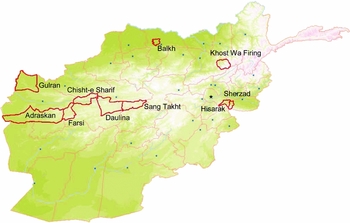
The sample for the experiment comprises 500 villages spanning ten rural districts (see Figure 1) that were large enough in terms of number of villages, had no previous experience with the program, and met basic security conditions that ensured that respondents were not likely to face any sort of harm, threat, or retribution.Footnote 9
Ten Sample Districts

Despite the necessary exclusion of southern areas from the sample due to security concerns, the ten districts are broadly representative of Afghanistan's ethnolinguistic diversity, with five predominantly Tajik districts, four predominantly Pashtun districts, one predominantly Hazara district, and two districts with significant populations of Uzbek and Turkmen minorities. Using the 2007–08 National Risk and Vulnerability Assessment (NRVA), it is possible to identify differences between households sampled for the study and a randomly selected stratified sample of the population of rural Afghanistan. Although there is no significant difference in the age of respondents or income (see Table A1 in the Online Appendix), evaluation villages are more likely to be engaged in production activities related to agriculture, and have slightly worse access to medical services and better access to electricity, although the magnitude of these differences is quite small (Beath et al. Reference Beath, Christia, Enikolopov and Kabuli2010).Footnote 10
Assignment of Treatment
In each of the ten districts, 50 villages were selected to be included in the study,Footnote 11 25 of which were then selected as treatment villages using a matched-pair randomization procedure, which also clustered proximate villages to limit potential for spillovers between treated and untreated units. These villages received NSP following the administration of a baseline survey in September 2007, with the remaining 250 control villages assigned to not receive NSP until early 2012.
The randomization proceeded in four stages:
-
1. Village Clusters. To minimize potential for spillover between treated and untreated units, villages located within one kilometer were grouped in village clusters. Of the 500 sample villages, 107 were assigned to 41 village clusters. The number of villages in each village cluster ranged from two to six.
-
2. Matched Pairs. In each district, the 50 sample villages were paired into 25 groups of two using an optimal greedy matching algorithm (King et al. Reference King, Gakidou, Ravishankar, Moore, Lakin, Vargas, Téllez-Rojo, Hernández Ávila, Hernández Ávila and Hernández Llamas2007), which matched villages to ensure similarity based on background characteristics provided that the villages were not in the same village cluster. The matching was done based on information available before the baseline survey and used background characteristics such as village size (based on data collected a few years earlier by Afghanistan's Central Statistics Organization) and a set of geographic variables (distance to river, distance to major road, altitude, and average slope).
-
3. Assignment of Treatment. In each matched pair, one village was randomly assigned to receive NSP, such that the clusters of villages were assigned the same treatment status.Footnote 12
-
4. Violations of Clustering Restrictions. In a few districts, the large number of clustered villages precluded the co-assignment of all the villages in the same village cluster to the same treatment status. For cases in which assignment of treatment status without a violation of the clustering restriction was not possible, the number of violations was minimized through a simulation approach.Footnote 13
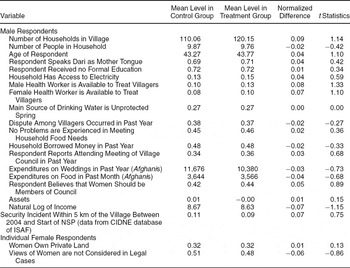
The randomization procedure was successful in ensuring statistical balance between treatment and control groups. Table 1 below presents means, normalized differences,Footnote 14 and t-statistics for several important variables using baseline survey data. Among the variables listed, mean differences are always less than 13% of the standard deviation.
Statistical Balance between Treatment and Control Groups

Notes: Based on data from the baseline survey. Normalized differences are differences divided by pooled standard errors (Imbens and Wooldridge 2009). t statistics take into account clustering of errors at the village level.
HYPOTHESES
In this study, we seek to explore whether the introduction of a community development program mandating female participation in an environment characterized by extreme discrimination against women increased female involvement in economic and social activity by changing attitudes toward the role of women at three different levels—community, household, and the broader societal context.
Female Participation in Local Governance
Development programs such as NSP that require women's involvement in village governance are expected to create demonstration effects of women's capabilities and effectiveness, thereby changing perceptions of women's role in local governance and community activities. Specifically, we expect that such an intervention will make villagers more open to women's involvement in community affairs. We expect that both male and female villagers will be more likely to support women's participation in village councils and in the selection of a village headman. This would be consistent with the literature on women's quotas (in particular, Beaman et al. (Reference Beaman, Duflo, Chattopadhyay, Pande and Topalova2009) from the general literature and Azarbaijani-Moghaddam (Reference Azarbaijani-Moghaddam2009), from the Afghan-specific literature), that shows that increased female involvement in leadership positions changes both male and female views on women's leadership capacity, project preference over resource allocation, and participation in local governance among others. Thus our first empirical hypothesis is as follows:
Hypothesis 1: A development program mandating female participation will increase the acceptance of women's involvement and role in local governance.
Female Mobility, Socialization, and Economic Participation
The intervention is expected to create a venue where village women can congregate and demonstrate that women can positively contribute to local governance. By extension, the intervention is expected to increase female mobility, enabling women to leave their houses more often and with fewer restrictions, and thereby increase female socialization (as measured by social activity and interaction with other women outside their household) and involvement in income generating activities, which would be consistent with qualitative evidence in Azarbaijani-Moghaddam (Reference Azarbaijani-Moghaddam2009). Thus our second two-part empirical hypothesis is as follows:
Hypothesis 2a: A development program mandating female participation will increase socialization among women.
Hypothesis 2b: A development program mandating female participation will increase women's engagement in economic activity.
Gender Division of Household Decision-Making
Although this intervention is designed to directly affect only the role of women in the life of their community, it could also translate into changing their position at a more private level, i.e., within the family. At the level of the household, the expectation is that women will increasingly have more say in household decisions as a result of their elevated position in the community and their increased involvement in income-generating activities. This rationale is reflected in Hypothesis 3 below.
Hypothesis 3: A development program mandating female participation will increase women's engagement in household decision-making.
Gender Roles in Society
The intervention, consistent with the women's quota literature which shows attitudinal changes toward the status of women as a result of mandated political participation (Beaman et al. (Reference Beaman, Duflo, Chattopadhyay, Pande and Topalova2009) and Bhavnani (Reference Bhavnani2009) among others), is also expected to improve perceptions of the role of women in society more generally. In particular, we would expect villagers to be more likely to approve women working for the government or NGOs, support their participation in national elections, and be more open to girls going to school and to male doctors treating women. The literature suggests that such results become stronger over time. In our case, however, given the one shot character of the intervention where there is no credibility in potential council re-election, the expectation of such an effect would be in the short run rather than the longer run. Thus, we formulate the following hypothesis:
Hypothesis 4: A development program mandating female participation will improve perceptions of women's status in society.
DATA
Data Sources
Data for this article come from two surveys conducted in the 500 NSP impact evaluation villages and from two monitoring exercises.
Baseline Survey
Data from the baseline survey was collected during August and September 2007 prior to randomization and prior to the introduction of the development program to the 250 treatment villages. The survey consisted of four different instruments: (a) a male household questionnaire administered to ten randomly selected male heads of household in each village; (b) a male focus group questionnaire administered to a group of village leaders in each village; (c) a female focus group questionnaire administered to a group of important women who tended to overwhelmingly be wives or other relatives of the village leaders; and (d) a female individual questionnaire. In total, the survey covered 13,899 male and female villagers as well as village leaders across the 500 sample villages.Footnote 15
Monitoring of Elections and Project Selection
Information on council elections and project selection was collected during two separate monitoring exercises. Monitoring data on the council election process was collected in 131 randomly selected villages between October 2007 and May 2008 and includes monitors’ systematic observations of the council election as well as from 1,675 post-vote interviews with individual participants in the council election process. Monitoring data on the project selection process was collected in 127 randomly selected villages between December 2007 and May 2008 and includes monitors’ systematic observations of the project selection process as well as from 1,238 interviews with participants on the subproject selection process.
Follow-up Survey
Data from the follow-up survey was collected between May and October 2009. The follow-up survey was administered following NSP council elections and project selection, but before projects were completed.Footnote 16 Carrying out the survey at a time when most of the projects were being implemented but were not yet delivering any services (i.e., wells were being dug but not yet yielding any water, roads were being groveled but were not usable, etc.) allows us to isolate the effects of expectations of provision from the actual provision of goods.
The follow-up survey drew upon many of the same questions from the baseline survey, but changed the sample for the female individual questionnaire from female focus group participants to wives of male household respondents. Specifically, during our baseline survey, an individual survey was administered only to female elites because of logistical constraints, while during our follow-up survey potential panel data on individual responses of the female elites were sacrificed in order to measure attitudes of ordinary female villagers. Detailed information on the coverage of the baseline and follow-up surveys can be found in Table A2 in the Online Appendix.
Due to deterioration in security conditions, 26 villages (11 treatment and 15 control villages) could not be surveyed during the follow-up survey. Thus, although the analysis based on the data from the follow-up survey provides internally valid estimates of the average treatment effect for villages that were secure enough to be surveyed, the results cannot be generalized to villages inaccessible due to security.
Enumerators administering the male household questionnaire were instructed to locate and interview the same households and, whenever possible, the same villagers who participated in the baseline survey. Enumerators were able to successfully locate such respondents in 65% of households in which male respondents were interviewed during the baseline survey. The predominant reason for enumerators not being able to interview baseline respondents was that the person was away from home on the day that the survey team visited the village, as it was the time of harvest. Differences between treatment and control groups in individual-level attrition are not statistically significant.
Data Description
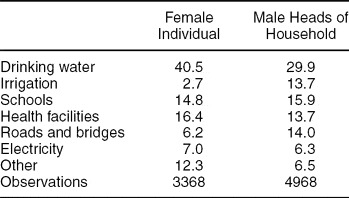
Women leaders in our sample are less educated and younger than their male counterparts across control and treatment communities, a finding consistent with Chattopadhyay and Duflo (Reference Chattopadhyay and Duflo2004). The average age for female leaders is 38 years, whereas for male leaders the average is 46 years. The average number of years of education (both secular and religious) is less than one for female leaders and more than four for male leaders. Female leaders also have different policy preferences than men. During the baseline survey, the respondents were asked to indicate what type of development project should be implemented first in their village, if the community were to be given a grant. The projects preferred by women and men turned out to be quite different (see Table 2). Women were much more likely than men to support projects that would provide drinking water and less likely to support irrigation projects and transportation-related construction projects such as roads and bridges, which is consistent with male preferences as they have more control over land and are more mobile.
Preferences over Projects
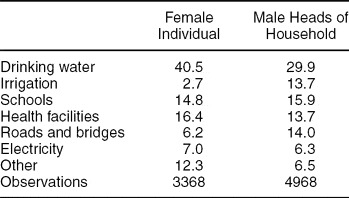
Notes: Percent of respondents who think that the corresponding type of project is the most needed by the community.
Information on nonelite female villagers comes from the follow-up survey. The average age of nonelite female villagers is 35 years. The level of education is extremely low with only 11% of women attending religious school and 3% attending secular school, and the average number of years of education (both secular and religious) being only 0.4 years. The average number of years of education for those women who have attended school is 2.9 years. As a consequence, only 2% of female respondents were able to read a basic sentence and 38% were able to perform a basic calculation. Female asset ownership is limited, with only 3.4% of women owning land, 7% of women owning jewelry, and 42% owning some livestock. The majority of women are housewives with 39% involved in income generating activity.
Monitoring of council elections and project selection processes offered some additional information on program implementation. In all of the villages where elections were monitored, women were able to participate in elections, usually using separate voting booths (that was the case in 87% of the monitored villages). In the villages where project selection was monitored, female participation was high and not significantly different from male participation. The mean number of women who participated in the village consultation meeting was 75, whereas the mean number of women who participated in the referendum was 133 (the corresponding numbers for males are 71 and 138, respectively).
RESULTS
All hypotheses are tested by regressing the measures relevant for each hypothesis on a treatment indicator variable using the following OLS model:
 \begin{equation}
Y_{vi} = \alpha + \tau * T_v + \varphi _p + \varepsilon _{vi}\end{equation}
We use a comparison of treatment and control as the benchmark specification, rather than a difference-in-differences approach, because most of the indicators are based on the results of the survey of females from the random sample of households, which was not conducted during the baseline survey. For a number of indicators based on the survey of male households and female leaders’ focus groups, we also do not have the corresponding indicators in the baseline due to differences in the survey instruments. To take into account possible pre-existing differences between treatment and control villages, we check for the robustness of our results by controlling for relevant baseline characteristics.
Following Bruhn and McKenzie (Reference Bruhn and McKenzie2009), we include village-pair fixed effects to account for allocation of treatment by pairwise matching. Standard errors are clustered at the village-cluster level to account for correlation of residuals caused by the nonindependence of treatment assignment within clusters. To improve statistical power, wherever multiple measures exist for the same concept, we also use a summary index similar to the one introduced in Kling, Leibman, and Katz (Reference Kling, Liebman and Katz2007), which is defined to be the equally weighted average of z scores of the added measures.Footnote 17
Female Participation in Local Governance
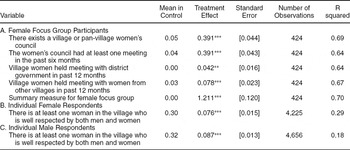
We start by looking at the most immediate effects of the introduction of a community-driven development program that mandates female participation in local elected office and examine whether it leads to the creation of functional women's councils (a compliance test) and whether those in turn increase the activity of women in the community. The results reported in Table 3 indicate that the share of villages in which a women's council exists is approximately 5% of the control villagesFootnote 18 and in 4% of the control villages these councils had a meeting during the six months prior to the survey, whereas in treatment villages both of these shares where higher by 39 percentage points. Women had no meetings with district authorities in the year before the survey in any of the control villages, and in only 3% of them they had a meeting with women from other villages. The share of treatment villages with such meetings was higher by 4 and 8 percentage points, respectively. The overall measure of female local governance activity is 1.2 of a standard deviation higher in villages that received the intervention.
Functionality of Women's Council

Notes: The treatment effect is estimated in the regression, which includes matched pairs fixed effects and a dummy variable for villages that have been assigned to the treatment group. Robust standard errors adjusted for clustering at the village-cluster level in brackets. * significant at 10%; ** significant at 5%; *** significant at 1%.
Importantly, women's self-reported increased participation in community affairs is more than just an opinion shared among female leaders. Both male and female respondents residing in NSP villages are also more likely to report a notable increase in the presence of well-respected women in the community (a difference of about 8 percentage points), offering additional support for the first hypothesis.
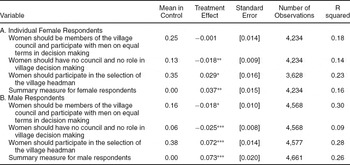
The intervention also improves the attitudes of both men and women toward women's involvement in local governance (see Table 4). Although the share of respondents who think that women should participate in decision-making in the village council on equal terms with men is slightly smaller in villages that received the intervention, the difference is not statistically significant for female respondents and only marginally significant for male respondents. At the same time, the share of respondents who think that women should play no role in village decision-making is significantly smaller in treatment villages. The difference is approximately 2 percentage points for both female and male respondents, which corresponds to 14% and 39%, respectively.
Attitudes toward Women's Participation in Village Governance
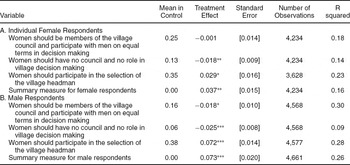
Notes: The treatment effect is estimated in the regression, which includes matched-pairs fixed effects and a dummy variable for villages that have been assigned to the treatment group. Robust standard errors adjusted for clustering at the village-cluster level in brackets. * significant at 10%; ** significant at 5%; *** significant at 1%.
The share of respondents who think that women should participate in the selection of the village headman is also higher in treatment villages. The magnitude of the effect is noticeably higher for male respondents, for whom the increase constitutes 7 percentage points as compared with 3 percentage points for female respondents. This corresponds to a 19% and 8% increase, respectively.
The overall measure of attitudes toward the involvement of women in local governance is higher in treatment villages by 4% of a standard deviation for female respondents and 7% for male respondents.
Female Mobility, Socialization, and Economic Participation
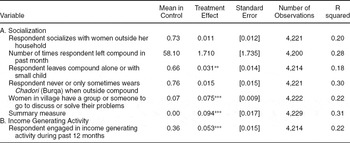
Next we examine the effect on women's socialization as a test of Hypothesis 2a. Although we do not observe an increase in the overall frequency of social activity, we see a significant difference in the type of activity in which women engage (see panel A in Table 5). Women residing in villages that received NSP are no more likely to report increased frequency of socialization outside their household or an increase in the number of times they left their compound during the past month. Although women in NSP villages are no more likely to go out without the all-enveloping attire of a burqa, they are more likely to go out without a chaperone. The magnitude of the effect, however, is rather small, with the 3-percentage-points difference corresponding to a 5% increase.
Socialization and Economic Activity (Individual Female Respondents)
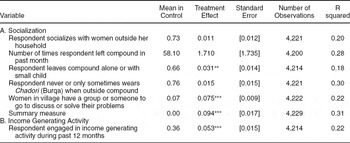
Notes: The treatment effect is estimated in the regression, which includes matched-pairs fixed effects and a dummy variable for villages that have been assigned to the treatment group. Robust standard errors adjusted for clustering at the village-cluster level in brackets. * significant at 10%; ** significant at 5%; *** significant at 1%.
However, the intervention appears to induce a substitution effect in women's social activities. Women in treatment villages are 50% more likely to report that they have someone with whom to discuss and solve their problems in the village, although the existence of such meetings and venues is relatively rare even in treatment villages. In addition, women in treatment villages are more mobile and, as noted above, are more likely to have attended a meeting with women outside their village as well and/or with representatives of the district government. These patterns suggest that, although levels of social activity among women in both groups of villages are similar, the type of venues and type of social activities differ.
Looking at income generating activities, we find evidence that lends support to Hypothesis 2b (see panel B in Table 5). Specifically, female respondents in treatment villages are 5 percentage points more likely to have engaged in such activities in the past year, a 15 percent difference that signals productive involvement for women outside the confines of the household.
Gender Division of Household Decision-Making
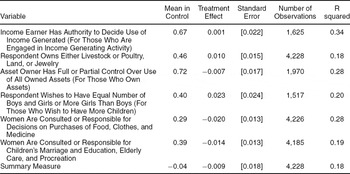
Despite increasing the role of women in village life, NSP has virtually no effect on their position within the family, with no change in the degree of agency over what is done with the money and assets that women identify as their own (see Table 6). Thus, we find no support for Hypothesis 3. Specifically, over 60% of female respondents, in control and treatment villages alike, stated that they have the authority to decide how to use the income they generate. 72% of among the roughly 50% of respondents who stated that they own assets—be they livestock, poultry, land, or jewelry—claimed to have a certain degree of control over the use of their assets, with no statistically significant differences among respondents in treatment versus control communities.
Intra-family Decisions (Individual Female Respondents)

The treatment is estimated in the regression, which includes matched-pairs fixed effects and a dummy variable for villages that have been assigned to the treatment group. Robust standard errors adjusted for clustering at the village-cluster level in brackets. * significant at 10%; ** significant at 5%; *** significant at 1%.
It is important to underline that such financial decisions, irrespective of gender, are traditionally seen as family decisions rather than individual-level decisions. As such, the fact that they remain unchanged despite higher female involvement in the market place is in no way surprising. Apart from the financial decisions of the family, there are other even more sensitive decisions—those pertaining to family planning. Specifically, there has traditionally been a strong preference for male over female children in Afghanistan and this appears to remain unchanged two years into the program's implementation. About 40% of respondents stated that they would like to have an equal number of boys and girls or more girls than boys, with no statistically significant effect attributed to the intervention. There is also no difference in the share of women who are involved in decisions over the purchase of food, clothes, and medicine or in decisions in family affairs such as children's marriage and education, elderly care, and procreation. Thus, even though women are arguably gaining in legitimacy in the community realm, their role in the family appears to remain largely unchanged.
Gender Roles in Society
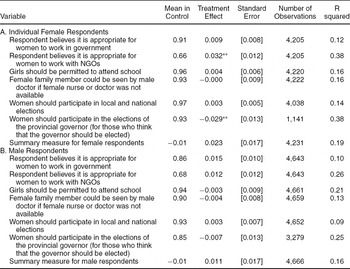
We find no significant effect of the program on attitudes toward women in the broader public sphere extending beyond the community, as perceived by both men and women, finding almost no support for Hypothesis 4. Results reported in Table 7 indicate that be it for questions that the household is likely to have direct exposure to and experience with—such as whether girls should be allowed to go to school and women examined by male doctors when female doctors are not available—or more abstract and general questions—such as whether women should be allowed to work for the government—men and women hold comparable views and there are no differences that can be attributed to the existence of the community-driven development program. Female respondents, however, are more likely to think that women should be allowed to work for NGOs in treatment villages, which likely reflects their direct experience interacting with female social organizers who were working for NGOs that were involved in implementing the program.
Women's Status in Broader Society

Notes: The treatment effect is estimated in the regression, which includes matched-pairs fixed effects and a dummy variable for villages that have been assigned to the treatment group. Robust standard errors adjusted for clustering at the village-cluster level in brackets. * significant at 10%; ** significant at 5%; *** significant at 1%.
The difference in trends between questions specific to the community versus more abstract level questions is also mirrored in the context of elections and direct political participation which we use as alternative measures for Hypothesis 4. Though the presence of the program clearly increases men's openness to the involvement of women in village governance, making them slightly more open to the existence of women's councils and increasing the proportion that supports the participation of village women in the selection of the village headman, there is no impact with respect to the election of the provincial governor. Women are somewhat more open to women's participation in the election of the provincial governor (the difference is marginally statistically significant), but neither for male nor for female respondents is there an effect on views concerning women's participation in local and national elections. The null effect in the question pertaining to participation in local and national elections, however, is probably driven by the fact that almost all respondents support women's participation in that realm.
Robustness Checks
As was indicated above, the structure of the data do not allow us to use difference-in-differences as an estimating approach. Instead we check for the robustness of our results by controlling for relevant baseline characteristics. For each indicator we find the same or the most closely related questions across the baseline instruments. The baseline indicators that were collected during the male or female focus group or in the individual female surveys can not be linked with the follow-up survey at the household level as the samples are different, so we average these indicators at the village level and use these village-level variables as baseline controls. The information collected from male heads of households in the baseline and the follow-up survey can be linked at the household level for 65% of households that were included in both surveys. Since individual level attrition leads to a significant reduction in the number of observations, we link baseline data from the male head of household survey both at the household level and at the village level by averaging the results of the baseline survey.
The results in general prove to be robust to the addition of such controls. Several results lose their significance when we control for individual level controls, but the loss in statistical significance is driven by the reduction in sample size caused by individual-level attrition.
The estimations with baseline controls for summary measures reported in Table A3 in the Online Appendix indicate that the results for the functionality of the women's council, attitudes toward women's participation in village governance, women's socialization, and attitudes of male respondents toward women's participation in village governance are robust to the inclusion of baseline controls. The attitudes of female respondents toward women's participation in village governance are robust to the inclusion of baseline controls measured at the village level, but lose their significance if we include household level controls. The loss of significance, however, is driven by the reduction in sample caused by household-level attrition. The results lose their significance even if we do not include the baseline controls, but restrict the sample only to those households for which these controls are available. The results for intrafamily decision-making and attitudes of male respondents toward women's status in broader society remain insignificant, whereas marginally significant results for attitudes of female respondents toward women's status in broader society lose their significance.
Overall, all the results that were significant at the 5% level prove to be robust to the inclusion of baseline controls, with the only exception being the results for attitudes of female respondents toward women's participation in village governance, which lose their significance if we restrict the sample to households that were surveyed in both the baseline and the follow-up surveys.
Geographical Heterogeneity of Treatment Effects
There is some variation on women's rights among Afghanistan's different ethnic groups with women being less mobile and having lower levels of community participation in Pashtun areas (Azarbaijani-Moghaddam Reference Azarbaijani-Moghaddam2009). As the districts in our sample are largely ethnically homogeneous, we examine whether the effects of the program are different in the four ethnically Pashtun districts (Sherzad, Hisarak, Fersi, and Balkh) in our sample. Two of these districts (Sherzad and Hisarak) are located in the eastern province of Nangarhar, where the levels of violence have also been more pronounced (Beath, Christia, and Enikolopov Reference Beath, Christia and Enikolopov2012). To distinguish between the effect of ethnicity and violence, we examine these two eastern districts separately.
The results indicate that in Pashtun districts there is no positive effect of the program on attitudes to women's participation in village governance (see Table A4 in the Online Appendix). The difference between Pashtun districts and other districts is statistically significant only for women's attitudes toward women's participation in village governance. There is also evidence that in nonviolent Pashtun areas the effect of the program on intrafamily decision making is smaller, whereas the positive effect on male's perceptions of women's status in broader society is stronger. For all other indicators there are no statistically significant differences in the effect of the program between Pashtun districts and other districts.
Since the demonstration effect of women's involvement in village decision-making might depend on the size of the village, we also examine how the effect of the program varies with population size in each community. The only significant difference is a stronger positive effect of the program in larger villages on male attitudes toward women's participation in local governance (Table A5 in the Online Appendix).
Overall, the results suggest that the effect of the program is not considerably different in Pashtun districts, in districts that are more affected by insecurity, or in villages of different size.
Individual Heterogeneity of Treatment Effects
We also examine individual heterogeneity of treatment effects by looking at how the effect of the program depends on such characteristics as land ownership, education, and age of respondents. In results presented in Table A6 in the Online Appendix, we find that women tend to be more involved in decision-making if they own land, which is the most precious asset in rural Afghanistan where people subsist on agriculture (Azarbaijani-Moghaddam Reference Azarbaijani-Moghaddam2009). Consistent with this notion, we find that women who own land have more say in intrafamily decision-making and have more positive attitudes toward women's participation in local governance and women's status in broader society. The effect of the program on attitudes toward women's status in broader society turns out to be significantly negative for women who own land, whereas it is significantly positive for women who do not own land. At the same time, the positive effect of the program on women's socialization is even stronger for women who own land.
Women who have received some education are more likely to be engaged in income generating activities and to have more positive attitudes toward women's status in broader society. The effect of the program is stronger for the husbands of educated women, so that in treatment villages they are more likely to think that there is at least one woman who is well respected by both men and women. They are also more likely to support women's involvement in village governance. The effect of the program on attitudes is smaller for older respondents (both men and women) who prove to be significantly less likely to improve their attitudes regarding women's status in broader society. Older women are in turn more likely to socialize outside their household, but the positive effect of the program on socialization is smaller for them.
Disentangling Alternative Mechanisms
As stated above, NSP bundles mandated participation of women in local governance—through the creation of gender-balanced councils elected by universal suffrage elections, and through the requirement that women participate in project selection—with the funding of village development projects, and the funding of projects focused specifically on women. As such, the positive effects reported above could be driven by the mandated participation of women in council elections and project selection, by the requirement that half of the council consists of women, by the income effect caused by the infusion of material resources, or by the effect of projects aimed at benefiting women. Although experimental results do not allow us to distinguish between these alternative mechanisms we provide two sets of additional results which shed some light on the potential relative importance of these mechanisms.
To take into account the program's possible income effects we control for various measures of economic welfare. In particular, we include as additional controls measures of income, expenditures, and assets both at the household and the community level. The results of these estimations, reported in Table A7 in the Online Appendix, demonstrate that the general results are robust to including controls for economic welfare and that the results on female attitudes toward women's status in broader society become even stronger. To the degree that these measures accurately capture the infusion of resources, the results arguably suggest that the effects reported above are not merely driven by the program's monetary side.
To account for the effect of projects that were aimed at benefiting women (all of which were training courses), we include in the regression a dummy variable that indicates whether the women's project in the village had been completed by the time of the survey.Footnote 19 As reported in Table A8 in the Online Appendix, almost all the results on attitudes toward women remain robust to the inclusion of this additional variable.Footnote 20 The coefficient on the dummy for project completion is hard to interpret, since it reflects not only the effect of implementing women's projects, but also the characteristics of the village that are conducive to fast implementation of such projects. Indeed, and consistent with expectation, we find that fast implementation of women's projects is associated with more active women's councils and with the existence of well-respected women.
However, the results on attitudes toward women's status in the household, the community, and beyond, which are more likely to reflect the effect of women's projects, provide mixed evidence. We find a positive effect on some indicators (such as the probability that women have some assets, that female respondents wish to have equal numbers of boys and girls, and that male respondents support women's participation in the elections of provincial governor), but a negative effect on others (such as female support for women's village councils, engagement in income generating activities, and whether women are being consulted in questions of education, elderly care, and procreation). Thus the effect is not systematically different in villages where the women's project was complete versus those where it was not, suggesting that is not merely driven by the positive effect of projects on women.
Overall, the results suggest that the positive effects of the program are not entirely driven by the infusion of material resources, or by the effect of projects aimed at benefiting women, which indicates that institutional changes are playing an important role. However, we cannot interpret these results as evidence that all findings are driven by institutional changes, since the controls for economic welfare may not perfectly capture the changes coming from improvements in the household's wellbeing or the community's economic position and because the speed of implementation of women's projects is highly endogenous. The results in this subsection should thus be considered as merely suggestive and should be interpreted with caution.
DISCUSSION
Overall, our results indicate that this community driven development intervention increases women's involvement in community life as reflected both in women's increased activity outside the household and in making men and women more accepting of female participation in local governance and other aspects of community life. Specifically, men become more open to the idea of women being involved in the work of a village council and in participating in the selection of the village head. The intervention also has a positive effect on the socialization of women and on their involvement in income-generating activities. However, the program does not affect either the position of women within the family or the attitudes toward women's role in society more broadly. The intervention has no effects on attitudes either in areas of direct relevance to the household, such as girls’ school enrolment or female medical treatment, or in more general areas, such as whether women should be allowed to work for the government.
The results thus show that even in a society in which women face extreme discrimination, the introduction of development programs with mandated female participation can have an effect on the role of women in community life. Contrary to some anecdotal evidence (Boesen Reference Boesen2004; Brick Reference Brick2008), mandated female participation does not seem to be reduced to a pure formality. The positive effect of the program, however, is limited to the areas that are closely linked to direct interventions prescribed by the program. Women's involvement in community-level decision-making is mandated by NSP, and that experience seems to make men more receptive to women's involvement in that aspect of community life. There is also an increase in income generating activities with the underlying mechanism arguably being the women's training to which women in NSP villages are exposedFootnote 21 as well as the increase in women's mobility. These positive effects, however, do not appear to carry over to other areas that are not directly linked to the program's prescribed interventions, such as the role of women in the family or in the broader public sphere.Footnote 22
Although the intervention under study is complex and consists of multiple components (creation of a gender-balanced development council, universal suffrage elections to the council, selection of village development projects, funding of the projects; provision of training courses for women), the results provide some evidence on the relative importance of these alternative channels. They are robust to controlling for various measures of income, consumption, and assets, which suggests that the identified effects are not merely driven by additional resources (though the money provided as part of the program certainly induces compliance, allowing for the election of women). The results also do not depend on the implementation of development projects, which is not surprising as NSP provides resources for the community as a whole and does not include direct provision of resources to women such as a conditional transfers program. Although the program does prescribe implementation of one project that should specifically benefit women, in almost all cases the projects that fell under this category were training courses of different types that may provide more resources to women in the long run, but do not involve any such immediate transfers. Thus gender quotas in the council and mandated female participation in the council elections and project selection appears to be driving at least part of the effect. However, given the nature of the treatment, it is not possible to tease out the effect of these interventions separately and argue whether the effects are driven by mandated council representation, by mandated participation in council elections and project selection, or by the combination of the above.
The results on the heterogeneity of effects indicate that the intervention has a lesser effect on attitudes within households in which women own land and thus have enhanced economic status. Similarly, older respondents, who are likely to have deeper engraved notions about the role of women, are also less likely to change their attitudes as a result of the program. At the same time, households in which women have at least some education appear more open to the idea of higher status of women in society and are more likely to change their attitudes as a result of the program.
An important issue is the way the program effects evolve over time. Previous work that has examined the long-term effects of quotas (Beaman et al. Reference Beaman, Duflo, Chattopadhyay, Pande and Topalova2009) finds that, although gender quotas altered male perceptions of female leaders’ effectiveness, there was no such effect for women living in villages that had not experienced the quota or had experienced it only once. However, differences in female attitudes do emerge once villages have experienced the quota a second time. They also find that social norms are harder to alter than gender-based perceptions of the effectiveness of leaders. These results thus indicate that more broad-based changes in social attitudes may require a longer duration of treatment. Accordingly, it is perhaps unsurprising that the two years of exposure to the treatment examined in this study does not suffice to change the Afghan conservative core family values or general societal attitudes toward women.
CONCLUSION
In this article, we analyze the effect on women's empowerment of a development program that mandates female participation. In particular, we examine the impact of the largest community-driven development program in Afghanistan on attitudes toward women's involvement in the household, the community, and society more generally. The program prescribes the creation of gender-balanced local councils elected through secret ballot voting and requires female participation both in the election of councils and the selection of development projects. Random assignment of the program across 500 evaluation villages allows us to estimate the program's causal effects. The results indicate that the program has significant positive effects on the acceptance of female participation in local governance, but it does not affect—at least not in the short term—women's roles in household decision-making or in broader society.
The observed changes do not appear to be merely driven by the infusion of financial resources that accompanies the program, but rather by the women's mandated involvement in the decision-making process. Thus the evidence suggests that the strategy of empowering women through the provision of development programs that mandate female participation can work even in environments where women are subject to very high levels of discrimination. Mandated female involvement in decision-making processes at the community level demonstrates the effectiveness of female community and political participation and induces change in male and female attitudes toward women and their role in community life. It also shows that women can be actively involved in community life beyond the immediate confines of their family, which makes them more likely to socialize with other women outside their household.
Though this effect could potentially apply beyond the immediate scope of community life, we do not see any evidence of such an effect. The absence of any effects of the intervention on the gender division of household decision-making or on broader societal attitudes could either be due to effects being confined to activities in which women's involvement is directly prescribed by the program or to the limited duration over which effects are being measured following the intervention, that being a span of two years. Distinguishing between these two matters is an important issue that will need to be addressed in future work. Another important issue that requires further investigation is the broader applicability of the findings in other contexts. Although the conditions of extreme insecurity in Afghanistan are arguably specific to the country, most of the restrictions faced by Afghan women result from cultural and religious norms that predate recent conflicts, suggesting that the effects may generalize to other contexts. If a development intervention could improve the conditions for women's lives in a context as challenging and strict as that of Afghanistan, it could arguably prove to be a promising intervention for other gender-biased environments across the world.




Comments
No Comments have been published for this article.