Narratives are an important language skill, often a vehicle for expressing personal and social identity (Chang, Reference Chang2004; Stein, 1998). They are used, for instance, by very young children at school during show-and-tell or around the family table to share the experiences of the day. It is therefore not suprising that narratives lay the foundations for literacy acquisition and school success (Heath, Reference Heath, Brenneis and Macaulay1998; Holdaway, Reference Holdaway1979; Roth, Speece, Cooper, & Paz, Reference Roth, Speece, Cooper and Paz1996), which are in turn essential components for full participation in most modern societies.
Given all this, difficulty with narratives may have effects across the range of communicative and social behaviors in populations with intellectual disability (ID), for which social interaction may already be compromised and mechanisms of compensation for cognitive challenges may be less available (Thomas & Karmiloff-Smith, Reference Thomas and Karmiloff-Smith2005). In this paper, we analyze the narratives of boys with the most common type of inherited ID, fragile X syndrome (FXS), and compare them to narratives of typically developing (TD) boys and boys with Down syndrome (DS), group matched on a measure of nonverbal mental age (MA). As we mentioned above, narrative skills are strongly related to language development, reading, listening comprehension, and many other areas of educational attainment including literacy. Therefore, an understanding of the development of narratives in different populations with language disorders is key. In addition, this is the first study of narrative skills in young boys with FXS with or without autism spectrum disorder (ASD). Our analysis centers on the macrostructure or discourse level of narratives (not the microstructural level of sentence cohesion, for instance). Because both FXS and DS have demonstrated syntactic impairments in conversation (see below), we were interested in determining whether there were specific narrative difficulties beyond language challenges. With that goal in mind, we assessed retellings of the Bus Story (Crowley & Glasgow, Reference Crowley and Glasgow1994; Renfrew, Reference Renfrew1991) using a story grammar schema (Frazier, Reference Frazier1994; Rumelhart, Reference Rumelhart, Bobrow and Collins1975; Stein & Glenn, Reference Stein, Glenn and Freedle1979), after adjusting for several cognitive, linguistic, and environmental predictor variables.
NARRATIVE SKILL IN TYPICAL DEVELOPMENT
To narrate successfully, children need linguistic knowledge such as appropriate pronoun and tense use, and other morphosyntactic structures to express temporal and causal relations (Bamberg, Reference Bamberg1987; Halliday & Hasan, Reference Halliday and Hasan1976; Peterson & Dodsworth, Reference Peterson and Dodsworth1991). In addition, they need to give plot information, which are references to characters and events, and evaluative information, which is the narrator's perspective on how characters and events are significant to the story (Labov & Waletzky, Reference Labov, Waletzky and Helm1967). In this study, we focus exclusively on the provision of plot information. Narration is a cognitively demanding task, soliciting a range of cognitive capacities, linguistic, and social–pragmatic knowledge. The language performance of children with developmental disabilities, in this case FXS and DS, may be particularly vulnerable in storytelling compared to that of TD children. Cognitive disabilities affect memory, attention, inferencing, and reasoning skills, all crucial to understand and remember and convey the content of a story. We know that as their cognitive capacity increases with age, children are able to express and comprehend more complicated story material (Miles & Chapman, Reference Miles and Chapman2002), but this increase may be compromised in populations with ID. This makes narratives a fertile ground for exploiting linguistic richness or revealing language deficits. It it is important, therefore, to determine whether there is a narrative impairment in populations with ID beyond that explained by general cognitive difficulties and language (especially morphosyntactic) impairments.
Narratives in typical development
Early narratives of preschool-aged children are mostly event descriptions, and do not follow a story structure (Kuczaj & McClain, Reference Kuczaj, McClain and Kuczaj1984). At 2 years of age, stories begin mainly via immediate action with no conventional setting (Pradl, Reference Pradl1979). Causal connections in a story emerge between 3 and 4 years (Bishop & Donlan, Reference Bishop and Donlan2005; van den Broek, Reference van den Broek, van den Broek, Bauer and Bourg1997; our participants with lowest MA equivalents fall within this range; see below). By age 4, children introduce at least one participant along with more information about characters’ thoughts and actions, and the story ending (Astington Reference Astington1990; Price, Roberts, & Jackson, Reference Price, Roberts and Jackson2006). At age 5, they include more conventional endings (Pradl, Reference Pradl1979), and by the time they reach age 6, children's narratives become more causally coherent, taking into account actions, physical states, and mental states as explanations for characters’ behavior (Kemper & Edwards, Reference Kemper and Edwards1986), but still with more attention paid to overt actions than to characters’ goals. Complete episodes (which consist of a consequence and at least two of the following: event, motivating state, or attempt) are narrated by the TD 8- or 9-year-old at least some of the time (Peterson & McCabe, Reference Peterson and McCabe1983), although even third graders’ stories may lack mention of internal states, goals, and reactions (Hudson & Shapiro, Reference Hudson, Shapiro, McCabe and Peterson1991). Even when younger children do use complete episodes, they are less likely than older children to include attempts (Peterson & McCabe, Reference Peterson and McCabe1983), which is a story element that may also be used more often by children around 11 years of age than those around 9 years (John, Lui, & Tannock, Reference John, Lui and Tannock2003). Finally, at age 10, children begin to encode psychological motivation for the characters’ actions (Bishop & Donlan, Reference Bishop and Donlan2005; van den Broek, Reference van den Broek, van den Broek, Bauer and Bourg1997; our participants with highest MA equivalents are expected to be at this stage; see below).
From this short review, we can expect all our TD participants to express some aspects of story structure, with narrative skill increasing with increasing age. Moreover, if narrative skill is also related to chronological age (CA) but not to MA in our populations with ID (perhaps through longer experience with the storytelling format), these groups should have better narrative scores. If the opposite is true, then MA will be a good predictor of narrative skill and the boys with ID may show some impairment with respect to MA-matched TD boys.
GENOTYPE AND PHENOTYPE OF FXS AND DS
FXS is the most common inherited cause of ID, affecting 1 in 1,250 to 1 in 2,500 males, and 1 in 1,667 to 1 in 5,000 females (based on cytogenetic diagnostic tools) or approximately 1 in 4,000 males and 1 in 8,000 females (based on a more sensitive DNA diagnostic test; Sherman, Reference Sherman, Hagerman and Hagerman2002, p. 143). It accounts for 2% to 3% of all forms of ID in boys (Tan, Law, Zhao, Yoon, & Ng, Reference Tan, Law, Zhao, Yoon and Ng2000). This X-linked disorder is caused by excessive repeats (more than 200) of a CGG trinucleotide sequence on the long arm of the X chromosome (Xq27.3). Ensuing methylation shuts down the fragile X mental retardation-1 (FMR-1) gene. This reduces or eliminates production of fragile X mental retardation protein (FMRP), hypothesized to be involved in synaptic plasticity (O'Donnell & Warren, Reference O'Donnell and Warren2002). Boys with FXS present with mild to severe ID, hyperactivity, hyperarousal, attention deficits, social anxiety, and autistic-like behaviors such as hand biting and flapping, sensory defensiveness, decreased eye contact, and repetitive behaviors (Hagerman, Reference Hagerman, Hagerman and Hagerman2002). Language disabilities include perseveration, echolalia, poor intelligibility, and deficits in syntax comprehension and production (Levy, Gottesman, Borochowitz, Frydman, & Sagi, Reference Levy, Gottesman, Borochowitz, Frydman and Sagi2006; Price, Roberts, Vandergrift, & Martin, Reference Price, Roberts, Vandergrift and Martin2007; Roberts et al., Reference Roberts, Long, Malkin, Barnes, Skinner and Hennon2005; Roberts, Mirrett, Anderson, & Neebe, Reference Roberts, Mirrett, Anderson and Neebe2002). Females are less affected, possibly because X-inactivation allows for expression of the wild-type FMR-1 gene in the second X chromosome in a varying percentage of cells. Because we wanted to assess narratives in children with at least a moderate degree of ID, we only included boys with FXS in this study.
In addition, at least 25% of preschool and elementary school-aged boys with FXS also have mild to severe autism (Bailey et al., Reference Bailey, Mesibov, Hatton, Clark, Roberts and Mayhew1998), although autism prevalence in this population could be as high as 47% (Demark, Feldman, & Holden, Reference Demark, Feldman and Holden2003). Moreover, 50%–90% of males display autisticlike symptoms (Hagerman, Reference Hagerman and Dew-Hughes2004). Although greater numbers of autistic characteristics in FXS are correlated with lower IQs and more severe social and language deficits (Bailey, Hatton, Mesibov, Ament, & Skinner, Reference Bailey, Hatton, Mesibov, Ament and Skinner2000; Rogers, Wehner, & Hagerman, Reference Rogers, Wehner and Hagerman2001), the issue of whether FXS and autism is a distinct subtype of FXS is currently debated (e.g., Demark et al., Reference Demark, Feldman and Holden2003; Kaufmann et al., Reference Kaufmann, Cortell, Kau, Bukelis, Tierney and Gray2004; Lewis et al., Reference Lewis, Abbeduto, Murphy, Richmond, Giles and Bruno2006; Philofsky, Hepburn, Hayes, Hagerman, & Rogers, Reference Philofsky, Hepburn, Hayes, Hagerman and Rogers2004). In this study, we include a subgroup of boys with FXS and ASD to tease apart the possible contribution of comorbid ASD to narrative skill in FXS. We surmise that given known narrative difficulties in autism (reviewed below), we will find evidence supporting the conceptualization of FXS-ASD as a separate group from FXS only (FXS-O).
The phenotype of DS (our comparison group with ID) is similar to that of FXS when one considers the levels of ID found in both populations, and the linguistic impairments found in both groups. However, there are also important differences. DS is the most common genetic (but not inherited) cause of ID, affecting approximately 5,500 infants yearly (i.e., almost 1 in 750 live births; Centers for Disease Control and Prevention, 2006). It is caused by trisomy of all or part of chromosome 21, but the mechanism that gives rise to the phenotypical effects is still unknown (Patterson & Lott, Reference Patterson, Lott, Roberts, Chapman and Warren2008). Some of the most salient phenotypic features in DS are ID, hypotonia, lax ligaments, short stature, with a subset of individuals presenting with congenital heart disease, hearing loss, and ophtalmologic problems (Roizen & Patterson, Reference Roizen and Patterson2003). The language of individuals with DS is delayed beyond nonverbal cognition, with expressive language more affected than receptive language (Chapman & Hesketh, Reference Chapman and Hesketh2000; Fowler, Reference Fowler, Nadel and Rosenthal1995; Martin, Klusek, Estigarribia, & Roberts, Reference Martin, Klusek, Estigarribia and Roberts2009). Vocabulary comprehension is better than syntax comprehension (Chapman, Schwartz, & Kay-Raining Bird, Reference Chapman, Schwartz and Kay-Raining Bird1991), and syntax production is particularly impaired (Chapman, Seung, Schwartz, & Kay-Raining Bird, Reference Chapman, Seung, Schwartz and Kay-Raining Bird1998; Roberts et al., Reference Roberts, Hennon, Price, Dear, Anderson and Vandergrift2007). Some of the anatomical and motor problems mentioned above are likely to contribute to low speech intelligibility and possibly to low expressive language scores, language characteristics also found in FXS. If there are differences in narrative skill between FXS and DS, they must be due to something other than the mere presence of ID, therefore making the case for syndrome-specific narrative impairments.
NARRATIVES IN FXS
Information about the narrative skills of individuals with FXS is very scarce. Research has focused on adolescents and adults, and mostly on females (Medved & Brockmeier, Reference Medved and Brockmeier2004; Simon, Keenan, Pennington, Taylor, & Hagerman, Reference Simon, Keenan, Pennington, Taylor and Hagerman2001). In the only study to date related to our populations, Keller-Bell and Abbeduto (Reference Keller-Bell and Abbeduto2007) concluded that narratives based on Frog Goes to Dinner (Mayer, Reference Mayer1977) produced by 18 adolescents and young adults (females and males) with FXS and no ASD (CAs 12–23 years) were not significantly different from those of 21 TD children, but different from those of 23 adolescents and young adults with DS, when all groups’ mean nonverbal MA and range were matched. Both the participants with FXS and the TD children produced similar levels of narrative evaluation devices (mental state verbs, character names, character dialogue, repetition for emphasis, sound effects, and fantasy), and had lower proportions of evaluation devices in their narratives than those with DS. In addition, the participants with DS had more ungrammatical utterances than the other two groups. The authors suggested that known morphosyntactic difficulties in DS are somewhat offset by a richer use of narrative evaluation devices. The other narrative measures yielded no significant differences between the groups. There are to date no studies on the narrative abilities of younger children with FXS.
Narratives in ASD
Many of the changes in the typical development of narratives accompany changes in theory of mind, which may be especially compromised in populations with ASD. There is currently no information available on narratives in FXS accompanied by ASD. Extrapolating from results for idiopathic autism and ASD, we surmise that social and pragmatic difficulties will negatively impact storytelling in FXS-ASD (e.g., Loveland, McEvoy, & Tunali, Reference Loveland, McEvoy and Tunali1990). Narratives in ASD contain fewer causal links and are less coherent (Diehl, Bennetto, & Carter-Young; Reference Diehl, Bennetto and Carter-Young2006; Tager-Flusberg, Reference Tager-Flusberg1995), and contain fewer shifts in speaker perspective than children of similar CA matched for verbal MA who have ID (García-Pérez, Hobson, & Lee, Reference García-Pérez, Hobson and Lee2008). Losh and Capps (Reference Losh and Capps2003) also found that the storybook narratives of 28 high-functioning children with autism or Asperger syndrome (ages 8–14 years) contained fewer story components when compared to TD children. Specific deficits in making inferences were also found by Norbury and Bishop (Reference Norbury and Bishop2002) for children with high functioning autism (HFA) compared to children with specific language impairment, pragmatic language impairment, and TD.Footnote 1 To summarize, narrative deficits associated with ASD are likely in causal linking and possibly in conveying the characters’ perspectives and internal mental states. We therefore hypothesized in this study that this would be reflected in lower overall narrative scores for boys with FXS-ASD and lower production of narrative content related to the human character in the story. In addition, if causal links are difficult to establish, recall of material in a causal chain may be compromised.
Narratives in DS
More information is available for narratives in DS than for narratives in FXS. Miles and Chapman (Reference Miles and Chapman2002) found that adolescents and young adults with DS expressed more plot lines, thematic content, and misadventures than TD controls at their expressive language level (measured by mean length of utterance [MLU]), but still below MA levels. Other studies show that having to process a narrative may overly tax the cognitive resources of individuals with DS (on a fast-mapping task; Kay-Raining Bird, Chapman, & Schwartz, Reference Kay-Raining Bird, Chapman and Schwartz2004), but also that storytelling seems to elicit better language production in DS than conversation (Chapman et al., Reference Chapman, Seung, Schwartz and Kay-Raining Bird1998). The complexity of narrative performance represents a supplemental receptive and expressive processing burden for individuals with DS. However, picture support may mitigate these effects (Boudreau & Chapman, Reference Boudreau and Chapman2000; Kay-Raining Bird & Chapman, Reference Kay-Raining Bird and Chapman1994; Miles, Chapman, & Sindberg, Reference Miles, Chapman and Sindberg2006), possibly by facilitating encoding and subsequent recall. In this study we employed a storytelling protocol with picture support to try to minimize the cognitive challenges our task could pose for our participants with ID, and we hypothesized that the recall task would be more successful with increasing levels of short-term memory and nonverbal MA.
STUDY QUESTIONS
This study aims to fill a gap in the research on the narrative skills of young boys with FXS. We were interested in whether boys with FXS would show evidence of storytelling difficulties, and to identify what cognitive, environmental, and linguistic factors explain a significant portion of narrative skill in each population. In particular, we wanted to model the effects of nonverbal MA, short-term memory, caregiver education, and syntactic skill. Expressive syntax is important, because narratives require the use of sophisticated syntactic devices. Nonverbal MA is independently known to be related to language skills in children with FXS (e.g., Price et al., Reference Price, Roberts, Vandergrift and Martin2007; Roberts et al., Reference Roberts, Hennon, Price, Dear, Anderson and Vandergrift2007), and could be a primary cause of a secondary narrative impairment. Several studies of TD children and children with developmental disabilities have demonstrated an association between maternal education levels and children's language development (Dollaghan et al., Reference Dollaghan, Campbell, Paradise, Feldman, Janosky and Pitcairn1999; Fewell & Deutscher, Reference Fewell and Deutscher2004; Price et al., Reference Price, Roberts, Vandergrift and Martin2007). We surmised that caregiver education may influence children's familiarity with storytelling schemas and therefore have a mediating effect on narrative measures. In addition, because we used a retelling task, we wanted to gauge the effect of differences in short-term memory between groups.
Given the high comorbidity of FXS and ASD, and the well-known narrative difficulties of individuals with autism, we analyzed separately boys with FXS-O from those with FXS-ASD to determine whether their narratives had distinct characteristics. Finally, we inquired whether the narrative profile of FXS is syndrome specific or shared by other disorders causing ID (Abbeduto et al., Reference Abbeduto, Pavetto, Kesin, Weissman, Karadottir and O'Brien2001). To that effect, we included a group of boys with DS of comparable MA range. Both syndromes present with moderate or severe ID, adaptive, social, speech, and language difficulties, so a comparison between them is ideal to address questions of disorder specificity.
We tested the following hypotheses:
1. There will be a positive relationship in each group between overall narrative scores and nonverbal MA, short-term memory, syntactic scores, and caregiver education level.
2. Extrapolating from Keller-Bell and Abbeduto (Reference Keller-Bell and Abbeduto2007), we hypothesized that, after controlling for nonverbal MA, short-term memory, syntactic complexity, and primary caregiver education: (a) boys with FXS-O would have lower overall narrative scores than boys with DS, suggesting distinct narrative profiles for the populations with ID; (b) the FXS-O group would not differ from the TD group, but the FXS-ASD group would retell fewer narrative elements overall than the TD group.
3. Participants with FXS-ASD will have lower overall scores and produce fewer narrative elements related to the story's human character (the bus driver), and the characters’ motivations, than those with FXS and those with DS.
METHOD
Participants
The boys who participated in this study were recruited for a larger ongoing longitudinal project that examines the language development of boys with FXS, boys with DS, and TD boys (Roberts et al., Reference Roberts, Long, Malkin, Barnes, Skinner and Hennon2005). Boys with FXS or DS were eligible if no older than 16 years, with an MLU greater than 1.1 and an expressive vocabulary of at least 40 words (from parental reports). The TD boys ranged from 3 to 8 years of age, and their developmental ages for nonverbal cognition from the Brief IQ composite of the Leiter International Performance Scale—Revised (Roid & Miller, Reference Roid and Miller1997) were similar to those of the other two groups. We excluded boys whose primary language at home was not English, boys who used sign language as their primary mode of communication, and boys with a hearing loss greater than 30 dB in the better ear (screened across 500, 1000, 2000, and 4000 Hz using a Grason Stadler GSI 16, Grason Stadler GSI 17, or MAICO MA 40 audiometer). In addition, TD boys and boys with DS were excluded if they had autism or ASD, speech or language impairments, developmental disabilities (other than DS in the case of the DS group), or if they were receiving speech or language therapy at the time of recruitment. We determined autism status for all participants with the Autism Diagnostic Observation Schedule (Lord, Rutter, DiLavore, & Risi, Reference Lord, Rutter, DiLavore and Risi2002). Each child received a categorical score of “no autism,” “spectrum,” or “autism,” and the boys with the latter two scores were assigned to a single group (FXS-ASD).Footnote 2 We also measured participants’ short-term memory, expressive syntax skill, and primary caregiver education levels. Short-term memory was assessed with the Woodcock–Johnson Test of Cognitive Abilities, Third Edition (WJ-III) memory for words subtest (Woodcock, McGrew, & Mather, Reference Woodcock, McGrew and Mather2001). Syntactic skill was measured from independent 100-utterance conversational samples with the Index of Productive Syntax (IPSyn; Scarborough, Reference Scarborough1990). Finally, primary caregiver education (mostly mothers’) was measured in years of completed education, as given in parental report.
All boys with disabilities were referred from genetic clinics, pediatric offices, or developmental clinics from Delaware, Florida, Georgia, Maryland, New Jersey, North Carolina, Pennsylvania, South Carolina, Tennessee, and Virginia. All study protocols were approved annually by the Institutional Review Board at the University of North Carolina at Chapel Hill, and each child's parent or guardian provided informed consent at the time of enrollment.
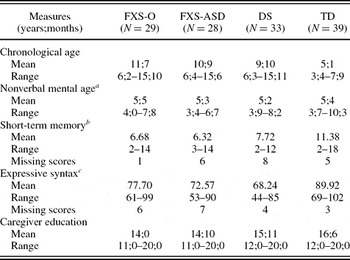
Table 1 displays CA, nonverbal MA, short-term memory scores, primary caregiver education, and syntactic scores for each of the four diagnostic groups. We describe other measures below.
Means, ranges, and missing data for predictors of FXS-O, FXS-ASD, DS, and TD groups

Note: FXS-O, fragile X syndrome only; FXS-ASD, fragile X syndrome with autism spectrum disorder; DS, Down syndrome; TD, typically developing.
aLeiter International Performance Scale—Revised.
bWoodcock–Johnson Test 17: Memory for Words.
cIndex of Productive Syntax.
Boys with FXS-O. This group consisted of 29 boys with FXS who did not have ASD. Full mutation for all boys was confirmed by DNA analysis. Their age ranged from 6 years, 2 months (6;2) to 15;10 (M = 11;7) and their MLU in morphemes (MLUm) in conversation was 4.11 (range = 2.59–5.93). Their primary caregivers’ education level ranged from 11 to 20 years (M = 14), with 31% of the caergivers having a high school degree, 55% having some college education or a college degree, and 10% having some graduate education at least. Eighty-three percent were Caucasian, 14% were African American, and 3% were other ethnicity.
Boys with FXS-ASD. Twenty-eight boys had FXS and ASD (FXS-ASD). Ten of them were in the “autism” range, and 18 in the “spectrum” range on the Autism Diagnostic Observation Schedule. Their ages went from 6;4 to 15;6 (M = 11;7) and their MLUm in conversation was 3.89 (range = 2.36–5.50). Caregiver education ranged from 11 to 20 years (M = 14;10). For 25% of the caregivers, the terminal education was a high school degree, whereas 61% had some college or a college degree, and 11% some graduate education. Eighty-nine percent were Caucasian, and 11% were African American.
Boys with DS. Thirty-three boys had DS. The source of DS was Trisomy 21 for all boys, as reported by parents. Their age ranged from 6;3 to 15;11 (M = 10;9) and their MLUm in conversation was 3.38 (range = 1.90–5.08). Caregiver education ranged from 12 to 20 years (M = 15;11). For 12% of the caregivers, the terminal education was a high school degree, whereas 55% had some college or a college degree, and 33% some graduate education. Ninety-one percent were Caucasian and 9% were African American.
TD boys. The study included 39 TD boys, recruited from schools, childcare centers, and pediatric offices in North Carolina. They ranged in age from 3;4 to 7;9 (M = 5;1) and their MLUm in conversation was 5.34 (range = 3.75–8.04). Caregiver education ranged from 12 to 20 years (M = 16;6). For 3% of the caregivers, the terminal education was a high school degree, but 49% had some college or a college degree and 49% some graduate education. Sixty-nine percent were Caucasian, 21% were African American, and 10% were classified as other ethnicity.
Procedure
Children were assessed at the FPG Child Development Institute, at their school, or in their home, according to parental preference. A structured story recall task, the Bus Story Language Test (American version; Crowley & Glasgow, Reference Crowley and Glasgow1994), was administered as part of a longer assessment protocol (Roberts et al., Reference Roberts, Long, Malkin, Barnes, Skinner and Hennon2005). This standardized narrative assessment is easy to administer and is designed to test children's “ability to give a coherent description of a continuous series of events” (Renfrew, Reference Renfrew1991, p. 2), while at the same time reflecting the integrated skills needed for story telling (Crowley & Glasgow, Reference Crowley and Glasgow1994). The Bus Story (British version) has been used as a measure of narrative skill in Paul and Smith (Reference Paul and Smith1993) and more recently in Hayiou-Thomas et al. (Reference Hayiou-Thomas, Kovas, Harlaar, Plomin, Bishop and Dale2006), Kennedy et al. (Reference Kennedy, McCann, Campbell, Law, Mullee and Petrou2006), Durkin and Conti-Ramsden (Reference Durkin and Conti-Ramsden2007), and Bowyer-Crane et al. (Reference Bowyer-Crane, Snowling, Duff, Fieldsend, Carroll and Miles2008). The American version was recently used to investigate narrative development in the African American preschool population by Price et al. (Reference Price, Roberts and Jackson2006). The story booklet is composed of four pages, each page containing three pictures for a total of 12 pictures. The story script (see Appendix A) begins with a “naughty” bus that decides to run away while being fixed by his driver. During his ultimately unsuccessful attempts to escape from the driver, the bus performs a series of salient actions such as racing a train or jumping over a fence. A trained examiner read the Bus Story script while showing the pictures to the child one at a time. The examiner then asked the child to retell the story while looking at the pictures. Because story generation tasks do not elicit enough narrative behavior from our participants with ID, we used The Bus Story retell task instead. Story retelling is not a mere parrotlike repetition of adult input and still reveals underlying narrative knowledge. This argument is commonly made, for instance, in elicited imitation studies of children's syntactic development (see Lust, Flynn, and Foley, Reference Lust, Flynn, Foley, McDaniel, McKee and Cairns1996). One of the factors that would influence successful recall of different aspects of the story is children's ability to commit those to a mental representation of a “story grammar” (see below; e.g., Trabasso & van den Broek, Reference Trabasso and van den Broek1985). However, this also implies short-term memory is an important factor in children's relative success with the task, and this is why we controlled for it in our analysis.
Children's narratives were audiotaped with a portable Digital Auditory Tape TASCAM (DA-P1) recorder and a Shure WBH headset microphone system and videotaped with a Sony Digital8 video camera (Model DCR-TVR27).
Transcription reliability. A trained research assistant transcribed the narratives from audio recordings in Codes for Human Analysis of Transcripts format using Computerized Language Analysis (MacWhinney, Reference MacWhinney2000; MacWhinney & Snow, Reference MacWhinney and Snow1985). Another trained research assistant transcribed about 15% (n = 17) of narratives from each group of children (four from the DS group, four from the FXS-ASD group, four from the FXS-O group, and five from the TD group). Morpheme–morpheme agreement between the two transcribers was 81% for the DS group, 84% for the FXS-ASD group, 85% for the FXS-O group, 88% for the TD group, and 84% overall. The transcripts were then verified by two other trained transcribers (one a coauthor of this paper). Morpheme–morpheme agreement after this stage was 91% for the DS group, 90% for the FXS-ASD group, 98% for the FXS-O group, 98% for the TD group, and 95% overall.
Narrative measures: Story grammar. Following Johnston (Reference Johnston1982), Rumelhart (Reference Rumelhart, Bobrow and Collins1975), and Stein and Glenn (Reference Stein, Glenn and Freedle1979), we view stories as composed of a setting plus subsequent episodes whose internal structure contains one (or several) initiating events, an internal response, a plan, one (or several) attempts, a consequence, and a reaction, in that order. Stein (Reference Stein1978) provides experimental evidence supporting the psychological reality of this story grammar structure. She shows that children remember stories better when the order of the story grammar structure is respected, and that adults are likely to fill in missing parts of a story to make it conform to the story grammar model. In addition, there is an almost universal order of recall of story grammar elements: setting (introduction) is the most easily recalled, followed by consequence, attempt, initiating event, reaction, and last, internal response (Trabasso, Secco, & van den Broek, Reference Trabasso, Secco, van den Broek, Mandl, Stein and Trabasso1984). Trabasso and colleagues proposed that the elements better recalled are the ones that have a greater proportion of causal chain events. Consequently, knowledge of the conventional overall structure of stories is a crucial developmental step in narrative skills. However, populations with disabilities may have delays in the acquisition of this structure. Individuals with ID may have difficulties creating and storing integrated representations of narrative macrostructure. Individuals with ASD may lack an understanding of participants’ goals and internal mental states that drive the actions in a story and that help evaluate whether a goal has been achieved or not. They may furthermore have impaired understanding of causal links necessary to convey the relation between participants’ actions and outcomes. Story grammar provides a well-defined theoretical framework to assess knowledge pertaining to all these domains. Such a measure is independent from analyses of microstructure focusing on linguistic markers of coherence/cohesion. We believe it is useful, then, in assessing narrative in populations with a known or suspected language deficit.
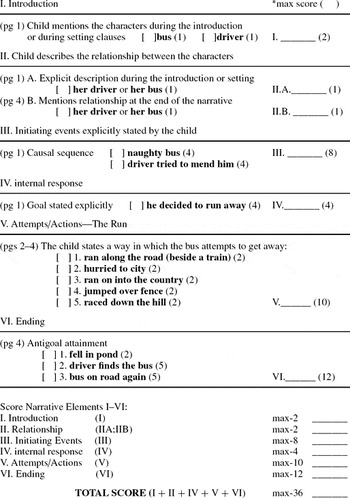
The transcribed narratives were coded by a trained researcher. The coding system (see the coding sheet in Appendix B) is based on the work of Stein and Glenn (Reference Stein, Glenn and Freedle1979) and Frazier (Reference Frazier1994). The story grammar schema for the Bus Story was that used by Price et al. (Reference Price, Roberts and Jackson2006): introduction, which gives characters (bus and driver) and story setting; initiating events, which states a situation or problem that requires action (the bus is naughty, broken), and provides the beginning of a causal sequence (the driver tries to mend it); internal response, which conveys goals and mental states of the participants (bus decides to run away); attempts/actions, which are characters’ actions toward a goal (many actions whereby the bus attempts to escape); and finally, ending, in this case the antigoal attainment of the story (bus falls in a pond; driver finds it and puts it back on the road). We also identified the structural element relationship (Frazier, Reference Frazier1994), stating explicitly the relationship between the story's two main characters. Appendix B has a full breakdown of the the subelements of the Bus Story that contribute to each story grammar element.
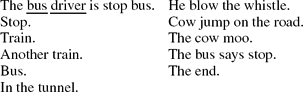
The use of a literary introduction (e.g., “once upon a time”) is part of the original story grammar structure, but was not coded in our study as part of the introduction, because the examiner always provided this to the child as a prompt. As for relationship, Price and colleagues (Reference Price, Roberts and Jackson2006) found it not to be a useful measure for preschool African American children's narratives. Furthermore, relationship was not included in either Rumelhart (Reference Rumelhart, Bobrow and Collins1975) or Stein and Glenn (Reference Stein, Glenn and Freedle1979) original story grammar. Consequently, in the present study we retained it only for descriptive purposes but did not include it in statistical analyses. Scores for each story grammar element were calculated as well as the total score (which excludes relationship). The range of possible total points is 0 to 36. Appendix C contains two sample narratives from the FXS-O group. A second trained coder scored 15% of all narratives. Using the kappa statistic (Fleiss, Reference Fleiss1981), intercoder reliability was 0.87 for introduction elements, 0.95 for initiating events, 1.00 for internal response, 0.94 for attempts, and 0.85 for ending. Each coded transcript was then verified by either the second or the fourth author, with 14 narratives (11%) coded by both. Mean intercoder agreements (kappas) between the two verifiers at this stage were 1.0 for introduction, relationship, initiating events, and internal response, 0.92 for attempts, and 0.86 for ending. reliability for total was 0.98, calculated using Shrout and Fleiss’ (Reference Shrout and Fleiss1979) intraclass correlation coefficient of 2.1.Footnote 3
RESULTS
Between-group comparisons of story grammar scores
Seven narrative measures were obtained for each participant. Six of them measured children's production of particular story grammar elements. These were introduction, relationship, initiating events, internal response, attempts/actions, and ending. However, the relationship and internal response scales lacked enough variability in all groups to be included in a regression analysis: we report them only as descriptive statistics. Moreover, relationship was mentioned very rarely in most groups. Consequently, the seventh narrative measure, total, was the aggregate of all story grammar elements except relationship.
The first step was to fit a multiple regression with total as outcome and diagnostic group and nonverbal MA, WJ-III short-term memory scores, Index of Productive Syntax (IPSyn) scores, and caregiver education as covariates to test between-group differences in overall knowledge of narrative structure. Interactions of all covariates with group were included as a first step, but only the interaction with short-term memory was significant and therefore retained. We fit subsequent separate multiple regression models with introduction, initiating events, attempts/actions, and ending as outcomes and the same predictor structure used for the total score. We also report the Cohen d as a measure of effect size. Statistical significance was evaluated with an α = 0.05 for all tests. Because comparisons were planned and limited in number, no adjustment was performed.
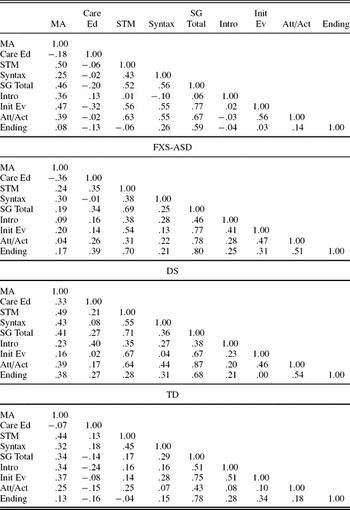
Because of missing data in two covariates (IPSyn and WJ-III short-term memory), we used a multiple imputation procedure to avoid deleting cases with missing observations with corresponding loss in power and possible bias in the resulting sample. Details of this procedure are given in Appendix D. Table 2 displays total correlation coefficients for all the variables in each group, to help the reader gain a more complete understanding of the bivariate relationships in the model.
Pearson r correlations between variables in the regression model FXS-O

Note: FXS-O, fragile X syndrome only; MA, nonverbal mental age; Care Ed, primary caregiver education; STM, short-term memory; SG Total, story grammar total score; Intro, story grammar introduction score; Init Ev, story grammar initiating events score; Att/Act, story grammar attempts/actions score; FXS-ASD, fragile X syndrome with autism spectrum disorder; DS, Down syndrome; TD, typically developing.
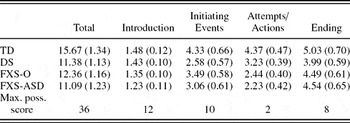
Story grammar total. Table 3 shows the adjusted least-squares means for all outcome variables by diagnostic group (see Table 4 for all effect sizes). The overall model predicting total scores was significant across all imputations, all F (10, 118) > 9.03, all p < .0001, all R 2 > .43.
Hypothesis 1: There will be a positive correlation in each group between nonverbal MA, short-term memory, syntactic scores, and caregiver education level, and overall narrative scores.
This hypothesis is only partially confirmed. The main effects for syntactic scores and caregiver education, and their interactions with group, were not significant. The main effect for nonverbal MA was positive and significant (B MA = 0.10, t = 2.14, p = .03). This effect was the same in all groups (the interaction with diagnostic group was not significant in an earlier model).
Model adjusted means (standard errors of estimated means) by group

Note: TD, typically developing; FXS-O, fragile X syndrome only; FXS-ASD, fragile X syndrome with autism spectrum disorder; DS, Down syndrome.
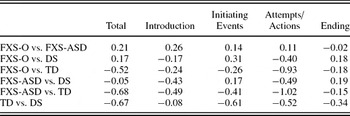
Cohen d effect sizes for pairwise comparisons

Note: As a guideline for interpretation, Cohen (1988) proposed to define an effect size d = 0.2 as small, d = 0.5 as medium, and d = 0.8 as large. FXS-O, fragile X syndrome only; FXS-ASD, fragile X syndrome with autism spectrum disorder; DS, Down syndrome; TD, typically developing.
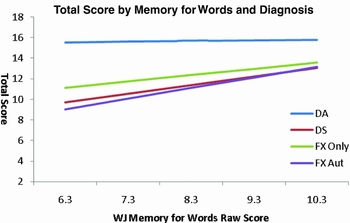
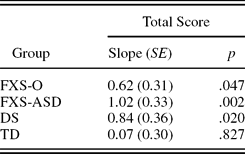
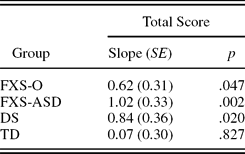
The main effect for short-term memory was also positive and significant (B STM = 1.02, t = 3.14, p = .002). In this case, however, the effect of short-term memory is different for the TD group from that for the other groups (B STM×TD = −0.96, t = −2.18, p = .03). All other interaction coefficients are not significantly different from 0, nor are there any pairwise differences between the ID groups (post hoc tests). Figure 1 plots the estimated slopes for short-term memory by group in the regression of the SG total score. The graph illustrates that short-term memory has no effect in the TD group, and that it has a positive and equal effect in the three groups with ID. Table 5 provides the post hoc tests for differences in slope.
Hypothesis 2a: Boys with FXS-O will have lower overall narrative scores than boys with DS, suggesting distinct narrative profiles for the populations with ID.
This hypothesis was not supported by Model 1, SG(FXS-O) – SG(DS) = 0.97, t = 0.58, p = .56, d = 0.17. There is no evidence of a difference between the two groups.
Hypothesis 2b: The FXS-O group will not differ from the TD group, but the FXS-ASD group will retell fewer narrative elements overall than the TD group.
This hypothesis is supported by the model. Boys with FXS-ASD have lower total scores than TD boys, SG(FXS-ASD) – SG(TD) = −4.57, t = −2.46, p = .01, d = −0.68. However, the difference between the FXS-O and TD groups approached significance, SG(FXS-O) – SG(TD) = −3.31, t = −1.84, p = .07, d = −0.52.
Partial slopes for short-term memory by diagnostic group showing the presence of an interaction. [A color version of this figure can be viewed online at journals.cambridge.org/aps]

Estimated slopes (standard errors) for short-term memory as a predictor of overall narrative scores and post hoc t-test probabilities that the slopes are different from 0
Note: FXS-O, fragile X syndrome only; FXS-ASD, fragile X syndrome with autism spectrum disorder; DS, Down syndrome; TD, typically developing.
Story grammar elements.
Hypothesis 3: Participants with FXS-ASD will have lower overall scores and produce fewer narrative elements related to the story's human character (the bus driver), and the characters’ motivations, than those with FXS and those with DS.
This hypothesis was not supported. There was no evidence of a difference between FXS-ASD and the other groups with ID in total score or any of the subscales, including those with subelements related to the driver (introduction, initiating events, or ending). However, both groups with FXS recall fewer attempts and actions than the TD group: AA(FXS-O) – AA(TD) = −1.94, t = −3.12, p = .002, d = −0.93; AA(FXS-ASD) – AA(TD) = −2.14, t = −3.31, p = .001, d = −01.02.
Descriptive statistics of story grammar elements by group
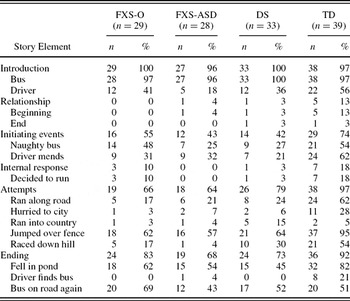
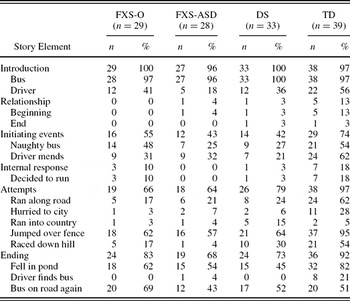
We next tabulated the raw frequency and percentages of boys in each group that mentioned each story grammar element and subelement coded (Table 6). This was a follow-up exploratory analysis to help us uncover other sources of possible differences between groups. As we suspected, the relationship variable was mentioned very infrequently in every group. Internal response elements were never mentioned in the FXS-ASD group (and only very rarely in the DS group). According to Trabasso et al. (1994), this element is the least easily recalled in typical populations. This was borne out in our sample, where only 18% of TD boys mentioned it, compared to 97% for introduction, 97% for attempts/actions, 92% for ending, and 74% for initiating events (relationship was only mentioned by 13% of TD boys).
Numbers and percentages of children who narrated story elements in each group
Note: FXS-O, fragile X syndrome only; FXS-ASD, fragile X syndrome with autism spectrum disorder; DS, Down syndrome; TD, typically developing.
Boys with FXS-O. All the boys with FXS-O introduced at least one of the main characters, with 97% mentioning the bus and 41% the driver. Fifty-five percent mentioned some initiating event: almost half stated that the bus was naughty, and 31% recalled that the driver tried to mend the bus. Sixty-six percent stated a way in which the bus attempts to get away, with 62% saying that he jumped over a fence. Eighty-three percent also narrated parts of the ending: 62% said that the bus fell in the pond, and 69% mentioned that the bus was put back on the road again. However, no boys in this group stated that the driver finds the bus.
Boys with FXS-ASD. Almost all boys with FXS-ASD introduced one character (96%), but only 18% mentioned the driver as opposed to 96% for the bus. Forty-three percent talked about an initiating event, but only 25% mentioned that the bus was naughty. In attempts, most children mentioned the bus jumping over the fence (57%). Finally, only two-thirds of them (68%) recalled the ending, with the bus falling in the pond and being put back on the road again most frequently cited, and the driver finding the bus only mentioned by one child (4%). No children in this group alluded to the internal response event of the bus deciding to run away.
Boys with DS. All boys with DS introduced the bus but only one-third (36%) did so with the driver. Forty-two percent referred to an initiating event, with 27% talking about the naughty bus and 21% about the driver's trying to fix the bus. Almost 80% of boys with DS spoke of the bus attempting to get away: 64% of them mentioned jumping over the fence, 30% racing down the hill, and 24% running along the road. The ending was alluded to by 73% of boys in this group, but none of them talked about the driver finding the bus. In addition, only one boy (3%) referred to the bus's internal response.
TD boys. Finally, the TD boys introduced the characters 97% of the time (97% bus, 56% driver), and mentioned an initiating event 74% of the time (bus being naughty 54%, and driver attempting to fix the bus 62%). Eighteen percent of them mentioned the bus deciding to run away. Almost all (97%) referred to at least one attempt to escape, with 95% talking about the bus jumping over the fence. In addition, 92% of the TD boys provided an ending to the story, with 82% of them alluding to the bus falling in the pond, 51% to its being put back on the road again, and only 21% to the driver's finding the bus.
To summarize, more boys with DS (79%) convey attempts and actions than boys with FXS-O (66%). The effect size d for the (nonsignificant) difference in means FXS-O–DS was moderate, d = −0.40, meaning that the mean of the DS group is at about the 66th percentile of the FXS-O group. Conversely, more boys with FXS-O provided initiating events (55%) and endings (83%) than boys with DS (42% and 73%, respectively). The effect size d for the difference in means for initiating events was small (absolute value 0.31), and the one for ending was small as well (absolute value 0.18). Moreover, even though 100% of boys with FXS-O and 96% of those with FXS-ASD gave some introductory element (mention of bus or driver in the setting), and similarly high percentages introduced the bus, only 18% of those with FXS-ASD introduced the driver, compared to 41% in the FXS-O group. TD and FXS-ASD are the only groups where fixing the bus was mentioned by more children than the bus being naughty. Finally, the ranks of frequencies for each element are remarkably consistent across groups, from most frequent to least frequent: introduction, attempts/actions, ending, initiating events, internal response, and relationship. However, in the two FXS groups, endings are more frequently mentioned than attempts and actions. As for subelements, introduction of the bus, the bus jumping over a fence, and the bus falling in the pond, were the most frequently recalled across all groups. Of interest, for the three groups with ID, the bus being put back on the road was at least in the top four most frequent subelements, but for the TD group it ranked ninth out of 15. The remaining subelements had fairly comparable rankings across groups. We stress that rank comparisons are descriptive results, because no statistical tests were run on them.
DISCUSSION
In this study we compared the narrative skills of boys with FXS-O and FXS-ASD, to those of boys with DS and TD boys, after controlling for nonverbal MA, short-term memory, syntactic ability, and primary caregiver education. We focused on children's knowledge of narrative (macro)structure as evidenced by their recall of story grammar elements during a story retell task. Ours constitute the first results obtained on emergent narrative skills in young children with FXS with and without comorbid ASD.
This study has a number of strengths. First, the sample sizes in our four participant groups are quite large, especially in the two subgroups with FXS (with and without ASD). Second, we were able to examine the influence of comorbid ASD on the narrative skills of boys with FXS. We showed that comorbid ASD is associated with poorer narrative performance in FXS when compared to TD children. Third, we controlled for the effects of nonverbal cognition (MA), short-term memory, syntactic skill, and caregiver education levels in all analyses, thus ensuring the associations between diagnosis and narrative skill are independent of these factors and protecting against bias in our estimates because of model misspecification and the exclusion of relevant variables. Fourth, we used a theoretically well-founded measure of narrative structure knowledge (story grammar) and adapted it to the Bus Story to meet our analysis purposes.
The basics of story structure are conveyed by all groups in this story retell task, as expected from the MA ranges of all participants. We found narrative skill related to nonverbal MA, but no evidence of a CA advantage for the groups with ID. Overall, the readiness with which story grammar elements are recalled in our populations matches that found by Trabasso et al. (Reference Trabasso, Secco, van den Broek, Mandl, Stein and Trabasso1984) for the TD population. Moreover, the relative difficulty of story grammar sublements is consistent between the TD group and the groups with ID, except that attempts/actions are less commonly recalled than endings in both groups with FXS. In addition, internal response was difficult across the board, even for the TD group, and may be slowly emerging during the range of MAs examined in this study. This is the subelement of the story that mentions the unobservable mental state of a participant (“the bus decided to run away”). Note also that psychological motivation for characters’ actions does not emerge consistently until age 10 (Bishop & Donlan, Reference Bishop and Donlan2005; van den Broek, Reference van den Broek, van den Broek, Bauer and Bourg1997), which is above the MA range of this study's participants. It is therefore not surprising that all groups have difficulty with this element (see below). As Price et al. (Reference Price, Roberts and Jackson2006) concluded, we confirmed that the structural category relationship may not be as useful in a narrative such as the Bus Story that contains few characters.
Narrative profiles of boys with FXS-O and FXS-ASD
Overall, we found some evidence of a specific narrative impairment associated with FXS. The difference between the FXS-O group and the TD group only approached significance at the .05 level. The Cohen d value for that comparison was −0.52, indicating that the mean for the TD group is around the 70th percentile of the FXS-O group. On average, the TD group scored almost 3.5 points more than the FXS-O group on the total score. Because the maximum possible total score is 36, this represents over a 10% advantage for the TD group. We suggest that our failure to detect a significant difference in this case is partly because of the range of scores, in particular in the FXS group whose total Bus Story scores range from 2 to 23. Moreover, boys with FXS produced significantly fewer mentions of the bus's attempts and actions to escape than the TD boys.
In addition, we did not find differences between the FXS-O and the DS groups. Even the impact of other cognitive, linguistic, and environmental factors was the same across all groups with ID (see below). Although the boys with DS mentioned more of the bus's attempts to run away, they did not have a significant advantage over those with FXS-O. Because this is a high point of the narrative in terms of evaluative interest, it may be that our participants with DS simply focused more on it. Our results then suggest that the narrative profiles in FXS and DS are similar and may be associated more generally with the presence of ID regardless of etiology.
This pattern is somewhat different from what we expected given the findings of Keller-Bell and Abbeduto (Reference Keller-Bell and Abbeduto2007). In that study, the group with FXS-O was found to perform at levels not significantly different from a control TD group, but worse than the group with DS. However, their study focused on adolescents and young adults with FXS and DS who were older than our participants on average. It also included female participants. Females with FXS could be expected to perform better than males, given that the cognitive impairments tend to be milder (although Keller-Bell and Abbeduto report no significant differences by gender in each group, from separate nonparametric tests). Finally, their outcome variables were measures of lexical, syntactic, and evaluative production in narrative samples, whereas we measured narrative macrostructure directly. It is possible that, had we measured microstructural narrative components, our results would have been more in line with theirs. Although the studies cannot be compared directly because of CA disparities and divergent narrative measures, our results indicate that the differences between FXS-O and DS observed by Keller-Bell and Abbeduto (Reference Keller-Bell and Abbeduto2007) may well be restricted to a greater use of evaluations (i.e., opinions, mental states) by individuals with DS. However, another possible explanation is that aspects of narrative structure in FXS may develop more slowly than in DS over time, therefore creating a gap that widens with age that would reproduce the differences found for evaluative devices in the older populations.
Finally, there were no significant differences between the boys with FXS-ASD and those with FXS-O or DS. However, the boys with FXS-ASD had lower overall scores and lower attempts/actions scores than the TD boys, which is consistent with the presence of a clear narrative impairment in this group. This impairment was not localized in mentions of the human character as we had expected, but rather in mentions of the bus's actions in trying to escape its driver. Because the bus is heavily anthropomorphized in the Bus Story, it is still possible that a bias against mention of human or humanlike characters is responsible for this difference. Moreover, in our descriptive measures, we noted that fewer than one in five boys with FXS-ASD introduced the driver, whereas almost half of all boys with FXS-O did. This difference bears further exploration. Finally, FXS-ASD was the only group where no child mentioned the initiating event of the bus deciding to run away, a not surprising result given the known difficulties with mental states evinced by individuals with ASD. We conclude that comorbid ASD in FXS is associated with lower narrative performance than in TD children. This is largely consistent with the extant literature on narrative skill in autism. It is in agreement with Losh and Capps (Reference Losh and Capps2003), who found that high-functioning children with autism or Asperger syndrome produced fewer story components in their narratives, but it does not agree with Norbury and Bishop (Reference Norbury and Bishop2003), who did not find a structural impairment in narratives of children with high-functioning autism (our children with ASD, however, are not high functioning, because they have FXS). Known difficulties in shifting speaker perspective and in grasping other people's internal states (theory of mind) may lead to children with ASD contributing fewer story components in recall and fewer causal explanations. It is apparent that the subgroup of individual with FXS who also have ASD present a different narrative profile that includes some challenges typical of idiopathic autism.
As for cognitive, linguistic, and environmental predictors of narrative recall, contrary to our expectations, syntactic ability was not related to narrative scores. This may seem surprising given the dependence of narratives on advanced syntactic devices. However, it strongly supports the contention that story grammar measures aspects of narrative skill that are independent from microstructural, linguistic aspects (at least, at the language levels examined here). Story grammar, then, seems to be a particularly useful narrative measure for populations with linguistic impairments. Similarly, caregiver education was not related to narrative scores, contrary to our expectations. It may have been the case that this proxy measure of environmental effects is too crude to detect any association. In contrast, nonverbal MA and short-term memory were related to the overall scores. The effect of MA was identical for all groups with ID, with roughly an increase of 1 year in MA scores associated with a gain of 1 point in the total score. However, the TD group was the only one where short-term memory was not related to narrative scores. In the other groups, an increase of 1 point in the Memory for Words Test was associated with an increase of roughly 1 point in the total score. This may be because the short-term memory scores in the TD group are higher than those of all other groups, suggesting that the effect of short-term memory tapers off or even disappears at higher levels.
We must stress that our results pertain to “average” performances in each population, but there were considerable individual differences within each group. First, the model predicts just under half of the variance in narrative total scores. The remaining variance is because of individual differences with unknown sources. For boys with FXS-O, total scores ranged from 2 to 23. This variability is not necessarily related to cognitive level: two boys in this group with identical MA (5;2) scored 2 and 20 in total, respectively. In the FXS-ASD group, one boy had a total score of 3, another had a score of 23, and both had a MA of 5;5. Finally, in the DS group, a child with a MA of 5;3 scored 1 in total, while another with a MA of 5;2 scored 22.
Implications for social and educational attainment
Our results suggest that although narrative recall in FXS is overall in line with nonverbal cognitive level, there are indications of narrative difficulties. First, we did detect a marginally significant difference in favor of the TD group when compared with the FXS group, and a significant difference on the attempts/actions subscale. Of more importance, narrative knowledge was tested in this study via a recall protocol aided by picture support, which may have tended to minimize differences between typical and atypical participants. Therefore, even though the structure of narratives of children with FXS seem largely conmensurate with their cognitive level, the ability to understand and construct an original narrative with fewer prompts—the kinds of narrative most strongly associated with literacy acquisition and educational attainment—may still be compromised. Narratives of personal experience are also important vehicles of personal and social identity, and our results do not extrapolate easily to those contexts.
For the group with FXS and comorbid ASD, difficulty with narratives may have even broader effects on communicative and social behaviors. That we found clear evidence of narrative challenges on a task that was designed to facilitate narration in populations with ID indicates that these challenges may be even more severe in more difficult narrative tasks. Moreover, the structural impairments in this subpopulation with FXS may be somewhat determined by a lack of understanding of causal links, or at a minimum by difficulties in conveying such causal links in productive language. If this is the case, then the underlying causal impairment could hinder other cognitive and communicative aspects of the FXS-ASD profile, such as social and relational understanding, and comprehension of social schemas or scripts for action.
STRENGTHS, LIMITATIONS, AND FUTURE DIRECTIONS
Our study has some limitations that are important for future research. The first limitation is related to the type of narrative task chosen. There are several dimensions along which narratives differ: story retelling versus story generation, picture support versus no picture support, personal versus storybook narrative, and the properties of the story itself. As we mentioned above, the combination of retelling and picture support used here was one we found necessary to elicit enough response from our subjects, given their MA and other language-related challenges (in the populations with ID), and their CA (in the TD population). Furthermore, the Bus Story has a rather simple story grammar structure. For example, it does not have a clear goal. To this effect, we conceptualized the ending as an “antigoal attainment,” with the purported goal of the story being the bus's escape. (In any case, no differences were found on the provision of an ending to the story.) Because story grammar analysis is plot centered, as opposed to character centered (Nicolopoulou & Richner, Reference Nicolopoulou and Richner2007), we are currently collecting and analyzing data from a story with more character-based content, “A Bed Full of Cats” by Keller (Reference Keller2003).
Second, we assessed children's macrostructure using a story grammar schema. Other measures of narrative skill such as evaluative devices, mental state, and causal vocabulary, or even other schemas for narrative structure, may yield important additional insights. Third, our FXS-ASD group includes children with classical autism and children who are on the autism spectrum. Future studies should examine FXS-autism and FXS-spectrum separately to uncover possible further differences. Fourth, the groups with ID include a wide range of CAs. However, visual examination of plots of Total against CA indicate no correlation between CA and overall narrative ability.Footnote 4 Fifth and finally, we need to include other comparison groups with ID from different etiologies to further tease apart syndrome-specific impairments from those attributable to the presence of ID alone.
We focused on boys only in this study. Even though females are less affected by FXS, in future research we plan to examine the narrative (and language) skills of girls and adult females with FXS. In addition, to make the contribution of ASD to FXS clearer, we are currently collecting data for future analyses including a comparison group of males with ASD only using a story generation task from a wordless video (Pingu). In addition, the deployment of narrative skills depends on both event encoding and recall (Bishop & Donlan, Reference Bishop and Donlan2005). We used the Bus Story as an auditory and pictorial recall task. One further aspect to explore is whether encoding difficulties may account for some of the narrative impairment in groups with ID and may mediate the effect of MA, at least in part. This is especially important in light of the known problems with attention and hyperactivity in FXS (Baumgardner, Reiss, Freund, & Abrams, Reference Baumgardner, Reiss, Freund and Abrams1995) and in the processing of sequential information (Burack et al., Reference Burack, Shulman, Katzir, Schaap, Iarocci and Amir1999; Hodapp, Dykens, Ort, Zelinsky, & Leckman, Reference Hodapp, Dykens, Ort, Zelinsky and Leckman1991). Moreover, Wolman, van den Broek, and Lorch (Reference Wolman, van den Broek and Lorch1997) showed that causal structure facilitated both immediate and delayed story recall in children with mild mental retardation (of unspecified etiology), learning disabilities, and TD children. Perhaps a richer causal structure could facilitate the performance of children with DS and FXS and no ASD and give rise to even starker differences between the groups.
APPENDIX A
Examiner script
Now I am going to tell you a story about this bus. Listen very carefully because when I am finished, you are going to tell me the story. Are you ready?
(Read the story with expression keeping strictly to the printed text that follows. Point to each picture as you read.)
Once upon a time there was a very naughty bus. While his driver was trying to fix him, the bus decided to run away.
He ran along the road beside a train. They made funny faces at each other and raced each other. But the bus had to go on alone, because the train went into a tunnel. He hurried into the city where he met a policeman who blew his whistle and shouted, “Stop bus.”
But the naughty bus paid no attention and ran on into the country. He said, “I'm tired of going on the road.” So he jumped over a fence. He met a cow who said, “Moo, I can't believe my eyes.”
The bus raced down a hill. As soon as he saw there was water at the bottom, he tried to stop. But he didn't know how to put on his brakes. So he fell in the pond with a splash and stuck in the mud. When the driver found where the bus was, she telephoned for a tow truck to pull him out. . . And put him back on the road again.
Now you tell me the story. Once upon a time there was a . . .
APPENDIX B
Story grammar coding
In the original story grammar coding, mention of each subelement is credited with 1 point. We devised a system of weights to reflect that some elements of a story grammar are more important than others. The elements introduction and relationship have a weight of 1, the element attempts/actions have a weight of 2, and the subelement “fell in pond” of ending has a weight of 2 and “driver finds the bus” and “bus on road again” have a weight of 5 each.
Coding format for bus story narratives
APPENDIX C
Sample narratives from the FXS-O group
Underlined items receive a score; xxx marks unintelligible segments.
Narrative A (total score = 21)

Narrative B (total score = 2)
APPENDIX D
Multiple imputation procedure
Some data were missing from the final analysis data set (see Table 1). Missing data were replaced using the EM algorithm through SAS Proc MI. Following accepted practice (see, e.g., Schafer & Graham, Reference Schafer and Graham2002), 10 data sets were imputed. In addition to those in the analysis models, several additional background variables were included in the imputation model to improve the estimation of missing values. The complete set of variables used for imputation included child CA; total number of child utterances; intelligibility in conversation; nonverbal MA; nonverbal IQ; IPSyn total score; child ethnicity; diagnostic group; caregiver education; Comprehensive Test of Phonological Processes nonword repetition raw score (Wagner, Torgesen, & Rashotte, Reference Wagner, Torgesen and Rashotte1999); Expressive Vocabulary Test raw score (Williams, Reference Williams1997); MLU from conversation; type/token ratio in conversation; Peabody Picture Vocabulary Test, Third Edition, raw score (Dunn & Dunn, Reference Dunn and Dunn1997); WJ-III auditory working memory scores; and WJ-III short-term memory scores. Following a statistical analysis, the results were compiled using SAS Proc MIAnalyze.
ACKNOWLEDGMENTS
This research was supported by the National Institute of Child Health and Human Development (Grants 1 R01 HD038819, 1 R01 HD044935, 1 R03 HD40640, and 5 T32 HD40127). The authors thank Jan Misenheimer for her help with data entry and Debra Skinner and Molly Losh for comments on the manuscript.