INTRODUCTION
Safe use of agrochemicals is an important part of food safety. Pesticides were already in use during ancient Greek and Roman times and are extensively used to control pests in the agricultural industry (Jeong et al. Reference Jeong, Kwak, Ahn and Jeong2012). Currently, there are more than 600 active ingredients of pesticides and approximately 28 000 pesticide products registered in China. Neonicotinoids belong to a relatively new group of insecticides, derived from the nicotine group. Their physicochemical properties render them useful for a wide range of applications, including foliar application, seed treatment, soil drench, etc. (Matsuda et al. Reference Matsuda, Buckingham, Kleier, Rauh, Grauso and Sattelle2001; Millar & Denholm Reference Millar and Denholm2007; Žabar et al. Reference Žabar, Komel, Fabjan, Kralj and Trebše2012).
Rice is one of the world's most important food crops. It is a grain, like wheat and maize. A large population uses rice as their main source of food, especially in Asia. In Bangladesh, rice production has increased steadily, but it is still not sufficient to cover the needs of the growing population (Shahid Reference Shahid2011). Because of its long growth period and growth conditions, rice crops tend to be attacked by pests and diseases such as stem borer, gall midge, brown plant hopper, white backed plant hopper, rice blast, brown spot, stem rot, sheath rot, sheath blight, false smut, etc. According to the China Pesticide Information Network (http://www.chinapesticide.gov.cn/hysj/index.jhtml), there are approximately 200 active ingredients (a.i.) and >7000 brands of pesticide products registered for controlling various pests of rice in China as of 2017. The use of pesticides in paddy fields has increased steadily in China during recent decades, but in the Republic of Korea, the use of pesticides on paddy fields increased gradually to a peak of 9·65 kg/ha in 1991 and then decreased slightly to 9·11 kg/ha in 1992 (Lee & Song Reference Lee, Song, Huang and Iskandar1999).
Clothianidin[(E)-1-(2-chloro-1,3-thiazol-5-yl-methyl)-3-methyl-2-nitroguanid -ine] is an insecticide belonging to the class of nitromethylenes and neonicotinoids. It acts as an agonist of the nicotinic acetylcholine receptor (Franklin et al. Reference Franklin, Winston and Morandin2004; Cutler& Scott-Dupree Reference Cutler and Scott-Dupree2007; Li et al. Reference Li, Sheng, Cong and Wang2013; Ramasubramanian Reference Ramasubramanian2013), affecting the synapses in the central nervous system of sucking and chewing insects. Government factsheets indicate that clothianidin is a toxic chemical (U. S. EPA 2003; Australian Pesticides and Veterinary Medicine Authority 2007; Health Canada 2011). Analytical methods for clothianidin determination have been reported, such as high-performance liquid chromatography/ultra-violet (HPLC/UV; Chen et al. Reference Chen, Wang, Li and Gong2009), HPLC/diode-array detection (DAD; Hou et al. Reference Hou, Cai, Zhang and Wan2010) and liquid chromatography tandem mass spectrometry (LC-MS/MS; Xie et al. Reference Xie, Qian, Ding, Chen, Xi and Jiang2009). Li et al. (Reference Li, Jiang, Liu, Liang, Sun and Li2012) observed that clothianidin's half-lives were 7·9– 11·9 and 6·7–12·7 days in tomatoes and soils, respectively. At the rate of 60 and 90 g a.i./ha, the residues of clothianidin in tomato flesh and peel were found to be 0·037 and 0·197 mg/kg, respectively. Clothianidin has been registered in many countries for fruits, vegetables, soybean, sugar cane, oilseeds and tea (Kim et al. Reference Kim, Park, Choi, El-Aty, Na and Shim2012). Some maximum residue limits (MRLs) for clothianidin on rice have been established, such as 0·5 mg/kg for rice by the Codex Alimentarius Commission (which develops and adopts food standards that serve as a reference for international food trade), 0·7 mg/kg for brown rice in Japan, 0·1 mg/kg for rice in Korea, 0·5 mg/kg for rice in Europe and 0·01 mg/kg for grain in the USA. In China, clothianidin is registered only for controlling Bemisia tabaci (Gennadius) and rice plant hopper in tomato and rice. However, MRLs for rice crops have not yet been established in China (National Food Safety Standards of China 2014). To ensure the safe use of clothianidin in the paddy ecosystem and to provide data for developing a MRL for brown rice or straw in China, it is important to determine the clothianidin residues in rice crop fractions (brown rice, hull and straw), paddy water and soils and to study its degradation dynamics in the paddy field ecosystem.
The purpose of the current study was to develop an analytical method for determination of clothianidin by using the Quick, Easy, Cheap, Effective, Rugged and Safe (QuEChERS) technique for sample preparation, followed by LC-MS/MS analysis. Moreover, the work was to study clothianidin residues and its dissipation in the paddy field ecosystem under various climatic conditions. The study will provide an overview of degradation of clothianidin to ensure safe human consumption and minimized adverse effects on agricultural environments.
MATERIALS AND METHODS
Materials and equipment
The LC-MS/MS analysis was performed on a 1200SL HPLC system equipped with an Agilent G6410A triple quadrupole mass spectrometer (Agilent Technologies, Santa Clara, CA, USA). The LC-MS/MS system was controlled by Mass Hunter software. The analytical column was an Agilent ZORBAX SB-C18 (2·1 × 150 mm2, 5 µm). Other equipment included a high-speed homogenizer (T-18; IKA Werke, Staufen, Germany), nitrogen evaporator (N-EVAP 112; Organomation Associates, Inc., Berlin, MA, USA), shaker (PYB, China Academy of Science Wuhan Science Equipment Factory, Wuhan, China), centrifuge (Beckman Coulter, Avanti J-30I, Brea, CA, USA) and husker (Satake THU35B, Satake Manufacturing Co. Ltd, Suzhou, China).
Pesticide standard clothianidin (97%, w/w) was purchased from Sigma-Aldrich (Shanghai, China). A formulation of a suspension concentrate containing 20% of clothianidin was obtained from Hebei Weiyuan Bio-chemical Co. Ltd. (Hebei, China). Acetonitrile was purchased from Merck (Darmstadt, Germany). Purified water was prepared by a Milli-Q (Millipore, Bedford, MA, USA) water purification system. All other solvents and reagents used in the current study were of HPLC grade or analytical grade.
A stock standard solution of clothianidin was prepared by weighing clothianidin and dissolving it in acetonitrile. Working standard solutions (0·1, 0·2, 0·5, 1, 2 and 5 ng/ml) were prepared by diluting the stock solution or a working solution using acetonitrile. All standard solutions were maintained in amber bottles at 4 °C.
Field trials
A multi-location field study was conducted in paddies in three different provinces in China in 2012: Site 1inEast China (Nanjing, Jiangsu province, 32°04′N, 118°78′E), Site 2 in Southwest China (Nanning, Guangxi Guangxi Zhuang Autonomous Region, 23°32′N, 108°51′E) and Site 3 in South China (Changsha, Hunan Province, 28°16′N, 113°27′E).
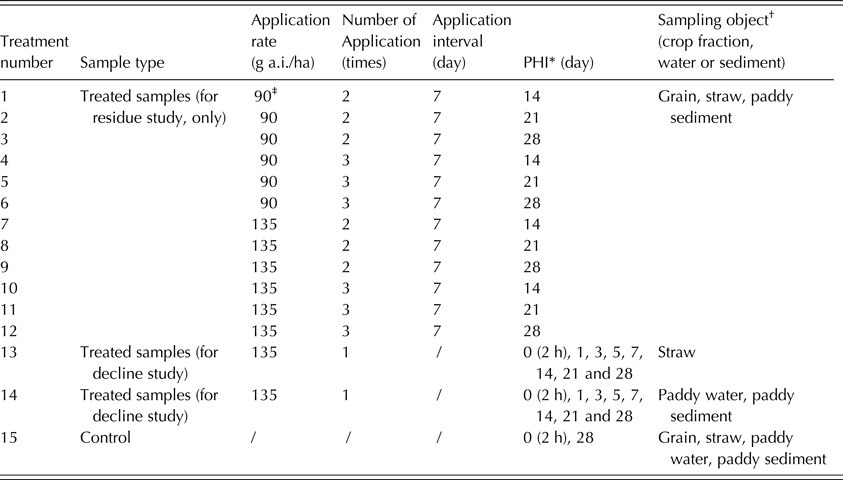
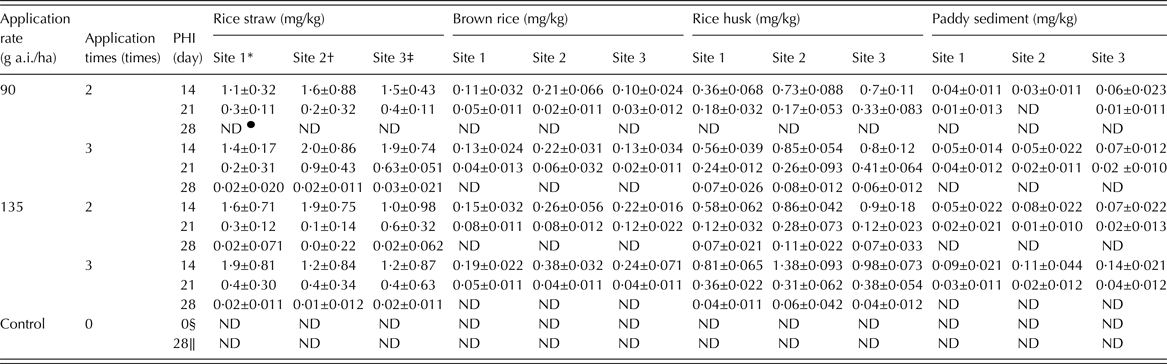
The study was conducted according to ICAMA (2007) and included dissipation experiments and residue determination. Details of the field experiments in the three trials are listed in Table 1.
Details about the field trials of residues and degradation of clothianidin in grain, water and sediment at three experimental sites in China

* Pre-harvest interval.
† Treated samples in triplicate.
‡ Manufacturer recommended maximum application rate (90 g a.i./ha); manufacturer recommended maximum number of times of application (2 times, interval of 7 days); and manufacturer recommended pre-harvest days (28 days).
As per ICAMA's standard operating procedures (ICAMA 2007), each trial consisted of 15 different treatments, including one control, 12 treated for residue determination and two treated for the decline study (Table 1). Each treatment number had a plot size of 5 × 6 m2. Applications were carried out using a JACTO-HD 400 internal pump backpack sprayer (Maquinas Agricolas Jacto S.A., Brazil).
For decline studies, straw, paddy water and paddy sediment samples (n=3) were collected from each plot on days 0 (2 h), 1, 3, 5, 7, 14, 21 and 28 after application. For residue studies, treated samples (grain, straw and paddy sediment samples) were collected from each plot on days 14, 21 and 28 after the last application (hereafter termed the pre-harvest interval, PHI). Based on OECD (2009), whole straw (above-ground parts) was collected from 12 separate, randomly selected plants in each plot. Paddy sediment samples (from 0 to 10 cm below the water) and water samples (0–10 cm above the paddy sediment) were collected from each paddy. Each treated straw sample (approximately 1 kg) was chopped and divided into three sub-samples. Air-dried grain samples were ground by a rice milling machine (mesh size 121 mm) and separated into brown rice and hull. Samples (brown rice, hull, straw and paddy sediment samples) were stored in individual polyethylene bags and water samples stored in plastic bottles. Water samples were stored in a refrigerator at 4 °C and other samples were maintained in a freezer at −20 °C until analysis. The average daily field temperature during the experiment was 20–39 °C and the total rainfall was 135–378 mm during the field experiments. All samples were analysed in triplicate.
Extraction and clean-up
In the present study, the analytical method for determining the clothianidin residues in brown rice, hull, straw, paddy water and paddy sediment samples was derived from the reference methods using the QuEChERS clean-up technique (Lehotay et al. Reference Lehotay, de Kok, Hiemstra and Van Bodegraven2005; Chowdhury et al. Reference Chowdhury, Mukhopadhyay and Bhattacharyya2012; Wang et al. Reference Wang, Xue, Cui, Ma, Zhang and Li2012).
Grain, hull and straw sample extraction
A pulverized grain or hull sample (10·0 g) or a straw sample (5·0 g) was weighed into a polypropylene bottle. Acetonitrile (15·0 ml) was added and the sample mixture was macerated using a homogenizer for 1 min. The probe of the homogenizer was rinsed with 5·0 ml of the extraction solvent and the rinsate was added to the extraction bottle. The sample was centrifuged at 5000 rpm for 5 min. Then, a portion (2 ml) of supernatant was transferred to a 15-m plastic centrifuge tube for clean-up.
Paddy sediment sample extraction
A sediment sample (10·0 g) was transferred to a 50-ml tube and shaken for 2 h. The mixture was centrifuged at 5000 rpm for 5 min. Then, a portion (2 ml) of supernatant was transferred to a 15-ml plastic centrifuge tube for clean-up.
Water sample extraction
A portion (2 ml) of the water sample was filtered through a 0·22 µm filter and was then ready for analysis (no clean-up necessary). Since the density of paddy water is close to 1·0 g/cm3, for an easy comparison, the residue unit is expressed as mg/kg in the current paper.
Clean-up (except water samples)
The supernatant (2 ml) was transferred into a 15-ml centrifuge tube containing a mixture consisting of 100 mg of primary secondary amine, 100 mg of octadecyl silane-C18 (ODS-C18) and 100 mg of florisil. The sample mixture was vortexed for 2 min. After centrifugation (5 min, at 5000 rpm), the supernatant was filtered into an autosampler vial using a 0·22 µm nylon filter. The sample was analysed using LC-MS/MS.
The LC-MS/MS analysis was carried out using Agilent LC-MS/MS. The parameters were as follows: mobile phase A: water containing 0·1% of formic acid (v/v); mobile phase B: acetonitrile containing 0·1% of formic acid (v/v);injection volume 10 µl; flow rate 1·0 ml/min; mobile phase gradients of binary pump: 20% B (0–0·50 min), 20–90% B (ramp, 0·51–3·00 min), 90% B (hold, 3·01–5·00 min) and 20% B (5·01–6·00 min); electrospray-positive ionization (ESI+); gas flow 10 l/min; gas temperature 350 °C; nebulizer pressure 45 psi; capillary voltage 3500 V; nozzle voltage 2000 V. The multiple reaction monitoring (MRM) transitions (m/z) for clothianidin were 250 >169 (collision energy 7) and 250>132 (collision energy 12) and fragmentor 80 V, respectively. The MRM transition 250>160 was used for quantification and 250 > 132 for confirmation, respectively. The retention time of clothianidin was 3·71 min.
As per SANCO (2009) guidelines, a calibration curve was constructed by plotting the clothianidin standards injected v. peak areas. The concentration of clothianidin in the sample was calculated using the peak area obtained against the calibration curve.
Data analysis
Sample analyses were performed on triplicate samples, which were collected from divided plots. Excel 2007 was used for the standard deviation (SD) analysis.
RESULTS
Limit of quantitation and limit of detection
Calibration curves were obtained by plotting the peak area against the concentration of clothianidin of the corresponding calibration standard solutions. A linearity regression of y = kx+b was used, where k is the slope and b intercept. For example, in a batch of analysis study, k=550·9, b=−6·156 and R 2=0·9988. This method can be used to determine the clothianidin residues in brown rice, hull, straw, paddy water and sediments. The limit of quantification (LOQ) was set to the lowest fortification level at which acceptable recovery data were obtained per China's National Standards (Ministry of Agriculture 2004). Therefore, the LOQ was 0·01 mg/kg in the current study. The limit of detection (LOD) is defined as the lowest calibration standard used whose signal-noise ratio is found to be >3 (Ministry of Agriculture 2004). In the present study, the lowest calibration standard used was 0·0001 µg/ml and injection volume of 10 µl. Thus, LOD = 0·0001 µg/ml × 10 µl = 0·001 ng = 1 pg.
Fortification recoveries
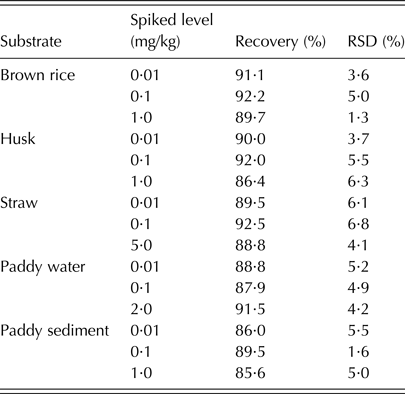
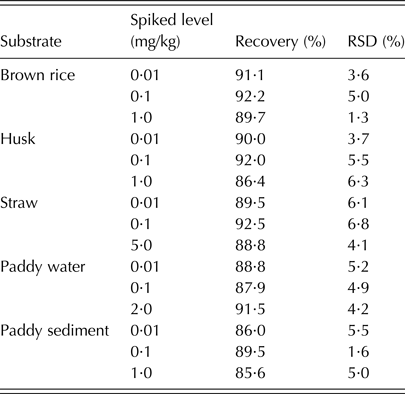
The data of recoveries are given in Table 2. As can be seen, at three fortification levels, the recoveries ranged from 89·7 to 92·2% for brown rice, from 86·4 to 92·0% for hull, from 88·8 to 92·5% for straw, from 88·8 to 91·5% for paddy water and from 85·6 to 89·5% for paddy sediment, respectively. Relative standard deviation (RSD) values ranged from 1·3 to 5·0% for brown rice, from 3·7 to 6·3% for hull, from 4·1 to 6·8% for straw, from 4·2 to 5·2% for paddy water and from 1·6 to 5·5% for paddy sediment, respectively. Based on the results obtained, it can be concluded that the method developed is a robust, accurate method and is capable of analysing clothianidin in the present study.
Recoveries, relative standard deviations (RSD) of clothianidin from brown rice, husk, straw, paddy water and sediment (n = 5)
Degradation of clothianidin in straw, paddy water and paddy sediment
The degradation trends of clothianidin in straw, paddy water and paddy sediment followed first-order kinetics:
 $$C_t = C_0{\rm e}^{ - rt}$
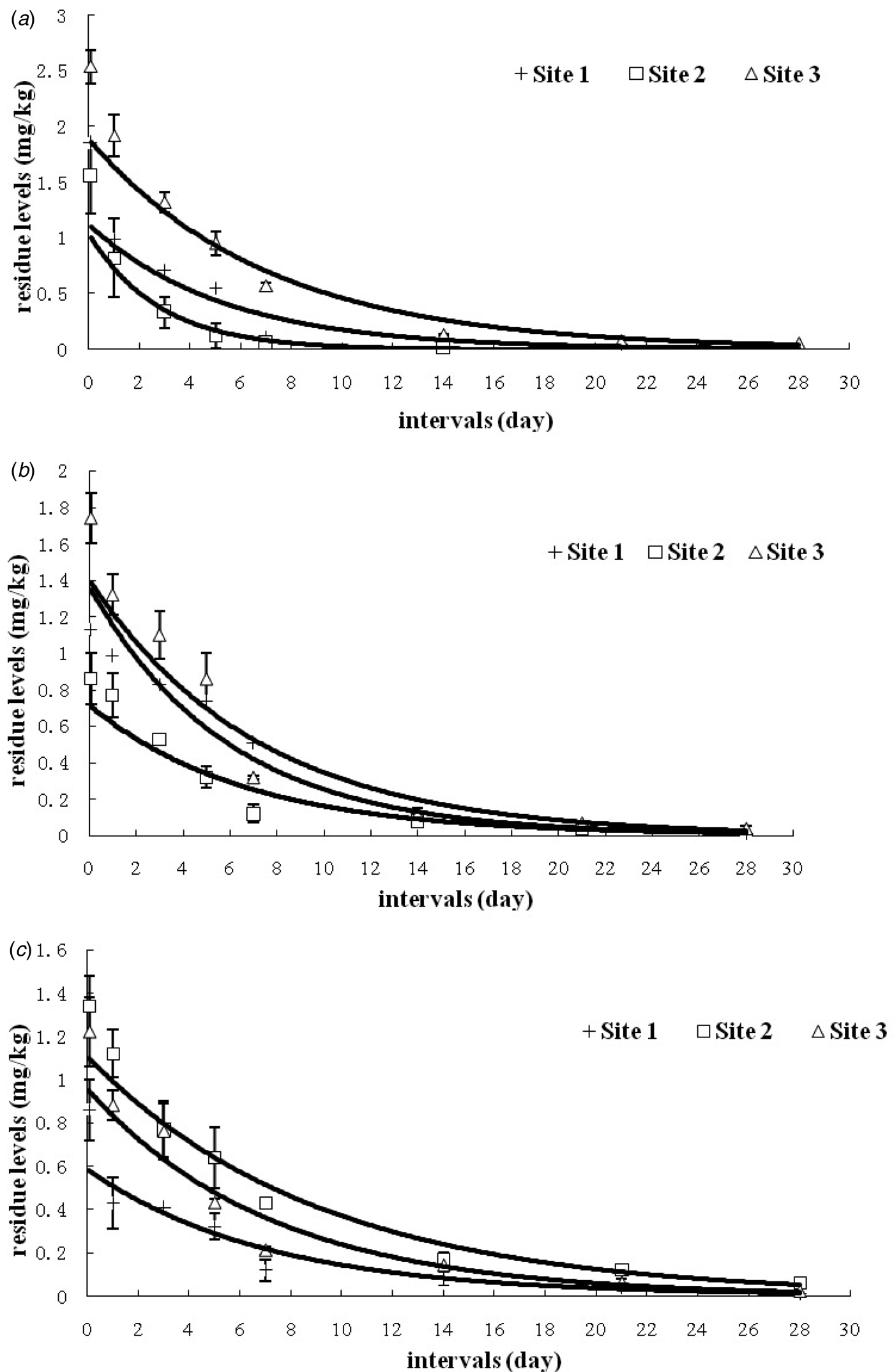
where C t is the concentration at time t (days) after treatment, C 0 the initial concentration (2 h after the treatment) and r the first-order rate constant (1/d). The degradation half-life (t 1/2) of clothianidin in each experiment was obtained using t 1/2=ln(2)/r (Ma et al. Reference Ma, Rahman, Holland, James and McNaughton2004; Zhang et al. Reference Zhang, Shen, Yu and Liu2012). Degradation trends of clothianidin residues in straw, paddy water and sediment are shown in Fig. 1. Two hours after application, the initial concentrations of clothianidin in straw, paddy water and sediment at different experiment sites were found to be 1·55–2·54, 0·86–1·74 and 0·86–1·22 mg/kg, respectively. After day 14, degradation rates of clothianidin in straw, paddy water and sediment were >50%. At the end of the sampling period (i.e. 28 days after application), >95% of clothianidin residues in straw, paddy water and sediment in all testing sites were degraded (Fig. 1).
Degradation of clothianidin. (a) straw, (b) paddy water and (c) paddy soil. Site1: Nanjing, Jiangsu (East China); Site 2: Nanning, Guangxi (Southwest China); and Site 3: Changsha, Hunan (South China).

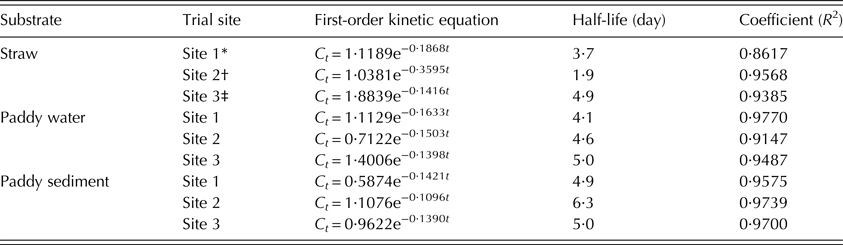
The half-lives were calculated and the results are listed in Table 3. Half-lives of clothianidin in straw, paddy water and sediment were 1·9–4·9, 4·1–5·0 and 4·9–6·3 days, respectively.
First-order kinetic equations and half-lives for clothianidin degradation from straw, paddy water and sediment at three experimental sites
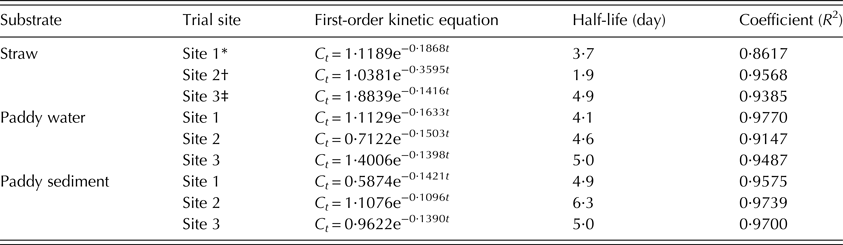
* Site1: Nanjing, Jiangsu (East China).
† Site 2: Nanning, Guangxi (Southwest China).
‡ Site 3: Changsha, Hunan (South China).
Residues of clothianidin in brown rice, hull, straw and paddy sediment
The clothianidin residues in brown rice, hull, straw and paddy sediment after the last application at 14, 21 and 28 PHI at two different application rates, i.e. 90 and 135 g a.i./ha, in the three locations are listed in Table 4. The manufacturers’ recommendations are: application rate 90 g a.i./ha, in two applications with PHI 28 days. Following ICAMA (2007), an elevated application rate (90 g a.i./ha × 1·5 = 135 g a.i./ha) and an additional application were also used. The results are given in Table 4.
Clothianidin Residues in brown rice, straw, husk and sediments (mean ± S.D., n = 3)
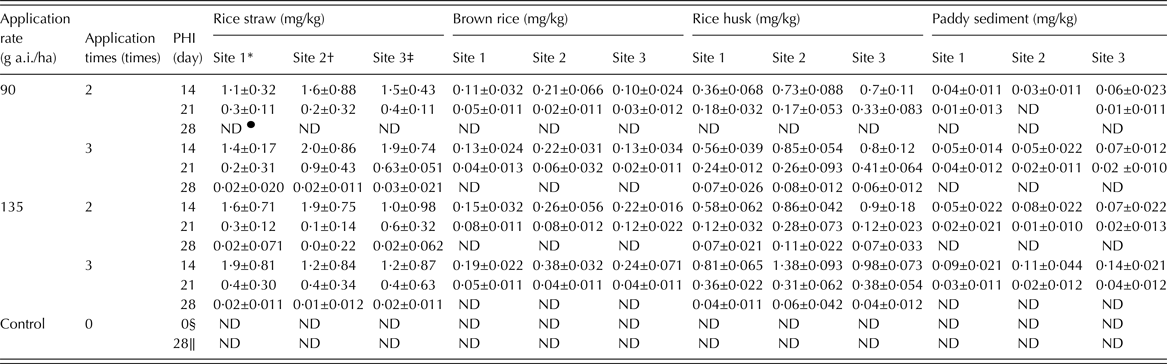
a.i., active ingredient; PHI, pre-harvest interval; ND, not detectable (<0·01 mg/kg).
* Site1: Nanjing, Jiangsu (East China).
† Site 2: Nanning, Guangxi (Southwest China).
‡ Site 3: Changsha, Hunan (South China).
§ Before treatment.
‖ The day at the last sampling.
Brown rice: As expected, the highest residues were found at 14 PHI. For example, when two applications were used, the maximum residues in brown rice were 0·21 mg/kg at the rate of 90 g a.i./ha and 0·26 mg/kg at the rate of 135 g a.i./ha, respectively. When three applications were used, the maximum residues in brown rice were 0·22 mg/kg at 90 g a.i./ha and 0·38 mg/kg at 135 g a.i./ha at 14 PHI.
The residues of clothianidin in husk followed the same pattern as for brown rice; however, with the exception of the manufacturers’ recommended dosage, residues were found to be greater than the LOQ (0·01 mg/kg) even after PHI 28 days. For instance, when two applications were used, the clothianidin residues were <0·01–0·73 and 0·07–0·88 mg/kg for 90 and 135 g a.i./ha, respectively. When three applications were used, the residue levels in the husk were 0·06–0·85 and 0·04–1·38 mg/kg for 90 and 135 g a.i./ha, respectively.
The residue patterns in straw are consistent with those in husk. It is worth noting that residues in straw appear to be highest among the four matrices. When two applications were used, the maximum residues were 1·11 and 1·88 mg/kg for application rates of 90 and 135 g a.i./ha, respectively. When three applications were used, maximum residues were 1·96 and 1·88 mg/kg for 90 and 135 g a.i./ha, respectively.
It is noted that residues in the sediments were relatively low. The highest residue was 0·14 mg.kg for site 3 (South China), with three applications at135 g a.i./ha and PHI 14. It appeared that the residues decreased to be non-detectable (i.e. <0·01 mg/kg) at PHI 28 days.
DISCUSSION
The current method is a robust, sensitive and accurate LC-MS/MS method that uses the QuEChERS technique for clean-up; the analytical method with LOQ of 0·01 mg/kg and LOD of 1 pg is capable of determining clothianidin levels in various matrices. Degradation trends for clothianidin in different matrices follow the same pattern but at different rates. The data of half-lives demonstrate that the degradation order is: straw<paddy water≈sediments: residues are also higher in straw than in husk and brown rice. Residues of clothianidin in brown rice, husk and straw samples were not detectable (i.e. <0·01 mg/kg) 28 days after treatment application. The results suggest that use of clothianidin on rice at an application rate of 90 g a.i./ha with two applications 7 days apart and with a 28-day sampling interval is considered to be safe.
Shorter half-lives of 1–2 days have been reported for clothianidin in cabbage (Chen et al. Reference Chen, Wang, Gong, Li and Zhao2008). In the current work, the data obtained showed that degradation in straw was faster than in paddy water and sediment at each of the three testing locations. It should be noted that, in the analysis, the solvent effect of water samples was ignored, i.e. paddy water samples are aqueous while other samples and standards are in acetonitrile. Within experimental error, the half-lives for paddy water and paddy sediment are basically the same. This is probably because the paddy water and sediment samples were constantly in contact prior to being collected. The water and paddy sediment samples were collected 0–10 cm above and below the water/sediment interface and the residues tend to reach equilibrium between the water and sediment matrices. As a result, the residues in water and sediment were similar.
Residue degradation can be influenced by many factors, including the frequency and rate of pesticide application (initial concentration), the weather (radiation light, temperature, humidity and wind), micro-organisms, pH of sediment and water, the nature of plant species, etc. (Kidd & James Reference Kidd and James1991; Tewary et al. Reference Tewary, Vipin, Ravindranath and Adarsh2005). In the present study, the differences in clothianidin degradation rate could be caused by the weather induced growth characteristics of the different varieties of rice.
The present study provides residue data, which may be useful for establishing MRL and assessing the amount of clothianidin residues in rice under Chinese field conditions. Clothianidin should be applied correctly, according to good agricultural practice, using only the required amounts, frequencies and PHI.
Based upon above data, in the current study, the residues of clothianidin in brown rice and sediment samples were not detectable (i.e. <0·01 mg/kg) at PHI of 28 days, regardless of application rate or the number of applications. The data are consistent in the three testing sites. The above results strongly suggest that clothianidin residues mainly depend on PHI. For example, residues decreased with increasing PHI for the same application rates and number of applications. The results indicate that the use of clothianidin is safe with a PHI of at least 28 days and application rate of 135 g a.i./ha.
The current data show that clothianidin persisted mainly on the straw, husk and brown rice. Under the same conditions, the order of residues found in the sample matrices is: straw>husk>brown rice>paddy sediment. The residues of clothianidin in brown rice, straw, husk and paddy sediment were also related to application rate and number of applications. As expected, residues increased with higher application rates and/or more numbers of applications.
The results obtained in the current study indicate that clothianidin dissipates through gradual and continuous decomposition after last application. Possible routes of clothianidin dissipation and transformation in the environment include plant species, climatic conditions and biotransformation via microorganisms in the sediment and photo-conversion to simpler products on plant surfaces (Mandal et al. Reference Mandal, Kanrar, Das and Bhattacharyya2010).
Rice straw and husks are often used as feed for ruminants in many regions of China and other countries. Thus, the persistence of pesticide residues is a potential risk. Compared with existing MRLs on rice in different countries, such as 0·2 mg/kg in brown rice (China), 0·01 mg/kg in grain (USA), 0·05 mg/kg in straw (USA), 0·5 mg/kg in rice (CAC), 0·5 mg/kg in rice (EU), the clothianidin residues in brown rice, straw and husk in the present study are found to be <0·01 mg/kg, less than these established MRLs.
This work was supported by the National Key Research and Development Program of China (Grant No. 2016YFD0200203), the National Natural Science Foundation of China (Grant No. 31471797) and the Independent Innovation of Agricultural Sciences in Jiangsu Province (Grant No. CX(14) 2060).