1. Introduction
This paper identifies discrepancies between prescriptive grammar rules concerning the number of the indefinite pronoun none and the actual use of this pronoun in modern academic English as shown in the Michigan Corpus of Academic Spoken English (MICASE) and Michigan Corpus of Upper-level Student Papers (MICUSP). Whereas prescriptive rules state that the number of none is determined by its referent or by the user's desired effect, the analyses of the MICASE and MICUSP search results suggest that, regardless of the modality of discourse, (1) the number of none with an anaphoric referent is determined by the number of its referent and (2) the principle of proximity applies without exception when none is used as part of a ‘none of + singular noun/pronoun’ phrase and applies frequently but not always when followed by an ‘of + plural noun/pronoun’ phrase.
2. Background
We ensure that most of our subjects agree with verbs most of the time, and we do so almost without thought. In fact, it is more difficult to compose a sentence whose subject and verb do not agree, unless one is a true beginner who has only recently begun to learn the English language. Errors in agreement – a singular subject matched to a plural verb or vice versa – often reflect that the speaker or writer has either misidentified the number of the subject or, more likely, lost sight of what words are meant to agree. Thus, to avoid errors in subject-verb agreement, one must know how to select the subject for every verb to be used and how to determine whether that subject is singular or plural. Alternatively, one can routinely trace verbs back to their subjects if he/she loses track of what he/she is talking or writing about.
However, there are some tricky cases where the subjects are not inevitably singular or plural. For instance, some indefinite pronouns such as all, any, most, and some can use either singular or plural number depending on how they are used, as in All of the sautéed rattlesnake was devoured and All of the seats were occupied. In those cases, we can follow the formal agreement rule based on overt grammatical number: If the indefinite pronoun is used in combination with a singular subject (i.e., a singular countable noun or an uncountable noun such as sautéed rattlesnake), it requires a singular verb; and with a plural subject (i.e., a countable plural noun such as seats), it takes a plural verb.
Unlike the aforementioned pronouns, the indefinite pronoun none poses a particular challenge. Strictly speaking, none is a contraction for ‘not one’, which is singular (Hairston, Ruszkiewicz & Friend, Reference Hairston, Ruszkiewicz and Friend1999), as in I consulted five doctors, but none was able to help me. However, none can sometimes mean ‘not any’, as in There are several versions of these prints, but none are complete, which could be considered either singular or plural. For this reason, the decision as to how to treat none depends partly on whether a singular or plural notion predominates and partly on the desired level of formality in tone – formal writing dictates, or so we are told, that none should be treated as singular (Stilman, Reference Stilman1997).
Many English teachers, especially in the past, have insisted that none can have no meaning other than ‘not one’, classifying it with invariably singular indefinite pronouns such as everything, nobody, anyone, and each (Cook, Reference Cook1985). Most grammarians, on the other hand, contend not only that none can be plural, meaning ‘not any ones', but that the sense is more commonly plural than singular (Ehrlich & Murphy, Reference Ehrlich and Murphy1967; Schutt, Reference Schutt1949). Their claim is that even in a sentence in which none is clearly singular – e.g., None of my work has paid off or None of this advice seems valid – the meaning is not ‘not one’ but ‘not any’ or ‘no part of’, both of which may imply a plural.
Despite the ambiguity in the distinction between singular and plural none, no serious scholarly attempt has been made – to the best of the author's knowledge – to discover their actual uses in everyday interaction and potential differences in their distribution depending on, for example, the modality of discourse (i.e., spoken versus written discourse). Motivated by this, the current study aimed to examine both prescriptive rules governing none and its actual uses shown in corpus data to address the following research questions:
1. Do English grammar/usage books (prescriptive grammar) contain explicit rules about the singular none versus plural none usage?
2. Does the actual use of singular none versus plural none (descriptive grammar) follow the prescriptive rules in real life?
3. Are there any differences in how none is used depending on the modality of discourse?
3. Methodology
Looking for rules governing the uses of singular versus plural none, the author consulted 17 English dictionaries, 17 English grammar/usage books, and four English writing style books to ascertain how the usage of none is defined in prescriptive grammar, which establishes rules about what is right and what is wrong (Nunan, Reference Nunan and Nunan2003). The dictionaries were selected among those on the market in spring 2017 that include usage notes attached to the entry for none. The English grammar/usage and writing style books were chosen from leading reference works used in undergraduate general English education programmes or graduate professional English writing programmes in the Republic of Korea. A complete list of the materials consulted is provided as an appendix at the end of this article. In addition, to reveal a glimpse of the descriptive rules or patterns that underlie people's actual use of the word, two sets of corpus data were analysed: the Michigan Corpus of Academic Spoken English (MICASE) (Simpson et al., Reference Simpson, Briggs, Ovens and Swales2002) and the Michigan Corpus of Upper-level Student Papers (MICUSP) (Römer & Wulff, Reference Römer and Wulff2010).
Initially, the objective was to analyse four sets of data including the British Academic Spoken English Corpus (BASE) and the British Academic Written English Corpus (BAWE). However, these two corpora were unsuitable for the current study, as they sometimes failed to provide a sentence containing none along with its preceding sentence(s), which made it impossible to trace back the target token none to its anaphoric referent – e.g., fantastically expensive [[voiced pause]] none is completely effective all have more or (transcription number Islct011 in BASE) or despite previously publishing his opinion that none should be allowed. The decision that Lord (text#279 in BAWE).
The steps for the corpus analyses were as follows: First, concordances for all occurrences of none were obtained and then were classified into three categories depending on their syntactic function in a sentence: (1) a subject including an instance for a relative clause (see Examples A and B) but not for a participial phrase, with a verb taking the present participle form or being omitted (see Example C); (2) an object (see Example D); and (3) a complement of a sentence starting with the existential there, which factors into the decision of whether the verb is singular or plural (see Example E). (The combination of letters and figures in parentheses at the end of each example represents the MICASE transcription number or the MICUSP paper ID.) Then, all the objective instances of none were eliminated because, obviously, it could not be determined whether they implied singularity or plurality.
(A) … they want them to be part of their organizations … but … um, the, housing activist ones, are kind of, um, none of those are organizations that are actually centered in the African-American community … (MICASE: OFC115SU060)
(B) … it will always be susceptible to accusations of twisting the meaning of texts to establish some sort of historic connection where none exists … (MICUSP: CLS.G1.01.1)
(C) … I think there are a number of factors possibly at play here, none of them particularly morally sound. Perhaps we find it difficult to denounce the bombings because … (MICUSP: PHI.G0.07.2)
(D) … all the way along to suggest questions you'd like to see on the exams, and so far i have received none … (MICASE: LAB175SU033)
(E) … you can see that after treatment, there are very few of these germinal centers present as a matter of fact on this particular cross section there are none. okay, and … (MICASE: COL200MX133)
Following this step, subjective instances of none were further divided into two subcategories depending on whether or not their number could be identified. To that end, the sentences written in the past, past perfect, and future tenses were filtered out, except for those written in the past tense using to be as the main verb. Also excluded were those whose main verb came after a modal auxiliary. In addition, sentences comprised solely of none – such as None (declarative) and None? (interrogative) – and sentence fragments lacking a verb were eliminated.
After the screening was complete, detailed analyses were conducted, taking into account the full context in which each token appears, to identify consistent patterns concerning the use of singular versus plural none in discourse. The analyses were performed manually by the author.
4. Results and discussion
4.1 Review of English dictionaries, grammar/usage books, and writing style books
According to a review of the relevant literature, the argument that none requires a singular verb regardless of context – i.e., even when referring to a plural antecedent or quantifying a plural noun/pronoun – stems from a misunderstanding of where the word comes from (Schutt, Reference Schutt1949). That is, given the assumption that it is a condensed form of no one or not one, both of which always take a singular verb, so must none. However, the origin of none – nān, a contraction of ne ān (meaning not one) (OxfordDictionaries.com, n.d.) – was in effect inflected depending on the context and had different singular and plural forms in Old English, demonstrating that it was commonly used both ways (Merriam-Webster's Dictionary of English Usage, 1994; Schutt, Reference Schutt1949). Most dictionaries and grammar/usage books similarly dismiss the myth that none can only be singular, stating that the plural usage of none is not only widespread (Azar & Hagen, Reference Azar and Hagen2009; American Heritage Dictionary of the English Language, 2011) but more common currently (Murphy, Reference Murphy2015).
All reference materials consulted for the current study unanimously confirm that none in the ‘none of + a plural noun/pronoun’ phrase can be used with either a singular or plural verb. However, most of those printed in the UK describe the use of plural none as informal – albeit not incorrect. The argument is that in a formal British style, since ‘none means not one, like one, it takes a singular verb’ (Oxford Learner's Dictionary of Academic English, 2014: 543), whereas in general American English, none used with a plural noun/pronoun usually takes a plural verb.
For specific usage, the Penguin Concise English Dictionary (2004) and the New American Webster Handy College Dictionary (2006) note that none can be used both ways depending on the intended meaning. For instance, if we wish to emphasize the individuals in a group, we use the singular; if we want to emphasize a group, the plural is more common. In other words, we need to apply the same rule that is enforced for determining the number of a collective noun, such as class, couple, crew, family, group, staff, and team. On a similar note, Merriam-Webster's Dictionary of English Usage (1994) explains that writers usually make none either singular or plural according to what their idea is and that such writers follow their sense when determining whether it is one or many things that they are writing about. The American Heritage Book of English Usage (1996) also mentions that the singular versus plural use of none depends on the desired effect.
A check of modern grammar authorities suggested that even though some writers insist that none always be singular because of its origin, a more accurate way to assess its meaning is to recognize it as the negative – or opposite – of all and to treat it the same way, with its number determined by the number of the modifier or referent (Kolln, Reference Kolln1986). The Longman Grammar of Spoken and Written English (Biber et al., Reference Biber, Johansson, Leech, Conrad and Finegan1999), for instance, states that ‘usage [of none] is fairly evenly divided between singular and plural concord with none of’ (p. 184), while ‘none alone shows distinct preference for singular concord’ (p. 185). Most English writing style books similarly note that both singular and plural uses are acceptable depending on the context.
4.2 Results of the MICASE and MICUSP data analyses
Of the 104 utterances of none in 61 transcripts in the MICASE corpus, 50 instances were chosen for analyses after the screening process. A closer examination of subjective none revealed that these instances could be further divided into four subcategories: (i) none used on its own as a subject, as in Examples 1 (singular referent) and 2 (plural referent); (ii) none used as part of the ‘none of + singular noun/pronoun’ phrase, as in Example 3; (iii) none used as part of the ‘none of + plural noun/pronoun’ phrase, as in Example 4; and (iv) none serving the syntactic function of complement of the be-copula following a dummy subject there, as in Examples 5 (singular referent) and 6 (plural referent). (Referents are underlined in the examples.)
(1) … Some public transportation exists between Ida and Monroe (where the health department is located) but none exists between Ida and any of the HIV testing areas … (MICUSP: NUR.G0.13.1)
(2) … While some of these studies capture the perspectives of college administrators (e.g., Gappa and Leslie, 1993), none venture to capture the perspectives of students … (MICUSP: EDU.G3.04.1)
(3) … in Mexico, all this is uh hand-picked coffee. so none of it is mechanized, none of the coffee is mechanized and, hardly in any place in the world is mechanized either … (MICASE: COL425MX075)
(4) … uh, as i say, working with lambda, we kinda get a sense of, you know the comparative, comparisons there, but none of these equations say much about, what do the materials think of it all … (MICASE: LES365JG029)
(5) … okay i'm not too sure that i buy that but, it's advocating agency where there is none. or missing, what agency there is right? right … (MICASE: SEM140JG070)
(6) … we are unable to characterize them based on their actions because there are none. This is not to say that there is no movement whatsoever … (MICUSP: ENG.G0.49.1)
In the case of the MICUSP search results, a total of 80 of 164 instances of none were chosen for analyses after employing the same screening process applied to the MICASE search results. The results are summarized in Table 1.
Use of none as singular versus plural
(Asterisk * indicates where the principle of proximity has been violated.)
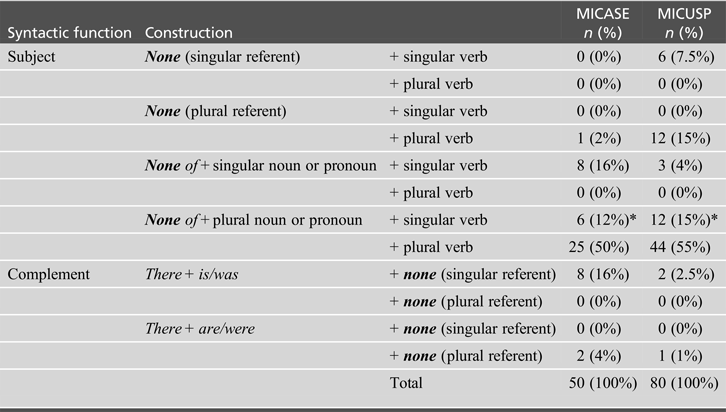
As Table 1 illustrates, one and 18 of the 50 and 80 instances of none in MICASE and MICUSP, respectively, were identified as following the ‘none + verb’ construction. Irrespective of the modality of discourse, all instances of none in this category were used according to the agreement rule tightly regulating other indefinite pronouns, such as all, most, some, more, and any, taking the same number verb as the referent. The same held true for the ‘there + be-copula + none’ construction, as there was not a single case in which the rule was violated.
When none was used as part of the subjective ‘none of + singular noun/pronoun’ phrase, the number of none was determined by the number of the following noun/pronoun – the singular. Eight utterances in MICASE and three sentences in MICUSP employed the construction, and 100% of the verbs took the singular forms regardless of the modality of discourse.
In the case of the ‘none of + plural noun/pronoun + verb’ construction, the verb forms were often but not always determined by the number of the following noun/pronoun – the plural. As shown in Examples 7 and 8, most verbs (81% of the MICASE and 78.5% of the MICUSP instances) took the form of the noun closest to the verb, which indicates that the ‘principle of proximity’ applies to the construction. Consistent with the description in the American Heritage Book of English Usage (1996) and A Comprehensive Grammar of the English Language (Quirk et al., Reference Quirk, Greenbaum, Leech and Svartvik1985), most uses of none followed by the ‘of + plural noun/pronoun’ phrase seemed to reflect people's belief that the verb should agree with the closer of the two nouns, even when it is not the head of the subject noun phrase (Biber, Conrad & Leech, Reference Biber, Conrad and Leech2002). In fact, many English writing style or usage books, such as Merriam-Webster's Dictionary of English Usage (1994), caution that although proximity agreement passes for acceptable in speech and other forms of unplanned discourse, it will be considered an error in print (Einsohn, Reference Einsohn2006). Nonetheless, what would be regarded an ‘error’ constituted a large majority (78.5%) of the uses of none in MICUSP, composed of A-graded papers written by upper-level undergraduate and graduate students.
(7) … it has a few drawbacks in that it measures other concepts besides autonomy, none of the items are weighted, thereby lim- oversimplifying the measurement … (MICASE: STP450SG128)
(8) … I have argued, nonetheless, that none of these objections achieve their goal. On the one hand, even if we accept that some innate properties … (MICUSP: PHI.G1.02.1)
Taken as a whole, the corpus data (both spoken and written) suggested that at least in American English, two descriptive rules govern the number of none: First, the number of none with an anaphoric referent is strictly restricted by the context indicating singularity or plurality – i.e., the number of the referent (DG1). Second, when none is used as part of the subjective ‘none of + singular noun/pronoun’ phrase, the principle of proximity (DG2) applies. When none is followed by ‘of + plural noun/pronoun’, however, the same rule applies usually but not necessarily. As demonstrated in Table 1, approximately 19% (six of 31 cases) of the spoken data and 21.5% (12 of 56 cases) of the written data, which are marked with an asterisk in the table, were found to violate DG2 (see Examples 9 and 10) possibly due to the past prescriptive grammar rule limiting the use of none to the singular.
(9) … uh the first one with just that, as evidence, there's nothing you can say about anything cuz none of these rules applies really. but my problem is … (MICASE: OFC270MG048)
(10) … The information above demonstrates that none of the potential sites has an extremely high rate of unemployment. Therefore, it is important to consider … (MICUSP: IOE.G0.07.1)
5. Conclusion
For well over 400 years in Modern English, the infinite pronoun none has been used as both a singular and a plural, with the number of the referent used as a determining factor (English Plus+, 2008). The findings of the current study also suggest that the most sensible rule to apply is the one that governs similar indefinite pronouns indicating portions, such as percent, fraction, part, some, all, or remainder. Just as the phrases some of it is and two - thirds of it is are commonly used and accepted as grammatical, none of it is was found to be the only form used in real-life interactions. By the same token, none of them are was considered to be just as correct as some of them are and two - thirds of them are.
Idiomatically, few of us would be comfortable with sentences such as None of these people is happy or None of my friends is coming with me, not only because the sense here is obviously plural, indicating none other than ‘not any’, but also because the noun immediately preceding the verb is plural. Of course, as elaborated in the American Heritage Dictionary of the English Language (2011), the choice between a singular and plural verb might depend on the desired effect, and accordingly, both options are acceptable. However, as amply shown in the Results and Discussion section, two prescriptive rules were identified to govern the use of none in American English: one that requires its number to be determined by the referent (PG1), which coincides with DG1; and the other, a more lenient version, in which the choice relies on the writer's or speaker's intended meaning (PG2). For PG1, the usage followed the rule consistently in both spoken and written communications. For PG2, unfortunately, there was no way to tell; instead, the principle of proximity (DG2) was found to be in full effect regarding the matter.
Clearly, the traditional prescription that none is always singular is inadequate. The findings of this study support such a conclusion, as instances of none in 28 of 50 (56%) MICASE utterances and 57 of 80 (71%) MICUSP sentences are used as plural. Given that language usage changes over time and that authentic usage formulates grammar (and not the reverse), it would do no harm to teach beginning English learners – at least for now – that when none refers to or is followed by a plural noun or pronoun, the plural verb inflection may well be used. As is often the case in modern English grammar, there is not always one correct answer, and none is no exception to this.
Appendix: List of materials consulted
Dictionaries
1. Collins English Dictionary, 7th edn. (2015, HarperCollins)
2. Longman Active Study Dictionary, 5th edn. (2010, Pearson Education)
3. Longman Dictionary of American English, 5th edn. (2014, Pearson Education)
4. Longman Dictionary of Contemporary English, 6th edn. (2014, Pearson Education)
5. Longman Exams Dictionary (2006, Pearson Education)
6. Longman Wordwise Dictionary, 2nd edn. (2008, Pearson Education)
7. MacMillan English Dictionary for Advanced Learners, 2nd edn. (2007, MacMillan/A&C Black)
8. Merriam-Webster's Dictionary of English Usage, 1994, Merriam Webster)
9. Merriam-Webster's Essential Learner's English Dictionary (2010, Merriam Webster)
10. Oxford Advanced Learner's Dictionary, 9th edn. (2015, Oxford University Press)
11. Oxford American Dictionary for Learners of English (2011, Oxford University Press)
12. Oxford Learner's Dictionary of Academic English (2014, Oxford University Press)
13. Oxford Wordpower Dictionary, 4th edn. (2012, Oxford University Press)
14. Paperback Oxford English Dictionary, 7th edn. (2012, Oxford University Press)
15. The American Heritage Dictionary of the English Language, 5th edn. (2011, Houghton Mifflin Harcourt)
16. The New American Webster Handy College Dictionary, 4th edn. (2006, Berkley)
17. The Penguin Concise English Dictionary (2004, Penguin UK)
English grammar/usage books
1. A Comprehensive Grammar of the English Language, 2nd edn. (1985, Longman)
2. An A–Z of English Grammar & Usage, 2nd edn. (2001, Longman)
3. Basic English Usage (1984, Oxford University Press)
4. Collins COBUILD English Grammar, 4th edn. (2017, HarperCollins)
5. Collins COBUILD English Usage, 3rd edn. (2012, HarperCollins)
6. Collins Webster's Easy Learning Complete English (2012, Collins)
7. English Grammar in Use, 4th edn. (2012, Cambridge University Press)
8. Longman Grammar of Spoken and Written English (1999, Pearson Education)
9. Longman Student Grammar of Spoken and Written English (2002, Pearson Education)
10. Oxford English Grammar Course Advanced (2015, Oxford University Press)
11. Oxford Practice Grammar Advanced (2006, Oxford University Press)
12. Practical English Usage, 4th edn. (2016, Oxford University Press)
13. Practical Grammar 3 (2011, Heinle ELT)
14. The American Heritage Book of English Usage (1996, Houghton Mifflin)
15. The McGraw-Hill Handbook of English Grammar and Usage, 2nd edn. (2012, McGraw-Hill Education)
16. Understanding and Using English Grammar, 4th edn. (2009, Pearson Education)
17. Understanding English Grammar, 2nd edn. (1986, Macmillan)
English writing style books
1. Grammatically Correct: The Writer's Essential Guide to Punctuation, Spelling, Style, Usage and Grammar (1997, Writer's Digest Books)
2. Line by Line: How to Edit Your Own Writing (1985, Houghton Mifflin Harcourt)
3. The Elements of Style, 4th edn. (1999, Pearson)
4. The Scott, Foresman Handbook for Writers (1999, Longman)
 SUGENE KIM is an assistant professor in the Department of English Studies at Nagoya University of Commerce & Business in Japan. Her research specializations are in second language acquisition and academic literacy development of adult learners of English as a foreign language (EFL). She is particularly interested in examining cognitive and linguistic strategies utilized by adult EFL learners to address writing difficulties in different rhetorical contexts. Email: sugene_kim@nucba.ac.jp