Tobacco smoking causes devastating disease and preventable death worldwide, producing nearly 6 million deaths each year – a rate that will rise to over 8 million a year by 2030 if smoking consumption remains at the current trend (World Health Organization, Reference World Health Organization2011). To date, despite the fact that most of the industrialized countries have implemented antismoking policies, smoking prevalence remains extremely high; nearly 27% of the European Union population and 15.1% of the United States population are daily smokers. As per the latest estimates, the prevalence of daily cigarette users in Spain is 30.8% (Plan Nacional sobre Drogas, 2017).
The vast majority of smokers report that they would like to quit and almost half make a quit attempt each year. Unfortunately, smoking relapse rates are high at long-term follow-ups even when smokers receive effective interventions (Veldheer et al., Reference Veldheer, Hrabovsky, Yingst, Sciamanna, Berg and Foulds2018). Therefore, identifying individual factors that determine whether or not successful quitters will relapse becomes a major clinical concern.
Smoking relapse is a complex biopsychosocial phenomenon that develops via the interaction between psychosocial and biological factors. Evidence concerning prognostic predictors of this phenomenon has shown that impulsivity, as measured by both behavioral and questionnaire approaches, is associated with earlier relapse in cigarette smokers (Doran, Spring, McChargue, Pergadia, & Richmond, Reference Doran, Spring, McChargue, Pergadia and Richmond2004; Perea-Baena & Oña-Compan, Reference Perea-Baena and Oña-Compan2011).
Impulsivity is broadly defined as taking actions without forethought (Arce & Santisteban, Reference Arce and Santisteban2006). Current conceptualizations of impulsivity define this construct as multidimensional, encompassing: Premature response, sensation-seeking, and an inability to delay gratification, among others (Knezevic, Reference Knezevic2013). Specifically, delay discounting (DD), defined as the devaluation of a reinforcer as the delay of its receipt rises (Odum, Reference Odum2011), has been linked to a return to smoking after tobacco abstinence in laboratory studies (Dallery & Raiff, Reference Dallery and Raiff2007) and clinical samples (Sheffer et al., Reference Sheffer, Christensen, Landes, Carter, Jackson and Bickel2014). The rationale behind DD is that smokers tend to overestimate immediate rewards (i.e., anxiety relief) but undervalue delayed ones (i.e., improved health). As this variable supposes a marker of poor treatment outcomes, it is important to consider the impact of specific treatments on preventing relapse back to smoking.
Despite these significant results, few studies have directly analyzed the relationship between DD and smoking relapse among participants enrolled in formal treatments. Furthermore, these previous studies were conducted in the US and involved specific populations, including individuals with low socioeconomic status (Sheffer et al., Reference Sheffer, MacKillop, McGeary, Landes, Carter, Yi and Bickel2012; Reference Sheffer, Christensen, Landes, Carter, Jackson and Bickel2014), postpartum females (Yoon et al., Reference Yoon, Higgins, Heil, Sugarbaker, Thomas and Badger2007), and smokers with heavy drinking problems (MacKillop & Kahler, Reference MacKillop and Kahler2009), limiting the generalizability of these findings to the general population of smokers.
Besides impulsivity, previous clinical studies have consistently demonstrated that people possessing certain characteristics such as younger age, less education, greater nicotine dependence, and more previous quit attempts are at a higher risk of smoking relapse. Likewise, higher relapse rates are found among individuals with psychiatric disorders, including those with anxiety and depression (Morissette, Tull, Gulliver, Kamholz, & Zumering, Reference Morissette, Tull, Gulliver, Kamholz and Zimering2007; Nakajima & al´Absi, Reference Nakajima and al´Absi2012; Wilhelm, Wedgwood, Niven & Kay-Lambkin, Reference Wilhelm, Wedgwood, Niven and Lambkin-Kay2006). Nonetheless, important questions remain regarding the influence of some of these variables on smoking relapse. While some studies found that women are more likely to relapse after quitting than men (Bohadana, Nilsson, Rasmussen, & Martinet, Reference Bohadana, Nilsson, Rasmussen and Martinet2003; Borrelli, Spring, Niaura, Hitsman, & Papandonatos, Reference Borrelli, Spring, Niaura, Hitsman and Papandonatos2001), others did not find gender differences in relapse rates (Hoving, Mudde, & de Vries, Reference Hoving, Mudde and de Vries2006; Marqueta, Nerin, Jiménez-Muro, Gargallo, & Beamonte, Reference Marqueta, Nerin, Jiménez-Muro, Gargallo and Beamonte2013). So far, tobacco control efforts in Spain have been successful at developing effective smoking cessation treatments (Becoña & Míguez, Reference Becoña and Míguez2008; Becoña et al., Reference Becoña, Fernández del Río, López-Durán, Martínez-Pradeda, Martínez-Vispo and Rodríguez Cano2014). There exists cumulative evidence on the high efficacy of Cognitive Behavioral treatments, with smoking cessation rates fluctuating between 61.9% and 95% at post-treatment (Piñeiro et al., Reference Piñeiro, López-Durán, Fernández del Río, Martínez, Brandon and Becoña2016; Secades-Villa, García-Rodríguez, López-Núñez, Alonso-Pérez, & Fernández-Hermida, Reference Secades-Villa, García-Rodríguez, López-Núñez, Alonso-Pérez and Fernández-Hermida2014). Unfortunately, less research has examined which variables predict smoking relapse among smokers who received a psychological treatment. Studies involving Spanish individuals indicate that 47%–70% of smokers relapse within the first three months after quitting (Martínez et al., Reference Martínez, Fernández del Río, López-Durán, Rodríguez-Cano, Martínez-Vispo and Becoña2016; Piñeiro & Becoña, Reference Piñeiro and Becoña2013). The availability of evidence on which variables prompt relapse back to smoking is crucial in developing tailored treatments that promote long-term abstinence.
The main objective of this study was to examine whether DD predicts smoking relapse at six-month follow-up among individuals who successfully quit after receiving a treatment for smoking cessation. Additionally, sociodemographic, psychological, and smoking-related characteristics were explored as potential predictors of smoking relapse.
Methods
Participants
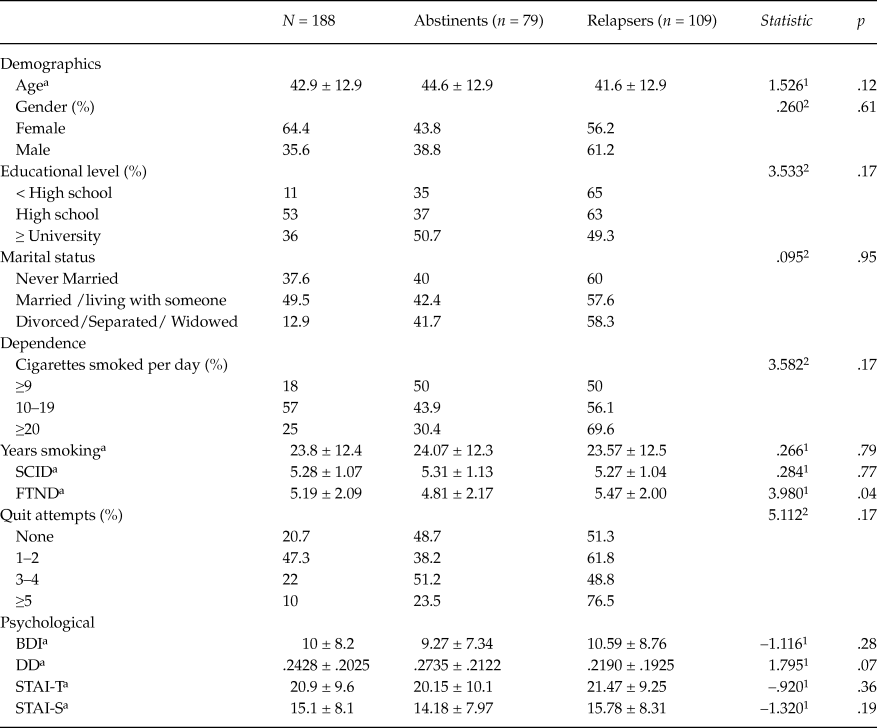
This study involved a secondary data analysis using the dataset from two population-based studies. Participants were adult smokers who had enrolled in two earlier clinical trials for smoking cessation. Both studies used a 6-week cognitive–behavioral treatment (CBT) course of treatment alone, or combined with either contingency management (CBT + CM) or cue exposure treatment (CBT+CET). Both protocol treatments are described in detail elsewhere (Pericot-Valverde, García-Rodríguez, Ferrer-García, Secades-Villa, & Gutiérrez-Maldonado, Reference Pericot-Valverde, García-Rodríguez, Ferrer-García, Secades-Villa, Gutiérrez-Maldonado, Wiederhold and Riva2012; Secades-Villa, et al., Reference Secades-Villa, García-Rodríguez, López-Núñez, Alonso-Pérez and Fernández-Hermida2014). Since the purpose of the present study was not aimed at exploring the differential effect of treatments, data from the three treatment conditions were combined. Recruitment was carried out by advertisements and flyers posted around the local community in two different cities of Spain: Oviedo and Barcelona. Written inform consent and the review board approval of the abovementioned institutions were obtained before study initiation. Inclusion criteria for the study were being aged over 18, smoking 9 or more cigarettes per day for the prior 12 months, and meeting the diagnostic criteria for nicotine dependence according to the Diagnostic and Statistical Manual of Mental Disorders (4th ed., text rev.; DSM–IV–TR) assessed using the Structured Clinical Interview for DSM–IV (SCID). Scoring three or more in the SCID was considered as indicative of nicotine dependence (Becoña, Nogueiras, Flórez, Álvarez, & Vázquez, Reference Becoña, Nogueiras, Flórez, Álvarez and Vázquez2010). Participants were excluded if they were diagnosed with a current severe psychiatric disorder (e.g., dementia or a psychotic disorder), if they met criteria for abuse or dependence on a substance other than nicotine, or if they were currently involved in other smoking cessation treatment. Of the 292 smokers initially screened, 32 were excluded based on the aforementioned exclusion criteria. Of these 261 smokers who received treatment, only those participants who finished the entire treatment and were abstinent at the end of the treatment were included in this study. Thus, the final sample of the study was made up of 188 participants. Table 1 shows baseline characteristics of participants.
Descriptive Data regarding Sociodemographic and Smoking-Related Characteristics by Smoking Status at Six-Month Follow-up

Note. Statistic = 1t Student; 2Chi-squared. FTND = Fagerström Test for Nicotine Dependence; BDI = Beck Depression Inventory II; DD = Delay Discounting rates (AUC); STAI-T = Trait Anxiety Inventory; STAI-S = State Anxiety Inventory.
a Mean ± SD.
Measures
Variables examined as potential predictors of relapse were sociodemographic, smoking-related, and psychological characteristics. Sociodemographic characteristics included gender, age, marital status and, education. Smoking-related characteristics were years of smoking, number of cigarettes smoked per day, the number of previous quit attempts (of at least 24 hours of abstinence), and the degree of dependence assessed by the Fagerström Test for Nicotine Dependence (FTND; Heatherton, Kozlowski, Frecker, & Fagerström, Reference Heatherton, Kozlowski, Frecker and Fagerström1991). The FTND allows classification of nicotine dependence severity into five levels: Very low (0 to 2), low (3 to 4), moderate (5), and high (6 to 7). Psychological characteristics were measured by the State-Trait Anxiety Inventory (STAI) (Spielberger, Gorsuch, & Lushene, Reference Spielberger, Gorsuch and Lushene1970), the Beck Depression Inventory – Second Edition (BDI–II) (Beck, Steer, & Brown, Reference Beck, Steer and Brown1996) and the Delay Discounting (DD) task. The DD task provides an operational measure of impulsivity that measures the preference for smaller and immediate rewards over larger and delayed ones. The DD measure used was the area under the curve (AUC) which provides a theoretically neutral approach to evaluating the degree of discounting by the delay. The AUC can range from 1 to 0; lower AUC values indicate greater discounting and greater impulsivity, while higher AUC values correspond to lower discounting and less impulsivity (Odum, Reference Odum2011).
Participants also provided a carbon monoxide sample (CO) in expired air using a Micro Smokerlyzer (Bedfont Scientific Ltd., Rochester, UK) for objective verification of self-reported smoking status at the end of treatment and at the six-month follow-up.
Outcome measure
The outcome variable was point-prevalence at the six-month follow-up. The percentage of participants abstinent was defined as abstinence for a minimum of seven days before the interview. Self-reported abstinence was validated by a negative result for CO (less than 4 parts per million, ppm) (Cropsey et al., Reference Cropsey, Trent, Clark, Stevens, Lahti and Hendricks2014). Agreement between both measures was required.
Statistical Analyses
Various descriptive and frequency analyses were carried out to determinate the participants’ baseline characteristics. Comparisons of sociodemographic, smoking-related, and psychological variables between those participants that were abstinent and those who relapsed were conducted using Student’s t test for continuous variables and the χ2 test for categorical variables. Then, a logistic regression analysis was performed to identify statistically significant predictors of relapse. Variables reaching statistical significance at the 0.2 level in the bivariate analyses were entered in the multivariate model. A multiple logistic stepwise regression with the best subset variable selection was conducted aimed at detecting predictors for relapse at six-month follow-up. In this model, treatment condition was introduced as a covariate. Data was analyzed with the statistical package SPSS for Windows (version 19, SPSS Inc., Chicago IL, USA).
Results
Of the 188 participants that were abstinent at the end of the treatment, 109 (57.9%) relapsed within the six months after treatment. Variables included in the multivariate model because of statistical significance (p < .20) were: DD (p = .07); age (p = .12); educational level (p = .17); number of cigarettes smoked per day (p = .17); number of previous quit attempts (p = .17); the scores obtained from Fagerström Test for Nicotine Dependence (p = .04) and STAI state test (p = .19).
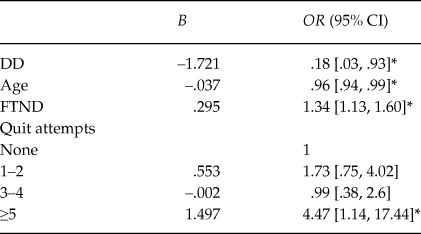
The logistic regression model was statistically significant, χ2 (6) = 23.64, p = .001, and explained 17% of the variance. Variables that significantly predicted smoking relapse were presenting higher DD, being younger, reporting five or more previous quit attempts, and greater nicotine dependence as measured by the FTND (See Table 2).
Predictors of Relapse

Note. B = beta weights; OR = odd ratios; 95% CI = 95% confidence interval; DD = delay discounting rates (AUC); FTND = Fagerström Test for Nicotine Dependence.
* p < .05.
Discussion
The main objective of this study was to explore the relation between DD and other predictors, and smoking relapse at six-month follow-up among individuals who successfully quit after receiving a treatment for smoking cessation. The results indicated that greater delay discounting, younger age, more previous quit attempts, and higher nicotine dependence as measured by the FTND were associated with higher risk of smoking relapse.
This study adds support to previous evidence showing that DD (preference for small immediate rewards over larger delayed rewards) increases the risk of smoking relapse in the general population of treatment-seeking smokers. Several mechanisms may account for this finding. First, it has been hypothesized that more impulsive smokers award both greater reinforcement expectancies and subjective reinforcement value from cigarettes than their less impulsive counterparts, which might undermine their motivation to remain abstinent (Doran, McChargue, & Cohen, Reference Doran, McChargue and Cohen2007). Impulsive smokers might also reflect deficits in self-directedness such as difficulty in delaying gratification when immediate reinforcement is available (e.g., tobacco cigarettes) (Cloninger, Svrakic, & Przybeck, Reference Cloninger, Svrakic and Przybeck1993). Finally, the rewarding value of tobacco may be higher in impulsive smokers than in non-impulsive smokers (Doran, Cook, McChargue, & Spring, Reference Doran, Cook, McChargue and Spring2009).
In line with previous research (Gökbayrak, Paiva, Blissmer, & Prochaska, Reference Gökbayrak, Paiva, Blissmer and Prochaska2015), younger smokers were more likely to relapse at follow-up. Young smokers are less likely to experience negative symptoms caused by smoking due to their shorter smoking history, and are thereby less preoccupied with the effects of tobacco on their health (García-Rodríguez et al., Reference García-Rodríguez, Secades-Villa, Flórez-Salamanca, Okuda, Liu and Blanco2013). Life transitions experienced by young adults, which include changes in social roles such as adult responsibilities and facing stressful life events, may increase susceptibility to smoking relapse as a coping behavior (Siahpush & Carlin, Reference Siahpush and Carlin2006; Slopen et al., Reference Slopen, Kontos, Ryff, Ayanian, Albert and Williams2013). Third, younger smokers may be in contact with high-risk environments (e.g., exposure to peer smokers and low support to quit smoking) which do not reinforce smoking cessation and counteract abstinence (Herd, Borland, & Hylandc, Reference Herd, Borland and Hylandc2009).
In agreement with previous studies (Caponnetto & Polosa, Reference Caponnetto and Polosa2008; McDaniel et al., Reference McDaniel, Vickerman, Stump, Monahan, Fellows, Weaver and Zbikowski2015) the number of previous quit attempts significantly predicted relapse to smoking. Unsuccessful quit attempts in the past may have a negative effect on self-efficacy and motivation, which increases the likelihood of failing in a further quit attempt (Gwaltney, Metrik, Kahler, & Shiffman, Reference Gwaltney, Metrik, Kahler and Shiffman2009). On the other hand, these smokers may be repetitively trying to give up smoking using ineffective smoking cessation methods.
Consistent with previous research, higher nicotine dependence (i.e., greater FTND scores) was associated with an increased risk of relapse (Zhou et al., Reference Zhou, Nonnemaker, Sherrill, Gilsenan, Coste and West2009). Those with severe nicotine dependence have been shown to experience intense withdrawal symptoms when quitting, such as negative affect, sleep disturbances, or difficulty at concentrating; these increase the likelihood of relapse after a short period of abstinence (Aguirre, Madrid, & Leventhal, Reference Aguirre, Madrid and Leventhal2015). Furthermore, as severely dependent smokers are more likely to link certain stimuli such as people or environments with the rewarding effects of smoking tobacco cigarettes, exposure to internal or external smoking paired cues might induce craving and drug seeking responses.
The strengths of this study include the inclusion of a large sample of smokers, the long-term follow-up assessment and the use of a stringent CO cut-off (≤ 4 ppm) to determine smoking status. Also, the low relapse rate reported herein (57.9%) represents another positive aspect that supports the efficacy of CBT treatments to promote long-term abstinence. This rate is still significantly lower than both pharmacological (Alonso Fernández, Franco Vidal, López Sampedro, & García Lavandera, Reference Alonso Fernández, Franco Vidal, López Sampedro and García Lavandera2002) and psychological treatments (Martínez et al., Reference Martínez, Fernández del Río, López-Durán, Rodríguez-Cano, Martínez-Vispo and Becoña2016; Piñeiro & Becoña, Reference Piñeiro and Becoña2013). The inclusion of cognitive and behavioral components to manage stress and negative mood might account for such low relapse rates. Further, the inclusion of relapse prevention strategies (i.e., role-playing exercises) might have aided patients to anticipate and successfully cope with high risk situations. Notwithstanding, several limitations of the present study should be noted. First, the sample used is mainly formed of smokers with moderate levels of nicotine dependence, so some caution is warranted in generalization to other highly nicotine dependent populations such as self-quitters. Second, despite the argument that a six-month follow-up period is an acceptable period in providing confidence when reporting smoking cessation outcomes, further studies should include longer-term follow-ups.
In spite of the noted limitations, these results suggest that individuals with high impulsivity and with certain characteristics benefit less from smoking cessation treatments and underscore the importance of developing innovative intervention strategies directed at curtailing tobacco use in these populations.
The study highlights several clinical implications that should be mentioned. Certain sociodemographic and psychological characteristics have the potential to become markers of relapse, alerting clinicians that these individuals might need additional support to maintain smoking abstinence. Significantly, the fact that impulsivity is associated with smoking relapse is particularly relevant in order to develop smoking cessation treatments specifically tailored to impulsive smokers. Recently, an innovative treatment approach, “Episodic Future Thinking” has shown to reduce both cigarette demand and delay discounting rates (Stein, Tegge, Turner, & Bickel, Reference Stein, Tegge, Turner and Bickel2018). This treatment aims to train patients in vividly imagining smoking-related events that will occur in the future, helping them overcome immediate smoking urges as well as valuing the long-term benefits associated with abstinence (i.e., improved health). Lastly, the fact that younger age, greater previous quit attempts, and higher nicotine dependence predict smoking relapse, indicates that more intensive protocols (i.e., more follow-up sessions closer to the quit day) should be delivered for this group of individuals.