




No CrossRef data available.
Article contents
Prefrontal lesions and attentional skills in childhood
Published online by Cambridge University Press: 16 December 2005
Abstract
Despite the potential impact on development, few studies have examined the influence of prefrontal lesions occurring prior to maturation of the central nervous system. This study investigates the effect of prefrontal lesions in general, as well as the impact of lesion laterality, with respect to attentional abilities. The sample comprised 36 children with prefrontal lesions and 40 healthy controls. Attentional function was assessed across four domains: selective, shifting and divided attention, and processing speed. Group mean performances for children with prefrontal lesions indicated global attentional deficits, with greatest difficulties for “higher-order” skills including shifting and divided attention. Children with left prefrontal lesions performed similarly to controls, with a specific deficit characterized by difficulties with on-line processing of auditory-verbal information. Right prefrontal lesions were primarily associated with impairments in day-to-day executive functions, including reduced monitoring, poor shifting attention and disinhibition. Children with bilateral prefrontal lesions performed worse than controls on tasks requiring greater cognitive resources. These results provide evidence of the important role played by prefrontal cortex in the development of attentional skills, and the particular role of the right prefrontal cortex. The pattern of attention deficits observed following early prefrontal lesions suggests some lateralization of function within the frontal lobes, even during childhood. (JINS, 2005, 11, 817–831.)Source of funding: Australian National Health and Medical Research Council, Australian Research Council, Murdoch Children's Research Institute.
Information
- Type
- Research Article
- Information
- Journal of the International Neuropsychological Society , Volume 11 , Issue 7 , November 2005 , pp. 817 - 831
- Copyright
- © 2005 The International Neuropsychological Society
INTRODUCTION
The frontal lobes, particularly the prefrontal cortices, are critical for normal development, because of their rich connections with other cerebral regions and their central role in efficient executive function. These structures develop rapidly through childhood and early adolescence, paralleled by increases in “higher-order” executive abilities such as attentional control, planning, and mental flexibility (Gogtay et al., 2004). Emerging research suggests that damage to prefrontal regions during childhood may interrupt normal maturational processes, leading to irreversible changes in brain structure and organization, and associated impairments in neurobehavioral development (Anderson et al., 2002). With respect to attentional processes, there is also a suggestion from adult literature that the laterality of prefrontal pathology may contribute to the nature of the attentional impairment, with different patterns of impairment described for left- versus right-frontal pathology (Mecklinger et al., 1999; Stuss et al., 1999). However, whether attentional skills can be similarly lateralized in childhood is not known, due to incomplete understanding of normal developmental trajectories, limitations in reliable and valid assessment options, and the relatively rare occurrence of discrete prefrontal lesions during childhood.
The application of neuropsychological models of attention and information-processing skills has provided some insight regarding links between frontal pathology, lesion laterality, and neurobehavioral function. One of the earliest neuropsychological models of attention was that postulated by Alexander Luria (1973). He proposed a posterior- and an anterior-attentional system working in parallel in the mature brain, allowing the individual to monitor the environment for events that might require a response (posterior system), while pursuing various goals guided by intentional behaviors (anterior system). Consistent with Luria's model, Posner (1988, 1995) hypothesized a dual component model, with one aspect directed towards selective attention, and shifts in spatial attention, and predominantly located in the posterior cerebral cortex, in particular the parietal lobes. A second, anterior element, incorporating the anterior cingulate gyrus and areas of the prefrontal cortex, he argued represented higher-order function, although with substantial neural links to the posterior system.
More recent attempts to describe attentional function have argued for greater complexity, describing multicomponent systems with separate but interacting attention modules (e.g., Dove et al., 2000; Mirsky et al., 1991; Rubia et al., 1999; Shimamura, 1995; Stuss et al., 1999). Specific details of these models remain controversial. In keeping with early concepts, it is generally agreed that attention is subsumed by an integrated neuroanatomical network. This network includes the brain stem, aspects of the subcortex and posterior cortical regions, and prefrontal cortex, with a critical role for the right hemisphere (Mirsky et al., 1991; Posner & Petersen, 1990; Stuss et al., 1995; Stuss et al., 1999; Woods & Knight, 1986). Definitions and operationalization of this attentional system remain problematic, but a number of separate, interdependent components are consistently identified: (i) sustained attention, referring to the ability to maintain attention to a task for prolonged periods; (ii) selective attention, the capacity to attend to, and focus on, relevant stimuli, while filtering out extraneous information; (iii) the ability to shift or switch attention, moving flexibly from one concept or set to another; and (iv) divided attention, the capacity to attend to competing stimuli simultaneously. In keeping with its role as “manager” or “central executive” of the brain, the prefrontal cortex is argued to be critical to all aspects of the system, but primarily the higher-order components of the attentional system, including shifting and divided attention (Dove et al., 2000; Mesulam, 1981; Mirsky et al., 1991; Shimamura, 1995; Stuss et al., 1995).
Clinical and functional imaging studies in adult samples have identified impaired attention in association with frontal lobe pathology, arguing for a particular role for the right prefrontal cortex. These findings provide evidence that right hemisphere dysfunction is associated with deficits in arousal, sustained attention, selective attention, response speed, response inhibition, self-monitoring, and motor activation (Heilman et al., 1991; Mesulam, 1981; Posner, 1988; Robertson, 1999; Stuss et al., 1995, 1999; Woods & Knight, 1986). In contrast, for patients with left frontal pathology, deficits are reported to be primarily language-based, with some suggestion that skills in initiation and divided attention may also be impaired (Godefroy et al., 1996; Godefroy & Rousseaux, 1996; Mecklinger et al., 1999; Smith & Jonides, 1999). Lesions to either hemisphere may result in deficits in attentional shift and cognitive flexibility (Grattan et al., 1994; Owen et al., 1991). Within the developmental literature, recent imaging studies have identified a specific role for the right frontal cortex for children with attention deficit/hyperactivity disorder (Semrud-Clikeman et al., 2000; Sowell et al., 2003), suggesting that lateralization of attentional skills may be present early in childhood.
To fully understand the potential impact of prefrontal pathology on attentional skills in children, it is critical to have some understanding of normal maturational processes in this domain. Without such developmental markers, it is difficult to discriminate normal from deviant levels of ability. Recent developmental research has provided such data, identifying different developmental trajectories for specific attentional components. For example, a number of studies document relatively early development of basic selective attention skills, indicating rapid maturation in infancy and early childhood, with adult level performances demonstrated by children as young as 6 (McKay et al., 1994; Manly et al., 2001; Rebok et al., 1997; Ruff & Rothbart, 1996). Shifting and divided attention skills have been found to progress slowly in early childhood, with more dramatic development into adolescence (Anderson et al., 2001a; Chelune & Baer, 1986; Manly et al., 1999, 2001). Processing speed, which underpins performance on many attentional tasks, shows a gradual progression, with regular increments documented from age 6 to midadolescence (Anderson et al., 2001a; Kail, 1986, 1988). These late developing skills may be particularly susceptible to the effects of disruption from cerebral insult due to their protracted developmental course (Dennis, 1989).
A number of studies have examined the neurobehavioral impact of very early focal brain lesions occurring in either the pre- or perinatal period (Ballantyne et al., 1992; Bates et al., 1999; Riva & Cassaniga, 1986; Vargha-Khadem et al., 1994), with the focus generally on language outcomes and intellectual abilities. However, the long-term developmental implications of focal prefrontal injury in childhood are as yet unknown, with the incidence of such lesions relatively rare in childhood and adolescence. Animal work investigating this developmental period provides some insights into the possible long-term effects of these early frontal lesions. Margaret Kennard, in her seminal work in the 1930s and 40s, described relatively better functional outcome from early versus late focal lesions in monkeys, but noted that some subtle deficits emerged over time even following early lesions (Kennard, 1936, 1940, 1942). More recently, Kolb and colleagues, also using animal models, have argued for a complex, nonlinear relationship between age at injury and outcome. Their work with rat models has identified a number of specific developmental periods corresponding to better outcome, while damage during other developmental periods may result in very poor outcome (Kolb et al., 1994, 1998, 2000). They argue that these “windows of opportunity” for better outcome are linked to peak periods of neural generation and synaptogenesis, which allow for changes in dendritic and synaptic structure and connectivity (Kolb & Gibb, 1993; 2002; Kolb et al., 1994, 1996, 1997). The applicability of these results to humans is questionable for a number of reasons, including the greater complexity of the human brain, particularly the prefrontal cortex, differences in rates of brain development across species, variations in lesion characteristics and associated complications with human insults (e.g., seizures), as well as the differential impact of environmental factors (Vargha-Khadem et al., 1985; Yeates et al., 1997).
Evidence supporting the presence of attentional difficulties in the context of early prefrontal pathology derives primarily from a small number of human case studies. These cases are characterized by disinhibition, reduced attention and executive deficits in association with prefrontal pathology (Ackerly & Benton, 1948; Anderson, 1988; Anderson et al., 2000b; Eslinger & Biddle, 2000; Eslinger et al., 1992, 1997, 1999; Marlowe, 1992). In keeping with the developmental model of emerging deficits (Dennis, 1989), Eslinger and colleagues (1992) report a pattern of delayed onset of impairments, with difficulties only identified over time as new skills fail to “come on-line” and mature at critical stages throughout development. In particular, these authors identify poor development of attention and self-regulation as core deficits following prefrontal lesions sustained in childhood.
To date, group-based studies of this population are rare. Even in the adult literature, seminal studies have included participants with extrafrontal injuries in addition to the more focal prefrontal pathology of interest here (Stuss et al., 1999, 2000, 2001a, 2001b). Most research examining the impact of frontal pathology in childhood has described samples of children with traumatic brain injury where frontal lobe pathology often occurs in the presence of more global cerebral pathology (Anderson & Pentland, 1998; Dall'Oglio et al., 1994; Ewing-Cobbs et al., 1998; Kelly, 2000; Levin et al., 1997). Such samples, while valuable, do not enable the fractionation of deficits specifically related to frontal pathology. In one such study, Mateer (1990) examined a small group of children who had sustained early cerebral insult. Her findings documented intact or mildly depressed intellectual ability, despite presence of frontal pathology, consistent with adult findings (Walsh, 1978, 1985). In contrast, these children demonstrated symptoms of perseveration, reduced attention, rigidity, and social difficulties. Several other studies (Anderson & Moore, 1995; Garth et al., 1997; Levin et al., 1997; Pentland et al., 1998; Todd et al., 1996), also employing samples of children with traumatic brain injury, have reported similar findings.
Differential consequences of lateralized frontal pathology following focal brain lesions have not been investigated within the pediatric age range. While individual case studies have reported particular clinical features associated with unilateral prefrontal pathology, such descriptions have limited generalizability (Anderson et al., 2000b; Eslinger & Biddle, 2000). Some preliminary results, including those from our own research, suggest that laterality effects in children may be somewhat different than those observed in adults (Anderson et al., 2002; Bates et al., 1999; Goldberg & Costa, 1981; Vargha-Khadem & Polkey, 1992). Specifically, with respect to prefrontal pathology, children with right-sided insults have been found to perform more poorly than those with left prefrontal lesions of similar severity on executive and attention measures, regardless of the primary domain of the task. Such results imply that the right prefrontal cortex plays a critical role in the early development of basic attentional skills. On the basis of these findings, and in keeping with the well-established theory of nonverbal learning disability (Rourke, 1989), we have postulated that, in early childhood, the right prefrontal cortex may play a critical role in the mediation of executive functions, including attention, with the left hemisphere being recruited for language tasks and for complex tasks which require more global activation of frontal brain regions in the immature brain. This hypothesis is consistent with data from functional imaging studies that show more generalized frontal lobe activation in adolescents, compared with adults, on inhibition tasks (Casey et al., 1997; Tamm et al., 2002).
From a functional perspective, attentional skills are of particular significance during childhood, being critical for the development of cognitive and neuropsychological systems, which in turn influence adaptive, social and academic functioning (Cooley & Morris, 1990; Dennis et al., 1995; Douglas, 1983). If attentional skills are impaired, then children may be less able to learn and acquire skills from their environment, to function independently in day-to-day life, and to make use of teaching and instruction. Accurate mapping of a child's attentional profile may enable the implementation of appropriate and accurately targeted intervention.
The present study aimed to examine components of attention and information processing in childhood and their cerebral lateralization using a pediatric sample with documented prefrontal pathology. The study is unique, in that no previous child-focused research has addressed this domain in the context of focal prefrontal pathology, that is, without additional significant and potentially contaminating extrafrontal cerebral pathology. The study evaluated several aspects of attention/processing, consistent with current theoretical models, including selective attention, the ability to flexibly shift attention, and divided attention. Speed of processing was also examined due to its close links with efficient attentional function, and its potential confounding effect on attention measures incorporating a timed component. We predicted that, in keeping with adult models, children with prefrontal lesions would exhibit deficits in shifting and divided attention, skills thought to be subsumed by prefrontal regions. By contrast, we expected selective attention skills, argued to be mediated by posterior systems, to be relatively intact. We also considered the possibility of lateralization of attentional processes. Based on a developmental framework in which the right prefrontal region plays a key role in the growth of attentional skills, our expectation was that children with right-frontal pathology would demonstrate greater deficits in attentional function than those with left-sided pathology.
METHOD
Participants
Between 1996 and 2002, children meeting study criteria were ascertained via neuroscience clinics at the Royal Children's Hospital, Melbourne, and the Sydney Children's Hospital, Australia. Recruitment was consecutive for children meeting the following criteria: (i) magnetic resonance imaging (MRI) evidence of focal frontal pathology, as judged by a pediatric neuroradiologist and neurologist, with exclusion of children with lesions confined to frontal motor cortex, extrafrontal pathology, diffuse or progressive lesions; (ii) aged 7.0–16.11 years at time of assessment; (iii) at least 6 months since diagnosis of frontal pathology, to reduce confounding of outcomes with acute deficits and treatment effects; (iv) English as the first language; (v) Full Scale IQ ≥ 70, based on the Wechsler Intelligence Scale for Children–Third Edition (Wechsler, 1991); and (vi) absence of a preexisting psychiatric condition, including attention deficit/hyperactivity disorder (ADHD). A subset of the sample was using anticonvulsant medication to control seizures.
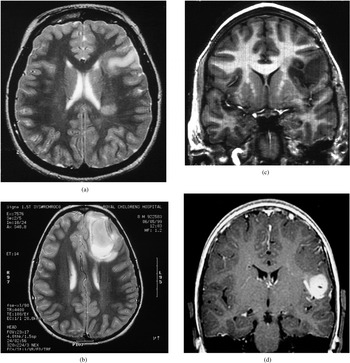
All families of children in the clinical sample that were invited to participate agreed to do so. The resultant clinical sample comprised 36 children (20 males), mean age 11.5 (SD = 2.8) years. All participants had documented evidence of circumscribed frontal pathology, involving prefrontal cortex, based on MRI scans. Timing of lesion varied, with pathology resulting from either pre-natal abnormalities (n = 12), or peri/postnatal disorders (n = 24). Etiology of frontal pathology was necessarily diverse, due to the low incidence of such lesions in childhood. Prenatal abnormalities included focal cortical dysplasia (n = 5), developmental tumours (n = 4), and migrational disorders (n = 3). Peri-/postnatal pathologies included stroke (n = 6), focal brain injury (n = 12), space-occupying pathologies (n = 5), and acute disseminated encephalomyelitis (n = 1). Extent of lesions varied across the sample, with 18 participants having pathology circumscribed within dorsolateral prefrontal cortex. Seven children had lesions extending to both dorsolateral and orbitofrontal regions, two had lesions involving dorsolateral and medial areas, and seven had lesions involving all three areas. One child had a lesion specifically involving medial prefrontal cortex, and another had pathology confined to the orbitofrontal region. Examples of these lesions are provided in Figure 1.

MR scans of four participants, illustrating nature of prefrontal pathology. Note radiological conventions apply to all scans). (a) 12-year old female (ID = 33) who sustained a stroke causing focal insult to the left prefrontal cortex six months prior to imaging. (b) 6 year old female (ID = 23) who presented with a cerebral haemorrhage causing bilateral prefrontal injury. (c) 12 year old male (ID = 13) with a developmental tumor involving left dorsolateral prefrontal cortex, diagnosed following onset of seizures at age 12 years. (d) 8 year old female (ID = 7) with left hemisphere ganglioglioma involving the dorsolateral prefrontal region, identified following emergence of seizures at age 8 years.
Laterality of lesion also varied with 15 children having left-sided lesions, 10 right-sided lesions, and 11 bilateral lesions. Individual case details of cerebral pathology, lesion timing, and age at symptom onset (age at injury for acquired lesions, age at seizure onset for prenatal lesions) are provided in Table 1.
Clinical and lesion data for children with prefrontal lesions.

Forty healthy children (22 males), mean age 11.0 (SD: 2.8) years, were recruited to match the demographic characteristics of the prefrontal group (gender, age, and socioeconomic status or SES as measured by the Daniel Scale of Occupational Prestige (1983). These children were ascertained via local schools, where information outlining the study and letters of invitation were sent to parents of children meeting the gender and age characteristics required. Families agreeing to participate were considered for involvement on a consecutive basis. Children in the control sample were excluded from participation if they failed to meet criteria (ii), (iv), (v) and (vi) as described above for the clinical sample. The resulting controls group was similar to the prefrontal group on all matching variables, with no significant differences. Mean SES was 4.2 (SD = 1.8) for the controls and 4.8 (SD = 1.3) for the prefrontal group.
Screening measures
Medical and demographic variables: Data were obtained via medical records (clinical participants) and from a demographic/medical questionnaire completed by parents (all participants). The latter questionnaire requested information on the child's medical and developmental history, handedness, parental education and occupation, and family constellation. Age at symptom onset, neurological symptoms and seizures were noted. Seizures were coded into none, controlled by medication, and uncontrolled. Socioeconomic status (SES) was coded using Daniel's Scale of Occupational Prestige (1983) which rates parent occupation on a 7 point scale, where a high score represents low SES.
Radiological data. All clinical participants underwent MRI scan. Lesions were rated and coded by a pediatric radiologist and neurologist, according to the following parameters: laterality (left, right, bilateral), location (lateral, medial, orbitofrontal); extent (global: diffuse frontal pathology; multifocal: multiple frontal lesions; and focal: single lesion site), and timing (pre-, peri-, postnatal).
Intellectual evaluation. The Wechsler Intelligence Scale for Children-III (WISC-III: Wechsler, 1991) was administered to all children. Verbal, Performance and Full Scale Intellectual Quotients were calculated.
Cognitive measures of attention
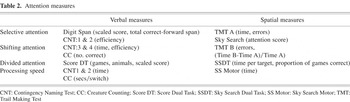
The following attention tests were chosen to measure selective, shifting and divided attention, and to cover both verbal and spatial domains, as summarized in Table 2.
Attention measures

Digit span. (Wechsler, 1991): Children were asked to repeat strings of digits of increasing length, both forwards and backwards. Scaled scores were employed in analyses. An additional score was recorded for maximum number of digits forwards repeated reliably (that is, on both trials).
Contingency Naming Test (CNT: Anderson et al., 2000a; Taylor & Alden, 1997). This test includes four subtests, of increasing difficulty. The child is presented with a laminated card on which are printed rows of shapes, of different colors. Within each “outside” shape a second, “inside” shape, of the same color, is drawn. Above some of the stimuli a reverse arrow is drawn. For Subtest 1 the child is required to name the stimulus color, while for the second subtest the aim is to name outside shapes. Subtests 1 and 2 act as baseline measures, and tap selective attention skills. The third and fourth subtests (CNT3, CNT4) involve a “shift” in attention. For CNT3 the child is given two rules: if inside and outside shape are the same, the child must name the stimulus color. If the shapes are different, the correct response is the name of the outside shape. On the fourth subtest, the child is instructed to follow the rules for CNT3, except when a reverse arrow is above a stimulus, in which case the child is directed to reverse the rules from CNT3 (i.e., where the shapes are the same, the correct response is the shape of the stimuli). Time taken to completion and efficiency scores (incorporating speed and accuracy measures) were recorded.
Trail Making Test (TMT: Reitan & Davison, 1974). In this test children are required to draw lines connecting consecutive numbers (Part A) or numbers alternating with letters (Part B). Time to completion and number of errors were recorded. A ratio score was also employed (Trails B: time to completion–Trails A: time to completion)/Trails A: time to completion) as an index of shifting attention.
Sky Search (SS: TEA-Ch: Manly et al., 1999). Children were given a laminated sheet depicting rows of spacecraft and instructed to find all targets, indicated by two of the same ships within a pair, as quickly as possible. To control for differences attributable to motor speed rather than visual selection, children completed a motor control task, identical to that of the Sky Search test with the exception that all of the distractor items were removed. For each part of the test, an “attention score” was calculated (targets found/time). Subtraction of the “motor” time-per-item from the more attentionally demanding condition time-per-item produced an “attention” score that was relatively free from the influence of motor speed. Time to completion for Sky Search Motor and the attention score were also employed in analyses.
Creature Counting (CC: TEA-Ch: Manly et al., 1999). For each item, a variable number of “creatures” were depicted in their burrow. Interspersed between the creatures were arrows either pointing up or down. Children were asked to begin counting creatures from the top left hand corner of the page, and through the “burrows,” but to use the arrows as a cue to switch the direction of their count. The accuracy of the response and the time taken to complete the page were recorded. A timing score was calculated (seconds-per-switch) by dividing the time taken to complete correct items by the number of switches within those items.
Score Dual Task (Score DT: TEA-Ch: Manly et al., 1999). This task was divided into a series of 10 items or “games” in which the child was asked to listen to a tape, and to count a series of tones, while listening to a news broadcast. The tone counting aspect of the task required children to silently count tones separated by silent interstimulus intervals of variable duration (between 500 and 5000 ms), and to give the total at the end. In addition, meaningful, auditory speech—in the form of news bulletins—was simultaneously presented. Children were asked to keep a count of tones whilst listening for the mention of an animal during the news broadcast. Scores used in analyses included number of games correct (i.e., the number of items where the child correctly counted number of tones presented), number of animals correctly identified and a score combining accuracy for both measures.
Sky Search Dual Task (SSDT: TEA-Ch: Manly et al., 1999). Children were asked to complete a parallel version of the visual search stimuli used in Sky Search. As they did this they were asked to count the number of tones presented within each item or game of a counting task, as described in Score Dual task, above. Tones were presented at 1-second intervals. The test was ended when the child completed the visual search component. Time taken to find each visual target was calculated, together with the percentage of the counting items correct.
Behavioral evaluation
In addition to tests of attention, parents completed the Behavioral Rating Inventory of Executive Function (BRIEF: Gioia et al., 2000) to assess day-to-day executive and attentional function. The BRIEF yields T scores (mean 50, SD = 10), with scores above 65 representing significant impairment. Scores employed in analyses included: (i) Global Executive Composite (GEC): total score; (ii) Inhibit Scale: assesses inhibitory control and the ability to resist the temptation to act on impulse; (iii) Shift scale: evaluates the ability to move freely from one situation, activity or aspect of a problem to another according to task demands or environmental circumstances; and (iv) Monitor scale: taps the child's ability to check his or her own work for errors and to monitor the effect the child's own behaviour may have on others.
Procedure
Potential clinical participants were identified via neuroscience clinics, based on the criteria described above. For children with postnatal conditions, families were contacted at least six months post-event, to allow for acute recovery to take place. For all others, families were contacted after an initial chart review. According to requirements of the Royal Children's Hospital, Melbourne, and Sydney Children's Hospital Human Ethics Committees, letters describing the study, together with a brief questionnaire seeking information on the child's developmental, neurologic, and psychiatric history, parent occupation and ethnicity, were distributed to families. Participants were children for whom signed consent was obtained and who met inclusion criteria. Children were then assessed at the Australian Centre for Child Neuropsychology Studies.
Healthy control children were identified from local schools, in accordance with education department ethics procedures. Children were chosen from class lists, to match clinical participants as closely as possible with respect to age, gender, and SES. Information on the study and the background questionnaire were sent to families via the school. Children were assessed within the school context once signed consent was obtained, and inclusion criteria checked.
Assessments were conducted on an individual basis, and by a qualified child psychologist. All tests were administered in fixed order. Assessment duration was approximately 2 hours, divided into two sessions by a short break. Intellectual testing was completed in the first session and attentional measures in the second.
Statistical analyses
To examine between-group differences, the attention measures were subjected to analysis of covariance (ANCOVA), covarying for age, gender, and SES. IQ was not employed as a covariate, as the development of IQ is likely to be intimately linked to deficient executive functions in children (Hebb, 1947; Williams & Mateer, 1992).
Although preliminary analysis failed to reveal outliers, children who were unable to complete a task were assigned the lowest (age-normed) score possible for a given measure. These scores were applied to individual scores for a small number of children (11% of prefrontal sample and 2.5% of control sample). Two sets of ANCOVA were carried out, one set comparing the total prefrontal group with controls, and the second comparing the left prefrontal, right prefrontal, bilateral prefrontal, and control groups. As comparisons were considered exploratory in nature, a p level of .05 was adopted for these analyses. Post-hoc analyses of simple effects were conducted using Bonferroni adjusted p levels. Effect size was computed using partial eta-squared.
A series of correlation analyses was conducted, to examine the potential relationship between a number of specific factors and attentional function. These included timing of lesion (pre-/postnatal), age at symptom onset and presence of seizure activity.
RESULTS
IQ and Demographic Characteristics
Mean FSIQ (SDs) for the prefrontal and control groups were 89.7 (10.8) and 104.6 (13.4), respectively, F(1,75) = 27. 7, p < .001. Children with prefrontal lesions thus performed more poorly than controls, with the mean score for the prefrontal group at the lower end of the average range. This finding is contrary to adult-based evidence, which has argued that individuals sustaining frontal lobe damage present with intact IQ scores.
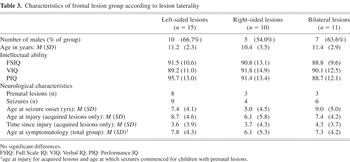
The lesion laterality subgroups did not differ from one another with respect to age, gender, VIQ, PIQ, or FSIQ (see Table 3). No group differences were identified for presence of seizures, onset of seizures, or age at symptom onset. There were no differences between left and right lesion subgroups for extent and location of lesion or for timing of lesion. There was a trend for a greater proportion of the bilateral subgroup to be peri- or post-natal in origin, and for pathology in this subgroup to extend across multiple prefrontal regions (e.g., lateral, medial, orbitofrontal).
Characteristics of frontal lesion group according to lesion laterality

Cognitive measures of attention
Comparisons of prefrontal and control groups. As summarized in Table 4, children with prefrontal lesions performed significantly worse on measures of shifting and divided attention. Reduced scores were evident on tasks involving both verbal (CNT, Score) and nonverbal (TMT, CC, SS) domains, and for accuracy (TMT: B errors, CC: number correct, Sky Search DT: percent games correct, Score DT: animals correct, games correct, total) and speed measures (CNT 3 & 4: efficiency). Processing speed was also slower within the prefrontal sample, with significant group effects identified for SS Motor: time and CNT trial 1: time.
Mean adjusted scores, F, p values and partial eta-squared values for attention measures across pre-frontal and control groups

For selective attention, group differences were identified for Digit Span (total subtest score and digits forwards) only, with the prefrontal groups performances not significantly different from healthy controls for CNT: trial 1: efficiency, CNT: trial 2: efficiency, TMT: A: time and errors and SS attention.
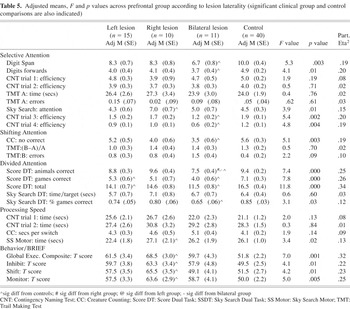
Comparisons of left prefrontal, right prefrontal, bilateral frontal and control groups. To evaluate the effect of lesion lateralization, the clinical group was divided into children with left (n = 15), right (n = 10) and bilateral (n = 11) prefrontal lesions. Data pertaining to these three groups are provided in Table 5. Group comparisons revealed surprisingly few differences. The bilateral prefrontal group performed significantly more poorly than the control group on the Digit Span test (Digit span, p = .003; Digits forwards, p = .01). For shifting attention, the bilateral prefrontal group performed significantly more poorly than controls on trials 3 and 4 of the CNT (CNT3 efficiency, p = .002, CNT4 efficiency, p = .004), Creature Counting number of games correct (p = .003). On measures of divided attention, the bilateral prefrontal group identified fewer animals on Score DT than both the right (p = .003) and control (p < .001) groups and achieved fewer “score” games correct than controls (p < .001), and consistent with this performance, obtained a lower total score compared with the control group (p < .001) on this task. The bilateral prefrontal group also performed more poorly than controls on the auditory/verbal component of Sky Search DT, obtaining fewer “score” games correct on this task than controls (p = .030).
Adjusted means, F and p values across prefrontal group according to lesion laterality (significant clinical group and control comparisons are also indicated)

For the left lesion group, deficits were only found on auditory/verbal aspects of divided attention tasks. Compared with controls, the left lesion group achieved fewer ‘score’ games correct on Score DT (p = .05), and had a significantly lower total score for this task (p = .020).
Impairments detected for the right lesion group were not consistent across attentional domains, perhaps reflecting the role of the right frontal lobe in sustained attention, online monitoring and self-regulation (Dobler et al., 2003). This group achieved a significantly lower Sky Search Attention score compared with both the control and left lesion groups (p = .010, p = .030, respectively), and were slower than the control group to complete the Sky Search Motor task (p = .060). Within the domain of divided attention, there was a trend for the right lesion group to obtain a lower score than controls with respect to the number of “score” games correctly identified on Score DT (p = .060). Of note, the right prefrontal lesion group was the only group to have significantly elevated scores on all subscales of the BRIEF pertaining to attention, achieving a lower Global Executive Composite compared with controls (GEC: p < .001) as well as raised scores on three subscales: Inhibit (p = .010), Shift (p = .020) and Monitor (p = .003).
Behavioral Indices of Attention (BRIEF)
Parent ratings of children's attentional skills as derived from the BRIEF indicate consistently greater difficulties for children with prefrontal pathology. Children with prefrontal lesions recorded significantly higher Global Executive Composite scores than healthy controls, F(1,75) = 27.7, p < .001. Means (SDs) for the prefrontal and control groups, respectively, were 64.0 (12.7) and 51.2 (10.0). Further, Inhibit, Shift, and Monitor subscales (F(1,75) = 12.6, p = .001, F(1,75) = 4.5, p = .040; F(1,75) = 14.4, p < .001, respectively) were all significantly elevated for the clinical group. BRIEF ratings were highest for the right prefrontal group, with the mean GEC score significantly different from the control mean (p < .001) and falling within the clinically impaired ranged (Adj M = 68.5, SE = 3.5). This group obtained significantly higher subscale scores than controls for Inhibit (p = .001), Monitor (p = .002), and Shift subscales (p = .006).
Correlations of Lesion Characteristics with Attention Measures
Correlations between predictor variables and attention variables were also calculated. Results indicated strong correlations between shifting and divided attention measures and age at symptom onset, with younger age at onset predicting poorer performance. Specifically, age at symptom onset was negatively correlated with Sky Search: attention (r = −.606, p < .01) and Sky Search DT: time/target (r = −.390, p < .05), suggesting that children with younger age at symptom onset took longer to complete these tasks. For Creature Counting: number correct (r = .368, p < .05) and Score DT: total (r = .405, p < .05) younger age at symptom onset was associated with greater performance accuracy. No correlations were found for seizure severity or lesion timing.
DISCUSSION
Children with lesions involving prefrontal cortex exhibit attentional impairments when compared with healthy age and gender matched controls. These impairments are evident on both psychometric measures and for parent ratings of day-to-day function. On both cognitive and behavioral measures of attention, deficits were detected in all components investigated. Further, the effects of lesion laterality suggested few deviations from expectations for children with left prefrontal lesions, with reduced scores evident only on the auditory-verbal task of divided attention. Children with right prefrontal lesions also exhibited specific deficits, demonstrating difficulties on measures of visual selective attention. However this group was characterized by most impaired day-to-day function. Not surprisingly, children with bilateral lesions demonstrated a trend to poorest scores across a range of attention domains, with greatest impairments in shifting and divided attention, possibly indicating the greater cognitive resources required for these tasks. Results provide evidence of the importance of prefrontal cortex in attentional function during childhood, and indicate that the lateralization of attention deficits observed following early prefrontal lesions may not be identical to those described for adults.
Comparisons between controls and children with prefrontal pathology identified the expected discrepancies in attention. Children with prefrontal lesions performed poorly on “executive” aspects of attention, including shifting and divided attention. For divided attention tasks, scores recorded for the clinical sample were greater than one standard deviation below controls for all measures, reflecting a highly significant discrepancy. For shifting attention measures, clinically relevant group differences were also evident. These findings suggest that children with prefrontal lesions experience substantial difficulties with cognitively demanding activities such as dividing attention across two tasks simultaneously, or shifting flexibly from one dimension to another.
In keeping with attentional models (Mirsky et al., 1991; Posner, 1995), group means for more “posterior” based, selective attention functions were closer to developmental expectations. With the exception of Digit Span and CNT1: efficiency, performances on selective attention measures were comparable across groups, suggesting no substantive impairments in association with prefrontal pathology. Findings for the Digit Span task are worthy of further consideration. While this measure is commonly listed as tapping selective attention (Mirsky, 1996; Mirsky et al., 1991), it may be argued that such a classification is problematic. Specifically, due to the inclusion of a “digits backwards” component, the resultant score may be better interpreted as a working memory index (Baddeley, 1990). Poorer performances may thus reflect impairments in higher order attention processing, rather than selective attention deficits. Speed of processing was also slowed in children with prefrontal lesions, in keeping with adult literature which links slowed processing to frontal impairments. The magnitude of deficits was less than those identified for higher level processing tasks, but was present for both speech and motor responses.
These results are consistent with expectations from adult-based studies, which suggest that the anterior regions of the brain are responsible for shifting and divided attention, and aspects of processing speed, reflecting the high level of attentional resources required to perform effectively on such tasks. Recently, adult studies have examined the impact of frontal lobe pathology in more detail, suggesting that there may be some localization or lateralization of function within the prefrontal cortex (Mecklinger et al., 1999; Stuss et al., 1999). To date, pediatric research has not addressed this possibility for the less differentiated, developing brain, with published data restricted to case studies, and more global insults (Bates et al., 1999; Eslinger et al., 1999; Vargha-Khadem et al., 1994). The present study provided an opportunity to investigate the possibility of lateralization of “prefrontal” attentional functions in children. Interestingly, differences across the laterality groups were few, consistent with earlier reports comparing verbal and performances IQ in children with congenital, diffuse, unilateral lesions (Bates et al., 1999; Vargha-Khadem et al., 1994). Children with left hemisphere pathology performed closest to expectations across attention domains, with no problems identified for visually based measures or processing speed. Deviations from controls were identified only for auditory-verbal divided attention, which requires on-line attention skills and verbal working memory.
Children with right prefrontal pathology also demonstrated relatively circumscribed attentional impairments. Within the selective attention domain, poorer performances were recorded within the visual modality only. For shifting and divided attention measures, most results were similar to controls, although there was a tendency for the group to demonstrate lower accuracy on more demanding tasks, consistent with suggestions of greater impulsivity and poorer attentional control associated with right prefrontal pathology (Eslinger et al., 1997, 1999). This possibility is supported by this group's elevated scores for parent ratings of behavior, with impairments noted on Monitor, Inhibit, and Shift subscales, and reflecting difficulties with attentional control.
Not surprisingly, children with bilateral prefrontal pathology also demonstrated impairments in many aspects of attention. With the exception of Digit Span, and consistent with suggestions that selective attention is mediated by posterior brain regions, this group exhibited relatively intact selective attention. Similarly, processing speed was intact. In contrast, this group achieved poorer results for the more demanding shifting and divided attention tasks, with scores falling well below controls. In keeping with adult models (Stuss et al., 1999; Walsh, 1978), as well as with developmental perspectives (Anderson et al., 2001a; Kolb & Gibb, 1993; Taylor & Alden, 1997; Vargha-Khadem et al., 1994), such findings suggest that more global prefrontal pathology may result in difficulties coping with resource-intense cognitive tasks, regardless of the attentional component under investigation. With respect to day-to-day behavior, children with bilateral prefrontal lesions were similar to controls, with mean scores within the average range.
The possibility that the results of the bilateral lesion group might reflect an additive or cumulative effect of both left and right prefrontal performance characteristics was considered, but results indicate that such an explanation may be too simplistic, given that this group did not demonstrate impairments on behavioral indices nor on several measures which were deficient for either the left or right prefrontal groups. Further, there were a number of areas where only the bilateral prefrontal group recorded deficient scores. These latter uniquely poor results are specific to the higher-order shifting and divided attention domains, suggesting that serious deficits in these aspects of attention in children may only occur when both prefrontal cortices are dysfunctional. One explanation for this pattern of results may be that, where damage is present in both prefrontal regions, the impact is similar to that seen for early generalized brain insults, such as head injury, where there is limited potential for “reorganization” or “recruitment” within healthy brain tissue in either the ipsilateral or contralateral hemisphere (Anderson et al., 1997, 2001b). The somewhat unexpected finding that children with bilateral prefrontal lesions did not demonstrate behavioral problems in the attention domain needs some further consideration. Comparison of the three clinical groups identified no differences with respect to demographic, and no differences in lesion characteristics, with a similar distribution of prefrontal pathology across groups. One potential explanation may be that, while focal right prefrontal pathology reduces attentional control, concurrent left prefrontal pathology may act to dampen these symptoms, or alternatively, given their more generalized cognitive impairments, parent ratings may reflect lower expectations of these children.
Finally, while attention was the focus of this study, the intellectual characteristics of the sample were somewhat unexpected. Children sustaining prefrontal lesions demonstrated poorer overall intellectual ability than controls, in contrast to adult findings, which suggest that IQ is not impacted by frontal lesions (e.g. Walsh, 1978, 1985), but consistent with child-based case reports (Eslinger & Biddle, 2000; Hebb, 1947; Williams & Mateer, 1992). However, such a difference between adult and child findings makes intuitive sense. As has been documented (Lezak, 1995), standardized intellectual tests primarily assess well-learned skills. For adults sustaining prefrontal lesions, these well-learned skills are largely established, and less vulnerable to executive dysfunction (Anderson, 1998; Anderson et al., 2001b). For children, acquisition of intellectual abilities is dependent upon a logical, efficient approach to the registration, organization and storage of new information and skills. Thus, prefrontal damage (and associated executive dysfunction) at an early age may impede the development of cognitive abilities in a global manner, rather than cause specific “executive” symptoms seen in adults (Anderson, 1998).
Comparison of children with left and right prefrontal lesions detected the predicted modality-specific pattern on attentional tasks, although this relationship was not so clear for IQ measures. No group differences were identified for VIQ, with both left and right lesion groups demonstrating mean scores at the lower end of the average range. Further, children with right-sided lesions recorded a marginally lower score on this measure (right frontal lesion: VIQ = 91.8; left frontal lesion: VIQ= 89.2). For nonverbal skills, group differences were in the expected direction, but remained nonsignificant. These results are consistent with findings from other studies, which have identified global reduction in intellectual capacity following unilateral lesions (not confined to the frontal lobes) in the first 12 months of life. In contrast, these studies have not detected such a significant impact on IQ for those children sustaining similar lesions after 12 months of age (Aram & Enkelman, 1986; Ballantyne et al., 1992: Bates et al., 1999; Riva & Cassaniga, 1986; Vargha-Khadem et al., 1985). It may be that prefrontal lesions, and associated higher-order cognitive impairments, have a dramatic impact on development processes, regardless of timing.
The findings described above need to be interpreted in the context of some methodological considerations. First, sample size, while larger than previous studies, is relatively small, due to the low incidence of prefrontal lesions in children. While a number of potentially confounding variables were statistically controlled, the contribution of factors such as lesion size, and seizure severity and medications, age at injury, localization of cerebral pathology within the frontal lobes, and socioeconomic status cannot be adequately canvassed with such a small sample. In a similar vein, despite recruiting a sample with lesions largely confined to the prefrontal lobes, the study necessarily comprises a variety of brain conditions, which restricts interpretation across disorder groups. Further, the limitations in sensitivity inherent in current MR technology restrict the capacity of such methods to identify subtle cerebral pathology. These issues may be argued to reduce the degree of specificity that can be achieved in addressing the contribution of the prefrontal cortex to particular aspects of cognition and behavior. Of note, seminal studies in the adult literature have been able to clearly demonstrate highly specific deficits linked to particular prefrontal regions, despite including participants with similarly diverse brain pathology (Stuss et al., 1999, 2000, 2001a, 2001b). We would argue that the lack of specificity in our findings may not be simply explained by the nature of the sample. Further research is required to address these outstanding areas.
In conclusion, children sustaining prefrontal lesions demonstrate compromised intellectual and attentional function. In keeping with current neuropsychological models of attention, when compared with healthy controls, impairments are greatest for high-level attentional skills, purported to be subsumed by anterior systems, including shifting and divided attention. Selective attention skills are closer to normative expectations. Behavioral correlates of these attentional deficits are also present. Within the prefrontal group, subtle laterality differences in attention were identified, consistent with adult findings. Left prefrontal pathology was associated with relative resilience, with impairments restricted to auditory-verbal, divided attention skills, possibly suggesting difficulties in “on-line” processing capacities. Behavioral ratings indicated few discrepancies from healthy controls. In contrast, right prefrontal pathology was characterized by deficits in spatial aspects of attention as well as high error rates and greater impulsivity. Finally, bilateral prefrontal lesions were linked to severe deficits in higher-order shifting and divided attention skills, with other aspects of attention closer to normal expectations.
While some differences in performance are evident between left- and right-prefrontal groups, in keeping with adult patterns, the integrity of both regions appears to be required for developmentally appropriate attentional in childhood. Such a notion is consistent with neuroimaging studies in healthy children demonstrating the recruitment of more prefrontal regions to support high-order cognitive processes in childhood and early adolescence when compared with adults (Casey et al., 1997; Tamm et al., 2002). The implications of such deficits for both cognitive function and everyday life are enormous, and suggest that children with frontal lobe pathology will have difficulty coping efficiently with a range of day-to-day activities, perhaps particularly those requiring greater cognitive resources, more “on-line” processing, efficient self-monitoring or cognitive flexibility.
ACKNOWLEDGMENTS
We would like to thank Dr. Anna Mandalis for her support in recruitment of participants, and the children and families who gave of their time to contribute to the study.
References
REFERENCES
Ackerly, S. &
Benton, A.
(1948).
Report of a case of bilateral frontal lobe defect.
Association for Research on Nervous and Mental Disorders,
27,
479–504.Google Scholar
Anderson, P.,
Anderson, V.,
Northam, E., &
Taylor, H.G.
(2000a).
Standardization of the contingency naming test (CNT) for school-aged
children: A measure of reactive flexibility.
Clinical Neuropsychological Assessment,
1,
247–273.Google Scholar
Anderson, S.,
Damasio, H.,
Tranel, D., &
Damasio, A.
(2000b).
Long-term sequelae of pre-frontal cortex damage acquired in early
childhood.
Developmental Neuropsychology,
18,
281–296.Google Scholar
Anderson, V.
(1988).
Recovery of function in children: The myth of cerebral
plasticity. In
M. Matheson &
H. Newman (Eds.),
Brain Impairment,
Proceedings from the Thirteenth Annual Brain Impairment
Conference (pp.
223–247).
Sydney:
ASSBI.
Anderson, V.
(1998).
Assessing executive functions in children: Biological,
psychological, and developmental considerations.
Neuropsychological Rehabilitation,
8,
319–349.CrossRefGoogle Scholar
Anderson, V.,
Anderson, P.,
Northam, E.,
Jacobs, R., &
Catroppa, C.
(2001a).
Development of executive functions through late childhood and
adolescence in an Australian sample.
Developmental Neuropsychology,
20,
385–406.Google Scholar
Anderson, V.,
Levin, H., &
Jacobs, R.
(2002).
Developmental and acquired lesions of the frontal lobes in
children: Neuropsychological implications. In
D. Stuss &
R. Knight (Eds.),
Principles of frontal lobe function (pp.
504–527).
New York:
Oxford University Press.
Anderson, V. &
Moore, C.
(1995).
Age at injury as a predictor of outcome following pediatric head
injury.
Child Neuropsychology,
1,
187–202.CrossRefGoogle Scholar
Anderson, V.,
Morse, S.,
Klug, G.,
Catroppa, C.,
Haritou, F.,
Rosenfeld, J., &
Pentland, L.
(1997).
Predicting recovery from head injury in school-aged children: A
prospective analysis.
Journal of the International Neuropsychological Society,
3,
568–580.Google Scholar
Anderson, V.,
Northam, E.,
Hendy, J., &
Wrennall, J.
(2001b).
Developmental Neuropsychology: A Clinical approach.
London:
Psychology Press.
Anderson, V. &
Pentland, L.
(1998).
Attention deficit following paediatric head injury.
Neuropsychological Rehabilitation,
8,
283–300.Google Scholar
Aram, D. &
Enkelman, B.
(1986).
Cognitive profiles of children with early onset unilateral
lesions.
Developmental Neuropsychology,
2,
155–172.CrossRefGoogle Scholar
Baddeley, A.
(1990).
Human memory: Theory and practice.
London:
Lawrence Erlbaum Associates.
Ballantyne, A.,
Scarvie, K., &
Trauner, D.
(1992).
IQ patterns in children with early-onset focal brain lesions.
Journal of Clinical and Experimental Neuropsychology,
14,
115.Google Scholar
Bates, E.,
Vicari, S., &
Trauner, D.
(1999).
Neural mediation of language development: Perspectives from lesions
studies of infants and children. In
H. Tager-Flusberg (Ed.),
Neurodevelopmental disorders (pp.
533–581).
Cambridge:
MIT Press.
Casey, B.,
Trainor, R.,
Orendi, J.,
Schubert, A.,
Nystrom, L.,
Giedd, J.,
Castellanos, X.,
Haxby, J.,
Noll, D.,
Cohen, J.,
Forman, S.,
Dahl, R., &
Rapoport, J.
(1997).
A developmental functional MRI study of prefrontal activation during
performance of a Go-No-Go task.
Journal of Cognitive Neuroscience,
9,
835–847.CrossRefGoogle Scholar
Chelune, G. &
Baer, R.
(1986).
Developmental norms for the Wisconsin Card Sorting Test.
Journal of Clinical and Experimental Neuropsychology,
8,
219–228.CrossRefGoogle Scholar
Cooley, E. &
Morris, R.
(1990).
Attention in children: A neuropsychologically-based model for
assessment.
Developmental Neuropsychology,
6,
239–274.CrossRefGoogle Scholar
Dall'Oglio, A.,
Bates, E.,
Volterra, V.,
Di Capua, M., &
Pezzini, G.
(1994).
Early cognition, communication and language in children with focal
brain injury.
Developmental Medicine and Child Neurology,
36,
1076–1098.Google Scholar
Daniel, A.
(1983).
Power, privilege and prestige: Occupations in Australia.
Melbourne:
Longman-Cheshire.
Dennis, M.
(1989).
Language and the young damaged brain. In
T. Boll &
B. Bryant (Eds.),
Clinical neuropsychology and brain function: Research, measurement
and practice (pp.
89–123).
Washington:
American Psychological Association.
Dennis, M.,
Wilkinson, M.,
Koski, L., &
Humphreys, R.
(1995).
Attention deficits in the long term after childhood head
injury. In
S. Broman &
M. Michel (Eds.),
Traumatic head injury in children (pp.
165–187).
New York:
Oxford University Press.
Dobler, V.,
Manly, T.,
Verity, C.,
Woolrych, J., &
Roberson, R.
(2003).
Modulation of spatial attention in a child with developmental
spatial neglect.
Developmental Medicine and Child Neurology,
45,
282–288.Google Scholar
Douglas, V.
(1983).
Attentional and cognitive problems. In
M. Rutter (Ed.).
Developmental neuropsychiatry (pp.
280–329).
New York:
Guilford Press.
Dove, A.,
Pollman, S.,
Schubert, T.,
Wiggins, C., &
van Cramon, D.
(2000).
Prefrontal cortex activation in task switching: An event-related
fMRI study.
Cognitive Brain Research,
9,
103–109.CrossRefGoogle Scholar
Eslinger, P. &
Biddle, K.
(2000).
Adolescent neuropsychological development after early right
prefrontal cortex damage.
Developmental Neuropsychology,
18,
297–330.CrossRefGoogle Scholar
Eslinger, P.,
Biddle, K., &
Grattan, L.
(1997).
Cognitive and social development in children with prefrontal cortex
lesions. In
N. Krasnegor,
G. Lyon, &
P. Goldman-Rakic (Eds.),
Development of the prefrontal cortex: Evolution, neurology, and
behavior (pp.
295–336).
Baltimore, MD:
Brookes.
Eslinger, P.,
Biddle, K.,
Pennington, B., &
Page, R.
(1999).
Cognitive and behavioral development up to 4 years after early right
frontal lobe lesion.
Developmental Neuropsychology,
15,
157–191.CrossRefGoogle Scholar
Eslinger, P.,
Grattan, L.,
Damasio, H., &
Damasio, A.
(1992).
Developmental consequences of childhood frontal lobe damage.
Archives of Neurology,
49,
764–769.CrossRefGoogle Scholar
Ewing-Cobbs, L.,
Brookshire, B.,
Scott, M., &
Fletcher, J.
(1998).
Children's narratives following traumatic brain injury:
Linguistic structure, cohesion, and thematic recall.
Brain and Language,
61,
395–419.CrossRefGoogle Scholar
Garth, J.,
Anderson, V., &
Wrennall, J.
(1997).
Executive functions following moderate-to-severe frontal lobe
injuries: Impact of injury and age at injury.
Pediatric Rehabilitation,
1,
99–108.Google Scholar
Gioia, G.,
Isquith, P.,
Guy, S., &
Kenworthy, L.
(2000).
The Behavior Rating Inventory of Executive Function.
Odessa, FL:
PAR Inc.
Godefroy, O.,
Lhullier, C., &
Rousseaux, M.
(1996).
Non-spatial disorders in patients with frontal or posterior brain
damage.
Brain,
119,
191–202.CrossRefGoogle Scholar
Godefroy, O. &
Rousseaux, M.
(1996).
Divided and focussed attention in patients with lesion of the
prefrontal cortex.
Brain and Cognition,
30,
155–174.CrossRefGoogle Scholar
Goldberg, E. &
Costa, L.
(1981).
Hemispheric differences in the acquisition and use of descriptive
systems.
Brain and Language,
14,
144–173.CrossRefGoogle Scholar
Gogtay, N.,
Giedd, J.,
Lusk, L.,
Hayashi, K.,
Greenstein, D.,
Vaituzis, C.,
et al.
(2004).
Dynamic mapping of human cortical development during childhood and
early adulthood.
Proceedings of the National Academy of Science,
101,
8174–8179.CrossRefGoogle Scholar
Grattan, L.,
Bloomer, R.,
Archambault, F., &
Eslinger, P.
(1994).
Cognitive flexibility and empathy after frontal lobe lesion.
Neuropsychiatry, Neuropsychology and Behavioral Neurology,
7,
251–259.Google Scholar
Hebb, D.
(1947).
The effects of early experience on problem solving at
maturity.
American Psychologist,
2,
737–745.Google Scholar
Heilman, K.,
Voeller, K., &
Nadeau, S.
(1991).
A possible pathophysiologic substrate of attention deficit
hyperactivity disorder.
Journal of Child Neurology,
6 (Suppl.),
76–81.Google Scholar
Kail, R.
(1986).
Sources of age differences in speed of processing.
Child Development,
57,
969–987.CrossRefGoogle Scholar
Kail, R.
(1988).
Developmental processes for speeds of cognitive processes.
Journal of Experimental Child Psychology,
45,
339–364.CrossRefGoogle Scholar
Kennard, M.A.
(1936).
Age and other factors in motor recovery from precentral lesions in
monkeys.
American Journal of Physiology,
115,
138–146.Google Scholar
Kennard, M.A.
(1940).
Reorganization of motor function in cerebral cortex of monkeys
deprived of motor and pre-motor areas in infancy.
Journal of Neurophysiology,
1,
477–496.Google Scholar
Kennard, M.A.
(1942).
Cortical reorganization of motor function.
Archives of Neurology and Psychiatry,
48,
227–240.CrossRefGoogle Scholar
Kelly, T.
(2000).
The development of executive function in school-aged
children.
Clinical Neuropsychological Assessment,
1,
38–55.Google Scholar
Kolb, B.,
Cioe, J., &
Muirhead, D.
(1998).
Cerebral morphology and functional sparing after prenatal frontal
cortex lesions in rats.
Behavioral Brain Research,
91,
143–155.CrossRefGoogle Scholar
Kolb, B. &
Gibb, R.
(1993).
Possible anatomical basis of recovery of function after neonatal
frontal lesions in rats.
Behavioral Neuroscience,
107,
799–811.CrossRefGoogle Scholar
Kolb, B. &
Gibb, R.
(2002).
Frontal plasticity and behavior. In
D. Stuss &
R. Knight (Eds.),
Principles of frontal lobe function (pp.
541–556).
New York:
Oxford University Press.
Kolb, B.,
Gibb, R., &
Gorny, G.
(2000).
Cortical plasticity and the development of behavior after early
frontal cortical injury.
Developmental Neuropsychology,
18,
423–444.CrossRefGoogle Scholar
Kolb, B.,
Gibb, R., &
van der Kooy, D.
(1994).
Neonatal frontal cortical lesions in rats alter cortical structure
and connectivity.
Behavioral Brain Research,
645,
85–97.Google Scholar
Kolb, B.,
Petrie, B., &
Cioe, J.
(1996).
Recovery from early cortical damage in rats, VII. Comparison of the
behavioural and anatomical effects of medial prefrontal lesions at
different ages of neural maturation.
Behavioral Brain Research,
79,
1–13.Google Scholar
Kolb, B.,
Stewart, J., &
Sutherland, R.J.
(1997).
Recovery of function is associated with increased spine density in
cortical pyramidal cells after frontal lesions and/or noradrenaline
depletion in neonatal rats.
Behavioral Brain Research,
89,
61–70.CrossRefGoogle Scholar
Levin, H.,
Song, J.,
Scheibel, R.,
Fletcher, J.,
Harward, H.,
Lily, M., &
Goldstein, F.
(1997).
Concept formation and problem solving following closed head injury
in children.
Journal of the International Neuropsychological Society,
3,
598–607.Google Scholar
Lezak, M.
(1995).
Neuropsychological assessment.
New York:
Oxford University Press.
Luria, A.R.
(1973).
The working brain.
New York:
Basic Books.
Manly, T.,
Anderson, V.,
Nimmo-Smith, I.,
Turner, A.,
Watson, P., &
Robertson, I.
(2001).
The differential assessment of children's attention: The Test
of Everyday Attention for Children (TEA-Ch), normative sample and ADHD
performance.
Journal of Child Psychology and Psychiatry,
42,
1065–1081.CrossRefGoogle Scholar
Manly, T.,
Robertson, I.,
Anderson, V., &
Nimmo-Smith, I.
(1999).
The test of everyday attention for children.
Cambridge, UK:
Thames Valley Test Company.
Marlowe, W.
(1992).
The impact of a right pre-frontal lesion on the developing
brain.
Brain and Cognition,
20,
205–213.CrossRefGoogle Scholar
Mateer, C.A.
(1990).
Cognitive and behavioral sequalae of face and forehead injury in
childhood.
Journal of Clinical and Experimental Neuropsychology,
12,
95.Google Scholar
McKay, K.,
Halperin, J.,
Schwartz, S., &
Sharma, V.
(1994).
Developmental analysis of three aspects of information processing:
Sustained attention, selective attention, and response
organization.
Developmental Neuropsychology,
10,
121–132.CrossRefGoogle Scholar
Mecklinger, A.,
von Cramon, D.,
Springer, A., &
Matthes-von Cramon, G.
(1999).
Executive control functions in task switching: Evidence from brain
injured patients.
Journal of Clinical and Experimental Neuropsychology,
21,
606–619.Google Scholar
Mesulam, M.
(1981).
A cortical network for directed attention on unilateral
neglect.
Annals of Neurology,
10,
309–325.CrossRefGoogle Scholar
Mirsky, A.
(1996).
Disorders of attention: A neuropsychological perspective.
In
G. Lyon &
N. Krasnegor (Eds.),
Attention, memory and executive function (pp.
71–96).
Baltimore:
Paul H. Brookes Pub.
Mirsky, A.,
Anthony, B.,
Duncan, C.,
Ahearn, M., &
Kellam, S.
(1991).
Analysis of the elements of attention: A neuropsychological
approach.
Neuropsychological Review,
2,
109–145.CrossRefGoogle Scholar
Owen, A.M.,
Roberts, A.C.,
Polkey, C.E.,
Sahakian, B.J., &
Robbins, T.W.
(1991).
Extra-dimensional versus intra-dimensional set shifting performance
following frontal lobe excisions, temporal lobe excisions or
amygdalo-hippocampectomy in man.
Neuropsychologia,
29,
993–1006.CrossRefGoogle Scholar
Pentland, L.,
Todd, J., &
Anderson, V.
(1998).
The impact of head injury on planning ability in adolescence: A
functional analysis.
Neuropsychological Rehabilitation,
8,
301–317.CrossRefGoogle Scholar
Posner, M.
(1988).
Structures and functions of selective attention. In
T. Boll &
B.K. Bryant (Eds.),
Clinical neuropsychology and brain function: Research, measurement
and practice (pp.
173–202).
Washington:
American Psychological Association.
Posner, M.
(1995).
Attention in cognitive neuroscience: An overview. In
M. Gazzaniga (Ed.),
The cognitive neurosciences (pp.
531–556).
Cambridge:
MIT Press.
Posner, M. &
Petersen, S.E.
(1990).
The attention system of the human brain.
Annual Review of Neurosciences,
15,
25–42.CrossRefGoogle Scholar
Rebok, G.,
Smith, C.,
Pascualvaca, D.,
Mirsky, A.,
Anthony, B., &
Kellam, S.
(1997).
Developmental changes in attentional performance in urban children
from eight to thirteen years.
Child Neuropsychology,
3,
47–60.Google Scholar
Reitan, R.M. &
Davison, L.A. (Eds.)
(1974).
Clinical neuropsychology: Current status and applications.
Washington:
Winston.
Riva, D. &
Cassaniga, L.
(1986).
Late effect of unilateral brain lesions before and after the first
year of life.
Neuropsychologia,
24,
423–428.CrossRefGoogle Scholar
Robertson, I.
(1999).
The rehabilitation of attention. In
D.T. Stuss,
G. Winocur, &
I. Robertson (Eds.),
Cognitive Neuropsychological Rehabilitation (pp.
302–313).
New York:
Cambridge University Press.
Rourke, B.P.
(1989).
Nonverbal learning disabilities.
New York:
Guilford Press.
Rubia, K.,
Overmeyer, S.,
Taylor, E.,
Brammer, M.,
Williams, S.,
Simmons, A., &
Bullmore, E.
(1999).
Hypofrontality in attention deficit hyperactivity disorder during
higher-order motor control: A study with functional MRI.
American Journal of Pediatrics,
156,
891–896.Google Scholar
Ruff, H. &
Rothbart, M.
(1996).
Attention in early development: Themes and variations.
New York:
Oxford University Press.
Semrud-Clikeman, M.,
Steingard, R.,
Filipek, P.,
Biederman, J.,
Bekken, K., &
Renshaw, P.
(2000).
Using MRI to examine brain-behavior relationships in males with
attention deficit hyperactivity disorder.
Journal of the American Academy of Child and Adolescent
Psychiatry,
39,
477–484.CrossRefGoogle Scholar
Shimamura, A.
(1995).
Memory and frontal lobe function. In
M. Gazzaniga (Ed.),
The cognitive neurosciences (pp.
803–813).
Cambridge:
MIT Press.
Smith, E. &
Jonides, J.
(1999).
Storage and executive processes in the frontal lobes.
Science,
282,
1657–1661.CrossRefGoogle Scholar
Sowell, E.,
Thompson, P.,
Welcome, S.,
Henkenius, A.,
Toga, A., &
Petersen, B.
(2003).
Cortical abnormalities in children and adolescents with attention
deficit/hyperactivity disorder.
Lancet,
362,
1699–1707.CrossRefGoogle Scholar
Stuss, D.,
Shallice, T.,
Alexander, M., &
Picton, T.
(1995).
A multi-disciplinary approach to anterior attentional
functions.
Annals of the New York Academy of Science,
769,
191–211.CrossRefGoogle Scholar
Stuss, D.T.,
Bisschop, S.,
Alexander, M.,
Levine, B.,
Katz, D., &
Izukawa, D.
(2001a).
The Trail Making Test: A study of focal lesion patients.
Psychological Assessment,
13,
230–239.Google Scholar
Stuss, D.T.,
Floden, D.,
Alexander, M.,
Levine, B., &
Katz, D.
(2001b).
Stroop performance in focal lesion patients: Dissociation of
processes and frontal lobe lesion location.
Neuropsychologia,
39,
774–786.Google Scholar
Stuss, D.T.,
Levine, B.,
Alexander, M.,
Hong, J.,
Palumbo, C.,
Hamer, L.,
Murphy, K., &
Izukawa, D.
(2000).
Wisconsin Card Sorting Test performance in patients with focal
frontal and posterior brain damage: Effects of lesion location and test
structure on separable cognitive processes.
Neuropsychologia,
38,
388–402.CrossRefGoogle Scholar
Stuss, D.T.,
Toth, J.,
Franchi, D.,
Alexander, M.,
Tipper, S., &
Craik, F.
(1999).
Dissociation of attentional processes in patients with focal frontal
and posterior lesions.
Neuropsychologia,
37,
1005–1027.CrossRefGoogle Scholar
Tamm, L.,
Menon, V., &
Reiss, A.L.
(2002).
Maturation of brain function associated with response
inhibition.
Journal of the American Academy of Child and Adolescent
Psychiatry,
41,
1231–1238.CrossRefGoogle Scholar
Taylor, H.G. &
Alden, J.
(1997).
Age-related differences in outcomes following childhood brain
insults: An introduction and overview.
Journal of the International Neuropsychological Society,
3,
555–567.Google Scholar
Todd, J.,
Anderson, V., &
Lawrence, J.
(1996).
Planning skills in head injured adolescents and their peers.
Neuropsychological Rehabilitation,
6,
81–99.CrossRefGoogle Scholar
Vargha-Khadem, F.,
Isaacs, E., &
Muter, V.
(1994).
A review of cognitive outcome after unilateral lesions sustained
during childhood.
Journal of Child Neurology,
9(Suppl. 2),
2S67–2S73.CrossRefGoogle Scholar
Vargha-Khadem, F.,
O'Gorman, A., &
Watters, G.
(1985).
Aphasia and handedness in relation to hemispheric side, age at
injury and severity of cerebral lesion during childhood.
Brain,
108,
677–696.CrossRefGoogle Scholar
Vargha-Khadem, F. &
Polkey, C.
(1992).
A review of cognitive outcome after hemidecortication in
humans. In
F. Rose &
D. Johnson (Eds.),
Recovery from brain damage: Advances in experimental medicine and
biology; Vol. 325. Reflections and directions (pp.
137–151).
New York:
Plenum Press.
Walsh, K.W.
(1978).
Neuropsychology: A clinical approach.
New York:
Churchill Livingston.
Walsh, K.W.
(1985).
Understanding brain damage: A primer of neuropsychological
evaluation.
New York:
Churchill Livingston.
Wechsler, D.
(1991).
Manual for the Wechsler Scale of Children's
Intelligence-III.
New York:
Psychological Corporation.
Williams, D. &
Mateer, C.
(1992).
Developmental impact of frontal lobe injury in middle
childhood.
Brain and Cognition,
20,
96–204.Google Scholar
Woods, D.L. &
Knight, R.T.
(1986).
Electrophysiological evidence of increased distractibility after
dorsolateral prefrontal lesions.
Neurology,
36,
212–216.CrossRefGoogle Scholar
Yeates, K.O.,
Taylor, H.G.,
Drotar, D.,
Wade, S.,
Stancin, T., &
Klein, S.
(1997).
Pre-injury environment as a determinant of recovery from traumatic
brain injuries in school-aged children.
Journal of the International Neuropsychological Society,
3,
617–630.Google Scholar
MR scans of four participants, illustrating nature of prefrontal pathology. Note radiological conventions apply to all scans). (a) 12-year old female (ID = 33) who sustained a stroke causing focal insult to the left prefrontal cortex six months prior to imaging. (b) 6 year old female (ID = 23) who presented with a cerebral haemorrhage causing bilateral prefrontal injury. (c) 12 year old male (ID = 13) with a developmental tumor involving left dorsolateral prefrontal cortex, diagnosed following onset of seizures at age 12 years. (d) 8 year old female (ID = 7) with left hemisphere ganglioglioma involving the dorsolateral prefrontal region, identified following emergence of seizures at age 8 years.

Clinical and lesion data for children with prefrontal lesions.
Attention measures
Characteristics of frontal lesion group according to lesion laterality

Mean adjusted scores, F, p values and partial eta-squared values for attention measures across pre-frontal and control groups
Adjusted means, F and p values across prefrontal group according to lesion laterality (significant clinical group and control comparisons are also indicated)
 You have
Access
- 36
- Cited by