Introduction
On April 25, 2015, Nepal experienced a major earthquake and ensuing aftershocks that killed nearly 9,000 people, injured greater than 22,000 others, and partially or fully destroyed more than one million homes. 1 In mountainous Nepal, the effect of this disaster was especially devastating in communities whose access to outside resources was difficult due to the terrain. While any earthquake can be expected to destroy roads, damage cell phone towers, disrupt electric and water supplies, render homes uninhabitable, decrease food availability, and create a myriad of medical needs, the impact is exponentially worsened when aid relief is delayed.Reference Noji 2 After the 2015 earthquake in Nepal, it was several days before any outside supplies could reach many of the more isolated villages, and then only by helicopter. For countries with limited resources and populations living in areas that are difficult to access, the local community may be the only option available to assist in the critical time period immediately following a disaster.
With over 1.3 million community health workers (CHWs) globally, 3 this cadre is an untapped resource that may be able to contribute considerably to disaster risk reduction, preparedness, and response.Reference Nicholls, Picou, Curtis and Lowman 4 In Nepal, the CHW role is filled by approximately 50,0000 female community health volunteers (FCHVs) under the direction of the Ministry of Health and Population (Kathmandu, Nepal), supervised monthly by medical professionals at the local government level.Reference Miyaguchi, Yasuoka, Poudyal, Silwal and Jimba 5 , Reference Schwarz, Sharma and Bashyal 6 The FCHVs, like most CHWs worldwide, are trained to assist households with family planning services, track immunizations, and treat respiratory infections and diarrhea, in addition to providing education on newborn care, nutrition, proper hygiene, and safer motherhood.Reference Miyaguchi, Yasuoka, Poudyal, Silwal and Jimba 5 By program design, they reside in the communities they serve, placing them in position to aid the households under their care in the event of an emergency. The challenge is that evidence is lacking on what type of training is most effective in preparing these CHWs for such an event, as well as on the best mechanism for incorporating them into the emergency response.
The primary objective of this study was to document – from the perspective of Nepalese FCHVs, community members, and key informants – the ways in which FCHVs contributed to the 2015 earthquake relief response, both independently and through collaboration with other organizations. A secondary goal was to elicit FCHVs’ recommendations on trainings they felt would help improve their capabilities to prepare for and address the emergency conditions that arise as a result of a disaster. This information can be used to aid the international understanding of the community first-responder experience in emergencies and to guide future research and implementation of disaster risk management for CHWs around the world.
Methods
Key-informant interviews, FCHV interviews, and focus group discussions (FGDs) were conducted at local health facilities during a two-week period in March 2016. Prospective participants were included if they were: (1) established and in position prior to the earthquake; (2) still in the same position at the time of the study; (3) knowledgeable about the activities of FCHVs; and (4) able to communicate effectively in English or Nepali. Potential study candidates were excluded if they did not meet all four of the above criteria.
Key informants were chosen by reputational case selection to span different levels of FCHV supervision, while the FCHVs were purposively selected by maximum variation sampling to optimize the diversity of experiences included.Reference Schensul, Schensul and LeCompte 7 , Reference Devers and Frankel 8 The FGD participants were recruited by phone and word-of-mouth invitation to all women in the community’s “mothers’ health group” (MHG), an association of women who gather regularly with their FCHV. The purpose of the FGDs was to provide a community perspective through which to triangulate the data gleaned from the FCHV and key-informant interviews.
All of the semi-structured interviews and FGDs were conducted with the assistance of a local Nepali-English translator, audio-recorded, and transcribed verbatim from the English translation. The transcripts were then coded by two independent researchers, using topics from the interview guide (Appendix; available online only), as well as themes that emerged during data analysis. Coding was performed both manually and with the assistance of NVivo 11 Pro software by QSR International (Melbourne, Australia).
The study was facilitated by the Dhulikhel Hospital Department of Community Programs (Dhulikhel, Nepal). The regions included were between 45 minutes and three hours driving distance from the hospital and were all sites that received outreach programming from the hospital. Ethical approval of this study was given by both Dhulikhel Hospital (Dhulikhel, Nepal) and the Harvard T.H. Chan School of Public Health (Boston, Massachusetts USA). Verbal consent was obtained prior to the initiation of each interview or FGD, and no financial incentive was provided for participation in the study.
Results
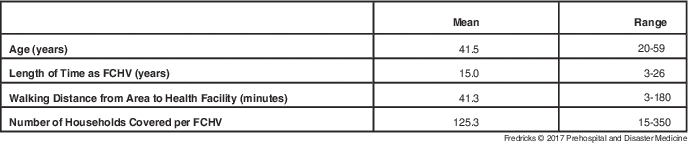
Fourteen FCHVs were interviewed, including two women from each of seven regions dispersed within Kavre, Sindhupalchowk, and Dhading Districts in central Nepal. They were all married mothers who had attended a standard 16-day or 18-day government training following their selection as FCHVs by the members of their respective MHGs. Five (35.7%) of them had never received any formal education and did not possess significant literacy skills. All FCHVs were uncompensated, except for the nominal financial assistance provided for attending trainings or special events such as vitamin distribution days or vaccination campaigns. The cohort of FCHVs interviewed represented different regions uniquely affected by the earthquake, a wide range of ages, varying amounts of experience as FCHVs, and considerable variability in distance of their community to the nearest health facility (Table 1).
FCHV Demographic Data (n=14)

Abbreviation: FCHV, female community health volunteer.
The three key informants included the focal point person for FCHVs in Kavre District (who oversees 980 FCHVs), an FCHV supervisor and health center director, and an auxiliary nurse-midwife who worked alongside FCHVs in the community. The FGDs were conducted in two of the seven regions (one that experienced severe destruction from the earthquake and one that suffered only minor damage) and involved nine participants in one group and 11 in the other.
During the interviews and FGDs, four major topics related to FCHVs and the 2015 earthquake emerged and reached thematic saturation: (1) community care and rapport; (2) emergency response; (3) training; and (4) interaction with relief organizations.
Community Care and Rapport
The FCHVs were committed to their communities and respected as providers of health information and services, especially for women and children. Prior to the earthquake, they were tasked with treating simple illnesses as well as providing health education and disease prevention. The FCHVs distributed medications such as zinc and oral rehydration solution to community members with diarrhea, acetaminophen for those with fever, iron tablets for pregnant women, and oral contraception pills and/or condoms for family planning. When illnesses required more advanced care, FCHVs referred patients to local health facilities. In terms of health education, each FHCV met monthly with her community’s MHG to discuss topics pertaining to nutrition and sanitation. She also advised on birth spacing, neonatal care, and for pregnant women, the importance of antenatal visits and delivery in a health facility. To further prevent disease, she routinely gave vitamin A and polio immunizations to children under five years of age, checked that their other vaccines were up to date, and monitored their weights every month.
After the 2015 earthquake, FCHVs continued their regular duties and started assessing for malnourishment by measuring the mid-upper arm circumference (MUAC) of children ages six months to five years. In response to the increasing rates of pediatric malnutrition found by MUAC assessment, FCHVs were instructed to begin distributing a micronutrient powder supplement to all children in that age group.
Their commitment to help was summarized by one of the FCHVs, who stated, “I am ready to serve the people, as I have taken the step forward to help the community, so will not take that step backward.” Another FCHV expressed why she felt so determined to assist in her community:
By working as an FCHV, I have been involved in taking care of many children, and I am seen as one of the mothers. I feel I do have love and affection to each and every one of the children as if they are my own.
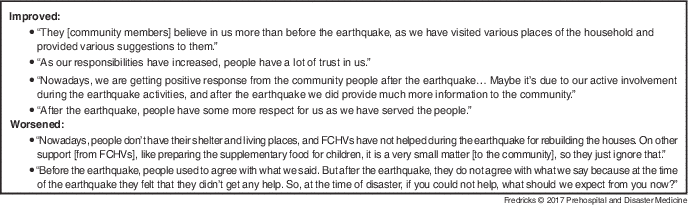
Due to the FCHVs’ dedication and beneficial contributions, their communities held them in high regard. Some FCHVs stated, “They [community members] believe in me so much,” and “People easily accept my suggestions and advice.” The mothers in the FGDs concurred, saying, “They [FCHVs] have helped us in various aspects of care for our children. We think of them in a good way.” In the aftermath of the earthquake, eight (57.1%) of the FCHVs reported that their communities continued to view them in the same positive manner. Four (28.6%) of them noted that they had gained additional respect after the disaster, while two (14.3%) found a less receptive audience in their communities (Table 2).
Post-Earthquake Relationship between FCHVs and the Community

Abbreviation: FCHV, female community health volunteer.
Emergency Response
After the earthquake, FCHVs were able to provide assistance for many of the new problems in the community, mostly without formal instruction from their supervisors. The major issues that arose pertained to shelter, water, food, latrines, and illness, including mental health and pediatric concerns. In terms of shelter, there was an immediate need for safe housing, as many homes were collapsed or damaged. The temporary shelters or tents that were erected were not able to withstand inclement weather, and people suffered further injuries from their destruction. Despite this, most people continued to reside in temporary housing nearly one year after the earthquake; their former homes were either completely collapsed or rendered unsafe, and they did not have the resources needed to rebuild. However, some community members returned to homes that had been damaged, despite the decreasing but persistent aftershocks that threatened to further weaken the foundations of their houses.
In addition to shelter, insufficient safe drinking water was a significant issue after the earthquake. Reservoirs that had been clean prior to the event became polluted or no longer accessible (eg, the pipes that brought water from the source became blocked). Due to the destruction of latrines, open defecation became routine practice in many communities, often on the banks of the same river used to obtain drinking water. Access to food was also a problem; people could not retrieve foodstuffs or cooking equipment from the piles of rubble that had once been their homes.
Physical and mental health were particularly large concerns, especially for children. Apart from injuries, common illnesses that presented after the earthquake were diarrhea, upper respiratory tract infections, fever, nausea, rashes, loss of appetite, and premature delivery. There were severe shortages of medical resources such as medication and transportation (eg, stretchers and vehicles to carry the wounded/sick). Children were particularly at risk of negative effects from disease and lack of medications due to their increased susceptibility to cold and risk of exposure to snakes and insects. They also suffered from psychological trauma:
The children who can understand, who are from the ages of 5-15, they still are afraid. If in case a little bit of shake comes, the children just want their parents to carry them so they can’t fall.
In addition to the mental health effects on children, many adults – including FCHVs – struggled with anxiety and fear. According to one FCHV, she was afraid to resume her normal activities, even more than 10 months after the earthquake:
I think that even now the aftershocks are coming. By working, by going to work, it might be bad for me. I have a decrease in my interest towards doing the work due to the aftershocks coming time and again.
Another FCHV noted:
During the earthquake, other people, they have anxiety. And still I’m living in temporary shelter. If something comes and falls in my seat, it makes a loud noise and I am worried.
In spite of personal concerns, most FCHVs were able to contribute substantially to the disaster response prior to the arrival of external aid, since neither governmental nor international relief agencies reached the seven study regions for a mean of 18.9 days (range 1-60 days). Without instruction, FCHVs provided basic first aid, assisted with transport of the severely wounded, participated in search and rescue of people who were trapped, suggested proper management of human and animal corpses, helped distribute and ration available food, aided construction of temporary shelters, and salvaged useful materials from partially-collapsed houses. Perhaps most importantly, they took it upon themselves to share messages of psychological support, telling mothers and children to remain calm and reassuring them that they were safe. The FCHV supervisors were mainly concerned with preventing diarrheal illnesses and advised their FCHVs to have community members boil water or use purification units, wash their hands after using a latrine and before eating, and make temporary latrines by digging holes and then covering up deposited human waste with mud. It was generally at least two days before FCHVs heard these instructions and, since some FCHVs were never given relief-specific tasks from their supervisors, many of the interviewed FCHVs shared sanitation information on their own.
Training
Since FCHV training programs are largely focused on maternal and child health and do not include sessions on disaster management, the majority of FCHVs interviewed felt that they needed additional instruction in order to be better prepared for future emergencies. Firstly, they requested information on how to build safe housing, in terms of permanent structures that are less likely to collapse as well as temporary shelters that will resist the elements. Secondly, they wanted to understand how to keep pregnant women and children safe and healthy during a disaster (eg, how to meet their nutritional needs when limited food is available). Other desired trainings included more first aid courses, learning about common illnesses that could arise and how to prevent them, personal hygiene after a disaster, and further information on water purification techniques. The FCHVs were also interested in how to create resilience:
Those kinds of training should be provided that can make the people psychologically strong so that they can be able to fight, be mentally strong before the earthquake.
Interaction with Relief Organizations
The FCHVs consistently stated that aid agencies, both governmental and nongovernmental, should partner with them when planning to bring disaster relief to their communities. In two of the areas, international nongovernmental organizations (NGOs) did collaborate with FCHVs to distribute aid such as medication, food, and water purification units. One region’s FCHVs were requested to provide data to the NGOs on the number of households in their wards and the number of individuals within each household. This information was then used by organizations to apportion available relief funds to build shelters and latrines. While the majority of other FCHVs indicated that outside relief agencies were involved in their communities, they did not interact with them.
Interviewed FCHVs suggested that, subsequent to a disaster, governments and NGO emergency aid teams should closely collaborate with local FCHVs in the early stages of the response in order to help determine the exact needs of the community:
Outside organizations, they should coordinate better with the FCHV so that they can get the knowledge from the FCHV about the whole community – what might be the needed things – so that they can find out or prioritize the needs and provide assistance to the community.
The FCHVs noted that acting as a liaison between their communities and relief agencies could help direct the distribution of aid to those who need it most. One FCHV stated, “FCHVs can be mediators because they know the community well and the community members trust them.” According to the FCHVs, this method would bring about a more equitable allotment of services and “it would be easier for those organizations to work efficiently and effectively.”
Discussion
This study highlights the vital roles of Nepalese FCHVs in the aftermath of the 2015 earthquake. Their entrenched, trusted relationships with the communities in which they live and serve uniquely positioned them to respond to the disaster. By helping build shelters, caring for the sick, and providing hope in the face of devastation, FCHVs brought support to those with whom they were intimately familiar. Although it is not possible to measure their effect, it is likely that the FCHVs’ actions decreased mortality, improved the mental health of their communities, addressed simple illnesses and injuries, and helped prevent epidemic diseases. Where FCHVs were able to contribute beneficially to relief efforts, their communities’ respect for them was maintained – and, in some cases, strengthened – after the event. However, in areas where the community felt that FCHVs were unable to assist with meeting their basic needs, the strong pre-earthquake rapport suffered.
The interviewed FCHVs suggested that dedicated training in disaster preparedness and emergency management for all FCHVs could help preserve the FCHV-community relationship. It could also improve the effectiveness of early relief efforts, since the majority of local leaders, health facilities, and humanitarian aid agencies were not able to intervene immediately after the earthquake. The training topics requested by the FCHVs – including psychological first aid, wound care, water and sanitation, and construction of temporary shelters – are not methodologically difficult to teach or understand. These subjects could be incorporated into the standardized education that each new FCHV receives at the start of her career, as well as disseminated through separate information sessions for existing FCHVs. In turn, FCHVs could share the knowledge and skills with their communities at the monthly MHG meetings, thus increasing the entire community’s capacity to take care of itself in the event of a future earthquake or other disaster.
In 2011, the Global Health Workforce Alliance, United Nations High Commissioner for Refugees (UNHCR; Geneva, Switzerland), United Nations International Children’s Emergency Fund (UNICEF; New York, New York USA), World Health Organization (WHO; Geneva, Switzerland), and International Federation of Red Cross and Red Crescent Societies (IFRC; Geneva, Switzerland) published a joint statement that called upon governments and NGOs to recognize the key contributions of CHWs in emergency management and to invest in further training of CHWs in this arena. 9 This brought increased international attention to the importance of CHWs in fulfilling the community component of emergency management that has been endorsed by leading humanitarian agencies such as the United Nations International Strategy for Disaster Reduction (UNISDR; Geneva, Switzerland) – through the Hyogo Framework for Action 2005-2015 and Sendai Framework for Disaster Risk Reduction 2015-2030 – and the WHO, among many others. 10 - 12 In Nepal, however, the most recent iteration of its disaster policy was published in 2009 and does not include community-based participation in disaster preparedness, risk reduction, or emergency response.Reference Adhikari, Mishra and Raut 13 Furthermore, a 2012 commitment from 47 African countries to implement a 10-year health disaster risk management strategy did not specifically mention the involvement of CHWs, despite the fact that a network of these individuals was already in place in many of the regions. 14 , Reference Olu, Usman and Manga 15 That same year, a systematic review of the international literature found that none of the published disaster management approaches described a holistic, health system strengthening plan.Reference Bayntun 16 Without the incorporation of all levels of the health system, including community-based resources such as CHWs, an emergency risk reduction and response strategy is unlikely to succeed. 10 - 12
Although CHWs have not been formally incorporated into most emergency management plans, mounting evidence from disaster relief efforts (eg, 2008 Cyclone Nargis in Myanmar, 2010 flooding in Pakistan, and 2013 Typhoon Haiyan in the Philippines) indicates that CHWs can play a critical role in emergency response.Reference Campbell, Shafique and Sansom 17 - Reference Hung and Otsu 19 Future research is needed in order to better understand how to optimally utilize this often-overlooked cadre, including studies of best-practice training packages for CHWs on disaster management and further investigation into the most effective implementation strategies. While this research is ongoing, CHW programs should move forward with training and equipping CHWs in emergency response, based on the currently available evidence. The international humanitarian community does not have the ability to rapidly assist in all man-made and natural crises, and the inclusion of properly prepared CHWs in relief efforts may be the solution necessary to fill this void.
Limitations
This study was limited by the need to use a translator; while every attempt was made to do so, quotations may not represent verbatim Nepali responses from the participants. Nevertheless, clear themes consistently emerged from the data. The research was also restricted by geography, as only the outreach areas visited by Dhulikhel Hospital were included. Although these regions may have inherently had different occurrences after the earthquake than regions with no health access, the variability documented among the experiences of FCHVs, key informants, and community mothers in this study suggests the sample is representative of the broader effect of the earthquake in Nepal. Finally, although this type of study could be susceptible to social desirability bias, the effect was minimized by explaining to participants that their responses would remain anonymous and that the purpose of the questions was to capture their individual stories and thoughts.
Conclusion
In Nepal, community-based FCHVs were instrumental in mitigating the devastating effects from the 2015 earthquake, both in the immediate aftermath of the disaster and during the recovery period. Targeted training of FCHVs – and CHWs in general – on how to prepare for and respond effectively, coupled with formal collaborations with relief agencies, has the potential to significantly increase the capacity of CHWs to respond to future emergencies. The experiences and recommendations of the participants in this study could be used to help guide the design of disaster preparedness and emergency response policies for CHW programs in various contexts as well as inform humanitarian organizations and governments on how to best incorporate CHWs into coordinated disaster response plans.
Supplementary Material
To view supplementary material for this article, please visit https://doi.org/10.1017/S1049023X1700680X