


Introduction
Concerns about rising immigration and homegrown radicalization have dominated both European and US politics in recent years, fueling populist far-right parties and driving policy choices of elected political leaders. At the confluence of these two issues lies the large and growing group of Muslim immigrants, which has been increasingly perceived as less desirable than other cultural and religious groups (Bansak, Hainmueller, and Hangartner Reference Bansak, Hainmueller and Hangartner2016), difficult to assimilate (Bisin et al. Reference Bisin, Patahini, Verdier and Zenou2008), and a threat to Western values (Sniderman, Hagendoorn, and Prior Reference Sniderman, Hagendoorn and Prior2004). Either as a direct response to terrorism, or as a means of reaffirming society’s secular character in view of a new and salient religious minority, several governments have enacted policies that regulate women’s Islamic dress. As shown in Figure 1, about one third of European countries have either a local or national ban on some form of veiling, ranging from full-face covers, like the niqab or burqa, to partial ones that cover hair and sometimes neck, like the headscarf. The scope of bans’ application also varies, from restricting covering in all public spaces to only in state or state-funded institutions (like public services, courts, or schools).
Prevalence of Laws Regulating Veiling across Europe
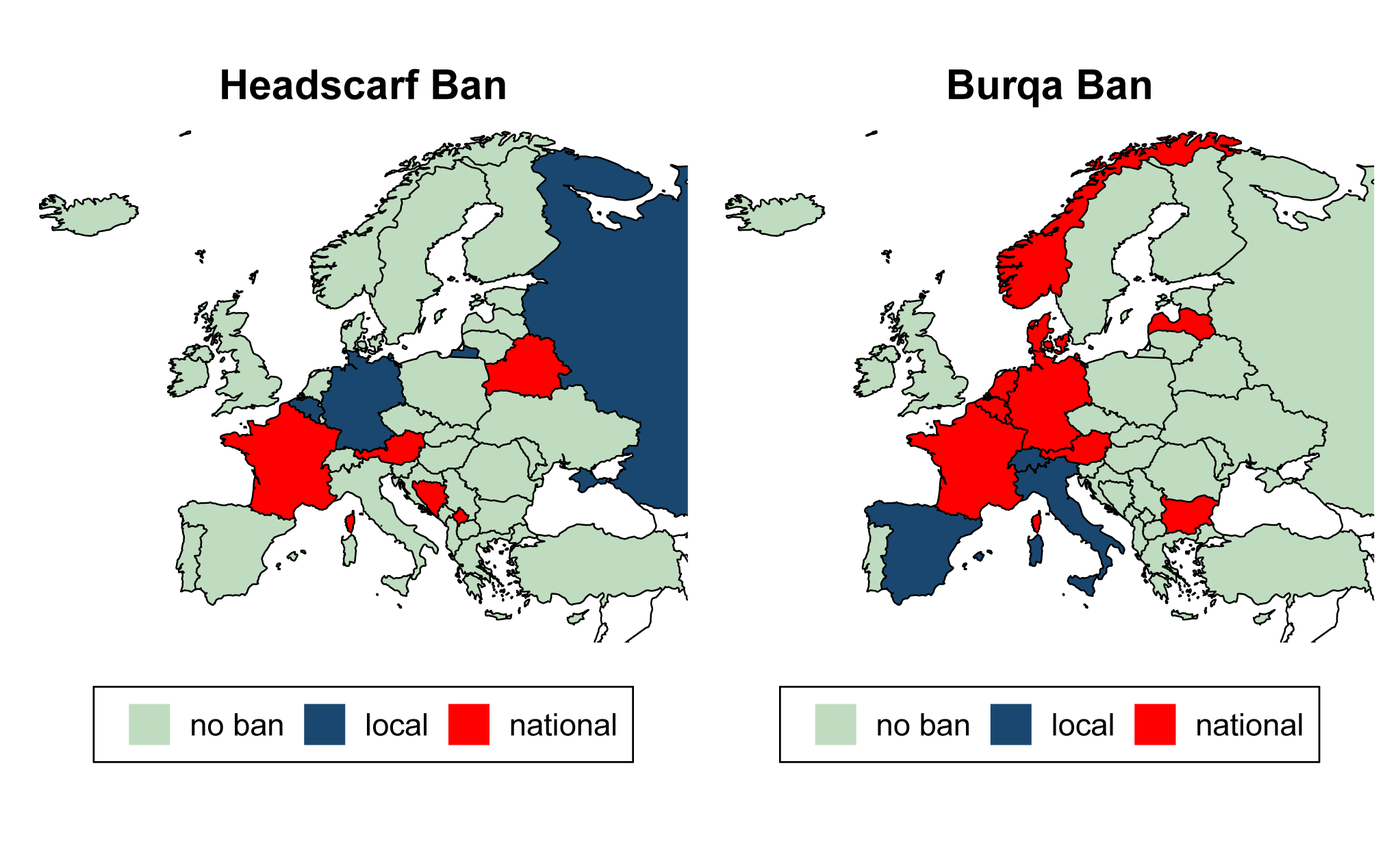
Such policies have on various occasions been upheld by the European Court of Justice, and survey data indicates that bans are supported by a majority of the public in countries where they are debated or enacted.Footnote 1 While their intended goal often is to reduce the visibility of religion in the public sphere, policies of secularity may inadvertently have other effects on the behavior of the religious minorities they target. There has been little systematic investigation of bans’ broader effects, and yet this question should be of paramount importance, not only to social scientists but also to policymakers and Western societies that grapple with achieving both immigrant integration and the preservation of Western culture. To what extent are religious bans contributing toward these goals?
Research suggests reasons to doubt the efficacy of bans in assimilating immigrants. Despite approval from native populations, veiling bans are perceived as discriminatory by Muslims.Footnote 2 Discrimination has been robustly connected to pernicious effects on psychological well-being (Banks, Kohn-Wood, and Spencer Reference Banks, Kohn-Wood and Spencer2006; Noh and Kaspar Reference Noh and Kaspar2003; Padela and Heisler Reference Padela and Heisler2010), which can negatively affect many domains of an individual’s life. For Muslim women affected by veiling bans, this implies worse school performance or impaired labor market integration.
When it comes to minorities’ social and psychological integration, the effects of discrimination are less well understood. Theoretically, discrimination may weaken attachments to the discriminated group and precipitate assimilation. Equally plausibly, it may increase the sense of minority identification as a means of buffering negative effects on self-esteem (Branscombe, Schmitt, and Harvey Reference Branscombe, Schmitt and Harvey1999; Turner and Tajfel Reference Turner and Tajfel1986) and trigger “reactive identity” (Rumbaut Reference Rumbaut and Weiner2005, Reference Rumbaut2008). Empirically distinguishing between these possibilities is challenging because discrimination and its perceptions are endogenous to minority members’ integration and identity.Footnote 3 Existing correlational studies have found evidence of both higher and lower engagement of minority members with majority society in response to institutionalized or societal discrimination (Oskooii Reference Oskooii2016, Reference Oskooii2018; Schildkraut Reference Schildkraut2005). Similarly ambiguous is the literature on anti-Muslim discrimination in the West. While most studies speculate that Islamophobia has led to “reactive religiosity,” empirical evidence on this remains inconclusive (Voas and Fleischmann Reference Voas and Fleischmann2012).
This paper is the first attempt to empirically identify the effect of veiling bans on a range of behavioral and attitudinal outcomes of Muslims. We do so in the context of the most famous of veiling laws, the 2004 French law on secularity and conspicuous religious symbols. The law banned the use of religious signs in primary and secondary public schools in France, and though it did not explicitly single out any particular symbol or religion (large Christian crosses as well as Sikh turbans and Jewish yarmulkes were included in the ban), it targeted and de facto mostly affected veiled Muslim schoolgirls. Using rich individual-level data from the French Labor Force Survey, the French census, and a representative survey of immigrants and immigrant-descendants in France, we employ a difference-in-differences strategy to isolate the effect of the law on the socioeconomic and identity outcomes of Muslim women. Muslim-origin women have different outcomes from women of non-Muslim origin, but if this gap increases or decreases for cohorts young enough to have been at school when the law was enacted (compared with older cohorts that did not experience the ban), the change can be attributed to the law’s effect.
Our main finding is that exposure to the ban significantly reduces the likelihood of completing (any) secondary education. This effect is due to disruptions in women’s educational trajectory during the period of the ban’s implementation. There is an increase in dropout rates from secondary education for Muslim women aged 17 and above—the cohorts that, by French compulsory schooling law, were legally allowed to drop out. We also find that Muslim women affected by the ban took longer to complete secondary education and were more likely to have repeated a class. The negative educational shock carries over to a number of longer term outcomes, such as labor force participation and employment rates.
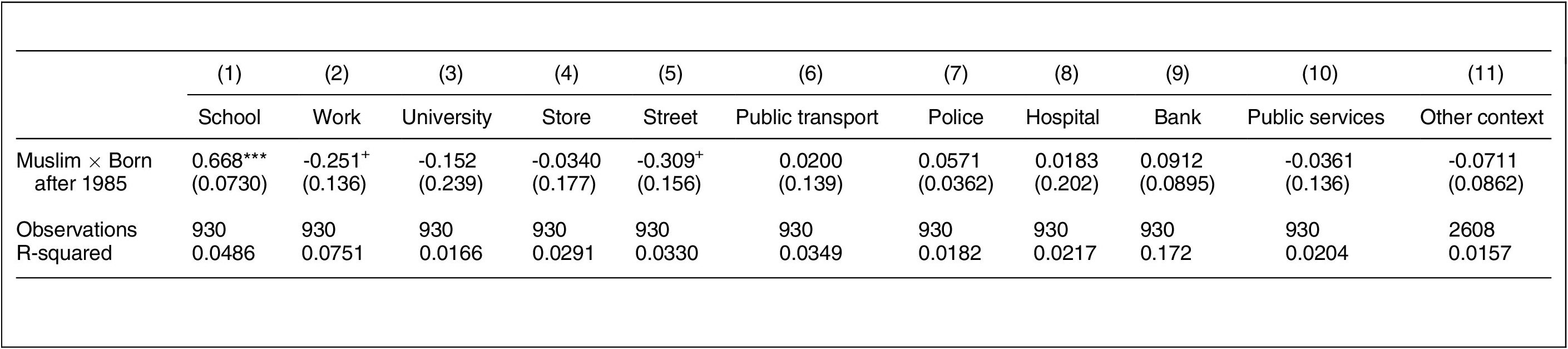
We find evidence that the law disrupted the educational trajectory through increased perceptions of discrimination at school among Muslim girls. The magnitude of our estimates is too large to be explained by the relatively low number of girls estimated to have veiled at school prior to the ban. This indicates that the climate of increased scrutiny of Muslim girls’ dress created by the law also affected girls who did not veil. School-aged Muslim girls only report higher discrimination in the school, but not in other contexts such as streets, stores, or public services, speaking against effects being driven by broader Islamophobia triggered by the law. We find only a small and transitory effect of the law on school-age Muslim boys, suggesting discrimination at school was targeted against or perceived more intensely by Muslim girls.
We also find that the ban influenced identity choices. Muslim women in affected cohorts increase their identification both with France and with Islam. These results indicate a general increase in the salience of identity for affected cohorts and can be interpreted as a reaffirmation of Muslim women’s belonging to both French society and their religious communities. Not all identities were strengthened equally for all women. Religious identity increased more for devout women and French identity increased more for women who, by various metrics, were initially more integrated in French society.
One of the paper’s central contributions is to provide the first causal assessment of the effects of veiling laws in general and of the French 2004 law in particular. Given the increasing prevalence of these laws, the intense debate surrounding them, and increasing convergence in integration policy across Europe (Joppke Reference Joppke2007), a systematic positive evaluation of their effects was prominently absent.
Beyond that, we contribute to several other literatures. First, we provide new evidence on discrimination’s effects on the behavior and integration outcomes of immigrants in general and Muslim immigrants in particular (Gould and Klor Reference Gould and Klor2015; Oskooii Reference Oskooii2016, Reference Oskooii2018; Schildkraut Reference Schildkraut2005). The majority of studies on this topic lack exogenous variation in discrimination and thus do not causally identify discrimination’s effects on minority behavior. Our study contributes to this literature by isolating a causal effect of the veiling ban on Muslim outcomes and providing evidence that the effect is driven by material changes in schools that heighten perceived discrimination and dampen psychological well-being. And while most studies emphasize either assimilation (Fouka Reference Fouka2019) or alienation (Adida, Laitin, and Valfort Reference Adida, Laitin and Valfort2014; Gould and Klor Reference Gould and Klor2015; Schildkraut Reference Schildkraut2005) as a consequence of discrimination, our results show that worsened educational and socioeconomic outcomes do not necessarily go hand in hand with social alienation from majority society and that identity choices in response to discrimination are not necessarily binary. Individuals may strengthen their in-group identity while simultaneously affirming their belonging to the majority group.
Second, we contribute to a long-standing debate on the effects of assimilationist versus multiculturalist policies, complementing existing cross-country evidence (Bloemraad and Wright Reference Bloemraad and Wright2014; Wright and Bloemraad Reference Wright and Bloemraad2012). Consistent with both theoretical and empirical accounts (Bisin et al. Reference Bisin, Patahini, Verdier and Zenou2011; Carvalho Reference Carvalho2012; Fouka Reference Fouka2020), we find that policies with an assimilationist character lower minority integration. Despite this, religious bans do not necessarily reduce the sense of belonging to majority society but rather lead to the reaffirmation of dual identities.
Finally, our paper also contributes to a burgeoning literature on the politics of the headscarf. Scholars document that veiled women report experiencing discrimination at higher rates relative to other Muslim Americans (Dana et al. Reference Dana, Lajevardi, Oskooii and Walker2019), and several papers link these discriminatory experiences to greater political activism (Jalalzai Reference Jalalzai2011; Westfall et al. Reference Westfall, Russell, Welborne and Tobin2017). We provide causal evidence that institutional discrimination differentially affects Muslim women’s outcomes beyond political participation.
Context
Islam and Laicité in France
France is home to approximately 6 million Muslims (Mattei and Aguilar Reference Mattei and Aguilar2016). Contemporary debate over their assimilability can be traced to the 1980s, when Islam in France underwent a religious resurgence. Muslims’ increased religiosity triggered public anxiety in France. Islam was associated with fanaticism and retrogradeness, due in part to media coverage conflating Islam with global fundamentalism and terrorism (Appignanesi and Maitland Reference Appignanesi and Maitland1989; Bowen Reference Bowen2007; Piscatoi Reference Piscatoi1990). The heightened salience of Islam was also perceived to be in conflict with France’s secular tradition. France’s approach to religion, and response to Islam, is shaped by historical church-state relations (Mattei and Aguilar Reference Mattei and Aguilar2016; Soper and Fetzer Reference Soper and Fetzer2003). In 1905, a republican government codified the separation of the church and state, effectively enshrining the principle of laicité (loosely translated as “secularism”), after which faith has been relegated to the private sphere and organized religion strongly regulated.
Laicité was importantly enacted through the establishment of a republican education system. Religious instruction was removed from the curriculum and lay personnel became responsible for schools. With these changes, the state sought to replace religious fealty with nationalism (Kepel Reference Kepel2012). Schools were and remain an important vehicle through which the French state creates citizens (Lorcerie Reference Lorcerie2012). Within this context, the increasing religiosity of Muslim children—exemplified by pupils in headscarves, requests for halal food (meals prepared as prescribed by Muslim law), and refusal to engage in certain activities (like co-ed physical education)—was perceived as an assault on the very institution instilling republican values (Bowen Reference Bowen2007).
The Headscarf Ban
Tensions between Muslim pupils’ increased religiosity, most clearly manifest in girls veiling, and the French tradition of laicité culminated in several crises focused on the headscarf. School principals and administrators, to varying degrees, tried to combat veiling among Muslim pupils. These daily battles erupted onto the national stage with the 1989 headscarf affair, an event which instigated government intervention. In 1989, three veiled Muslim girls were expelled from Gabriel-Havez middle school for infringing on the neutrality of public schools. The students filed suit against the school, and the case reached the Conseil d’Etat (French Supreme Court for administrative law). Ultimately, the court ruled that girls had the right to veil unless their headscarves were disruptive, and it instructed schools to determine disruptiveness on a case by case basis (Mattei and Aguilar Reference Mattei and Aguilar2016). In 1994, the minister for education François Bayrou issued a circular reinforcing the court’s decision and set up a ministerial office to mediate between schools and pupils in headscarf cases (Winter Reference Winter2009).
In 2003, when headscarf expulsion persisted, the government convened the Commission to Reflect on the Application of the Principle of Secularism in the Republic. The Stasi Commission—as it is known—consisted of a group of public intellectuals and politicians and conducted expansive consultations. Educators reported that headscarves jeopardized the liberating mission of schools “to give citizens-in-the-making the means to free themselves from social, cultural, ethnic, or gendered determinism” (Bowen Reference Bowen2007). Veiling, they argued, impinged on the liberty of conscience of other pupils and represented the triumph of communitarian pressures. After hearing submissions from over 100 stakeholders, the commission published the Stasi Report (Reference Stasi2003), where it advocated state intervention, including among other suggestions a ban on veiling in schools.
In 2004, the French parliament passed a bill banning conspicuous religious symbols in schools. The bill broadly prohibits ostentatious religious symbols, including large crosses and yarmulkes. However, headscarves were the intended target of the law and also the main symbol affected by the law in practice, given their relative prevalence as compared with other religious symbols (Silverstein Reference Silverstein2004). The bill went into effect in September 2004 in primary and secondary public schools.
While no systematic study of the ban exists, there are a few lessons about its effects. The French government sponsored a study of the law’s immediate impact. The Chérifi report studied four public schools and documented a decrease in veiling and expulsions (Chérifi Reference Chérifi2005). At the start of the school year in 2004, only 639 out of 10 million students showed up wearing ostentatious religious symbols, 626 of whom were Muslims (Mattei and Aguilar Reference Mattei and Aguilar2016).Footnote 4 Of the 639, 143 students switched from public to private schools and 50 enrolled in long-distance courses (Mattei and Aguilar Reference Mattei and Aguilar2016).
Conceptually Linking Religious Bans to Minority Outcomes
How would we expect the 2004 ban on religious symbols to affect the choices and outcomes of French Muslim women? We form our expectations based on a rich interdisciplinary literature, as well as semi-structured interviews with Muslim women conducted by one of the authors in Paris in July and August 2011.Footnote 5
Educational Outcomes
The law’s differential effect on Muslim girls could have impaired educational outcomes through two channels. The first one is school-specific. The law changed the reality in schools for Muslim girls, both veiled and unveiled. For veiled schoolgirls, it authorized differential treatment by instructing school administrators to single them out and subject them to scrutiny over their mode of dress. Moreover, the law imposed sanctions on veiled girls who persisted in wearing the headscarf. As a first step, the girls were removed from their classes to discuss alternatives to veiling with school administrators (Mattei and Aguilar Reference Mattei and Aguilar2016). If this negotiation failed, the girls were expelled with few other educational options: they could leave the education system (if older than 16), switch to private school, pursue distance learning, or leave the country.
The role of educational disruptions through the mediation and expulsion of veiled girls is highlighted in our interviews. Twenty-eight-year-old Nadia shared her own experience.Footnote 6 After her teachers tried and failed to convince her to unveil, the school suspended her and engaged a government mediator to resolve the impasse. Her parents, concerned about her education, ultimately convinced her to unveil and she returned to school. Her experience illustrates how outlawing veiling in schools directly disrupts the educational trajectories of veiled Muslim girls, with the potential to undermine their academic performance.
Besides its direct effect on veiled girls, the law altered the overall environment in schools. Officials in the Education Ministry noted within schools “a newly aggressive climate toward Muslims” to eradicate religious symbols (Bowen Reference Bowen2007). Our interviews illustrate that this greater scrutiny and more aggressive school environment likely undermined psychological well-being for all Muslim schoolgirls, including those who did not veil. Interviewees in school during the 2004 law reported greater focus on them and their choices. One respondent, a university student in 2004, observed within her community that Muslim girls became the center of attention and “lost support in school.” A significant literature demonstrates that incidents perceived as discriminatory (differentially targeting one’s group) are associated with mental distress in the form of anxiety, stress, depression, and low self-esteem (Banks, Kohn-Wood, and Spencer Reference Banks, Kohn-Wood and Spencer2006; Cano et al. Reference Cano, Castro, de Dios, Schwartz, Lorenzo-Blanco, Roncancio and Martinez2016; Coker et al. Reference Coker, Elliott, Kanouse, Grunbaum, Schwebel, Gilliland, Tortolero, Peskin and Schuster2009; Padela and Heisler Reference Padela and Heisler2010). A lawyer who defended Muslim girls in school expulsion cases explained, “For those who remained [in school], there was an enormous psychological effect. They are made to feel like culprits but they have done nothing. Despite that, they are humiliated, and [they] do not understand why they are insulted or made to feel like outsiders.” Both veiled and unveiled respondents indeed recall feeling “dirty,” “not accepted,” “alienated,” and “ashamed.” In line with studies that directly link discrimination to impaired educational outcomes (Chavous et al. Reference Chavous, Rivas-Drake, Smalls, Griffin and Cogburn2008; Levy et al. Reference Levy, Heissel, Richeson and Adam2016), we expect that the school climate’s negative effects on psychological well-being adversely affected educational performance.
A second plausible channel for the law’s effects is through the public debate that it spurred over veiling, which contributed to greater scrutiny over Muslims. Media coverage and elite discourse linked the headscarf to communitarianism, Islamism, and sexism (Bowen Reference Bowen2007) and presented it as a threat to women’s rights and French republican values (Deltombe Reference Deltombe2005). It is plausible that such discourse and associated Islamophobia would affect those identifiable as Muslim, consistent with a literature showing that characteristic Muslim features such as names, or attire, are associated with increased bias in observational and experimental contexts (Adida, Laitin, and Valfort Reference Adida, Laitin and Valfort2010, Reference Adida, Laitin and Valfort2014; King and Ahmad Reference King and Ahmad2010; Park et al. Reference Park, Malachi, Sternin and Tevet2009). For such effects to be picked up by our identification strategy, they would have to differentially affect school-aged cohorts of Muslim girls.Footnote 7
Identity
Besides direct effects on educational outcomes, the 2004 ban could have influenced social and group identity.Footnote 8 The law increased the salience of both Muslim and French identities and, to some, defined the Muslim headscarf as a “violation of French secularism, and by implication, a sign of the inherent non-Frenchness of anyone who practiced Islam, in whatever form” (Scott Reference Scott2009). Casting the two identities as incompatible could have led French Muslim girls, who until that point had readily identified as members both of their religious community (perhaps by wearing the headscarf) and of France (their country of birth), to identify more with one or the other group.
The literature’s findings on the relation between perceived discrimination and identity are decidedly mixed. On one hand, research in social psychology shows that exclusion from a group can increase identification with that group (Gomez et al. Reference Gomez, Francisco Morales, Hart, Vazquez and Swann2011). The need of French-born girls to belong and avoid discrimination might have led them to disassociate from their religious and ethnic communities and emphasize their Frenchness (Fouka Reference Fouka2020). Increased identification with the majority in response to discrimination would be consistent with patterns in aggregate data. For example, despite pervasive discrimination against them (Adida, Laitin, and Valfort Reference Adida, Laitin and Valfort2010; Duguet et al. Reference Duguet, Leandri, L’Horty and Petit2010), Muslims report feeling closer to French people than to members of their own religion or nationality (Laurence and Vaisse Reference Laurence and Vaisse2006).
On the other hand, perceived discrimination can lead individuals to disengage behaviorally and attitudinally from the discriminating majority (Fleischmann and Phalet Reference Fleischmann and Phalet2018; Kunst et al. Reference Kunst, Tajamal, Sam and Ulleberg2012; Schildkraut Reference Schildkraut2005). Reactive identity theory (Portes and Rumbaut Reference Portes and Rumbaut2001; Rumbaut Reference Rumbaut2008) even emphasizes the reaffirmation of minority identity in response to hostility by the majority, with a number of studies providing empirical evidence in support of it (Connor Reference Connor2010; Haddad Reference Haddad2007; Kabir Reference Kabir2012; Nagra Reference Nagra2011; Peek Reference Peek2005). Specifically, studies of Muslims have speculated “reactive religiosity” in response to Islamophobia, perhaps because religion uniquely helps individuals deal psychologically with low self-esteem caused by discrimination (Ysseldyk, Matheson, and Anisman Reference Ysseldyk, Matheson and Anisman2010).Footnote 9 According to these theories, Muslim girls could have retreated from French society, particularly the school system, the site of direct discrimination.
A third theoretical possibility is that women rejected the choice between identities and reasserted their right to be both French and Muslim. Oskooii (Reference Oskooii2016, Reference Oskooii2018) finds that institutional discrimination increases Muslims’ political engagement while simultaneously strengthening their engagement in their ethnic and religious communities. Relatedly, Beaman (Reference Beaman2015, Reference Beaman2016) shows that middle-class Muslims are adapting religious practice to gain acceptance in French society and maintain religious identity.
Interviews also point to the potential for different reactions to the law. Though respondents generally viewed the law as forcing “a choice for Muslims: concede your faith or recede from French society,” they responded in diverse ways. No interviewee conceded her religious and ethnic identities, but several cited women in their communities who stopped veiling after the law.Footnote 10 Some interviewees did choose to integrate on their own terms, by maintaining their veils and French values. As one respondent put it, she was born in France, she speaks the language, and she respects the laws, and therefore she was as French as any other citizen. To affirm their dual identities, several interviewees engaged in activism at university or through civic associations. One such activist explained, “But for me, I think that it [disengaging from French society] is not the solution at all. I think it is necessary to cling on . . . when you hang on, you make advancements.”
In contrast, other respondents chose to retreat into their Muslim identity. Several respondents observed members of their communities becoming more conservative as an “identity reflex.” One respondent explained that “some girls put on the hijab as an act of resistance because they felt attacked.” Another interviewee linked this conservative reflex directly to the law, stating, “When you stigmatize a community, people in the community will move toward extremism.” Retreat from French society was expressed in a myriad of ways, like attending a school where children of immigrants predominate, applying to work in Muslim-owned businesses, and moving to immigrant-dominated suburbs. One woman who left work altogether and began wearing the burqa presented her decision as a response to the specific targeting of Muslims: “You can do what you want without limitations if you have bad intentions. But there is persecution [of those who want to do good]. It is the hypocrisy of France. They teach in schools [that we are free] but then they close off all of your options; they do not accept you at all [if you do not conform].”
Heterogeneous Effects
The multiplicity of identity responses highlights a theme prominent in the literature studying discrimination: that baseline identity moderates both the actual experiences and perceptions of discrimination, as well as its effects. Women with a stronger religious identity could be subject to more discrimination but could also be more likely to label ambiguous encounters as discriminatory (Dana et al. Reference Dana, Lajevardi, Oskooii and Walker2019). At the same time, stronger religious identities could mitigate the negative effects of discrimination on well-being (Branscombe, Schmitt, and Harvey Reference Branscombe, Schmitt and Harvey1999). Depending on the dominant mechanism, the effect of the law on educational outcomes could have been stronger or weaker for Muslim girls who initially identified more with their religious communities.
Similarly, the initial degree of minority identification has ambiguous effects on the identity response to the ban. For individuals fused with a group, studies have found both that exclusion increases compensatory behavior the most (Gomez et al. Reference Gomez, Francisco Morales, Hart, Vazquez and Swann2011) but also causes the greatest disengagement (Schildkraut Reference Schildkraut2005). Theory thus provides little guidance on the heterogeneous identity impact of the law by initial degree of religious and national identification.
Summary of Hypotheses
In sum, we hypothesize that the headscarf ban depressed educational attainment primarily through disruptions in the classroom for veiled Muslim girls and through perceived discrimination and psychological distress for all Muslim schoolgirls. We also hypothesize that the ban impaired labor market outcomes in the long run, as a direct result of its negative effect on Muslim girls’ educational attainment. We expect that the law affected French, ethnic, and religious identity, without a clear prior as to the direction of average effects. Lastly, we expect that the initial degrees of devoutness and integration moderate the effects of the law on education and identity.
Data and Empirical Strategy
Data
We use two datasets in our main analysis of the ban’s effect on educational attainment, long-term labor and social outcomes, and identity.
French Labor Force Survey
Our main data source is the French Labor Force Survey (Enquête Emploi) and henceforth LFS (INSEE 2003-2012).Footnote 11 The LFS is a comprehensive survey of socioeconomic and labor market characteristics conducted in a representative sample of the French population. It is a rolling panel, with each household surveyed six consecutive quarters. For most of our analysis, we keep an individual’s first quarterly observation, thus treating the survey as a repeated cross-section. We rely on the father’s region of birth to identify Muslim women.Footnote 12 We identify “Muslims” as those whose fathers are born in the Maghreb or Middle East and drop those from sample regions which contain countries with and without a significant Muslim population (such as Rest of Africa). Our sample comprises French-born respondents, aged 20 or older in each survey year so that we can examine completed education and labor market characteristics, and interviewed from 2005 to 2012, survey years measuring both respondents’ and fathers’ place of birth.Footnote 13 Our cross-sectional sample consists of 52,201 observations including 4,163 Muslims.
Census Microdata
To verify the LFS results, we use the 2011 1% sample of the French census microdata, which is part of the International Integrated Public Use Microdata Series (Minnesota Population Center 2019). We identify Muslim women as those whose fathers were born in the Maghreb or Turkey and non-Muslim women as those whose fathers were born in Europe. Father’s nationality is only available for women who live with their fathers, so the dataset is unrepresentative of the population. More details on this data source are provided in Appendix Section B.4.
Trajectories and Origins Survey
To investigate identity responses and the mechanisms underpinning the ban’s effects, we use the Trajectories and Origins survey (Trajectoires et Origines) and henceforth TeO (INED and INSEE 2008).Footnote 14 The TeO was conducted in 2008 and 2009 on a sample of 21,000 people, including representative samples of immigrants, descendants of immigrants, and non-immigrant French. We identify treated and control groups by using self-reported religious adherence.Footnote 15 We restrict attention to women born in France.
A description of all variables is provided in Appendix Section C.1. Tables C.2 and C.3 provide summary statistics.
Identification Strategy
To evaluate the effects of the headscarf ban, we employ a difference-in-differences analysis. We compare the difference in outcomes between Muslim and non-Muslim women for cohorts in school during the ban versus cohorts who completed school before the ban. Students in France attend secondary education between ages 11 and 18. Attendance is compulsory by law until age 16. Upper secondary education prepares students for either a vocational or technical diploma (like BEP or CAP), which lasts until age 17, or for a high school degree, or baccalauréat, which lasts until age 18. Therefore, we assume that women born in 1985 or earlier, who were 19 or older in 2004, left secondary education before the law and were thus unaffected. Any cohort born in 1986 or later likely had at least one year of education under the new law.Footnote 16 These younger cohorts of Muslim girls constitute our treatment group. The distinction between treatment and control group is not sharp—some girls born after 1985 may have left school before the ban’s implementation—but this only introduces measurement error that would bias estimated effects toward zero. We always restrict our focus to cohorts born 1980 or later, to ensure roughly equal cohorts on either side of the 1986 cutoff.
Our simplest specification takes the form
 $$ {Y}_{icg}={\alpha}_1+{\alpha}_2{T}_{cg}+{g}_g+{c}_c+{\epsilon}_{icg}, $$
where i indexes individuals, c indexes birth cohorts, and g indexes groups based on the father’s region (LFS) or country of birth (IPUMS) or the individual’s religion (TeO); Tcg is an indicator for individuals identified as Muslim and who were 18 or younger in 2004 (born 1986 or later), gg and cc are group and birth cohort fixed effects, respectively, and ϵicg is an idiosyncratic error term. The coefficient of interest is α2, the differential treatment effect of the ban on school-age cohorts of Muslim women. When using the LFS, we control for birth year, survey year, and age fixed effects because we observe the same birth cohorts multiple times. Our preferred specification also includes father’s region of origin by age fixed effects because many educational and labor force outcomes follow a different age profile for Muslim versus non-Muslim women.Footnote 17
Threats to Identification
The validity of the difference-in-differences approach relies on two identifying assumptions. First, outcomes of Muslim and non-Muslim women would have followed parallel trends in the absence of the law. This assumption cannot be tested directly, but data for older cohorts demonstrates the absence of differential pre-trends in outcomes before the law. This rules out the possibility that school-age Muslim women’s behavior was already changing for reasons unrelated to the headscarf ban.
Second, there can be no time-variant unobservable factors that coincide temporally with the headscarf ban and differentially affect Muslim women. This assumption is unlikely to be violated because we are exploiting birth cohorts as a central dimension of time variation. Any time-variant confounder would have to differentially affect Muslim girls under the age of 18. We are not aware of changes in legislation or rules relating to the educational system that could be correlated with the 2004 ban. To the extent that the law spurred anti-Muslim sentiment that also affected older Muslim women, we likely would be estimating a downward biased differential effect of the law on school-age Muslim women.
A concrete time-varying unobservable confounder is a source of discrimination unrelated to the law, such as Islamophobia spurred by the September 11 attacks and still prevalent in later years. However, even if such discrimination differentially affected younger cohorts, it would not have manifested in a sharp break in the educational attainment of cohorts just old enough to be in school in 2004. In Appendix Section B.1, placebo exercises show that no cohort born before 1986 displays a significant drop in secondary educational attainment, as we would expect if other sources of discrimination, and not the ban, explained our findings.
Finally, it is worth emphasizing that we lack information on who veiled in 2004 and was thus treated by the law in the strictest sense. We also lack information on discriminatory treatment of Muslim schoolgirls, which constitutes an additional component of the law’s effect. What we are identifying is the effect of the law on school-age women who either report being Muslim (TeO) or whose fathers were born in an identifiable Muslim-majority region or country (LFS, IPUMS). To the extent that school-age Muslim women who did not veil or did not experience discrimination were unaffected by the 2004 ban, we would expect an additional downward bias in our estimates. In short, the potential spillover effects of the law and the lack of precise information on veiling practices and experiences of discrimination at school contribute to estimated treatment effects being a lower bound of actual effects.Footnote 18
Effects on Educational Attainment
The first order effect of the 2004 law should be traceable in educational attainment. Figure 2 depicts patterns of secondary school attainment for Muslim and non-Muslim women in the LFS. The upper panel plots the share of women who completed secondary education in the raw data. We define secondary completion as finishing any secondary education and attaining a vocational degree (CAP, BEP, or similar) or higher. Secondary attainment of Muslim women is generally lower, but follows a parallel trend to non-Muslim women for older cohorts, thus providing support to the main identifying assumption of the difference-in-differences strategy. This pattern ends abruptly with the group born in 1986, precisely the first cohort old enough to be affected by the ban while at school. The lower panel of Figure 2 plots residuals of the likelihood of having completed secondary education, conditioning on age and survey year fixed effects. It confirms the pattern in the raw data. The gap between Muslim and non-Muslim women more than doubles for the 1986 cohort, and remains large thereafter.
Rates of Secondary Education Completion by Birth Cohort for French-Born Women
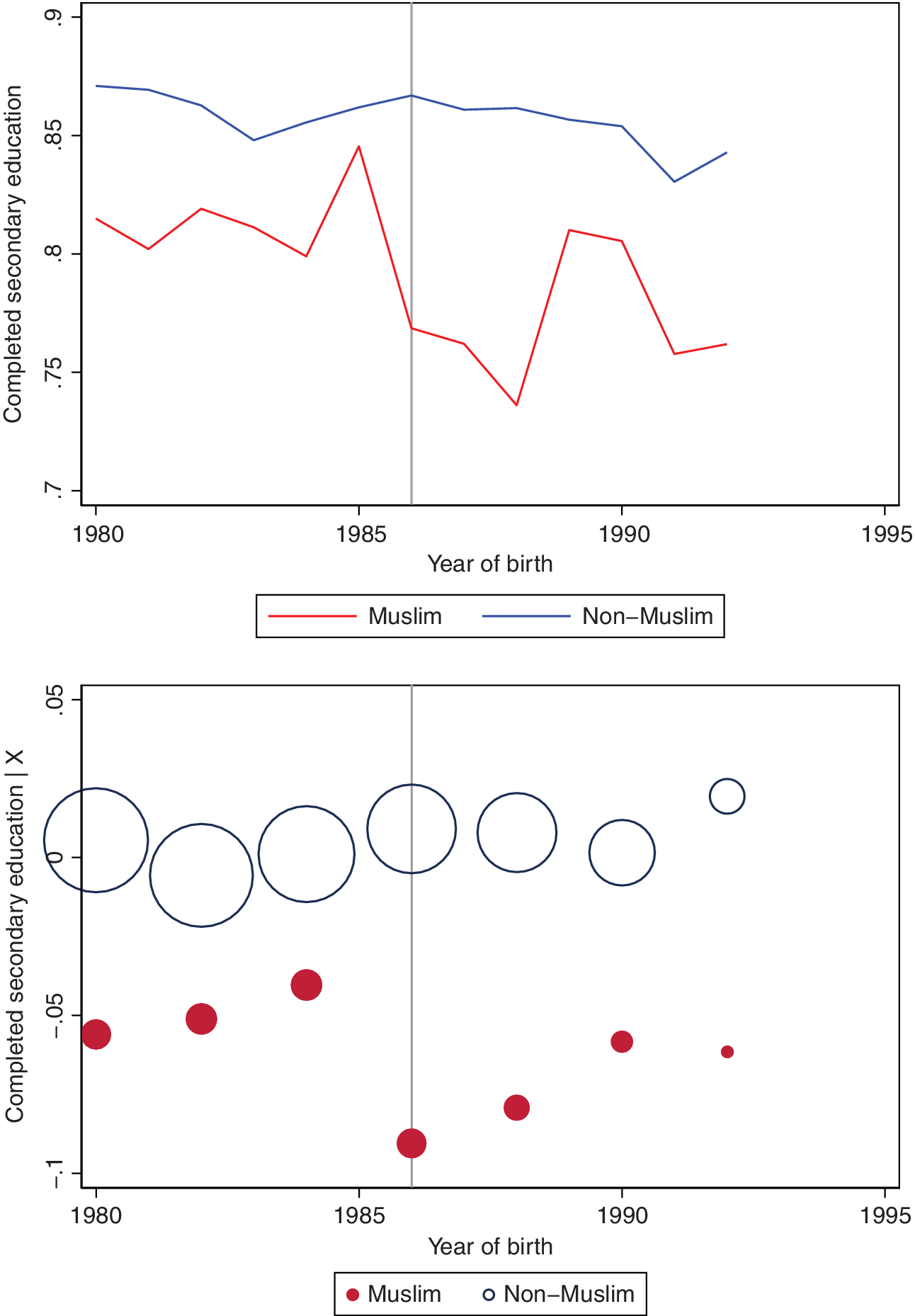
The most negative effect of the law is felt by cohorts aged 16–18 in 2004. This is not surprising. First, one would expect negative effects on well-being associated with the removal of the headscarf to be concentrated among older adolescents, who were more likely to be veiled and to have worn the headscarf for longer. Second, cohorts above the age of 16 were legally allowed to drop out of school and could have done so in response to perceived discrimination. In Section B.3 of the Online Appendix we provide direct evidence for increased dropout rates among older treated cohorts.
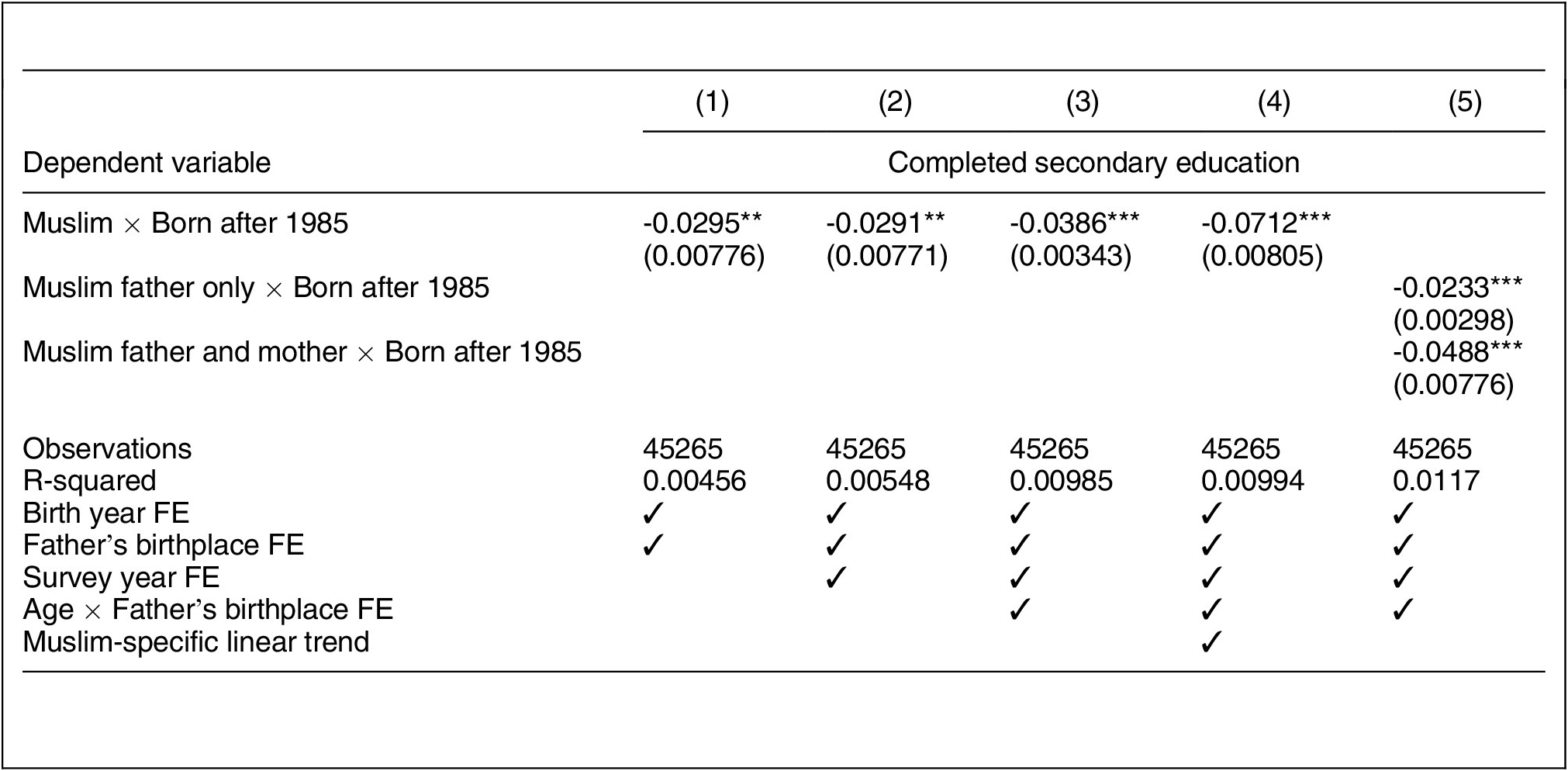
Table 1 clarifies the magnitude and demonstrates the robustness of the graphical result. Column (1) reports the interaction coefficient from equation 1, which indicates that the difference in the likelihood of completing secondary education between Muslim and non-Muslim women becomes almost three percentage points larger for school-age cohorts. The effect remains unchanged when including survey year fixed effects in column (2). In column (3), we control flexibly for age by father’s birthplace fixed effects, effectively allowing women from different origins to have different age profiles in terms of when they complete secondary education. This increases the magnitude of the estimated coefficient. In column (4), we include a linear Muslim-specific trend in birth year. The coefficient remains robust and further increases in magnitude. This increase likely captures a fact that can be observed in the lower panel of Figure 2: conditional on age, Muslim women born before 1986 were catching up with their non-Muslim counterparts in terms of secondary educational attainment.
Effect on Secondary Education Completion Rates
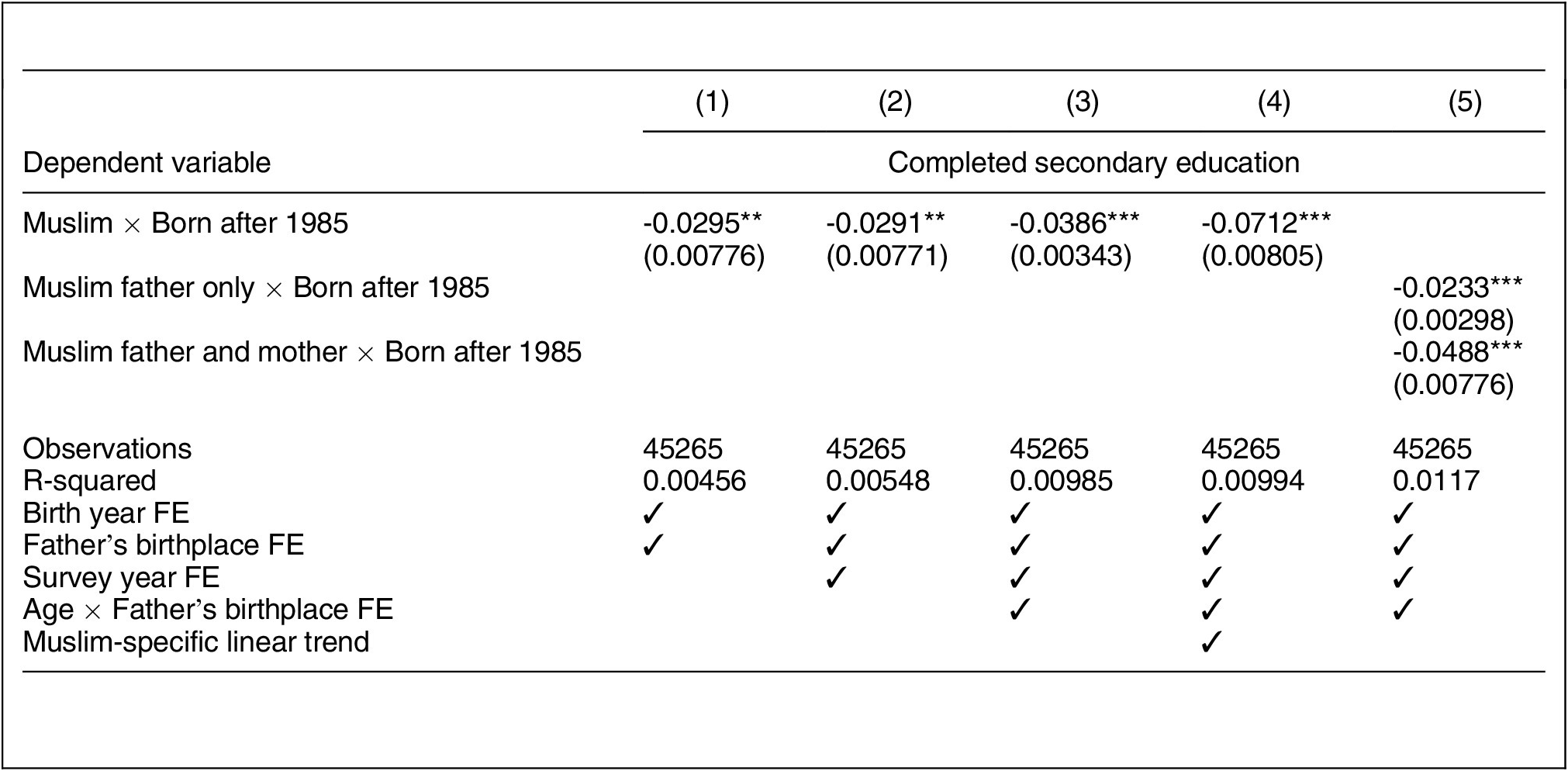
Note: The sample consists of French-born women born 1980 or later and who were at least 20 years old at survey year. Standard errors are clustered at the father’s birthplace level. Significance levels: ***p < 0.001, **p < 0.01, *p < 0.05, +p < 0.1.
The estimated effects are large. The magnitudes imply that the difference between Muslim and non-Muslim women in secondary attainment more than doubles. Our preferred specification, reported in column (3), implies that we can attribute to the veiling law a differential increase in the share of Muslim women who fail to finish any secondary education of 3.9 percentage points, which corresponds to 20% of the overall share of women without secondary education in our sample (19.1%).
Finally, column (5) investigates a source of the effect’s heterogeneity: the origins of the parents. The drop in secondary educational attainment is double in magnitude for women with both parents born in Muslim-majority regions, compared with those with a Muslim father and a non-Muslim mother. Parental origin may proxy for two things. The first is the intensity of the treatment—girls born in Muslim families are more likely to wear the headscarf or to be identifiable as Muslim and thus to have been directly affected by the ban. The second is the strength of religious identity, which may enhance perceptions of discriminatory treatment and amplify any negative effects on psychological well-being and school performance.Footnote 19
We perform a number of checks to validate the estimated effect of the ban on secondary school attainment. We find no negative effects on education for school-age cohorts of women with non-Muslim immigrant parents, which speaks against general xenophobia or other confounders potentially affecting second-generation immigrants at school. We show that the effect is not driven by other changes coinciding temporally with the headscarf ban, such as Islamophobia spurred by the September 11 attacks, or by imbalances across the sample of Muslims and non-Muslims. We also assess the sensitivity of our results to different definitions of secondary school completion. A detailed description of robustness checks is available in Appendix Sections B.1 and B.2.
We show that the negative effect of the law on women’s educational outcomes works through two channels. First, Muslim girls are more likely to drop out of secondary education. Second, girls who remain in school take longer to complete secondary education. We summarize these results here and provide a detailed analysis in Section B.3 of the Online Appendix.
The LFS data reveals that Muslim women in treated cohorts were significantly more likely than their non-Muslim counterparts to be enrolled in secondary education at any given age, which indicates that it took them longer to complete secondary education (Figure B.3). The effect is large enough to explain the entire difference in secondary enrollment rates among 20-year-olds (7.9% for non-Muslims vs. 13.3% for Muslims). Exploiting information from TeO, we find that treated Muslim women are more likely to have repeated a class and more likely to have attended a school outside their designated school district because of the religious beliefs of their parents (Table B.5).
We use the panel nature of the LFS to examine how the student status of Muslim women changed after 2004. We find that Muslim women are 6 percentage points more likely to drop out of secondary education between 2003 and 2004 (Figure B.4 and Table B.6). This effect explains up to 60% of the long-run average rate of leaving secondary education in our data (11.8%).
Effects on Long-Run Integration
Socioeconomic Outcomes
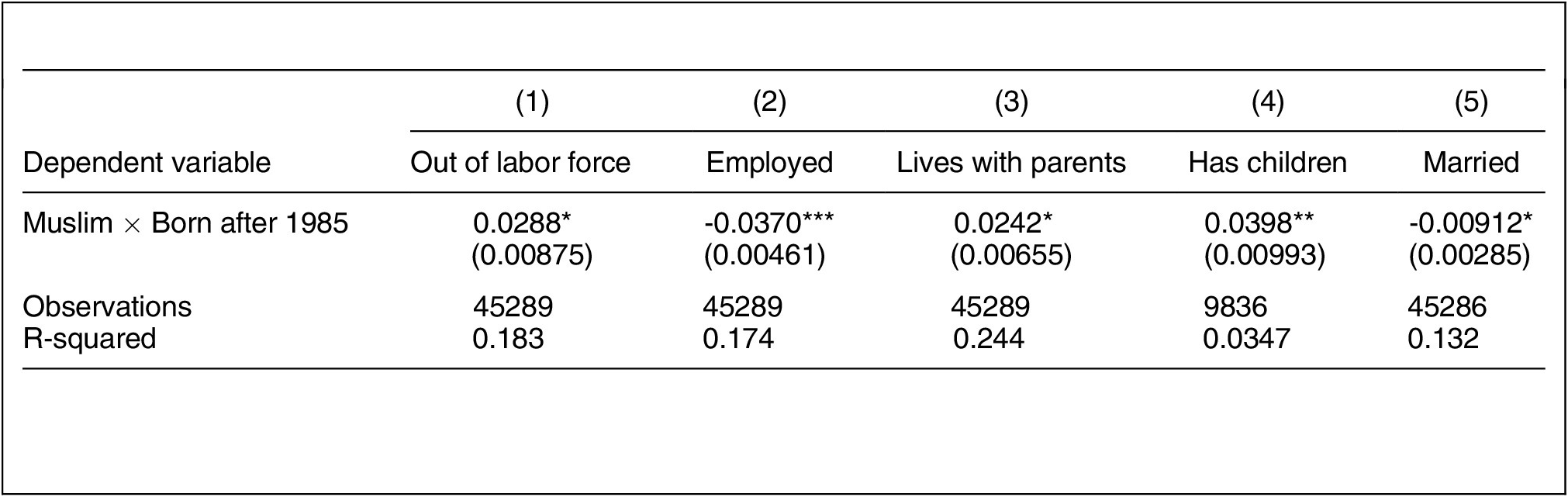
We next proceed to examine how the headscarf ban affected long term integration. We repeat the analysis presented in Table 1 using as dependent variables a number of economic and social outcomes: labor force participation, employment, co-habitation with one’s parents, marital status, and number of children. In Table 2, we estimate our preferred specification of equation 1, which includes age fixed effects interacted with father’s birthplace. Affected cohorts of Muslim women are almost 3 percentage points more likely to be out of the labor force and 3.7 percentage points less likely to be employed. They are also 2.4 percentage points more likely to live with their parents. Finally, while we find a small (negative) difference in the likelihood of marriage, affected cohorts are almost 4 percentage points more likely to have children.
Effect on Long-term Outcomes

Note: The sample consists of French-born women born 1980 or later and who were at least 20 years old at survey year. All regressions include birth year, father’s birthplace and survey year fixed effects, and father’s birthplace by age fixed effects. Standard errors are clustered at the father’s birthplace level. Significance levels: ***p < 0.001, **p < 0.01, *p < 0.05, +p < 0.1.
The effects are substantial. When comparing them with the difference between Muslim and non-Muslim women among untreated cohorts, the estimated magnitudes indicate that the veiling law widens the employment gap by more than a third (initial gap of 10.9%) and the labor force participation gap by more than half (initial gap of 5.3%). The gap between Muslims and non-Muslims in cohabitation with parents also increases by more than a third of the initial gap of 6.9%.
Reassuringly, we find similar patterns when we replicate our results in the 2011 1% sample of the French census (Table B.7 in the Appendix). In that data, the law is estimated to differentially reduce secondary completion rates by 2.9 percentage points for treated cohorts, a magnitude essentially identical to that estimated in the LFS. Negative effects on labor force participation and employment rates are also very similar. This is encouraging, as it suggests that the results are not sensitive to the precise definition of the Muslim and non-Muslim groups nor to the representativeness of the sample. A more detailed discussion of the Integrated Public Use Microdata Series results is provided in Appendix Section B.4.
Identity
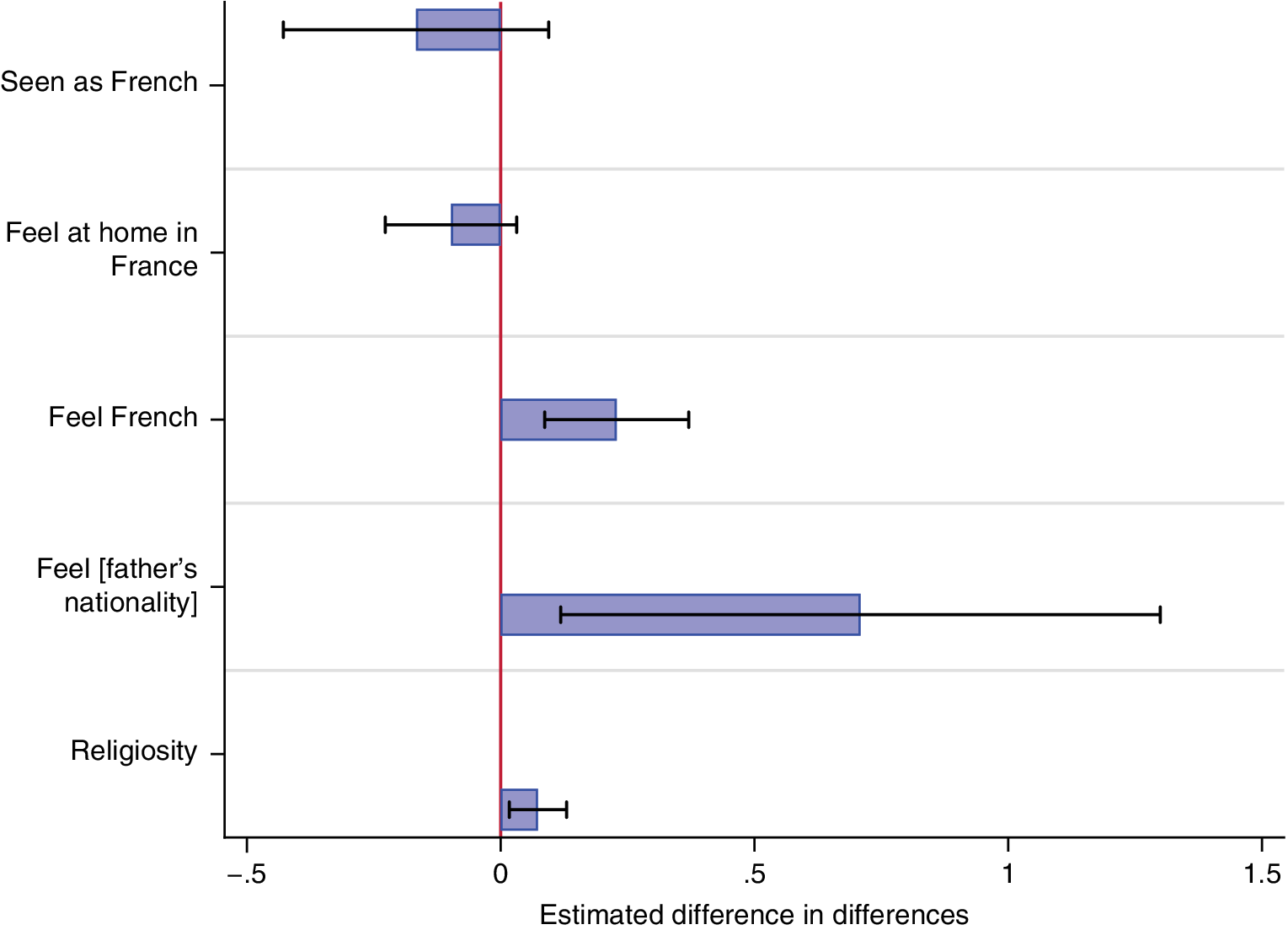
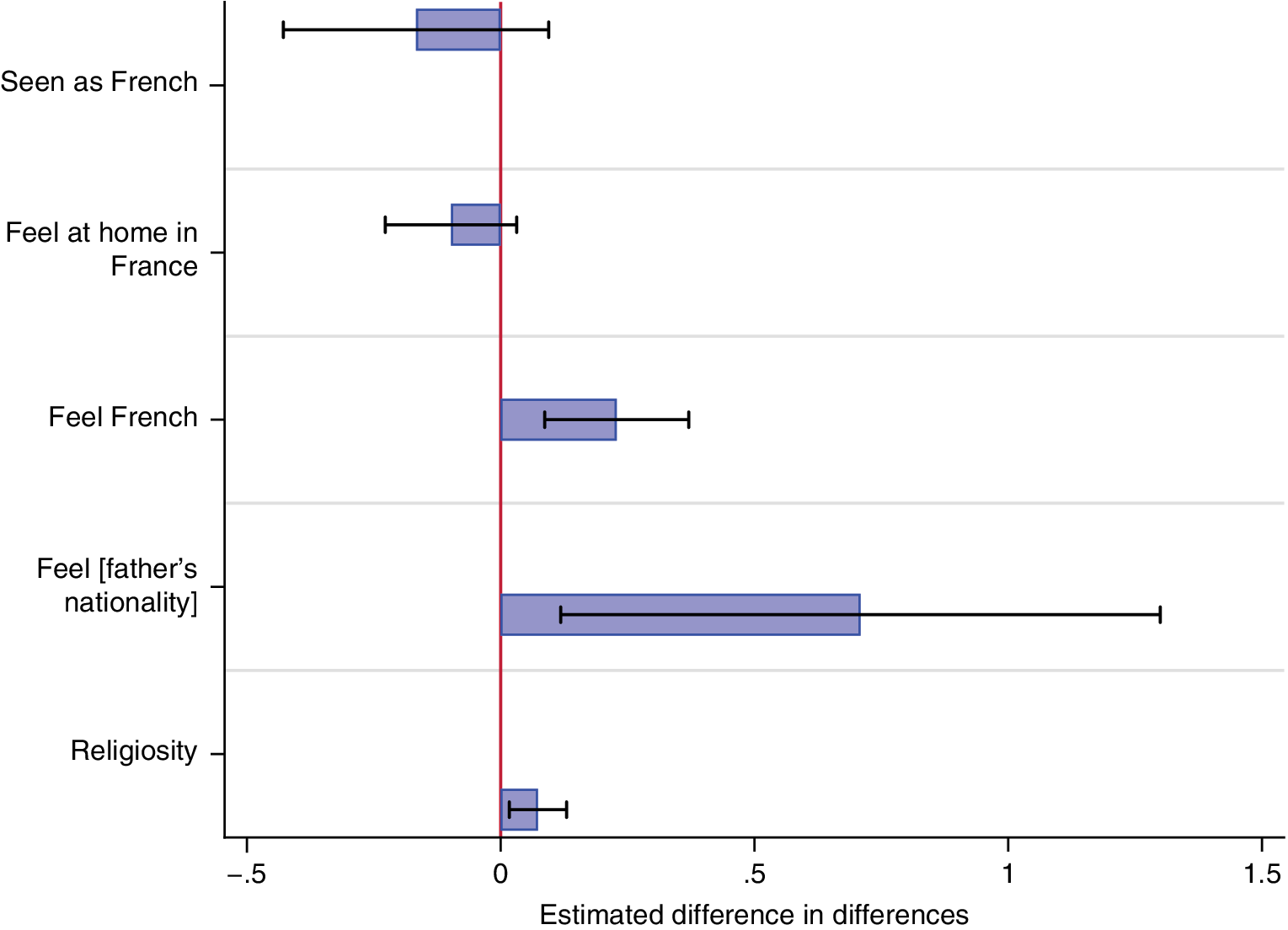
We next use the TeO data to examine whether the 2004 ban had an effect on social identity. Figure 3 reports differential effects on various self-reported measures of identity for school-age cohorts of Muslim women.Footnote 20 While treated cohorts are less likely, though not significantly so, to report that they are seen as French or that they feel at home in France, they are significantly more likely to identify as French. They are also more likely to identify with the father’s country of origin, though this outcome is only available for a small subset of observations and is estimated with noise. We also find that religious identity, proxied by an index of religiosity, is strengthened in response to the law.Footnote 21 Existing theories of oppositional identity formation (Bisin et al. Reference Bisin, Patahini, Verdier and Zenou2011) and reactive identity (Rumbaut Reference Rumbaut2008) emphasize the strengthening of one out of several, presumed to be incompatible, identities in response to discrimination. Our results provide a more nuanced picture. The headscarf ban may have cast Muslim identity as incompatible with French ideals, but the TeO results suggest that Muslim women respond to this by reaffirming their belonging to both France and their ethnic and religious communities. These results resonate with those in Oskooii (Reference Oskooii2018), who finds that perceptions of institutional discrimination against Muslims are correlated with increased political participation and higher mosque attendance.
Effects on Self-Reported Measures of Identity
One way of interpreting these findings, together with our interview data, is as pointing to a new mode of identity formation in migrant-receiving societies. Native-born children of immigrants redefine what it means to be a citizen of a Western country, by asserting that existing notions of national identification should be modified to incorporate their cultural and religious differences.
Mechanisms
Discrimination in the School
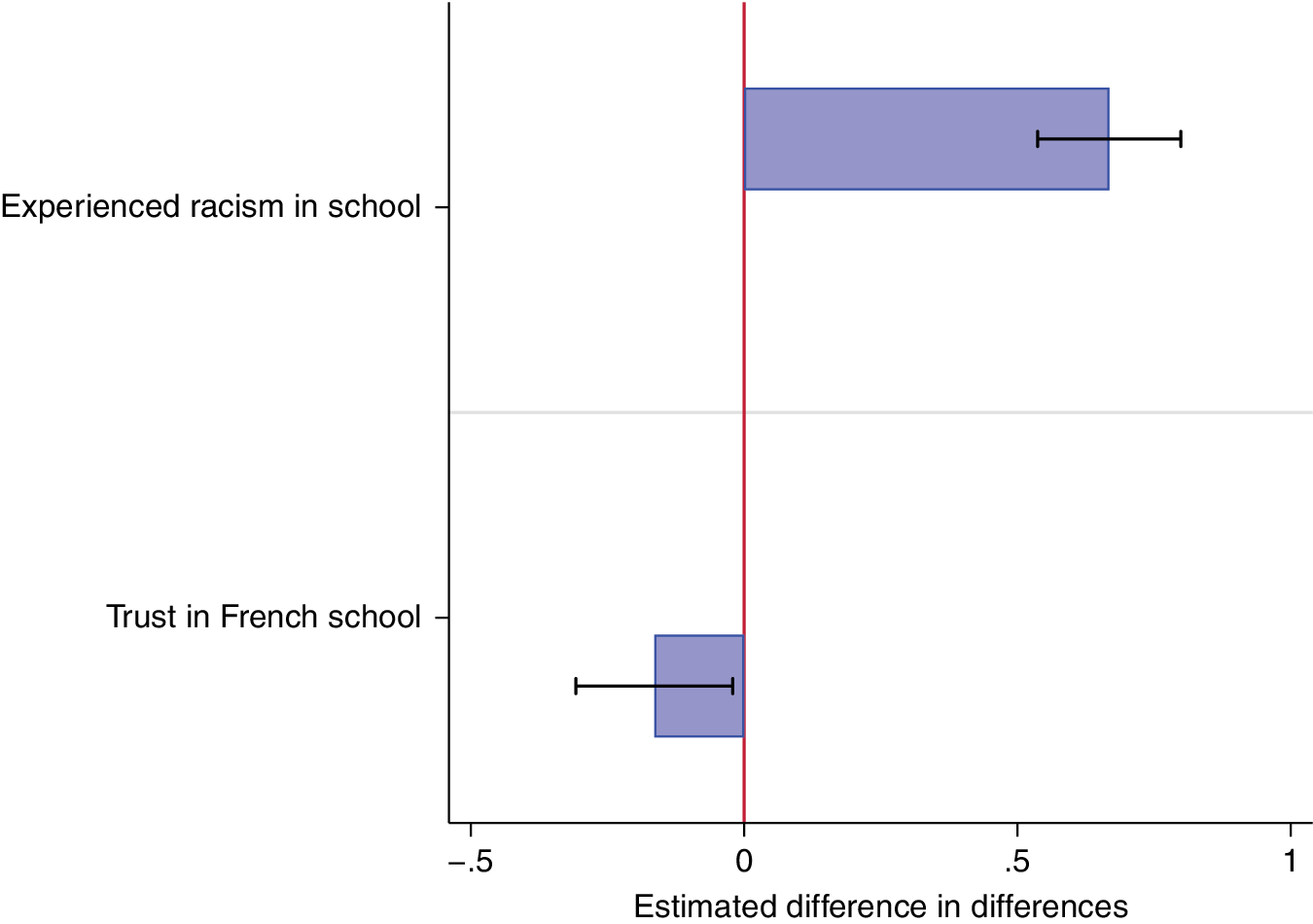
To investigate whether discrimination while at school was a key mediator for the observed effects on Muslim girls’ outcomes, we directly examine perceptions of discrimination of treated cohorts using the TeO survey. Figure 4 plots the interaction coefficient from equation 1.Footnote 22 Affected cohorts are significantly more likely to say that they experienced racism (i.e., insults or harassment) in school. They are also more likely to report lower trust in the French school.
Experiences in and Views of French School.

Following literature in public health (e.g., Coker et al. Reference Coker, Elliott, Kanouse, Grunbaum, Schwebel, Gilliland, Tortolero, Peskin and Schuster2009), heightened perceptions of discrimination in school could have negatively affected educational performance by depressing psychological well-being. The TeO does not contain questions about mental health. Instead, we use questions about general health to investigate this pathway. We find tentative evidence that treated cohorts experienced worse health outcomes. Table A.3 in the Online Appendix shows that treated cohorts report (not significantly) lower levels of subjective health (Column 1). The effect is strongly significant when we examine a binary indicator for respondents who say that their health is bad or very bad (Column 2). We further investigate health disparities between treated and control cohorts through questions on types of health problems and ages at which they started. We construct an indicator for individuals whose health problems relate to life conditions or difficulties in private life and whose problems appeared while they were at school age. Treated cohorts are significantly more likely to report health problems related to these two domains while at school age (Column 3). As a falsification test, we examine health problems related to preexisting health conditions, pregnancy (Column 4), or work (Column 5). No effect is found for the first two types, though there is noisy indication of higher incidence of work-related problems. Taken together, these patterns provide evidence that the ban may have operated through a health-related pathway.
Law and Public Debate
An alternative mechanism through which the law could have affected Muslim schoolgirls is the broader debate it spurred around the headscarf and Muslims in France. News data reveals that public discussion around veiling became increasingly heightened in 2003 and 2004, directly after the government convened the Stasi Commission and enacted the headscarf law (Figure A.2 in the Online Appendix). To the extent that the public debate adopted an anti-veiling and anti-Muslim tone, broader hostility and discrimination against Muslims could have ensued.
That such generalized anti-Muslim sentiment drove the effects we estimate is a priori unlikely. Our identification relies on cross-cohort variation in exposure to the law at school and both the raw data (Figure 2) and our placebo exercises (Table B.1) indicate that the drop in secondary education manifests sharply for school-age cohorts. Even if generalized hostility against Muslims differentially affects younger cohorts who are more impressionable (Krosnick and Alwin Reference Krosnick and Alwin1989), there is no reason for a sharp break in secondary completion rates to manifest for women aged 18 or younger.Footnote 23
Additional evidence suggests that our estimates are not driven by broader anti-Muslim debate. First, one would expect anti-Muslim sentiment to differentially affect impressionable adolescents and also, to some extent, Muslim men’s outcomes. There is limited evidence for that in our data. Appendix Figure A.3 replicates Figure 2 for Muslim men. One observes a dip in the secondary completion rates of Muslim men that is smaller in magnitude than that of women and more noisily estimated. Table A.4 confirms this pattern. Conditioning on origin-specific age trends and linear trends, there appears to be no systematic effect on Muslim men’s education. Table A.5 also indicates that there was no increase in dropout rates of Muslim men after the ban.
Second, if broader anti-headscarf sentiment drove the results, one would also expect affected cohorts to have experienced additional hostility and scrutiny more generally. Using TeO information, Table 3 shows that affected Muslim girls experienced more racism in school, but not in other contexts. If anything, the likelihood of experiencing racism at work or in the street is lower for affected cohorts (a result consistent with older cohorts of Muslim women, who had left school, experiencing increased discrimination in those contexts). This result strongly suggests that the law’s impact was felt by Muslim girls through differential treatment in the school, and not through differential higher frequency of (actual or perceived) discrimination by the broader society.
Experiences of Racism

Note: The sample consists of French-born women born 1980 or later. Outcomes are standardized and estimated differences can be interpreted in terms of standard deviations. All regressions include birth year and religion fixed effects as well as a linear Muslim-specific trend. Standard errors are clustered at the religion level. Significance levels: ***p < 0.001, **p < 0.01, *p < 0.05, +p < 0.1.
Lastly, we attempt to approximate a counterfactual of public debate about covering without associated legislative action. A 1993 school incident involving veiled girls instigated significant controversy around the headscarf, culminating in a 1994 ministerial circular. The circular reaffirmed the status quo in schools: non-ostentatious religious symbols are allowed, but schools have ultimate responsibility to regulate veiling. In Appendix Section B.5, we analyze the 1994 circular’s effect on women’s educational attainment. We replicate the analysis of the 2004 law, but define treated cohorts as those born 1976 or later, and thus in school during the 1994 debate. We estimate a dip in secondary attainment of treated cohorts that is not statistically significant and is of one third the magnitude of the 2004 ban’s effect (Figure B.7 and Table B.8). Furthermore, unlike the 2004 law, the 1994 controversy had, if anything, a transitory effect, with secondary attainment rates returning to their long-run mean for younger cohorts. Even this effect may overestimate the impact of public debate, since the circular, albeit not binding, did likely change material conditions in schools.Footnote 24 All in all, our counterfactual analysis suggests a limited role for public debate without legislative action in affecting Muslim women’s outcomes.
Heterogeneous Effects
There are reasons to expect that the effects of the ban varied by women’s initial religiosity and integration into French society. More religious and less integrated Muslim girls may have experienced or perceived greater discrimination, with more negative effects on educational outcomes. More devout women may also have been more likely to veil and thus to be affected by the law in the strictest sense.
Estimating heterogeneous effects is a challenge because all measures of religiosity or assimilation in the 2008 TeO survey are post-treatment, and thus potentially affected by the ban. To circumvent this problem, we use information from control cohorts to identify plausible pretreatment predictors of religiosity and assimilation. We measure religiosity by the index presented in Figure 3 and focus on two dimensions of assimilation: psychological and linguistic (Harder et al. Reference Harder, Figueroa, Gillum, Hangartner, Laitin and Hainmueller2018; Emeriau and Laitin Reference Emeriau and Laitin2018). The first one is measured as average agreement with the statements “I feel French,” “People see me as French,” and “I feel at home in France.” We measure linguistic assimilation as an average of three indicators: French is the language most frequently used in the family, spoken with the spouse, and used between the respondent and their children. As potential pretreatment predictors of religiosity and assimilation, we consider characteristics of respondents’ parents and household situation prior to attending school. Given the “wide” nature of our data, with relatively few observations and many potential explanatory variables, we use LASSO to identify predictors. We then create measures of predicted religiosity and assimilation by computing fitted values using the models identified by LASSO. These predicted measures are entirely based on pretreatment characteristics of respondents and thus not subject to bias.Footnote 25
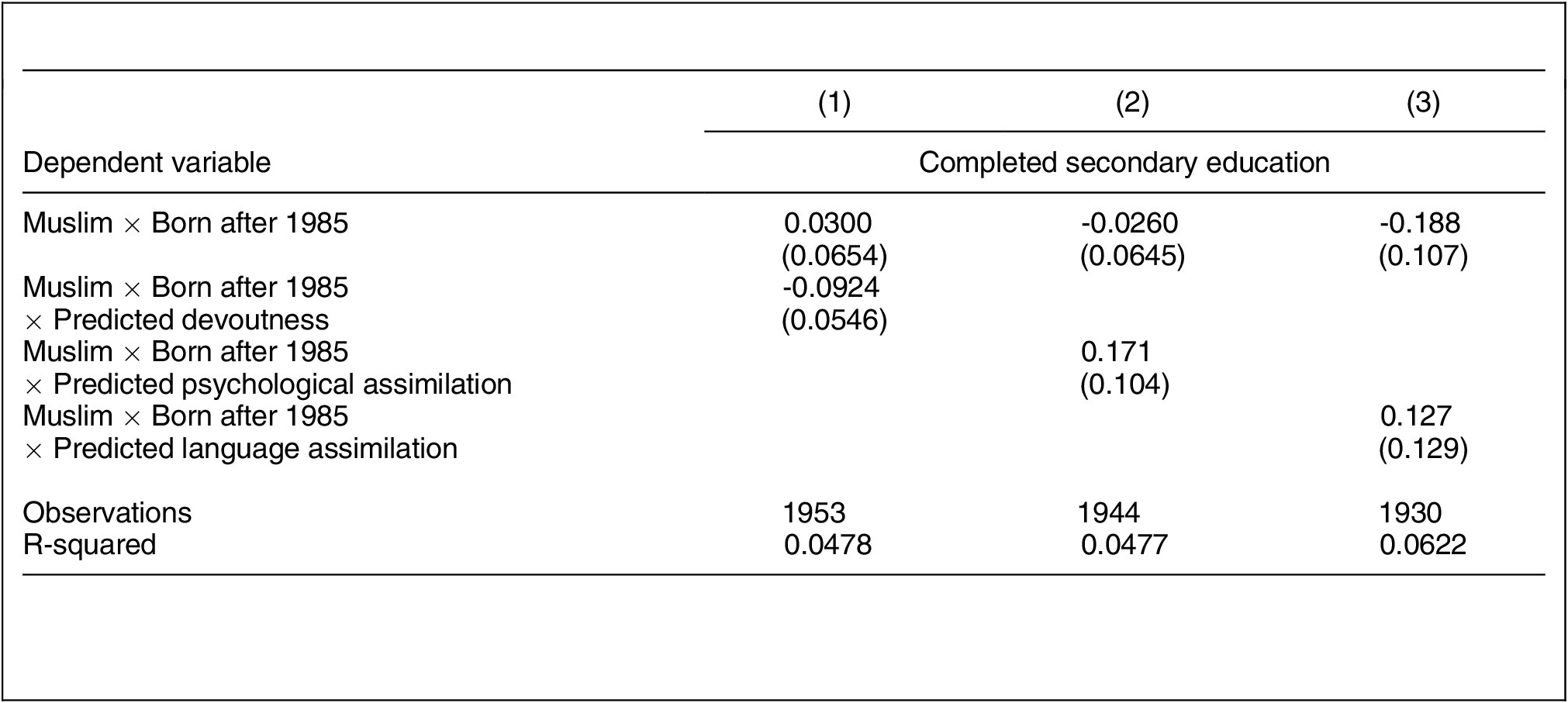
Table 4 presents estimates of heterogeneous effects on educational attainment by predicted religiosity and assimilation. The effect of the ban is exacerbated for more devout individuals and mitigated for those with higher psychological or language integration. Religiosity is a proxy for veiling and could thus capture the intensity of the treatment. More religious and less assimilated groups could also have experienced more intense discrimination, with more negative effects on schooling outcomes. This might be because these groups are more identifiable as Muslim (Adida, Laitin, and Valfort Reference Adida, Laitin and Valfort2010, Reference Adida, Laitin and Valfort2014). Indeed, experiences of racism at school for treated cohorts are significantly higher for more devout women. The differential increase of the likelihood of perceiving racism is 32 percentage points for women at the lower decile of devoutness and 39 percentage points for those at the highest decile. The results are consistent with the finding in Column 5 of Table 1 that the law’s effect was more negative for women with two Muslim parents, as such women are more religious and less assimilated on average.
Heterogeneous Effects

Note: The sample consists of French-born women born 1980 or later and aged 20 or older at survey year. All regressions include birth year and religion fixed effects as well as a linear Muslim-specific trend. Standard errors are clustered at the religion level. Significance levels: ***p < 0.001, **p < 0.01, *p < 0.05, +p < 0.1.
We present heterogeneous effects on identity in Table A.6. One finding that emerges is that both identification with France and religiosity increase on average for all treated women. This suggests that the law does not increase identity polarization among Muslims. Instead, Muslim women respond to the law by reaffirming their belonging to both France and their religious communities.
The extent of increased identification, however, is moderated by devoutness and assimilation. Devout women’s identification with France increases by less.Footnote 26 Their degree of religiosity is instead strengthened. The opposite pattern is true for more assimilated women. These results are consistent with other studies that find a strengthening of minority identity in response to discrimination among the least assimilated individuals (Fouka Reference Fouka2020) or, conversely, a strengthening of majority identity among the most assimilated subgroups (Fouka Reference Fouka2019; Williams and Sommer Reference Williams and Sommer1997).
Discussion and Conclusion
Do bans on religious expression affect minority integration? In this paper we systematically investigate the effects of the 2004 French headscarf ban and show that the educational outcomes and economic integration of Muslim women was negatively affected by the law. Group identity was also affected, with both French and religious identities becoming stronger for affected Muslim women. These effects are moderated by existing identities: identification with France increases more for initially more assimilated women, and increase in religiosity is instead higher for the more devout.
We emphasize the role of discrimination as the mediator of the observed effects most supported by our evidence. It does not, however, exhaust the set of potential channels at work. The headscarf ban may affect outcomes by interfering with other functions that veiling performs for women who use it.
There is evidence that Muslim women wear pious dress to signal religiosity (Patel Reference Patel2012), perhaps due to marriage market considerations (Blaydes and Linzer Reference Blaydes and Linzer2008), or as a device that affirms commitment to the religious community and allows women to participate in broader society (Carvalho Reference Carvalho2012). In response to the ban, religious parents could have driven substitution away from veiling to other forms of religious commitment for affected school-age girls. Such behaviors could have had a lasting influence on girls’ religiosity and associated attitudes toward female education or labor force participation.Footnote 27 It is, however, unlikely that these channels explain the magnitude of our results, given the low estimated number of veiled girls in school before the ban (Winter Reference Winter2009). Neither can these mechanisms readily explain the strengthening of French identity among treated cohorts.
At this point, it is important to highlight our study’s limitations. We focus on the ban’s implementation and its effects on cohorts directly affected at school. We do not examine the effect of the law on cohorts entering the educational system with the ban already established. Much of our evidence indicates that the negative effects on education were driven by the transitional period and discrimination in school. It is possible that cohorts facing a new institutional status quo absent these sources of differential treatment would not have been similarly negatively affected. At the same time, there is no indication of any positive effects of the law, at least in terms of educational outcomes, for younger cohorts in our sample.Footnote 28
It is also worth emphasizing that generational effects of the ban are not easy to assess with existing data. One of the potential effects of veiling bans highlighted by Carvalho (Reference Carvalho2012) is their potential to increase religiosity and minority identification among younger generations. To what extent policies like the headscarf ban affect the incentives of second-generation immigrants to acculturate their children and the implications this may have for minority identity in the long-run are important questions that remain unanswered. We leave such questions to future research.
Supplementary Materials
To view supplementary material for this article, please visit http://dx.doi.org/10.1017/S0003055420000106.
Replication materials can be found on Dataverse at: https://doi.org/10.7910/DVN/KSSFDI.






Comments
No Comments have been published for this article.