Introduction
In late December 2019, an unidentified coronavirus erupted formidably out of Wuhan city, Hubei Province, China. This novel virus, later known as severe acute respiratory syndrome coronavirus-2 (SARS-CoV-2), which leads to coronavirus disease 2019 (Covid-19), has since run rampant, afflicting people globally.Reference Hui, Azhar, Madani, Ntoumi, Kock and Dar1 As of 25 April 2021, the total case number has reached over 146 million worldwide, with a mortality rate of 2.1 per cent.2
Coronavirus disease 2019 has demonstrated a heterogeneous spectrum of symptomatology, ranging from asymptomatic to severe illness with multiple organ failure.Reference Hui, Azhar, Madani, Ntoumi, Kock and Dar1 Intriguingly, approximately one-quarter of victims remain asymptomatic throughout their infections.Reference He, Guo, Mao and Zhang3,Reference Alene, Yismaw, Assemie, Ketema, Mengist and Kassie4 In addition to distorting the true epidemiology of SARS-CoV-2, patients with subclinical manifestations may serve as a possible means of contagion and present threats to the community.Reference Alene, Yismaw, Assemie, Ketema, Mengist and Kassie4 A massive and proactive screening of asymptomatic individuals should remain the cornerstone of the concerted effort to eliminate Covid-19 infections.
A new fourth syndrome of SARS-CoV-2 viral infection, known as isolated sudden-onset anosmia, was first described by Gane et al. after observing anosmia among patients with ‘asymptomatic’ or mild Covid-19.Reference Gane, Kelly and Hopkins5
Numerous articles associating Covid-19 with smell disturbances have been published in response to the pandemic. While the vast majority of research evaluated olfactory deficits based on questionnaires or self-perception, only a few studies assessed individuals through an objective smell evaluation.Reference Seden, Yiğit, Yiğit and Kaygisiz6–Reference Lechien, Cabaraux and Chiesa-Estomba9 Additionally, there is wide variation across continents in the incidence of anosmia amongst patients infected with Covid-19, ranging from 5 to 98 per cent.Reference Moein, Hashemian, Mansourafshar, Khorram-Tousi, Tabarasi and Doty7,Reference Hannum, Ramirez, Lipson, Herriman, Toskala and Lin10–Reference von Bartheld, Hagen and Butowt12 A higher preponderance of chemosensory deficit is reported among Caucasian patients than among Asian patients.Reference von Bartheld, Hagen and Butowt12,Reference Mishra, Gowda, Dixit and Kaushik13
Subjective measures of olfactory function are less sensitive than objective assessments, and there is a lack of standardisation. They are vulnerable to recall bias and to underestimating smell loss because of the initial lack of awareness that it is a symptom of Covid-19.Reference Hannum, Ramirez, Lipson, Herriman, Toskala and Lin10 The cognisance of smell disturbance remains far lower in comparison to a perceptual loss in other sensory modalities, such as audition and vision.Reference Cavazzana, Röhrborn, Garthus-Niegel, Larsson, Hummel and Croy14 A systematic review and meta-analysis has indicated that objective measures are more dependable to identify smell loss caused by infection with SARS-CoV-2.Reference Hannum, Ramirez, Lipson, Herriman, Toskala and Lin10
A well-designed objective smell screening strategy that is practical, cost-effective and replicable is necessary to provide a more reliable outcome and better quantification of smell loss. This study aimed to assess the prevalence of anosmia (using the culturally adapted Malaysian version of the Sniffin’ Sticks Identification smell test) among asymptomatic laboratory-confirmed infected individuals who are otherwise categorised as having normal olfaction based on self-perception (using the validated subjective Malaysian Smell and Taste Questionnaire).
Materials and methods
This cross-sectional study was conducted on patients infected with SARS-CoV-2. Ethical approval was obtained from the Institutional Review Board of University Kebangsaan Malaysia Medical Centre and the Ministry of Health, Malaysia, before the study commenced. All participants provided informed consent for study participation.
Study population
Convenience sampling methods were used. The study population consisted of individuals who attended the University Kebangsaan Malaysia Medical Centre Ward and Malaysia Agro Exposition Park Serdang Covid-19 Quarantine and Low-Risk Treatment Centre.
Asymptomatic patients aged 18 years and above infected with SARS-CoV-2 were enrolled in this study. Asymptomatic patients were defined as those who had tested positive for Covid-19 using real-time polymerase chain reaction, but who did not exhibit any fever, cough, sore throat or myalgia at the time of assessment. The exclusion criteria were critically ill patients requiring assisted ventilation and oxygen supplementation, uncooperative patients, pregnant women, and those with histories of the following: radiotherapy to the head and neck, rhinosinusitis, allergic rhinitis, degenerative neurological disorder, previous nasal surgical procedures, and prior odour and taste dysfunction.
The information obtained included gender, age group, co-morbidities and the timeline from exposure to confirmatory diagnosis.
Malaysian Smell and Taste Questionnaire
The Malaysian Smell and Taste Questionnaire is a six-item self-administered questionnaire that was developed based on patients’ symptoms. It is a subjective assessment in which the first two items evaluate the presence of olfactory dysfunction and gustatory dysfunction. The other four items evaluate nasal symptoms; namely, nasal congestion, nasal or post-nasal discharge, headache, and sleep disturbance. The data were obtained through self-administered responses. All participants responded using a five-point Likert scale ranging from ‘normal’ (1 point) to ‘profound symptoms’ (5 points), with a sum score between 6 and 30.
The questionnaire was validated using 30 subjects and 30 healthy control individuals with matched ages and genders.
Malaysian smell test
After completion of the Malaysian Smell and Taste Questionnaire, objective smell function was measured in all participants within two weeks of diagnosis using the Malaysian version of the Sniffin’ Sticks Identification smell test, which employs pen-like odour-dispensing devices.Reference Lum, Husain, Zahedi, Ahmad and Gendeh15 The Sniffin’ Sticks kit consists of 16 reusable pens as applicators of different odorants. The pens are 14 cm long and 1.3 cm in diameter, containing a tampon filled with 4 ml of liquid odorants dissolved in propylene glycol.Reference Kobal, Hummel, Sekiner, Barz, Roscher and Wolf16
All participants abstained from eating or drinking (except plain water) for 15 minutes before the test. Upon removal of the cap, the tip of the pen was placed approximately 2 cm in front of both nostrils for 3 seconds. The study subjects then identified the odorant from the list given. The list comprised four items – one correct answer and three distractors. A similar process was repeated for 16 pens with different odorants. The time interval between pen presentations was 20–30 seconds. One mark was awarded for each of the correctly identified odorants. Participants were grouped as indicative of normosmia if they achieved a score of more than 12, hyposmia for a score of 9–12 and anosmia if they scored less than 9.Reference Lum, Husain, Zahedi, Ahmad and Gendeh15
Personal protective equipment and safety protocols
All investigators were equipped with personal protective equipment as per recommended protocol throughout the process.Reference Hockaday, Krause, Sobieski, Li, Hurst and Ryan17 The smell test was carried out in properly ventilated rooms with the use of odourless gloves and protective suits. All study subjects were instructed to wear a three-ply surgical mask before and after the evaluation.
Statistical analysis
All statistical analyses and data presentations were performed and generated using SPSS software, version 25 (IBM, Armonk, New York, USA). Data were presented as proportions and means (standard deviation (SD)). The normosmia, hyposmia and anosmia groups were compared. One-way analysis of variance was used to compare participant age and time from diagnosis to the smell test, between groups. The chi-square test was used for categorical variables, and Kendall's tau B was used for the sum Malaysian Smell and Taste Questionnaire score.
Results
This study included 81 participants with Covid-19 self-perceived as asymptomatic, with a mean ± SD age of 31.59 ± 12.04 years. The mean ± SD time between confirmation of the diagnosis and the odour identification test was 7.47 ± 3.79 days.
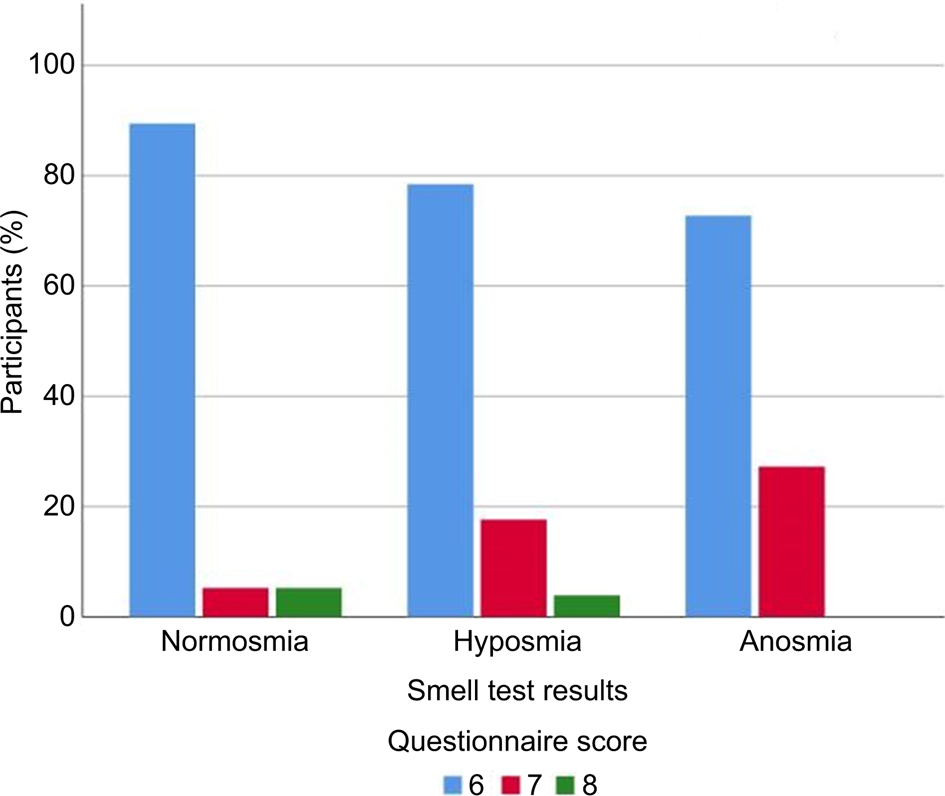
All subjects underwent the second stage of screening with the Malaysian Smell and Taste Questionnaire evaluation. Most participants (80.2 per cent, n = 65) were free from nasal symptoms, with a questionnaire score of 6. Nineteen per cent (n = 16) had mild nasal symptoms: 16.0 per cent (n = 13) scored 7 points and 3.7 per cent (n = 3) scored 8 points. One participant reported olfactory changes as the only complaint (1 out of 5 on the 5-point Likert scale; overall Malaysian Smell and Taste Questionnaire score of 7). Of the other participants, 9.9 per cent (n = 8) reported nasal discharge, 6.2 per cent (n = 5) reported nasal obstruction, 3.7 per cent (n = 3) reported headache and 2.5 per cent (n = 2) reported disturbed sleep. None of these participants complained of smell or taste disturbances.
The mean ± SD score of the objective assessment, using the Malaysian version of the Sniffin’ Sticks Identification smell test, was 10.89 ± 2.11. The prevalence of olfactory impairment using the objective assessment tool in self-perceived asymptomatic Covid-19 patients was 76.6 per cent (63.0 per cent and 13.6 per cent for hyposmia and anosmia, respectively). Intriguingly, the only subject who reported a mild smell disturbance (Malaysian Smell and Taste Questionnaire score of 7) had anosmia based on the objective test.
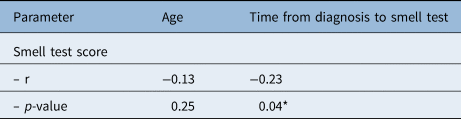
There were no statistical differences between olfactory impairment groups in terms of age or co-morbidities. The difference in time from diagnosis to smell test was statistically significant between the groups (p = 0.02) (Table 1). There was no association between the sum Malaysian Smell and Taste Questionnaire score and smell status based on the Malaysian version of the Sniffin’ Sticks Identification smell test score (p = 0.25) (Figure 1). There was a weak negative correlation between the objective smell test score and the duration from diagnosis to smell test (r = −0.23, p = 0.04) (Table 2).
The sum Malaysian Smell and Taste Questionnaire score among asymptomatic coronavirus disease 2019 patients with normosmia, hyposmia and anosmia based on the Malaysian version of the Sniffin’ Sticks Identification smell test. There was no association between the subjective Malaysian Smell and Taste Questionnaire score and the objective smell identification test results (p = 0.25).

Association between baseline characteristics and smell identification test results

* Indicates statistical significance (p < 0.05). SD = standard deviation
Correlations of smell test score with age and time from diagnosis to smell test

* Indicates statistical significance (p < 0.05).
Discussion
The theory of virus-induced olfactory dysfunction has always been a familiar certitude in the field of medicine. The SARS-CoV-2 infection can cripple olfaction through the disruption of conductive and/or sensorineural paths.Reference Han, Mukdad, Long and Lopez18 Similarly to other infections of the nasal cavity and paranasal sinuses, Covid-19 induces local mucosal inflammation, leading to venous engorgement, increased nasal secretion and oedema of the respiratory epithelium. The resultant narrow nasal passage with reduced airflow contributes to impaired travel of odorants to the olfactory binding receptors, resulting in smell disturbance.Reference Han, Mukdad, Long and Lopez18 Other proposed theories, including virus-induced loss of the olfactory receptor neurons, damage to the olfactory epithelium support cells, and direct brain infiltration by the virus affecting the olfactory centres, are plausible explanations for sensorineural injury.Reference Bryche, Albin, Murri, Lacôte, Pulido and Gouilh19
The overall reported prevalence of olfactory impairment in Covid-19 patients is 47.85 per cent (95 per cent confidence interval = 41.20–54.50), ranging from 10.71 per cent to 54.40 per cent.Reference Saniasiaya, Islam and Abdullah20 While a multitude of studies have reported olfactory impairment in Covid-19 patients based only on self-perception, a few have gleaned information from both subjective and objective assessments.Reference Seden, Yiğit, Yiğit and Kaygisiz6–Reference Lechien, Cabaraux and Chiesa-Estomba9,Reference Saniasiaya, Islam and Abdullah20 The utilisation of a variety of objective evaluation kits, including the Sniffin’ Sticks test, the University of Pennsylvania Smell Identification Test, the Cross-cultural Smell Identification test and the Connecticut Chemosensory Clinical Research Center Orthonasal Olfaction test, has been described.Reference Moein, Hashemian, Mansourafshar, Khorram-Tousi, Tabarasi and Doty7,Reference Altin, Cingi, Uzun and Bal21–Reference Seo, Seok, Hwang, Choi, Jeon and Sohn24
We limited the study population to asymptomatic individuals with a diagnosis of Covid-19 infection confirmed via the real-time polymerase chain reaction test. Before we embarked on objective smell evaluation, all participants asserting that they had no changes in smell underwent the second stage of subjective assessment, which was the validated Malaysian Smell and Taste Questionnaire. We then employed the culturally adapted Malaysian version of the Sniffin’ Sticks Identification smell test as our objective assessment tool.
It was interesting to note that one participant (1.2 per cent) who claimed to have no symptoms demonstrated hyposmia with the Malaysian Smell and Taste Questionnaire and was actually suffering from anosmia, as reflected in the Malaysian version of the Sniffin’ Sticks Identification smell test. Lechien et al. observed a similar but contradictory finding; they found that 38 per cent of subjects with subjective olfactory dysfunction were actually normosmic on objective evaluation.Reference Lechien, Cabaraux, Chiesa-Estomba, Khalife, Hans and Calvo-Henriquez25 Such disparity has reflected the inconsistency of a subjective tool in olfactory screening.
Variable independent influences can affect the self-perception of olfaction, such as previous experience, and there are difficulties in integrating and interpreting the data, as they are often presented on an ordinal scale.Reference Jahedi and Mendez26 In our study, despite the fact that 98.8 per cent of self-perceived asymptomatic patients did not complain of any Covid-19 symptoms, 77.4 per cent had impaired smell as detected on the objective smell test. Our results showed a consistent outcome with other studies in that a much greater prevalence of olfactory impairment was found through an objective evaluation compared with a subjective test.
• Patients with coronavirus disease 2019 (Covid-19) self-perceived as asymptomatic had impaired smell test scores (hyposmia and anosmia) on objective smell assessment
• There was no association between the subjective questionnaire and objective smell test scores in this study
• Objective measurement is important in the assessment of olfactory function in Covid-19 patients
• Correlation analysis indicated that smell progressively worsens in the first two weeks of Covid-19 diagnosis
Our study focused only on asymptomatic subjects; hence, we could not correlate the relationship between the impact of disease severity and olfactory function. In order to reduce exposure to the virus, all questionnaires were self-administered by patients, which may have underestimated the olfactory threshold. We found a weak negative correlation between the duration from diagnosis to smell test and the smell test score. This suggests that smell progressively worsens in the first two weeks after diagnosis; however, this requires further study regarding the natural progression of symptoms.
Conclusion
Most of the asymptomatic patients had impaired smell test scores, despite not having other Covid-19 symptoms. Although asymptomatic Covid-19 patients did not complain of smell disturbances, the objective assessment proved that they had olfactory impairment. Therefore, a smell identification test is an important tool to determine olfactory function in patients with Covid-19.
Acknowledgement
This research was funded by the Faculty of Medicine Special Covid-19 grant (project code: COVID-2020-003). There were no competing financial interests.
Competing interests
None declared