


Introduction
The Mamluk sultan Qāʾitbāy (r. AH 872–901/1468–1496 CE) is widely recognised as one of the most active endowers in the late medieval Islamicate world. His endowments extended far beyond Cairo to encompass Egypt, Syria, and the Hijaz, and they have attracted sustained scholarly attention, most notably in studies of Mamluk political economy and patronage of art and architecture. Nevertheless, the so-called waqf al-dashīshah, which the sultan established mainly to distribute dashīshah (porridge) and bread in the Ḥaramayn (Mecca and Medina), particularly in Medina, has remained insufficiently examined.Footnote 1
This relative neglect is all the more striking given the survival of a detailed documentary corpus relating to this waqf, preserved in Bibliothèque nationale de France (BnF), MS Arabe 1118 (Supplément 471). According to the manuscript catalogue by M. le Baron de Slane,Footnote 2 this 235-folio codex contains documents dating from 888/1483 to 988/1580, the latter date presumably being erroneous, as will be shown below. In their new catalogue, Georges Vajda and Yvett Sauven list the dates of individual documents included in the manuscript and mention that it was copied by Muḥammad b. Saʿd,Footnote 3 whose ownership mark dated 1156/1743 appears on folio 1a. This Muḥammad served as the scribe of the waqf al-dashīshah al-kubrá in Bulaq (kātib waqf al-dashīshah al-kubrá bi-Būlāq). Unlike isolated waqf deeds, this codex thus makes it possible to trace change over time, including the establishment of the waqf under Qāʾitbāy, its subsequent expansion during his lifetime, and its continued administration into the tenth/sixteenth century.
Despite this potential, the codex remained largely unexamined until Doris Behrens-Abouseif drew attention to it around the turn of the twenty-first century, though her discussion addressed only selected portions of the manuscript.Footnote 4 More recently, Muḥammad al-Shishtāwī’s monographFootnote 5 has made use of this source, but it ‘largely takes the form of a summary edition of parts of the text of the document’.Footnote 6 To date, no study has sought to examine what the corpus as a whole reveals about how Qāʾitbāy’s waqf al-dashīshah functioned in practice.Footnote 7
Through a comprehensive analysis of MS Arabe 1118 (BnF) in conjunction with related sources, this article argues that the waqf al-dashīshah functioned not merely as a personal charitable foundation but as a centrally managed mechanism capable of adaptation across regime change.
Qāʾitbāy’s patronage in Mecca and Medina
Before turning to the analysis of the Paris codex, it is useful to situate the waqf al-dashīshah within the broader context of Qāʾitbāy’s pious patronage in the Ḥaramayn as described in narrative sources. Like other Mamluk sultans and emirs, Qāʾitbāy sought to cultivate political legitimacy through acts of devotion towards Mecca and Medina. Yet the scale, continuity, and degree of personal involvement evident in his patronage suggest a strong concern that exceeded episodic or symbolic charity. From the outset of his reign, the sultan demonstrated an active interest in the welfare of the Ḥaramayn by combining fiscal intervention, architectural patronage, and ritual provision. His engagement is particularly noteworthy in light of his own pilgrimage to Mecca and Medina, which placed him among the few Mamluk sultans who performed the ḥajj.Footnote 8
Shortly after his ascension to the throne in 872/1468, Qāʾitbāy issued a decree abolishing non-canonical levies (mukūs or mukūsāt, sg. maks) in Mecca.Footnote 9 This was followed by the repair and enlargement of water facilities and mosques in and around the city, as well as the donation of a minbar to the Ḥarām Mosque.Footnote 10 In 882/1477–1478, he ordered the merchant Ibn al-Zamin (d. 897/1492)Footnote 11 and the shādd ʿamāʾir (superintendent of constructions) Sunqur al-Jamālī (d. 902/1497)Footnote 12 to build a complex adjacent to the Ḥarām Mosque, comprising a madrasah, ribāṭ, and maktab (primary school). Two years later, during his ḥajj, Qāʾitbāy personally intervened in the institutional organisation of this complex by appointing four chief judges of MeccaFootnote 13 as professors of his madrasah, selecting 40 students, six Qur’an reciters, three muezzins, and a shaykh of the ribāṭ, and arranging for the distribution of dashīshah and bread.Footnote 14 These measures reflect not only royal patronage at a distance but direct engagement with the religious and social life of Mecca.
By the second half of the tenth/sixteenth century, however, Quṭb al-Dīn al-Nahrawālī (d. 990/1582) observed that although Qāʾitbāy had endowed the Meccan complex with 2,000 gold dīnārs derived from the rents of apartment and house rents in Mecca as well as from Egyptian villages and landed estates, the waqf properties were being exploited; the madrasah had become a lodge for emirs travelling from Egypt, the public kitchen had ceased to function, and many of the donated books had disappeared.Footnote 15 Al-Nahrawālī’s account thus underscores the tension between royal intention and long-term institutional sustainability, a theme that would later become central to the history of the waqf al-dashīshah.
Qāʾitbāy’s engagement with Medina was even more intense. He ordered the renovation of the Prophet’s mosque in 879/1474–1475 and again in 881/1476 and financed the installation of lamps between 881/1476–1477 and 884/1479–1480.Footnote 16 Around the same time, preparation began for the establishment of a madrasah in Medina. In 882/1478, however, a judge of Medina was killed by a resident of the building acquired by Ibn al-Zamin for the site of Qāʾitbāy’s madrasah, after the judge had approved the building’s demolition.Footnote 17 This incident appears to have disrupted the project, which was likely suspended for some time.
In 884/1479–1480, Qāʾitbāy visited Medina en route to the pilgrimage. This encounter seems to have marked a turning point. Upon his return to Cairo, he publicly declared his intention to establish an endowment specifically dedicated to the regular distribution of dashīshah and bread in Medina, signalling a shift from episodic patronage to systematic provisioning.
The manner in which this waqf was organised further underscores its importance. Qāʾitbāy initially attempted to entrust the acquisition of waqf properties to Egyptian chief judges and leading emirs, offering a substantial sum of 60,000 dīnārs. When they declined, he delegated the task to two of his closest officials, the then amīr silāḥ (emir of arms) Yashbak min Mahdī and the khāzindār (treasurer) Barsbāy al-Maḥmūdī.Footnote 18 Yashbak min Mahdī (d. 885/1480) was among the sultan’s most trusted associates,Footnote 19 while Barsbāy al-Maḥmūdī (d. 890/1485) already supervised the waqf for Qāʾitbāy’s mausoleum complex in Cairo. He also appears to have been responsible for the waqf al-dashīshah because after his death, Barsbāy al-Khāzindār (d. 897/1492),Footnote 20 one of Qāʾitbāy’s mamluks, was reportedly entrusted with the endowments for Medina.Footnote 21 The subsequent construction of revenue-generating properties in several Cairene quarters—including Bāb al-Naṣr, al-Bunduqānīyīn, al-Khashshābīn, and al-Dajjājīn—suggests that the waqf was conceived as a durable and well-capitalised institution.Footnote 22
An event soon reinforced the centrality of Medina to Qāʾitbāy’s agenda. In 886/1481, a fire caused by lightning severely damaged the Prophet’s mosque, with repair costs estimated at 100,000 dīnārs. To initiate the restoration, Qāʾitbāy transferred Sunqur al-Jamālī and more than 100 artisans from Mecca to Medina with an initial payment of 20,000 dīnārs. He also dispatched Ibn al-Zamin from Cairo together with more than 300 artisans, 200 camels, and 100 donkeys.Footnote 23 Once repairs were underway, construction resumed on a new complex in Medina, comprising a madrasah, ribāṭ, and public kitchen.Footnote 24 Juristic debates concerning architectural features—such as whether or not the madrasah’s door and windows might open onto the Prophet’s mosque—further illustrate the sensitivity of building projects in this sacred space and the extent to which Qāʾitbāy’s initiatives intersected with legal and devotional concerns.Footnote 25
During the mawlid festival in Rabīʿ I 888/April–May 1483, Qāʾitbāy announced the establishment of the waqf to send more than 7,000 irdabbs (487,200 kg)Footnote 26 of wheat to distribute dashīshah and bread in Medina explicitly linking this provisioning to the encouragement of abolishing the mukūs.Footnote 27 According to ʿAbd al-Bāsiṭ al-Malaṭī, approximately 200,000 dīnārs were spent to acquire the waqf properties.Footnote 28 In the following year, the major repairs to the Prophet’s mosque were completed, and Qāʾitbāy’s complex in Medina was nearing completion. One of Qāʾitbāy’s favoured officials, Badr al-Dīn Abū al-Baqāʾ Ibn al-Jīʿān (d. 902/1497),Footnote 29 was dispatched to oversee the provision of food supplies for Medina and Mecca in accordance with the sultan’s instructions.Footnote 30 The combined cost of repairs and construction exceeded 100,000 dīnārs.Footnote 31 Even after the main complex was completed, additional expenditures were required for further renovations in 891–892/1486–1487.Footnote 32 As will be shown below, Qāʾitbāy continued to add properties to the waqf until at least 895/1490, probably in order to offset these ongoing expenses.
Thus, narrative sources depict a ruler whose repeated interventions, personal presence, and financial commitment reflect a deliberate and evolving strategy to care for the Ḥaramayn, with Medina occupying a particularly prominent position. It is against this background that the documentary evidence preserved in MS Arabe 1118 must be read.
The waqf al-dashīshah during Qāʾitbāy’s lifetime
The value of MS Arabe 1118 (BnF) lies in the way it documents the gradual formation, expansion, and administrative consolidation of the waqf al-dashīshah over time. The contents of the codex can therefore be grouped analytically into two categories: (1) documents issued during Qāʾitbāy’s lifetime and (2) materials relating to the waqf’s posthumous administration. This section focuses on the former, examining six sets of documents issued by Qāʾitbāy himself between 888/1483 and 895/1490, together with two additional sets of deeds generated by other individuals and later incorporated into the waqf.
The earliest surviving waqf deed, dated 24 Ṣafar 888/3 April 1483 [fols. 1b–18b], established the basic framework of the waqf. Twenty-four properties were alienated, the majority of which consisted of rural estates in Egypt, as indicated in Table 1.
Waqf properties in the first document dated 24 Ṣafar 888/3 April 1483

Table 1 Long description
The table inventories twenty-four waqf properties, giving each item’s type and share (when stated), site name, province, and acquisition or source notes. Most entries are land holdings spread across many Egyptian provinces, including al-Qalyubiyah, al-Minufiyah, al-Ushmunayn, al-Gharbiyah, al-Bahnasawiyah, al-Daqahliyah, al-Asyutiyah, al-Sharqiyah, al-Buhayrah, al-Ikhmimiyah, and al-Fayyumiyah. Only one urban property appears: two buildings in Suwayqat al-Usfur in Cairo, noted as purchased in the year 885. Many land entries are identified as state land associated with the public treasury, while a smaller number are described as acquired through exchange transactions, and a few are described as bought. Several land items specify fractional shares, ranging from very small portions to large majorities, indicating partial ownership rather than whole parcels in many cases. Three non-Egyptian entries appear near the end: a village in Tripoli, a village share in the Damascus region, and a village in Baalbek, plus one entry for a tax revenue right in al-Bahnasawiyah. Notes frequently cite documentary references and place-name variants, so spellings and identifications may reflect source conventions rather than modern standardized geography.
The yields of these properties were to be used to cover maintenance costs and then to be spent as follows: (1) 600 irdabbs (41,760 kg) of wheat were to be sent from Upper Egypt for the preparation of dashīshah and bread to be distributed in Mecca and, if necessary, to compensate for any deficit in Qāʾitbāy’s madrasah there; (2) 7,500 irdabbs (522,000 kg) of wheat from Upper Egypt were designated for dashīshah and bread for the meals of the sojourners at Qāʾitbāy’s madrasah in Medina; and (3) the remaining revenues were earmarked for the operational costs of the waqf, including transport, cooking, and staff salaries. The marked disparity between the allocations to Mecca and Medina underscores the primacy of Medina in Qāʾitbāy’s endowment strategy from the outset.
Equally significant is the administrative structure stipulated in the deed. Qāʾitbāy positioned himself as the supervisor of the waqf, supported by the Egyptian atābak al-ʿasākir (commander-in-chief of the armies), dawādār kabīr (executive secretary), and kātib al-sirr (confidential secretary). In the absence of a designated successor, supervision would pass to the reigning sultan, while Egypt’s four chief judges served as notaries (shuhūd, sg. shāhid) and Badr al-Dīn Ibn al-Jīʿān as manager (mubāshir). This arrangement placed the waqf firmly within the institutional framework of the sultanate.
Subsequent documents demonstrate how quickly the waqf was expanded. Less than two months later, on 15 Rabīʿ II 888/23 May 1483 [fols. 18b–28a], Qāʾitbāy purchased and added two revenue-generating urban properties in Cairo:
(1) two buildings (sg. bināʾ) containing shops and storehouses in Jazīrat al-Wusṭá in the southern suburb of Cairo. The sultan’s agent Barsbāy al-Maḥmūdī purchased half of these from Jamāl al-Dīn Yūsuf b. Muḥammad al-Minūfī (d. 890/1485)Footnote 33 for 1,200 ashrafī dīnārsFootnote 34 and the other half from a certain ḥalqa soldier al-Ṣārimī Ibrāhīm b. Yaʿqūb for the same amount;
(2) a mill (bināʾ al-ṭāḥūn) in Khuṭṭ al-Qammāḥīn in the western suburb of Cairo, also purchased from Jamāl al-Dīn Yūsuf al-Minūfī for 500 ashrafī dīnārs.
A more substantial transformation is evident in the third document, dated 24 Rabīʿ II 890/10 May 1485 [fols. 28a–91a], which records the alienation of 28 properties [fols. 32b–89b], as shown in Table 2.
Waqf properties in the third document dated 24 Rabīʿ II 890/10 May 1485

Table 2 Long description
The table inventories 28 waqf properties, giving each item’s type and any ownership share, its site or name, its area or province, and brief notes on origin or status. Properties cluster most heavily in Cairo, largely as buildings in multiple quarters, several recorded as purchases on specific dates and sometimes held as partial shares. Medina forms the next largest group, including a caravanserai and bath near Qāʾitbāy’s madrasah plus houses and orchards, with several marked as private property. Rural landholdings appear in several Egyptian provinces, with notes distinguishing state land from property obtained through exchange arrangements and indicating fractional interests. Damascus entries include a group of shops south of the Citadel and a half share in a complex, alongside village holdings in the Damascus region and one village spanning the Hama and Maʿarrat al-Nuʿmān area. Notes frequently cite acquisition method, dates, and external references, so the list functions as a documented register rather than a valuation or size comparison.
Note:
a Khamsah qarārīṭ wa-niṣf wa-rubʿ wa-thumn qīrāṭ wa-niṣf qīrāṭ wa-rubʿ qīrāṭ min arabaʿah wa-ʿishrīn qītāṭan [MS Arabe 1118 (BnF), fol. 88b].
In contrast to the earlier emphasis on rural estates, approximately 60 per cent of these properties were urban, located in Cairo, Medina, and Damascus. Particularly noteworthy is the inclusion of two transport ships, Abū Salāmah and Abū al-Saʿādāt. Their donation indicates that Qāʾitbāy sought to secure not only production and revenue but also the logistical chain linking Egypt to the Hijaz. The yields from these properties were to be used to cover the expenses of Qāʾitbāy’s complex in Medina and his water facilities in Cairo, which constituted part of a complex in Khuṭṭ al-Dajjājīn, though the document provides no further details.
The incorporation of the waqf of the kātib al-sirr Zayn al-Dīn Abū Bakr Ibn Muzhir (d. 893/1488)Footnote 35 illustrates the waqf al-dashīshah’s capacity to absorb external foundations [fols. 91a–96a]. On 10 Ṣafar 888/20 March 1483, Ibn Muzhir alienated half of the commercial complex in Khuṭṭ al-Dajjājīn—the other half already belonging to the waqf al-dashīshah—for the following purposes: (1) 150 copper dirhams for al-Shāfiʿī’s mausoleum; (2) 56 copper dirhams for al-Mashhad al-Ḥusaynī; and (3) 57.5 copper dirhams for Waqf al-Irbilī(?); (4) 65 copper dirhams for the Ḥaramayn; (5) 65.5 copper dirhams for Waqf al-Majdīyah(?); and (6) 130 copper dirhams for Waqf al-Shāwī(?).
Two years later, on 28 Rabīʿ II 890/14 May 1485, Ibn Muzhir revised the stipulations of this waqf so that any surplus would be diverted to the sultan’s public kitchen in Medina. He seemingly presumed that cooperating with Qāʾitbāy would offer protection and stability for his waqf.Footnote 36
Moreover, Qāʾitbāy incorporated the endowments known as Bayt al-Khāzin, associated with Baktimur al-Sāqī, one of the favoured emirs of Sultan al-Nāṣir Muḥammad b. Qalāwūn, and his family, into the waqf al-dashīshah by an order (murabbaʿah) dated 29 Rabīʿ I 893/13 March 1488. The first governor of Ottoman Egypt, Khāyirbak, instructed four Egyptian chief judges to examine this order and approved it on 2 Rabīʿ II 926/22 March 1520 [fols. 224a–226a, 232b–233a]. This confirmation underscores both the juridical validity of the incorporation and the enduring relevance of the waqf al-dashīshah as an institutional framework.
The extracts of the following five endowment deeds associated with Baktimur al-Sāqī and his family are included in the codex:Footnote 37
(1) In the document dated 14 Rabīʿ II 716/6 July 1316 [fols. 227b–228b], the nāẓir al-khāṣṣ (controller of privy funds) Karīm al-Dīn alienated land (ḍayʿah) in al-Marj al-Shamālī, a suburb of Damascus, and seven orchards (sg. bustān) in Jazīrat al-Fīl, the southern suburb of Cairo, for Baktimur and his descendants and thereafter their freed slaves.
(2) On 13 Muḥarram 721/12 February 1321 [fols. 226a–227a], sultan al-Nāṣir Muḥammad added a village called Taqūʿ in the province of Jerusalem to the waqf properties for Baktimur and his descendants. A copy of this document has been preserved in the Egyptian National Archives (Dār al-Wathāʾiq al-Qawmīyah), Cairo (no. 5/27), and has been published.Footnote 38
(3) On 22 Jumādá I 728/4 April 1328 [fols. 227a–b], the sultan added two further villages in the province of Jerusalem, Bayt Jālā and Bethlehem.
(4) On 13 Jumādá II 748/20 September 1347 [fols. 230b–232b], Qarājā, the wife of Baktimur, alienated for herself, her descendants, and her freed slaves six properties in Cairo as follows: (a) a caravanserai (funduq) in Bayn al-Qaṣrayn; (b) a caravanserai (funduq) in Khuṭṭ al-Ḥarīrīyīn; (c) a caravanserai (qaysārīyah) in Khuṭṭ Bāb al-Faraj; (d) a bath (ḥammām) in Khuṭṭ Suwayqat al-ʿIzzī; (e) an oven (furn) in Khuṭṭ Suwayqat al-ʿIzzī; and (f) a caravanserai (qaysārīyah) between Bāb al-Futūḥ and Bāb al-Naṣr.
(5) On 19 Rabīʿ II 756/3 May 1355 [fols. 228b–230b], Rukn al-Dīn ʿUmar, the son of Baktimur’s son Aḥmad, alienated two-thirds of the following six properties, while ʿUmar’s sister Fāṭima alienated the remaining one-third of them three days later: (a) land (ḍayʿah) in Qārā in the province of Ḥimṣ; (b) a water wheel for irrigation (zūr)Footnote 39 in Shayzar; (c) 23/24 of a mill with a stable in Shayzar; (d) seven-eighths of the land of a zūr near item ‘b’; (e) 13/24 of a village in al-Marj al-Qiblī, Damascus; and (f) seven-eighths of the pieces of land in Jazīrat al-Fīl, Cairo.Footnote 40
In these endowment deeds, it was stipulated that the ultimate beneficiary was the Ḥaramayn. Therefore, Baktimur al-Sāqī’s family line must have ended by 893/1488 when Qāʾitbāy issued the order. Here again, the waqf al-dashīshah functioned as a consolidating mechanism, drawing dispersed charitable resources into a centrally managed system.
The fourth and fifth sets of documents further illuminate the political and fiscal logic underlying this waqf. In the fourth document, dated 24 Rabīʿ II 890/10 May 1485 [fols. 96a–101a], Qāʾitbāy alienated the following five landed estates in Egypt, which he had acquired through istibdāl (see below for details on this), in order to supply the emir of Medina with 1,000 irdabbs of wheat annually: (1) two pieces of land (1,000 faddāns) in Abū TījFootnote 41 in al-Asyūṭīyah; (2) two pieces of land (1,000 faddāns in total) in SumsuṭāFootnote 42 in al-Bahnasāwīyah; (3) an orchard (bustān) (45+37/48(?)Footnote 43 faddāns) in al-Marj in the suburb of Cairo; (4) an orchard (100 faddāns) in SiryāqūsFootnote 44 in al-Qalyūbīyah; and (5) ṬarshūbFootnote 45 in al-Bahnasāwīyah. The provision was explicitly conditional: should the emir fail to abolish taxes (sg. maks, maghram) imposed on the inhabitants of Medina, the wheat would instead be diverted to Qāʾitbāy’s waqf.
The fifth document [fols. 158a–197b] contains extracts from several deeds dated between 890/1485 and 894/1489, in which Qāʾitbāy changed the beneficiary of a Cairene building (property no. 11 in Table 2) from the waqf al-dashīshah to his children and their descendants [fols. 158b–159a], and substituted the building with 19 properties (Table 3) designated for Medina [fols. 159b–183b, 196b].
Waqf properties in the fifth document from 24 Rabīʿ II 890/10 May 1485 to 9 Rabīʿ II 894/12 March 1489

Table 3 Long description
The table lists nineteen waqf properties, giving each item’s type and share, its site or name, the province, and brief notes on ownership and references. Cairo entries dominate the early rows and are mostly private urban assets such as buildings, a stable and mansion, a ruin, and several half shares, many clustered around the al-Azhar area and Ḥawḍ Ibn Hanas. Outside Cairo, the holdings shift toward rural administrative units such as districts and villages in provinces including al-Ikhmīmīyah, al-Jīzīyah, al-Sharqīyah, al-Minūfīyah or al-Qalyūbīyah, al-Bahnasāwīyah, and al-Asyūṭīyah. Several non-Cairo items are explicitly marked as state land, while others are private land; one Aleppo house is noted as state property belonging to the public treasury. Shares are frequently partial, including halves and smaller fractions, and a few entries add area measures such as faddāns. Notes often indicate proximity between related Cairo properties and cite external sources, and a few place names are uncertain, so some identifications should be treated cautiously.
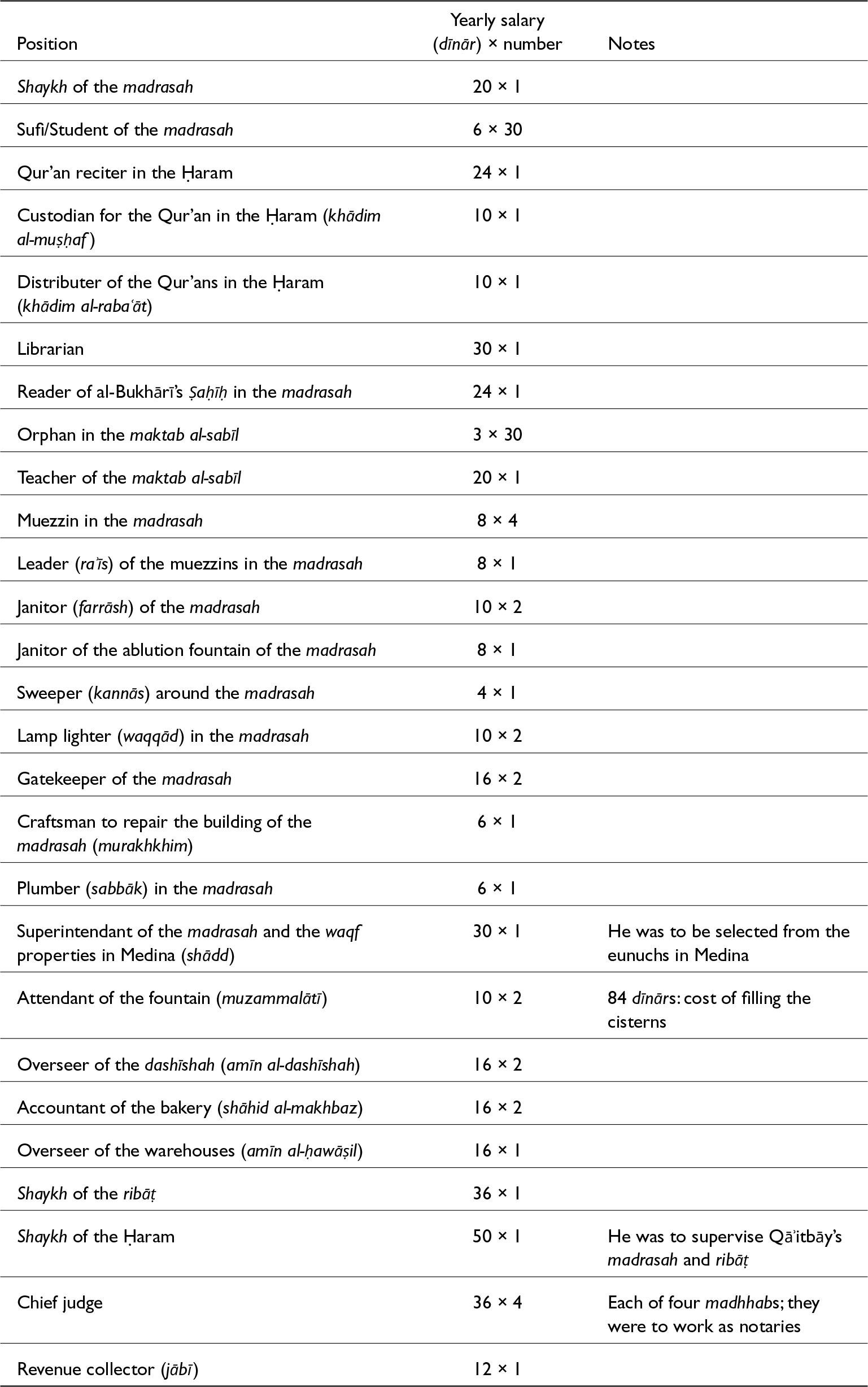
The revenues from these properties were used to cover the costs of collecting and transport from Suez to al-Yanbuʿ and Jedda, as well as the preparation of provisions including dashīshah and bread, although the documents remain largely silent on operational details. Tables 4 and 5 summarise the salaries of the staff in Cairo and Medina [fols. 184a–193b].
The staff in Cairo and their salaries

Table 4 Long description
The table lists staff positions in Cairo and their monthly salaries in dirhams, along with how many people held each role and brief appointment notes. The highest salary shown is 3,000 dirhams for one atābak al-ʿasākir, one dawādār kabīr, and one superintendant. Chief judges are paid 2,000 dirhams each, with four judges representing the four madhhabs, and they also serve as notaries. Several other single posts receive 2,000 dirhams, including the kātib al-sirr and the manager (mubāshir). Mid-level roles include the superintendant of maintenance and the granary secretary at 1,000 dirhams each. Lower-paid roles are the scribe at 500 dirhams and two accountants at 750 dirhams each, tasked with recording waqf property maintenance. Notes indicate some posts temporarily held deputy-supervisory duties and that certain successors were to be chosen from a ruler’s freed slaves, sometimes with a reduced salary.
Note:
a On Uzbak (or Azbak) min Ṭuṭukh, see al-Sakhāwī, al-Ḍawʾ, vol. ii, pp. 270–272; ʿAbd al-Bāsiṭ al-Malaṭī, al-Majmaʿ, vol. ii, pp. 509–511; Ibn Iyās, Badāʾiʿ al-zuhūr, vol. iii, pp. 411–413.
b On Aqbirdī min ʿAlī Bāy al-Ashrafī, see al-Sakhāwī, al-Ḍawʾ, vol. ii, p. 315; ʿAbd al-Bāsiṭ al-Malaṭī, al-Majmaʿ, vol. ii, pp. 571–573; Ibn Iyās, Badāʾiʿ al-zuhūr, vol. iii, pp. 421–422.
c On Gānbulāṭ min Yashbak al-Ashrafī, who became later sultan (r. 905–906/1500–1501), see al-Sakhāwī, al-Ḍawʾ, vol. iii, pp. 62–63; Ibn Iyās, Badāʾiʿ al-zuhūr, vol. iii, p. 472 passim.
The staff in Medina and their salaries

Table 5 Long description
The table lists staff roles and annual salaries in dīnār, showing the pay rate per role and how many people held each role, plus occasional notes. The top-paid single position is the Shaykh of the Ḥaram at 50 dīnār per year, followed by the Shaykh of the ribāṭ at 36 and several 30 dīnār posts such as the librarian and the superintendent of the madrasah and waqf properties. Judges are notable for scale: four chief judges, one for each madhhab, each paid 36 dīnār and also serving as notaries. Many operational roles are lower paid, including sweepers at 4, craftsmen and plumbers at 6, and several janitorial and service posts around 8 to 16 dīnār, often with two or more staff. The largest headcounts are students or Sufis of the madrasah and orphans in the maktab al-sabīl, each with thirty people, paid 6 and 3 dīnār respectively. Notes add constraints or extra costs: the superintendent was to be chosen from eunuchs in Medina, the Shaykh of the Ḥaram supervised specific institutions, and the fountain attendant entry mentions 84 dīnār for filling cisterns, which may be an expense rather than wages.
The final document, dated 15 Dhū al-ḥijjah 895/30 October 1490 [fols. 205b–210b],Footnote 46 shows that Qāʾitbāy continued to augment the waqf, adding five properties as follows: (1) half of a bath and a building (bināʾ) in Ḥārat al-Saqqāʾīn, Cairo, which had been bought on 19 Muḥarram 894/23 December 1488; (2) half of a bath in Maḥallat Masjid al-Qaṣab, Damascus, that had been bought in Rabīʿ I 895/February 1490;Footnote 47 (3) a silo (shūnah) in Khuṭṭ Būlāq, Cairo, which had been bought on 5 Dhū al-qaʿdah 895/20 September 1490;Footnote 48 (4) a silo (turbah) in al-Ṣaḥrāʾ, the north-eastern suburb of Cairo, that had been bought on 21 Dhū al-qaʿdah 881/7 March 1477;Footnote 49 and (5) Satamāyah in al-Gharbīyah, which had been Qāʾitbāy’s private property.Footnote 50
In sum, the documents produced between 888/1483 and 895/1490 reflect a deliberate effort to diversify the waqf’s income base and secure liquid revenues to support long-distance provisioning. The waqf al-dashīshah thus emerges not as a static charitable foundation but as a flexible and evolving administrative structure, repeatedly expanded through new endowments, adjusted through substitution, and strengthened through the incorporation of external waqfs.
According to Muḥammad Muḥammad Amīn’s catalogue, a collection of Qāʾitbāy’s documents was formerly preserved in the archive of the Ministry of Endowments (Wizārat al-Awqāf), Cairo (no. 885 qadīm), before being transferred to the Mujammaʿ al-Taḥrīr in Cairo in 1956. This collection is said to contain several documents from 24 Ṣafar 888/3 April 1483 to 9 Rabīʿ II 894/12 March 1489. It is therefore assumed that this collection is the same as our codex, although the sixth document, from 15 Dhū al-ḥijjah 895/30 October 1490, does not seem to be included in the Cairene collection.Footnote 51
Waqf properties, income, and expenditure
Table 6 summarises the composition of the waqf properties by location (Egypt, Syria, or Medina) and type (urban or rural). Two patterns stand out. First, Egyptian properties predominate (63 of 82, approximately 77 per cent). Second, roughly 60 per cent of the endowed assets consist of rural estates. Taken together, these features point to a waqf whose revenue base rested primarily on agrarian surplus generated in Egypt.
Classification of the waqf properties

Table 6 Long description
The table counts different types of properties assigned to six separate waqfs and provides totals by property type and by waqf. Landed estates in Egypt are the largest category with 37 properties, followed by urban properties in Cairo with 27, with a note that one item is adjusted in that Cairo total. Landed estates in Syria total 9, while urban properties in Syrian cities total 4. Medina holdings are smaller: orchards total 3 and urban properties total 3. By waqf, the first waqf has 24 properties, the second has 2, the third has 28 with a note of one adjustment, the fourth has 5, the fifth has 19, and the sixth has 5. Overall, the combined total is 83 properties, with a note that one item is adjusted in the overall total as well. Dashes indicate no properties recorded for that category in that waqf, and the parenthetical adjustment suggests a correction or exclusion affecting the third waqf and the grand total.
As noted above, several chroniclers report that the Egyptian chief judges declined to accept the 60,000 dīnārs that Qāʾitbāy initially allocated for the purchase of waqf properties. This may be understood as a reflection of the legal and administrative sensitivities surrounding large-scale property acquisition. Al-Ṣayrafī (d. circa 900/1495), while praising Qāʾitbāy for designating the inhabitants of Medina as the primary beneficiaries, nevertheless expressed the view that the waqf ought to have been exempt from istibdāl—the exchange of one waqf property for another—a practice frequently criticised by jurists for its susceptibility to abuse.Footnote 52 The Paris codex, however, records that at least 11 properties entered the waqf through istibdāl, indicating that normative ideals articulated in narrative sources did not preclude pragmatic adjustments in documentary practice.
In addition, a house in Cairo (property no. 1 in Table 3) was incorporated following its confiscation from the eunuch Mithqāl al-Sūdūnī (d. 895/1489–1490).Footnote 53 These cases suggest that the assembly of the waqf’s property base involved multiple legal pathways, not all of them uncontested. The killing of a Medinan judge for approving demolition related to Qāʾitbāy’s madrasah similarly underscores the tensions that could accompany such interventions.
Another notable feature of the assets is that 51 per cent of the rural estates are explicitly described as belonging to the bayt al-māl (state treasury), rather than to Qāʾitbāy’s private holdings. Comparable formulations appear in other waqf documents produced for the sultan’s Egyptian institutions.Footnote 54 In principle, a waqf presupposed prior ownership by the endower, and the alienation of state land risked encroaching on iqṭāʿ allocations reserved for the emirs. The recurrent identification of bayt al-māl land therefore points to a broader late Mamluk pattern, whereby increasing amounts of state land were diverted into waqfs during the eighth/fourteenth and ninth/fifteenth centuries.Footnote 55 In this context, the explicit designation of such land in Qāʾitbāy’s waqf documents may reflect an attempt to regularise practices that had become administratively routine, particularly where the ultimate beneficiaries were the Ḥaramayn.
Comparison with the cadastral survey al-Tuḥfah al-sanīyah,Footnote 56 compiled in 880–881/1475–1477 by Sharaf al-Dīn Yaḥyá Ibn al-Jīʿān, the father of Badr al-Dīn Abū al-Baqāʾ, highlights the instability of such arrangements. Villages listed in the Paris codex as bayt al-māl land—such as Badawayh (property no. 8 in Table 1) and possibly Ṭarshūb (property no. 5 in the fourth document)Footnote 57—appear in the Tuḥfah as waqf properties of emirs Lājīn al-Ẓāhirī (d. 886/1481)Footnote 58 and Yashbak min Mahdī,Footnote 59 respectively. If both sources are accurate, these estates must have reverted to the state treasury following the deaths of their beneficiaries. The fiscal status of rural land thus emerges as fluid.
Table 7 presents the numbers of the villages alienated in each Egyptian province together with their annual revenues. As Carl Petry has shown for the properties supporting Qāʾitbāy’s Egyptian institutions,Footnote 60 the estates alienated for the waqf al-dashīshah were likewise geographically dispersed. A significant divergence, however, lies in the prominence of Upper Egypt. Whereas only five of the 33 villages endowed for Qāʾitbāy’s Egyptian institutions were located in Ṣaʿīd (Upper Egypt), 17 of the 37 villages (approximately 46 per cent) assigned to the waqf al-dashīshah lay there, accounting for nearly two-thirds of its rural revenue. This concentration reflects fiscal logic rather than coincidence. Wheat destined for the Ḥaramayn was collected in kind in Ṣaʿīd, whereas Delta taxation was largely monetised, making Ṣaʿīd especially suitable for provisioning-oriented endowments.Footnote 61
Egyptian rural landed estates

Table 7 Long description
The table lists provinces with counts of rural estate sites and their tax revenues measured in ʿibra, reported in dīnār jayshī. Across all provinces there are 37 sites producing 98,012 in tax revenue. Upper Egypt totals 17 sites and 64,158, exceeding the Delta subtotal of 20 sites and 33,854, indicating higher revenue per site in Upper Egypt overall. The largest single provincial revenue is al-Bahnasāwīyah with 35,001 from 8 sites. Other high-revenue provinces include al-Qalyūbīyah at 8,979 from 6 sites and al-Gharbīyah at 8,300 from 3 sites, while al-Ḍawāḥī is the smallest at 242 from 1 site. Several provinces have three sites but very different revenues, such as al-Gharbīyah at 8,300 compared with al-Buḥayrah at 2,340, showing wide variation by location. Subtotals and totals aggregate the listed provincial figures; the table does not explain why revenues differ or whether site sizes are comparable.
With respect to Cairo’s urban properties, Doris Behrens-Abouseif has already observed contrasts between those alienated for Qāʾitbāy’s Egyptian institutions and those assigned to the waqf al-dashīshah. In the former case, a majority of the estates consisted of residential buildings clustered near the Azhar Mosque and in the quarters to its south. In the latter, the properties were more widely dispersed across Cairo and included a higher proportion of buildings located in the commercial centre of the city.Footnote 62
We now turn to the balance of income and expenditure of the waqf al-dashīshah. Assuming that one jayshī dīnār (a currency of account for the tax yield of land) equalled four-fifths of an ashrafī dīnār,Footnote 63 the annual yields from the Egyptian villages may be estimated at 78,410 ashrafī dīnārs. According to ṭapu taḥrīr defteri 169(?), compiled in 932–938/1525–1532 (in the Ottoman Archives of the Prime Minister’s Office (Başbakanlık Osmanlı Arşivi), Istanbul),Footnote 64 15 of the 23 Syrian waqf properties, including those of Baktimur al-Sāqī’s family, generated 129,617 aqçehs, suggesting a total of 198,746 aqçehs for all Syrian estates. At an exchange rate of 90 aqçehs per ashrafī dīnār, this amounts to 2,208 ashrafī dīnārs. Estimating the Cairene urban properties at 1,000 ashrafī dīnārs per unit yields 26,500 ashrafī dīnārs, while the Medinan properties may be valued at 2,000 ashrafī dīnārs, following al-Nahrawālī’s account. The total annual income of the waqf al-dashīshah may therefore be estimated at 109,118 ashrafī dīnārs.
Estimating expenditures presents greater challenges. Although wheat prices fluctuated and much of the grain was likely collected in kind, assuming a price of one dīnār per irdabb Footnote 65 yields an annual cost of 9,100 dīnārs for the 9,100 irdabbs dispatched to Medina and Mecca. Based on Table 5, annual expenditure in Medina amounted to 1,000 dīnārs. Assuming that 300 copper dirhams/dirhams of account (dirham min al-fulūs) equalled one dīnār,Footnote 66 staff salaries in Cairo likewise totalled 1,000 dīnārs per year. Hence, the waqf’s total annual expenditure may thus be estimated at 11,100 dīnārs—roughly 10 per cent of the calculated income.
This apparent surplus accords with Petry’s broader findings on late Mamluk waqfs.Footnote 67 At the same time, the calculation necessarily excludes substantial and difficult-to-quantify costs, including maintenance, transport, baking, cooking, and extraordinary building works. The repeated addition of properties until 895/1490 may therefore be understood less as accumulation for surplus extraction than as an effort to stabilise revenues in the face of ongoing obligations, including repairs to the Prophet’s mosque and the construction of Qāʾitbāy’s Medinan complex.
More generally, the waqfs were rarely highly profitable. In 961/1554, for example, the income of Qāʾitbāy’s madrasah in Jerusalem exceeded its expenditures by only about 10 per cent.Footnote 68 At the end of the tenth/sixteenth century, moreover, approximately 70 per cent of the income of the waqf al-dashīshah al-kubrá, which comprised the endowments of Qāʾitbāy, Jaqmaq (r. 842–857/1438–1453)Footnote 69, and others, was in arrears from previous years.Footnote 70 Viewed in this light, and given its reliance on bayt al-māl land and the active involvement of officials and chief judges in Cairo and Medina, Qāʾitbāy’s waqf al-dashīshah appears less as a personal act of piety than as a fiscally and administratively integrated enterprise. It functioned as a mechanism through which the Cairo Sultanate articulated its role as khādim al-Ḥaramayn (the server of the Ḥaramayn), particularly in Medina, which was increasingly a site of interest for other Muslim powers, including the Aqquyunlu and the Ottomans.Footnote 71
The waqf al-dashīshah after the death of Qāʾitbāy
MS Arabe 1118 (BnF) preserves extracts of six documents issued after the death of Qāʾitbāy, which together illuminate both the continued operation of the waqf al-dashīshah and the ways in which it was reshaped under early Ottoman rule. Rather than indicating decline, these documents point to ongoing administrative intervention, periodic recovery of lost assets, and further incorporation of properties into the waqf.
One such document, dated 1 Ramaḍān 925/27 August 1519 [fols. 119b–121b], records that Khāyirbak reclaimed and added 11 properties to the waqf al-dashīshah: (1) Ṣuqayl in al-Jīzīyah; (2) Minyat Sharaf in al-Daqahlīyah; (3) Qubaydah in al-Daqahlīyah; (4) al-Ṣafrā in al-Minūfīyah (al-Sharqīyah); (5) one-sixth of Sinjirj in al-Ushmūnayn; (6) three-eighths of Ṭayyibat Nishā in al-Gharbīyah; (7) a building (bināʾ) near the mosque of Alṭinbughā al-Māridānī in Cairo; (8) Sūhāy in al-Ikhmīmīyah; (9) various pieces of land (1,000 faddāns) in Abū Tīj in al-Asyūṭīyah; (10) various pieces of land (1,000 faddāns) in Sumsuṭā in al-Bahnasāwīyah; and (11) half of Siryāqūs in al-Qalyūbīyah. Significantly, the document states explicitly that four of these properties—no. 8 to no. 11—belonged at that time to the bayt al-māl, despite having previously been alienated by Qāʾitbāy for the waqf. This suggests that portions of the endowment had reverted to the state treasury in the intervening years and were subsequently reincorporated.
The remaining five posthumous documents concern the activities of the emir Tanam min Mughulbāy, whose involvement exemplifies the active management of the waqf in the 920s–940s/1510s–1530s. In a document dated 6 Shaʿbān 925/3 August 1519 [fols. 115b–119b], Tanam—then governor of Alexandria—successfully claimed that part of a property held by Yashbak min Mahdī’s grandson rightfully belonged to the waqf al-dashīshah. Shortly thereafter, Tanam appears as supervisor (nāẓir) of the waqf. Ibn Iyās reports that in Rajab 927/June–July 1521, Tanam, acting in this capacity, commissioned a large ship to transport the waqf’s agricultural yields.Footnote 72
Four further documents detail Tanam’s efforts to augment or recover waqf assets:
(1) In the document dated 4 Shawwāl 927/7 September 1521 [fols. 121b–126a], he donated one-fortieth of Mūshah in al-Asyūṭīyah, which he had purchased from Nūr al-Dīn ʿAlī b. Jamāl al-Dīn ʿAbd Allāh b. Shams al-Dīn Muḥammad, mihtār al-ṭashṭ-khānah (foreman of wardrobe) for 227 dīnārs. Since other portions of Mūshah already formed part of the waqf—property no. 17 in Table 1 or property no. 19 in Table 3—this transaction either expanded the waqf’s share or restored land that had slipped from its control.
(2) On 16 Ramaḍān 935/24 May 1529 [fols. 129b–131b], Tanam purchased debris (anqāḍ) from Qāniṣawh al-Ghawrī’s (r. 906–922/1501–1516) waqf property in Khuṭṭ Bayn al-Qaṣrayn, Cairo, for 2,000 niṣfs Footnote 73 of Sulaymānī new silver coin (al-fiḍḍah al-jadīdah al-Sulaymānīyah), which was equivalent to 50 gold dīnārs according to this document; he also leased the site for the waqf al-dashīshah for 40 years for 1,000 niṣfs.
(3) Ten days later, on 26 Ramaḍān 935/3 June 1529, Tanam acquired a residential unit (riwāq) in Khuṭṭ Bayn al-Qaṣrayn from Shams al-Dīn Abū ʿAbd Allāh Muḥammad b. Muḥibb al-Dīn Abī al-Fidāʾ Ismāʿīl al-Mijwalī, Shāfiʿī qāḍī for 600 niṣfs [fols. 126a–129a].
(4) In the last document [fols. 233b–235b], he sold half of the siloFootnote 74 in Khuṭṭ Būlāq, Cairo, and used the proceeds to purchase one-twentieth of Ṭaḥā Nūb in al-Minūfīyah (or al-Qalyūbīyah) from a certain Zaynab bt. al-Sayfī Qarājā b. ʿAbd Allāh al-Ẓāhirī for 10,500 niṣfs, again either augmenting or restoring the waqf’s holdings.Footnote 75
Although this final document was dated 29 Jumādá II and 7 Rajab 988/11 and 18 August 1580—hence, this has been regarded as the latest document in the codex—such a date would imply implausibly long tenures for both Tanam and the vendor: Tanam would have held the supervisorship of the waqf al-dashīshah for more than 60 years; Zaynab would have owned the property for more than 70 years because she had bought it on 18 Jumādá I 912/6 October 1506 [fol. 234a]. According to the related tanfīdh (rendering the judgement effective) document of 25 Rajab 941/30 January 1535, however, the same document was dated 9 [sic] Rajab 938/16 February 1532 [fol. 133a].Footnote 76 This is more consistent with the broader documentary context. On this basis, the latest document in the codex appears to be the tanfīdh document of 3 Dhū al-ḥijjah 944/3 May 1538 [fols. 135a–136a].
Evidence from outside the Paris codex further confirms the waqf’s continued relevance. Waqf documents issued between 936/1530 and 949/1542 by Sulaymān Pasha al-Khādim, who served twice as governor of Egypt, stipulate that any surplus from his endowments was to be diverted to Qāʾitbāy’s waqf al-dashīshah.Footnote 77
Ottoman registers likewise record its Syrian properties. In ṭapu taḥrīr defteri 169(?) (Başbakanlık Osmanlı Arşivi), as mentioned previously, 23 Syrian properties are listed under the waqf al-dashīshah, and the annual yields from 15 of them amounted to 129,617 aqçehs. Eighteen of the 23 can be identified as properties alienated for the waqf al-dashīshah and Baktimur al-Sāqī’s family, although the shares of some of them changed. The remaining five properties not found in the Paris codex, such as half of Yibnā/Tīnā in the province of Gaza (see below), were seemingly added in the meantime, while two properties recorded in the codex—property no. 23 in Table 1: Yūnīn in Baʿlabakk; property no. 24 in Table 2: shops in Damascus—but not found in the register were lost.Footnote 78 The properties in Aleppo (nos. 11, 12, 16 in Table 3) are also not included in ṭapu taḥrīr defteri 169(?) probably because this register was for the district (wilāyah) of Damascus, to which Aleppo did not belong.
In ṭapu taḥrīr defteri 522 (Başbakanlık Osmanlı Arşivi), from the middle of the tenth/sixteenth century, the parts of three villages in the province of Jerusalem, namely, five-eighths of Taqūʿ, one-quarter of Bayt Jālā and Bethlehem, and half of Yibnā/Tīnā in Gaza, were listed as properties of the waqf al-dashīshah, including the Bayt al-Khāzin, which generated a total of 21,040 aqçehs.Footnote 79 Thus, on the one hand, half of Yibnā/Tīnā was added later by an unknown person; on the other hand, parts of three Jerusalem villages had been lost from the waqf of Baktimur al-Sāqī’s family, although the entire villages were recorded as waqf properties of this family in the Paris codex. According to ṭapu taḥrīr defteri 522 and ṭapu taḥrīr defteri 342 (Başbakanlık Osmanlı Arşivi) compiled in 970/1562–1563, the remaining three-eighths of Taqūʿ in Jerusalem were a waqf property of the khānqāh/madrasah of the eunuch Jawhar al-Qunuqbāyī (d. 844/1440).Footnote 80 Ibn Qāḍī Shuhba states that half of Bayt Jālā and Bethlehem were given first to emir Shaykh al-Ṣafawī, and then, after his arrest, to emir Baklamish al-ʿAlāʾī in 800/1397; both emirs died the next year.Footnote 81 It is not known what happened to these two villages after that. In ṭapu taḥrīr defteri 342, however, three-fourths of the properties were listed as waqf properties of the complex (ʿImārah ʿāmirah) established by the wife of the Ottoman sovereign Süleymān I (r. 926–974/1520–1566), Khürrem Sulṭān (d. 966/1588), in Jerusalem in 959/1552.Footnote 82
These discrepancies underscore an important methodological point: the Paris codex does not offer a static inventory of waqf assets at any given moment but rather preserves traces of an endowment whose composition was continually renegotiated through confiscation, restitution, exchange, and reallocation.
Despite these fluctuations, Qāʾitbāy’s waqf al-dashīshah appears to have functioned relatively effectively until the mid tenth/sixteenth century. Thereafter, it was amalgamated with other endowments for the Ḥaramayn into the waqf al-dashīshah al-kubrā (or vaqf-i deşīşeh-i kübrá).Footnote 83 The share of Qāʾitbāy’s waqf al-dashīshah within this larger conglomerate diminished over time. Al-Nahrawālī stated that, in his time, the revenues of the waqf decreased to one-fourth or one-fifth of their initial levels due to corruption in the Egyptian endowments.Footnote 84 In addition, approximately 30 per cent of the waqf properties became ‘inactive’ (ʿāṭil), according to marginal notes in the Paris codex. Nevertheless, the manuscript itself was still in the possession of a scribe of the waqf al-dashīshah al-kubrā in 1156/1743. It is assumed that part of Qāʾitbāy’s waqf was still operating in the eighteenth century.Footnote 85 Additionally, ‘[m]ost of [his] buildings in the Hijaz survived into the twentieth century’.Footnote 86 Furthermore, the transfer of a related document collection to Cairo’s Mujammaʿ al-Taḥrīr in 1956 further suggests that Qāʾitbāy’s waqf al-dashīshah continued to carry legal and administrative significance long after its foundation.
Conclusion
This article has examined the waqf al-dashīshah founded by Qāʾitbāy through a comprehensive analysis of MS Arabe 1118 (BnF) and related documentation. It has shown that Qāʾitbāy’s waqf al-dashīshah was not simply a charitable foundation for food distribution in the Ḥaramayn but a state-oriented endowment that mobilised land, labour, and administrative authority to project Cairo’s political and moral claims over the Ḥaramayn, especially Medina.
Several findings are particularly significant. First, the composition of the waqf’s property base—dominated by rural estates in Egypt and especially in Upper Egypt—demonstrates that the waqf was designed primarily as a provisioning system rather than a revenue-maximising endowment. The reliance on Upper Egyptian villages, where taxation was largely paid in kind, was well suited to the logistical demands of supplying grain to the Hijaz.
Second, the explicit incorporation of land belonging to the bayt al-māl reveals the extent to which the waqf blurred the boundary between public finance and pious endowment. Although juristic discourse often problematised such practices, the documents show that Qāʾitbāy did not hesitate to alienate state land when the beneficiaries were the Ḥaramayn. In this respect, the waqf al-dashīshah exemplifies a broader late Mamluk trend in which the waqfs were used flexibly to legitimise the redirection of state resources towards projects of political and religious significance. The involvement of officials and chief judges in the management of the waqf further reinforces its quasi-governmental character.
Third, the integration of transport infrastructure—most notably ships donated specifically for transport of waqf revenues—highlights the administrative sophistication of the foundation. These measures suggest that the waqf was conceived as a self-contained system encompassing production, transport, and distribution. Such features complicate conventional distinctions between waqfs and state provisioning, indicating that endowments could function as instruments of governance without formally belonging to the fiscal apparatus of the state.
The posthumous history of the waqf al-dashīshah strengthens this interpretation. Tenth-/sixteenth-century documents and Ottoman registers demonstrate both continuity and transformation: while some properties were lost or reduced, others were reclaimed or newly added, and the waqf continued to operate into the Ottoman period before being incorporated into the waqf al-dashīshah al-kubrā. This trajectory shows that Qāʾitbāy’s foundation was not merely a personal act of piety but a centrally managed mechanism capable of adaptation across the transition from Mamluk to Ottoman rule. At the same time, discrepancies between the documents issued during Qāʾitbāy’s lifetime and posthumous records caution against endowment deeds (waqfīyas) as transparent reflections of reality; they instead articulate normative claims that were continually renegotiated in practice.
Taken together, these findings support the central argument of this article: Qāʾitbāy’s waqf al-dashīshah functioned as a political and fiscal instrument through which the Cairo Sultanate articulated its role as khādim al-Ḥaramayn, particularly in Medina. By embedding a large-scale provisioning system within the framework of waqf, Qāʾitbāy was able to mobilise state resources, involve elite administrators, and present these actions as acts of piety rather than coercive extraction. The waqf al-dashīshah thus served simultaneously as charity, governance, and representation, remaining effective for several decades and leaving discernible traces well into the early modern period.
Acknowledgements
I would like to thank Zacharie Mochtari de Pierrepont and Kaori Otsuya for inviting me to participate in the workshop in Liège. I am also grateful to the anonymous reviewers for their insightful comments.
Conflicts of interest
None.