Introduction
Behavioral variant frontotemporal dementia (bvFTD) is a neurodegenerative disease that results in social behavioral disturbances. BvFTD strikes the neural regions involved in social behavior including emotional expression (Joshi et al., Reference Joshi, Barsuglia, Mather, Jimenez, Shapira and Mendez2014), social bonding (Mendez et al., Reference Mendez2013a), empathy (Rankin et al., Reference Rankin, Kramer and Miller2005), theory of mind (Pardini et al., Reference Pardini2013), and awareness of self and others (Mendez and Lim, Reference Mendez and Lim2004). Individuals with bvFTD commonly violate social or moral norms and fail to appreciate the impact of their actions on others (Mendez and Shapira, Reference Mendez and Shapira2011). For the family members and caregivers of bvFTD patients, disturbances in social behavior are associated with significant caregiver burden and depression (Passant et al., Reference Passant, Elfgren, Englund and Gustafson2005; Diehl-Schmid et al., Reference Diehl-Schmid2013).
The social disturbances in bvFTD pose unique challenges in recognition and diagnosis. Most information on these disturbances come from caregiver reports, rather than direct examination or observation. The patients themselves lack insight into their behavioral changes and fail to report them. Therefore, the diagnosis of bvFTD usually depends on the availability and accuracy of reports of patients’ social behavior. Moreover, in the clinic, providers often fail to recognize that changes in social behavior indicate symptoms of dementia, which may lead to delayed or incorrect diagnoses and ineffective intervention (Rankin et al., Reference Rankin, Santos-Modesitt, Kramer, Pavlic, Beckman and Miller2008).
The recognition of social behavioral disturbances in bvFTD is most evident in descriptive, qualitative investigation involving direct observation of their social interactions (Mendez et al., Reference Mendez, Joshi, Tassniyom, Teng and Shapira2013b). For example, one observational study of bvFTD found more pervasive environmental dependency behaviors among bvFTD patients compared to those with Alzheimer's disease (AD) (Ghosh et al., Reference Ghosh, Dutt, Bhargava and Snowden2013). Another observation study found that apathy, disinhibition, failure to maintain eye contact and initiate interactions, and a lack of concern with meeting clinicians’ expectations were prevalent in bvFTD (Rankin et al., Reference Rankin, Santos-Modesitt, Kramer, Pavlic, Beckman and Miller2008). In one of the few observational studies in naturalistic settings in bvFTD, investigators found significantly decreased “you” comments and tact and manners among those with bvFTD as compared to those with AD (Mendez et al., Reference Mendez2013a).
The aim of the current study is to expand on this literature by utilizing behavioral observation and qualitative methodology to identify the social categories or themes disturbed in bvFTD in natural settings. The presence of social behavioral disturbances are most evident and valid when observed in patients' most natural and familiar settings, such as their homes (Black and Rabins, Reference Black and Rabins2007; Han et al., Reference Han, Northoff, Vogeley, Wexler, Kitayama and Varnum2013). Thus, among patients with bvFTD, the current study predicts real-world disturbances in basic social themes, which can be targeted for improvements in the diagnosis and management of these patients.
Methods
Participants
Participants were recruited from the UCLA Behavioral Neurology Clinic upon approval from the Institutional Review Board. The participants were community-based bvFTD patients who completed clinical neurobehavioral, neuropsychological and neuroimaging evaluations. Patients with severe comorbid medical, neurologic, or psychiatric disorders were excluded. The bvFTD participants (n = 13) were diagnosed based upon revised International consensus diagnostic criteria for bvFTD (Rascovsky et al., Reference Rascovsky2011) and supported by frontotemporal hypometabolism on fluorodeoxy-glucose positron emission tomography imaging. The clinical features of bvFTD was further characterized by the Clinical Dementia Rating Scale (CDR) (O’Bryant et al., Reference O’Bryant2010), the Functional Activities Questionnaire (FAQ) (Pfeffer et al., Reference Pfeffer, Kurosaki, Harrah, Chance and Filos1982), the Center for Epidemiologic Studies Depression Scale (CES-D) (Carleton et al., Reference Carleton2013), the Neuropsychiatric Inventory (NPI) (Cummings et al., Reference Cummings, Mega, Gray, Rosenberg-Thompson, Carusi and Gornbein1994), and the Frontal Systems Behavior Scale (FrSBe) (Grace and Malloy, Reference Grace and Malloy2001).
Procedures
Observational method
Onsite. Observation of participants occurred in social interactions associated with three separate research visits, but outside of formal testing scenarios. Researchers took walks (n = 6), ate meals and snacks (n = 8), and spent time in waiting rooms with patients and their caregivers (n = 11). A single researcher also visited each participant one to three times for three to four hours each visit, including: personal homes (n = 12), residential neighborhoods (n = 6), local parks (n = 4), car rides (n = 3), coffee shops (n = 3), department stores (n = 2), bus stops (n = 2), and restaurants (n = 2). Researchers documented observations directly afterward in field notes and audio-recorded memos, and strove to utilize descriptive and objective language in recording interactions to reduce bias. Reflexive statements involving observational views about patients’ behaviors were documented in order to recognize and exclude any researcher interpretation of the data during data collection.
Coding and theme development
The total textual corpus of field notes included 40 documents comprising 74 single-spaced pages with a 45,278-word count. Observational field notes were transcribed in ATLAS.ti (a qualitative data analysis software package). A team of independent raters, not involved in data collection reviewed the textual corpus for emergent patterns using open, line-by-line coding to develop a codebook of behavioral themes (Glaser, Reference Glaser1992). The independent rater team utilized an iterative process of written memos and audit trail of emergent concepts to identify unrecognized concepts not previously captured in the coding process. Concepts were regarded as essential if they described social phenomena and recurred throughout the field notes and across participants. A constant comparison method (Glaser, Reference Glaser1992) was utilized to identify and tag subsequent themes. Axial coding combined an inductive and deductive process to sort and sift data, as well as describe and condense concepts into broader themes (Eaves, Reference Eaves2001; Charmaz, Reference Charmaz2006; Corbin and Strauss, Reference Corbin and Strauss2007). The code-building process concluded upon consensus that the list of codes captured the most inclusive and comprehensive framework regarding the specified study aims. Once the corpus reached saturation through constant comparison, the entire transcript text was exported from ATLAS.ti at the theme and subtheme level.
Results
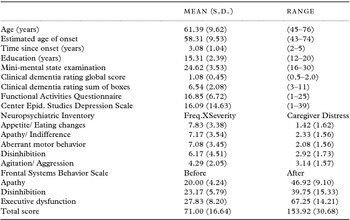
Clinical features of the sample (see Table 1)
The bvFTD group was composed of 5 women and 8 men and were 85% White. The dementia severity of the group was mild to moderate on the CDR with impairment in independent completion of instrumental activities of daily living on the FAQ. The CES-D was not indicative of significant depression, but the NPI disclosed five common neuropsychiatric symptoms: appetite/eating changes (n = 12), apathy/indifference (n = 12), aberrant motor behaviors (n = 12), disinhibition (n = 12), and agitation/aggression (n = 7). On the FrSBe, participant caregivers reported pre- to post- disease increases in apathy, t(11) = 10.60, p < 0.001, disinhibition, t(11) = 3.54, p < 0.001, and executive dysfunction t(11) = −9.11, p < 0.001 (Total Score pre- to post- change was t(11) = 8.69, p < 0.001)
Participants demographics (Total n = 13)

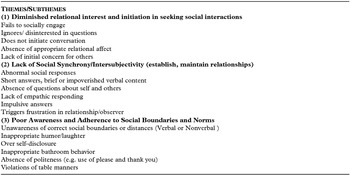
Three main social themes with their common subthemes were generated from iterative category development (See Table 2). These three main themes were (1) Diminished relational interest and initiation in seeking social interactions; (2) Lack of social synchrony/intersubjectivity (establish, maintain relationships); and (3) Poor awareness and adherence to social boundaries and norms. Descriptions of the three themes are provided below along with italicized examples listed below were deemed most representative for their subthemes.
ATLAS.ti major themes and subthemes

Diminished relational interest and initiation in seeking social interactions
This category pertained to initiation of social contact, apparent interest in engaging in interaction, and attachment/proximity seeking behaviors. This theme differs from the subsequent theme, lack of social synchrony/Intersubjectivity, as this category was specific to the primary or initial demonstration of social drive, described as an impetus to begin an interaction. The construct conceptually corresponds with attachment seeking behavior, and establishing social bonds (Magai and Cohen, Reference Magai and Cohen1998).
Failed social engagement
On multiple occasions, participants demonstrated lack of social connection, leaving others feeling unheard, ignored, and relationally frustrated, for example: Mr. A was involved in a card game but doesn't seem to care what is going on during the game. . . He isn't paying attention to the game; he seems careless. . . He never reacts to being corrected [i.e. multiple attempts by others to engage his interest in the social situation].
Ignores/disinterested in questions
This subtheme included instances in which participants were frequently disinterested or ignored the researchers’ or family members’ questions. The [female] participant is very concentrated on this puzzle and she does not take her gaze off of it [even when others are having conversations]. She did not look around or make eye contact with family members when they called to her.
Does not initiate conversation
The participants often failed to initiate conversations or interject themselves into ongoing conversations, showing a lack of relational interest. He had a somewhat blank, direct look when I first walked in [to meet him]. No smile recognition, [no change in his face, in response to my presence]. In response to [my greeting] “I’m [name]”, he said “ok” with no smile or change in expression.
Lack of social synchrony/intersubjectivity (establish, maintain relationships)
The theme focuses on behaviors involved in establishing and maintaining the reciprocal sending and receiving of signals in social interaction. Examples of this theme include the length and depth of interactions, the degree of engagement, the presence of empathic responses, and the appropriateness or thoughtfulness of responses.
Abnormal social responses
This subtheme included un-prefaced or tangential interruptions or interjections to conversation or a failure to respond in a manner that facilitated or sustained an interaction. [Participants often made interjections that seemed to have salience to the participant or, alternatively, left dead space or long uncomfortable pauses in the conversation].
Short answers, brief or impoverished verbal content
Participants demonstrated an inability to maintain social synchrony in giving short, blunt replies. Interlocutor: Why don't you show me one of the grandkids [photo albums]? Participant: [to spouse, perplexed] Why would she want to see our photo albums? Interlocutor: [Nonverbally motioned with interest in seeing photo album of family.] Participant: [flipped through photo album quickly, said some people's names but rarely gave context; gave no stories or commentary about what was happening in the photos, despite researcher's verbal and nonverbal expression of interest].
Absence of questions about self and others
This subtheme includes inappropriate, intrusive, tangential, or perseverative inquiries about subjects. The participant asked repetitive questions to the researcher such as, “Are you Chinese? Do you have a boyfriend? [did not wait for or monitor researcher's response between questions] Are you Asian?. . . Thrilla in Manila [tangential reference to historic boxing match in Philippines]. . .“You can see I like Asian women [pointing to his own wife].”
Lack of empathic responding
Several participants exhibited incongruence between conversational content and their affective responses, such as a failure to offer empathic gestures or words of consolation in response to family members’ distress. While a family film was playing, B's wife began to cry. He looked at his wife and did not exhibit a response to his spouse's crying or initiate any signs of affection [no attempt to comfort her]. . .[But] there was a time when B wasn't like this, before the onset of the disorder [per his wife].
Poor awareness and adherence to social boundaries and norms
This theme included violations of mainstream social norms such as physical boundaries, manners, and appropriate use of humor in social situations.
Unawareness of correct social boundaries or distances (verbal or nonverbal)
This subtheme included instances when participants would abruptly and without explanation walk away from an ongoing interaction (especially in open spaces), intrude and violate another's physical space, or make inappropriate comments. This patient would also shout out in the elevator “this is ridiculous” a couple of times. . . stood in middle of elevator that was crowded (spatially intrusive) and blurted out “this is ridiculous and said “f*ck” as they were leaving an office. While on the elevator the patient presses all the buttons with other individuals in the elevator.
Inappropriate humor or laughter
This subtheme includes telling inappropriate jokes, sharing humor only of relevance to the participant (devoid of context), and unprompted laughter not connected to any identifiable trigger. The participant began laughing out loud for no apparent reason while in an aisle at the store. The patient continued to laugh and did not change his behavior; despite him seeing that [others] appeared annoyed with him. He apparently did not realize the effect he was having on them or that they were responding to his laughing.
Over self-disclosure
Participants over-disclosed personal information pertaining to both themselves and family members that would otherwise be private, such as family secrets or private financial and medical information (e.g., sexual orientation). He would make socially inappropriate remarks like announcing in public shopping settings [department store] “My grandson's girlfriend turned gay” or “I didn't go [to an event] because I had diarrhea. . . He also shared to strangers that he, “loved ice cream, and has Pick's disease, but does not have diabetes.”
Discussion
The current study provided concrete examples of abnormal social behaviors in bvFTD that occurred in a variety of real-life environments. Qualitative analysis yielded three primary thematic behavioral clusters which included (1) Diminished interest and initiation in seeking social interactions; (2) Lack of social synchrony (bonding or sustaining attachments) (Atzil et al., Reference Atzil, Hendler and Feldman2013), and intersubjectivity (generating and sharing meaningful experiences) (Allen and Williams, Reference Allen and Williams2011); and 3) Poor awareness and adherence to social boundaries and norms. These themes catalogue specific behaviors illustrating the disconnection between patients with bvFTD and others in their environment and are consistent with their neuropsychiatric symptoms and the apathy and disinhibition seen on the NPI and FrSBe scales (Mendez et al., Reference Mendez, Lauterbach and Sampson2008). These findings can facilitate caregiver advice and education on the management of these patients and help clinicians target their diagnostic questions.
BvFTD patients demonstrated an inability to preserve the “social glue” required to sustain connectedness. They wandered away from interactions, had intrusive behaviors, gave indifferent responses (e.g., “I don't care”), and lacked relational curiosity. The group had trouble sustaining the ebb and flow of sending and receiving interactive communication signals inherent in reciprocal socioemotional interactions. When they were able to establish a degree of basic interaction, the cognitive and affective depth of the interaction was lacking and impoverished. BvFTD patients were also typically unable to detect and/or respond to cues of emotional discomfort or frustration in observers, such as a failure to redirect prolonged gazes after the receiver exhibited discomfort. These results align with studies suggesting that bvFTD patients exhibit difficulty responding to the emotional expressions of others (Rosen et al., Reference Rosen2006).
Assessing socioemotional deficits as part of a diagnostic workup is essential, as these features reliably distinguish bvFTD from other common dementias such as AD (Mendez et al., Reference Mendez, Perryman, Miller and Cummings1998). However, few appropriate clinical assessment tools exist. The observational examples from this study can be utilized to develop effective clinical methods of assessing social deficits in these patients. The current findings can serve as a paradigm for generating observational tables, coding systems, and quantitative methods for evaluating patients with bvFTD, as well as other neurological disorders characterized by disturbances in social behavior.
In addition to helping in the diagnosis of bvFTD, clinicians can use these social behavioral themes to educate caregivers and providers on potentially disturbed behaviors. BvFTD patients have unique caregiver needs compared to other dementias (LoGiudice and Hassett, Reference LoGiudice and Hassett2005; Nunnemann et al., Reference Nunnemann, Kurz, Leucht and Diehl-Schmid2012). For example, caregivers can anticipate social intrusions in more enclosed or smaller spaces, whereas they must anticipate wandering and difficulty maintaining physical interpersonal proximity in more open spaces. Given the patient's lack of concern for their own and others’ privacy, caregivers may choose to refrain from disclosing new private or sensitive information to individuals with bvFTD. Furthermore, caregivers can interpret a patient's social disinterest as a symptom of the disease, rather than a willful choice to disengage. The social behavior themes described in this study can aid both caregivers and providers in meeting the unique caregiving needs of bvFTD patients (Bakker et al., Reference Bakker2013).
There were limitations to this qualitative study. They included the potential for observer bias, small sample size, and natural restrictions of qualitative methods. Individual observer bias was probably inevitable when choosing and recording social behaviors during this observational study. Because of the labor involved in observational study of each participant, this study had a small sample of 13 participants, and this sample may not be representative of a larger bvFTD cohort. Additionally, the qualitative nature of this study limited the ability to establish frequency or prevalence of behaviors across the entire sample.
In conclusion, this study describes observable disturbances in major social behavioral themes in bvFTD and validates the diagnostic criteria for this disorder (Rascovsky et al., Reference Rascovsky2011). These findings offer a source for future studies regarding behavioral phenomena in bvFTD. In particular, the use of observational research in natural settings may advance the assessment of interpersonal behaviors in this, and related disorders. Thus, future studies using this approach may yield further information regarding social functioning in bvFTD that can help in the recognition and management of this disorder (Mendez and Manes, Reference Mendez and Manes2011).
Conflict of interest
None.
Description of authors’ roles
F. R. Nedjat-Haiem (FRN-H) (primary rater) and C. Velasco (CV) (research assistant) analyzed data and identified behavioral themes. J. Barsuglia (JB) drafted the paper. M. J. Mather (MJM) contributed to data collection and paper revision. Jimenez (EJ), J. Shapira (JS), and M. Mendez (MM) contributed to critical review and paper revision.
Acknowledgments
Funding though NIA Grant #R01AG034499-04; Joseph P. Barsuglia is funded through the VA Geriatric Research Education and Clinical Centers Advanced Fellowship; Frances R. Nedjat-Haiem is funded through the VA Associated Health Postdoctoral Fellowship Program, and the Hartford VA Social Work Scholars Program.