


Austria distinguishes itself for the careful preservation of its history and cultural heritage. Not surprisingly, one of the first things that tourists notice when strolling the streets of any Austrian city or town is the memorial plaques and the flags and shields that identify every site of historical interest and every museum. This attitude toward heritage preservation is also behind the excellent institutional support that makes the country's historical records available to scholars and to the public at large. Thus, just as the visitor on a ‘music tour’ of Vienna has no problem locating the houses where Schubert was born or where Beethoven wrote his “Heiligenstadt testament”, the international scholar has digital access to a treasure trove of resources, reference material, and documents that are indispensable for in-depth research on Anton Bruckner.
The state-funded Austrian Academy of Sciences (ÖAW, for Österreichische Akademie der Wissenschaften, www.oeaw.ac.at) oversees a wide variety of institutes and programmes for research, the transmission of knowledge, and social engagement in all scientific disciplines, including of course the social sciences and humanities. An important part of the Academy's tasks is fulfilled by the Austrian Centre for Digital Humanities and Cultural Heritage (ACDH-CH), whose Musicology Division (Abteilung Musikwissenschaft) has recently taken over the functions previously assigned to the Institut für kunst- und musikhistorische Forschungen (IKM). The digital resources available from the ACDH-CH's Musicology Division cover a wide variety of documents, manuscripts, editions, and recordings of music from the Middle Ages to our time. In addition to sizeable collections of audio-visual material and iconographic resources, the Research section that is devoted to documentation of editions and sources, for instance, includes music preserved at St Stephen Cathedral, music composed and performed in Habsburg courts, and complete editions of music by Johann Joseph Fux, Schubert, Brahms and Webern. Along similar lines, the Digital Musicology section includes a database of medieval music manuscripts preserved in Austrian libraries and archives, and the Publication Series section provides access to manuscript and printed sources for the composers listed above as well as to a wide variety of music repertoires available from the Imago Musicae, Tabulae musicae Austriacae and Mittelalterliche Musikhandscriften databases. And, perhaps more important to the reader of the present review, the Publication Series provides links to the Wiener Bruckner-Studien monograph series on Anton Bruckner, published by the Musikwissenschaftlicher Verlag of Vienna (MWV), as well as to the periodical publications of the Anton Bruckner Institut Linz (ABIL), i.e., the series Bruckner-Jahrbuch, Bruckner-Symposion and Anton Bruckner: Dokumente und Studien.
Among the research tools and resources supported by the Austrian Centre for Digital Humanities and Cultural Heritage of the Austrian Academy of Sciences is Bruckner-online (www.bruckner-online.at). Funded in part by the Wissenschaftsfond FWF, this internet archive hosts multiple resources in one. The far-right button of the home page's uppermost navigation bar, for instance, takes the user to the portal of the Anton Bruckner-Lexikon online (ABLO, www.bruckner-online.at/?page_id=1259), a separate ACDH-CH supported project. (It must be noted that even though they are supported by the same institution, both Bruckner-online and the ABLO project are independently administered.) And, along the same lines, Bruckner-online provides a link to the ABIL-supported database Anton Bruckner Chronologie Datenbank (more on this presently).
In addition to the Lexikon, the navigation buttons of the Bruckner-online home page provide links to two of its projects, namely, to the List of complete works (‘Werkverzeichnis’) database and to the Kitzler notebook (‘Kitzler-Studienbuch’). While the former will be the subject of discussion and illustrations presently, I shall note here that the latter is a valuable resource for scholars interested in conducting research on the studies of form and instrumentation that Bruckner undertook with conductor and cellist Otto Kitzler in 1861–63.Footnote 1 The non-specialist, for whom Kitzler may not be a household name, may find useful to read the ‘Kitzler, Otto’ entry in the ABLO ‘Personen rund um Bruckner’ database – which is a good starting point for information on anyone with whom the composer interacted. Beyond the biographic and factual information on Kitzler that one can find in Grove Music Online and similar reference sources, the Bruckner-Lexikon article addresses the relationship between Kitzler and the composer. Furthermore, Paul Hawkshaw's ‘Kitzler-Studienbuch’ ABLO article provides a good entry point into the contents and organization of this source. (A facsimile edition of the Kitzler notebook, edited by Hawkshaw and Wolfgang Erich Partsch, is published as volume 25 of the Neue Bruckner Gesamtausgabe.)Footnote 2 The Kitzler notebook, incidentally, includes a wide range of material, from four-bar exercises to continuity sketches to finished scores of large-scale movements and pieces, and it is an indispensable source for scholars interested in tracing Bruckner's steps from apprenticeship to mastery of specific genres. It is difficult to imagine, for instance, the command of idiomatic writing, structure and form that the composer achieved in his 1879 String Quintet in F major (WAB 112) without the exploratory work he had undertaken in the 1862–63 String Quartet in C minor (WAB 111) that he wrote for Kitzler.Footnote 3 Given its importance for research into Bruckner's early works in various genres, the usefulness of a link to the Kitzler notebook cannot be overstated.Footnote 4
The top navigation bar of the Bruckner-online portal offers several options whose scroll-down menus can be seen by mousing over them: the ‘Projekt’ button includes the project's description, short bios of the technicians in charge of the site's digitization and content, a link to the Bruckner Research section of the ÖAW and relevant updates (‘Neuigkeiten’). The ‘Bruckner’ button takes the visitor to ‘Leben’, which offers access to chronological synopses of events in the composer's life organized according to specific time periods, and to ‘Bibliographie’, a basic search tool to access a quite comprehensive database of articles and monographs on Bruckner published from his lifetime up until its latest update – which, at the time of writing this review, was 2019. The ‘Drucke’ button takes the user to two categories of printed sources, the first of which, ‘Erstausgaben’, leads to a database of first editions of Bruckner's works. Here, the entries are arranged according to WAB number, and basic information is provided for each publication. Perhaps the most useful feature in this section is that it is fully digitized, and thus at the end of each entry there is a link to the work's first edition. By mousing over the second option of printed sources, ‘Gesamtausgaben’, the user sees a drop-down menu that leads in turn to four options. For each of the items in the first of these, the ‘Alte Gesamtausgabe’, there are links to the actual publications. As with the first editions, the Old Edition volumes are all digitized, which is very useful given that these are out-of-print sources. Most of the scores currently used for performance purposes are those of the ‘Neue Gesamtausgabe’ – which is presumably why they are not made available in digital format. Finally, the current editorial endeavours include the Anton Bruckner Gesamtausgabe and the Anton Bruckner Urtext Gesamtausgabe (ABUGA). The webpage for each of these two incipient projects is, understandably, limited to basic information about their rationale, scope, and planned features. By clicking on the images of the front-page rotating banner, incidentally, one can access the same resources that are accessible from the top navigation menu.
Regardless of the scope and depth of the Bruckner-online user's intended research, the two most important options offered by the home page's top navigation bar are the ‘Forschung’ and ‘Werkverzeichnis’ buttons. From the former's drop-down menu one can access the ‘Kitzler Studienbuch’, whose own drop-down menu in turn leads to various options. While most of these options are descriptions of the project and of its digitization tool (MEI, Music Encoding Initiative), the last option, ‘Imageviewer’, is the actual link to the contents of the notebook. In addition to the facsimile published in the Neue Bruckner Ausgabe, the digital version offers a transcription to facilitate music analysis, with the two views displayed side by side. The other options in the ‘Forschung’ drop-down menu include ‘Bruckner Forschung (ÖAW)’ and ‘Bruckner Forschung International’, which provide descriptions of, and links to, a variety of ongoing Bruckner research projects, both supported by the Austrian Academy of Sciences and independently undertaken. The ‘Bruckner-Gesellschaft’ option offers a brief historical synopsis of the Society and relevant information about its current organization and membership; ‘Weitere Studien’ furnishes a link to a historical account and description of the Music Archive of the Linz Cathedral, which dates from the late nineteenth century and holds early manuscript parts for Bruckner's Mass in E minor (WAB 027) and other works. The last option under ‘Forschung’ offers external links to a variety of independent Bruckner organizations. In addition to the Anton Bruckner Institut Linz, the Anton Bruckner Gesamtausgabe, and the Anton Bruckner Urtext Gesamtausgabe, these links include The Bruckner Society of America, The Bruckner Journal (which is, incidentally, a broken link), the Musikwissenschaftlicher Verlag, and the Bruckner category of IMSLP (Petrucci Music Library), which makes available, in digital form, manuscript copies, early editions and scores from both the first and the second editions of the composer's complete works. The ‘Forschung’ links also take the user directly to the search page of Franz Scheder's Anton Bruckner Chronologie Datenbank (ABCD, www.abil.at/Datenbank_Scheder/db_suche.php), an ABIL-supported database of bibliographic sources and factual information about works, places, institutions, and people related to the composer (see Fig. 1). This comprehensive reference tool – which originated as Scheder's two-volume Chronologie – is an essential resource to scholars working on any area of Bruckner research.Footnote 5
Franz Scheder, Anton Bruckner Chronologie Datenbank (ABIL), portal front page.

By mousing over ‘Werkverzeichnis’ – the button at the centre of the top navigation bar – the user can see a drop-down menu whose items provide a good sense of the catalogue's organization (‘Werksystematik’); the concordances between the Grasberger 1977 catalogue and recent revisions (‘WAB-Konkordanz’); the type of information that each entry offers (‘Werkeinträge’); and the website, contact information, and link to each of the archives and depositories that hold autograph and early manuscript copies of Bruckner's works (‘Aufbewahrungsorte’) – a useful resource for scholars planning on conducting research in situ. At the top of the drop-down menu is ‘Werkverzeichnis’, the link to a page that includes at once a search tool and the catalogue itself – both of which can be arranged by the user in various ways (see Fig. 2).
Werkverzeichnis (WAB), search page.

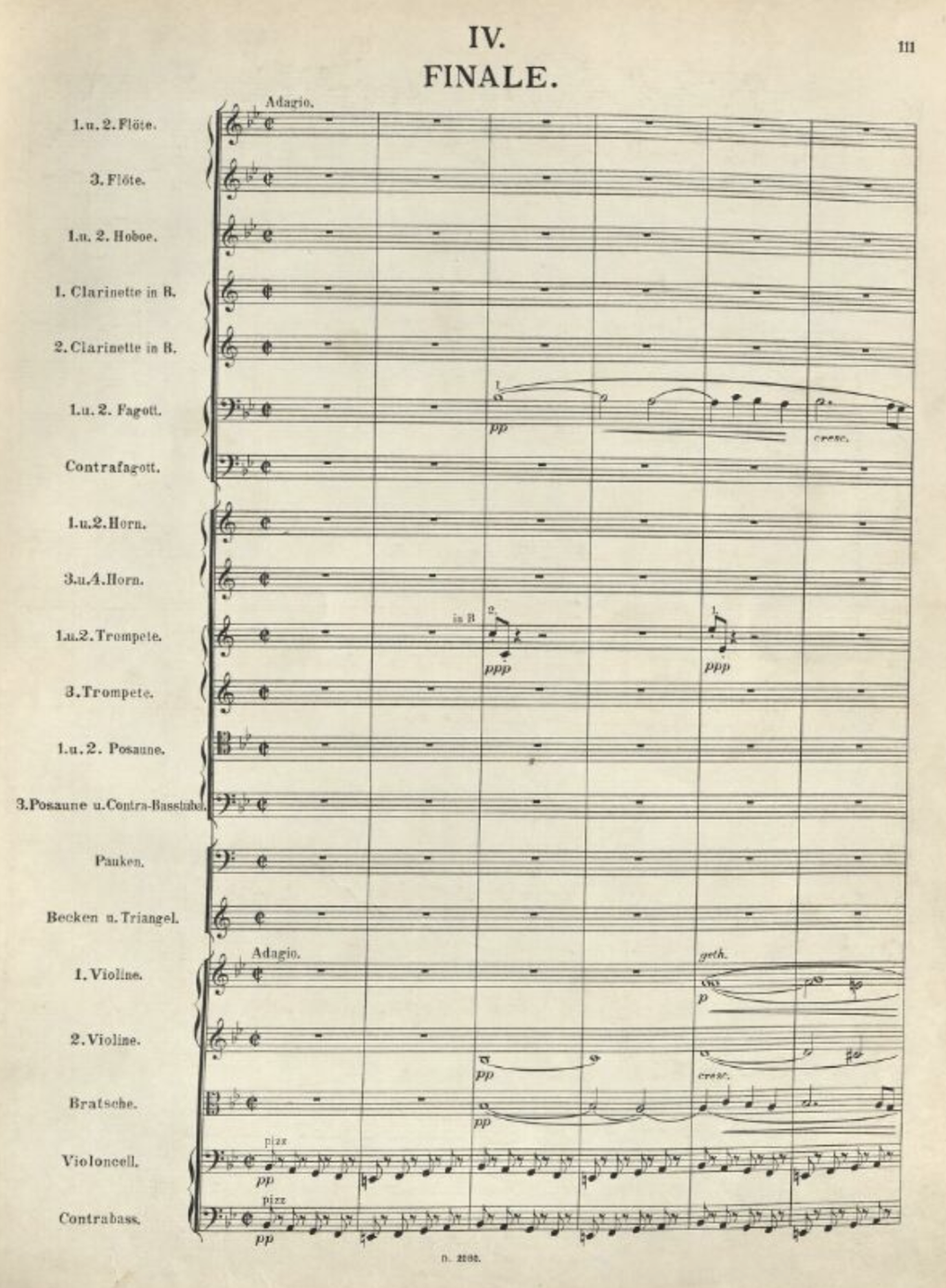
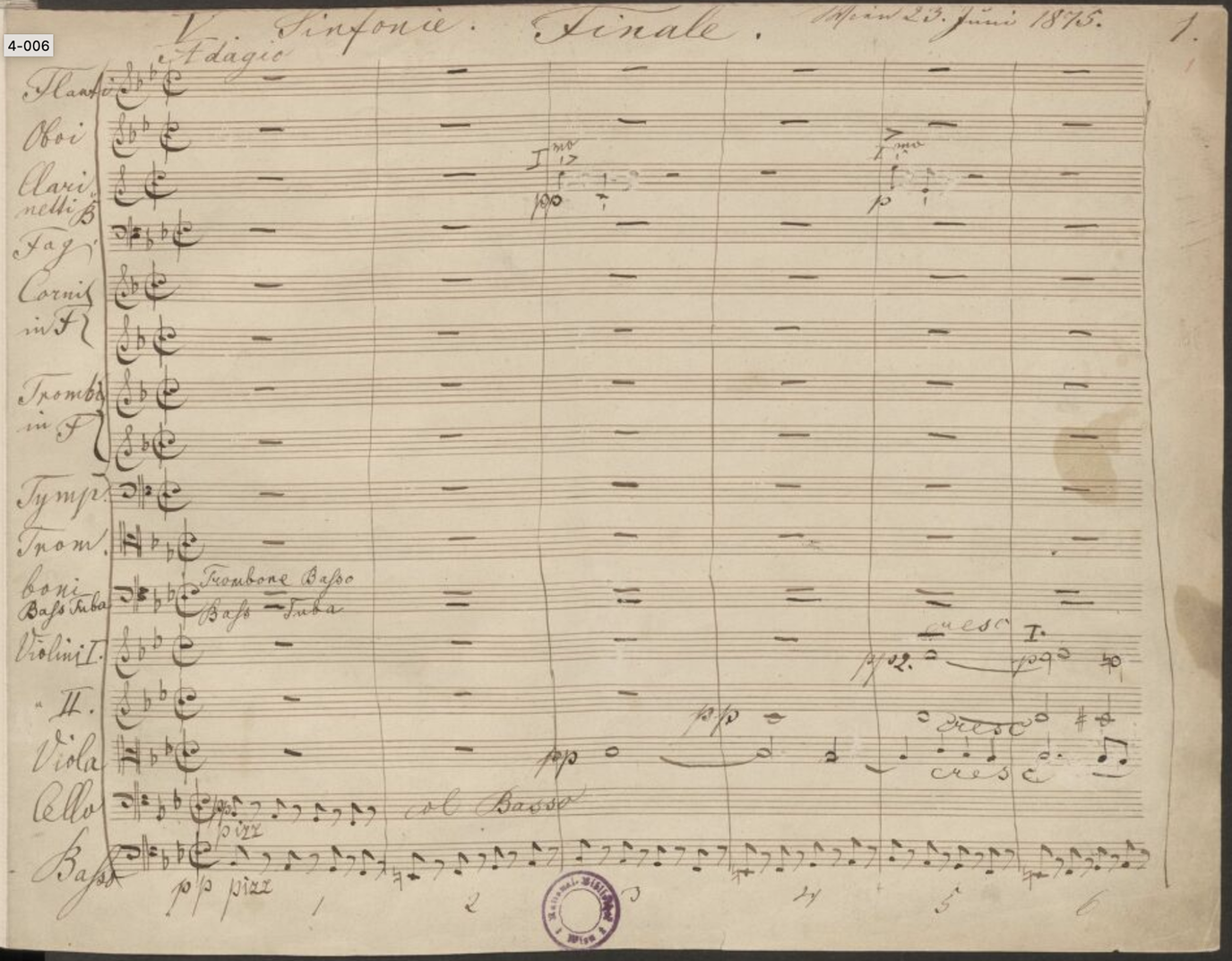
In what follows, I will provide two examples of the ways in which Bruckner-online can help scholars who seek in-depth information about the composer in a variety of research scenarios within the fields of source studies, music analysis and reception history. Bruckner's works present an unparalleled challenge in the field of nineteenth-century source studies, given that a significant portion of his works are preserved in multiple versions – all of which are considered authentic so long as the revisions involved were made, supervised, or sanctioned by the composer himself. The quotation of an excerpt from the composer's will and testament placed under the rotating banner of the Bruckner-online home page is of particular importance. Even though the quoted text is straightforward – it is merely a statement whereby the composer assured the preservation of his manuscripts for posterity – it actually has interesting implications, as the scores in his bequest preserve multiple versions of some of his symphonies and other large-scale works.Footnote 6 Nonetheless, while Bruckner's will and testament does not solve the ‘problem’ of the multiplicity of authentic versions whereby many of his large-scale works are preserved, it does solve the issue of foreign intervention, that is, the problem posed by those versions and editions of Bruckner's works that were made or revised by others without his consent – and in some cases without his knowledge. This is precisely the case with the Symphony No. 5 in B-flat major (WAB 105), which Bruckner composed between February 1875 and May 1876.Footnote 7 Even though this work is preserved in one version, it is not free from serious philological problems.Footnote 8 In this instance, there are numerous and significant discrepancies between the text of the autograph score and the reading of the work as it was premiered and published for the first time. In a heavily revised version made by Bruckner's former student and supporter Franz Schalk, the work was premiered in Graz on 9 April 1894 and first published – in Schalk's version – by Doblinger in 1896.Footnote 9 Although the Schalk brothers had the best of intentions in their support of the Brucknerian cause, they engaged in a pattern of deception, by keeping their former teacher in the dark about the unauthorized changes they introduced into his works, particularly in their revisions of the F-minor Mass (WAB 028) and the Fifth Symphony. In the case of the Symphony's premiere, the brothers led Bruckner to believe that Franz was using parts drawn from the autograph score while he was actually using a score and a set of parts that contained his own ‘arrangement’ of the work.Footnote 10 Franz Schalk's revisions range from performing indications (tempo, dynamics, articulation) to cuts and substitutions in the musical text itself to significant changes in the work's orchestration. Figure 3 shows a comparison of the opening bars from the Fifth Symphony Finale in the first edition of 1896 (Fig. 3a) and in the autograph score (Fig. 3b) – both of which are available via the relevant links in the website's ‘Werkverzeichnis’. As the images of these two sources show, Franz Schalk added parts for a third flute and a contrabassoon as well as cymbal and triangle.Footnote 11 The unauthorized changes in orchestration introduced to the work, incidentally, go well beyond the addition of a few woodwind and percussion parts. Schalk's extensive use of a ‘Wagnerian’ mixture of woodwinds and strings, for instance, represents an egregious distortion of the sound and effect of Bruckner's orchestral conception.
Bruckner, Symphony No. 5, IV, first edition, Doblinger, 1896.
Bruckner, Symphony No. 5, IV, Autograph manuscript, ÖNB Mus. Hs. 19477.
My second example concerns analytical and critical issues as illustrated in the coda from the opening movement of the Eighth Symphony. Bruckner composed his Symphony No. 8 in C minor (WAB 108) between June 1874 and August 1877.Footnote 12 Upon completing the score, Bruckner sent it to the director of the Munich Hofoper and Music Academy concerts, Hermann Levi, who had become his ‘artistic father’ after conducting a highly successful performance of the Seventh Symphony in the Bavarian capital – a performance widely regarded as the single most important event that led to Bruckner's recognition in Austria, Germany and beyond. This time, however, Levi backtracked on his intention to premiere the work. As he confessed in his correspondence with Bruckner and with Josef Schalk, the new symphony remained ‘a closed book’ to him despite his meticulous study of the work.Footnote 13 (Except for the Eighth Symphony, Levi was to continue conducting the composer's works and supporting the Brucknerian cause. In fact, he was the main force behind the honorary doctorate that the University of Vienna was to confer on Bruckner a few years later.) Although the composer was deeply disappointed, he quickly overcame his depression and started to revise his work; and by early October 1890 he had a new, significantly improved version of the Eighth Symphony. Three months later, in preparation for a performance of his newly revised composition, Bruckner asked the conductor Felix Weingartner to observe the cuts that he had marked in the score. In a letter of January 1891 he expressed his wish for the conductor to ‘strictly observe the cuts in the Finale as indicated; otherwise it would be far too long, and is valid only for later times, and for a circle of friends and connoisseurs’.Footnote 14 Bruckner's instructions indicate that the cuts in question were not definitive but only meant for the performance of his Eighth Symphony that Weingartner was planning to conduct in Mannheim, with somewhat limited instrumental resources. In fact, when the conductor asked for permission to make adjustments to the brass and woodwind parts in order to improve the balance between the wind groups and the small string section of his orchestra, Bruckner replied: ‘By all means make the necessary changes for your orchestra, but please do not alter the full score, and also leave the orchestral parts unchanged when preparing them for print – that is one of my most ardent requests’.Footnote 15 Bruckner's exchange with Weingartner reflects a concern that he expressed elsewhere and in various ways, but perhaps most clearly in the bequest of his last will and testament quoted on the Bruckner-online home page.
There are many differences, large and small, between the two versions of the Eighth Symphony. In its 1887 version, the coda of the opening movement ends, like all other Bruckner first-movement codas, with a tutti fortissimo. In the 1890 version, the composer did away with the coda's final tutti, and he ended the movement with a pianissimo in the strings over a timpani pedal that seems to fade into nothingness. Unique within Bruckner's symphonic output, this new version of the coda provides a more satisfying ending to the opening movement. Not only does the revised version tie in better with the following movement – which is now the Scherzo rather than the Adagio, as initially intended – but it works more effectively in the context of the entire work because it avoids pre-empting the powerful effect of the Finale's coda. This instance illustrates how a comparative analysis of different versions of Bruckner's compositions lends support to the notion that, by and large, he revised his works to make improvements on them, especially by tightening their structure and achieving a higher degree of cohesion. Thus, along with the extant documentary and anecdotal evidence, comparative analysis of the various versions can help in deconstructing the myth that Bruckner was an insecure composer willing to change – and even allow others to change – his scores in order to conform to public taste.
Bruckner-online can help the user in navigating issues concerning the early reception of the composer's music – though in this area of research the user needs to supplement the portal tools and links with external resources. The premiere of the Eighth Symphony, which took place on 18 December 1892, was among the most anticipated musical events in early 1890s Vienna. At the head of the Vienna Philharmonic, conductor Hans Richter did a great job, not only of preparing the musicians during rehearsals but also of preparing the public for a work of great complexity and monumental proportions – features that explain the unusual programme of a concert in which the symphony was performed as a stand-alone piece. The audience's preparation was achieved in part by the ‘press release’ of a concert guide (see Fig. 4 for an excerpt thereof) – which the Bruckner-online user can access via a link to ‘ANNO Historische Zeitungen und Zeitschriften’, i.e. the historical periodicals digital database of the Austrian National Library (https://anno.onb.ac.at).Footnote 16 As explained by the author of the concert guide that Die Presse published the morning of the concert, Bruckner's Eighth Symphony
is so expansive that the Philharmonic will not precede it even with an overture at the concert. An exhaustive analysis of this gigantic work cannot be given here, but a presentation of its main ideas will make it easier for concertgoers to understand this complex creation, and it will give those readers who are not attending the concert at least an idea of its thematic content.Footnote 17
Beginning of the Concert guide for Symphony No. 8 premiere, Die Presse 18 December 1892.

As it turned out, the premiere of the Eighth Symphony was a complete triumph for Bruckner, and it certainly was one of the most successful events he experienced in Vienna. The anticipation and excitement with which the city's musicians and music lovers had awaited the concert was elicited in part by the war between pro- and anti-Bruckner factions that had been playing out in the Viennese press for about ten years. Needless to say, the clash between an anti-Bruckner camp led by the influential music critic Eduard Hanslick and a growing number of critics, musicians, concert-goers and University students who supported the composer is a topic that requires a separate discussion.Footnote 18 Be that as it may, critical studies is the one area in which the usefulness of Bruckner-online can be enhanced by adding links to important reviews of the Bruckner premieres and early performances. Regarding the Eighth Symphony premiere, for example, the concert guide quoted above is the only press account for which the website provides a link. In this instance, it would be useful to have links to reviews by Hanslick, Max Kalbeck, Richard Heuberger, Theodor Helm, Ludwig Speidel and Hans Paumgartner – to name but a few of the prominent music journalists who wrote for the Viennese newspapers of wider circulation at the time. As with most large-scale compositions by Bruckner, references to the critical and public reaction to the early performances of his Eighth Symphony can be found in the Göllerich/Auer biography and other sources.Footnote 19 Direct links to the relevant reviews, however, would be welcome, and they could save Bruckner-online users a significant amount of time in their research on the early reception of the composer's music in Vienna.
Bruckner-online does not offer an English translation of its contents.Footnote 20 Bruckner scholars tend to have a working knowledge of written German, which is needed for the survey of primary sources in Bruckner-related research; and casual users with no working knowledge of the language would probably benefit more from a survey of secondary and tertiary sources, particularly the copious English-language literature on Bruckner published during the past few decades in England, the United States and Australia. Finally, it must be noted that the portal works relatively well on tablets and phones, with the caveat that when working from such devices users must switch back and forth between portrait and landscape orientation, depending on the specific page or image on display.
The examples I have provided illustrate some of the ways in which Bruckner-online can assist scholars and other users in their research on Bruckner-related topics. Unless watermarks, graphology, and/or in-depth philological issues are essential to one's research, scholars interested in any aspect of Bruckner's life and music can save countless hours of primary-source survey by taking advantage of the digital resources made available on the portal. All in all, Bruckner-online is an impressive undertaking, and it is an extremely helpful resource for the scholar and the casual user alike. Not only is it an indispensable tool for the advancement and dissemination of Bruckner scholarship, it is a gateway to any aspect of nineteenth-century music that intersects with the composer and his oeuvre.



