I. INTRODUCTION
An individual's life possesses a unity which a collection of individuals lacks. This has the following implication for distributive ethics: some ways of balancing benefits and burdens that are appropriate when these accrue to a single individual are inappropriate when benefits accrue only to some and burdens only to others. In some cases, this difference between intrapersonal and interpersonal trade-offs arises because of the presence (in the former) and absence (in the latter) of full intrapersonal compensation. In a one-person case, you have good reason to let a burden fall on a person when and because that person will be fully compensated by an associated greater benefit. In a two-person case in which both individuals are each initially as well-off as the individual in the one-person case, you do not have as much reason to let a burden fall on one person merely because the other will thereby receive a greater benefit. In such a two-person case, it is harder to justify letting the burden and benefit materialize together, because the person who would suffer the burden, and who would, because of this burden, become worse off than the other, is not compensated by the greater benefit to someone else.
However, the appropriateness of making intrapersonal trade-offs with an eye to a person's good is not limited to cases in which one knows that an individual will be compensated for a loss by a greater gain. In some risky one-person cases, for example, there will be no such compensation. There are merely two, mutually exclusive, potential futures, one in which a person receives a benefit, and another in which he bears a burden. Nevertheless, these two futures are unified by the fact that they are both potential futures of his. That makes it appropriate to balance the potential benefit and potential burden to him from the perspective of his interests.Footnote 1 And that is why, when we choose to leave someone exposed to a risky course of events because the expected benefit to him of the uninterrupted unfolding of this course of events is sufficiently larger than the expected burden to him, we naturally speak of ‘choosing for his sake’. By contrast, the different futures of two separate individuals are not so unified.
It has long been recognized that this difference between intrapersonal and interpersonal trade-offs rules out utilitarianism as a theory of distributive ethics.Footnote 2 Moreover, in the article that is the subject of this issue, Michael Otsuka and Alex Voorhoeve argue that a version of the Priority View must be rejected because it, too, inappropriately mandates balancing chances of gain and risks of loss to a single individual in the same manner as one balances potential gains and losses to separate individuals.Footnote 3
Egalitarian views have been thought to succeed where these other views fail. It is easy to see why this is so. In a one-person case in which a risk of a burden is the flipside of a chance of a benefit which outweighs it, there is no egalitarian objection to letting the single person be exposed to both the risk of the burden and the chance of the benefit, so long as the person's fate is considered in isolation from how well or badly others fare. By contrast, in a two-person case in which both individuals are each initially as well-off as the individual in the one-person case, and one person faces only the risk of the burden and another only the chance of the greater benefit, there is an egalitarian objection to letting the first person be exposed to the burden and the second to the benefit, because the person who would suffer the burden will, because of this burden, become worse off than the other.
For this reason, giving weight to egalitarian concerns is widely regarded as a way of meeting the demands of the separateness of persons. For example, David Gauthier, who was among the first to argue that utilitarianism fails to respect the separateness of persons, proposes to solve this problem by giving weight to both total utility and equality.Footnote 4 Moreover, in their aforementioned article, Otsuka and Voorhoeve argue that, in the cases they discuss, egalitarian views treat intrapersonal and interpersonal trade-offs appropriately differently.Footnote 5 And in his contribution to this issue, Martin O'Neill claims that a ‘pluralist’ version of the Priority View can account for the difference between intrapersonal and interpersonal trade-offs by giving weight to egalitarian considerations.Footnote 6 These conclusions are in line with the common thought that, as Dennis McKerlie writes, ‘[t]he contrast between intrapersonal judgments and interpersonal judgments is central to egalitarianism’.Footnote 7
Our purpose in this article is to examine more carefully than has previously been done which forms of egalitarianism can, and which cannot, draw this contrast appropriately. We argue that a form of egalitarianism which is concerned only with the extent of (unchosen, undeserved) outcome inequality cannot account for the shift in the moral weight of changes in utility between intrapersonal and interpersonal trade-offs. We also argue that, by contrast, an egalitarian view which is concerned both with outcome inequality and with the fairness of individuals’ chances of receiving the outcomes in question can account for this shift. (Such a view has been proposed by Richard Arneson and Larry Temkin.Footnote 8 However, to our knowledge, it has not previously been argued that a concern for individual's chances plays a crucial role in enabling this form of egalitarianism to respect the difference between the unity of the individual and the separateness of persons.) Finally, we limn a different view, on which inequality is not bad, but nonetheless determines the strength of individuals’ claims. We argue that this ‘Competing Claims View’ can also account for the shift.
Our argument proceeds as follows. In section II, we introduce a pair of cases in which there is such a shift. In section III, we argue that none of the following adequately account for this shift: utilitarianism, a version of the Priority View, an egalitarian view that is concerned only with outcome inequality, and pluralist views that combine this form of egalitarian concern with a concern for total (priority-weighted) utility. In sections IV and V, we argue that, respectively, an egalitarian view concerned both with outcomes and with chances and the Competing Claims View can account for the shift. Section VI concludes.
II. AN ILLUSTRATION OF THE SHIFT
Consider the following:
One-Person Case: Imagine a ten year-old child,Footnote 9 Albert, has a considerable visual impairment, short of total blindness. You are a morally motivated stranger who learns that unless you intervene in an unpredictable natural course of events, Albert will either, with 50 per cent probability, receive a gain in utility by becoming fully sighted, or instead, with 50 per cent probability, suffer a loss in utility because of a worsening of his sight which is no larger than the possible gain. If you intervene, Albert will face neither the prospect of gain nor the risk of loss. You must decide whether to intervene while considering only Albert's self-interest in isolation from any consideration of how well off or badly off anybody else is (yourself included). Suppose the expected gain to Albert of the uninterrupted unfolding of this course of events is great enough relative to the expected loss to make it the case that, from the perspective of his self-interest alone, the value of the chance of the gain outweighs or perfectly balances the value of the chance of the loss.
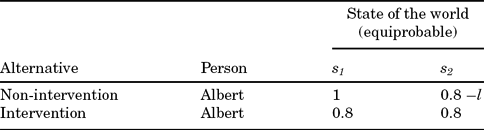
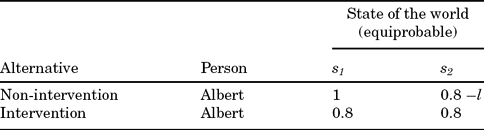
This case is represented in table 1: 1 is the utility of having excellent vision, 0.8 is the utility associated with living with the considerable visual impairment, and l (0 < l ≤ 0.2) is the possible loss in utility, so that 0.8 −l is the utility associated with living with this loss. By assumption, l is a loss for which you can offer the following powerful justification to Albert for non-intervention:
In making this choice, I had to balance a 50 per cent chance of your having unimpaired vision rather than the considerable visual impairment against a 50 per cent chance of your having a visual impairment somewhat worse than the considerable visual impairment rather than the considerable visual impairment. I balanced this potential gain and potential loss from the perspective of your self-interest alone. From this perspective, the value of the chance of gain outweighed or perfectly balanced the value of the chance of loss. I therefore chose non-intervention. In sum, I did the best I could for you, given the information I had at the time.Footnote 10
The distribution of utility in the One-Person Case
Now consider the following:
Two-Person Intrapersonal Case: Imagine that two ten-year-old children, Albert and Bob, are considerably visually impaired, though not wholly blind. You are a morally motivated stranger who learns that unless you intervene in an unpredictable natural course of events, Albert will either, with 50 per cent probability, receive a gain in utility by becoming fully sighted, or instead, with 50 per cent probability, suffer a loss in utility because of a worsening of his sight which is no greater than the possible gain. Bob will be unaffected. If you intervene, Albert will face neither the prospect of gain nor the risk of loss. Bob will again be unaffected. You must decide whether to intervene while considering these individuals’ fates in isolation from any consideration of how well off or badly off anybody else is. Suppose, as before, that the expected gain to Albert of the uninterrupted unfolding of this course of events is great enough relative to the expected loss to make it the case that, from the perspective of his self-interest alone, the value of the chance of gain outweighs or perfectly balances the value of the chance of loss.
The key difference between the One-Person Case and this case is that you are asked to take into account Bob's well-being – which remains unaffected by your choice. In deciding whether to intervene, you must therefore take account of the possible gain to Albert of non-intervention, the possible loss to Albert, and the badness (if any) of the inequality between Albert and Bob generated by non-intervention.Footnote 11 Assume for the moment that, if such inequality is bad, you ought to give it non-infinite weight.Footnote 12 Then there will be a possible loss small enough for it to be justifiable to let Albert remain exposed to this gamble.Footnote 13
Next, consider the following:
Two-Person Interpersonal Case: This is identical to the Two-Person Intrapersonal Case, except that you learn that, unless you intervene, either, with 50 per cent probability, Bob will receive a gain in utility by becoming fully sighted while leaving Albert unaffected, or instead, with 50 per cent probability, Albert will suffer a loss in utility which is no greater than the possible gain to Bob, while Bob remains unaffected. The size of the gain and loss are the same as in the Two-Person Intrapersonal Case. If you intervene, Albert will not face the prospect of a loss, and Bob will not have the chance of a gain.
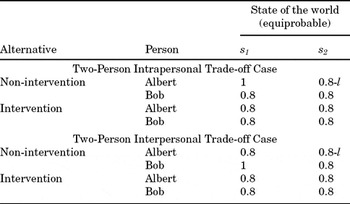
The utilities of Albert and Bob in this pair of two-person cases are described in table 2.
The distribution of utility in a pair of two-person cases

It should immediately be apparent that these two-person cases differ in morally relevant respects. In the intrapersonal case, for Albert, the prospect of the gain is the desirable flipside of his exposure to the risk of a loss which is no greater than the gain. In the contrasting interpersonal case, there is no such person for whom the prospect of a gain balances or outweighs the risk of a loss. Rather, if you do not intervene, Bob will face just a prospect of a gain and Albert will face just a risk of a loss. Moreover, unlike in the corresponding intrapersonal case, Albert will be worse off than Bob no matter what happens. These differences make a clear difference to the justifiability of non-intervention. In the intrapersonal case, you can justify non-intervention to Albert on the grounds that in letting the chips fall where they may, you were doing the best you could for him, given the knowledge you had at the time. By contrast, in the interpersonal case, all you can say to Albert is that you let him be exposed to a risk of loss, and thereby let him become worse off than Bob, for Bob's sake. This is a considerably less powerful justification. There will therefore be some loss in the specified range for which non-intervention is permissible in the intrapersonal case, but for which you should intervene in the interpersonal case to prevent Albert from facing the risk of this loss, thereby also eliminating Bob's prospect of a gain.
III. WHY SEVERAL VIEWS FAIL TO ACCOUNT FOR THE SHIFT
In sum, we take our pair of two-person cases to illustrate the following claim. There is a loss of a given size for which it is justifiable to opt for non-intervention in the intrapersonal case but for which it is unjustifiable to opt for non-intervention in the interpersonal case.Footnote 14 We will now argue that several distributive principles cannot account for the soundness of this claim.
Unsurprisingly, the claim is at odds with utilitarianism. The expected total utility of intervention in the intrapersonal case is identical to the expected total utility of intervention in the interpersonal case. The same is true of non-intervention. For a utilitarian, therefore, for a loss of a given size, non-intervention is justified in the intrapersonal case if and only if it is justified in the interpersonal case.
Nor can a version of the Priority View accept this claim. According to the Priority View, each person's ‘utility has diminishing marginal moral importance’, only because equal improvements in a person's utility matter less the better off she is in absolute terms.Footnote 15 As Parfit puts it, on the Priority View, ‘benefits to the worse off matter more, but that is only because these people are at a lower absolute level. It is irrelevant that these people are worse off than others. Benefits to them would matter just as much even if there were no others who were better off.’Footnote 16 In other words, the extra weight the Priority View gives to improvements in utility for a person further down the utility scale does not depend on the presence of another person who is better or worse off than the first person, and whose interests conflict with the first person's interests. Insofar as the moral value of utility outcomes is concerned, the Priority View therefore holds that the weight one gives to the difference in utility between the considerable visual impairment and the somewhat-worse-than-considerable visual impairment (in table 2, the difference between 0.8 and 0.8 − l) in the intrapersonal case should be the same as the weight one gives to this difference in the interpersonal case. The same is true, of course, for the weight one gives to the difference in utility between the considerable visual impairment and unimpaired vision. Therefore, a prioritarian view which cares exclusively about the moral value of utility outcomesFootnote 17 must hold that for a loss of a given size, non-intervention is justified in the intrapersonal case precisely when it is justified in the interpersonal case.
Here is another way of putting the point. On the version of the Priority View under consideration here, one first assesses the total moral value of every possible end state separately using a ‘moral value function’ which assigns positive but decreasing marginal moral value to each person's utility in that state. One then bases one's decision on the moral value of the utility outcomes in these end states alone.Footnote 18 Now, on this view, if s1 turns out to be the end state, the total moral value of non-intervention in the intrapersonal case is the moral value of one person's level of utility being 1 plus the moral value of another's level of utility being 0.8. This is, of course, equal to the total moral value of non-intervention in the interpersonal case if s1 turns out to be the end state. If s2 turns out to be the end state, the moral value of non-intervention in the intrapersonal case is the moral value of one person's level of utility being 0.8 − l plus the moral value of another's level of utility being 0.8. This is obviously equivalent to the total moral value of non-intervention in the interpersonal case if s2 is the end state. In each state, therefore, the value of non-intervention in the intrapersonal case is identical to the value of non-intervention in the interpersonal case. It follows that, on this version of the Priority View, one has just as much reason to choose non-intervention in the intrapersonal case as one has to choose non-intervention in the interpersonal case.Footnote 19
A particular form of egalitarianism fares no better. To see this, note that whatever the true state of the world is, the outcome inequality generated by non-intervention is the same in the Two-Person Intrapersonal Case as in the Two-Person Interpersonal Case. In s1, the outcome inequality generated by non-intervention in the intrapersonal case is the same as the outcome inequality generated by non-intervention in the interpersonal case: one person's utility level is 1 and another person's utility level is 0.8. The same is, of course, true of non-intervention in s2: in both cases, one person's utility level is 0.8 − l and the other's is 0.8. A form of egalitarianism which is concerned only with the extent of outcome inequality (or only with unchosen – by the people affected – and undeserved outcome inequality, as all inequalities in our examples are) cannot, therefore, distinguish between non-intervention in the intrapersonal and interpersonal cases.
This is true even if we drop the assumption (made in section II) that in the Two-Person Intrapersonal Case, the expected benefit to Albert has sufficient weight relative to the badness of inequality to ensure that there is a loss for which non-intervention is justifiable. Even if for every possible loss in the specified range, you should intervene in order to preserve equality, it is clear that for any such loss, the reasons to opt for non-intervention are stronger in the intrapersonal case than in the interpersonal case. In the former, you have reason to refrain from intervening because non-intervention is best for Albert and does not affect Bob's interests. By contrast, in the latter, the only thing to be said for non-intervention is that it offers an expected gain to Bob that is larger than or equal to the expected loss it threatens to Albert. Because of the contrast between the unity of the individual and the separateness of persons, the latter is a less weighty reason in favour of non-intervention than the former. This difference cannot be explained by a view which cares only about the extent of the outcome inequality in this pair of cases.
Of course, this is just one form of egalitarianism. We will explore another form in the next section. First, we observe that given the foregoing, it is easy to establish that views which combine this type of egalitarian concern with a concern for total utility or total priority-weighted utility will also fail to account for the change in the justifiability of non-intervention in our pair of cases. Consider, for example, what Parfit calls the ‘Pluralist Egalitarian View’, on which ‘it would be better both if there was more equality, and if there was more utility. In deciding which of two outcomes would be better, [this view gives] weight to both these values.’Footnote 20 If the aforementioned egalitarian view is the egalitarian element of this pluralist view, then, in each state of the world, inequality and total utility for non-intervention are the same in the intrapersonal case as they are in the interpersonal case; the same goes for intervention. The choice between intervention and non-intervention in the intrapersonal case will then, on this view, be equivalent in all relevant respects to the choice between intervention and non-intervention in the interpersonal case.
Consider next ‘Equality-Prioritarianism’, proposed by Martin Peterson and Sven Ove Hansson, which judges the goodness of a distribution by the sum of priority-weighted utility outcomes multiplied by a factor that represents the degree of outcome equality in the population.Footnote 21 As we have seen, in each state of the world, the badness of outcome inequality and total priority-weighted utility for non-intervention is the same in the intrapersonal case as it is in the interpersonal case. Equality-Prioritarianism will therefore also fail to register any difference between the choice of non-intervention in the intrapersonal case and in the interpersonal case.
In sum, we have argued that three distributive principles, whether alone or in combination, fail to respect fully the difference between the unity of the individual and the separateness of persons. In order to see clearly where these views go wrong, note that, on each of these views, the following claims about our pair of two-person cases are true:
(a) In s1, the pattern of well-being generated by non-intervention is identical except that the identities of the people who end up with unimpaired vision and the considerable visual impairment are different. But these identities are irrelevant; all that matters for the evaluation of non-intervention in s1 is that there is someone with unimpaired vision and someone with the considerable visual impairment. In s1, non-intervention in the intrapersonal case therefore has the same morally relevant characteristics as in the interpersonal case.
(b) In s2, the pattern of well-being generated by non-intervention is identical in both cases. In s2, non-intervention in the intrapersonal case therefore has the same morally relevant characteristics as in the interpersonal case.
(c) Since non-intervention in the intrapersonal case has the same morally relevant characteristics as non-intervention in the interpersonal case in each possible state of the world, it has the same morally relevant characteristics overall.
Claims (a) and (b) are problematic.Footnote 22 It is wrong always to evaluate a risky alternative such as non-intervention by considering only the anonymized pattern of well-being that this alternative will generate in each state of the world. Doing so excludes consideration of what an individual would have achieved in another state of the world (which, at the time of choice, has positive probability). As we have seen, this information is relevant, because it is relevant for whose sake the risky alternative was chosen.
IV. AN EGALITARIAN VIEW THAT ACCOUNTS FOR THE SHIFT
We conclude from the foregoing that in order to fully respect the difference between the unity of the individual and the separateness of persons, egalitarians need to take account of more than the badness of outcome inequality. There is a natural way for egalitarians to do so. For while the outcome inequality due to non-intervention is identical in our pair of cases, there is a marked difference in the inequality in individuals’ expected utilities, and their concomitant chances of ending up worse off than another. In the intrapersonal case, Albert's expected utility is 0.9 − (l/2) and Bob's is 0.8; in the interpersonal case, Albert's expected utility is 0.8 − (l/2) and Bob's is 0.9.Footnote 23 The inequality in expected utility is therefore greater in the interpersonal case. Connected with this larger inequality, Albert's chance of ending up worse off than Bob rises from 50 per cent in the intrapersonal case to 100 per cent in the interpersonal case. In sum, non-intervention in the interpersonal case would systematically place Albert at a disadvantage relative to Bob. By contrast, non-intervention in the intrapersonal case does not systematically place a particular person at a relative disadvantage. Egalitarians can therefore distinguish these cases by claiming that non-intervention in the interpersonal case is less fair than in the intrapersonal case, because it involves a more unequal distribution of the chances of being relatively advantaged.
Such a claim is not ad hoc.Footnote 24 At the heart of the strand of contemporary egalitarianism developed by G. A. Cohen, Arneson and Temkin lies a concern for the unfairness of unchosen, undeserved outcome inequality.Footnote 25 Now, the unfairness, and therefore badness, of such outcome inequality may be partly determined by individuals’ chances of ending up worse off than others; a given outcome inequality may be less unfair when each person has a chance to end up better off than when the worse off have no such chance. The core concern of these egalitarians – unfairness – can therefore motivate a concern both with the extent of outcome inequality and with inequality in expected utility.
Temkin puts these points as follows:
Equality is a subtopic of the more general . . . topic of fairness. Specifically, concern about inequality is that portion of our concern about fairness that focuses on how people fare relative to others. . . . We say that inequalities are objectionable because they are unfair; but by the same token, we say that there is a kind of unfairness in being worse off than another through no fault or choice of one's own.Footnote 26
Egalitarians should be pluralists . . . in terms of the kinds of equality that matter. . . . Equality, like morality itself, is complex. And more than one conception may be relevant to our “all things considered” egalitarian judgements. . . . [A] large component of the egalitarian's concern should be with equality of welfare. . . . However, I also think the egalitarian should give weight to equality of opportunity.Footnote 27
Temkin goes on to make clear that he here understands ‘equality of opportunity’ as being satisfied when there are equal chances of receiving a good in a lottery that is itself unchosen by the participants. For he illustrates his claim about a distinctive concern with such chances with an example of two imagined societies which have the same degree of unchosen, undeserved outcome inequality. In one of these societies, an individual's place in the distribution of benefits and burdens is determined entirely by the family he or she is born into; in the other, individuals’ places are determined by a lottery held at birth, which gives each baby an equal chance of ending up in any position.Footnote 28 Temkin holds that this second society, while being substantially unfair, would be less unfair than the first because each has an equal chance of ending up in any position. Discussing a similar example, Arneson concurs: ‘[t]he inegalitarian society [in which each has an equal chance of ending up in any position] seems to me far from just in its distributive practices, but more nearly just than an otherwise similar society minus the [equal chances]’.Footnote 29
Such a concern with the equality of individuals’ chances of receiving a benefit is not merely distinct from a concern with the extent of outcome equality. It can also motivate choices that conflict with the choices motivated by a concern for the extent of outcome equality alone. Consider, for example:
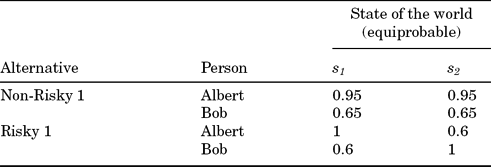
Treatment Case 1: Albert and Bob will both go wholly blind due to natural causes unless you, a morally motivated stranger, intervene. You can provide one of two treatments. Non-risky treatment 1 will ensure Albert is left with only a slight visual impairment, and leave Bob almost, but not quite, fully blind. Risky treatment 1 will either, with 50 per cent probability, fully cure Albert and leave Bob wholly blind, or instead, with 50 per cent probability, fully cure Bob and leave Albert wholly blind.
The utilities associated with these treatments are listed in table 3: 0.6 is the utility of living while totally blind; 0.65 the utility of living while almost wholly blind; and 0.95 is the utility of living with the slight visual impairment.
The distribution of utility in the Treatment Case 1
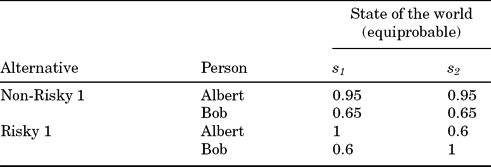
In Treatment Case 1, a concern for equal chances of receiving the most beneficial treatment would motivate a choice of Risky Treatment 1, whereas a concern for the extent of outcome equality would motivate a choice of Non-Risky Treatment 1.
It is important to note that the type of fairness of equal chances appealed to by Arneson and Temkin is distinct from fairness conceived of as the absence of partiality or favouritism in the distribution of a good. While giving people equal chances of receiving some indivisible benefit can be a way of ensuring and demonstrating the absence of partiality, it may not be the only way to do so.Footnote 30 Moreover, there can be cases in which impartiality is assured and in which it is nonetheless in one respect fairer (on the view proposed by Arneson and Temkin) to give each an equal chance of a benefit. Consider, for example, the following:
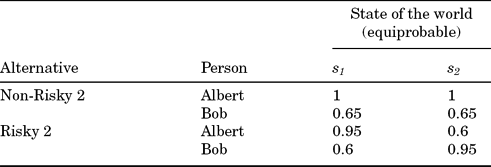
Treatment Case 2: Albert and Bob will both go wholly blind due to natural causes unless you, a morally motivated stranger, intervene. You can provide one of two treatments. Non-risky treatment 2 will fully cure Albert and leave Bob almost, but not quite, fully blind. Risky treatment 2 will either, with 50 per cent probability, ensure Albert has only a slight visual impairment and leave Bob wholly blind, or instead, with 50 per cent probability, ensure Bob has only this slight visual impairment and leave Albert wholly blind.
The utilities associated with these treatments are represented in table 4.
The distribution of utility in the Treatment Case 2
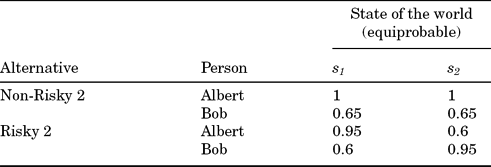
In this case, the worst and best well-being outcomes are marginally better under the non-risky treatment. Suppose further, for simplicity, that the relevant measure of outcome inequality is such that both treatments generate the same amount of outcome inequality and that, as a morally motivated stranger, you are known to be free of bias. On a view on which equal chances of receiving a good are merely a way of ensuring and expressing impartial consideration of the interests of each, there is nothing fairer about choosing the risky treatment in this case. Indeed, on this view, you have every reason to choose the non-risky treatment. By contrast, on the view on which equal chances of a benefit make a distinctive contribution to fairness, you have a reason to choose the risky treatment.Footnote 31
The intuition that giving people equal chances of being advantaged can make such a distinctive contribution to fairness appears to be widely shared.Footnote 32 The best explanation of this judgement seems to us to be that a given outcome inequality among people with equally strong claims to a benefit is less unfair when each person has a chance to end up better off than when the worse off have no such chance, because in receiving this chance, each person receives something of expected value.Footnote 33 Chances of receiving benefits, or of avoiding harms, are of expected value to people, and the more equally this value is distributed at a relevant point in time, the fairer the distribution. Of course, the well-being value of a chance evaporates once it is clear that this chance is unrealized.Footnote 34 However, a chance's contribution to fairness does not evaporate. It remains true, for example, of someone who received an equal chance at an indivisible benefit, but for whom the benefit did not materialize, that he had a fair chance of receiving it.
Now, some, like David Wasserman, reject the idea that equal chances make a contribution to fairness beyond their contribution to ensuring, and expressing, impartiality.Footnote 35 We will not resolve this dispute about the fairness of equal chances here. Our aim has merely been to establish the following: (i) in order to fully respect the difference between the unity of the individual and the separateness of persons, egalitarians must care about more than the extent of outcome inequality; and (ii) caring, in addition, about the fairness of the distribution of chances is one way that egalitarians can respect this difference. If Wasserman is right, and, in our cases, one should not care about the distribution of mere chances of being benefited or harmed, then, we believe, egalitarians need to adjust their views in some other way in order to fully respect this difference.Footnote 36
V. THE COMPETING CLAIMS VIEW
There is, indeed, a different view which can account for the shift in judgement between the intrapersonal and interpersonal case, and which can be held separately from, or (as part of a pluralist view) in conjunction with, a view about the badness of outcome equality.Footnote 37 On what we will call the ‘Competing Claims View’, we decide between alternatives by considering the comparative strength of the claims of different individuals, where (i) a claim can be made on an individual's behalf if and only if his interests are at stake; and (ii) his claim to have a given alternative chosen is stronger: (iia) the more his interests are promoted by that alternative; and (iib) the worse off he is relative to others with whom his interests conflict.
On this view, because an individual has no claim when his interests are not at stake, mere inequality does not ground a claim when he could not be any better off. It is therefore not the case that, on this view, inequality (whether of prospects or of outcomes) is intrinsically bad. Nonetheless, between people with competing claims, inequality matters because it lends force to the claims of those who are worse off.
On the Competing Claims View, in both our one-person and our two-person intrapersonal case, there is only a claim on Albert's behalf. It is natural to take this to be a claim for him to be exposed to a sufficiently attractive gamble. Non-intervention is therefore straightforwardly justifiable when we would choose it for Albert's sake. In the interpersonal trade-off case, by contrast, we must consider two competing claims: Albert's claim not to be exposed to a risk of harm, and Bob's claim to be granted the chance of a benefit. The strength of these claims is determined by the size of the harm and benefit, the probability of their occurrence, and Albert's and Bob's relative condition. Albert's claim is therefore strengthened by the fact that, if he were exposed to the risk of harm, he would be worse off than Bob no matter what happened. The potential loss to Albert therefore acquires greater significance in our interpersonal case than in our intrapersonal cases, and this accounts for the difference in the justifiability of non-intervention.
As sketched here, the Competing Claims View is far from a complete moral view. (For example, it is silent on whether and how claims should be aggregated in many-person interpersonal trade-off cases.) It seems to us that it would be valuable to further develop the Competing Claims View and to examine its implications in detail. There are, however, reasons to think that attention to the claims of individuals can be, at most, only one element in a comprehensive theory of distributive ethics. For it seems that in some so-called ‘Non-Identity Cases’, these claims play no role in our moral deliberations, so that such cases need to be decided with reference to other distributive principles.Footnote 38
VI. CONCLUSION
We have argued that a concern for the extent of outcome equality is not sufficient to account for the shift in moral judgement between intrapersonal and interpersonal trade-off cases. We have also argued that one can fully respect the difference between the unity of the individual and the separateness of persons by appealing to both the unfairness of unequal outcomes and the unfairness of unequal prospects or to the way inequality determines the strength of competing claims.Footnote 39