Since H.J. Dyos’ study of Camberwell, historical research on suburbia in Britain has enjoyed widespread attention.Footnote 1 The result is a broad understanding of the dynamics of suburban development. The roles of its chief actors have been mapped; the landowners, the developers, the speculative builders, the railway companies and the middle classes.Footnote 2 Areas still, however, need attention. While there is work on the marketing of suburbia in the inter-war period, not much is known for the period before 1914.Footnote 3 The detailed work which Peter Scott has undertaken on the marketing of suburbia and home-ownership to the working class in the 1930s is not evident for the previous century.Footnote 4 A holistic picture is also lacking. Suburban development was a complex process, involving the co-operation of a number of diverse parties. Scott has shown, for example, that the marketing of suburban housing to the working class in the 1930s was dependent on close co-operation between developers and building societies.Footnote 5 Mechanisms of co-operation and development for the earlier period have not been fully charted. Without an examination of all these issues, an understanding of suburban development will remain partial and fragmented.
This article will examine these two subjects through a discussion of the development of the Essex suburb of Ilford between 1880 and 1914. It will do so by applying stakeholder theory.Footnote 6 Stakeholder theory argues that businesses should not only consider shareholder interests, but also those of its stakeholders before deciding strategy and operations. Stakeholders are defined as any individual, group or organization which has an interest in the activities of a business or organization, and can affect or be affected by it.Footnote 7 Stakeholder theory claims that the traditional production and managerial views of the firm are inadequate. The former simply concentrates on suppliers and customers whilst the latter incorporates owners and employees. Neither accommodates influential stakeholders who fall outside this narrow remit. This includes the government, the media, special interest groups, customer advocate groups, environmentalists, local residents and competitors.Footnote 8 It is argued that businesses cannot operate efficiently without developing stakeholder management capability, taking account of all the groups and individuals its actions affect. It does this by mapping its stakeholders and developing procedures which encompass them.Footnote 9 Within this framework, success is defined as producing positive sum outcomes agreeable to all stakeholders. Stakeholder theory is germane for an analysis of Ilford's development since there were many groups who were involved and affected by its growth. Its marketing was premised not only on appealing to economic groups such as investors and customers, but also to non-economic parties such as local government and communities.
It must be stressed that Ilford in this case-study should not be seen as indicative of all suburbia but rather as typical of a white-collar, residential variety of suburbia, which sprang up around London in the closing decades of the nineteenth century.Footnote 10 In this respect, this article accepts the new revisionism in suburban history which has swept the subject, particularly in the context of North America. Revisionist writers on suburbia in North America such as Richard Harris and Robert Lewis and Mary Sies have emphasized the diversity of suburban development.Footnote 11 The tendency to see suburbia as planned, middle-class and homogeneous, separated from work and composed of modern, nuclear families, should be avoided. Suburbs came in all shapes and sizes. Some were middle class, some working class, some were planned and others witnessed more sporadic development. Some were effectively industrial and commercial centres outside of city limits, whilst others were residential domiciles connected to cities by the arteries of railways, tram lines and roads. Harris and Lewis have argued that assumptions concerning the fundamental split between cities and suburbs, which have heavily influenced historical discourse, should be rejected. Variety in cities and suburbs overshadowed any simple juxtaposition between the two.Footnote 12 For London, this analysis is apposite. By 1900, it had a melange of suburbia surrounding it which included middle-class and working-class suburbs and industrial and residential varieties. In the north-east, for example, within the rapidly growing settlements of metropolitan Essex, there were the working-class and industrial suburbs of Tottenham, Edmonton, Enfield and Walthamstow which contrasted with the bourgeois, residential rus in urbe of Ilford, Woodford, East Ham and Leytonstone.Footnote 13 Within the west London suburb of Acton, there was a working-class area in the south, dominated by laundries and factories, a mainly white-collar, clerical district in the north situated around its railway lines, and a more salubrious middle-class area to the west.Footnote 14 Here, the taxonomies of elite, affluent, working-class, industrial and residential suburbia merged into one.
The growth of Ilford, 1880–1914
Dyos has divided the growth of Victorian London into three stages; the build up of the population in its centre, its spill-over into the outer districts of London after 1860, and following 1890, the development of the outer suburbs of Greater London in its hinterlands of metropolitan Middlesex, Essex, Surrey and Kent.Footnote 15 The growth of Ilford falls into this third phase. This was a period of suburban expansion which reflected a far greater maturity in matching suburb to class, and was dominated by London's lower-middle and artisan classes.Footnote 16 Although a train line had connected the village of Ilford with London from 1839, it attracted few inhabitants until the late 1880s. Thereafter, the growth of Ilford was frenetic.Footnote 17 Extra trains were provided to Ilford in 1893. Both Liverpool Street, the terminus of the Great Eastern Railway (GER) line into the City of London, and Ilford train station were enlarged in the 1890s, and the number of railway tracks between the two destinations was increased from two to four between 1895 and 1898.Footnote 18 In 1891, Ilford's population stood at 10,913, in 1901 at 41,234 and in 1911 at 78,188.Footnote 19
The importance of the railways in Ilford's growth is reflected in its inhabitants’ occupations. In 1911, almost 10,000 of its 21,652 male working population were in commercial or government occupations.Footnote 20 The majority worked in London. In 1921, 21,749 of Ilford's occupied inhabitants (59 per cent) worked outside of the town. Of these 17,345 worked in London and 9,607 in the City.Footnote 21 Also apparent are the 6,766 male clerical workers living in Ilford, 31.4 per cent of its total working male population.Footnote 22 This can be compared to the 175,653 clerical workers in London in 1911, who made up 12.5 per cent of the total male working population of 1,404,262.Footnote 23 By 1911, Ilford had developed into a white-collar, commuter suburb. That year, Ilford Urban District Council (IUDC) announced, ‘Ilford was created by the city worker for the city worker, and it is a model of what a residential locality should be for the professional and commercial class.’Footnote 24 The marketing of Ilford was clearly premised on a strategy of targeting white-collar workers.
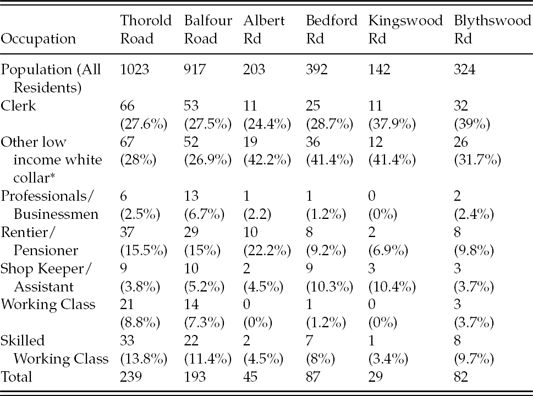
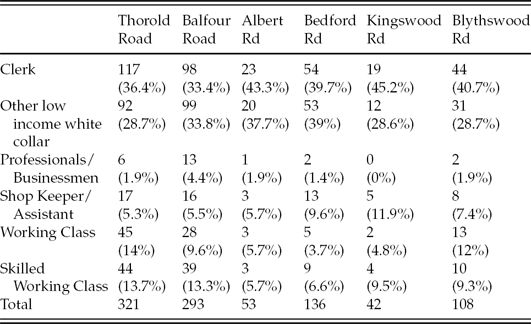
Ilford's new arrivals were mainly young, married and had families. This is demonstrated by an analysis of a sample of six streets taken from the 1901 census. These are Thorold Road and Balfour Road built on the Ilford Lodge Estate from 1898, Albert Road and Bedford Road on the Clements House Estate built from 1894, and Kingswood Road and Blythswood Road on the Downshall Estate, Seven Kings, built from 1897.Footnote 25 The first two were built by W.P. Griggs and the latter four by Archibald Cameron Corbett. These were Ilford's principal builders. These streets contained c. 3,000 inhabitants out of a total population of 41,240. They were chosen because they were built by Ilford's principal developers, were distributed across the suburb and were built mainly in the late 1890s. They were thus newly built streets in 1901 when the census was taken and provide a snapshot of Ilford's new inhabitants. All six streets contained heavy concentrations of clerical workers. Clerks were heads of households in one in four of these houses and made up around one in three of the working populations of the streets (Table 1). These streets were also socially homogeneous with three-quarters of their inhabitants being lower middle class (‘Clerk’, ‘Other low income white collar’, ‘Rentier/Pensioner’ and ‘Shop Keeper/Assistant’). Working-class inhabitants were a minority on these streets (10–20 per cent) and professionals and businessmen were virtually absent. Ilford's new residents were predominantly clerks, salesmen, agents, warehousemen, shopkeepers, teachers and pensioners (Table 2).
Occupations of heads of households of Thorold Road, Balfour Road, Albert Road, Bedford Road, Kingswood Road and Blythswood Road

* ‘Other low income white collar’ refers to lower-middle-class occupations such as commercial salesman, agent, teacher, warehouseman, telegraphist or nurse.
Sources: The National Archives, London, ‘Census returns of England and Wales, 1901’, RG 13/1649, RG 13/1650, RG 13/1652.
Occupations of working occupants of Thorold Road, Balfour Road, Albert Road, Bedford Road, Kingswood Road and Blythswood Road (excluding servants)
Sources: The National Archives, London, ‘Census returns of England and Wales, 1901’, RG 13/1649, RG 13/1650, RG 13/1652.
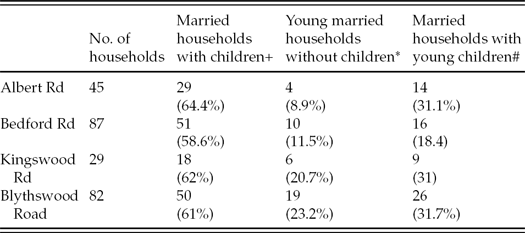
In relation to family composition, Albert Road, Bedford Road, Kingswood Road and Blythswood Road were examined. Households with children (15 years and under) and young married couples (age of wife 35 and under) comprised the majority. They made up on average 77.6 per cent of all households. In addition, it appears that many families were moving into their first home in Ilford. As these streets were built between 1894 and 1897, and as clerical and lower-middle-class couples tended to have children within two years of marriage, this can be established by calculating the number of families with young children (8 years and under) or married couples with no children. Whilst clerical workers delayed marriage, they did not limit or space child-birth once married.Footnote 26 Combining both data sets provides a figure for first home occupation as couples moving in would have had either babies or toddlers or would have been newly married. This suggests that a major motivation for coming to Ilford was to start a family. For Albert Road the figure was 40 per cent, for Bedford Road 29.9 per cent, for Kingswood Road 51.7 per cent and for Blythswood Road 54.9 per cent. The figures for Albert and Bedford Road are lower as they were built in 1894, three years before Kingswood Road and Blythswood Road, and therefore children would have grown older. Half the individuals moving to Ilford came with very young families or with the intention of starting one. Ilford's social and demographic uniformity was one of its most appealing features (Table 3).
Number and percentage of houses in Albert Road, Bedford Road, Kingswood Road and Blythswood Road with young children or young couples without children
+ Children aged up to 15
* Women aged 18–35
# Children aged eight and under
Source: The National Archives, London, ‘Census returns of England and Wales, 1901’, RG 13/1650, RG13/1652.
Map of Ilford, Essex, 1921. Highlighted streets are from the top centre in descending order Balfour Road, Thorold Road, Albert Road and Bedford Road. In the top right hand corner from left to right, they are Blythswood Road and Kingswood Road. Printed with kind permission of the Ordnance Survey.
The office worker's demand for suburbia
Ilford's rapid growth is reflected in the expansion of clerical workers in London.Footnote 27 In the capital, male commercial clerks increased from 58,278 to 82,027 between 1881 and 1911 and female commercial clerks from 2,327 to 32,893. Adding civil servants, local government officers, bank, insurance, law and railway clerks, this figure rose from 80,109 to 140,847 for men; and 3,101 to 39,847 for women.Footnote 28 In 1911, there were a further 46,860 male clerks living in Middlesex, 42,473 living in Essex, 25,315 in Surrey and 14,782 living in Kent.Footnote 29 By 1911, there were an estimated 250,000–300,000 clerks living in metropolitan London. It is the expansion of this occupational sector which explains a significant part of its suburban expansion over this period.
From 1890, suburbia was promoted to clerks as an environment where domestic happiness and personal success could be obtained. This was prominent in popular culture and the media. It can be detected, for example, in the emergence of the suburban novel.Footnote 30 These novels, written by authors such as Keble Howard, Shan Bullock and William Pett Ridge, praised suburbia, its denizens and its way of life. Two themes commonly appeared; the idea that a happy marriage could be found in suburbia, and that a successful career and personal fulfilment were encouraged by suburban living. In William Pett Ridge's A Clever Wife, for example, the novel's estranged couple, Cicely Westerham and Henry Halliwell, were reconciled at the end of the book in Clapham Common, a suburb in south London. The novel ended with Cicely confessing to Henry that ‘I had no idea that the suburbs could contain such joy’, and the couple settling down to a life of domestic bliss in south London suburbia.Footnote 31 Another of Pett Ridge's novels, 69 Birnam Road, tracked the progress of Fred Hartley from cockney assistant head clerk in a railway company to debonair superintendent of the line. Suburbia and domestic stability featured throughout the novel as strong factors in his rise.Footnote 32
The new popular journalism was another important advocate of suburbia. The Daily Mail and other journals owned by the Harmsworth brothers were prolific in its support.Footnote 33 Indicative of this was the Daily Mail's Ideal Home Exhibitions.Footnote 34 The first took place over two weeks in October 1908 in Olympia, west London, and attracted over 200,000 visitors. The event was an exhibition of suburbia and domesticity. It featured houses and gardens, the latest household appliances, modern packaged foodstuffs and even babies in model nurseries.Footnote 35 The home and everything in it was on display. The exhibition demonstrated modern appliances and provided lectures on the new science of domestic economy in which topics such as nutrition, hygiene, baby rearing and food preparation were explained.Footnote 36 The Ideal Home Exhibition not only sold its visitors material goods but also an ideology of domesticity and consumption. It was one which taught that happiness could be achieved within the modern family by the purchase and creation of a home equipped with the latest consumer goods. What one sees here is the beginning of a culture of mass consumption. Broadcasted by the suburban novel and popular press, it greatly enhanced the attractiveness of suburban living.
Ilford's stakeholders
Having examined the demand side of Ilford's market, the stakeholders involved in its development can now be discussed. Four groupings stand out; its developers, its council, the GER and its local community. When discussing these stakeholders, it is important to appreciate that market competitiveness and success derived not only from the individual actions of each of the four, but also from their ability to co-operate with each other. What is apparent when examining these four stakeholders is their co-ordinated behaviour and the sharing of an overall marketing strategy in the development of Ilford.
The bulk of building in Ilford between 1890 and 1914 was carried out by two men, A. Cameron Corbett and W.P. Griggs.Footnote 37 Corbett built 3,000 homes in Ilford, and Griggs constructed 2,000 properties. These men were typical of a growth in scale in property developers whereby one enterprise would plan, build, market and sell entire streets and estates.Footnote 38 Corbett will be examined in detail. At the time, he was one of London's largest suburban developers and was posthumously described as the founder of modern Ilford.Footnote 39 Corbett was a member of parliament for Glasgow between 1885 and 1911 and a member of the House of Lords from 1911 until his death in 1933. Much of the wealth he amassed in London was spent on charitable pursuits in his native Scotland.Footnote 40 His philanthropic and staunch Presbyterian beliefs guided his business activities. Alcohol was banned on his estates and recreation and ‘rational’ pursuits encouraged by the provision of parks and libraries.Footnote 41 The moral driving force behind Corbett's building activities lay in the independence and domesticity that he believed his homes provided to their inhabitants.Footnote 42 In relation to sales promotion, Corbett's activities were relatively anodyne. There was none of the glitz of the marketing imagery and promotional showmanship of the inter-war period.Footnote 43 Short text adverts were placed in newspapers, where estates were announced and details of houses and cost briefly given.Footnote 44 Interested parties could send off for a brochure which contained more information and featured illustrations of houses and estates.Footnote 45 Individuals were then encouraged to visit the estates and were shown the houses by one of Corbett's agents.
Corbett's marketing success resided in his strategy and active co-opting of stakeholders who helped develop and promote his estates. He targeted white-collar workers and facilitated the purchase of their own homes. His properties were three- to six-bedroom family houses costing between £280 and £500. These were sold mostly on leasehold, enabling Corbett to generate capital for further developments and earn the bulk of his profits from ground rents, usually £5 a year.Footnote 46 The relative cheapness of Corbett's properties was matched by his supply of funds to purchase them. For example, a four-bedroom Corbett house on Glenmore Terrace, Green Lane, Seven Kings, cost £305 leasehold in 1910. This could be acquired by the buyer paying a £12 10s deposit, taking out a £195 mortgage at 4.5 per cent and obtaining a loan from Corbett of £85 repayable over eight years. The remaining £12 10s would be paid on completion of purchase. Including an annual ground rent of £5 10s per annum, this would work out at £28 11s 2d per annum for the first eight years and £14 5s 6d for the remainder of the mortgage.Footnote 47 For a clerk earning between £150 and £200 a year, a level he would normally reach in his thirties, this was affordable and, given the stability of his work, quite feasible.
The novelty of Corbett's strategy of suburban development based on home-ownership can be appreciated when considering contemporary owner-occupation within Britain. Home-ownership in the late Victorian and Edwardian periods is estimated to have stood at no more than 10 per cent.Footnote 48 The majority of Britons rented their accommodation from private landlords. Daunton has shown home-ownership amongst the working classes in certain northern districts such as Lancashire cotton towns. What distinguished these areas was stable employment, a lack of a commercial investing class and the existence of institutions such as building societies which supplied credit.Footnote 49 Swenarton and Taylor have claimed that home-ownership can also be detected amongst the middle classes moving into new suburban developments.Footnote 50 Ilford falls into this category. Whilst there were a number of working-class households in new properties in Ilford, these were firmly in the minority. The working classes lacked sufficient critical mass to sustain suburban housing development on a scale that took place in Ilford. This was due to insufficient income and a lack of stable employment.Footnote 51 Conversely, it was stability of employment, combined with an overall growth in numbers, which explains the targeting of clerical workers by developers such as Corbett and Griggs. London clerical salaries increased between 1880 and 1914, and household income was augmented by the employment of their children in offices.Footnote 52 The concentration of home-ownership and suburban development amongst this demographic, evident in the inter-war period, first appeared in the late Victorian and Edwardian period.Footnote 53
Swenarton and Taylor also argue that increasing home-ownership in the suburbs can be explained by a glut of middle-class houses which depressed property and rental values, and led to a decline in investment in the buy-to-let market. Faced with this and an excess of capital, building societies targeted would be owner-occupiers with cheap and plentiful credit.Footnote 54 The ease of purchase and low cost of credit on Corbett's estates accords with this analysis. Advertisements in the London Evening News for properties for sale, which emphasized ‘NO RENT’, further lends support.Footnote 55 Additionally, one can detect the beginnings of the coupling of social status with home-ownership, which had been absent until the late nineteenth century.Footnote 56 The 1911 official promotional booklet for Ilford described it as ‘A Community of Landlords’, which had contributed to maintaining ‘a good tone’ in the town.Footnote 57 Many of the suburban novels mentioned earlier, such as 69 Birnam Road, The Smiths of Surbiton and even The Diary of a Nobody, ended with protagonists buying their own homes symbolizing social arrival and upward mobility.Footnote 58
Corbett augmented the value of his properties by locating them within easy distance of railway stations. He encouraged railway companies to build stations on his estates. At his Grange Estate he convinced the GER to build a booking hall and entrance to Ilford Station. On his Downshall Estate in 1897, Corbett induced the GER to build Seven Kings Station by guaranteeing £10,000 in revenue over its first five years. In 1902, a similar agreement was concluded for his Mayfield Estate where the GER built Goodmayes Station.Footnote 59 Corbett's homes were thus not only affordable, but also accessible to their residents’ places of work. He also catered to his residents’ social needs. He built parks and recreation grounds on his estates.Footnote 60 He guaranteed standards by stipulating in his leasehold agreements that properties should be maintained to a certain level. Leaseholders were obliged periodically to carry out work on their properties such as painting and the trimming of hedges. Fences, for example, could not be built over a certain height. By doing this, Corbett ensured that all residents were obliged to maintain the quality and standing of their homes and localities.Footnote 61
Ilford's council also had a vested interest in attracting residents to the area. Many of its members were involved in its development. Of the 13 known occupations of the 16 members of IUDC in May 1900, for example, four derived their livelihood from Ilford's property market. This included W.P. Griggs, John Stroud, Corbett's building contractor, and Ben Bailey, Ilford's largest auctioneer and estate agent and trustee of Ilford Park Estate.Footnote 62 IUDC promoted the suburb through its publications and by use of press releases, which produced articles on the town in newspapers and journals. These emphasized its benefits and created publicity.Footnote 63 The council used the Small Dwellings Acquisition Act, 1899, to provide credit for home-ownership.Footnote 64 This enabled the council to borrow money from the Public Works Loan Commissioners to lend at low rates of interest for those wishing to buy property. The council built up infrastructure and public services and publicized these.Footnote 65 At the same time, it attempted to keep rates low. This development of schools, transport and public health, combined with low local taxation, was highly attractive to its lower-middle-class residents.
An example of IUDC's efforts to enhance Ilford's attractiveness is the council's purchase and development of Valentines Park, the suburb's principal recreational area.Footnote 66 The park was opened in 1899 following the £30,000 purchase of 43 acres of the Valentine Estate by Ilford District Council. A further 47 acres were added in 1906, and IUDC purchased the remaining 22 acres of the estate in 1912. The building and property interests were heavily involved. Ben Bailey was one of the four councillors who advocated the building of a park in Ilford in the 1890s, and was instrumental in arranging its purchase.Footnote 67 Once open to the public, the building interests managed Valentines. W.P. Griggs became chairman for the Parks Committee on IUDC and John Stroud its vice-chairman. This enabled them to maintain and control all of Ilford's parks by regulating their usage.Footnote 68 Both Griggs and Bailey were highly active in acquiring the remaining 22 acres of the estate in 1912 and the development of the Ilford Garden Suburb Estate which adjoined this area.
IUDC also vigorously passed and implemented local bye-laws. These fall into four areas; those concerning building, sanitation, parks and pleasure grounds and Ilford's electric tramway. The development of bye-laws from 1848 was a key strategy of town planning by central government.Footnote 69 Permissive regulatory legislation was passed in areas such as house building, street lay-outs and sanitation which local councils were able to adopt. This saved the latter the time and expense of drafting their own particular legislation, and also acted as a means of encouragement by central government for reform to take place at the local level.Footnote 70 IUDC was active in passing such legislation which regulated the building of housing, streets and estates in Ilford and guaranteed their quality and public healthiness. In 1898, it had the Ilford Improvement Act passed through parliament.Footnote 71 Such legislation gave IUDC control over Ilford's future development for new streets, buildings and sanitary provision. Yet IUDC bye-laws regulated not just the physical structure of Ilford but also its inhabitants’ behaviour. A Nuisances bye-law passed in 1892 enforced inhabitants’ removal of snow, rubbish and filth.Footnote 72 Numerous bye-laws were passed for Ilford's parks which controlled their users’ behaviour and recreation. On Ilford's municipal tramways, travellers were forbidden to spit, swear, drink alcohol, smoke, be intoxicated or even wear inappropriate clothing.Footnote 73
IUDC was constructing a social habitus which appealed to white-collar workers.Footnote 74 Alongside the safety and predictability of their occupational and domestic spheres, these individuals were provided with a social environment which nourished a sense of ontological security. Much work has been carried out over the last several years on the subject of liberal governmentality in Victorian and Edward Britain.Footnote 75 The term, derived from Foucault, related to the process by which national and local government in Britain built social, physical and moral spaces which were hygienic, ordered, rational and predictable thereby empowering individuals to act as autonomous and self-controlling agents.Footnote 76 Liberty was made possible by the creation of such environments, whether this was in homes with separate bedrooms and bathrooms ensuring privacy and decency, regulated, hygienic and illuminated streets, or transport systems which were efficient and ordered.Footnote 77 Individuals were governed by reflexively regulating themselves and each other. Such an environment required active government which was able to construct (through wide streets, public health, parks and street lighting) and maintain such a milieu, and in turn be inspected, controlled and regulated by its members. Ilford through its active local government and citizen groups such as its Ratepayers Associations was able to achieve such liberal governance.Footnote 78
The third leg in Ilford's industrial structure was the GER. The railway was key to Ilford's attractiveness. The town positioned itself as a white-collar commuter suburb with easy links to the City of London. Within this strategy, the GER and its terminus at Liverpool Street played a prominent role. The benefits of co-operation between Corbett and the GER were mutual. The company faced competition within London from alternative forms of transport such as electric tramways, buses and the new underground railway companies. In response, the company encouraged the development of suburbs along its railway lines in Essex where it could draw on guaranteed revenues from season ticket holders.Footnote 79 In the inter-war period, this strategy would reach its apotheosis in the Metropolitan Railway Company's development of ‘Metroland’ in north-west London and Middlesex.Footnote 80
The GER before 1914 used marketing to increase tourist passenger numbers. It published several pictorial books promoting East Anglia and the eastern counties and published a book on walks in Belgium in 1894.Footnote 81 Its efforts to promote suburbia along its railway lines can be seen in its publication of the guidebook, By Forest and Countryside.Footnote 82 The book provided information on the residential districts along the GER line, giving details such as rail fares, rents, recreational facilities and death rates. Its two paragraph introduction to Ilford provided the same positioning messages which were being promoted by the IUDC, its builders and other promoters.Footnote 83 The town was modern, well governed, healthy and had first-rate links with London. It offered a range of cheap housing and possessed excellent recreational facilities. Valentines Park and its facilities featured heavily. Whilst the guide appeared in 1910, when a great deal of Ilford's population had already moved in, it is nevertheless indicative of the role that the GER played in marketing the suburb.
The success and sustainability of Ilford's development was only achievable with the active co-operation of a fourth stakeholder group, its local residents. Their willingness to remain living in Ilford and create a community that was attractive to newcomers was fundamental to its longevity. Home-ownership guaranteed a long-term commitment from Ilford's residents. It ensured that they had a long-term stake in the viability and prosperity of their town and community. Such commitment can be seen in 1901 when residents on Corbett's Downshall Estate prevented a licence to serve alcohol being granted to a hotel in Seven Kings. Residents argued that they had bought their houses on the basis that there would be no licensed premises in the area. It was claimed that the granting of such permission would not only upset the peace and respectability of the area, but also adversely affect the value of its properties.Footnote 84 It was thus not only Corbett's policies on his estates, but also the willingness of residents to uphold and enforce them that guaranteed his development's attractiveness.
Ilford's community also took an active interest in its local government. As its promotional brochure stated, the policy of developing a ‘community of landlords’ ‘has largely influenced the policy of its governing authority, and although a thoroughly progressive spirit is everywhere apparent, there is none of that administrative recklessness which has irretrievably blighted so many outer-metropolitan areas’.Footnote 85 The low rates of Ilford, for example, were favourably compared to the neighbouring suburban district of Forest Gate.Footnote 86 Local residents not only had a stake in Ilford's government through their ability to vote but also via their creation of a Ratepayers Association which was claimed to be the largest in Britain at the time.Footnote 87 The Association was active in Ilford politics and acted as a watchdog over its local government. It was supported by IUDC and its developers who realized the importance of integrating its residents in its civic life. W.P. Griggs, for example, was actively involved in the Ratepayers Association and was a firm advocate of the body. The long-term sustainability of Ilford was also supported by the development of a flourishing civic community by its local residents. In the Ilford Guardian between 1898 and 1901, 53 separate associations were counted in the local newspaper; an additional 11 appeared in the Ilford District Council promotional brochure.Footnote 88 These were national and local, church based and secular, and covered areas such as the political, social, mutual aid, sport, culture and philanthropy. Ilford had a flourishing civic and social life. This is important not simply in terms of leisure and recreation, but also in relation to the trust, inter-activeness and high degrees of social and political capital that such behaviour engendered. These were vital for a vibrant, sustainable community. Ilford's environmental commitment came not only from its administrators and business community, but also from the social behaviour of its citizens and the associations which they created.
A final question is how original was Ilford? How reflective was it of other contemporary London commuter suburbs? Broadly speaking, one can say that it was. The targeting of white-collar workers with young families was common to a whole swathe of London suburbs such as Leyton and East Ham in the West, Ealing and parts of Acton in the west and Lewisham and East Dulwich in the south.Footnote 89 These suburbs practised similar strategies. Their physical topography was almost identical. Developers concentrated on building rows of terraced family homes with large gardens which were concentrated in residential neighbourhoods. They situated their developments close to railway lines but beyond the pale of workmen's trains and trams allaying the fear of social mixing.Footnote 90 These suburbs emphasized the natural beauty of their localities and the health of their environments. Their urban councils built up social infrastructure such as schools and sanitation, and amenities such as parks, retail areas and leisure facilities. All were heavily marketed in their promotional literature.Footnote 91 There was a common emphasis on efficient government and low rates, Ratepayers Associations and an active citizenry. Similarities can also be found in the cultural lives of these localities. Whilst a premium was placed on privacy, family life and neighbourliness, these suburbs had rich associational lives with a plethora of clubs, societies, charities, self-help groups and churches. An examination of these suburbs, seen from the auspices of Mary Sies’ taxonomies of demographic data, local history information, records about cultural forms and wider macro-historical forces displays urban environments with a remarkable degree of homogeneity.Footnote 92
Yet, there were differences. Examining Leyton, a suburb five miles east of the City of London, which like Ilford experienced rapid growth over this period, one can see both comparisons and contrasts.Footnote 93 Leyton and its sister suburb Leytonstone targeted clerical workers and was successful in attracting large numbers of them.Footnote 94 Its Urban District Council built up infrastructure to accommodate these new arrivals, especially schools and transport.Footnote 95 The suburb similarly promoted the physical beauty and healthiness of its environs and surrounding countryside, placing much emphasis on its proximity to Epping and Hainault forests.Footnote 96 Yet, in contrast to Ilford, there is no evidence of large-scale developers such as Corbett and Griggs, no emphasis on home-ownership and little indication of close co-operation between developers and stakeholders such as local government and railway companies. It is perhaps as a consequence of this that Leyton eventually lost its reputation as a white-collar suburb (though this was maintained by Leytonstone), whilst Ilford was able to retain this, and was successful in attracting inhabitants from competing suburbs.Footnote 97 It is in the areas of close co-operation between stakeholders and a marketing strategy premised on home-ownership that Ilford was unique. Whilst there is some evidence of co-operation between other white-collar suburban developers and stakeholders such as local government and transport companies, it is its extent in Ilford which is singular.Footnote 98
Conclusion
Ilford's success as a suburb was premised on a marketing strategy which was co-ordinated and involved multiple stakeholders. It was one which targeted clerical workers and developed homes and an environment which satisfied their needs. What supported this was an understanding of the lifestyles and values of this group. All stakeholders discussed in this article repeated the same messages in their promotion of Ilford; it was healthy, respectable, convenient, economic and ideal for city workers. Much of what has been considered as marketing – the selling, advertising, pricing and development of a product – was predominantly an outcome of this approach. Its success was further the result of a planned use of its resources. This was not just in its use of land, but also its encouragement of home-ownership, its supply of public services, its efforts to keep rates low and its encouragement of a strong civic culture within the suburb.
What has also been demonstrated in this case-study are the links between these stakeholders. The builders and property interests were strongly represented on IUDC, they worked closely with the GER which co-operated with Ilford's administration. There were also connections between Ilford's builders, town council and local civic associations with interlocking memberships of all three. W.P. Griggs is an excellent example of this. He was one of Ilford's principal developers, was on Ilford Council and became its first mayor and member of parliament. He was active in many of Ilford's societies and was involved in the Ilford Ratepayers Association.Footnote 99 Ilford's value to residents was largely premised upon the closeness of these connections. Whilst each group had their private motivations, all shared the common goal of creating a residential and respectable civic space which could attract middle-class families. Stakeholder theory demonstrates how this was achieved. Whilst older production models are useful for providing a general picture of suburban development, they cannot explain why some succeeded and others failed. It does this not only by enabling other groupings which fall outside suppliers, producers and customers to be factored in, but also by going beyond the limitations of business history. It was only at the junction of the economic, social, political and cultural that a comprehensive outline of the development of a suburb can be created. Only by using an eclectic historical approach can this be provided.
The marketing of Ilford resembles the marketing of suburbia to sections of the working classes in the inter-war period. Ilford's developers supplied easy terms of purchase, provided brochures, tours of estates and offered promotions such as free gas fittings, wall paper, venetian blinds and electric door bells. The Ideal Home Exhibition is also present as are the slogans of the inter-war period such as ‘Why Pay Rent’. The experiential benefits of suburban living are evident; its emphasis on aspiration, lifestyle, family, social status, health, convenience, its use of media to promote its messages and its firm associations with the ideology of domesticity. While this is by no means a critique of Scott's article, it alerts us to the fact that many of the strategies, techniques and tropes used in the marketing of suburbia and home-ownership in the 1920s and 1930s, a period which historians have traditionally focused on, were in fact being developed before 1914.Footnote 100