Introduction
Following a large BSE epidemic in British cattle in the 1990s, concerns arose that other small ruminant transmissible spongiform encephalopathies (TSEs) may also represent a risk to humans or that endemic classical scrapie may mask the emergence of novel small ruminant TSE strains. This resulted in industry-wide initiatives to control and eventually eradicate small ruminant TSEs by exploiting the large apparent differences in TSE susceptibility between sheep with different PrP genotypes. In sheep, PrP protein coding polymorphisms at codons 136(A/V), 154(R/H) and 171(Q/R/H) give rise to five major alleles, sometimes referred to as haplotypes (ARR, ARQ, AHQ, ARH and VRQ) that can encode up to 15 genotypes (Baylis and Goldmann, Reference Baylis and Goldmann2004). Sheep with different PrP genotypes have dramatically different susceptibilities to classical scrapie, with the most susceptible genotypes being VRQ/VRQ, ARH/VRQ, ARQ/VRQ and AHQ/VRQ, ranging to the most resistant genotype ARR/ARR (Hunter et al., Reference Hunter, Goldmann, Smith and Hope1994; Baylis et al., Reference Baylis, Chihota, Stevenson, Goldmann, Smith, Sivam, Tongue and Gravenor2004).
In Great Britain, the National Scrapie Plan (NSP) aims to reduce and eventually eliminate classical scrapie in sheep. A major component of the NSP is the Ram Genotyping Scheme, a selective breeding programme that favours the resistant ARR allele over the highly susceptible VRQ allele. However, the impact of large-scale population-level manipulation of PrP genotypes on commercially important traits within the sheep industry is unknown.
The potential association of PrP genotype with production traits has been examined in a number of studies in sheep, as summarised by Sweeney and Hanrahan (Reference Sweeney and Hanrahan2008). However, these have often been performed either with small datasets (de Vries et al., Reference de Vries, Hamann, Drogemuller, Andrzejewski, Ganter and Distl2004; Vitezica et al., Reference Vitezica, Moreno, Bodin, Francois, Barillet, Brunel and Wilesmith2006) or focused on traits such as milk production traits (e.g. Alvarez et al., Reference Alvarez, Gutierrez-Gil, San, de la Fuente and Arranz2006) that are of little relevance to the broader British sheep industry, which is primarily focused on the production of lambs for consumption. Alternatively, they have been performed on experimental rather than on commercial sheep populations (Man et al., Reference Man, Brotherstone, Merrell, Murray and Villanueva2006; Sawalha et al., Reference Sawalha, Brotherstone, Man, Conington, Bünger, Simm and Villanueva2007). Only the study of Pritchard et al. (Reference Pritchard, Cahalan and Ap Dewi2008) has focused on commercial lamb performance data in a numerically important breed, the Welsh Mountain.
The availability of large datasets from pedigree performance recorded British sheep breeds has provided an opportunity to explore potential associations of the PrP gene with commercially relevant traits in large sheep populations. The work outlined here describes the analysis of lamb production traits and possible associations with PrP genotype, in three British hill breeds.
Material and methods
Datasets and traits
Performance and pedigree data were obtained from the Meat and Livestock Commission (MLC) for 32 commercial pedigree flocks, comprising lamb records from three British hill breeds raised under commercial conditions: North Country Cheviot (Hill), Scottish Blackface and Welsh Mountain. The flocks included in the analyses belonged only to those breeders who responded positively to invitation to participate in the project. Unique individual animal identifications were available for all animals; thus the PrP genotypes supplied by the National Scrapie Plan Administration Centre (NSPAC) were matched to individual animal pedigree and performance data. Not all animals had PrP genotypes available; however, all animals born in each flock during the years of data collection were included in the analyses, thus providing a complete dataset from each flock.
The dataset comprised five North Country Cheviot (Hill) flocks recorded from 2001 to 2005 and 17 Scottish Blackface and 10 Welsh Mountain flocks recorded from 1997 to 2005. The total number of lambs was 43 968, including 13 315 lambs with PrP genotype information. Breeds differed in the number of recorded lambs, although they were broadly similar with respect to the proportion of lamb records (28% to 32%) that could be unambiguously matched with NSP PrP genotypes (Table 1). Prior to formal analysis, the pedigree data were checked for consistency using the R’Tools package (Pong-Wong et al., Reference Pong-Wong, George, Woolliams and Haley2001).
Dataset structure by breed

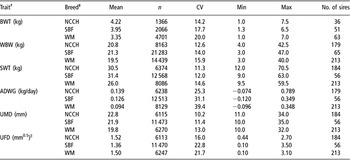
Six traits were analysed: birth weight (BWT), 8-week weight, scanning weight, average daily weight gain, ultrasonic muscle depth and ultrasonic fat depth. The traits were defined as follows. BWT: actual weight (kg) at or within 24 h of birth. Eight-week weight: actual lamb weight (kg) at a target age of 56 days. Scan weight: actual lamb weight (kg) at ultrasonic scanning (ca. 20 weeks). Ultrasonic muscle depth: actual muscle depth (mm) measured at the level of the third lumbar vertebra. Ultrasonic fat depth: actual fat depth (mm) measured at the level of the third lumbar vertebra. However, these data were right skewed from the standard normal distribution curve and the analyses were performed on square root transformed fat depths that were more normally distributed. Average daily weight gain: actual weight gain (kg) between 8-week weight and scan weight divided by the interval in days between weighing and scanning. The number of records, coefficient of variation and number of sires are shown by breed for each trait in Table 2. Substantially fewer data were available for BWT than for the other traits because fewer breeders recorded this trait; moreover, recording only occurred during 2004 and 2005.
Means by trait and breed

†BWT: birth weight; W8W: 8-week weight; SWT: scan weight; UMD: ultrasonic muscle depth; UFD: ultrasonic fat depth; ADWG: average daily weight gain from 8 to 20 weeks; n, number of observations; CV, coefficient of variation calculated using the phenotypic standard deviation; Min, minimum; Max, maximum.
‡NCCH: North Country Cheviot (Hill); SBF: Scottish Blackface; WM: Welsh Mountain.
§Square root transformed. Mean and maximum back-transformed values were 2.31 and 7.29 for NCCH, 1.89 and 12.25 for SBF and 2.25 and 9.96 for WM.
PrP genotypes
NSPAC supplied PrP genotypes obtained from animals using a variety of proprietary commercial genotyping methodologies, chiefly SNP assays. In all cases the ovine PrP gene was genotyped at polymorphic codons 136(A/V), 154(R/H) and 171(Q/R/H) to discriminate between the five major alleles: ARR, ARQ, ARH, AHQ and VRQ. After manual checking for consistency of animal identifiers, PrP genotypes were merged with performance datasets using SAS software version 9.1 prior to analysis.
Statistical methodology
Linear mixed models were used for all traits and included direct (animal) genetic effects and up to three maternal traits: maternal genetic, permanent environmental and temporary (litter) effect. All models were of the form:

where y is the vector of observations for each trait, b the vector of fixed effects, a the vector of direct additive genetic effects, m the vector of maternal additive genetic effects, l the vector of maternal temporary environmental effects, p the vector of permanent environmental effects, e the vector of random residual effects and X, Z 1, Z 2, Z 3, Z 4 are design matrices relating fixed and random effects to observations. A number of fixed effects, covariates and biologically plausible interactions were fitted in addition to random effects. All models included sex, maternal age, litter size or type of rearing and other fixed effects to accommodate flock/breeder variation in management and environmental conditions. These included variation in birth date and age at which measurements were obtained (i.e., age at weighing and age at scanning). Effects that contributed significantly toward the global model fit (as assessed by the likelihood ratio test) were included in the final model. In all cases the most economical model was selected and analysed using ASReml v 2.0 (Gilmour et al., Reference Gilmour, Gogel, Cullis, Welham and Thompson2006). This resulted in slightly different models sometimes being fitted for the same trait in different breeds; however, the primary aim was to define the best fitting model for the purpose of assessing PrP effects, rather than to estimate variance components.
Testing for associations with the PrP genotype
Potential associations between each performance trait and the PrP gene were estimated by including the PrP genotype as a fixed effect in the model, fitting ungenotyped animals as an additional category. Between six and nine PrP genotypes were included, e.g. ARR/ARR, ARR/ARQ, ARR/AHQ, etc., depending on the breed involved. Animals were then classified according to the number of copies (2, 1 or 0) of each of the PrP alleles carried (i.e. homozygous, heterozygous, or allele not present) and were examined in turn, e.g. ARR/ARR, ARR/xxx and xxx/xxx, where xxx represents non-ARR alleles, etc., again fitting ungenotyped animals as an additional category. In both types of analyses, because only a proportion of the animals in each dataset were genotyped, the statistical significance of the PrP genotype or allele effect was assessed from a further analysis in which an additional fixed effect of ‘genotyped or ungenotyped’ was fitted. For most traits, exploratory data analyses indicated that genotyped lambs had superior trait values relative to ungenotyped lambs, possibly reflecting preferential genotyping of better-performing lambs.
Exploration of PrP associations in these analyses involves a large number of independent comparisons, i.e. three breeds and several traits; hence there is an increased risk of obtaining apparently significant results by chance alone. A conservative means of adjusting for this is the Bonferroni correction in which the significance level is adjusted to [1−(1 − a)1/n], where there are n independent comparisons (hypotheses) being made. Correcting for three independent datasets, the 0.05 significance threshold becomes 0.017; for three datasets and two independent traits (body size and carcass composition), the threshold is 0.0085; for three datasets and three traits (body size, fat and muscle depth), the threshold is 0.0057.
Results
PrP allele distribution
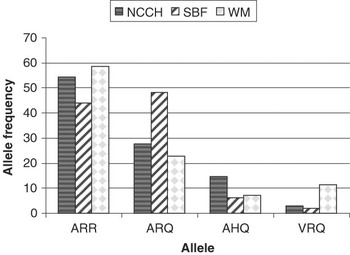
PrP allele frequencies for each breed dataset are shown in Figure 1. Some differences between breeds were observed. Scottish Blackface had the lowest ARR allele frequency (43.9%) and the highest ARQ allele frequency (48.1%). North Country Cheviot (Hill) and Welsh Mountain had similar ARR and ARQ allele frequencies, and North Country Cheviot (Hill) had the highest AHQ allele frequency (14.8%). The VRQ allele frequency was substantially higher in Welsh Mountain than in the other two breeds (11.3%). In general, allele frequencies were comparable with those estimated in the national (British) sheep populations (Eglin et al., Reference Eglin, Warner, Gubbins, Sivam and Dawson2005). Genotype frequencies in the North Country Cheviot (Hill) breed were in Hardy–Weinberg (HW) equilibrium, whereas those in the Scottish Blackface and Welsh Mountain populations differed significantly from HW equilibria (P < 0.01), although for different reasons. The Scottish Blackface population had fewer than expected AHQ/AHQ and AHQ/VRQ lambs, whereas the Welsh Mountain population had fewer ARR/AHQ lambs but more ARR/VRQ lambs than expected.
PrP allele frequencies shown for each breed, where NCCH is North Country Cheviot (Hill), SBF is Scottish Blackface and WM is Welsh Mountain.

Genetic and environmental parameters
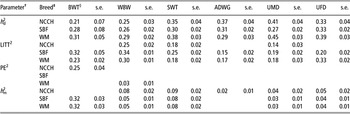
Estimates of genetic parameters for all traits in the three breeds are shown in Table 3. Overall, genetic parameters for all breeds and traits were in agreement with previous published studies. For most trait and breed combinations, the direct heritability (h a2) was moderate (range 0.21–0.45). The highest was for ultrasonic muscle depth in North Country Cheviot (Hill) and Welsh Mountain (0.41 and 0.45, respectively). In general, the maternal heritability (h m2) was low, and, where fitted, was highest for BWT. Litter (LITT2) effects were moderate and ranged from 0.14 to 0.33, while permanent environment effects were usually non-significant and therefore not included in the final models for most traits. However, the maternal environmental effects were partitioned as a permanent environmental effect rather than as a litter effect in the North Country Cheviot (Hill) breed.
EstimatesFootnote † of direct heritability, temporary dam (litter effect), permanent environmental effect of dam and maternal heritability for North Country Cheviot (Hill), Scottish Blackface and Welsh Mountain breeds (gaps indicate the variance component was not fitted)

† h 2d: direct heritability  ; LITT2:
 ; PE2:
 ; h 2m: maternal heritability
 , where
 are the additive genetic, maternal genetic, litter, permanent environment and phenotypic variance, respectively.
‡ NCCH: North Country Cheviot (Hill); SBF: Scottish Blackface; WM: Welsh Mountain.
§ BWT: birth weight; W8W: 8-week weight; SWT: scan weight at ∼20 weeks; ADWG: average daily weight gain between 8 and 20 weeks; UMD: ultrasonic muscle depth; UFD: ultrasonic fat depth.
PrP associations with performance traits
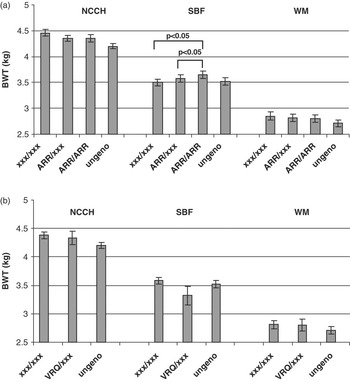
For each breed we present the significance (P-value) observed for the PrP genotype or allele class for each trait, and the predicted genotype means. Predicted means for the trait data, categorised by the number of copies of each allele, are presented graphically for ARR allele categories and VRQ allele categories only, as these are the alleles of most relevance to current breeding practices (Figures 2–7).
Least-squares means (and standard errors) for birth weight (BWT) of animals classified by the number of copies of (a) ARR and (b) VRQ alleles, where NCCH is North Country Cheviot (Hill), SBF is Scottish Blackface and WM is Welsh Mountain. Significant genotype contrasts and their P-value are indicated in the figure.

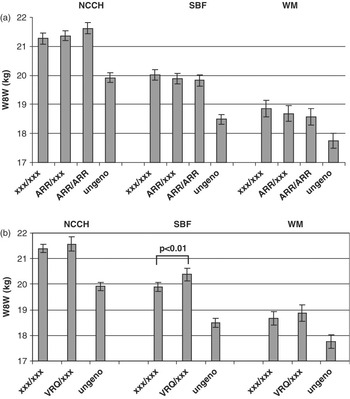
Least-squares means (and standard errors) for 8-week weight (W8W) of animals classified by the number of copies of (a) ARR and (b) VRQ alleles, where NCCH is North Country Cheviot (Hill), SBF is Scottish Blackface and WM is Welsh Mountain. Significant genotype contrasts and their P-value are indicated in the figure.

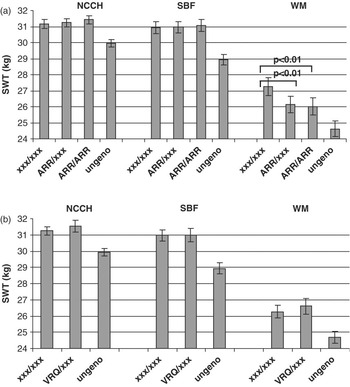
Least-squares means (and standard errors) for scan weight (SWT) of animals classified by the number of copies of (a) ARR and (b) VRQ alleles, where NCCH is North Country Cheviot (Hill), SBF is Scottish Blackface and WM is Welsh Mountain. Significant genotype contrasts and their P-value are indicated in the figure.

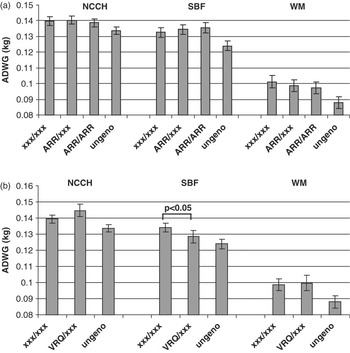
Least-squares means (and standard errors) for average daily weight gain (ADWG) of animals classified by the number of copies of (a) ARR and (b) VRQ alleles, where NCCH is North Country Cheviot (Hill), SBF is Scottish Blackface and WM is Welsh Mountain. Significant genotype contrasts and their P-value are indicated in the figure.

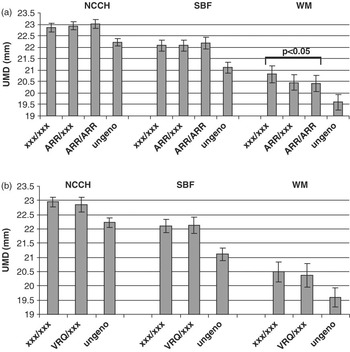
Least-squares means (and standard errors) for ultrasonic muscle depth (UMD) of animals classified by the number of copies of (a) ARR and (b) VRQ alleles, where NCCH is North Country Cheviot (Hill), SBF is Scottish Blackface and WM is Welsh Mountain. Significant genotype contrasts and their P-value are indicated in the figure.

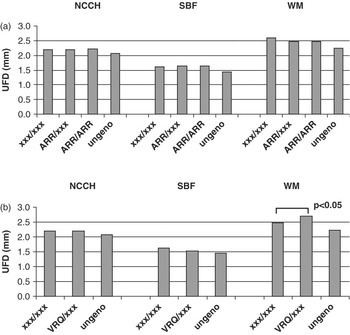
Least-squares means (backtransformed) for ultrasonic fat depth (UFD) of animals classified by the number of copies of (a) ARR and (b) VRQ alleles, where NCCH is North Country Cheviot (Hill), SBF is Scottish Blackface and WM is Welsh Mountain. Significant genotype contrasts and their P-value are indicated in the figure. Standard errors are not presented for backtransformed data.

Birth weight
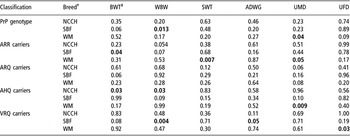
No significant PrP genotype associations with BWT were found in any of the breeds (Table 4). Further analysis by number of alleles carried did not detect any association common to all three breeds although some breed-specific associations were found. A significant AHQ allele association was found in North Country Cheviot (Hill) lambs (Table 4), with the 17 AHQ/AHQ animals having 0.37 kg heavier BWTs than lambs with only one or zero copies of the AHQ allele. A non-significant trend in the same direction was observed in Welsh Mountain lambs. The AHQ/AHQ genotype was not present in the Scottish Blackface dataset. An ARR allele effect (P = 0.03) was seen in Scottish Blackface (Table 4 and Figure 2). Here, lambs with two copies of the ARR allele weighed an average of 0.16 kg more than lambs with one or no copies. However, after Bonferroni correction, none of these comparisons reached the 5% significance level.
Tests of significance (P-values) for different traits and analyses differing in genotypic classifications for the three breeds

†NCCH: North Country Cheviot (Hill); SBF: Scottish Blackface; WM: Welsh Mountain.
‡BWT: birth weight; W8W: 8-week weight; SWT: scan weight at ∼20 weeks; ADWG: average daily weight gain between 8 and 20 weeks; UMD: ultrasonic muscle depth; UFD: ultrasonic fat depth.
Figures in bold represent significant results.
Eight-week weight
PrP genotype had a significant association (P < 0.05) with 8-week weight only in the Scottish Blackface breed, where significant associations were seen with the VRQ allele carriers (Figure 3). Heterozygous VRQ lambs had 0.51 kg higher 8-week weights than non-carriers (P < 0.01), and this comparison remained significant after Bonferroni correction. The 17 homozygous AHQ North Country Cheviot (Hill) lambs had 0.76 kg lower 8-week weights than heterozygous AHQ lambs or non-carriers (P = 0.03) (Table 4). However, as this effect was in the opposite direction to that found for BWT in this breed, and it was not significant after a Bonferroni correction, it is likely that one or both of these associations occurred by chance.
Scan weight
No significant association was detected between scan weight and PrP genotype in any of the breeds (Table 4). However, homozygous ARR Welsh Mountain lambs had scan weights that were 0.72 kg lower (P < 0.01) than animals with no copies of this allele, while heterozygous ARR lambs were also 0.50 kg lighter than non-carriers (Figure 4). This effect retained borderline significance, depending on how many independent tests were assumed, when performing the Bonferroni corrections.
Average daily weight gain
Analysis of data for all three breeds failed to detect a significant PrP genotype effect for average daily weight gain (Table 4). When the Scottish Blackface data were analysed at the allele level, lambs with one copy of the VRQ allele had significantly lower (P < 0.05) average daily weight gain (Figure 5) than non-carriers by 0.006 kg/day; however, this was not significant after the Bonferroni correction.
Ultrasonic muscle depth
A significant association between muscle depth and PrP genotype was apparent in Welsh Mountain lambs (P = 0.05) but not in the other breeds (Table 4 and Figure 6). The significant association seen in the Welsh Mountain lambs coincided with significant ARR and AHQ allele associations with muscle depth. Lambs with one or more copies of the ARR allele had 0.48 mm lower muscle depths than non-carriers, consistent with the lower lamb scan weights seen in this breed. AHQ/AHQ, AHQ/VRQ and to a lesser extent ARQ/AHQ lambs all had higher muscle depth predictions (P < 0.01) than non-carriers of the AHQ allele. These data were re-analysed using scan weight as a covariate: although inclusion of scan weight improved the model fit, the support for an association with PrP genotype dropped below significance (P = 0.20), suggesting that the muscle depth associations reflected differences in animal size rather than underlying muscularity.
Ultrasonic fat depth
No significant associations were found between PrP genotype and ultrasonic fat depth in any of the three breeds. However, a significant association was detected for the VRQ allele (P = 0.03) in Welsh Mountain lambs (Figure 7). When the predicted means were backtransformed to the observed scale, this result corresponded to VRQ carriers having a 0.2 mm greater fat depth than non-carriers. This effect was largely attributable to high fat depth measurements (2.8 mm) in AHQ/VRQ lambs, with fat depths in other VRQ carrier genotypes being similar to the population mean; however, it was not significant after the Bonferroni correction.
Discussion
A number of significant associations between PrP genotype and lamb performance traits were detected, and these associations varied widely in terms of the size and direction of their effect. They will be discussed in turn in terms of their anticipated impact on the hill sheep industry; however, it should be recognised that, as can be seen from the Bonferroni-correction-adjusted significance levels, some of these apparent associations may be false positives.
Overall, there was no consistent evidence for an effect of PrP genotype on BWT either across all breeds or within individual breeds. However, there was some support for AHQ and ARR allele effects apparent in North Country Cheviot (Hill) and Scottish Blackface, respectively. Notably there was no evidence for a VRQ allele effect on BWT, indicating that the NSP policy of eliminating the VRQ allele will have no discernible impact on BWTs.
North Country Cheviot (Hill) lambs with two copies of the AHQ allele had significantly higher BWTs than those with one or zero copies; however, there were only 17 animals present in this category. Lowered BWT is a risk factor for perinatal mortality in hill breeds (Sawalha et al., Reference Sawalha, Brotherstone, Man, Conington, Bünger, Simm and Villanueva2007), and therefore increased BWTs in homozygous AHQ lambs may have indirect beneficial effects via reduced perinatal mortality. Separate studies presently being carried out will determine whether this is the case and whether there is increased lambing difficulty associated with heavier homozygous AHQ BWTs. However, the 17 AHQ/AHQ animals represent only ∼2.1% of the total genotyped lambs, and therefore the anticipated impact on the population trait mean for BWT is expected to be minimal. Also, this BWT effect appears transient because it is not reflected in more commercially relevant traits such as scan weight and muscle depth.
In Scottish Blackface the ARR/ARR genotype was associated with higher BWTs, while the small number of heterozygous VRQ lambs were associated with much lower BWTs. If these results are true findings, they suggest that the NSP policy of favouring the ARR allele would have beneficial consequences and possibly improve perinatal survival in Scottish Blackface lambs.
A PrP genotype association with 8-week weight was observed in the Scottish Blackface, where VRQ-bearing genotypes were around 0.5 kg heavier than non-carriers. However, no consistent significant VRQ allele effect was found in more commercially relevant traits such as scan weights in this breed. Given that the current VRQ allele frequency is low (<0.02), the effect of elimination of VRQ alleles on population means for 8-week weight in Scottish Blackface is expected to be minor.
A significant association between the ARR allele and scan weight was found in Welsh Mountain lambs, with ARR carriers having significantly lower scan weights than non-carriers. In this breed, the homozygous ARR lambs also had the lowest 8-week weights, the lowest scan weights and consequently the lowest average daily weight gains, although the results for these traits failed to reach the 5% significance threshold. A similar result was reported by Pritchard et al. (Reference Pritchard, Cahalan and Ap Dewi2008) in the same breed, with homozygous and heterozygous ARR lambs being lighter than non-carriers at scanning. Given that ARR carriers collectively represent more than 85% of the genotyped population, and the direction of the effect is for decreased weights in a commercially relevant trait, the impact on the Welsh Mountain breed may be important.
Analysis of the rate of weight gain between 8 weeks and scanning age failed to find a significant association with the PrP genotype. However, an association of borderline significance with the VRQ allele was apparent in the Scottish Blackface (P = 0.05). The lower weight gain rate in the heterozygous VRQ lambs relative to non-VRQ carriers (Figure 6) is consistent with the slower finishing of VRQ carriers in a study of two large experimental Scottish Blackface flocks (Sawalha et al., Reference Sawalha, Brotherstone, Man, Conington, Bünger, Simm and Villanueva2007).
Few significant results were observed for muscle or fat depth, apart from a reduced muscle depth in ARR carrier lambs in the Welsh Mountain breed, and an increased fat depth in VRQ carriers. However, Pritchard et al. (Reference Pritchard, Cahalan and Ap Dewi2008) observed a different result for muscle depth in the same breed, with homozygous ARR lambs having a significantly greater muscle depth than heterozygous lambs. Thus, no strong pattern of association is emerging.
Further analyses of all the traits studied using a subset of data comprising only the genotyped animals were carried out (results not shown); however, they served to confirm the results found using the complete dataset.
This study is one of a growing literature examining potential associations between PrP and performance traits in sheep, although one of the few studies to consider data from more than one breed. A comprehensive summary of published papers on this topic is provided by Sweeney and Hanrahan (Reference Sweeney and Hanrahan2008). In general agreement with this study, Sweeney and Hanrahan (Reference Sweeney and Hanrahan2008) observed that whilst significant associations with growth and carcass traits were sometimes reported, there was no compelling evidence to reject the null hypothesis that there is no association between PrP genotype and lamb growth traits or carcass traits. More specifically, they concluded that there was little evidence for the negative associations that are often perceived within the sheep breeding industry.
As stated above, although several apparently significant associations were detected in all three hill breeds examined in this study, few were consistent in effect, direction or magnitude and few survived the Bonferroni correction. However, it can be observed that four of the five nominally significant associations shown graphically for post-natal traits involved either superiority for VRQ-carrying genotypes or inferiority for ARR-carrying genotypes. Possibly this may be related to the preferential genotyping of better-performing animals seen in the data. It is likely that some breeders would only genotype animals that have a risk of carrying a VRQ allele if they were phenotypically (or genetically) high-performing animals, whereas a high proportion of potential homozygous ARR animals are likely to be genotyped.
Despite the possible impact of the genotyping strategy described above, there is a lack of consistency across breeds and this may arise from either breed-specific direct PrP effects or indirect effects such as the action of neighbouring genes in linkage disequilibrium with PrP. The possibility that a breed-specific effect may simply reflect a breed-specific environmental effect is unlikely because the three hill breeds considered in this study share broadly similar environments and management practices. Alternatively there may be breed-specific epistatic effects with other loci, although no such effects have ever been described for the PrP locus. Apart from being false positives, the most plausible explanation for the lack of consistency across hill breeds is that the effects that have been observed reflect breed-specific associations between PrP and functionally significant alleles of linked genes that are in linkage disequilibrium with specific PrP alleles. Although little genomic detail is currently available for sheep, there is ample evidence in mice of loci neighbouring the PrP locus that may have such effects (Nagle et al., Reference Nagle, McGrail, Vitale, Woolf, Dussault, DiRocco, Holmgren, Montagno, Bork, Huszar, Fairchild-Huntress, Ge, Keilty, Ebeling, Baldini, Gilchrist, Burn, Carlson and Morre1999; Rocha et al., Reference Rocha, Eisen, Van Vleck and Pomp2004a and Reference Rocha, Eisen, Van Vleck and Pomp2004b).
Acknowledgements
This work was part of project SE0236, funded by Department of Environment, Food and Rural Affairs (DEFRA), with in-kind contributions from the Rare Breeds Survival Trust, the Sheep Trust and the Meat and Livestock Commission, particularly Gert Nieuwhof, gratefully acknowledged. The authors would like to thank Bill Hill and Beatriz Villanueva for comments on the manuscript.