Introduction
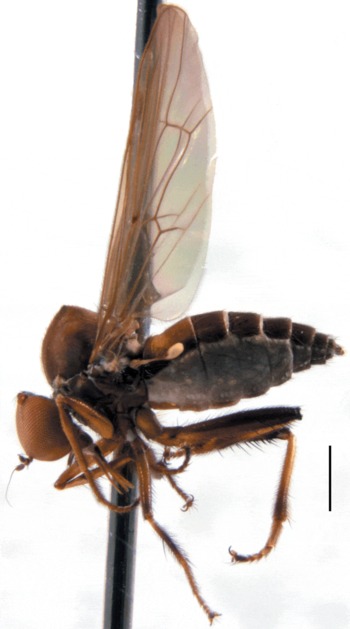
Empidoidea (dance flies) is comprised of five families: Atelestidae, Brachystomatidae, Dolichopodidae, Empididae, and Hybotidae (Sinclair and Cumming Reference Sinclair and Cumming2006). Within Hybotidae, species of Syneches Walker (Hybotinae) are attractive mid- to large-sized empidoids readily recognized by their generally inflated, red, frontally flattened eyes (wider than height), slender stout proboscis, and distinct humpbacked appearance (Fig. 1). There are nearly 175 described species of Syneches worldwide (as defined in this paper), occurring in all six zoogeographic regions. In the Australasian Region there are 16 described species, including 3 from Fiji (Bezzi Reference Bezzi1928), which were the only species of Empidoidea (exclusive of Dolichopodidae) named from these islands prior to the commencement of the Terrestrial Arthropod Survey of Fiji in 2002 (Evenhuis and Bickel Reference Evenhuis and Bickel2005). In Hybotinae, three other genera are also recognized in Fiji (B.J. Sinclair, unpublished data): Euhybus Coquillett and two as yet unidentified genera. In Tachydromiinae (Hybotidae), numerous specimens of undescribed species of the following genera were collected during the survey: Austrodrapetis Smith, Chersodromia Walker, Crossopalpus Bigot, Drapetis Meigen, Elaphropeza Macquart, and Tachydromia Meigen. In Empididae, the Fijian species of Dolichocephala Macquart and Hemerodromia Meigen were revised by Sinclair and Evenhuis (Reference Sinclair and Evenhuis2005) and Plant and Sinclair (Reference Plant and Sinclair2008), respectively.

In this study, the three Fijian species of Syneches are revised and two new species are described. Two of the three Fijian species described by Bezzi (Reference Bezzi1928) were collected during the Terrestrial Arthropod Survey. The generic concept of Syneches is re-assessed, with Epiceia Walker, Harpamerus Bigot, and Parahybos Kertész considered congeneric with the latter two assigned as new synonyms.
Material and methods
This study is based primarily on material from the Terrestrial Arthropod Survey of Fiji (Evenhuis and Bickel Reference Evenhuis and Bickel2005). All specimens in this study were loaned from, or deposited in, the following institutions: the Natural History Museum, London, UK (BMNH); Bishop Museum, Honolulu, Hawaii, United States of America (BPBM); and Canadian National Collection of Insects, Ottawa, Canada (CNC). All dissections were made in glycerin and tissues cleared using hot 85% lactic acid. Terms used for adult structures primarily follow those of McAlpine (Reference McAlpine, McAlpine, Peterson, Shewell, Teskey, Vockeroth and Wood1981), except for antennae and wing venation where the terms of Stuckenberg (Reference Stuckenberg1999) and Saigusa (Reference Saigusa2006) were used, respectively. Saigusa (Reference Saigusa2006) homologised the dipteran vein A1 (McAlpine Reference McAlpine, McAlpine, Peterson, Shewell, Teskey, Vockeroth and Wood1981) with CuP of Mecoptera. Consequently, the following wing venation terms are used here: CuA1 (of McAlpine) = M4, CuA2 = CuA, anal cell = cell cua, and anal vein (A1 + CuA2) = CuP + CuA. Homologies of male terminalia follow Sinclair and Cumming (Reference Sinclair and Cumming2006).
The following abbreviations are used in the descriptions and material examined sections: ad, anterodorsal; av, anteroventral; dc, dorsocentral bristles/setulae; ES, E. Schlinger; MEI, M.E. Irwin; MT'a, M. Tokota'a; MT, Malaise trap; npl, notopleural bristles; pal, postalar bristle; pd, posterodorsal; pprn, postpronotal bristle; pv, posteroventral; sctl, scutellar bristles; spal, supralar.
Label data for primary types are presented exactly as they appear. Data are listed from the top downward, with data from each label enclosed in quotation marks; lines are delimited by a forward slash mark. Additional information is included in square brackets.
Syneches Walker
Syneches Walker, 1852: 165. Type species, S. simplex Walker, 1852 (by monotypy).
Harpamerus Bigot, 1859: 306. Type species, H. signatus Bigot, 1859 (by monotypy) syn. nov.
Epiceia Walker, 1860: 149. Type species, E. ferruginea Walker, 1860 (by monotypy).
Parahybos Kertész, 1899: 176. Type species, Parahybos iridipennis Kertész, 1899 (by monotypy) syn. nov.
Diagnosis
Syneches is a distinctive genus, recognized by the following combination of characters: head hemispherical and holoptic in both sexes, eyes usually frontally flattened and inflated, making the head wider than its height (from anterior view); postpedicel oval with apical to subapical hair-like stylus; mouthparts stoutly sclerotized and slender with narrow and apically pointed labellum, lacking pseudotracheae; palpus slender, much shorter than labrum with long apical setae; thorax normally highly arched; hind femur often enlarged and spinose beneath; wings broad, often with distinct pterostigma; vein Rs long, arising on proximal half of cell br; vein CuA gently arched such that cell cua only slightly longer than cell bm; male terminalia nearly symmetrical, lacking articulated surstylus, rotated 45°–90° to the right.
Notes on synonymy
Syneches has been divided into a number of subgenera and genera, and the justification of this classification has been controversial (see Saigusa Reference Saigusa1964). Harpamerus was erected to represent species with a broad and flattened abdomen, hind femur with setose tubercles (more pronounced in males), and hind tibia arched. Many species of Syneches found worldwide (e.g., S. bezzii sp. nov.) possess stout setae on the hind femur, and these diagnostic features of the former genus simply represent an extreme development of characters. Recognition of Harpamerus rendered Syneches a paraphyletic assemblage of undefined species. The related genus Hybos Meigen also has great variation in hindleg armature, but has not been divided into generic groupings so far. Parahybos includes species of Syneches with modified male mid-tarsi (e.g., S. deformitarsis Saigusa), and consequently females cannot be assigned to this genus without association of male conspecifics. Epiceia is characterized by convergent radial and medial veins, a variable feature among species of Syneches and consequently not a convincing diagnostic character. In fact S. fijiensis was originally assigned to Epiceia, but its wing veins are only convergent subapically and, at the wing margin, run parallel. This is often the case with this diagnostic character, making its usefulness doubtful.
Melander (Reference Melander and Wytsman1928) recognized Epiceia and Harpamerus as subgenera of Syneches, with Parahybos as a related genus. Although Smith (Reference Smith1969) did not follow the subgeneric classification and did not consider them to be distinguishable on a world basis, he maintained Melander's classification for Oriental and Australasian species (Smith Reference Smith, Delfinado and Hardy1975, Reference Smith and Evenhuis1989). Chvála (Reference Chvála1983) agreed with Smith (Reference Smith1969), stating that separation of subgenera based on converging veins and differences in size and bristles of the hind femur to be variable among species. Yang and Yang (Reference Yang and Yang2004) continued recognition of Harpamerus, Syneches, and Parahybos as separate genera based on a combination of male secondary sexual modifications and presence and absence of ventral bristles on the hind femur, although these characters are not convincing. The empidid world catalogue also recognized those three genera but assigned Epiceia as a synonym of Syneches (Yang et al. Reference Yang, Zhang, Yao and Zhang2007).
Recognizing these generic groups creates a paraphyletic Syneches. Consequently, Harpamerus, Parahybos, and Epiceia are hereinafter considered junior synonyms of Syneches, and no subgeneric groupings are recognized. Species affected by these synonyms result in 20 new species combinations and two new replacement names. In total, 33 species are transferred to Syneches (Appendix 1). This re-assessment of Syneches results in a clearly defined genus with the following autapomorphies: uniquely broad head (eyes wider the height in anterior view), frontally flattened eyes, and nearly symmetrical male terminalia (likely secondarily derived).
Bionomics
Adults of Syneches are predators, commonly encountered in grassland areas (Wilder Reference Wilder1974) and forest edges. The proboscis is highly modified with a long piercing labrum and slender, well-sclerotized labellum.
Syneches bezzii sp. nov.
Type material
Holotype ♂, labelled: “FIJI. Vanua Levu Island. Bua Prov./ Kilaka, FJ-58 3.vi.-10.vi.04/ 178°59′110′′E, 16°48′927′′S/ M.E. Irwin, E. Schlinger, M. Tokota'a/ 146 m MT FBA 040509”; “HOLOTYPE/ Syneches/ bezzii/ Sinclair [red label]” (BPBM). Paratypes: FIJI: Taveuni: Tavuki Village, Mt. Devo, MT 4, 14–31.vii.2004, 892 m, 16.837°S, 179.973°E, ES, MT'a (FBA 151586-587) (1 ♂, 1 ♀, BPBM); Tavuki Village, Mt. Devo, MT, 30.vi.–14.viii.2004, 734 m, 16.831°S, 179.98°E, FJTA9a_M05_02, ES, MT'a (FBA 071118) (1 ♂, BPBM); Devo For. Res., MT, 3–10.i.2003, 800 m, 16.50°S, 179.59°E, MEI, ES, MT'a (FBA 042929) (1 ♂, BPBM); 5.3 kmSE Tavuki Village, Mt. Devo, MT 3, 31.vii.–14.viii.2004, 1064 m, 16.841°S, 179.968°E, ES, MT'a (FBA 107552-554) (3 ♀, BPBM); 5.3 kmSE Tavuki Village, Mt. Devo, MT 3, 24–31.x.2002, 1064 m, 16.841°S, 179.968°E, ES, MT'a (FBA 105647-651) (3 ♂, 2 ♀, BMNH); 5.3 kmSE Tavuki Village, Mt. Devo, MT 3, 14–21.xi.2002, 1064 m, 16.841°S, 179.968°E, ES, MT'a (FBA 162050) (1 ♂, BPBM); 5.3 kmSE Tavuki Village, Mt. Devo, MT 3, 3–20.xii.2002, 1064 m, 16.841°S, 179.968°E, ES, MT'a (FBA 153760-761) (2 ♀, BPBM); 5.3 kmSE Tavuki Village, Mt. Devo, MT 3, 20–27.xii.2002, 1064 m, 16.841°S, 179.968°E, ES, MT'a (FBA 128064-065) (2 ♀, BPBM); 5.3 kmSE Tavuki Village, Mt. Devo, MT 3, 21.xi.–13.xii.2002, 1064 m, 16.841°S, 179.968°E, ES, MT'a (FBA 162908) (1 ♀, CNC); 5.3 kmSE Tavuki Village, Mt. Devo, MT 3, 27.xii.2002–3.i.2003, 1064 m, 16.841°S, 179.968°E, ES, MT'a (FBA 146355-356) (2 ♀, BPBM); 5.5 kmSE Tavuki Village, MT, rainfor., 30.vi.–14.viii.2004, 1188 m, FJTA8b_M02_02, 16.843°S, 179.966°E, ES, MT'a (FBA 070289-290) (1 ♂, 1 ♀, BPBM); 5.6 kmSE Tavuki Village, Devo Peak, MT 1, 14–21.xi.2002, 1187 m, 16.843°S, 179.966°E, ES, MT'a (FBA 120295) (1 ♂, 1 ♀, BPBM); Devo Peak, MT, 10–16.i.2003, FJ-7,8,9, MEI, ES, MT'a (FBA 038651) (1 ♀, BPBM); Devo Peak Radio Tower, MT in rainfor., 31.x.–21.xi.2002, FJ-8, 1200 m, 16.51°S, 179.58°E, MEI, ES, MT'a (FBA 005168) (1 ♀, BPBM); 5.6 kmSE Tavuki Village, rainfor., MT 1, 31.x.–14.xi.2002, 1187 m, FJTA8a_M01_06, 16.843°S, 179.965°E, ES, MT'a (FBA 056745-746) (2 ♂, BPBM). Vanua Levu: 6 kmNW Kilaka, 3–10.vi.2004, Batiqere Range, MT 3, 61 m, 16.811°S, 178.988°E, ES, MT'a (FBA 114260) (1 ♀, BPBM); 6 kmNW Kilaka, 15–28.vi.2004, Batiqere Range, MT, 146 m, 16.8153°S, 178.9864°E, FJVN58d_M01-07, ES, MT'a (FBA 072317) (1 ♂, BPBM); Kilaka, 3–10.vi.2004, MT, 145 m, FJ-58A, 16°48′927′′S, 178°59′110′′E, MEI, ES, MT'a (FBA 040503-508) (3 ♂, 3 ♀, BPBM); Kilaka, 3.vi.–10.vii.2004, MT, 98 m, FJ-58E, 16°48′412′′S, 178°59′290′E, MEI, ES, MT'a (FBA 023108) (1 ♀, BPBM); 6 kmNW Kilaka, 13–26.vi.2004, Batiqere Range, MT, 146 m, FJVN58e_M04_02, 16.8153°S, 178.9864°E, ES, MT'a (FBA 059235-236) (1 ♂, 1 ♀, BPBM); 6 kmNW Kilaka, 3–15.vi.2004, Batiqere Range, MT, 113 m, FJVN58c_M02_06, 16.7317°S, 178.9997°E, ES, MT'a (FBA 069210-211) (1 ?, 1 ♀, CNC); 6 kmNW Kilaka, 15–24.vi.2004, Batiqere Range, MT, 98 m, 16.8067°S, 178.9914°E, ES, MT'a (FBA 074942) (1 ♀, BPBM); 6 kmNW Kilaka, 15–28.vi.2004, Batiqere Range, MT, 145 m, FJVN58d_M01_07, 16.8153°S, 178.9864°E, ES, MT'a (FBA 072317-18) (2 ♂, BPBM); Kilaka, 28.vi.–2.vii.2004, MT, 154 m, FJ-58D, 16°48′412′′S, 178°59′017′′E, MEI, ES, MT'a (FBA 047582-585) (2 ♂, 2 ♀, CNC); Kilaka, 24.vi.–21.vii.2004, MT, 98 m, FJ-58E, 16°48′412′′S, 178°59′290′E, MEI, ES, MT'a (FBA 028279-281) (3 ♀, BPBM). Viti Levu: Koroyanitu N.H.P., Savuione Trail, FJ-1, MT in montane woodland, 12–19.x.2002, 450 m, MEI, ES, MT'a, 17°40′S, 177°33′E (FBA 005228) (1 ♂, CNC); 3.2 kmE Navai Vlg., Veilaselase Track, 1020 m, MT 1, 26.i.–13.ii.2004, ES, MT'a, 17.624°S, 178.009°E (FBA 122315-318) (4 ♀, BPBM); 3.2 kmE Navai Vlg., Veilaselase Track, 1020 m, MT 2, 18–26.x.2004, ES, MT'a, 17.624°S, 178.000°E (FBA 184757-760) (3 ♂, 1 ♀, CNC); 3 kmE Navai Vlg., old trail to Mt. Tomaniivi, 700 m, MT 3, 26.ix.–11.x.2003, ES, MT'a, 17.621°S, 178°E (FBA 124759) (1 ♀, BPBM); 3.2 kmE Navai Vlg., Veilaselase Track, 1020 m, MT 1, 8–24.xi.2003, ES, MT'a, 17.624°S, 178.000°E (FBA 166817) (1 ♀, BPBM); 3.5 kmN Veisari Stlmt., logging rd. to Waivudawa, 14.ii.–8.iii.2003, 300 m, MT 3, ES, MT'a, 18.068°S, 178.367°E (FBA 136510) (1 ♀, BPBM); 3.3 kmN Veisari, logging rd. to Waivudawa, 8.iii.–31.iii.2003, 300 m, MT M04, MT'a, 18.069°S, 178.367°E (FBA 192567-568) (1 ♀, BPBM); 3.2 kmE Navai Vlg., Veilaselase Track, 1020 m, 18–26.x.2004, MT 2, ES, MT'a, 17.624°S, 178.000°E (FBA 184757-760) (3 ♂, 1 ♀, BPBM); 3.2 kmE Navai Vlg., Veilaselase Track, 1020 m, 8–24.xi.2004, MT 1, ES, MT'a, 17.624°S, 178.000°E (FBA 166817) (1 ♀, BPBM).
Diagnosis
This large, brownish species is distinguished from the other Fijian species by the smoothly arched scutum, distinct pterostigma nearly twice as long as wide, hind femur swollen and bearing spine-like ventral setae mounted on short protuberances, and hind tibia geniculate at base, not clavate.
Description
Male
Eyes orange-brown, flattened dorsally and facets enlarged. Occiput black with grey tomentum. Ocellar triangle elevated, bare and shiny, including posterior face; bearing two long ocellar bristles and two posterior setulae. Postocular setae short and pale. Antenna with scape and pedicel pale; postpedicel dark, quadrate with one long dorsal setula; arista-like stylus, black. Proboscis brown; palpifer stout and quadrate, paler than labrum, palpus brown with several long basal setae and single long apical seta, slightly shorter than palpus.
Scutum highly arched, but rounded; orange-brown with sparse tomentum; somewhat darker median stripe and line along dc. Chaetotaxy generally pale; acrostichals 5–6 serial, short and fine; dc uniserial, increasing in length posteriorly, posteriormost stout bristle; one fine pprn; 2–3 npl, upper stouter; scattered setulae on spal; one stout pal; pair of stout apical sctl, longer than all other bristles, 2–3 pairs of outer sctl, stouter and finer and several marginal setulae.
Legs concolorous with thorax, except hind femur and tibia darker on apical fourth and third, respectively; trochanter-femur joint black; tarsomeres darker apically. Fore femur slightly wider than mid-femur; clothed in erect fine setae forming widely separated biserial ventral row. Fore tibia swollen about basal gland; posteroventral face with long fine setae, longer than width of tibia apically; two stout dorsal bristles beyond mid-length and several additional stout setae; apical half of anteroventral face with matted setae forming apical comb longer than tibial width. Mid-femur with long setae forming av and pv rows, longer than width of femur. Basal third of mid-tibia with stout ad bristle longer than half length of tibia, one pd and posterior bristle shorter and finer than ad bristle; mid-length with stout pd bristle, half length of tibia; apical third with one pv bristle, similar in size to pd bristle; apex with preapical circlet of various length bristles, ventral bristle subequal in length to tarsomere 1. Hind femur with two ad and one pd bristles on apical third; apical fourth with 4 pv bristles; av face with biserial row of bristles, outer row subequal to width of femur, inner row spine-like, half length of outer bristles. Hind tibia slightly geniculate at base; slightly clavate; one pd bristle basal to mid-length; surfaces with fine erect setae, especially longer on pv face, forming pv apical comb. Tarsomeres of all legs with long, dense mat of short setae; hind tarsomeres 1–3 with distinct posteroapical combs.
Wing length 4–6 mm. Wing lightly infuscate; pterostigma dark brown, nearly twice as long as wide; veins dark brown, R4 + 5 and M1 + 2 parallel apically. Squama brownish with pale hairs. Halter brown.
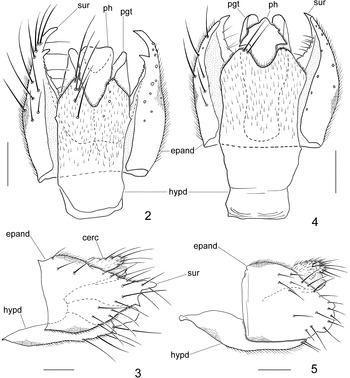
Abdomen concolorous with thorax, posterior margin darker as slender band; lateral margin and ventral surface pale; posterior margin with dark setae, stouter on apical segments. Terminalia (Figs. 2, 3): Epandrium with medially directed subapical hook-like process, ventral margin posterior to process with short teeth-like projections; apex of epandrium (surstylus) tapered, medially directed with slender, pointed tooth-like apex. Hypandrium broad, parallel-sided; posterior margin deeply bilobed, each lobe narrowly rounded, bearing 5 long setae. Phallus broad, half width of hypandrium, with truncate apex. Postgonite broad, tapered to rounded apex, not projecting beyond phallus.

Female
Similar to male in size, colour, and chaetotaxy.
Etymology
Named in honour of Mario Bezzi who described the first Fijian species of Syneches.
Syneches fijiensis Yang and Yao
Syneches fijiensis Yang and Yao in Yang et al., Reference Yang, Zhang, Yao and Zhang2007: 308. Replacement name for S. pullus Bezzi, Reference Bezzi1928nec Syneches pullus Bezzi, 1912.
Syneches (Epiceia) pullus Bezzi, Reference Bezzi1928: 54.
Type material examined
Lectotype ♂, here designated, labelled: “Type [red-bordered circle]”; “FIJI ISLANDS./ Buca Bay [Vanua Levu]/ 27.xii.1921/ H.W. Simmonds.”; “Fiji Is./ Pres. by/ Imp. Bur. Ent./ Brit. Mus./ 1929—1.”; “Syneches/ pullus/ typ. n.sp. [hand-written in red]”; “Syn-/ type [blue-bordered circle]”; “LECTOTYPE/ of Syneches/ pullus/ des. B.J. Sinclair 2009 [red label]” (BMNH). The lectotype of S. pullus is labelled accordingly to fix and stabilize the current concept of the name. Paralectotype: 1 ♂, same data as holotype (BMNH).
Additional material examined
FIJI: Vanua Levu: 2.6 km SSE Vusasivo Vlg., Mt. Navatadoi, 22.xii.2005–7.i.2006, 400 m, MT 1, L. Waga, 16.593°S, 179.772°E, FJVN87_M01_16 (FBA 517879) (1 ♂, BPBM). Viti Levu: 3.5 kmN Veisari Stlmt., logging rd. to Waivudawa, 14.ii.–8.iii.2003, 300 m, MT 3, ES, MT'a, 18.068°S, 178.367°E (FBA 136511) (1 ♀, BPBM).
Diagnosis
A distinctive species with its noninfuscated pterostigma and nearly entirely black thorax and hind femur.
Description
Male
The following expands on the thorough description of Bezzi (19Reference Bezzi28: 54): Scutum with two notopleurals; one postalar; one long dorsocentral; apical pair of scutellars and numerous marginal scutellar setae of various strengths. Mid-femur with posteroventral row of more than 10 setae, stouter towards base of femur; anteroventral row of about eight stout setae, longer than width of femur. Hind tibia yellow with apical half or more darkened. Hind femur with anterior face entirely yellow with apex dark or mostly dark with pale base; posterior view mostly pale yellow; with outer anteroventral row of about seven stout setae arising from short tubercles; posterior two-thirds with double row of shorter, ventral spine-like setae, also arising from tubercles. Hind tarsomeres 1–3 with distinct posteroapical combs.
Wing length 3.8–4 mm.
Base of abdomen pale with pale setae in lectotype. Entirely dark in additional material with dark setae. Terminalia (Figs. 4, 5): Epandrium lacking subapical process and ventral margin smooth, lacking small projections; apex of epandrium truncate, broadly rounded. Surstylus very short, rounded, only slightly projecting beyond epandrium. Hypandrium extended anteriorly well beyond epandrium, broad, somewhat parallel-sided with posteriorly portion slightly expanded; posterior margin shallowly bilobed, each lobe broadly rounded, bearing pair of long setae. Phallus with arrowhead-like apex, with narrowly rounded apex. Postgonite broad, tapered to rounded apex, projecting slightly beyond phallus.
Female
Similar to male.
Remarks
Bezzi (Reference Bezzi1928) based his description of S. pullus upon one male and one female type (actually male), without designating a holotype. Given the difficulty in associating male and female specimens, I have designated a lectotype for this species to stabilize the species concept.
Syneches insolitus sp. nov.
Type material
Holotype ♂, labelled: “FIJI: Taveuni, Cakaudrove Prov./ 5.3 km SE Tavuki Vlg., Mt. Devo,/ 1064 m, 24–31.x.2002, MT 3,/ coll. Schlinger, M. Tokota'a./ 16.841 S, 179.968 E, FBA 105652”; “HOLOTYPE/ Syneches/ insolitus/ Sinclair [red label]” (BPBM). Paratypes: FIJI: Gau: 4.0 kmSE Navukailagi Village, Mt. Delaco, 496 m, 10.i.–11.ii.2006, MT 2, U. Racule, 17.08°S, 179.275°E, FJGA65_M02_23 (FBA 517905) (1 ♂, BPBM). Taveuni: 5.6 kmSE Tavuki Village, rainfor., MT, 3–10.i.2003, 1187 m, FJTA8a_M01_12, 16.843°S, 179.965°E, ES, MT'a (FBA 057696) (1 ♂, CNC); Devo For. Res., MT, 3–10.i.2003, 800 m, 16.50°S, 179.59°E, MEI, ES, MT'a (FBA 042928) (1 ♂, BPBM); 5.3 kmSE Tavuki Village, Mt. Devo, MT 3, 21.xi.–13.xii.2002, 1064 m, 16.841°S, 179.968°E, ES, MT'a (FBA 162899) (1 ♀, CNC). Viti Levu: 3.2 kmE Navai Vlg., Veilaselase Track, 1020 m, MT 2, 18–26.x.2004, ES, MT'a, 17.624°S, 178.009°E (FBA 184756) (1 ♀, BPBM); 4.8 kmN Veisari Stlmt., log rd. to Waivudawa, 12.xii.2002–3.i.2003, 300 m, MT 1, ES, MT'a, 18.075°S, 178.362°E (FBA 177570) (1 ♂, BPBM).
Diagnosis
This is a very odd species of Syneches distinguished by eyes rounded (not frontally flattened), scutum rounded (not arched), and legs slender (not swollen).
Description
Male
Eyes brown, round, not frontally flattened dorsally and facets enlarged. Occiput black with brown tomentum. Ocellar triangle elevated, pollinose; bearing pair of very long ocellar bristles, extending nearly to base of antennae. Postocular setae long and dark. Antenna with scape and pedicel dark; postpedicel dark, quadrate with two long dorsal setulae; arista-like style black. Proboscis brown; palpifer stout and quadrate, palpus brown with several long basal setae and single subequal apical seta.
Scutum not arched, rounded; orange-brown with sparse tomentum; somewhat darker median stripe along acrostichals. Chaetotaxy dark, well developed; acrostichals biserial, short and fine, about 6 pairs; ca. 6 dc, uniserial, increasing in length posteriorly; one fine, short pprn; 1–2 npl; scattered setulae on spal; one long pal; two pairs sctl, apical pair more than twice length of outer pair; apex with several setulae.
Legs generally concolorous with thorax, except inner face of fore femur paler. Femora subequal in width. Fore femur clothed in scattered fine setae, lacking ventral rows. Fore tibia not swollen about basal gland. Mid-femur lacking long setae forming ventral rows. Basal third of mid-tibia with short ad bristle, no longer than one-sixth length of tibia. Hind femur not swollen and lacking spine-like setae; two widely separated av bristles; one preapical ad bristle. Hind tibia not geniculate at base; slightly clavate; lacking outstanding bristles; inner surface with longer setae forming loose pv apical comb. Hind tarsomeres 1–2 with distinct posteroapical combs.
Wing length 2.5–3 mm. Wing lightly infuscate; stigma dark, quadrate, squarish, with R2 + 3 dipped below pterostigma; veins dark brown, R4 + 5 and M1 + 2 slightly divergent to parallel apically. Squama brownish with pale hairs. Halter brown.
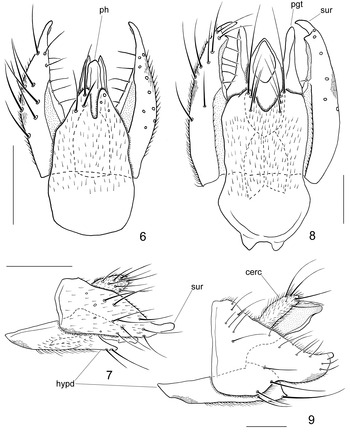
Abdomen brown, concolorous with thorax, clothed in long dark setae. Terminalia (Figs. 6, 7): Epandrium lacking subapical process; apex of epandrium (surstylus) tapered to broadly rounded apex. Hypandrium broad, slightly tapered posteriorly; posterior margin deeply and narrowly bilobed, each lobe narrowly rounded, bearing 3 long setae. Phallus narrow with slightly pointed apex. Postgonite broad, tapered to rounded apex, projecting slightly beyond phallus.

Female
Similar to male, except fore- and mid-legs, basal half of hind femur, and basal third of hind tibia pale often yellowish brown.
Etymology
The specific name is from the Latin insolitus (unusual, odd) in reference to the round head and unique shape of the wing.
Syneches oedicnemus Bezzi
Syneches (Syneches) oedicnemus Bezzi, Reference Bezzi1928: 52.
Type material examined
Holotype ♀, labelled: “Type [red-bordered circle]”; “H. Greenwood/ Mountains/ Lautoka.Fiji [Viti Levu]/ 11/4/20 [hand written]”; “Fiji Is./ Pres. by/ Imp. Bur. Ent./ Brit. Mus./ 1929—1.”; “Syneches/ oedicnemus/ typ. n.sp. [hand-written in red]”; “Holo-/ type [red-bordered circle]” (BMNH).
Diagnosis
The species is characterized by the pterostigma longer than wide, hind tibia clavate, hind femur not distinctly swollen, bearing four long anteroventral bristle-like setae, otherwise lacking spine-like anteroventral setae mounted on short protuberances.
Remarks
No additional material of this species was collected during the Fiji Arthropod Survey. The holotype is female, not male as stated by Bezzi (Reference Bezzi1928).
Syneches spinidorsum Bezzi
Syneches (Syneches) spinidorsum Bezzi, Reference Bezzi1928: 52.
Type material examined
Holotype ♂, labelled: “Type [red-bordered circle]”; “R. Veitch/ Labasa/ Fiji/ Dec. 1921 [hand written]”; “Fiji Is./ Pres. by/ Imp. Bur. Ent./ Brit. Mus./ 1929—1.”; “Syneches/ spinidorsum/ typ. ♂, n.sp. [hand-written in red]”; “Holo-/ type [red-bordered circle]” (BMNH). Paratype: 1 ♂, same data as holotype (BMNH).
Additional material examined
FIJI: Taveuni: Taveuni Estate, FJ-7, MT in garden, 31.x.–21.xi.2002, 140 m, 16°50′S, 179°59′E, MEI, ES, MT'a (FBA 005289) (1 ♀, BPBM). Viti Levu: 3.2 kmE Navai Vlg., Veilaselase Track, 1020 m, MT 1, 26.i.–13.ii.2004, ES, MT'a , 17.624°S, 178.009°E (FBA 122319) (1 ♀, BPBM); 4.8 kmN Veisari, Stlmt., log rd to Waivudawa, 300 m, 12.xii.2002–3.i.2003, MT 1, MT'a, 18°4′30′S, 178°21′43′E (FBA 177571, 1 ♂, BPBM; FBA 177572, 1 ♂, CNC); 3.3 kmN Veisari, log rd to Waivudawa, 300 m, 8.iii.–31.iii.2003, MT 4, MT'a, 18.?69°S, 178.367°E (FBA 192569) (1 ♀, CNC); 3.5 kmN Veisari Stlmt., log rd. to Waivudawa, 14.ii.–8.iii.2003, 300 m, MT 3, ES, MT'a, 18.068°S, 178.367°E (FBA 136509) (1 ♀, BPBM).
Diagnosis
A distinctive species with triangular thorax, pointed mesonotum, and rounded pterostigma.
Description
Male
The following expands on the thorough description of Bezzi (Reference Bezzi1928: 52): Scutum with two notopleural bristles.
Mid-femur with antero- and posteroventral row of slender setae, longer than width of femur. Hind femur with two subapical anterodorsal bristles; five anteroventral bristles (lacking mounting tubercles) and outer ventral row of spine-like setae. Hind tibia with one anterodorsal bristle near mid-length and one preapical. Fore tibial gland slit-like, parallel-sided. Hind tarsomeres 1–3 with distinct posteroapical combs.
Wing length 4.8–4.9 mm.
Abdomen darker than thorax, with terga one and two broadly pale; setae generally pale, becoming darker posteriorly. Terminalia (Figs. 8, 9): Epandrium with short, somewhat medially directed subapical tooth-like process, ventral margin smooth; apex of epandrium truncate, mostly straight. Surstylus produced beyond epandrium as tapered, medially directed tooth-like projection. Hypandrium broad, slightly concave near mid-length; anterior margin somewhat expanded with pair of short rounded projections; posterior margin bilobed, each lobe broadly truncate with inner triangular elevation, bearing 4 long setae. Phallus broadly triangular, strongly tapered to pointed apex. Postgonite broad, tapered to rounded apex, projecting well beyond phallus and dorsally arched.
Female
Similar to male, somewhat larger, wing length: 5.1–6.3 mm; hind femur darkened toward tip or completely darkened except extreme base; few ventral spine-like setae.
- Head round, not frontally flattened; scutum smoothly rounded, not strongly arched or triangular
Syneches insolitus sp. nov.
- Head with eyes frontally flattened (Fig. 1; Bezzi Reference Bezzi1928, Fig. 17); scutum strongly arched or triangular
2
- Wing with pterostigma very faint or absent (Bezzi Reference Bezzi1928, Fig. 17); thorax and hind femur dark brown to black; R4 + 5 and M1 + 2 slightly convergent at wing margin
Syneches fijiensis
- Wing with distinct pterostigma; thorax and hind femur yellowish brown to light brown R4 + 5 and M1 + 2 parallel at wing margin
3
- Scutum very strongly arched, with dorsoapical protuberance (Fig. 1); pterostigma about as broad as long
Syneches spinidorsum
- Scutum arched, but lacking dorsoapical protuberance; pterostigma longer than broad
4
- Hind femur not swollen, lacking spine-like ventral setae mounted on short protuberances; hind tibia clavate, not geniculate at base
Syneches oedicnemus
- Hind femur swollen, bearing spine-like ventral setae mounted on short protuberances; hind tibia not clavate, geniculate at base
Syneches bezzii sp. nov.
Key to Fijian species of Syneches
Discussion
In addition to Fiji, five described species of Syneches are known from the southwest Pacific islands of Samoa (formerly Western Samoa), Solomon Islands, and Belau (Smith Reference Smith and Evenhuis1989). Additional undescribed species from Australia and at least five species from New Caledonia, are known (J.M. Cumming and B.J. Sinclair, unpublished data). The genus is unknown from New Zealand. The descriptions and authors' comments for all previously known species have been examined in detail, and no Fijian species are presently known to occur in other island groups.
The five Fijian species recognized here are distinct from species described by Collin (Reference Collin1929) from Samoa (S. alienus Collin, S. brevipinus Collin, S. devius Collin). The hindleg tubercles of S. matemus Curran (Solomon Is.) (Curran Reference Curran1936) are very different from those of all other known species from the southwestern Pacific. Syneches platybregmus Quate from Belau (Caroline Is.), with convergent R4 + 5 and M1 + 2 veins (Quate Reference Quate1960), is most similar to S. fijiensis, but the former is yellow coloured and the latter is dark. The poor knowledge of the genus in the Australasian Region prevents further discussion of phylogenetic and biogeographic relationships of the Fijian species.
Acknowledgments
All new specimens were provided by the Terrestrial Arthropod Survey of Fiji project, funded in part by The National Science Foundation (DEB-0425790) and the Schlinger Foundation. The government of Fiji (Ministries of Environment and Forestry) and the Wildlife Conservation Society, Suva Office, are thanked for their support of the project. I thank E. Schlinger and N. Evenhuis (BPBM) for invitation and encouragement to analyze the Empidoidea collected from the Survey. Erica McAlister (BMNH) kindly arranged for the loan of the Bezzi types. Scott Brooks (CNC) assisted with the habitus photograph. Neal Evenhuis and one anonymous referee kindly reviewed the manuscript, Jim O'Hara (CNC) provided nomenclatural advice and guidance, and Danielle Takoff provided the French translation of the abstract.
Appendix 1
List of species affected by the designation of Harpamerus and Parahybos as junior synonyms of Syneches, including new species-group combinations and replacement names.
Syneches bakeri Melander, 1928: 45 (Syneches (Harpamerus)). rev. stat.
Syenches boettcheri Frey, 1938: 60 (Syneches (Harpamerus)). rev. stat.
Syneches chaetoproctus (Bezzi, 1907): 565 (Parahybos). comb. nov.
Syneches chiragra (Bezzi, 1912): 463 (Parahybos). comb. nov.
Syneches concolorus (Yang and Yang, 1992): 1091 (Parahybos). comb. nov.
Syneches daqingshanensis (Yang and Yang, Reference Yang and Yang2004): 114 (Harpamerus). comb. nov.
Syneches deformitarsis Saigusa, Reference Saigusa1964: 155 (Syneches). rev. stat.
Syneches dinoscelis Bezzi, 1904: 333 (Syneches (Harpamerus)). rev. stat.
Syneches fuliginosus de Meijere, 1915: 24 (Syneches (Harpamerus)). rev. stat.
Syneches horni Frey, 1938: 56 (Syneches (Parahybos)). rev. stat.
Syneches incertus (Bezzi, 1912): 461 (Parahybos). comb. nov.
Syneches infuscatus (de Meijere, 1911): 326 (Parahybos). comb. nov.
Syneches iridipennis (Kertész, 1899): 176 (Parahybos). comb. nov.
Syneches kongmingshanensis (Yang and Yang, Reference Yang and Yang2004): 231 (Parahybos). comb. nov.
Syneches longipilosus (Yang and Yang, Reference Yang and Yang2004): 232 (Parahybos). comb. nov.
Syneches luteicornis Frey, 1917: 6 (Syneches). rev. stat.
Syneches matemus Curran, Reference Curran1936: 19 (Syneches). rev. stat.
Syneches meijerei Sinclair (for Parahybos pusillus de Meijere, 1911) nom. nov.pusillus de Meijere, 1911: 327 (Parahybos) (junior subjective homonym, preocc. by Syneches pusillus Loew, 1861: 320), n. stat.
Syneches melas (Bezzi, 1912): 461 (Parahybos). comb. nov.
Syneches miyamotoi Saigusa, Reference Saigusa1964: 152 (Syneches). rev. stat.
Syneches nanpingensis (Yang and Yang, Reference Yang and Yang2004): 234 (Parahybos). comb. nov.
Syneches orientalis (de Meijere, 1907): 250 (Acarterus). comb. nov.
Syneches ornatipes (de Meijere, 1914): 69 (Parahybos). comb. nov.
Syneches pallipes (Bezzi, 1904): 327 (Acarterus). comb. nov.
Syneches sauteri (Bezzi, 1912): 464 (Parahybos). comb. nov.
Syneches signatus (Bigot, 1859): 306 (Harpamerus). comb. nov.
Syneches simplicipes (Bezzi, 1912): 462 (Parahybos). comb. nov.
Syneches simplicipes minutulus Frey, 1938: 56 (Syneches). rev. stat.
Syneches sinensis (Yang and Yang, 1992): 1091 (Parahybos). comb. nov.
Syneches velutinus de Meijere, 1906: 79 (Syneches (Harpamerus)). rev. stat.
Syneches xishuangbannaensis (Yang and Yang, Reference Yang and Yang2004): 116 (Harpamerus). comb. nov.
Syneches yangi Sinclair (for Syneches zhejiangensis Yang and Wang, 1998) nom. nov.
zhejiangensis Yang and Wang, 1998: 311 (junior subjective homonym, preocc. by Parhybos zhejiangensis Yang and Yang, 1995: 504), n. stat.
Syneches zhejiangensis (Yang and Yang, 1995): 504 (Parhybos). comb. nov.