Introduction
Forest fragmentation and edge creation from deforestation have been ranked among the most pervasive and disturbing results of present-day human land use dynamics (Whitmore, Reference Whitmore, Laurance and Bierregaard1997) and an ever-increasing proportion of the forested tropical landscape is in close proximity to edges (Broadbent et al., Reference Broadbent, Asner, Keller, Knapp, Oliveira and Silva2008). Much of the ecological degradation faced by fragmented forests (e.g. species loss, biomass collapse, disruption of species interactions) can be assigned to edge effects (Laurance et al., Reference Laurance, Lovejoy, Vasconcelos, Bruna, Didham, Stouffer, Gascon, Bierregaard, Laurance and Sampaio2002), such as altered microclimatic conditions (Williams-Linera et al., Reference Williams-Linera, Domiguez-Gastelu and Garcia-Zurita1998) and increased wildfire susceptibility (Cochrane & Laurance, Reference Cochrane and Laurance2002), which lead to increases in tree mortality (Nascimento & Laurance, Reference Nascimento and Laurance2004), changes in communities composition and structure (Harper et al., Reference Harper, Macdonald, Burton, Chen, Brosofske, Saunders, Euskirchen, Roberts, Jaiteh and Esseen2005), and acceleration of forest dynamism (Laurance, Reference Laurance2002). In terms of their tree assemblages, edge-influenced forests are strongly impoverished in species composition, life history traits and functional diversity (Girão et al., Reference Girão, Lopes, Tabarelli and Bruna2007; Tabarelli et al., Reference Tabarelli, Lopes and Peres2008), which goes along with a pronounced proliferation of pioneer trees (Oliveira et al., Reference Oliveira, Grillo and Tabarelli2004; Santos et al., Reference Santos, Peres, Oliveira, Grillo, Alves-Costa and Tabarelli2008; Tabarelli et al., Reference Tabarelli, Lopes and Peres2008).
This increased abundance of pioneer trees may, in turn, promote herbivore populations because these tree traits are likely to be a more attractive, less defended food source for herbivores than shade-tolerant species (Coley & Barone, Reference Coley and Barone1996). In fact, a recent review devoted to plant-herbivore interactions along the forest edge revealed robust evidence for a pronounced positive edge effect on herbivore densities, especially for generalist herbivores (Wirth et al., Reference Wirth, Meyer, Leal and Tabarelli2008). However, the underlying mechanisms and the impact of tropical forest edge on herbivory levels, herbivore performance or foraging behaviour have rarely been investigated (Benıtez-Malvido & Lemus-Albor, Reference Benitez-Malvido and Lemus-Albor2005; Urbas et al., Reference Urbas, Araújo, Leal and Wirth2007) in spite of the importance of these processes for the organization of plant communities and ecosystem function (Hulme, Reference Hulme1996). To give an example, to our knowledge, there is no study available to date on how forest edge influences the dietary diversity of tropical herbivores.
The purpose of this study was to determine if and how the diet of leaf-cutting ants (LCA), as prominent ecosystem engineers in the Neotropics, is affected by proximity to forest edge. LCA are highly polyphagous (Rockwood, Reference Rockwood1976) and are among those herbivores that hugely and persistently benefit from edges (Wirth et al., Reference Wirth, Meyer, Leal and Tabarelli2008; Meyer et al., Reference Meyer, Leal and Wirth2009). For example, the colony density of Atta cephalotes was about six times higher in the first 100-m edge zone than in the >100-m forest interior of Brazilian Atlantic forest (Wirth et al., Reference Wirth, Meyer, Almeida, Araújo, Barbosa and Leal2007), and colonies located at the forest edge removed about twice as much leaf area from their foraging grounds as interior colonies (Urbas et al., Reference Urbas, Araújo, Leal and Wirth2007). The reasons for these edge-induced phenomena are not yet fully understood, but the relaxation of bottom-up control (i.e. increased resource availability) has frequently been suggested to account for hyper-abundant LCA in anthropogenic habitats and early successional forests (Fowler, Reference Fowler1983; Farji-Brener, Reference Farji-Brener2001; Urbas et al., Reference Urbas, Araújo, Leal and Wirth2007). These habitats are dominated by pioneer plant species, which are known as preferred food plants of LCAs (e.g. Farji-Brener, Reference Farji-Brener2001; Wirth et al., Reference Wirth, Beyschlag, Herz, Ryel and Hölldobler2003). We, therefore, hypothesized that, if edge colonies of LCA indeed benefit from the higher proportion of pioneers in this habitat (Oliveira et al., Reference Oliveira, Grillo and Tabarelli2004; Santos et al., Reference Santos, Peres, Oliveira, Grillo, Alves-Costa and Tabarelli2008), diet breadth should be reduced compared to colonies of the forest interior. In detail, we compared (i) species richness and diversity and (ii) the relative proportion of pioneer versus non-pioneer species of plant materials harvested by A. cephalotes colonies in the forest edge versus the interior zone of a large remnant of Atlantic forest in northeastern Brazil.
Methods
Study site
This study took place at Usina Serra Grande, a private sugar-cane landholding in the State of Alagoas, northeastern Brazil (8°30′S, 35°50′W) within the most threatened region of the Brazilian Atlantic forest (Silva & Tabarelli, Reference Silva and Tabarelli2000). The forest cover is assigned to a unique biogeographic zone of the Atlantic forest biota – the Pernambuco Center of Endemism, an 80-km-wide strip of tropical forest that once covered 56,400 km2 of area along the Brazilian Atlantic coast (Santos et al., Reference Santos, Silva and Tabarelli2007). The landscape still retains ∼9000 ha of forest in a set of fragments of variable sizes, embedded in a uniform, old (at least 60 years) and stable matrix of sugar-cane monoculture. The largest fragment, locally named Coimbra Forest, covers 3500 ha of largely well-conserved lower montane wet forest (Veloso et al., Reference Veloso, Rangel-Filho and Lima1991) and is the single largest remnant of Atlantic Forest in Northeast Brazil. Despite the obvious limitations of the landscape configuration available to us (i.e. only a single, unreplicated tract of forest), the 40 km of Coimbra Forest perimeter represent a relatively stable environment particularly suitable for assessing the long-term effects of edge creation, as reflected by a number of published studies (e.g. Oliveira et al., Reference Oliveira, Grillo and Tabarelli2004; Girão et al., Reference Girão, Lopes, Tabarelli and Bruna2007; Santos et al., Reference Santos, Peres, Oliveira, Grillo, Alves-Costa and Tabarelli2008). The Coimbra Forest is situated on a low altitude plateau (300–400 m above sea level) covered by two similar classes of dystrophic and clay-laden soils, yellow-red latosol and yellow-red podzol according to the Brazilian system of soil classification (IBGE, 1985). Annual rainfall is ca. 2000 mm, with a 3-month dry season (<60 mm month−1) from November to January (Oliveira et al., Reference Oliveira, Grillo and Tabarelli2004). The vegetation largely consists of well-conserved, old-growth forest and has been classified as lower mountain wet forest, with Leguminosae, Lauraceae and Sapotaceae as the richest families in terms of tree species (Grillo et al., Reference Grillo, Oliveira, Tabarelli, Pôrto, Almeida-Cortez and Tabarelli2006). The forest is surrounded by plantations of sugar cane and the edge zone has been shown to be largely dominated by pioneer species, which represented over 90% of the adult trees at the edge and 27% in the forest interior (Grillo et al., Reference Grillo, Oliveira, Tabarelli, Pôrto, Almeida-Cortez and Tabarelli2006). The forest has been strictly protected against disturbances, such as wildfires and logging (Santos et al., Reference Santos, Peres, Oliveira, Grillo, Alves-Costa and Tabarelli2008), which has guaranteed the stability of forest borders (most forest edges in the area are at least 60 years old). A detailed description of the geomorphology, remaining vegetation, and floral and faunal composition of the area can be found in Pôrto et al. (Reference Pôrto, Almeida-Cortez and Tabarelli2006).
Atta cephalotes
Atta cephalotes (L) is a leaf-cutting ant of Neotropical forests, with a continuous distribution from Mexico to Bolivia and an additional disjunct occurrence in Northeast Brazil (Corrêa et al., Reference Corrêa, Bieber, Wirth and Leal2005). We chose Atta cephalotes for this study because (i) it occurs in both forest interior and edge habitats and (ii) its foraging activities are relatively easy to monitor due to their single-mounded and conspicuous nests (cf. Urbas et al., Reference Urbas, Araújo, Leal and Wirth2007; Almeida et al., Reference Almeida, Wirth and Leal2008). Along the edge of Coimbra Forest, the density of A. cephalotes colonies increased in a 100-m edge zone (1.70±2.83 ha−1) and sharply drops by a factor of about six towards the forest interior (0.30±1.41 ha−1: Wirth et al., Reference Wirth, Meyer, Almeida, Araújo, Barbosa and Leal2007).
Study design
We evaluated the influence of forest edge on diet breath for ten adult colonies of A. cephalotes, five at the forest edge (hereafter referred to as edge colonies) and five in the forest interior (interior colonies). Edge colonies were chosen within 100 m of the forest border along different portions of the 40-km perimeter of the Coimbra Forest. The distance among the studied edge colonies was 2.0±1.4 km (mean±SD). Interior colonies were located more than 200 m from the forest margin, with inter-colony distances averaging 1.1±0.4 km. We selected evenly-sized colonies across the two habitats, so that nest surface areas of edge and interior colonies did not differ from each other (79.0±44.7 m2 and 92.4±24.26 m2, respectively; t=0.59, df=8, P=0.57). The same nest size suggests that colonies were approximately even aged (Bitancourt, Reference Bitancourt1941). Colony size distribution of the colonies is fully representative for colonies of the local leaf-cutting ant population assessed in previous studies (Corrêa et al., Reference Corrêa, Silva, Wirth, Tabarelli and Leal2010).
Diet composition and dietary diversity
To estimate the diversity of the plant material harvested by Atta cephalotes colonies, we collected samples of the plant particles carried into their nests. Each survey of harvested food plants was conducted during a single observation day around the colony-specific time peak of daily activity (around midnight: Urbas et al., Reference Urbas, Araújo, Leal and Wirth2007) to increase representativeness of the samples (Wirth et al., Reference Wirth, Beyschlag, Herz, Ryel and Hölldobler2003). In a sampling night, the laden ants passing a fixed point close to the entrance of each foraging trail of each colony were collected for 1 min with a small rechargeable vacuum cleaner (Black & Decker V1250). After collection, the vacuum cleaner was shaken gently to induce the ants to drop their loads and release them. To account for seasonal patterns in LCA harvest behaviour, sampling was repeated in bimonthly intervals for the duration of one year over from July 2002 until May 2003, thus resulting in six samples per year per colony. One interior colony died during the study and was, therefore, excluded from the analysis.
The collected material was then divided into fragments of leaves and nongreen materials, which typically comprised less than 10% of the overall harvest (Shepherd, Reference Shepherd1985). Leaf fragments were separated into morphospecies based on morphological characters, such as surface texture, colour, pubescence and venation pattern, and counted per species. Where achievable, morphospecies were later identified to the lowest possible taxonomic level by taxonomists of the UFPE herbarium (see Acknowledgement) and, judging from herbarium specimens, collected at the study site (Oliveira et al., Reference Oliveira, Grillo and Tabarelli2004; Grillo et al., Reference Grillo, Oliveira, Tabarelli, Pôrto, Almeida-Cortez and Tabarelli2006). However, since fragments harvested by Atta ants are usually below 1 cm2 (Wirth et al., Reference Wirth, Beyschlag, Herz, Ryel and Hölldobler2003) and the diversity of food items was high, species identification was extremely difficult/incomplete. Therefore, to compare dietary diversity in the diets of edge and interior colonies, we employed a morphospecies approach, as has been previously used in comparative ecological studies, in which species diversity was high and identification difficult (e.g. Garrettson et al., Reference Garrettson, Stetzel, Halpern, Hearn, Lucey and Mckone1998; Condit et al., Reference Condit, Pitman, Leigh, Chave, Terborgh, Foster, Nuñez, Aguilar, Valencia, Gorky, Muller-Landau, Losos and Hubbell2002). As a control for potential biases, we used the subset of taxonomically identified species to check whether morphotyping adequately reflected the floristic differences among colony diets; we thus present findings for both a maximum and a conservative number of food species.
To determine the relative proportion of pioneer species of plant materials harvested by A. cephalotes colonies, the identified plants species were assigned to mutually exclusive categories of regeneration, which represent distinct functional groups, pioneer or shade-tolerant species, according to definitions provided by Hartshorn (Reference Hartshorn, Tomlinson and Zimmermann1978) and information on life-history traits provided by Oliveira et al. (Reference Oliveira, Grillo and Tabarelli2004) and Grillo et al. (Reference Grillo, Oliveira, Tabarelli, Pôrto, Almeida-Cortez and Tabarelli2006). Based on this information, we were able to assign 71 of a total of 78 identified species to one of these two categories.
To express the diversity of plant species in the ant diet, we used the inverse of Simpson´s index, “D” (Krebs, Reference Krebs1999):

where S is the number of species, and p i is the proportional abundance of species i in the diet. The inverse of this index is especially useful for diet comparisons since, in this case, it gives the number of ‘equally-used’ items that present the same level of diversity (Krebs, Reference Krebs1999). The value increases with both the specific richness of the diet and the equitability of those species (rarely eaten species contribute less to D than commonly eaten species).
Statistical analysis
The effects of the habitat (forest interior and edge) and the observed month (July, Sept., Nov., Jan., March, May) on dietary species richness and diversity were studied using a repeated-measure ANOVA with habitat, as a between-group factor, and month, as a within-group factor. In addition, we compared floristic similarity in species composition between colony habitats using ANOSIM tests of Bray-Curtis similarity measures. For this, we pulled the data from the six different sampling periods together for each nest. Species abundance data were square root-transformed and standardized (sensu Clarke & Gorley, Reference Clarke and Gorley2001) in order to avoid any bias resulting from highly abundant species and differences in sample sizes (i.e. fragment density per colony). The frequencies of pioneers and shade-tolerant species in the ant diet were compared using χ2 tests. Normality of the residuals and homogeneity of variances were checked via Shapiro-Wilk and Levene tests, respectively. All procedures are properly described in Zar (Reference Zar1999); analyses were carried out using STATISTICA v. 6.0 (StatSoft Inc., 2001) and Primer (Clarke & Gorley, Reference Clarke and Gorley2001).
Results
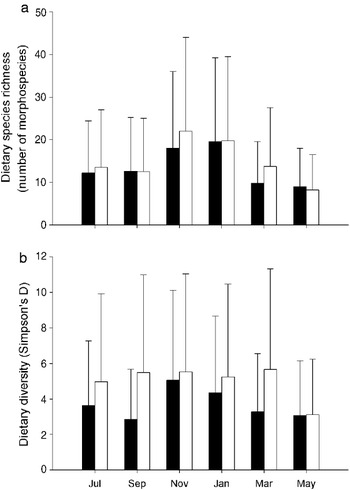
We sampled a total of 9538 leaf fragments belonging to 329 morphospecies in the annual diet of the studied Atta cephalotes colonies (n=9). The number of harvested morphospecies per colony and month ranged from 9 to 19.75 during one year with no significant habitat-related differences (F1,7=0.47, P=0.51; fig. 1a). On average, a colony foraged on ca. 14 host plant morphospecies per month. Dietary species richness varied markedly throughout the year (effect of sampling month; F5,35=8.47, P<0.001); for both edge and interior colonies, it clearly peaked in the dry season during November and January (fig. 1a).
Estimated monthly means (±SD) of the number of (a) morphospecies harvested, and the (b) inverse of Simpson´s index ‘D’, i.e. equally utilized species harvested of Atta cephalotes colonies at the edge (gray boxes; n=5) and interior (light boxes; n=4) of a remnant of the Atlantic forest in Northeast Brazil (▪, edge; □, interior).

In contrast to the absolute number of harvested species, dietary diversity of colonies (i.e. taking relative species abundance into account) was influenced by the forest habitat. Using the reciprocal of Simpson's index, harvest diversity of edge colonies was 3.7±0.84 (mean±SD) equally-used species per month, which was generally and significantly lower than in interior colonies (4.99±0.95) with no significant variation across months (habitat: F1,7=5.76, P=0.0474; sampling month: F5,35=1.29, P=0.291; fig. 1b). This means that, at the edge of the forest, ants focussed their harvesting on a smaller number of species compared to the forest interior, where diet breadth was wider. The interaction between habitat and time was nonsignificant for both dietary richness and diversity of harvested morphospecies.
The diet among A. cephalotes colonies was floristically more similar within edge (18.69±7.61) and interior (20.4±3.08) habitats than between habitats (14.75±5.13). These similarity patterns were corroborated by ANOSIM, which uncovered a strong habitat effect on the floristic similarity of dietary morphospecies among colonies (R=0.52, P=0.008). An additional ANOSIM evaluation of habitat effects with a subset of taxonomically identifiable food items (78 species from 41 families and 55 genera; see supplementary material) revealed similar findings (R=0.43, P=0.016) and confirmed that morphotyping seemed to adequately reflect the floristic differences among colony diets.
From those food species that could be assigned to a particular regeneration strategy (n=71), a significant majority were pioneers in both edge (74.6%; χ2=35.51, df=1, P<0.0001) and interior colonies (66.2%; χ2=14.9, df=1, P=0.0002) with no significant differences between habitats (χ2=1.22, df=1, P=0.3579). When considering the number of leaf fragments collected from these species, the predominance of pioneer species in the diet turned even higher in edge (86%; χ2=2630.02, df=1, P<0.0001) and interior (80.4%; χ2=872.08, df=1, P<0.0001). Such more quantity-based analysis also revealed significant differences in the proportion of fragments harvested from pioneer and shade-tolerant species between habitats (χ2=19.29, df=1, P<0.0001), where edge colonies collected proportionally more fragments from pioneer species (2177 versus 353) than colonies located in the forest interior (948 versus 231).
Discussion
Our study is the first to address edge effects on diet breadth of leaf-cutting ants. It clearly demonstrated that the diversity of food plants used by colonies living at the forest edge of a large remnant of the Atlantic forest is reduced as compared to colonies in forest interior habitats. Considering earlier findings on the foraging behaviour of LCA in edge-affected forests (e.g. smaller foraging areas: Urbas et al., Reference Urbas, Araújo, Leal and Wirth2007), we can reasonably conclude that the well-documented proliferation of pioneer tree species in edge habitats (e.g. Laurance et al., Reference Laurance, Lovejoy, Vasconcelos, Bruna, Didham, Stouffer, Gascon, Bierregaard, Laurance and Sampaio2002; Oliveira et al., Reference Oliveira, Grillo and Tabarelli2004) is the ultimate cause behind such marked narrowing in diet breadth. In consequence, these results complement previous evidence indicating the reduction of bottom-up forces as key factor explaining both edge-induced hyper-abundance (Wirth et al., Reference Wirth, Meyer, Almeida, Araújo, Barbosa and Leal2007; Meyer et al., Reference Meyer, Leal and Wirth2009) and increased (per colony) herbivory (Urbas et al., Reference Urbas, Araújo, Leal and Wirth2007; Wirth et al., Reference Wirth, Meyer, Leal and Tabarelli2008) of LCA in fragmented landscapes.
Our findings did not reveal habitat difference in the species richness of annual LCA diets, i.e. edge and interior colonies harvested similar numbers of food species throughout the year. However, when considering the relative contribution of each species in the measure of dietary diversity, the colonies differed in relation to their location in the forest. As colonies approach the edge, their dietary diversity decreased approximately by one fourth compared to the interior value. Moreover, around 40–50% of the variation in leaf diet was explained by habitat. As a causal mechanism, we suggest the palatable forage hypothesis (Farji-Brener, Reference Farji-Brener2001), which states that pioneer tree species show less physical and chemical anti-herbivore defence than shade-tolerant ones (Coley & Barone, Reference Coley and Barone1996) and are more palatable to LCA (Wirth et al., Reference Wirth, Beyschlag, Herz, Ryel and Hölldobler2003). For example, terpenoids are plant defensive compounds well known to repel ant workers and inhibit the growth of their fungal symbionts (Howard et al., Reference Howard, Cazin and Wiemer1988). At the study site, terpenoids have been shown to completely lack in dominant food plants of colonies in the forest edge zone, where they were less frequent compared to the forest interior site (Urbas, Reference Urbas2004).
The above mechanism is supported by the additional finding that edge colonies collected proportionally more leaf fragments from pioneer species than colonies located in the forest interior. Previous studies have already documented that leaf resources exploited by LCA depend on the abundance of preferred (or higher ranked) species and, as their abundance increases, dietary diversity decreases (Shepherd, Reference Shepherd1985; Rockwood & Hubbell, Reference Rockwood and Hubbell1987; Vasconcelos & Fowler, Reference Vasconcelos, Fowler, Vander Meer, Jaffe and Cedeno1990; Vasconcelos, Reference Vasconcelos1997). In fact, of 134 tree species identified at the study site, Oliveira et al. (Reference Oliveira, Grillo and Tabarelli2004) found twice as many pioneer species along the edge as compared to the forest interior (83 versus 37%), and pioneers represented over 90% of the stems of adult trees at the edge (versus 27% in the interior: Grillo et al., Reference Grillo, Oliveira, Tabarelli, Pôrto, Almeida-Cortez and Tabarelli2006).
Our results also point to the obvious lesson that species richness is an imperfect/misleading proxy for dietary responses to environmental changes in leaf-cutting ants and, probably, other generalist herbivores. LCA are notorious for their high degree of polyphagy; but, in effect, the bulk of harvested plant material is dominated by a few highly preferred resources (Rockwood, Reference Rockwood1973; Blanton & Ewel, Reference Blanton and Ewel1985). To give an example, in the annual harvest of Atta colombica in Panama, the seven top-ranked species were exploited just as much (51% of all foraging days) as all other 45 food species together (Wirth et al., Reference Wirth, Beyschlag, Herz, Ryel and Hölldobler2003). To date, these aspects of leaf-cutting ant foraging behaviour are best explained by suggestions of Shepherd (Reference Shepherd1985) and Pyke (Reference Pyke1984), who hypothesized that optimal foraging is achieved by constantly taking samples of all potential leaf sources, thus tracking variable distributions of substrate patches in time and space.
Hyper-abundance of LCA in small fragments (Rao, Reference Rao2000) or edge habitats (Wirth et al., Reference Wirth, Meyer, Almeida, Araújo, Barbosa and Leal2007; Meyer et al., Reference Meyer, Leal and Wirth2009) has been attributed to the release of resource limitation (i.e. top-down forces) (Rao, Reference Rao2000; Terborgh et al., Reference Terborgh, Lopez, Nunez, Rao, Shahabuddin, Orihuela, Riveros, Ascanio, Adler, Lambert and Balbas2001). Such effects have also been shown at the study site, where edge colonies experienced significantly fewer attacks by parasitic phorid flies than interior colonies (Almeida et al., Reference Almeida, Wirth and Leal2008). Recently, we proposed an additional mechanism to explain this increased LCA colony density in edge affected habitats via the attenuation of bottom-up forces (Urbas et al., Reference Urbas, Araújo, Leal and Wirth2007; Wirth et al., Reference Wirth, Meyer, Almeida, Araújo, Barbosa and Leal2007, Reference Wirth, Meyer, Leal and Tabarelli2008; Meyer et al., Reference Meyer, Leal and Wirth2009; Silva et al., Reference Silva, Bieber, Leal, Wirth and Tabarelli2009). Briefly, we argued that anthropogenically created forest edges lead to reduced foraging areas and increased herbivory rates per colony (Urbas et al., Reference Urbas, Araújo, Leal and Wirth2007), ultimately promoting an increase in LCA populations (Wirth et al., Reference Wirth, Meyer, Almeida, Araújo, Barbosa and Leal2007; Meyer et al., Reference Meyer, Leal and Wirth2009) via a pronounced proliferation of pioneer trees (Oliveira et al., Reference Oliveira, Grillo and Tabarelli2004; Santos et al., Reference Santos, Peres, Oliveira, Grillo, Alves-Costa and Tabarelli2008). As pioneer tree species show less anti-herbivore defence than shade-tolerant ones (Coley & Barone, Reference Coley and Barone1996), they are more palatable to LCA (Wirth et al., Reference Wirth, Beyschlag, Herz, Ryel and Hölldobler2003). The present findings can be fully integrated into this general concept of bottom-up induced hyper-abundance of LCA as edge proximity clearly reduced dietary diversity of the colonies, thus adding further support to this resource-driven perspective.
If the above interpretation of relaxed top-down and bottom-up control of LCA populations in edge habitats holds, we expect a synergism between anthropogenic edge creation and engineering impacts of LCA leading to detrimental consequences for human-modified Neotropical forests as outlined briefly in the following. Fragmentation and the consequent increase of edge habitats in tropical forests are widespread (Whitmore, Reference Whitmore, Laurance and Bierregaard1997; Broadbent et al., Reference Broadbent, Asner, Keller, Knapp, Oliveira and Silva2008) and support more LCA colonies (Rao, Reference Rao2000; Wirth et al., Reference Wirth, Meyer, Almeida, Araújo, Barbosa and Leal2007; Meyer et al., Reference Meyer, Leal and Wirth2009; Silva et al., Reference Silva, Bieber, Leal, Wirth and Tabarelli2009). This increase in colony density may alter both the floristic and functional signature of plant assemblages via two mechanisms: increased herbivory rates (Urbas et al., Reference Urbas, Araújo, Leal and Wirth2007) and the creation of canopy gaps above nest, which drastically change the light climate (Meyer, Reference Meyer2008; Corrêa et al., Reference Corrêa, Silva, Wirth, Tabarelli and Leal2010), reduce the density of shade-tolerant species around the nests (Corrêa et al., Reference Corrêa, Silva, Wirth, Tabarelli and Leal2010) and increase the performance of large-seeded seedlings (Meyer, Reference Meyer2008). Such changes on plant species regeneration across the borders of the Coimbra Forest are still apparent during the decade subsequent to nests abandonment (Bieber et al., in press). Thereby, LCA may amplify the impacts of forest fragmentation, which drive natural system towards early successional characteristics (Tabarelli et al., Reference Tabarelli, Lopes and Peres2008). To place the present study in this context, we conclude that edge creation implies the relaxation of LCA resource limitation and ultimately promotes high colony density, which, in turn, reinforces the deleterious effects of forest fragmentation.
Acknowledgements
The study was supported by the Brazilian-German collaboration project (PROBRAL CAPES/DAAD, project 257/07), ‘Conselho Nacional de Desenvolvimento Científico e Tecnológico’ (CNPq, processes 540322/01-6 and 243000/02), the ‘Deutsche Forschungsgemeinschaft’ (DFG, process WI 1959/1-2), and Schimper Foundation. Conservation International do Brasil (CI-Brasil), Centro de Pesquisas Ambientais do Nordeste (CEPAN) and Usina Serra Grande provided infrastructure and logistic support during the field work. We are grateful to M.V. Araújo Jr., P. Urbas and W.R. Almeida for help in the data collection. We thanks to CNPq by post-graduate support to P.F.Falcão and research grants to I.R.Leal and CAPES by post-graduate support to S.R.R.Pinto. Special acknowledgments to Alexandre Grillo (in memoriam), Marcondes Oliveira and Eleno José de Araújo (in memoriam) for plant identification and contribution during the whole study.