




No CrossRef data available.
State Death in the International System
Published online by Cambridge University Press: 19 May 2004
Abstract
Under what conditions do states die? Survival is often assumed to be the primary goal of states. Yet international relations scholars have not previously examined the rate or the causes of state death in a systematic way. I argue that buffer states—states caught between two rivals—are particularly vulnerable to being coerced out of existence. Each rival is afraid that its opponent will conquer the buffer that lies between them, gaining strength and strategic advantage. The rivals' inability to credibly commit to preserving the buffer state's sovereignty means that buffer states are extremely vulnerable to conquest. Using event history analysis, I test this argument while controlling for traditional realist variables such as power and alliances, as well as for changes in the post–World War II era. The analysis generates three major findings: buffer states are significantly more likely to die than are nonbuffer states; violent state death (conquest and occupation) virtually ceases after 1945; and the relationship between power and state survival is tenuous.For their valuable comments and suggestions, I thank James Fearon, Page Fortna, Erik Gartzke, Hein Goemans, Simon Jackman, Stephen Krasner, David Lewis, Scott Sagan, Erik Voeten, the editor of IO, two anonymous reviewers, as well as seminar participants at Stanford University, Harvard University, the University of Chicago, and the University of Virginia Law School. Earlier versions of this article were presented at the 2000 Annual Meetings of the International Studies Association and the American Political Science Association. Jessica Stanton provided valuable research assistance. I gratefully acknowledge the support of the Center for International Security and Cooperation and the John M. Olin Institute for Strategic Studies. Any errors are my own.
Information
- Type
- Research Article
- Information
- Copyright
- © 2004 The IO Foundation and Cambridge University Press
Under what conditions do states die? This question is central to the study and practice of international relations. State survival is frequently presumed to be a primary goal of states, policymakers, and citizens.1
For a discussion of the survival assumption in international relations, see Howes 2003.
For a recent exception, see Adams 2000.
This article constitutes a first attempt at examining state death by laying out the historical record of state death and by offering and testing an explanation for why some states die, but not others. I hypothesize that basic geopolitics are most determinative of prospects for survival. Specifically, I argue that buffer states—states caught between two rivals—are particularly vulnerable to conquest, annexation, and occupation.
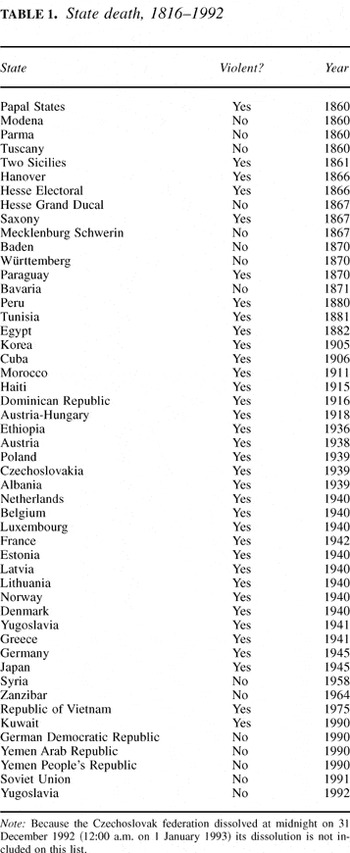
State death is defined here as the formal loss of foreign policymaking power to another state. Contrary to conventional wisdom, state death has occurred quite frequently over the past two centuries; fifty of 202 (about 25 percent) states have died, and most have died violently.3
See Table 1, below. I use the phrase “violent state death” to refer to cases in which one state uses military force to conquer or occupy another. Note that this definition does not include cases such as the dissolution of the Yugoslav Federation in 1992, as the change in the status of Yugoslavia was the result of a civil, not an international, war.
Likewise, state death plays a fundamental, although underappreciated, role in major international relations theories such as neorealism. Kenneth Waltz avoids a strict rationality assumption by making a state selection argument. “Since making foreign policy is such a complicated business, one cannot expect of political leaders the nicely calculated decisions that the word ‘rationality’ suggests. I accord [greater significance] to the process of selection that takes place in competitive systems…. Behaviors are selected for their consequences.”4
Waltz 1986, 330.
Waltz 1979, 95.
I make the somewhat counterintuitive argument that states that great powers have an interest in preserving—buffer states—are in fact in a high-risk group for death. Regional or great powers surrounding buffer states face a strategic imperative to take over buffer states: if these powers fail to act against the buffer, they fear that their opponent will take it over in their stead. By contrast, these concerns do not apply to nonbuffer states, where powers face no competition for influence or control.
The remainder of this article proceeds as follows. The next section more fully elaborates the argument discussed briefly above. Second, a brief analysis of an alternative argument—the neorealist claim that states that balance are more likely to survive than states that fail to balance—follows. Third, definitions of the variables and a brief description of the data used are presented. An event history model testing five hypotheses constitutes the fourth part of this article. The empirical section of this article continues with brief presentations of two cases of state death: the eighteenth-century partitions of Poland and the early-twentieth-century occupation of the Dominican Republic. The article concludes with a discussion of findings and their implications.
Stuck in the Middle: To Live and Die in a Buffer State
At least two approaches could be taken when studying state death. The first, and perhaps more natural, approach would be to examine characteristics of states that might enhance or diminish their prospects for survival. This kind of “inside-out” perspective suggests that the fates of individual states lie with their attributes and decisions. Logically, however, one problem with this approach is that it starts from the assumption that all states are in the same security environment. Rather than examining the features of states whose survival may or may not be at risk, a more promising approach suggests examining the incentive structures of states that seek to take over other states. This more “outside-in” perspective suggests that geopolitics can overwhelm the potential effects of state attributes or behaviors on survival. Specifically, I argue that regional or great powers engaged in rivalries with each other face strong strategic imperatives to take over the buffer states that lie between them. Buffer states are particularly likely to die.
Almost by definition, buffer states should enjoy a privileged position in terms of their prospects for survival. Neighboring powers have a stake in preserving buffer states that mitigate the effects of rivalry and, potentially, reduce or delay the effects of war.6
See Schroeder 1994; Chay and Ross 1986; Partem 1983; and Spykman 1938.
States between two rivals—“buffer states”—face a high risk of death.8
For a more extensive discussion of the definition of buffer states, see Partem 1983.
Note that Goertz and Diehl's definition of rivalry limits the problems of the potential stochastic properties of enduring rivalries exposed by Erik Gartzke and Michael Simon. See Diehl and Goertz 2000, 153, 155; and Gartzke and Simon 1999.
To illustrate the logic behind this claim, consider a situation where two states engaged in a rivalry surround a third, buffer, state. The nature of the relationship between the two rivals suggests that the probability that they may go to war is relatively high.10
If one assumes that the two rivals would prefer not to go to war, then it is in their interest to maintain the sovereignty of the buffer state—the buffer will be functional for them, serving as a sort of barrier to war. This outcome, however, is unlikely to occur if the two rivals do not trust each other. Even if each rival knows that its opponent would prefer to avoid war, neither can be certain that this preference will dominate the strategic imperatives facing the rivals. Geographically speaking, the buffer state is at the heart of a security dilemma between the two rivals. Gaining control of the buffer state would translate into a significant strategic advantage, one that cannot be passed up on the chance that one or both rivals will exercise restraint with respect to the buffer. Both rivals know that they would be better off if they could exercise mutual restraint with respect to the buffer area. But they both also want to avoid the worst-case outcome of being “suckered;” neither rival wants to exercise restraint while its opponent takes over the buffer area.11Jervis 1978 provides the general intuition governing the dynamics of security dilemmas, and even refers to a particular security dilemma over a buffer zone. Spykman and Rollins 1939 provide an earlier version of this logic with particular reference to buffer states.
But why is it that buffer states are more likely to die than nonbuffer states? Consider the implications of different geographies for buffer states versus states that have only one great or regional power as a neighbor. The power neighboring the nonbuffer state does not face a strategic imperative to take over the state, because there exists no rival on the other side of the nonbuffer state that might take it over if the powerful state failed to do so. Similarly, consider a situation where potential rival states surround a third (potential buffer) state. If relations between the would-be rivals are friendly rather than acrimonious, then—all else equal—neither potential rival has incentives to take over the state that lies between them. Thus, buffer states are more likely to die than nonbuffer states because surrounding powers do not fear that nonbuffers will be taken over at their expense.
H1: Buffer states will be more likely to die than nonbuffer states.
One might argue that, because of their relative importance to surrounding powers, buffer states' status should decrease their vulnerability. As explained above (and shown below), however, the simple fact of a buffer state is insufficient to protect against predation absent a credible enforcement mechanism governing relations between the two rivals. An alternative institutional arrangement to protect buffer states could be the formation of an alliance with one of the rivals. If one rival started to make threatening moves toward the buffer, why would the other rival not step in to protect the buffer state? Once the threat of war is sufficiently high to mean that one of the rivals is seeking the strategic advantage offered by the buffer state, the opposing rival has few incentives to protect the buffer. Indeed, the opposing rival will want the strategic advantage offered by the buffer for itself at that point. Forming an alliance with the buffer state would not give either rival the level of control necessary to protect itself against its opponent. Thus, again, the buffer state's geography will determine its fate.
An Alternative Explanation: Balancing
Waltz argues that states that fail to behave according to neorealist prescripts will be selected out of the system.12
For discussions of the difficulty of applying selection arguments to international relations, see Kahler 1999 and McKeown 1986.
Waltz 1979, 91.
Typically, internal balancing is equated with relative power. It is clear that on issues ranging from the construction and influence of international institutions to evaluations of the shape of various trade policies, realists consider power a central explanatory variable for international relations outcomes.14
See Mearsheimer 1994; Krasner 1991; and Mearsheimer 2001.
See Bean 1973; and Tilly 1990.
Waltz 1979, 194.
Thus, it seems straightforward to present the following as one neorealist hypothesis:
H2: Weaker states will be more likely to die than more powerful states.
Neorealists also predict a central role for external balancing. The formation of alliances is considered to be in states' interests whenever they perceive a major threat,17
and critical to success in deterrence and war whenever internal resources are insufficient to the task. Allying with other states when alliances are required for successful balancing is a fundamental principle of neorealism. Certainly, if a state faces threats to its survival, neorealists would expect that it would find and form an alliance to counter those threats and, further, that states that failed to form alliances in similar situations would face a much higher risk of extinction. Thus, an initial hypothesis regarding the effects of alliance on state death would be:H3a: Unallied states are more likely to die than allied states.
A straightforward neorealist hypothesis, then, might be that allied states are more likely to survive than unallied states. This claim, however, ignores a potential selection effect. Not all states will form alliances. Indeed, states will be most likely to attempt to form alliances when they face threats to their survival. Thus, one might expect that allied states will be less likely to survive than unallied states because allied states face a higher ex ante probability of death. This logic suggests an alternative specification of the relationship between alliances and state death:
H3b: Allied states are more likely to die than unallied states.
To complicate matters further, consider the decision faced by states courted as allies. As stated above, states that already face threats should be those most likely to seek allies. Would-be alliance partners may then be unlikely to form alliances with these threatened states, particularly if they do not face similar threats themselves, as the benefits of alliance would accrue mainly to the threatened state while the costs would be distributed between both states. Thus, one potential selection effect is layered upon another. While one set of states may not seek alliances because they do not face threats, another set of states may be unsuccessful in their search for allies because the threats they face are too great to make an agreement profitable for potential alliance partners. It is difficult, therefore, to predict the effect of alliances on state survival. In fact, it would not be surprising if being in an alliance has no effect on state survival.
H3c: The effect of alliances on state survival will be indeterminate.
Nonetheless, among threatened states, one might expect that those more successful at balancing should enjoy greater survival prospects. In the previous section, I identified buffer states as particularly threatened. A more nuanced version of the neorealist selection argument generates the following hypotheses:
H4: Weaker buffer states will be more likely to die than relatively powerful buffer states.
H5: Unallied buffer states will be more likely to die than allied buffer states.
Note that while neorealism is often taken to be a theory of great power behavior, in explicating his selection argument, Waltz specifically makes the point that, despite many differences, weak and powerful states are functionally similar. Following this point, he argues that “international politics consists of like units duplicating one another's activities.”18
Waltz 1979, 94–96.
Definition of Variables and Data
Given the lack of previous scholarship on state death, key terms require definitions. While some traditional international relations variables, such as alliances and capability, are used in this analysis, others, such as state death, require definition or operationalization.
State
States, here, are characterized by their membership in the international system. They are territorially bounded political units with central governments that hold a monopoly on the use of legitimate force. States are also recognized by their cohort; state legitimacy is drawn from external as well as internal actors. Membership in the interstate system can be considered along a number of dimensions. Two that seem sensible are sufficient size to affect the system, even if only in a small way, and external recognition of membership. Using these general principles, the Correlates of War (COW) establishes the following criteria for membership in the interstate system:
From 1816 to 1919:
- Reception of permanent diplomatic missions at the rank of chargé d'affaires or above from Britain and France, and;
- A population of 500,000 or more.
From 1920 to the present:
- Reception of permanent diplomatic missions at the rank of chargé d'affaires or above from any two major powers, and a population of 500,000 or more, or;
- Membership in the League of Nations or the United Nations.20
Small and Singer 1982, 41–43.
The missions and organizational membership criteria are meant to determine whether a state is recognized by others, while the population criterion is meant to provide a size threshold.
Although the COW list of members of the interstate system has been severely criticized on a number of dimensions,21
See, for example, Bennett and Zitomersky 1982; Gleditsch and Ward 1999; and Bremer and Ghosn 2003.
State Death
Although scholars such as Waltz and Alexander Wendt have often used the terms “state death” and “state selection,” they have never defined them clearly.22
See Waltz 1979; and Wendt 1999.
One could also conceive of state death in terms of a regime change (as in Cuba in 1959) or state collapse (as in Somalia in 1992). In these cases, though, the state is still present in the international system but has undergone serious internal changes. While students of comparative politics frequently label these cases of state death, because I am interested in the international pressures that may lead to state death, I exclude these categories from my definition of state death. This exclusion hinges on the notion that foreign policy capabilities must be lost to another state for a state death to have occurred. Using Stephen Krasner's typology, regime change or state collapse may well compromise interdependence, domestic, or Westphalian sovereignty. They do not, however, necessarily compromise international legal sovereignty.23
“International legal sovereignty refers to the practices associated with mutual recognition, usually between territorial entities that have formal juridical independence. Westphalian sovereignty refers to political organizations based on the exclusion of external actors from authority structures within a given territory. Domestic sovereignty refers to the formal organization of political authority within the state and the ability of public authorities to exercise effective control within the borders of their own polity. Finally, interdependence sovereignty refers to the ability of public authorities to regulate the flow of information, ideas, goods, people, pollutants, or capital across the borders of their state.” Krasner 1999, 3–4.
Another issue that must be considered is how one should treat cases of states that die and then reenter the system. In many if not most such cases, resurrection is by no means certain at the time of state death. The benefit of hindsight informs one that many state deaths were later reversed. Without the benefit of foresight, however, one cannot know that states such as Hanover, Austria-Hungary, and Zanzibar might not also return to the international system.24
Indeed, at the end of World War II, one of the proposed solutions to the “German Question” was to resurrect the small German states, such as Hanover. Further, Zanzibar has recently considered secession from Tanzania. New York Times, 28 October 2000, A7.
State death can occur in a number of ways. First, states may die through conquest. They may be colonized, as were the Indian princely states; or they may be taken over, and sometimes parceled out, as was Poland in World War II. Prolonged military occupation is another form of state death. States can die through federation or confederation (or reunification) with other states, as did East Germany in 1990 and Zanzibar in 1964. Finally, state death may occur through dissolution. Cases in point are Czechoslovakia in 1992–93 and Germany in 1945. Note that while cases of conquest and occupation are always violent, unification and dissolution can also occur violently, as in the Two Sicilies' annexation to Sardinia/Piedmont in 1861.
Fifty of 202 states have died since 1816. They are listed in Table 1. With three exceptions, this list of state deaths is consistent with the COW list of changes in membership in the interstate system.25
Using the above criteria, I added three state deaths to the COW list: Kuwait, USSR, and Yugoslavia. The Soviet and Yugoslav cases are considered nonviolent state deaths because in neither case was the original state conquered or occupied by an external actor. The Kuwaiti case is coded as a violent state death; although the Iraqi occupation of Kuwait was short-lived, Iraq clearly intended a permanent annexation of Kuwait.
State death, 1816–1992

Of the fifty states that have died, thirty-five—the clear majority—have died violently. In part because violent state deaths constitute the bulk of state deaths, and in part because some of the hypotheses presented above should work best in cases of violent state death, I distinguish analyses on those states that were “killed” from those on all state deaths. One could argue that the causes of violent and nonviolent state death might be different. A number of states, however, “commit suicide” rather than fighting their would-be conquerors. For example, Bavaria and Württemberg joined the Prussian federation in 1870 having seen what happened to states (such as Hanover and Saxony) that resisted Prussian expansion. Limiting the initial analysis to violent state death allows a “cleaner” test of both the buffer state and balancing hypotheses; extending the analysis to all state deaths provides a further test of these claims.
Buffer States
I define a buffer state as a state geographically located between two other states engaged in a rivalry, unless the rivals are separated by an ocean. This definition is generally considered a minimum criterion for buffer state status.26
Partem 1983, 4.
Buffer areas, or systems, constituted by more than one state, often exist between rivals. For example, a number of small states separated France and Prussia, two long-term rivals well before German unification. More than ten states were physically located between France and Prussia during the course of the rivalry; some bordered France, some Prussia, and others were in between their fellow small states. Yet, none of these states bordered both France and Prussia. Because all these states lay between the two rivals, all were vulnerable to victimization as a result of the dynamics of rivalry (note that the same is not true for states on the other sides of the rivals, as explained above). For this reason, I require only that a state lie in between two rivals, not that it border one or both of them, to be considered a buffer state.
Three additional issues must be addressed in defining buffer states. Under certain conditions, one might consider some states buffers even if they do not meet the strict geographical criterion of lying between two rivals. For example, strong arguments can be made for considering states geographically located between two imperial powers as buffers. Indeed, the term “buffer state” was first used to describe Afghanistan, caught between the British and Russian empires, in 1883.27
About a century earlier, Britain viewed Afghanistan as a buffer between the French and British empires. See Ross 1986, 16; and Jenkins 1986, 174.
Note that, for the same reasons, Tibet is not included in the data analysis below.
It is also important to note that rival states are sometimes separated by large bodies of water, such as oceans. Given the challenges of projecting power over water,29
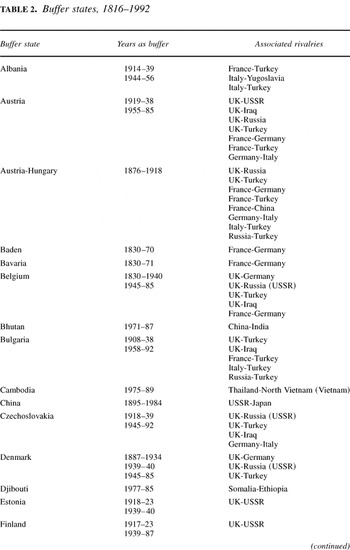
it would be difficult to classify the states lying between two such rivals as buffer states. In the U.S.-Soviet rivalry, for instance, the two rivals were separated by large bodies of water. In this case, though, it is not clear that oceans truly obstructed their reach; the extensive reach of both states makes identifying buffers attendant to the rivalry difficult. One some level, one could argue that all states (except the United States and the USSR) were buffer states during the Cold War. Note that the difficulty of distinguishing buffer states attached to the U.S.-Soviet rivalry does not mean that buffer states cease to be meaningful after the onset of the Cold War; a number of other rivalries and buffer states continue or develop during this time.Third, one could argue that coding buffer states from preexisting enduring rivalries biases the data in favor of the buffer state argument made here. Alternative codings of buffer states, however, would yield largely overlapping results. For example, a list of all states that lay between major powers not separated by oceans would essentially be a subset of the list of buffers presented in Table 2.30
This list would be a subset of the list in Table 2 because nonmajor powers also can be involved in rivalries, thus expanding the potential list of buffer states.
Buffer states, 1816–1992

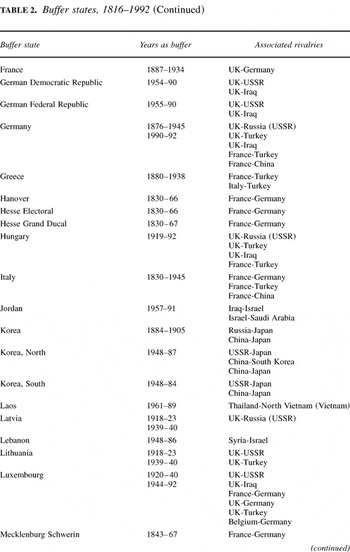
Buffer states, 1816–1992 (Continued)

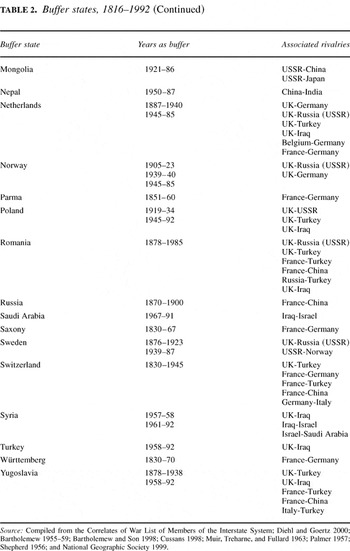
Buffer states, 1816–1992 (Continued)

Given both the number of exceptions one could make to the original definition of buffer state, and the difficulty these would cause in terms of coding, I maintain a fairly strict definition of buffer states. A buffer state is a state physically located between two rivals, unless an ocean separates the rivals. The exception regarding oceans only affects the coding for the U.S.-Soviet and U.S.-Chinese rivalries.31
The other sets of rivals separated by bodies of water are United Kingdom-Germany, China-Japan, and Japan-Russia. In none of these cases are the rivals separated by an ocean.
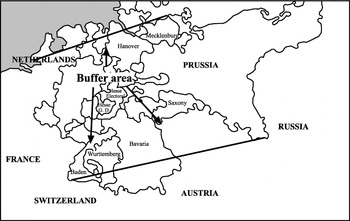
Using this definition, one can systematically construct a list of buffer states. In order to do so, it is first necessary to have a list of rivals. Fortunately, a large body of literature already exists on the causes, consequences, and nature of enduring rivalries. Using Diehl and Goertz's list of enduring rivalries, contemporary and historical maps, and the COW List of Members of the Interstate System, I identified those states geographically located between two rivals for the duration of the rivalry. For example, in identifying buffer states in the Franco-Prussian rivalry, I drew lines from Mulhouse in France to Southern Silesia in Prussia, and from Calais in France to Stralsund in Prussia (see Figure 1). These lines defined the boundaries of the buffer area. Any state within the buffer area was considered to be a buffer state unless an ocean divided the rivals.

Coding Buffer States
Capabilities and Alliances
Both capabilities and alliances have been calculated using standard measures from the COW project. The alliance variable is a dichotomous indicator noting whether a state was part of an alliance in a given year. The capability variable, which is based on data from the National Material Capabilities Data Set,32
has six components: military expenditure, military personnel, iron and steel production, energy consumption, urban population, and total population. The measure itself is calculated by determining what proportion of global resources a state holds, in a given year, on each dimension. The proportions are then averaged to obtain the state's capability score for that year.33This method is described in Singer, Bremer, and Stuckey 1972. I obtained data on capability scores and alliance patterns from D. Scott Bennett and Allan Stam's Expected Utility Generator. Bennett and Stam 2000.
Following Bremer, the problem of missing observations on a particular component of capability is solved by (1) averaging on all available proportions (that is, if only five of six measures are available, dividing by five instead of six), and (2) dropping all observations where no data are available.34
I use the log of capability in the analysis because of the skewed distribution of the capability variable.Results
In the event history analysis that follows, my dependent variable is the hazard rate for states. Another way of framing this variable is as the probability that a state will die in a given year conditional on it not having died already.35
Beck, Katz, and Tucker 1998 have proposed an alternative method to analyze time-series cross-sectional data with time-varying covariates that is closer to the better-known logit model. King and Zeng 2001 have proposed an additional alternative, relogit, for rare-events time-series data analysis. While state death is a relatively rare event, it is not so rare as to justify use of relogit, particularly because relogit would not allow the inclusion of additional independent variables without using options like “cluster” that would constitute rather blunt instruments for aggregating the data.
Duration analysis allows the modeler to use the state as the unit of analysis but also include time-varying covariates.36
Importantly, duration analysis also does not impose a normality assumption on the distribution of errors, but instead offers the modeler the choice of several distributions or, in the case of Cox proportional hazard models, does not require the modeler to make any assumptions about the distribution of errors.
Box-Steffensmeier and Jones 1997 provide an excellent presentation of the applications of duration analysis to political science; Yamaguchi 1991 also provides a useful discussion of duration analysis.
Expectations
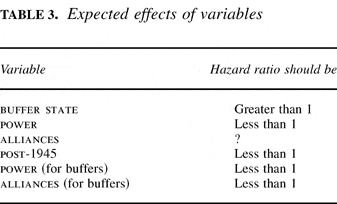
My prediction is that buffer states are more likely to experience state death than other states. In the vocabulary of duration analysis, one would say that buffer state status will increase the hazard ratio for states. In other words, buffer states will be in a higher “risk group” for state death. Because hazard ratios are interpreted in relation to the baseline of 1, this hypothesis predicts that the hazard ratio for buffer states will be greater than 1. Conversely, if a variable has a hazard ratio less than 1, then an increase in that variable decreases the risk of failure (state death). H2 suggests that power will have a negative effect on the probability of state death. The hazard ratios on power should, therefore, be less than one. Similarly, H4 and H5 constitute a version of a neorealist model of state death, and suggest that power and alliances should have negative effects on state death for buffer states. Together, the three versions of H3 suggest that the effect of alliances on state death may be indeterminate.
An indicator variable for the post-1945 period is also included in the analysis. A multitude of international phenomena in the post–World War II period—from bipolarity to the advent of nuclear weapons to the strengthening of norms protecting states' territorial sovereignty—suggest that this variable should have a hazard ratio less than one; survival past 1945 is expected to have an inverse effect on the probability of state death in general, and on violent state death in particular. The predicted effects of variables included in the analysis are summarized in Table 3.
Expected effects of variables

Empirics
I use a Cox model to analyze the duration of states. The advantage of using a Cox model is that it makes no assumptions about the shape of the hazard curve. The Weibull distribution shape parameter, p, is greater than 1, which suggests that a Weibull is preferred over an exponential model.38
Note that the fact that p > 1 suggests that the hazard for states increases with time. This finding challenges David Strang's claim (based on Arthur Stinchcombe's “liability of newness” thesis) that younger states are more likely to die than older states. See Strang 1991; and Stinchcombe 1965.
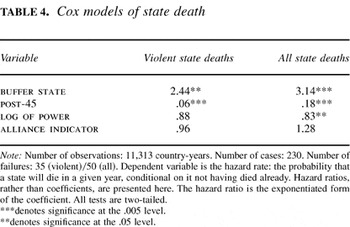
Table 4 shows results for tests of H1 to H3 and includes a control variable for the post-1945 period.39
Note that the number of cases listed in Table 4 is larger than the actual number of states, which is 202. Many states that exit the interstate system reenter the system later. These second incarnations of states are treated as new states for the purposes of simplifying the data analysis.
The hazard ratio is the exponentiated form of the coefficient.
Cox models of state death

The hazard ratios should be interpreted as follows. In the first column of results, the hazard ratio for the post-1945 period is .06. This result means that a state in the post-1945 period is 94 percent more likely to survive than a state in the pre-1945 period, given that the state has not already died. In the same model, the hazard ratios for the log of power and the alliance indicator suggest that power and alliances are unrelated to state survival; one cannot be certain that the coefficients on the log of power or the alliance indicator are not zero (p < 0.259 and p < .910, respectively). The probability that a buffer state will die violently (given that it has not died already) in a particular year is 144 percent higher than for nonbuffer states. Clearly, the effect of the buffer state variable is an extremely large one, as is the effect of being in the post-1945 period.
The results are extremely consistent across different characterizations of the dependent variable. Defining the dependent variable in terms of all state deaths (versus only violent state deaths) lends further support to the claim that buffer states are particularly likely to die. As above, one reason to distinguish violent state deaths from all state deaths is that the neorealist balancing argument should work best with respect to cases of violent state death. The logic of the buffer state argument, on the other hand, can apply to both violent and nonviolent state deaths. Upon realizing the imminence of their demise, (leaders of) buffer states may negotiate away their sovereignty for benefits in their new incarnation, thus avoiding the costs of war for all concerned.
Another important difference among the models is the changing significance of the power variable. Once the data are analyzed on all state deaths, the coefficient on power becomes statistically significant. Although the sign of the coefficient is consistent with the predictions of the neorealist selection argument, the substantive effect is a relatively small one. Further, the fact that power has an effect for all state deaths, but not for violent state deaths, is a puzzling one for the neorealist selection argument.
The differential performance of the two neorealist variables is surprising. Why would power affect the probability of state death more clearly than alliances? One potential answer to this question rests with the possibility of a selection effect in alliance formation, as mentioned above. If only threatened states are likely to try form alliances but are also less likely to be successful in forming alliances, then including alliances might not appear to be significant. A first step in assessing this possibility is to examine the relationship between a group of states that one knows is threatened—buffer states—and alliance formation. The correlation between buffers and alliance formation, however, is very low (.07). It is not clear that threatened states form alliances, or that, among threatened states, those that do form alliances are most likely to survive.
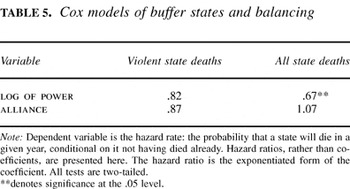
I attempt to test the neorealist selection argument on a restricted set of cases—buffer states from 1816–1945—below. I exclude cases after 1945 because violent state death in particular virtually ceases after 1945 (see Tables 1 and 4, above).
These results are fairly consistent with the analysis on the entire data set (above). Alliances remain statistically insignificant in both models, while the effect of power is statistically significant when broadening the cases to include all state deaths, a finding that remains somewhat puzzling for the balancing argument. These results constitute only a preliminary test of the neorealist selection hypothesis. At the same time, however, the test represented in the first column of Table 5 can be considered an easy one in that the neorealist argument should bear the greatest influence in cases of one state taking over another forcibly; this argument may be less applicable to cases of state “suicide” by voluntary annexation or dissolution. Given that the neorealist selection argument should best apply in cases of violent state death, these results can hardly be taken as strong support for the balancing hypotheses elaborated above.
Cox models of buffer states and balancing

Tests for Robustness
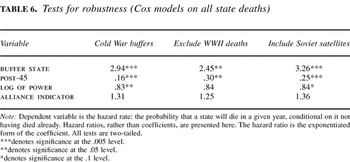
These results may be sensitive to a number of changes. First, buffer states may be undercounted, particularly during the Cold War. As stated above, the buffer state variable was constructed by identifying those states geographically between two rivals. In my coding of buffer states, I did not count any buffers for rivalries where the rivals are separated by an ocean. Thus, the U.S.-Soviet rivalry does not produce buffer states. The difficulty in coding buffer states for the Cold War is, of course, that the entire world could be considered a buffer state for this period. I addressed this problem in part by conducting an additional analysis where all European states were coded as buffers for the Cold War period; the results of the analysis show that all variables retained their relative statistical and substantive significance.
Alterations to the list of state deaths in the international system also could affect the results presented here. It is important to note, for example, that a large proportion of state deaths occur during the course of World War II. To what degree are the results sensitive to changes in codings of state deaths around this event? An additional data analysis that excludes the World War II–associated state deaths yields stable results.
Just as one could argue that the list presented here overcounts state deaths by including occupations during World War II, arguments also could be made that state deaths are undercounted because Cold War Eastern European states are not included. An analysis that includes Soviet satellite states for the Cold War period, however, also yields stable results. The quantitative results presented above are therefore robust against a number of changes in, and potential objections to, coding decisions justified in the definitional portion of this article.
Another potential challenge to these results is that the findings may rest on the particular list of rivalries used to generate the list of buffer states. To evaluate whether the findings reported above are particular to Diehl and Goertz's list of rivalries, I constructed a second list of buffer states based on an alternative list of rivalries. D. Scott Bennett defines a rivalry as “a dyad in which two states disagree over the resolution of some issue(s) between them for an extended period of time, leading them to commit substantial resources (military, economic, or diplomatic) toward opposing each other, and in which relatively frequent diplomatic or military challenges to the disputed status quo are made by one or both of the states.”41
Bennett 1996, 160.
The tests for robustness yield remarkably stable results (see Table 6). The coefficients on buffer state status are always positive and significant; by contrast, the coefficient on power is statistically significant in some models, while the alliance indicator remains insignificant. Survival to the post-1945 period also continues to exert a strong negative effect on the probability of state death.
Tests for robustness (Cox models on all state deaths)

Cases
The data analysis above shows strong results for the hypothesis that buffer states are particularly likely to die, particularly before 1945. Below, I briefly present two case studies of state deaths to illustrate more clearly the logic of my argument. Because the nature and incidence of state death changes dramatically after 1945, and because this article does not focus on the causes of those changes, I limit case selection to the pre-1945 period.
Below, I consider the deaths of one state that does and one state that does not meet the formal criteria for buffer state status. The partitions of Poland present a classic case of buffer state dismemberment and will constitute my first case. Tables 1 and 2 are helpful in the selection of a second case of state death where the state was not a buffer. Nine of these states were not buffers for either the Diehl and Goertz or Bennett list of rivals.42
Paraguay, Peru, Tunisia, Egypt, Cuba, Morocco, Haiti, Dominican Republic, and Ethiopia. Because Poland, France, Yugoslavia, and Greece were coded as buffers within ten years of their deaths, and because the Two Sicilies was very nearly a buffer state in the Austro-Hungarian rivalry, they were excluded from this list.
In fact, Dominican history provides multiple cases of (near) state death: the reannexation of the Republic by Spain in 1861; the near-annexation by the United States in 1870; the U.S. occupation of 1916; and the U.S. intervention of 1965.
The Partitions of Poland
The rivalries surrounding eighteenth-century Poland are easy to identify. As early as 1764, when the issue of succession to the Polish throne arose, nearby great powers were jockeying for influence over the Polish buffer. It did not take long for Empress Catherine of Russia to decide on her former lover, Stanislas Augustus Poniatowski, as the next king of Poland. The Russian choice was to be backed by approximately 70,000 troops. These tactics, as well as the choice, were initially objected to by Austria and the Ottomans in particular. When Polish constitutionalists appealed to the Turks for aid against growing Russian influence, the Turks declared war on Russia.
The Russo-Turkish war also provided excuses for other states to intervene in Poland. The first to do so was Austria; with what appeared to be genuine concern to prevent war from spilling over its border, Austria cordoned off its border with Poland in such a way as to include the town of Zips (also known as Spisz), which was part of Polish lands, in 1768. While the Prussians had actively been considering a Polish partition for some time, King Frederick of Prussia stepped very carefully. In a letter to the Prussian ambassador to Russia, Baron Solms, on 2 February 1769, he wrote:
Count Lynar has a rather curious idea concerning Russia that might appeal to the interests of the princes and that might improve the present conditions in Europe. He suggests that Russia offer to the court of Vienna for its assistance against the Turks the town of Lwow, with its environs, and Spisz; that Polish Prussia with Warmia and the right of protection over Gdansk be given to us; and that Russia, to indemnify herself for the expenses of the war, take whatever part of Poland would be convenient; and then Austria and Prussia, neither being envious of the other would in emulation of each other, aid Russia against the Turks…. The plan has some luster; it appears seductive.44
Kaplan 1962, 112. Count Panin was Catherine the Great's chief advisor on Poland.
Several months later, on June 14, Frederick sent a draft of a secret treaty to Moscow outlining his plans for partition.
Given that Austrian actions had precipitated Russian and Prussian plans for partition, it was surprising that the Empress Maria Theresa balked at the notion of dismembering Poland. She objected to the plan on moral grounds and reassured King Stanislas's brother that she meant to guarantee Polish territory as well as see Poland extricated from Russian domination. Soon after making these promises, however, on the advice of their advisor Prince Kaunitz, both Maria Theresa and Emperor Joseph accepted that, if Russia and Prussia were to carve up slices of Poland, Austria must have her share as well. Having agreed to the idea of partition, Austria insisted on an exactly equal slice of the pie. Indeed, the Austrian claims were so extensive as to alarm first Prussia and then Russia. In response to Prussian and Russian objections, Prince Kaunitz argued that the particular territory at issue was the only truly valuable portion of Austrian spoils from the partition. Even with this territory, Polish Austria would be a “narrow … and exposed strip of land;” if this territory were not granted to Austria, Kaunitz contended, the balance of power in the region would be upset.45
Ibid., 170–71.
Eversley 1915, 54–55.
The first Polish partition was characterized by great power concerns about rivals' gains. Seeing the opportunity for territorial gain, first Austria, and then Prussia, and finally Russia moved to permanently occupy various parts of Poland. They were attentive to distributing the spoils equally, so as to preserve the balance of power. But they also left a wounded Poland in their midst, to serve as a buffer between the three rivals.
In 1782, ten years after the first partition, war pitted Russia against Sweden, Prussia, England, and the Netherlands. During the war, the Poles set about making drastic constitutional reforms that would, they hoped, strengthen their state against further predation. Although distracted by the war, Catherine was outraged by the new constitution. She instructed plans for an invasion of Poland to be drawn up against the end of the war. But even when peace was achieved, Catherine still faced potential opposition from Austria and Prussia.47
Zamoyski 1992, 354.
In addition to these attempts at internal balancing, Poland also went in search of allies. Again highlighting the straitjacket of geography, the would-be allies that Poland approached were precisely the states that had participated in the first partition. Russia rejected an alliance with Poland. Prussia offered an alliance, which was accepted, but then quickly betrayed the Poles. Even when it seemed that allies—such as Prussia—had strong incentives to balance against Russia by preserving the Polish state, Poland was quickly betrayed when rivals began land grabs.
Catherine's plan was to divert Austrian and Prussian attention by embroiling them in war with revolutionary France. Leopold II, Austria's emperor, obeyed; King Frederick was more recalcitrant, until he consented to Catherine's suggestion that Prussia and Russia engage in a new partition of Poland. Both parties understood that Prussia's share of the spoils was contingent on her involvement with the war against France.48
Lukowski 1999, 147.
As in the case of the first partition, Austria objected to the inequality of the settlement. Prince Kaunitz's replacement, Baron Thugut, instructed Austria's ambassador to Russia to broach the topic with Catherine. The ambassador stated, “with regret, that the Emperor will decide to seek in Poland, after the example of these two Courts, an acquisition which, by right and justice, is due to him, but this must be inevitable in default of some other scheme of indemnity.”49
Ibid.
Quoted in Eversley 1915, 133.
Quoted in Ibid., 134–35.
Following the second partition, Poland's neighbors—and in particular Austria—were concerned for the survival of the Polish state only insofar as it affected their own. In a letter to the Austrian ambassador to Russia, Baron Cobenzl, Francis's advisor Thugut wrote:
The Emperor desires no change, and no acquisition in Poland, but only the right of garrison in certain border fortresses. But all this would be changed by a fresh aggrandizement by Prussia. Russia will know how to prevent this, and we beg to be informed of what she intends to do in opposition to Prussian rapacity…. Above all, we must be fully assured that Russia will not share her favour between us and Prussia. If Russia were to allow Prussian troops in Poland, we too should have to march in to secure our portion in the last partition.52
Quoted in Ibid., 191.
Catherine approached Francis to conclude a secret treaty of partition in 1793 that would exclude Prussia, thereby reducing its share in the next partition.
Poland was to be partitioned in its entirety. In the eighteenth-century Polish partitions, the net benefit of conquest had more to do with strategic concerns over rivals' gains than with the value of Polish territory per se. Although some territories were intrinsically valuable (the salt mines at Lwow were an important source of income, and Danzig was a critical port for Prussia), most of the wrangling over territory reflected Russia's, Prussia's, and Austria's desire to avoid a situation in which a rival's power was augmented at their expense. These three states—and Prussia and Austria in particular—were engaged in a true security dilemma. Had Poland abutted only one of these states, it is not clear that her demise would have been as certain or as complete.
At what point did concerns over rivals' gains outweigh the desire for a buffer state? To the end of Poland's life as a state, schemes for maintaining a shrinking Polish buffer were presented in the highest circles of Russian, Austrian, and Prussian government. The Poles themselves were convinced that their value as a buffer state provided an assurance of survival.53
Lukowski 1999, 49.
Lord 1925, 481.
Schroeder 1994 makes a similar argument. “Poland's weakness, combined with Russia's growing power and invulnerability and the rivalry between Prussia and Austria, which made both of them seek an alliance with Russia, laid the groundwork for the first partition of Poland. They did not, however, make it inevitable or even probable. Catherine and her advisers would have preferred to maintain Poland outwardly intact under Russian domination…. Partition instead came about mainly as a by-product of events, a means to other ends.”
At the same time that surrounding rivals were planning the demise of the Polish state, there was little Poland could do to save itself. Attempts at internal balancing were met with opposition and even an increased determination to crush the Poles. Attempts at external balancing were followed by rejection or, possibly worse, betrayal. Caught in the middle of three powerful, rival states, there was little—perhaps nothing—Poland could do to increase its chances for survival.
What did—and did not—drive the underlying dynamic of partition is clear. Poland's conquerors were determined to win—or at least stand their ground—in the game of great power politics. One of the cardinal rules of this game was that a rival's gains must be matched.56
Schroeder 1994, 6–7.
The Dominican Occupation
Like many of its Caribbean neighbors, the Dominican Republic suffered from poor geography and poor governance following its independence from Haiti in 1844. By the time Theodore Roosevelt gained the U.S. presidency in 1901, the situation had become acute. The Monroe Doctrine alone was no longer sufficient to preserve the U.S. sphere of influence; European creditors were insistently knocking at the doors of Caribbean debtors. To forestall European intervention in the region in general and in the Dominican Republic in particular, Roosevelt enunciated the Roosevelt Corollary to the Monroe Doctrine in 1904, committing that the United States would police the region and ensure that Caribbean states met their obligations. He outlined the logic of his position with specific reference to conditions in the Dominican Republic:
[U]nder the Monroe Doctrine [the United States] cannot see any European Power seize and permanently occupy the territory of one of these Republics; and yet such seizure of territory, disguised or undisguised, may eventually afford the only way in which the Power in question can collect any debts, unless there is interference on the part of the United States…. The conditions in the Dominican Republic not only constitute a menace to our relations with other foreign nations, but they also concern the prosperity of the people of the Island, as well as the security of American interests.57
Quoted in Welles 1928, Vol. 2, 621–23.
In stating this new policy, Roosevelt authorized the creation of a U.S. customs receivership in the Dominican Republic to manage that country's finances. While the receivership was a clear infringement of Dominican sovereignty, it did not constitute a state death per se, because the United States did not formally control Dominican foreign policy. Both the receivership and the fear of European influence that led to this policy, however, presaged more drastic violations of Dominican sovereignty.
In 1916, the United States formally stripped the Dominican Republic of its foreign policymaking powers by implementing a large-scale—and long-term—military occupation. The 1916 intervention raises a number of questions. The first, of course, is: Why did the intervention occur? The ostensible reason for intervention was to restabilize the Dominican government, but was the given reason the true one, or were other factors at work? Below, I argue that strong fears of a German threat led to the U.S. intervention in 1916.
By the early twentieth century, German actions from Venezuela to Mexico challenged U.S. hegemony in the region. In fact, Germany was alone among the European powers in refusing to accept the basic principles behind the Monroe Doctrine. At the time, Germany was seen as a major threat to U.S. interests in the Caribbean. This perception created a rivalry between the United States and Germany that would be played out in both Latin America and Europe; the states in between suddenly became buffers between these two rising great powers.
The general consensus among historians of the 1916 occupation is that fear of Germany drove the U.S. decision to intervene in the Dominican Republic. Bruce Calder writes, “The most important immediate cause of the U.S. occupation of the Dominican Republic, aside from the logic of its ever-increasing involvement in Dominican affairs, was strategic: the desire of the United States to protect the approaches to its southern coast and the Panama Canal against unfriendly powers, especially Germany.”58
Calder 1984, xii.
Kelsey 1922, 178.
What precisely were the grounds behind the American fear of the German threat? First, Germany—like the United States—was a rising power. The Kaiser's policy of Weltpolitik was threatening to all states, as was his commitment to his navy; in the early 1900s, it was clear that naval superiority favored the Germans over the Americans. Germany had missed out on the first wave of colonization, but Latin America seemed to provide an opportunity for a second wave. Second, as Nancy Mitchell shows, increased trade between Germany and the United States by the end of the nineteenth century led to as much conflict as cooperation. The U.S.-German relationship, which had previously been friendly, was characterized by tariff wars and mutual suspicion by the 1890s.60
Mitchell 1999, 18.
Quoted in Ibid., 98.
Thus, the United States had ample reason to fear German invasion in the region. The Caribbean, in particular, was pregnable because of its poorly managed states—such as the Dominican Republic and Haiti—that were vulnerable to the demands of outside creditors. Indeed, the German navy had war plans to invade both the Caribbean and the United States. Suspecting this possibility, the General Board of the U.S. Navy drew up responses, the most detailed of which was the Hi-Sd (Haiti-Santo Domingo) Plan.63
Mitchell 1999, 46, 54–55, 56.
Although there is no direct evidence linking an imminent German attack to the U.S. intervention of the Dominican Republic in 1916, the incident was practically a textbook case for German action. In a number of cases in recent years, German gunboats steamed into the ports of countries that were about to default on loans to Germany. Germany was also involved in the Mexican Revolution, taking advantage of the turmoil of domestic politics to increase its influence in Mexico, despite U.S. protests. The Dominican economy was in similarly dire straits. To preserve its influence in the country and prevent the interference of European powers, the United States insisted on increased decision-making power in the republic. Newly elected President Juan Isidro Jimenez refused, knowing that accession to such demands would amount to political suicide. This combination of domestic and financial instability had created clear targets for German intervention in the past. To forestall such intervention, the United States preempted it, landing an early contingent of 150 marines in the Dominican Republic on 5 May 1916.64
Fuller and Cosmas 1974, 7. Note that, under similar circumstances, the United States had invaded Haiti the previous year.
This case illustrates how the dynamics of rivalry can operate even when a strict geographical coding, as above, fails to count certain buffer states. The Dominican Republic was clearly a target between the growing U.S.-German rivalry. Mutual suspicion led the United States to take over the Dominican Republic in 1916. As in the Polish case, there was little or nothing the Dominicans could do to prevent this fate.
Discussion
When and why do states die? This question is fundamental for international relations theory and practice. A first, critical step to comprehending state death is knowing that states may have little control over the probability of their survival. As illustrated by both the quantitative analysis and brief case studies, buffer states are particularly likely to die, especially before 1945. While this article has focused on the logical and empirical relationship between geography and state death, it is worthwhile to discuss briefly the finding that states after 1945 are very unlikely to die.
At least three possible explanations could account for the shift away from (violent) state death in the postwar era. First, neorealists might suggest that the bipolar nature of the post-1945 period predicts fewer wars and, therefore, fewer violent state deaths.65
However, empirical evidence on the effects of multi- and bipolar systems on stability is ambiguous at best. See Hopf 1991; and Copeland 1996. See also Levy 1983.
See Brooks 1999; Kaysen 1990; and Posen 1993; for a contrasting view, see Liberman 1996. However, it is unclear why and how a sharp break in occupation costs could arise.
See Barkin and Cronin 1994; Zacher 2001; and Wendt 1999.
It is possible that all three arguments explain the absence of conquest and occupation after World War II. Tests of corollary hypotheses of these arguments shed additional light on the problem. For example, occupation costs have been shown to have little to do with whether a state death is permanent.68
While both bipolarity and a norm protecting state territorial sovereignty could work to prevent state death after 1945, additional phenomena cannot be accounted for by bipolarity. These include a rise in state resurrections at the turn of the twentieth century and a continued absence of violent state death in particular after the collapse of the Soviet Union.That both the buffer state and post-1945 variables continue to drive the results when the dependent variable is expanded to all state deaths raises another question: Why do some states die peacefully and others violently? Clearly, there is a continuum of state death, ranging from those that accede or dissolve completely voluntarily, to those that accede under pressure, to those whose conquest is clearly coerced. For the purposes of this analysis, I have dichotomized this continuum; an important next step will be to consider more carefully how similar causes may lead to different types of state death. Another interesting issue is that some rivalries lead to state death while others do not. This difference may be attributable to the fact that many rivalry dyads are contiguous; if there are no buffer states, no buffer states can die as a result of the rivalry. Also unanswered in this article is the question of why, even before 1945, some buffer states survive while others die.
Ultimately, while the effects of variables referring to attributes or behaviors of states are ambiguous, geopolitical variables clearly exert strong effects on the probability of state death. Note that this argument suggests a return to geopolitical analyses of international conflict.69
See Mackinder 1962; and Spykman 1938.
Major theoretical debates aside, it does appear that buffer states may be in such a bad position that changes in behavior or attributes may not materially affect their probability of state death. Why might this be so? The results of the duration analyses presented above can be thought of as identifying those factors that put states into risk groups. In other words, it helps one identify those states that might be targeted. The effect of power on the probability of being targeted is ambiguous; on some level, though, it makes sense that powerful states will be targeted as much as weak states. Although the cost of taking over a more powerful state will always be higher, the benefit may also be greater. Similarly, the effect of alliance is unclear; allied states do not seem particularly likely to be able to avoid being targeted. Indeed, as illustrated by the Polish case, it may be that states in danger are the most likely to seek alliances; it may also be the allies they find are not trustworthy.
Once a state is targeted, the likelihood that it will be killed off is high. This claim concedes the importance of asymmetries of power in dyadic targetor-targetee relationships but maintains that power is not a blanket protection against being targeted. Less analytically clear is the causal relationship between alliance formation and state survival. Contrary to a basic neorealist analysis, alliances may disadvantage states seeking survival—or, states in danger of dying may have a particularly difficult time finding (reliable) allies. A more sophisticated reading of neorealism, however, suggests that states that form balancing alliances are more likely to survive than states that bandwagon. This insight suggests a further refinement of the data to test the proposition that different types of alliances may have opposite effects on state death.
This analysis, while answering some questions, has raised a host of others. Two messages, though, are clear: buffer states enjoy little leeway—they may only be able to affect the mode of their demise, and not its occurrence; and states in the post-1945 period face few if any threats to their survival. Understanding the cause of this latter phenomenon is particularly important given today's international politics. Ultimately, though, these messages suggest that clear selection on behavior does not occur in the international system. Location and timing are more determinative of state survival than is state behavior.
References
REFERENCES
Adams, Karen Ruth.
2000.
State Survival and State Death: International and Technological
Contexts.
Ph.D. diss.,
University of California, Berkeley.
Barkin, J. Samuel, and
Bruce Cronin.
1994.
The State and the Nation: Changing Norms and the Rules of
Sovereignty in International Relations.
International Organization
48 (1):107–30.Google Scholar
Bartholemew, John, ed.
1955–59.
The Times Atlas of the World,
Vol. 3.
London:
Times Publishing.
Bartholemew, John, and Son, eds.
1998.
The Times Atlas of the World,
9th ed.
New York:
Times Books.
Bean, Richard.
1973.
War and the Birth of the Nation-State.
Journal of Economic History
33 (1):203–21.Google Scholar
Beck, Nathaniel,
Jonathan Katz, and
Richard Tucker.
1998.
Taking Time Seriously: Time-Series Cross-Section Analysis with a
Binary Dependent Variable.
American Journal of Political Science
42 (4):1260–88.Google Scholar
Bennett, D. Scott.
1996.
Security, Bargaining, and the End of Interstate Rivalry.
International Studies Quarterly
40 (2):157–83.Google Scholar
Bennett, D. Scott, and
Allan Stam.
2000.
EUGene: A Conceptual Manual.
International Interactions
26:179–204.Google Scholar
Bennett, Robert William, and
Joseph Zitomersky.
1982.
The Delimitation of International Diplomatic Systems,
1816–1970: The Correlates of War Project's Systems
Reconsidered. In
On Making Use of History: Research and Reflections from Lund,
edited by
Joseph Zitomersky,
67–129.
Lund, Sweden:
Scandinavian University Books.
Box-Steffensmeier, Janet M., and
Bradford S. Jones.
1997.
Time Is of the Essence: Event History Models in Political Science.
American Journal of Political Science
41 (4):1414–61.Google Scholar
Bremer, Stuart A.
1992.
Dangerous Dyads: Conditions Affecting the Likelihood of Interstate
War, 1816–1965.
Journal of Conflict Resolution
36 (2):309–41.Google Scholar
Bremer, Stuart A., and
Faten Ghosn.
2003.
Defining States: Reconsiderations and Recommendations.
Conflict Management and Peace Science
20 (1):21–41.Google Scholar
Brooks, Stephen G.
1999.
The Globalization of Production and the Changing Benefits of
Conquest.
Journal of Conflict Resolution
43 (5):646–70.Google Scholar
Calder, Bruce J.
1984.
The Impact of Intervention: The Dominican Republic During the U.S.
Occupation of 1916–1924.
Austin:
University of Texas Press.
Chay, John, and
Thomas E. Ross, eds.
1986.
Buffer States in World Politics.
Boulder, Colo.:
Westview Press.
Copeland, Dale.
1996.
Neorealism and the Myth of Bipolar Stability: Toward a New Dynamic
Realist Theory of Major War.
Security Studies
5 (3):29–89.Google Scholar
Cussans, Thomas,
et al., ed.
1998.
The Times Atlas of European History.
2d ed.
London:
Times Books.
Diehl, Paul, and
Gary Goertz.
2000.
War and Peace in International Rivalry.
Ann Arbor:
University of Michigan Press.
Eversley, G. Shaw-Lefevre.
1915.
The Partitions of Poland.
London:
Unwin.
Fuller, Stephen M., and
Graham A. Cosmas.
1974.
Marines in the Dominican Republic, 1916–1924.
Washington, D.C.:
History and Museums Division Headquarters U.S. Marine Corps.
Gartzke, Erik, and
Michael W. Simon.
1999.
Hot Hand: A Critical Analysis of Enduring Rivalries.
Journal of Politics
61 (3):777–98.Google Scholar
Gleditsch, Kristian S., and
Michael D. Ward.
1999.
A Revised List of Independent States Since the Congress of Vienna.
International Interactions
25 (4):393–413.Google Scholar
Goertz, Gary, and
Paul F. Diehl.
1992.
The Empirical Importance of Enduring Rivalries.
International Interactions
18 (1):151–63.Google Scholar
Hopf, Ted.
1991.
Polarity, the Offense-Defense Balance, and War.
American Political Science Review
85 (2):475–93.Google Scholar
Howes, Dustin Ellis.
2003.
When States Choose to Die: Reassessing Assumptions About What
States Want.
International Studies Quarterly
47 (4):669–92.Google Scholar
Jenkins, David B.
1986.
The History of Afghanistan as a Buffer State. In
Buffer States in World Politics, edited by
John Chay and
Thomas E. Ross,
171–89.
Boulder, Colo.:
Westview Press.
Jervis, Robert.
1978.
Cooperation Under the Security Dilemma.
World Politics
30 (2):167–214.Google Scholar
Kahler, Miles.
1999.
Evolution, Choice, and International Change. In
Strategic Choice and International Relations, edited by
David A. Lake and
Robert Powell,
165–96.
Princeton, N.J.:
Princeton University Press.
Kaplan, Herbert H.
1962.
The First Partition of Poland.
New York:
Columbia University Press.
Katz, Friedrich.
1981.
The Secret War in Mexico: Europe, the United States, and the
Mexican Revolution.
Chicago:
University of Chicago Press.
Kaysen, Carl.
1990.
Is War Obsolete? A Review Essay.
International Security
14 (4):42–64.Google Scholar
Kelsey, Carl.
1922.
The American Intervention in Haiti and the Dominican Republic.
The Annals of the American Academy of Political and Social Science
Vol. C (189):113–202.Google Scholar
King, Gary, and
Langche Zeng.
2001.
Logistic Regression in Rare Events Data.
Political Analysis
9 (2):137–63.Google Scholar
Krasner, Stephen D.
1991.
Global Communications and National Power: Life on the Pareto
Frontier.
World Politics
43 (3):336–66.Google Scholar
Krasner, Stephen D.
1999.
Sovereignty: Organized Hypocrisy.
Princeton, N.J.:
Princeton University Press.
Levy, Jack.
1983.
War in the Modern Great Power System: 1495–1975.
Lexington:
University Press of Kentucky.
Liberman, Peter.
1996.
Does Conquest Pay? The Exploitation of Occupied Industrial
Societies.
Princeton, N.J.:
Princeton University Press.
Lord, Robert H.
1925.
The Third Partition of Poland.
The Slavonic Review
3 (9):481–98.Google Scholar
Lukowski, Jerzy.
1999.
The Partitions of Poland: 1772, 1793, 1795.
London; New York:
Addison Wesley Longman.
Mackinder, Halford J.
1962.
Democratic Ideals and Reality.
New York:
Norton.
McKeown, Timothy J.
1986.
The Limitations of “Structural” Theories of Commercial
Policy.
International Organization
40 (1):43–64.Google Scholar
Mearsheimer, John J.
1994.
The False Promise of International Institutions.
International Security
19 (3):5–49.Google Scholar
Mearsheimer, John J.
2001.
The Tragedy of Great Power Politics.
New York:
Norton.
Mitchell, Nancy.
1999.
The Danger of Dreams: German and American Imperialism in Latin
America.
Chapel Hill:
University of North Carolina Press.
Muir, Ramsey,
R. F. Treharne, and
Harold Fullard, eds.
1963.
Muir's Historical Atlas: Ancient, Medieval and Modern.
London:
George Philip and Son.
National Geographic Society.
1999.
National Geographic Maps (CD-ROM).
Washington, D.C.:
National Geographic Society.
Palmer, R. R., ed.
1957.
Rand McNally and Company Atlas of World History.
Chicago:
Rand, McNally and Company.
Partem, Michael Greenfield.
1983.
The Buffer System in International Relations.
The Journal of Conflict Resolution
27 (1):3–26.Google Scholar
Posen, Barry R.
1993.
Nationalism, the Mass Army, and Military Power.
International Security
18 (2):80–124.Google Scholar
Ross, Thomas E.
1986.
Buffer States: A Geographer's Perspective. In
Buffer States in World Politics, edited by
John Chay and
Thomas E. Ross,
11–28.
Boulder, Colo.:
Westview Press.
Schroeder, Paul W.
1994.
The Transformation of European Politics 1763–1848.
Oxford:
Oxford University Press.
Shepherd, William R., ed.
1956.
Historical Atlas,
8th ed.
Pikesville, Md.:
Colonial Offset.
Singer, J. David,
Stuart Bremer, and
John Stuckey.
1972.
Capability Distribution, Uncertainty, and Major Power War,
1820–1965. In
Peace, War, and Numbers, edited by
Bruce M. Russett,
19–48.
Beverly Hills, Calif.:
Sage.
Singer, J. David, and
Melvin Small.
1993.
National Material Capabilities Data, 1816–1985.
Ann Arbor, Mich.:
Inter-University Consortium for Political and Social Research.
Small, Melvin, and
J. David Singer.
1982.
Resort to Arms: International and Civil Wars, 1816–1980.
Beverly Hills, Calif.:
Sage.
Spykman, Nicholas J.
1938.
Geography and Foreign Policy, II.
The American Political Science Review
32 (2):213–36.Google Scholar
Spykman, Nicholas J., and
Abbie A. Rollins.
1939.
Geographic Objectives in Foreign Policy, I.
The American Political Science Review
33 (3):391–410.Google Scholar
Stinchcombe, Arthur L.
1965.
Social Structure and Organizations. In
Handbook of Organizations, edited by
James G. March,
142–93.
Chicago:
Rand McNally.
Strang, David.
1991.
Anomaly and Commonplace in European Political Expansion: Realist
and Institutional Accounts.
International Organization
45 (2):143–62.Google Scholar
Tilly, Charles.
1990.
Coercion, Capital, and European States, 990–1990.
Cambridge, Mass.:
Blackwell.
Walt, Stephen M.
1987.
The Origins of Alliances.
Ithaca, N.Y.:
Cornell University Press.
Waltz, Kenneth N.
1979.
Theory of International Politics.
New York:
McGraw-Hill.
Waltz, Kenneth N.
1986.
Reflections on Theory of International Politics. In
Neorealism and its Critics, edited by
Robert O. Keohane,
322–46.
New York:
Columbia University Press.
Welles, Sumner.
1928.
Naboth's Vineyard: The Dominican Republic, 1844–1924.
2 vols.
New York:
Payson & Clarke.
Wendt, Alexander.
1999.
Social Theory of International Politics.
Cambridge:
Cambridge University Press.
Yamaguchi, Kazuo.
1991.
Event History Analysis.
Newbury Park, Calif.:
Sage.
Zacher, Mark W.
2001.
The Territorial Integrity Norm: International Boundaries and the
Use of Force.
International Organization
55 (2):215–50.Google Scholar
Zamoyski, Adam.
1992.
The Last King of Poland.
London:
J. Cape.
State death, 1816–1992
Buffer states, 1816–1992
Buffer states, 1816–1992 (Continued)
Buffer states, 1816–1992 (Continued)
Coding Buffer States
Expected effects of variables
Cox models of state death
Cox models of buffer states and balancing
Tests for robustness (Cox models on all state deaths)
 You have
Access
- 62
- Cited by