Introduction
Bio-Detection Dogs (BDDs) are increasingly being deployed in high-income countries as an efficient, reliable and mobile diagnostic intervention to detect volatile biomarkers contained in samples of human breath, skin and urine that are produced by particular diseases and health conditions. Recent trials have demonstrated that appropriately trained dogs have the capacity to identify cancers of the lung, breast, bladder and prostate (Cornu et al., Reference Cornu, Cancel-Tassin, Ondet, Girardet and Cussenot2010; Ehmann et al., Reference Ehmann, Boedeker, Friedrich, Sagert, Dippon, Friedel and Walles2012; McCulloch et al., Reference McCulloch, Turner and Broffman2012; Medical Detection Dogs, no date; Willis et al., Reference Willis, Church, Guest, Cook, McCarthy and Bransbury2004; Taverna et al., Reference Taverna, Tidu, Grizzi, Torri, Mandressi and Sardella2014). Medical Alert Assistance Dogs are also used on a one-to-one basis to provide advance warning of epileptic seizures and, for people living with type I diabetes, the onset of hypoglycaemia (Rooney et al., Reference Rooney, Morant and Guest2013). Very little is known, however, about the prospects for using BDDs in the Global South, where a lack of available, affordable and effective diagnostic technologies represents a major global health challenge (Petti et al., Reference Petti, Polage, Quinn, Ronald and Sande2006; Okeke, Reference Okeke2006).
Malaria has been an exception to this diagnostic gap: the roll-out of Rapid Diagnostic Test (RDT) and Loop-Mediated Isothermal Amplification (LAMP) kits have been a major global health success story, offering the possibility of effective diagnosis and treatment, even in remote rural areas without laboratory facilities (World Health Organization, 2011; Cook et al., Reference Cook, Aydin-Schmidt, González, Bell, Edlund and Nassor2015). Rapid Diagnostic Testing and LAMP kits, however, are both invasive tests that require blood sampling, and are typically used for individuals suffering symptoms and actively seeking treatment. Asymptomatic individuals are unlikely to come forward for invasive testing, particularly in contexts where blood sampling may be met with suspicion and resistance due to fears of ‘blood theft’ and ‘blood-depletion’ (Geissler & Pool, Reference Geissler and Pool2006; Fairhead et al., Reference Fairhead, Leach and Small2006; O’Neill et al., Reference O’Neill, Dierickx, Okebe, Dabira, Gryseels, d’Alessandro and Grietens2016).
This is problematic for two reasons. First, parasitic infections of any density can pose serious health risks, particularly for infants and children in resource-poor settings, including morbidity, co-morbidity, mortality and infection transmission (Chen et al., Reference Chen, Clarke, Gosling, Hamainza, Killeen and Magill2016). Second, the elimination of malaria requires that asymptomatic individuals, who constitute the ‘human reservoir of infection’ (Mwesigwa et al., Reference Mwesigwa, Okebe, Affara, Di Tanna, Nwakanma and Janha2015), are promptly identified and treated. Bio-Detection Dogs may, therefore, offer a non-invasive opportunity to accurately screen for parasitaemia (in community settings and/or border crossings) by detecting malaria-specific volatiles among asymptomatic carriers (cf. Berna et al., Reference Berna, McCarthy, Wang, Saliba, Bravo and Cassells2015).
This article draws on data from qualitative research conducted in The Gambia during a proof-of-concept study to ascertain the ability of BDDs to identify asymptomatic malaria infections in children (Durham University News, 2016). The study’s premise is that the deployment of laboratory-designed interventions in the field requires an appreciation of the social and cultural contexts of deployment. As such, this exploratory study investigates human–canine relations in The Gambia as a basis for assessing the feasibility of future BDD deployment.
Methods
Study site
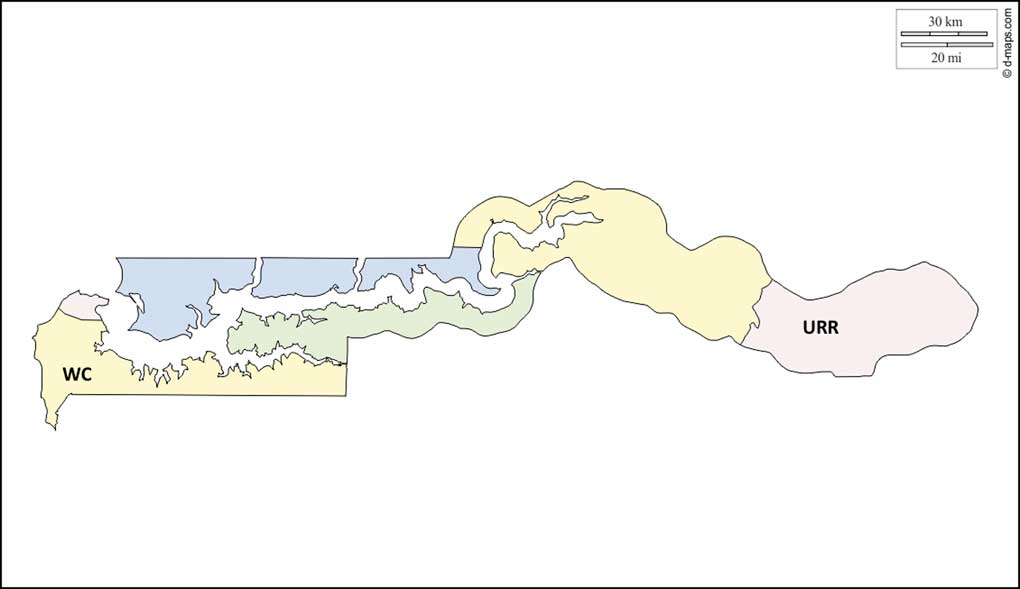
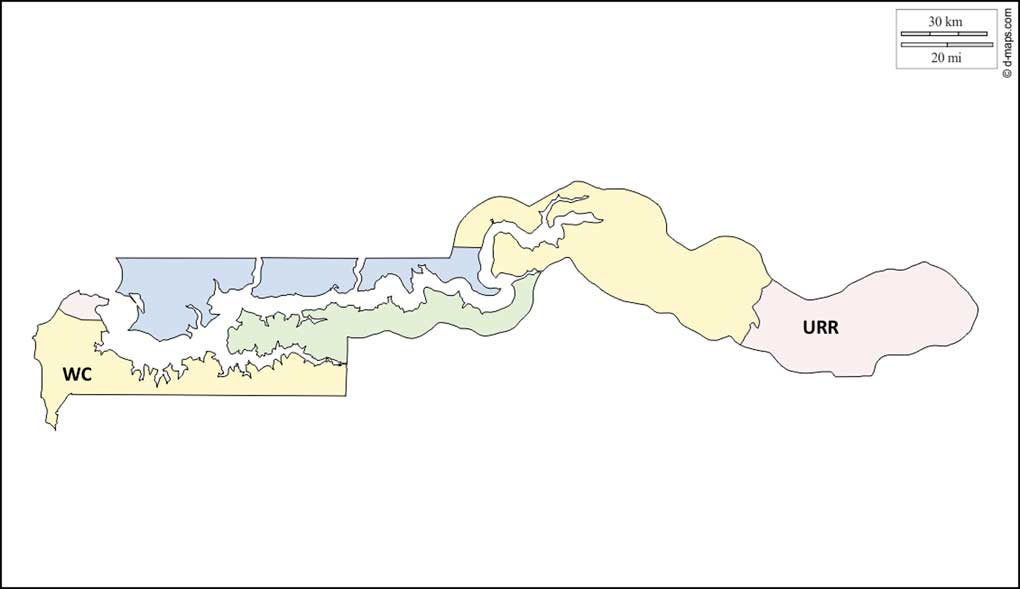
This research was conducted in collaboration with the Medical Research Council Unit in The Gambia at the London School of Hygiene and Tropical Medicine (MRCG). The Gambia is a small low-income country in West Africa with an ethnically diverse, Muslim majority population. The research sites included rural villages in the Upper River Region (URR) and urban settlements in the West Coast Region (WCR) (Figure 1). The qualitative research presented here forms part of a larger proof-of-concept study, to ascertain whether trained BDDs could detect volatiles from biological samples of malaria-infected children. The goal of the qualitative research component was to explore how Gambians might perceive the use of dogs as a diagnostic technology.
Map showing the research sites in the rural villages in the Upper River Region (URR) and urban settlements in the West Coast Region (WCR) of The Gambia. Retrieved from: https://d-maps.com/carte.php?num_car=27045&lang=en
Malaria in the study area
At the end of the malaria transmission season in November 2016, the prevalence of asymptomatic malaria infection in 5- to 13-year-old school children in the study area was 7.9% (46/585) as determined by microscopy. In rural Gambia clinical episodes of malaria are diagnosed using antigen-detecting rapid diagnostic tests or stained blood slides read using microscopes; both methods require a finger-prick sample of blood to be taken. Both RDTs and microscopy are sensitive methods for detecting clinical malaria where parasite densities are high (2000 or 5000 parasites/µl); they are less sensitive at low parasite densities (Satoguina et al., Reference Satoguina, Walther, Drakeley, Nwakanma, Oriero and Correa2009; World Health Organization, 2015). Moreover, strains of parasite have been detected that do not produce histidine-rich protein 2 – an antigen commonly used in RDTs, resulting in false negatives (Koita et al., Reference Koita, Doumbo, Ouattara, Tall, Konare and Diakite2012; Kumar et al., Reference Kumar, Pande, Bhatt, Shah, Mishra and Srivastava2013).
Qualitative research
The qualitative research was conducted in April–May 2017. Initial ethnographic observations of human–dog interactions in public spaces were conducted, alongside a series of informal conversations on human–canine relations in local mosques, churches, pharmacies, health facilities, schools and local neighbourhoods (in both rural and urban sites). These informed the design of a semi-structured focus group discussion (FGD) guide to obtain more detailed information on attitudes towards the possibility of using BDDs for malaria diagnosis.
Five FGDs were then conducted in three rural villages (URR), with eighteen female and seventeen males participants (all over 18 years of age) from the three dominant ethnic backgrounds (Mandinka, Fula and Serahuli); all but one were single-sex groups. Participants were recruited by MRCG fieldworkers in discussion with local alkalos (village heads). One limitation of this study is, therefore, that participants were not necessarily fully representative of other villagers, particularly those from minority ethnic backgrounds. As an exploratory study, however, this approach enabled a reasonable spectrum of perspectives to be quickly garnered.
The focus groups proceeded as follows. After project sensitization, participants were asked to discuss their experiences of, and attitudes towards, dogs in general before focusing more specifically on BDDs. The concept of BDDs was then raised by presenting a series of photographs showing working dogs in action, with the specific breeds (Springer Spaniels and Labradors) used by the UK-based collaborating charity Medical Detection Dogs. A well-behaved adult German Shepherd ‘companion dog’ was introduced in three of the five focus groups in order to elicit post-exposure perceptions. The dog was dressed with a branded red coat worn by working BDDs in the UK, and walked using a harness and lead at all times.
The companion dog was also introduced to residents of three extended-family compounds, and to staff and pupils in a rural school serving primary- and secondary-aged students. On one occasion the dog was led (by a handler) down a stationary line of research participants, mimicking the use of police dogs to identify criminal suspects, in order to observe people’s reactions and provide a focus for further discussions. The current protocol of Medical Detection Dogs is identification using biological samples (‘sample method’), but trialling a ‘line-up method’ was important to generate perceptions of BDDs as a mobile diagnostic technique. It is important to note that this German Shepherd companion dog was the most appropriate substitute for a ‘foreign’ BDD at the study’s disposal in The Gambia; all study participants were made aware that the dog was not a trained BDD.
All FGDs were convened by the lead author and were audio-recorded. The MRCG fieldworkers facilitated the discussions in Mandinka, Serahuli and Fula, providing real-time English translations. Other MRC staff checked the quality and consistency of translations. Detailed observational field-notes were kept, alongside information from informal interviews and discussions. Analysis proceeded on the basis of Grounded Theory (Corbin & Strauss, Reference Corbin and Strauss1990), whereby theoretical insights emerge from the data rather than being pre-imposed. All transcripts and field-notes were read and re-read closely by two of the authors, to identify patterns and key themes for coding (performed manually in Word).
Informed consent was obtained verbally both from settlement leaders and individually from all study participants, in line with the ethical guidelines of the Association of Social Anthropologists (2011). The MRCG fieldworkers presented the project orally in the relevant languages (Mandinka, Fula and Serahuli), ensuring that prospective research participants understood the purpose of the research, the procedures involved, and their right to withdraw at any point. The study was approved by the Gambian Government/MRC Unit Joint Ethics Committee on 16th May 2017 (SCC1479v2) and by the Department of Biosciences Ethics Committee at Durham University.
Results
Canine–human relations in The Gambia
Free-roaming dogs are ubiquitous across The Gambia. So-called ‘modern village dogs’ (Coppinger & Coppinger, Reference Coppinger and Coppinger2001; Boyko et al., Reference Boyko, Boyko, Boyko, Parker, Castelhano and Corey2009) – brown, short-haired of small-medium build – can be seen wandering dusty roads and paths, perched outside market stalls and panting underneath mango trees to escape the midday heat. Almost all dogs roam freely and fall into two broad categories: those owned by a family compound (and kept for security, company and sometimes for hunting) and, as many locals described, a growing stray population. Stray dogs across rural and urban areas were widely considered to be a nuisance. Focus group participants noted their unpredictability and potential to bite, prey on livestock, and even to exhume recently buried bodies from cemeteries. Owned dogs could also bite, and some interviewees in the urban sites mentioned the high-profile case of the (then) President-Elect Adama Barrow’s son being mauled to death by family-owned dogs in January 2017 (The Point, 2017; BBC News, 2017). For these reasons there was a general (pre-exposure) consensus among research participants that they would not approach a stray dog and would not invite an unfamiliar dog to sniff them, because the consensus was that ‘the likelihood of a bite is there’.
Introducing a mock-up Bio-Detection Dog
Large audiences gathered to observe the mock-up BDD — an unfamiliar companion dog being walked on a leash by foreigners — during the FGDs and compound visits. It is extremely rare to see a dog being walked on a leash, or otherwise constrained, in The Gambia. However, compound-owned dogs (used generally for security) are considered to be under control despite being free-roaming. The use of a leash and harness to manage the working dog therefore raised the suspicions of some residents, who interpreted the dog as being uncontrolled: likely to bite if not firmly held by the handler and thus a threat to safety.
Despite initial wariness, however, most study participants found the actual dog much less intimidating than they had expected. One Serahuli woman, for example, summed up the feelings of others in her focus group when she said:
Since the dog has been here with us it hasn’t done anything and they are comfortable. For me seeing that, I have confidence that the dog will not do anything to me. I can get close to the dog with no problem.
It was important for many not to get too close, however, as this paper goes on to discuss.
The German Shepherd dog was an unfamiliar and ‘foreign’ breed for study participants. This initially caused some scepticism; for example, one Serahuli man (pre-exposure) asserted:
I would not want to be sniffed by any of these dogs because these are not the type of dogs we usually see here. They are only in the West.
When introduced to the ‘foreign’ dog, however, there was a palpable shift in perception. As one Fula women put it:
I will not refuse that [being sniffed], because our own dogs are different from this one because of training – our dogs are not trained.
Dogs and malaria diagnostics: perceptions of safety and efficacy
The RDT is the principal method for malaria diagnosis in the study sites. Most study participants believed the RDT to be a largely safe and effective diagnostic method but there were widespread concerns – and sometimes fears – about its invasive nature and the pain associated with using a blood lancet. One Mandinka mother, for instance, said:
I am very scared of [finger] pricking: when my child is being pricked, I hold him close to my body because I feel it for the child.
Another (Serahuli) woman recalled:
We were being pricked for blood samples, I did accept it but I was uncomfortable with the amount of blood being taken for the test. I could see the blood coming from the fingertip and that was not something I was comfortable with.
In the light of this, most participants welcomed the possibility of a non-invasive diagnostic test. In the words of one Mandinka woman:
If there is a dog that can sniff and know your problem or there is a needle that can prick you, which one are you going to pick? I’m going to pick the dog!
In all five focus groups, however, concerns were expressed about safety and efficacy. Most prominent among these were anxieties about being bitten, particularly in a context where rabies remains endemic. One Fula male elder, for example, had serious reservations; his child had recently died shortly after being mauled by a dog and contracting ‘mad dog disease’ (suspected rabies). This, and similar accounts, led some to suggest the use of canine muzzles. Others did not object in principle but did not like the idea of a dog being inside (a health centre, for example); in The Gambia, dogs always stay outdoors. Some focus group participants also queried the reliability of BDDs compared with the more familiar RDTs, which are associated with health professionals and ‘modern’ clinics. Dogs and their handlers did not share this same professional status. Overall, participants wanted reassurance over both safety and capability, summed up eloquently by this Bambara mother:
I would not trust the dog sniffing the child unless I was assured that the dog would not do anything but sniff. If that assurance and guarantee is given to me, then I can allow the dog to sniff my child. Based on that trust, that guarantee, and the fact that you have given me a strong word that the dog will not do anything but sniff and not bite – then I would accept.
Socio-cultural considerations
In addition to questions about efficacy and physical safety, social and religious concerns about BDDs were also widely raised. Interpretations of Islamic teachings pertaining to impurity (Arabic, najasa) were often mobilized as an instruction for Muslims not to keep dogs, and some Muslim study participants considered it haram (forbidden) to touch a dog. Of particular concern was saliva: several participants explained that, according to Islamic teaching, cooking pots and utensils needed to be washed seven times if sniffed or licked by a dog. Such concerns were not exclusive to the Muslim majority population. A Christian priest declared that The Gambia (in general) was ‘not a dog-loving community to the extreme that you have in the West’. Although many Christians keep dogs for security and are Biblically mandated to care for animals, she contrasted dog ownership in The Gambia with the ‘lovey-dovey relationship that you have in England.’
In practice, however, there was considerable ambivalence and negotiation, with practical concerns often overriding religious ones. In rural areas, for example, many Muslim participants kept dogs for guarding family compounds and hunting. Likewise, among the rising middle classes, dogs are seen as an effective (and perhaps more reliable) alternative to hiring a night watchman. Interestingly, a Mandinka Imam (religious authority) in the WCR maintained that, while dog saliva was haram, being sniffed by a BDD would not violate pre-prayer ablutions. In fact, he strongly supported their potential use for protecting people’s health. A Serahuli Imam (WCR) corroborated this view, ‘if you train a dog to sniff malaria, if that’s the intention, you can do it’.
Discussion
The findings presented in this paper give cause for optimism that BDDs could be an acceptable diagnostic technology, even in populations in the Global South that are not normally regarded as ‘dog friendly’. Despite some concerns, most study participants (men and women, from a range of religious and ethnic backgrounds) were favourably disposed to their potential use, at least in principle. Crucially, BDDs offered the possibility of a non-invasive malaria test, less painful than current diagnostic technologies.
These findings also underline the importance of understanding and addressing local concerns, many of which are rooted in very real and reasonable apprehensions, for example, about the risk of biting in a rabies-endemic country. Several focus group participants proactively suggested possible solutions or mitigations, such as the ideas of equipping dogs with muzzles (although this would need careful trialling to ensure that the ability to detect volatiles would not be impaired). Religious injunctions also featured prominently among the concerns of Muslim participants in particular, but in practice there was substantial flexibility in interpretation, and many people took a pragmatic view of how to manage interactions with dogs without compromising their religious integrity. The Imam who distinguished ‘sniffing’ from the (forbidden) contact with saliva provides an excellent example of this. Context was also shown to be important in this study: what kind of dog and where (inside/outside) both mattered to different participants.
These specific findings may not be generalizable beyond the immediate context of The Gambia. They do, however underline, the wider importance of working with local people to understand and address their concerns before deploying a novel technology. In the case of BDDs, it is important to understand the wider context of canine–human relationships, and how these might be inflected by factors such as the appearance of the dog and handler, the location, the proximity and the most appropriate method (sample/line-up). The reaction of Imams, who took pragmatic views in the interests of protecting health, also underscores the value of working with local religious and other community leaders whose endorsement and input into accompanying awareness-raising initiatives can be crucial.
Conclusion
This study has provided a useful insight into a potentially important global health innovation: the use of BDDs as a mobile diagnostic method in low- and medium-income countries, particularly at ports of entry in malaria-free countries. Specifically, it signposts issues likely to arise when BDDs are applied in the very different social landscapes of the Global South compared with current use in high-income country settings, and highlights the importance of working with local communities and opinion leaders to identify and address their concerns.
As an exploratory study, this work has significant limitations: it was carried out over a relatively short time period (6 weeks) among a non-representative population in pre-selected settlements in The Gambia. Research conducted over a larger geographical area, over a longer period of time, with a greater diversity of participants, might have identified other issues and concerns. It is also important to recognize that social acceptability is only one of many hurdles that must be addressed for BDDs to be used at scale as diagnostic tools in the Global South. Even in high-income countries, their use remains limited, at least partly because of the substantial time and financial costs of breeding, training and looking after BDDs over the long-term.
Nonetheless, this study – and the accompanying proof-of-concept work – highlights the potential for using BDDs for diagnostic screening in low- and medium-income country settings. While the focus of this study has been specifically on malaria, the implications of possible BDD deployment are far-reaching in a continent where a chronic lack of diagnostic technology represents a major impediment to improving health care, particularly in the context of rising burdens of cancer and other non-communicable diseases (Livingstone, Reference Livingstone2012; Stefan, Reference Stefan2015; Jedy-Agba et al., Reference Jedy-Agba, McCormack, Adebamowo and Dos-Santos-Silva2016). If that potential is to be realized, it is crucial that clinical/scientific research and development go hand-in-hand with social research to ensure that interventions are appropriately designed, in consultation with the intended beneficiaries.
Ethical Approval.
The study was approved by the Gambian Government/MRC Unit Joint Ethics Committee on 16th May 2017 (SCC1479v2) and by the Department of Biosciences Ethics Committee at Durham University, UK. TheMRCG fieldworkers obtained informed consent (including consent for publication) in the relevant languages (Mandinka, Fula, and Serahuli) of participants.
Conflicts of Interest.
The authors declare that they have no competing interests.
Funding.
The study was funded by the Bill and Melinda Gates Foundation (OPP1150969).