


1. Introduction
This paper describes and analyses an unusual stress pattern found in the standard dialect of Kashmiri, refered to as Koshur in this study, spoken in and around Srinagar, the summer capital of Jammu and Kashmir, India. The special interest Koshur holds for studies of prosody lies in that its metrical system displays effects of a four-way weight distinction that has sometimes been described by the scale CVːC>CVː>CVC>CV. Arguments for these weight categories, and the claim that they organize coherently into a graded scale, have often relied on evidence from metrical systems that assign stress to the heaviest available syllable, as defined by the scale. This type of pattern occurs in a different dialect of Kashmiri, discussed in Kachru (Reference Kachru1969, Reference Kachru1973), Bhatt (Reference Bhatt1989), Rosenthall & van der Hulst (Reference Rosenthall and Hulst1999), and Morén (Reference Morén2000) (henceforth, the Kachru dialect). In the Kachru dialect, stress is noniterative and is never assigned to a final syllable. When all non-final syllables belong to the same weight class, stress occurs on the initial syllable, as in (1a). In words containing syllables of different weights, stress migrates to the right if by so doing it can upgrade to a heavier syllable. Both CVː and CVC syllables attract stress to the right, when the only alternative is to stress a CV syllable, as in (1b) and (1c). In (1d) we see that CVC is passed over in favour of CVː, and in (1e) we see that CVːC outranks CVː.
(1) Kachru's Kashmiri (data as reported in Morén Reference Morén2000)

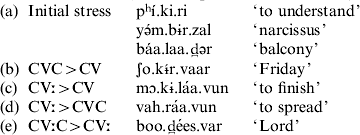
The metrical behaviour of CVC syllables in languages with the scale CVːC>CVː>CVC>CV (or the shorter ternary version CVː>CVC>CV) has stimulated interest because they seem to display effects of variable weight: CVC syllables attract stress like CVː syllables do in contexts where no CVː syllable is available, as in (1b), but, like CV syllables, they defer to CVː syllables (i.e. are passed over in favour of CVː syllables) if any are present, as in (1d).
The most fundamental effect of weight sensitivity is the assignment of stress to syllables containing long vowels in preference to those containing short vowels. The standard analysis of this effect has been to equate the unit of vowel length with the unit of syllable weight – the bimoraic structure that makes a vowel long is also what makes a syllable heavy. This system of representation is quite iconic: a syllable's prosodic weight is read off the number of its morae. By analogy, closed CVC syllables that pattern like CVː syllables in weight-sensitive stress systems have also been analysed as bimoraic. In these cases, a coda is assumed to contribute a mora to its syllable. In this theoretical context, some researchers have interpreted the ambiguous metrical behaviour of CVC syllables in languages such as Kashmiri as an effect of variable weight: CVC syllables have been treated as bimoraic – but only some of the time. In contexts where CVC syllables' metrical behaviour aligns them with CVː syllables, variable weight accounts analyse them as having two morae. But where CVC syllables defer to CVː syllables, they are analysed as monomoraic. This type of account has been associated notably with the work of Morén (Reference Morén2000) for the Kachru dialect of Kashmiri, Elias-Ulloa (Reference Elias-Ulloa2004a, Reference Elias-Ulloa, Bateman and Usseryb) for Shipibo and Capanahua, and especially Rosenthall & van der Hulst (Reference Rosenthall and Hulst1999), who discuss variable weight effects in a diverse set of languages.
But variable weight analyses come at a cost. A standard assumption among prosodists has been that most languages place an upper limit of two morae on syllable content. Models that allow a maximum of two morae per syllable can accommodate the ternary weight distinction expressed by the scale CVː>CVC>CV. However, such models are not able to capture a four-way weight distinction and still maintain the assumption that the mora is the unique determinant of syllable weight. Analysts committed to ‘mora only’ explanations of the four-way weight distinction expressed by the scale CVːC>CVː>CVC>CV, then, are forced to take the position that CVːC syllables are made ‘superheavy’ through the assignment of a third mora (e.g. Prince Reference Prince1980, Prince & Smolensky Reference Prince and Smolensky1993, Hayes Reference Hayes1995, Broselow, Chen & Huffman Reference Broselow, Chen and Huffman1997, Morén Reference Morén2000). This extension of syllable theory has been unfortunate, since little independent phonological evidence supports the existence of trimoraic syllables, beyond the observation that stress favours CVːC over CVː syllables in some languages.
It is now well understood that the ‘mora only’ view of weight sensitivity is too rigid. We now know that other phonological distinctions, notably vowel quality, can be primary influences on the distribution of stress in an impressive array of languages (Kenstowicz Reference Kenstowicz1996, Crowhurst & Michael Reference Crowhurst and Michael2005, Gordon Reference Gordon2002a). Moreover, some of this work has shown that languages do not necessarily fall into one category or the other – it is not uncommon to find languages whose stress pattern is influenced both by the interaction of syllable weight in the moraic sense and by vowel quality (e.g. Kenstowicz Reference Kenstowicz1996, Crowhurst & Michael Reference Crowhurst and Michael2005).
Bearing these points in mind, an alternative to the ‘variable weight’ perspective would be that the ambiguous metrical behaviour of CVC syllables in languages like Kashmiri does not signal a variable weight distinction at all. If, in metrical systems, CVC syllables are favoured over CV syllables but defer to CVː syllables, the reason might not be that they are moraically equivalent either to CV or CVː syllables, depending on context. Rather, closed syllables might simply belong to a distinct class. Our view is that where we find the weight scale CVː>CVC>CV, the property that distinguishes CVC syllables from both CV and CVː syllables is that they possess a non-weight-bearing coda which, assuming the representations of syllable structure proposed by Hayes (Reference Hayes1989), branches from a syllable's final mora. We argue that the presence of a branching mora creates a favourable stress environment for closed syllables relative to otherwise comparable open syllables. Under this proposal, the four-way weight distinction expressed by the scale CVːC>CVː>CVC>CV breaks down as the interaction of two binary oppositions: all bimoraic syllables are heavier than all monomoraic syllables in the traditional sense, CVːC, CVː>CVC, CV. But within each traditional (bimoraic, monomoraic) weight class, the syllable with the branching mora, CVːC and CVC, is a better stress peak than its open counterpart. This approach does not require trimoraic syllables to account for the CVːC >CVː problem. Considering the range of distinctions that influence stress, another advantage of our account is that it reinforces our intuition that the phonological distinctions that determine stress in natural languages have to do with properties of a syllable's morae: their number, the quality of vowels associated with them, and now, whether or not a syllable's morae branch. We are not alone in adopting the position that syllable codas play a role in stress systems indepently of mora count; deLacy (Reference de Lacy1997), Crowhurst & Michael (Reference Crowhurst and Michael2005) and Wiltshire (Reference Wiltshire, Mugane, Hutchison and Worman2006) have made similar points (see Section 5). But among these earlier works, deLacy (Reference de Lacy1997) and Wiltshire (Reference Wiltshire, Mugane, Hutchison and Worman2006) assume representations of the syllable that do not allow them to characterize the contribution of light codas to stress as a moraic effect, and so they miss the opportunity to connect the coda effect under discussion here to other stress-related properties of morae. Crowhurst & Michael (Reference Crowhurst and Michael2005) attribute stress effects associated with ‘weightless’ codas to mora branchingness, as we do, but their emphasis is not on making the connection between mora branchingness and other properties of the mora that contribute to stress. We make that connection explicit here, and this is the primary theoretical contribution of the present paper.
The paper also makes an empirical contribution to the stress literature of a detailed description of a rare four-grade stress scale, CVːC>CVː>CVC>CV, in a language that has not previously been discussed in the phonological literature. What is special about Koshur is the source of the evidence that closed syllables are distinguished from open syllables on this scale. In Koshur, stress assignment is iterative, and so works quite differently from the Kachru dialect of Kashmiri, in which a single heaviest syllable is singled out and assigned stress. Beyond this, what is remarkable about Koshur is the supporting role played by a pervasive phenomenon of syncope which supplies codas to open syllables that are assigned stress. The effect of syncope is to enhance a stressed syllable's value on the scale CVːC>CVː>CVC>CV by upgrading CV to CVC, and CVː to CVːC. This shows that stress systems not only target the strongest available syllables for stress, but that ‘auxilliary’ phonological processes can play an augmenting role. This is exactly what we expect in a theory claiming that sound behaviour is governed by hierarchies of interacting constraints, and the optimality theoretic analysis we provide is straightforward.
The remainder of the paper is organized as follows. Section 2 leads with a discussion of background information and assumptions about syllable structure in Koshur. This information is provided early as a necessary precursor for the subsequent description and analysis, but certain key assumptions about the representation of syllables are justified later, in Section 4. In Section 3 we describe and analyse the basic stress pattern of Koshur, followed in Section 4 by an account of syncope. Analyses are presented using the formalism of Optimality Theory (Prince & Smolensky Reference Prince and Smolensky1993, McCarthy & Prince Reference McCarthy, Prince, Booij and Marle1993, Reference McCarthy, Prince, Beckman, Urbanczyk and Walsh Dickey1995). Section 5 contains a discussion of implications and predictions, and Section 6 presents concluding remarks.
2. Preliminaries
The transcriptions used throughout reflect the unmarked stress pronunciations of the items given, as judged by the first author, and they are the forms used in polite conversational speech at a natural speaking rate (the rate at which a speaker paces him/herself in conversational speech, unprompted by requests for clarity, repetition, and the like). Basic stress patterns are not affected by derivational and inflectional morphology, but because stress is assigned differently in productive compounds, our data set is restricted to non-compounds. We do cite some forms that originated as compounds historically but which pattern synchronically as non-compounds for stress.Footnote 2
Our judgements as to where stress falls are based on several criteria. First and foremost, we rely on the intuitions of the first author, who is a native speaker of Koshur and a trained linguist. Vowel duration is the strongest and most reliable cue for primary stress. Duration can also cue secondary stress, but here intensity is a more obvious cue, especially in the case of long (i.e. bimoraic) vowels. Short vowels in unstressed open syllables are generally subject to reduction in quality as well as in duration. In particular, /a/ is reduced to [ɨ] in this context. We distinguish between vowel reduction, in which case the vowel appears on the surface, and syncope, in which case a vowel is fully deleted.
Syllable onsets in Koshur may consist of up to two consonants, if the second consonant is /r/ (e.g. kraːl ‘potter’, grakʰ ‘boil’). Onsetless syllables are allowed word-initially (e.g. a.ha.ni ‘yes (informal, female addressee)’, o.  ur ‘wet (masculine)’). Contrastively long vowels can occur anywhere but word-finally, due to a historical process that shortened long vowels in this position.Footnote 3 Syllable codas are common, and coda clusters are restricted to homorganic nasal+obstruent sequences (e.g. pʰamb ‘wool’, kɔŋg ‘saffron’, saŋg.
 ar ‘orange’, pa
 s. rɨh ‘thirty-five’). A typologically rare feature of Koshur is that complex codas are possible in syllables containing long vowels (e.g. braː ‘verandah’).
We assume with all contemporary work that short vowels have one and long vowels have two morae (Prince Reference Prince1983, Hyman Reference Hyman1985, McCarthy & Prince Reference McCarthy and Prince1986, Hayes Reference Hayes1989). In other respects, we adopt the formal representations of the syllable proposed by Hayes (Reference Hayes1989), in which onset consonants branch from the syllable node, as shown in (2a–c) below, and coda consonants that do not contribute moras are dependents of the rightmost mora dominating a vowel, as in (2c). Hayes' representations, arguably the most widely accepted ones, serve us well in two ways. First, since stress in Koshur is sensitive to coda but not onset consonants, we require representations of the syllable that distinguish them. Hayes' model does this by having onsets and non-moraic codas branch from different nodes. This distinction is not so neatly accomplished by models that represent onsets and (non-moraic) codas as branching from the same node, either the mora (Hyman Reference Hyman1985) or the syllable (McCarthy & Prince Reference McCarthy and Prince1986). The other way of distinguishing coda from onset consonants in languages whose stress systems require this is of course to assign a mora to the coda consonant. However, we show in Sections 3 and 4 below that the evidence does not support the latter, more traditional analysis. This being the case, the second way in which Hayes' representations are convenient is that by having codas branch from a mora, the vowel and following coda consonant are in a closer relationship than the vowel and preceding onset consonant: the vowel and coda form a de facto constituent as co-dependents of a branching mora. The distribution of stress in languages where syllable structure matters is most commonly determined by the moraic properties of the syllable – normally, whether a syllable has one or two morae. One of our proposals is that stress in Koshur, and in languages with similar metrical properties discussed in Section 5, is sensitive not only to the number of morae, but also to their branching structure.
(2)

In addition to CV, CVC, and CVː, Koshur also has CVːC, CVːCC, and CVCC syllables. Of these, CVːC's distribution is unrestricted, while the syllables with coda clusters CVCC and CVːCC are most common in word-final position (e.g. pʰamb ‘wool’, braː ‘verandah’). Some scholars have argued that CVːC and CVCC syllables are trimoraic in at least some languages (see Prince & Smolensky Reference Prince and Smolensky1993, Hayes Reference Hayes1995, Broselow et al. Reference Broselow, Chen and Huffman1997, Morén Reference Morén2000). Arguments for this position have often been based on demonstrations that ‘superheavy’ syllables are favoured over CVː syllables for stress in some languages. While this is true for Koshur, the effect that motivates the hierarchy CVːC >CVː differs from the evidence usually cited, and we argue that the Koshur facts weigh against an analysis in which a coda adds weight to CVːC. Nor do we find any evidence to suggest that a second coda consonant adds a mora, in the case of CVCC and CVːCC. We therefore adopt the representations in (3), consistent with the representation of codas in (2).
(3)
Our claim that codas do not add morae to syllables is a claim only about languages that pattern like Koshur in having a four-grade stress scale. Our analysis is that apparently superheavy syllables in Koshur are not trimoraic, and extending this analysis, we do question the claim made by others (e.g. Rosenthall & van der Hulst 1999, Morén Reference Morén2000) that preferential stress effects associated with CVːC syllables should be accepted as evidence that these syllables are trimoraic in any language that, like Koshur, has a four-grade stress scale, and in many languages that have a ternary stress scale (see the concluding section for further discussion). Having attended to these initial details, we now turn to a description and analysis of the basic stress pattern of Koshur.
3. The basic stress pattern
3.1 The data
The distribution of stress in Koshur is sensitive to (i) a syllable's position in a word; (ii) rhythmic factors – the avoidence of stress lapses and clashes; and (iii) syllable structure – whether a syllable contains a long or a short vowel, and whether the syllable is open or closed.
The distribution of stress in words consisting of repeating CV sequences is illustrated in (4). Bimoraic CV.CV words such as those in (4a) are common. As strings of CV syllables longer than this are normally reduced by syncope, our best examples of CV.CV.CV and CV.CV.CV.CV non-compounds, in (4b) and (4c), are cases in which syncope is blocked (see Section 4). Forms that normally undergo syncope used in this section will be labelled ‘syncope’ to the right. Underlying sequences /CVCVCVCVCV/ also occur, but there are no corresponding pentasyllabic CV.CV.CV.CV.CV forms on the surface, as these are always reduced by syncope.
(4) Repeating CV sequences Footnote 4
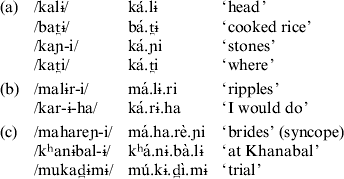
The examples in (4) reveal a basic pattern of primary stress on the initial syllable and secondary stress on the third syllable in the tetrasyllables. The trisyllables in (4b), in particular, show that stress is never assigned to a CV syllable in final position, a fact whose special significance will become clear below. As initial CV syllables receive primary stress, it should come as no surprise that this is also true for initial CVː and CVC syllables, shown in (5).
(5) Primary stress in CVː and CVC
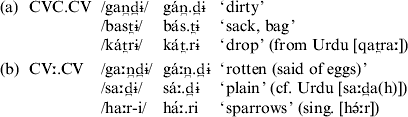
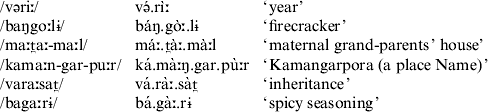
Syllables containing long vowels are always stressed, and long vowels in non-initial syllables do not attract primary stress.
(6) Stress occurs on every syllable containing a long vowel, CVː
The syllables of special interest for this study are closed syllables. CVːC syllables cannot be distinguished from CVː based on stress assignment alone, because all syllables with long vowels are stressed. However, closed syllables with short vowels, CVC (where CVC stands for both CVC and CVCC), do not behave uniformly like either CV or like CVː syllables, and can therefore be distinguished from both of them. CVC syllables are like CVː syllables in that they seem to demand stress – but unlike CVː in that they do so in a restricted set of contexts. Like CVː syllables – and unlike CV syllables – CVC syllables are always assigned secondary stress in final position, whether the preceding syllable is unstressed, (7a), or stressed, (7b) and (7c).
(7) Final CVC is always stressed

Again, the examples in (6) and (7b, c) show that Koshur tolerates stress clashes. Moreover, examples like those in (7c) will be footed as (sá)(b  z), meaning that Koshur permits a degenerate primary stress foot, when stress is required to occur on the following syllable.
CVC syllables also receive stress in positions where, if they did not, a sequence of two or more adjacent unstressed syllables would result. The example yú.ni.vàr.si.tìː ‘university’ in (8) below shows, trivially, that medial CVC syllables are stressed in rhythmic alternation, between unstressed syllables (a double stress lapse).Footnote 5 Of greater interest are the remaining examples in (8) in comparison with those in (4b). The latter set showed that stress is not assigned to a medial CV syllable in CV.CV.CV trisyllables (e.g. má.lɨ.ri ‘ripples’). In contrast, we see in (8) that a CVC penult does receive stress before a final CV. (These generalizations apply equally to longer words that end in the trisyllabic final sequence we are discussing.)
(8) Medial CVC stress
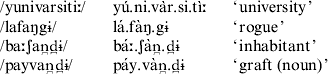
On the other hand, the examples in (9) show that CVC syllables are like CV and unlike CVː syllables in that they are not stressed between stressed syllables.
(9) Unstressed CVC syllables in medial positions
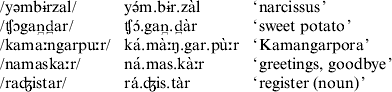
The factors that govern stress on CVC syllables are clearly illustrated by the pairs in (10). In each pair, a post-tonic CVC syllable receives stress in word-final position, but not when the addition of a suffix, in these cases -ʤiː and -vaː , places CVC between stressed syllables.
(10) CVC syllables: stress pairs

CVC syllables are stressed to avoid not only word-final stress lapses (see (8) above), but also medial lapses. The examples in (11a,b) illustrate the behaviour of a CVC syllable occurring in combination with a CV syllable between stressed syllables. In these cases, stress always falls on the CVC syllable. In (11c), where adjacent CVC syllables occur between stressed initial CV and final CVː or CVC syllables, the second syllable in the CVC.CVC sequence is stressed. Note that the unstressed CVC syllable in these cases (gar and lan) immediately follows the syllable with primary stress. This pattern sugests that even though an initial degenerate foot is tolerated (e.g. (sá)(b z) in (7c)), the second syllable is unstressed when possible, avoiding a stress clash with the syllable with primary stress, and making possible a binary primary stress foot.
(11) Stress in medial CV.CVC, CVC.CV, and CVC.CVC sequences

The one context in which CVC syllables defer to CV syllables is illustrated in (12). In tetrasyllabic forms where a peninitial CVC syllable is followed by a /CVCV/ sequence, stress falls not on the antepenult, but on the CV penult instead.
(12) CV is selected over CVC for stress

We saw in (4b) that final unstressed CV.CV sequences are possible when syncope cannot occur (e.g. má.lɨ.ri ‘ripples’). The difference between those forms and an alternative to (12) such as hypothetical *ʤá.là .a.rɨ, in which the antepenult is stressed, is that the alternative contains a stress clash as well as a stress lapse. Under these conditions, stress falls on the penultimate CV syllable.
Summarizing, we have seen that the main stress in Koshur falls on the initial syllable, whatever its structure – CV, CVC, or CVː. A non-initial CV syllable receives stress only in (rarely occurring) words of four CV syllables, e.g. kʰá.ni.bà.lɨ in (4c), and in tetrasyllabic forms where all (non-initial) syllables are CV except the peninitial CVC syllable, e.g. y  m.bɨr.zà.lɨ ‘narcissi’ in (12). All syllables containing long vowels, and word-final CVC syllables are stressed whether this results in a stress clash or not. CVC syllables are also stressed between unstressed CV syllables, e.g. yú.ni.vàr.si.tìː ‘university’ in (8), and in positions where, were they not stressed, a stress lapse would result, e.g. lá.fàŋ.gɨ ‘rogue’ in (8) and ʃár.mà .ɨ.gìː ‘embarrassment’ in (11b). In a choice between assigning stress to a CV or a CVC syllable in a potential lapse context, stress is assigned to CVC, e.g. nár.pə.rìs. àːn ‘place name’ in (11a). Given a choice between two CVC syllables, the second is stressed (cf. nár.pə.rìs. àːn and ʃár.mà .ɨ.gìː). CVC syllables are not stressed when they occur alone between stressed syllables that require stress because they are initial syllables, syllables with long vowels, or final CVC syllables (cf. (9) and (10)). Nor are CVC syllables stressed in preference to CV syllables when assigning stress to CVC would produce both a stress lapse and a stress clash, e.g. *ʤá.là .a.rɨ (cf. (12)).
A promissory note: one of our goals is to show that Koshur has a four-grade stress hierarchy, CVːC>CVː>CVC>CV, according to which closed syllables are favoured over open syllables containing vowels of the same length in stressed positions. We are able to make the point that the behaviour of CVC syllables is distinct from that of both CVː and CV syllables based on the stress data, and this point is supported by a pattern of syncope described in Section 4. However, the ranking CVːC>CVː cannot be proven based on stress data alone because syllables with long vowels always attract stress. We make the case for CVːC>CVː in Section 4, where syncope is discussed.
3.2 Formal analysis
3.2.1 Rhythmically alternating stress and stress on CVː Syllables
Our analysis follows in the tradition of contemporary analyses that employ constraints referring to the structure and position of objects in the metrical grid (in the sense of Prince Reference Prince1983), stress peaks and unstressed syllables, whether or not these constraints also refer to stress feet.Footnote 7 Three of the most central constraints employed by our analysis are defined in (13)–(15). Obligatory word-initial stress requires the constraint Initial.tress in (13).Footnote 8
(13) Initial.tress: Align-Left (PrWd,
)(Assess a penalty, *, for every prosodic word whose initial syllable is not stressed.)
 )
InitialStress is never violated in Koshur. Also required are the peak prominence constraint *PeakFOOT/σμ (*PkFT/σμ) (Kenstowicz Reference Kenstowicz1996, Crowhurst & Michael Reference Crowhurst and Michael2005), and the Weight-to-.tress Principle (WSP; Kager Reference Kager1999) in (14). The term PeakFOOT refers to any stressed syllable, and the constraint *PkFT/σμ penalizes monomoraic syllables (those having short Vs) with stress. The WSP penalizes unstressed bimoraic syllables (syllables with long Vs in Koshur).
(14) Prominence
(a) *PeakFOOT/σμ: *
μ(One * for any stressed monomoraic syllable.)
(b) Weight-to-.tress Principle (WSP): Heavy syllables are stressed.
(One * for any unstressed bimoraic syllable.)
 μ
Stress on initial CV syllables shows that InitialStress outranks *PeakFT/σμ. Forms such as v .rìː ‘year’ in (6) show that InitialStress also ranks above the constraint *Clash in (15) (Kager Reference Kager1999).
(15) *Clash: No stressed syllables are adjacent.
(One * for any pair of adjacent stressed syllables.)
The tableau in (16) for the forms ká.lɨ ‘head’ in (4a) and v .rìː ‘year’ illustrates the effect of these rankings.
(16) InitialStress » *PeakFT/σμ, *Clash
The WSP is never violated in Koshur, even when satisfying it results in stress clashes (e.g. v .rìː ‘year’ and máː. àː.màːl ‘maternal grandmother's house’ in (6)), or compels the main stress foot to be a degenerate monomoraic foot. Degenerate feet are forbidden by Ft.in(μ) in (17), which enforces a bimoraic minimum requirement on feet (e.g. Crowhurst Reference Crowhurst1996).
(17) Ft.in(μ): Feet contain at least two moras.
(One * per monomoraic foot.)
To account for v .rìː, both InitialStress and WSP must outrank FtMin(μ), as shown in (18). (WSP and InitialStress cannot be directly ranked, as neither constraint is ever violated.)
(18) WSP, InitialStress » FtMin(μ)
Tableau (16) showed that InitialStress must be ranked above *Clash in Koshur. The WSP must also outrank *Clash to account for forms like máː. àː.màːl, in which the assignment of stress to CVː syllables produces a stress clash between the second and third syllables, which cannot be attributed to InitialStress. The tableau for máː. àː.màːl in (19) proves the ranking WSP » *Clash.
(19) WSP » *Clash
To this point, we have introduced two sets of constraints, an unviolated set {WSP, InitialStress}, and a set {*Clash, FtMin(σ), *PeakFT/σμ}, all of which are violated in some contexts. We have shown that the top-ranked constraints dominate those in the bottom set, with the exception that WSP and *PeakFT/σμ do not conflict and therefore cannot be directly ranked. Critical rankings among the constraints in the bottom set are motivated in the next section.
3.2.2 Integrating closed CVC syllables into the analysis of Koshur stress
The focus of our paper is the contribution of syllable codas to a typologically unusual four-level stress hierarchy CVːC>CVː>CVC>CV found in Koshur. We showed in Section 3.2.1 that CVC syllables pattern differently from either CV or CVː syllables, and we turn now to an analysis of this behaviour.
In analyses of noniterative stress languages that have the ternary scale CVː>CVC>CV (whether or not the step CVːC>CVː is also present), claims about the intermediate position of CVC between CVː and CV have been based on the way in which primary stress is assigned (e.g. Morén Reference Morén2000). In typical cases, a CVC syllable is assigned primary stress as a better alternative to CV, but CVC is passed over when a CVː syllable can be assigned stress instead. A major difference between Koshur and other ternary stress languages that have been discussed is that the case for the scale CVː>CVC >CV rests on the distribution of non-primary stress. In Koshur, primary stress is fixed at the left edge, and the evidence for CVC>CV is that CVC syllables accept stress in non-initial positions where CV syllables reject it (e.g. lá.fàŋ.gɨ ‘rogue’ in (8), má.lɨ.ri ‘ripples’ in (4b)). In polysyllabic words, final CVC syllables also receive stress, but final CV syllables never do. The evidence for CVː>CVC, on the other hand, is that while CVː (and CVːC) syllables are always assigned stress (e.g. máː. àː.màːl ‘maternal grandmother's house’ in (6)), CVC is not stressed if the result would be a run of three stressed syllables (e.g. ʧ  .ga .àr ‘sweet potato’ in (9)). As discussed at the outset, ‘variable weight’ analyses (e.g. Rosenthall & van der Hulst Reference Rosenthall and Hulst1999, Morén Reference Morén2000) claim that in positions where CVC as well as CVː can receive stress, both must be bimoraic. In these contexts, CVC's coda contributes a mora to the representation. However, in contexts where CVC syllables are not allowed to be stressed, they are assumed to be monomoraic, like CV.
In our alternative to the variable weight analysis, CVC syllables in languages patterning like Koshur are monomoraic and form a weight class with CV syllables. However, CVC is unlike CV syllables in possessing a coda as a weightless dependent of the mora. CVː syllables have a second mora, which both CVC and CV syllables lack. Either feature (the presence of a coda, or a second mora) makes a CVC syllable a better stress peak than CV, and this accounts for the weight grades CVː >CV and CVC>CV. We see the difference between CVː and CVC (i.e. CVː >CVC) because the long vowel weighs in CVː's favour in contexts where CVC does not receive stress.
Before proceeding, it is worth reviewing the ways in which CV and CVC are treated differently in Koshur. Word-final CVC syllables are always stressed (e.g. kʰáː .àː.rÌɲ ‘woman of the house’ in (7b)), while CV syllables never are (e.g. ká.ɲi ‘stones’ in (4a), *ká.ɲì; má.lɨ.ri ‘ripples’ in (4b), *má.lɨ.rì). And while medial CV syllables are almost never stressed in Koshur (see Section 4 for the formal analysis), medial CVC syllables can be stressed to avoid stress lapses (e.g. nár.pə.rìs. àːn ‘place name’ in (11a)). The pattern of stress on final CVC syllables is an effect of Final.tress, in (20), the mirror image of the constraint InitialStress in (13).
(20) Final.tress: Align-Right (PrWd,
)(One * for every prosodic word whose final syllable is unstressed.)
Given (20), stress on final CVː syllables is doubly compelled – by FinalStress and by WSP.
The question is: If both CV and CVC syllables are monomoraic in Koshur, why is the final stress requirement fulfilled by CVC syllables, yet violated by CV? A mechanism for penalizing stressed CV syllables is required that does not also rule out CVC. Two properties that make CV a less attractive stress bearer than other syllables are that it is monomoraic (has a short vowel), and it has a non-branching mora. CVC is also monomoraic, but its mora branches. To re-emphasize a central point of the paper, weight-sensitivity can be understood as sensitivity to properties of the mora. In most cases, the properties that matter are the number of morae a syllable contains, or the quality of the vowel inhabiting a mora (and sometimes both; Kenstowicz Reference Kenstowicz1996, Crowhurst & Michael Reference Crowhurst and Michael2005). Our claim is that the coda effect in languages that pattern like Koshur is due to sensitivity to a mora's branching structure. We attribute this effect to the constraint *PeakFT/No.ranch(μ) (or *PkFT.oBr(μ)) in (21).Footnote 9
(21) *PeakFT.o.ranch(μ): Any mora in a stress peak must branch.
(One * for any mora of a stressed syllable which is associated to only one root node.)
*PkFT/NoBr(μ) is consistent with well-established constraints imposing binary structure on prosodic heads. FtBin constraints require branching feet; *PeakFT/σμ and the WSP impose branching structure on stressed syllables. *PkFT/NoBr(μ) extends the requirement of binarity on prosodic peaks down the prosodic hierarchy to the mora.
The constraints *PkFT/NoBr(μ) and *PeakFT/σμ have different effects. *PeakFT/σμ promotes stress on bimoraic syllables by penalizing the assignment of stress to monomoraic CVC and CV syllables. *PkFT/NoBr(μ) discourages stressed CV syllables, instead favouring stressed light closed syllables, whose mora dominates both the vowel and syllable codas. The table in (22) shows how these constraints evaluate stressed syllables of the types found in Koshur.
(22) Penalties assigned for stressed syllables in Koshur
*PkFT/NoBr(μ) assigns two penalty marks to stressed bimoraic CVC syllables.Footnote 10 It also assigns two penalty marks to stressed CVː syllables, whose morae do not branch (even though the single root node dominated by them does), but only one mark to CVːC, whose second mora branches (see (3) above). This is the basis for the ranking CVːC>CVː on the stress scale.
Since *PkFT/NoBr(μ) discourages the assignment of stress to open syllables with long vowels which are in fact always stressed, Koshur requires the ranking WSP » *PkFT/NoBr(μ), as shown by the tableau for the form kʰáː .àː.rÌɲ ‘woman of the house’ (in (7b)) in (23).
(23) WSP » *PkFT/NoBr(μ)
In Section 3.1 we argued based on words like v .rìː ‘year’ in (6) that the constraint InitialStress outranks *PeakFT/σμ and *Clash. Examples like sá.b z ‘green’ in (7c) show that InitialStress must also outrank *PkFT/NoBr(μ). The tableau for sá.b z in (24) illustrates the effect of this ranking.
(24) InitialStress » *PkFT/NoBr(μ)
The constraints *PkFT/NoBr(μ) and*PeakFT/σμ do not conflict, and so they cannot be directly ranked. However, *PkFT/NoBr(μ) can be shown to dominate *PeakFT/σμ because these constraints are ranked differently with FinalStress in (20). Stress on final monomoraic syllables is generally favoured by the ranking FinalStress » *PeakFT/σμ. However, stress on the subset of open monomoraic syllables, CV, is not allowed because *PkFT/NoBr(μ) outranks FinalStress. The tableau in (25) demonstrates the effect of the ranking *PkFT/NoBr(μ) » FinalStress » *PeakFT/σμ with the examples sá.b z ‘green’ and ká.ɲi ‘stones’ in (4a).
(25) *PkFT/NoBr(μ) » FinalStress » *PeakFT/σμ
To complete our analysis of final stress in forms like sá.b z, in which stressed syllables occur adjacently, we note that FinalStress must also outrank *Clash introduced earlier.
In medial inter-stress positions where FinalStress has no effect, CVC and CV pattern as a class in surfacing without stress. If CVC syllables were stress attractors like CVː syllables, we should find forms like*y m.bìr.zàl in Koshur. In this analysis, stress does not occur on CVC in this position because no constraint requires it. A form like *y m.b r.zàl (cf. y m.bɨr.zàl ‘narcissus’ in (9)) violates *PkFT/σμ, without improving the rhythmic structure. The tableau in (26) shows that the forms y m.bɨr.zàl and ká.nɨ.g ʧ ‘mushroom species’ in (7a) are consistent with the hierarchy we have already motivated.
(26) *PkFT/NoBr(μ) » FinalStress » *PeakFT/σμ
On the other hand, medial CVC syllables do receive stress when otherwise a stress lapse would occur (e.g. lá.fàŋ.gɨ ‘rogue’ in (8)). This is not true for CV syllables (e.g. má.lɨ.ri ‘ripples’ in (4b)). In this analysis, penultimate stress in lá.fàŋ.gɨ occurs because the constraint *Lapse in (27) (Kager Reference Kager2001, McCarthy Reference McCarthy2003, Buckley Reference Buckley2009) requires it, and *PkFT/NoBr(μ) does not prevent it.
(27) *Lapse:
(One * for any pair of adjacent unstressed syllables.)

Medial stress in má.lɨ.ri is excluded by ranking *PkFT/NoBr(μ) above *Lapse. Thus, *PkFT/NoBr(μ) rules out stress on CV as a lapse-avoidance strategy just as it rules out CV stress in word-final position. For penultimate stress in lá.fàŋ.gɨ to be possible, *Lapse must also outrank *PeakFT/σμ, *Clash, and FtMin(μ) (not shown). The tableau for lá.fàŋ.gɨ and má.lɨ.ri appears in (28). (One violation of *PkFT/NoBr(μ) in each case is compelled by InitialStress.)
(28) *PkFT/NoBr(μ) » *Lapse
The ranking used to account for penultimate stress in lá.fàŋ.gɨ also accounts for the stress patterns of nár.pə.rìs. àːn ‘place name’ in (11a) and kún.vàn.zɨ.h-ìm ‘forty-ninth’ in (11b), in which a CVC.CV or CV.CVC sequence occurs between stressed syllables. In each case, stress falls on the CVC and not the CV syllable, as required by *PkFT/NoBr(μ).
(29) *PkFT/NoBr(μ) » *Lapse » *PeakFT/σμ
In forms like ʤá.la .àr.kèn ‘to the people of Jalandhar’ in (11c), which have an inter-stress CVC.CVC sequence, stress favours the second CVC syllable. We analyse this as a strategy for maximizing the primary stress foot, an effect of the constraint Ft.in(μ) introduced earlier in (17). FtMin(μ) is ranked too low in Koshur to compete successfully with InitialStress, FinalStress, *Lapse, and WSP. However, ʤá.la .àr.kèn shows that when none of these is at stake, the effect of FtMin(μ) can be seen.
Two final observations remain to be accounted for. First, while sequences of two unstressed syllables are possible, stress lapses of three syllables never occur (má.ha.rè.ɲi ‘brides’ in (4c), not *má.ha.re.ɲi). The observation that sequences of three unstressed syllables are worse than sequences of two unstressed syllables is addressed by the constraint *Long.apse in (30) (Nespor & Vogel Reference Nespor and Vogel1989, Elenbaas & Kager Reference Elenbaas and Kager1999, Kager Reference Kager2001).
(30) *Long.apse: No lapse in the context of an unstressed syllable.Footnote 11
(One * for any sequence of three unstressed syllables.)
The tableau in (31) shows that ranking *Long.apse above *PkFT/NoBr(μ) rules out *má.ha.re.ɲi in favour of má.ha.rè.ɲi, even though a non-initial CV syllable is stressed in the latter. (Given a choice between CV syllables, the lower-ranked constraints *Clash and *Lapse reject the alternatives *má.hà.re.ɲi and *má.ha.re.ɲì in favour of the attested output.)
(31) *LongLapse » *PkFT/NoBr(μ)
The second observation is that forms like y m.bɨr.zà.lɨ ‘narcissi’ in (12) have the same alternating stress pattern as má.ha.rè.ɲi ‘brides’. This outcome at first seems unexpected. Given the analysis so far, the alternative*y m.b r.za.lɨ should be preferred: it improves on the attested form by avoiding stress on a CV syllable at the cost of a stress clash and a simple stress lapse, both of which are possible in other forms. However, *y m.b r.za.lɨ is worse than other clash and lapse forms we have seen in that it violates both *Lapse and *Clash. It seems, then, that in Koshur, the combination of a stress lapse and a stress clash together is worse than either a lapse or a clash by itself. We can account for the success of y m.bɨr.zà.lɨ by assuming that the local conjunction of *Lapse and *Clash, *Lapse&*Clash, is ranked above *PkFT/NoBr(μ). In this analysis, *LongLapse compels the presence of a second stress peak in y m.bɨr.zà.lɨ. The surprising fact that the CV and not the CVC syllable receives stress is due to the local conjunction.
(32) *Lapse&*Clash » *PkFT/NoBr(μ)
Since a syllable with a long vowel would receive stress in the position occupied by the syllable bɨr, the local conjunction must be ranked below the WSP in Koshur's constraint hierarchy.
To conclude, the Hasse diagram in (33a) summarizes the constraint rankings we have motivated in Section 3. The justification for each link in the Hasse diagram is given in (33b).
- (33)
(a) Hasse diagram
(b) Summary of constraint rankings
4. Syncope
Koshur has a four-grade weight hierarchy, and in Section 3 we made the case for the subhierarchies CVː>CVC and CVC>CV, based on the distribution of non-primary stresses. We were not able to show that CVːC>CVː based on the stress facts. In this section, we make a different argument that CVC>CV and CVːC>CVː based on a pervasive phenomenon of syncope that targets short vowels in a double-sided open environment – that is, short vowels separated from the preceding and following vowels by a single consonant, /CVːCVCV/ and /CVCVCV/ (or a consonant cluster that can be syllabified as a complex onset). We show that syncope in Koshur avoids two marked outcomes: (i) sequences of unstressed syllables, by conflating two CV syllables into one CVC syllable, and (ii) stress on open syllables, CV and CVː, by adding syllable codas. A detailed description of syncope is given in Sections 4.1 and 4.2. In Section 4.3 we argue against an analysis in which syllable codas resulting from syncope are assigned moras and we use this argument to reject the proposal that a moraic coda can be the only source of metrical prominence for CVC syllables in cases where they attract stress (the basis for coerced weight analyes, e.g. Morén Reference Morén2000). A formal analysis of syncope is developed in Section 4.4. The syncope facts support our main argument that the hierarchy CVːC>CVː>CVC >CV arises through the interaction of two separate hierarchies: bimoraic syllables (those containing long vowels in Koshur) are heavier than monomoraic syllables, and closed syllables, which we analyse as monomoraic, are preferred over open CV monomoraic syllables as stress peaks.
4.1 Contexts in which syncope applies
Syncope is a systematic feature of speech at natural speaking rates. In some cases syncope is obligatory, even in careful speech. In other cases syncope is not obligatory, but the syncope form is preferred over the careful speech no-syncope alternative. Syncope is obligatory when (i) deleting a vowel does not violate phonotactic constraints on consonant clusters or morphological restrictions, and (ii) a word-final stress lapse would occur if syncope did not apply.Footnote 12 The conditions in (ii) are present in words with a final /CVCV#/ syllable preceded by a /CV/ or /CVː/ sequence. In such cases, the penultimate vowel is obligatorily deleted (with the caveat in (i)), yielding the word-final sequence CVC.CV on the surface. The examples in (34) illustrate cases in which the penultimate vowel is dropped when the antepenultimate vowel is short, (34a,b), and when it is long, (34c). (No-syncope forms that are possible, though not preferred, appear in parentheses. Only forms marked with an asterisk are actually impossible.)
(34) Syncope is obligatory in /CVCV#/ sequences

In the preceding, syncope avoids both stress lapses and stress on open syllables, regardless of vowel length. The forms in (34c) weigh against the (alternative) claim that syncope promotes bimoraic syllables in stressed positions. If this were the force compelling syncope, there would be no reason to delete the penultimate vowels in (34c) since the preceding syllable in the no-syncope form is already heavy by virtue of its long vowel. There is no reason to assume that closing those syllables increases their prosodic weight.
The importance of closing stressed syllables can be seen by comparing the forms in (34) with those in (35), in which syncope is preferred but not obligatory. The difference is that in (35), the antepenultimate syllable in the no-syncope form is already closed.
(35) Syncope when /CV(ː)C/ precedes /CVCV#/ Footnote 16

There are three sources of evidence that syncopating vowels are underlyingly present. First, native speakers of Koshur judge them to be present. Second, the quality of the syncopated vowels cannot be predicted – the vowels /i a e ɨ/ are all dropped in examples cited so far. Third, surface V~ø alternations show that syncopating vowels are present when the conditions for syncope are not met. For example, the syncopated vowels in the plural nouns ká .ri ‘potsherds’, l' .ri ‘(iron) saws’, and rík'.ɲi ‘slips’ in (34a) are present in the corresponding singular forms ká. r, p .r, and rí.kìɲ.
The examples in (34) illustrated the contexts in which vowels are always dropped (with the caveats mentioned earlier) when a stress lapse would occur at the end of a word and when the antepenultimate syllable would be open if syncope did not apply. In (35), we saw an example of a context where syncope is not obligatory, but is the preferred outcome: when the stressed (antepenultimate) syllable before a final lapse is closed, not open. There are other contexts in which syncope is the preferred though not obligatory outcome. A primary context for preferred syncope also involves a stress lapse: syncope applies to a post-tonic unstressed CV1CV2 sequence, but whether V1 or V2 is dropped depends on the structure of the preceding stressed syllable in the no-syncope form. When that syllable is open, with either a short or a long vowel (as in (36a) and (36b) respectively), the first post-tonic vowel (V1) is dropped, reducing C (ː).CV1.CV2 to C(ː)C.CV2, an outcome parallel to that illustrated in (34a,b).
(36) Cases in which syncope is preferred (but not obligatory): initial /#CV(ː)CVCV/

Syncope applies differently in CC.CV1.CV2 sequences where the stressed syllable is closed. In this context, V2 is dropped, reducing CC.CV1.CV2 to CC.CV1C, as in (37). Syncope does not seem to target V1 in these cases because this would produce impermissible consonant clusters (e.g. *pá  .hi.mìs).
(37) Cases in which syncope is preferred (but not obligatory)

In all of the cases presented so far, syncope improves the output by avoiding two undesirable outcomes – stress lapses, and the occurrence of stress on open syllables (a marked structure, under our proposal). It is difficult to tease apart these factors in cases where both marked outcomes are at stake, but some observations can be made. As noted in Section 3, in cases where syncope is blocked (e.g. má.lɨ.ri ‘ripples’ in (4b)), Koshur tolerates a stress lapse rather than assign stress to a CV syllable. Where a lapse of two CV syllables can be avoided through syncope, there are often multiple sites from which a vowel could be dropped, with the prevocalic consonant typically closing the syllable before the deletion site. Thus, a /CVCVCV/ input could be realized as either CVC.CV or as CV.CVC under syncope. Other factors being equal, syncope favours outputs in which stress falls on a CVC, as in (38a), not on a CV syllable, as in (38b). The surface shapes in (38b) are perfectly possible in Koshur, but they are not the result of syncope, when those in (38a) are possible.
(38)
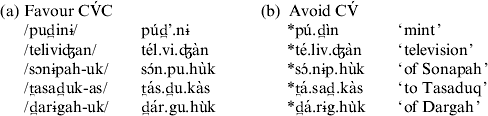
When syncope addresses a stress lapse, then, it often avoids stress on an open syllable as well. However, in (37) we saw cases in which syncope addresses only a stress lapse: the less preferred no-syncope output for the input /paah-im-is/ is pá .ɨ.hi.mìs ‘to the 50th one’, in which the stressed initial syllable is closed. This syllable is followed by two unstressed CV syllables which syncope reduces to a single unstressed CVC syllable in the preferred form pá .h.mìs. Again, lapses are not avoided by assigning stress to a CV syllable, *pá ..hi.mìs or *pá ..hì.mìs.
In another set of cases, no stress lapse occurs in the ‘unimproved’ form and syncope improves the output only by avoiding stress on an open syllable. In (39a), a word-initial C1.CV2 sequence is conflated into a single stressed CC syllable by dropping V2. The conflation of C.CV to CC also occurs in non-initial position, as in (39b). In this case, the preferred outcome is the syncope form in which the fourth vowel has been deleted.
(39)

In the case of (39b), s n.p h.kìs, with the initial two syllables reduced to one, is also possible, but is more common in speech at a more rapid rate. In this alternative, the medial CVC syllable is stressed, where a medial CVC syllable in underived forms such as y m.bɨr.zàl in (9) is not. We analyse this as a stress preservation effect: in s n.p h.kìs, the stressed vowel in p h is also stressed in both forms in (39b).
While the patterns of syncope described above are general and pervasive in Koshur, syncope is subject to phonological and morphological restrictions which we describe below.
4.2 Contexts in which syncope is blocked
There are two phonological restrictions on syncope. First, syncope is blocked when the outcome conflicts with phonotactic constraints on consonant clusters. For example, syncope forms that result in most tri-consonant clusters, as in (40a), and clusters of [l] followed by [r], as in (40b), are also not allowed. (Some sequences of three consonants are tolerated, especially if the last two can form a complex onset, as in ʤá.là .rɨ in (12).)Footnote 17
(40) Syncope blocked by phonotactic restrictions

The second restriction is that word-final vowels are protected from deletion, whether they are root-final, as in (41a), or suffixed, as in (41b). This is a firm generalization for final vowels that derive from vowels that were historically present in native Kashmiri forms.
(41) Vowel drop cannot lead to apocope

The exception is that final vowels that were historically appended through epenthesis to consonant final loan forms can be deleted in casual speech. Examples appear in (42).
(42) Deletion of historically epenthetic final vowels

Our formal analysis will focus on the preservation of word-final vowels in the native lexicon.
A primary effect of syncope is to close a stressed syllable that would otherwise be open, and stressed vowels in syncope forms correspond to stressed vowels in their no-syncope counterparts – except when the correspondence cannot be maintained under syncope. In (43), the stress-preserving syncope forms *máh.rèɲ (or equally, *má.ha.rèɲ) and *ʤá.la .àr are ruled out because apocope is not allowed, and *máh.re.ɲi contains a final stress lapse.
(43)
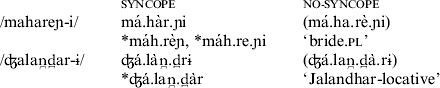
The permitted syncope forms avoid stress lapses and apocope, while remaining phonotactically well-formed (cf. lá.fàŋ.gɨ ‘rogue’ in (8)), but at the costs of correspondence between stressed vowels, and of avoiding stress on an open syllable.
4.3 Syncope does not add weight to stressed syllables
A coerced weight account might claim that when a vowel is dropped, and when the preceding syllable is stressed, the mora of the deleted vowel is transferred to the pre-deletion consonant, adding weight to the preceding stressed syllable in the form of a moraic coda. However, there are reasons to reject a coerced weight analysis for Koshur. The evidence is provided by cases in which syncope regularly conflates CVː.CV sequences to CVːC, exemplified in (44). The difference between (44) and the forms in (34c) is that in (44), syncope improves the output only by closing a stressed syllable, as there is no stress lapse to be avoided.
(44) Syllables containing long Vs are closed through syncope
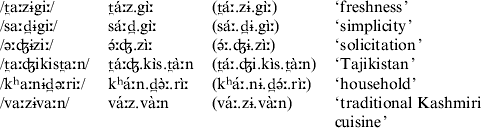
The coerced weight analysis might be plausible for cases in which a predeletion consonant closes a syllable containing a short vowel, in order to add weight to a stressed syllable. However, this cannot be the analysis of the forms in (44). In these cases, the stressed syllables closed by syncope are already bimoraic by virtue of their long vowels, so there is no reason to make these syllables heavier by adding a moraic coda.Footnote 20, Footnote 21 (Syllables containing more than two morae, and moraic consonants are both marked, and it is difficult to construct a plausible constraint hierarchy that would produce either in these cases.) The forms in (44) do, however, show that a closed syllable is a better stress peak than an open syllable, even when the syllable contains a long vowel. The simplest and most general explanation that accounts for forms like / aːzɨgiː/→áːz.gìː and for forms like /kanɨgɨʧ/→kán.g ʧ in (39), then, is that the assignment of the pre-syncope consonant as a coda in such forms satisfies the requirement, defined in Section 3, that the moras of a stressed syllable should branch.
Summarizing, in Sections 4.1, 4.2 and 4.3 we have described a process of syncope that improves phonological outputs in Koshur in two ways: syncope avoids stress lapses, and it avoids stressed open syllables by associating a pre-deletion consonant to a stressed syllable as a coda. Syncope is obligatory when not applying it would produce a word-final stress lapse. In the other contexts where syncope applies optionally, syncope forms are preferred over corresponding no-syncope forms.Footnote 22 The cases of syncope in Koshur that are most relevant for our theoretical point are those in which syncope closes a stressed syllable and in which lapsing stress is not a factor. We argued in Section 4.3 that pre-deletion consonants do not add a mora to the stressed syllable they close in Koshur. This supports the first part of our primary and most general claim about syllable ‘weight’ – that closed syllables are more harmonic stress peaks than open syllables by virtue of having a branching mora. This is not to say that coda consonants are never moraic in languages, only that adding a mora is not the only way that a coda consonant can contribute to syllable prominence.
4.4 An Optimality Theory analysis of syncope in Koshur
The pattern of syncope discussed throughout this section is complex and deserves to be treated in a full-length paper on its own.Footnote 23 The analysis in this section centres on our intuition that Koshur employs syncope as a strategy for avoiding two marked outcomes – stress on open syllables (stress-triggered syncope), and sequences of unstressed syllables (lapse-triggered syncope). With these broader points in mind, the analysis must account for a number of specific points. A first observation – that while syncope avoids stress lapses, it does result in stress clashes – is accounted for by the ranking *Lapse » *Clash, which we established in Section 3. Three additional points will need to be addressed in this section. First, in avoiding stress on open syllables, syncope results in degenerate feet, where an underlying /CVCV/ sequence is reduced to CVC on the surface. Secondly, syncope normally targets unstressed, not stressed vowels, so the same vowels are stressed in syncope and no-syncope forms. This means that syncope in Koshur is not for the most part associated with effects of metrical opacity often seen in languages with vowel elision (see for example Gordon Reference Gordon, Megerdoomian and Bar-el2001).Footnote 24 Finally, elision does not target word-final vowels.
The clearest examples of lapse-triggered syncope are seen in words like kú .rɨh.mìs (in (37), from /kurɨh-im-is/ ‘to the 29th one’) and .rɨ (in (35), from /əɨr-ɨ/ ‘edges’), in which the initial stressed syllable is closed regardless of whether syncope applies. In such cases, syncope improves the output only by avoiding a stress lapse. Lapse-triggered syncope is compelled by ranking *Lapse above the correspondence constraint MaxIO(V) in (45) (see McCarthy & Prince Reference McCarthy, Prince, Beckman, Urbanczyk and Walsh Dickey1995 on correspondence constraints). The tableau for kún. rɨh.mìs is given in (46).
(45) Maxio(V): Every vowel of the input has a correspondent in the output.
(One * for every input vowel that does not appear in the output.)
(46) *Lapse » MaxIO(V)
The best examples of stress-triggered syncope are cases such as áːz.gìː (in (44), from /aːzɨgiː/ ‘freshness’) and ás. ùk (in (39), from /asauk/ ‘Tasaduk (personal name)’), in which two open syllables are conflated to a single closed syllable in a context where no stress lapse is an issue. An account of stress-triggered syncope requires that MaxIO(V) be ranked at least below *PkFT/NoBr(μ), introduced in Section 3. The tableaux for áːz.gìː and ás. ùk are in (47).
(47) *PkFT/NoBr(μ) » MaxIO(V)
Stress-triggered syncope frequently results in monomoraic primary stress feet. In our analysis of stress in Section 3.2, we showed that the constraint FtMin(μ) must be ranked at least below the constraints InitialStress and WSP. The syncope facts establish that FtMin(μ) must be demoted to rank below *PkFT/NoBr(μ), as shown in (48).
(48) *NonBranch(
) » FtMin(μ)
 ) » FtMin(μ)
A form such as ár.gu.hùk (from /arɨgah-uk/ ‘of Dargah’ in (36a)) provides an example of both stress-triggered and lapse-triggered syncope. A stress lapse could be avoided by deleting either the second or the third vowel. However, only the second vowel can be dropped in this case, so that the stressed syllable is closed. The alternative * á.rɨg.hùk is impossible. The tableau for ár.gu.hùk is shown in (49).
(49) *PkFT/NoBr(μ) » *Lapse » MaxIO(V)
The ban on apocope (i.e. pú '.nɨ but not *pú. ìn from /puinɨ/ ‘mint’ in (34a)) reflects a general right-edge anchoring effect (McCarthy & Prince Reference McCarthy, Prince, Beckman, Urbanczyk and Walsh Dickey1995): neither consonants nor vowels in final position are deleted in Koshur.Footnote 25 This effect is due to ranking R-Anchor(Stem, Pr.d) in (50) (R-Anchor for short) above constraints that promote syncope. (See McCarthy & Prince Reference McCarthy, Prince, Beckman, Urbanczyk and Walsh Dickey1995 on Anchor constraints.)
(50) R-Anchor(Stem, Pr.d): The segment at the right edge of any stem has a correspondent at the right edge of some prosodic word.
(One * for any stem that does not meet this requirement.)
That final vowels are protected at the cost of tolerating a stressed open syllable in the output shows that R-Anchor outranks *PkFT/NoBr(μ) in Koshur. The tableau showing the effect of this ranking for the form bá. ɨ ‘steamed/cooked rice’ in (4a) is given in (51).
(51) R-Anchor » *PkFT/NoBr(μ)
In section 4.4, we described an effect of stress preservation: stressed vowels in no-syncope forms are stressed in corresponding syncope forms, even in cases where this would not be the case in forms unaffected by syncope. A clear example showing this is s n.pìh.kìs ‘to the 3rd.masc.obj of Sonapah’, the fast-speech syncope form corresponding to s .ni.pì.hɨ.kìs in (39b). Normally, CVC syllables are unstressed between stressed syllables (e.g. ʧ .gan. àr ‘sweet potato’ in (9) above). The form s n.pìh.kìs can be even more directly compared with kú .rɨh.mìs (from /kurɨh-im-is/ ‘to the 29th one’, in (37)), in which syncope has also applied and which has the same pattern as ʧ .gan. àr. In our analysis, the medial syllable in s n.p h.kìs is stressed because the vowel corresponding to [] is stressed in the no-syncope form. This pattern is an effect of the output–output constraint Ident.tress(OStem1, OStem2) in (52) (Ident.tressOO for short; see Benua Reference Benua, Beckman, Urbanczyk and Walsh Dickey1995 on output–output constraints.)
(52) Ident.tress(OStem1, OStem2):
Let OStem1 (the no-syncope stem) and OStem2 (the syncope stem) be output stem forms corresponding to a single input stem.
(Assign a * for any stressed vowel of OStem1 that does not correspond to a stressed vowel in OStem2.)
The medial syllable in s n.p h.kìs is stressed because IdentStressOO outranks FtMin(μ). In kú .rɨh.mìs ‘to the 29th one’, this ranking prevents stress on the medial syllable rɨh because it is not stressed in the no-syncope form. The tableau in (53) compares the analyses of kú .rɨh.mìs and s n.pìh.kìs. In this tableau, each of the syncope forms is being compared to the careful speech no-syncope alternative.
(53) IdentStressOO » FtMin(μ)
IdentStressOO has no effect on ʧ .ga .àr ‘sweet potato’, which has no no-syncope counterpart, and FtMin(μ) selects the correct output, (ʧ .ga )(àr) over the alternative with three degenerate feet.
A violation of IdentStressOO occurs in má.hàr.ɲi (from /mahareɲ-i/ ‘brides’ in (43)) stress falls on the second vowel, whereas in the no-syncope form má.ha.rè.ɲi it occurs instead on the third. In this case, syncope does not improve the stressed syllable in initial position, which remains open. However, other alternatives violate other high-ranking constraints: *máh.rèɲ violates R-Anchor, and the no-syncope form má.ha.rè.ɲi ‘brides’ incurs two *PkFT/NoBr(μ) violations as opposed to only one in the attested form.Footnote 26 The rankings that correctly produce má.hàr.ɲi, then, are IdentStressOO » IdentStressOO and IdentStressOO » *PkFT/NoBr(μ).
By way of summary, in this section we have added the new rankings shown in (54).
(54) Critical rankings
These new rankings can be incorporated into the hierarchy presented at the end of Section 3 with only minor changes, as shown in (55).
(55) Hasse diagram
5. Discussion
In this paper, we have presented a detailed description and analysis of the effects of a four-grade weight scale CVːC>CVː>CVC>CV in Koshur, a dialect of Kashmiri previously unknown to western phonologists. The way the scale works in Koshur is unusual in at least two ways. First, it determines the distribution not only of primary stress, but also of secondary stress. To our knowledge, we have seen this only once before, in a pattern of stress assigned to verbs in Nanti (Crowhurst & Michael Reference Crowhurst and Michael2005). Secondly, Koshur is unusual in that its stress system does not just seek out the most prominent syllable for stress. Rather, the broader phonology conspires to create more prominent stress peaks by adding syllable codas through syncope. Thus, the paper makes contributions in the area of typology. The weight scale we have described for Koshur also determines the distribution of stress in the Kachru dialect of Kashmiri.Footnote 27 This paper provides a companion study that, in concert with material on the Kachru dialect, shows how the same multi-grade weight scale is associated with very different metrical effects in related varieties. Our study goes further than previous studies of Kashmiri in providing a detailed account of the interaction between stress and syncope.
Multi-grade stress scales based on syllable structure, such as that found in both Koshur and the Kachru dialect of Kashmiri are not common, but quite a few other cases with similar scales have been discussed in the stress literature since the mid-1990s. Stress effects consistent with the ternary scale CVː>CVC>CV have been documented for Chickasaw (Gordon Reference Gordon2002b), Shipibo and Capanahua (Elias-Ulloa Reference Elias-Ulloa2004a, Reference Elias-Ulloa, Bateman and Usseryb), Klamath (Rosenthall & van der Hulst Reference Rosenthall and Hulst1999), to name just a few cases. The four-grade stress scale found in Koshur/Kashmiri is much less common, but it has also been documented in at least two other languages, Nanti (Crowhurst & Michael Reference Crowhurst and Michael2005) and Pulaar (Wiltshire Reference Wiltshire, Mugane, Hutchison and Worman2006), both discussed below. The issue that all researchers have confronted is the apparently flexible prosodic behaviour associated with CVC syllables in systems with these weight scales. Two classes of analysis have been proposed to account for this behaviour. The first type of analysis, which we shall label the ‘coerced weight account’ after its principal assumption, is represented by Morén's (Reference Morén2000) analysis of the Kachru dialect. Coerced weight analyses claim that CVC syllables are variably monomoraic or bimoraic, depending on context: the coda contributes a mora, but only under compulsion.Footnote 28 In the case of weight scales such as (CVːC>) CVː>CVC>CV, the compelling factor is (usually) the presence of a closed syllable in a position that favours stress.Footnote 29 We will refer to the second type of analysis as the ‘coda prominence account’. Coda prominence analyses claim that the prominence contributed by syllable codas can be distinct from the prominence contributed by morae and therefore, it should sometimes be possible to tease apart the effects associated with one kind of prominence (branching morae) from those associated with the other (mora count). Our analysis is aligned with the coda prominence camp, represented by prior works such as de Lacy (Reference de Lacy1997), Crowhurst & Michael (Reference Crowhurst and Michael2005) and Wiltshire (Reference Wiltshire, Mugane, Hutchison and Worman2006), but especially with Crowhurst & Michael (Reference Crowhurst and Michael2005), who attribute coda prominence to branching morae, as we do. In Section 5.1, we discuss the coerced weight analysis of Kachru's Kashmiri proposed in Morén (Reference Morén2000) and sketch a reanalysis in our terms. This is followed by a discussion of broader support for the coda prominence approach to CVC weight in Section 5.2.
5.1 Coerced weight and stress in Kachru's Kashmiri
The stress pattern of Kachru dialect of Kashmiri analysed in Morén (Reference Morén2000) is very different from that of Koshur. In the Kachru dialect, stress never falls on a final syllable in polysyllabic forms. Stress is assigned noniteratively, and in polysyllabic words, its position is determined by the hierarchy CVːC>CVː>CVC>CV. In words combining syllables of different grades on the scale, stress falls on the heaviest non-final one, and if more than one syllable in this grade is present, stress is assigned to the leftmost. When all non-final syllables are from the same grade, stress falls on the leftmost. Morén's analysis uncontroversially attributes left edge stress in words like má.lɨ.ri ‘ripples’ (our example in (4b)) and y m.bɨr.zal ‘narcissus’ in (1a) whose syllables are of equivalent weight to a constraint Align.ead-Left, which is ranked above its right-edge counterpart, Align.ead-Right (‘Align the head syllable of a prosodic word to the left/right edge of that prosodic word’). A stronger syllable can draw stress away from the left edge because the WSP outranks AlignHead-Left, as in mɔ.kɨ.láa.vun ‘to finish’ in (1c). A faithfulness constraint requiring vowels to have the same number of morae at input and output prevents long vowels from shortening to keep stress at the left edge. A high-ranking Non-Finality constraint rules out stress on a strong final syllable, as in ʃo.k  r.vaar ‘Friday’ in (1b).
Coerced weight analyses in general claim that CV and CVː syllables are straightforwardly mono- and bimoraic, but that CVC's mora count varies depending on context: the coda contributes a mora, but only under compulsion. Morén's analysis of Kashmiri compels the coda of a CVC syllable to bear weight in the general case by ranking the constraint Weight.by-Position (WbyP; ‘Coda consonants must surface as moraic’) over a set of constraints we will refer to collectively as *Mora[Cons] (‘Do not associate a mora with a consonant’), WbyP » *Mora[Cons].Footnote 30 In this way, when a CVC syllable co-occurs only with CV syllables in a form such as ʃo.k r.vaar, CVC attracts stress by virtue of its bimoraic status. The ranking WSP » AlignHead-Left accounts for the step CVC>CV in the stress scale, just as it does the step CVː » CV. However, if syllable codas receive a mora through Weight-by-Position so that CVC and CVː syllables are both bimoraic, then CVː and CVC should be indistinguishable for purposes of stress assignment. In Morén's account, WSP (which requires all heavy syllables to bear stress) exerts pressure for unstressed heavy syllables to drop a mora, and CVː fares better than CVC under this pressure. He ranks a faithfulness constraint Max.ink-μ[voc] (‘Do not delete an underlying mora from a vowel’) above WSP, so that long vowels can never shorten. However, WbyP is ranked below WSP, so that the codas of unstressed syllables do not have morae in outputs. This accounts for the step CVː>CVC in the stress scale, evident in forms like vah.ráa.vun ‘to spread’ in (1d). To explain the fact that CVːC syllables are assigned stress in preference to CVː syllables in forms like boo.dées.var ‘Lord’ in (1e), Morén assumes that CVːC syllables are trimoraic and he appeals to the constraint PeakProminence defined in (56).
(56) PeakProminence (PkProm)
Peak (x) is more harmonic than Peak (y) if |x|>|y|, where |μμμ|>|μμ|>|μ|.
(Prince & Smolensky Reference Prince and Smolensky1993, based on McCarthy & Prince Reference McCarthy and Prince1986, Hayes Reference Hayes1995)
In a contest between CVː and CVːC in boo.dées.var, then, PkProm selects a non-initial CVːC syllable as long as it is ranked above AlignHead-Left. The WSP does not contribute to the decision between CVː and CVːC, since both syllables are heavy.
In our view, a weakness of accounts relying on (56) is the assumption that syllables can be trimoraic. In this, the Morén analysis follows precedents established by Prince & Smolensky (Reference Prince and Smolensky1993), Hayes (Reference Hayes1995), Broselow et al. (Reference Broselow, Chen and Huffman1997), and Gordon (Reference Gordon2002a). Trimoraic syllables were admitted to the inventory of syllable types allowed by UG in part to account for the behaviour of superheavy CVːC and CVCC syllables in stress systems. There is no need, in the coda prominence account, to admit trimoraic syllables – in company with de Lacy (Reference de Lacy1997), Crowhurst & Michael (Reference Crowhurst and Michael2005), and Wiltshire (Reference Wiltshire, Mugane, Hutchison and Worman2006) we have reinterpreted the stress data that seemed to require them. A second weakness of coerced weight approaches, given that they must be able to handle four-level stress scales like CVːC>CVː>CVC>CV and not just the less problematic ternary scale CVː>CVC>CV, is that they offer no unified account of the contribution of coda consonants to syllable weight. Conceptually, CVC syllables are less attractive than CVː syllables as stress bearers in four-grade stress systems like CVːC>CVː>CVC>CV because CVC can lose a mora more easily than CVː (or gain one more easily than CV). However, the explanation for CVːC>CVː is quite different and less satisfactory – superheavy CVːC has an unusually large number of morae. In the coda prominence account, CVːC and CVC are ‘heavier’ than open CVː and CV syllables, respectively, and the source of the added weight is the same – it is contributed by the syllable coda, independently of the syllable's mora count.
Morén (Reference Morén2000: 392) claims as a strength of his analysis the fact that the constraints on which his coerced weight account relies cannot be reranked to describe the scale CVːC, CVC>CVː, CV according to which all closed syllables are heavier than all open syllables. According to Morén, the particularly problematic aspect of such a scale is that it anticipates stress systems in which closed light CVC syllables are preferred over open heavy syllables, CVː. In fact, a disadvantage of the Morén account is precisely that such languages, while not common, do seem to exist. As Wiltshire (Reference Wiltshire, Mugane, Hutchison and Worman2006) notes, Tiberian Hebrew has been discussed as just such a language (de Lacy Reference de Lacy1997, McCarthy Reference McCarthy1979). In this language, final CVːC, CVCC, and CVC syllables are assigned primary stress, but final CVː and CV syllables are not. We may add the example of Huehuetla Tepehua (Kung Reference Kung2007, Kung & Crowhurst Reference Kung and Crowhurst2008), in which primary stress falls on final syllables closed by sonorant consonants (e.g. ts'a.(ˈʔam) ‘corn stubble’), but is retracted to the penult in words ending in a CVː or CV syllable (or a syllable ending in a non-sonorant consonant) (e.g. (ˌta.laː)(ˈmaq.niː) ‘they killed each other’, ʔa.(ˈsiː.βiːk) ‘vine’, maː.(ˈɬi.juk) ‘spider’, pa.(ˈla.ta) ‘better’).Footnote 31 The coda prominence approach anticipates such languages. The scale CVːC, CVC>CVː, CV follows from ranking *PkFT/NoBr(μ) above the WSP.
Morén offers no argument against the proposal that a branching mora – for this is the source of the coda prominence effect – augments a syllable's attractiveness as a stress peak. He dismisses the idea that coda consonants can contribute in this way, as constituents of branching rhymes, by calling into question the formal status of branching rhymes (Morén Reference Morén2000, his Section 4.1.1).
The most widely adopted representations of the syllable since the late 1980s, those proposed in Hayes (Reference Hayes1989), do not include a formal rhyme constituent. However, in Hayes' representations, a coda consonant does form a de facto constituent with the previous vowel, as dependents of the rightmost mora of a closed syllable. This type of representation is not considered in Morén (Reference Morén2000), and so no worthy counterargument is presented.
In our terms, the analysis of stress in the Kachru dialect is straightforward. Noniterative stress can be attributed to a constraint *Struc(Foot) (‘Penalise any stress foot present in the output’; see Zoll Reference Zoll1996 on *Struc constraints), ranked above Parse-Syll (‘All syllables are included in feet’). Ranking the constraint Lex.ord=Pr.d (‘Every lexical word is a prosodic word’) guarantees the presence of a foot, since any prosodic word requires a head at the foot level. The subhierarchy AlignFoot-Left »AlignFoot-Right ensures that this foot (with its requisite stress peak) will be oriented to the left edge of the prosodic word. The subhierarchy WSP » *PkFT/NoBr(μ) » *PeakFT/σμ which accounts for the four-grade stress hierarchy in our analysis of Koshur, does the same work in the Kachru dialect but in the latter dialect, the WSP must be ranked below the pair AlignFoot-Left » AlignFoot-Right to explain why not every syllable containing a long vowel has stress. The fact that CVC, CVː, and CVːC syllables draw stress away from the left edge requires AlignFoot-Left to be ranked below the WSP and *PkFT/NoBr(μ). Finally, Morén's constraint Non-Finality (‘No head of a prosodic word is final in the prosodic word’) stands at the head of the hierarchy, above the WSP. The rankings required to account for the facts of stress in the Kachru dialect are summarized in (57).Footnote 32
(57) Constraint hierarchy for the Kachru dialect of Kashmiri
LexWord=PrWd » *Struc(Foot) » Parse-Syll
Non-Finality » WSP » *PkFT/NoBr(μ) » *PeakFT/σμ, AlignFoot-Left » AlignFoot-Right
5.2 Broader evidence for the coda prominence account
Like all mora-dependent analyses of syllable weight, coerced weight accounts along the lines of Rosenthall & Van der Hulst (Reference Rosenthall and Hulst1999) and Morén (Reference Morén2000) take as the point of reference for weight sensitivity the distinction between long and short vowels. The chain of reasoning behind the coerced weight approach goes as follows. In weight-sensitive stress systems the primary distinction is between long and short vowels. The unit of vowel length is the mora. In weight-sensitive systems that have a vowel length contrast, long not short vowels attract stress. Therefore, the unit of vowel length must be the unit of syllable weight: the bimoraic structure that makes vowels long also makes syllables heavy. If so, then if weight-sensitive effects are associated with both CVː and CVC syllables in some language, then whatever defines CVː as heavy (bimoraic structure) must also be attributed to CVC. There exist puzzling cases in which CVC syllables appear to pattern with CVː only some of the time. But following the same chain of reasoning, it must be the case that in such systems, CVC syllables are bimoraic only when they appear to behave like CVː syllables.
The alternative position taken here is that if enough systems are attested in which both CVː and CVC display weight-sensitive effects but their metrical behaviour is distinct, then what makes CVC heavy may not always be what makes CVː heavy. It is by now well understood that the number of a syllable's morae is not the only factor that determines preferential stress effects. In significant part due to Kenstowicz (Reference Kenstowicz1996) and later work following in that vein, it has become clear that the existence of a smorgaasbord of languages in which stress is sensitive to vowel quality has put to rest the once-dominant view that graded distinctions in the assignment of stress can be universally attributed to mora count.Footnote 33 Languages in which vowel quality determines two ‘weight’ grades have been known for some time (see Kiparsky Reference Kiparsky, Anderson and Kiparsky1973). As an example, the vowels of Mari (Cheremis) grade into two groups, a set of peripheral ‘strong’ vowels [a, ä, o, ö, e, i, u, ü], which are favoured in stressed positions, and central ‘weak’ vowels, which Kenstowicz (Reference Kenstowicz1996: 176) describes as ‘front and back round and unround variants of schwa’ and transcribes as [U, Ü, I, Ɨ ], all reflexes of schwa, which can receive stress only if a strong vowel is unavailable (Kiparsky Reference Kiparsky, Anderson and Kiparsky1973, Kenstowicz Reference Kenstowicz1996). Any stress hierarchy with only two grades can in principle be reduced to a distinction between monomoraic and bimoraic structure. For Mari, we might suppose that strong vowels have two morae, while weak vowels have only one.
However, there are multigrade prominence scales based on vowel quality whose effects cannot be reduced to an opposition between monomoraic and bimoraic structure. One of the more interesting examples of quality-sensitive stress is found in Kobon (Davies Reference Davies1981, cited in Kenstowicz Reference Kenstowicz1996). In Kobon, a scale based on vowel height, Low>Mid>High, assigns top priority to low vowels, and lowest priority to high vowels as stress peaks. A second scale, Peripheral>Central, favours the peripheral vowels [a, e, o, i, u], and disfavours the central vowels [ə, ɨ]. Interacting, these two scales produce the multigrade scale a>e, o>i, u>ə>ɨ.
In unaffixed words, stress is limited to one of the last two syllables in Kobon, implying the presence of a word-final disyllabic foot. When the last two vowels occupy the same rank on the scale a>e, o>i, u>ə>ɨ, stress falls on the penult (e.g. kɨj gɨl ‘tattoo’). However, when these vowels belong to different grades, stress falls on the vowel belonging to the higher grade (e.g. alágo ‘snake species’ and kidolmán ‘arrow type’, si.óg ‘bird species’). Kobon's stress scale of five grades cannot sensibly be accounted for by claiming that some vowels in Kobon are moraically better-endowed than others: even if one were to claim that the lowest ranked vowel [ɨ] has no morae, we might not want to suppose that the highest-ranking vowel [a] has four.
That preferential stress effects associated with vowel quality cannot be accommodated by analyses relying solely on the mora as the unit of stress is uncontroversial. It might seem possible to treat quality-sensitive stress as a separate phenomenon and still maintain the position that all stress distinctions that are sensitive to syllable structure (open vs. closed, long vs. short vowels, etc.) can be accommodated by analyses that count morae. Still, problems persist. Some multigrade stress scales are based on syllable structure, where vowel quality also plays a role. A particularly interesting example is found in Nanti, a Kampa language of Peru, whose stress pattern is described in Crowhurst & Michael (Reference Crowhurst and Michael2005).
The distribution of stress in Nanti verbs follows a complex multigrade scale that can be dissected into several subhierarchies. Like Kobon, Nanti stress has a quality-sensitive component, represented by the height-based scale in (58a). Nanti also shows effects of the four-grade scale CVːC>CVː>CVC>CV found in Koshur/Kashmiri. Crowhurst & Michael (Reference Crowhurst and Michael2005) break this scale down into two subscales, the standard quantity based scale in (58b) and a scale based on syllable closure in (58c), as we also do. The scales in (58) interact in such a way that each of the grades in the scale CVːC>CVː>CVC>CV is further subdivided into three grades, one for each grade in (58a). (One additional factor is described below.) The predicted result is a stress scale of twelve grades, most of which Crowhurst & Michael are able to attest. Astonishingly, all of these scales apply to stress assignment both at the foot and word levels.Footnote 34
(58) Nanti stress scales based on quality
(a) Low>Mid>High (a>e, o>i)
(b) σμμ>σμ
(c) Closed>open
In Nanti, verbs are parsed into disyllabic feet from left to right, subject to Non-Finality conditions discussed in Crowhurst & Michael (Reference Crowhurst and Michael2005). The form in (59a) shows that stress is iambic in feet combining syllables from the same grade (as defined by (58)). However, when a foot combines syllables from different quality grades, as in the underlined foot in each of (59b, c), stress falls on the syllable from the higher grade. The examples in (59) also show that the default position for primary stress is on the rightmost stressed syllable. Those in (60) show that stress migrates from the right edge to fall on a higher-ranking syllable further to the left.
(59) Nanti foot level (nonprimary) stress
(a) (o.kò)(wo.gó).te.ro ‘She harvests it.’
(b) (nò.ʃi)(po.ká).kse.ro ‘I doused it (a fire).’
(c) (nà.pje)(ʃi.gò)(pi.rè)(já.kse) ‘I rested.’
(60) Nanti primary stress
(a) (pi.ká)(bi.rì).ti ‘You get active.’
(b) (i.nò)(ʃi.já).gje.ti ‘He pulled multiple things.’
(c) (i.róo)(ga.ksèm).pa.ra ‘He will consume.’
The steps in the scale CVːC>CVː>CVC>CV can be fully illustrated using examples from both stress levels (foot and word). In (61a), a closed syllable mam woos stress away from the CV syllable ja, and in (61b) the CVː syllable roo wins over the closed syllable ksem. Finally, (61c) shows that the CVːC syllable raan in the second foot trumps the CVː syllable tai. ([ai] is a bimoraic diphthong; these pattern with long vowels in Nanti's stress system.)
(61) CVːC>CVː>CVC>CV

A closer look at the form in (61b) reveals a type of metrical sequence that is predicted by the coda prominence account but presents a real problem for a coerced weight account. In (i.róo)(ga.ksèm).pa.ra, the syllable roo must be heavier than the closed syllable ksem since roo pulls stress from the right. The coerced account would have roo be bimoraic and ksem be monomoraic. At the same time, however, the coerced weight account requires the syllable ksem to be bimoraic in the secondary stress foot; otherwise, ga should have the secondary stress, as low vowels outrank mid vowels on the quality scale. A coerced weight account might avoid the dual nature problem by proposing that in forms with no CVːC syllables, CVC could be given two morae and CVː three. Then, when CVC syllables are not present but CVː and CVːC syllables are, CVːC would have three morae and CVː would have only two. No such gymnastics are required to handle cases like (i.róo)(ga.ksèm).pa.ra in the coda prominence analysis.
Our proposal makes an additional prediction, which is supported, again, by evidence from Nanti. Crosslinguistically, diphthongs are known to pattern either as bimoraic or as monomoraic vowels for the purposes of stress assignment. A language well-known to phonologists for having diphthongs of both types is Rotuman (Churchward Reference Churchward1940, McCarthy Reference McCarthy2000). In addition to the scales described in (58), stress in Nanti is sensitive to the difference between the high vowel [i] and a [+high] light diphthong [Ɯi]. Nanti has bimoraic diphthongs [ai, oi, ae, Ɯii] whose stress behaviour is indistinguishable from that of long vowels. The light diphthong [Ɯi] does not pattern like a long vowel, rather – it patterns as heavier than [i] and lighter than the low vowel [a]. If light diphthongs are sequences of two vowel root nodes that share a mora, then [Ɯi] and [i], both specified [+high], are distinguished by the fact that [Ɯi] is characterized by a branching mora, and [i] is not. This fact about Nanti serves to make the point that mora branchingness is a more general phenomenon than simply coda prominence. The facts associated with [Ɯi] aid in making another point worth considering. The forms in (62a) stress in Nanti show that [a]>[Ɯi], and those in (62b) show that [Ɯi] has the same rank as the mid vowel [o], which outranks [i]. (See the examples in (59b, c).) The diphthong [Ɯi] occupies the same rank as the mid vowels [e, o], as shown by the fact that stress in the first foot of (nò.tƜi)(gá.kʲe).ri is retracted in the context of a stress clash, but is not retracted in (no.t  i).je.ro, where there is no clash. in Nanti's stress scale.
- (62)
(a) (jà.mƜi)(ta.kói).ga.kse.na ‘they helped us with something else’
(mƜi.tà)(kói.ga).kim.pi.ra ‘helped you with it’
(b) (nò.tƜi)(gá.kje).ri ‘I blew tobacco powder into his nose’
(no.tƜí).je.ro ‘I will knock it over’
However, [Ɯi]'s metrical behaviour, overlapping as it does with that of the mid vowels does not make [Ɯi] a mid vowel. This is the point we have been making throughout in regard to preferential stress effects found with CVC and CVː – if CVC attracts stress in some of the same contexts that bimoraic CVː syllables do, this does not necessarily mean that CVC must also be a bimoraic syllable, at least in the cases discussed here.
6. Conclusion
The point we have striven to make throughout this paper is that analyses relying on the number of a syllable's morae do not provide a satisfying account of preferential stress effects associated with the scale CVːC>CVː>CVC>CV, as we find it in languages such as Nanti and Koshur/Kashmiri. Wiltshire (Reference Wiltshire, Mugane, Hutchison and Worman2006) makes a similar observation in her analysis of stress in Pulaar. Coda prominence accounts attribute the effect of the coda to branching structure. Two previous works, de Lacy (Reference de Lacy1997) and Wiltshire (Reference Wiltshire, Mugane, Hutchison and Worman2006) (following de Lacy) present a different view of coda prominence. Those authors adopt representations of the syllable in which onsets branch from the first mora, while coda consonants branch from the syllable node. That approach misses an opportunity to connect the three different ways we have noted in which languages can access moraic structure in determining metrical prominence. We've long known that quantity matters, and have more recently come to understand the role played by the quality of vowels (and consonants, see Zec Reference Zec1995) associated with morae. Our contention is that branchingness is another property of the mora with metrical significance in some languages.
Our proposal, that analyses referring to branching morae can account for some cases in which closed CVC syllables seem to form a weight class with bimoraic open syllables, is not intended to challenge the view that coda consonants can and often do contribute a mora to syllables. Rather, the claim is that the traditional view is not sufficient to account for all preferential stress effects associated with closed syllables, and that a metrical theory that makes room for both types of prominence associated with coda consonants is better able to account for the range of attested phenomena. If so, then it should be possible to find languages in which the two types of structures associated with syllable codas together determine where stress falls. Such a language would meet two conditions: (i) CVC syllables and open CVː syllables (where Vː is a long vowel or heavy diphthong) would exhibit the same stress attracting properties in all contexts; and (ii) CVːC and CVCC syllables would pattern as heavier than either CVː or CVC, forming a ternary scale CVːC, CVCC>CVː, CVC>CV. In fact, at least one such stress system exists in the much discussed dialect of Hindi described by Kelkar (Reference Kelkar1968) and prominently discussed in works such as Prince & Smolensky (Reference Prince and Smolensky1993) and Hayes (Reference Hayes1995), among many others. The ternary scale found in Hindi, generally taken as evidence for trimoraic syllables, is reanalysed here as a case in which CVː and CVC syllables are both bimoraic, and in which the branching rightmost mora (from which the final consonant in CVːC and CVCC depends) makes an additional contribution.
The proposal we make in this paper raises issues that merit closer examination. The contribution of sonority scales to prosodic organization has been much studied in recent years (see for example Prince & Smolensky Reference Prince and Smolensky1993; Morén, Reference Morén1999, Reference Morén2000; Baertsch Reference Baertsch2002; Baertsch & Davis Reference Baertsch, Davis, A. Hall and Hamann2003; Smolensky Reference Smolensky, Smolensky and Legendre2006, for interesting discussions and analyses), and the issues discussed here should be examined in light of recent findings in that area. Languages whose stress systems oppose consonants in different sonority classes (see Zec Reference Zec1995) should be reexamined from a coda prominence perspective. As another example, we referred above to a difference in the contribution of morae that branch over two vocalic root nodes as opposed to morae branching over a vocalic and a consonantal root node in the stress system of Nanti. Given that vocalic segments rank higher on the sonority scale than any consonant, the grade CVC>[Ɯi] found in Nanti might seem counterintuitive. Given that Nanti exists, future studies should explore the different properties of light diphthongs and light closed syllables that might play a role. It is our hope that the discussion begun here provides an opening for further research on these issues.
 .ris.


