1. Introduction
As a result of immigration from Luxembourg to the United States—peaking in the 1880s—there exist a number of Luxembourg American communities located primarily in the upper-Midwestern region of the country. This article focuses on Ozaukee County, Wisconsin for two interrelated reasons: One of the largest concentrations of people of Luxembourgish descent is domiciled in that part of the United States; moreover, it is home to the Luxembourg American Cultural Center (LACC), which opened its doors to the public in 2009 and hosted a grand opening celebration in 2010. Ozaukee County locals have been celebrating Luxembourg heritage for decades, prior to the construction of the LACC and the related founding of the transatlantic Luxembourg American Cultural Society (LACS) in 2004. The first annual Luxembourg Fest of Belgium (Wisconsin) was held in August 1987, and in 2011 it was renamed the Luxembourg Fest of America. The local newspaper of northern Ozaukee County and southern Sheboygan County, The Sounder, reports on this rebranding of the Fest as follows:
Fans of the annual Luxembourg Fest celebration can expect a greatly expanded event in 2011. This year marks the 25th anniversary of the Luxembourg Fest of Belgium, which has become the largest Luxembourg celebration outside of the Grand Duchy. To commemorate this anniversary the fest is undergoing some major changes […] The name is being changed to “Luxembourg Fest of America” and the event is being billed as the World's Largest Luxembourg Family Reunion.
(The Sounder, 4 August 2011)
In this context, the locally organized Luxembourg Fest and other displays of Luxembourgish linguistic and cultural heritage in Belgium, WI are in the process of being gradually transformed, especially in light of the LACS decision to hold its Luxembourg American Cultural Conference and Luxembourg Heritage Weekend (since 2007) during the same weekend of the Luxembourg Fest of Belgium.Footnote 1
Based on ethnographic fieldwork and geosemiotic analysis, I discuss the ways in which Luxembourgishness is indexed in Belgium, WI and how localized practices are being recast in relation to augmented forms of transatlantic cooperation. The increasingly rapid movement of people and information on a global scale has frequently contributed to the renegotiation of ethnic identities and group membership, especially as new networks have been formed or reestablished across large geographical distances. It is, therefore, productive to consider the ways in which the accelerated processes of globalization are (re)shaping the multifaceted relationship between language and migration. This article aims to unpack the relationship between language, place, and heritage by analyzing how Luxembourgish linguistic and cultural heritage displays serve to construct a sense of ethnic place in contemporary Ozaukee County, in light of the fact that most of the immigration from the Grand Duchy of Luxembourg to Wisconsin took place 150 years ago.
2. Luxembourgish Immigration to the Upper-Midwestern US
It is estimated that some 70,000 people emigrated from Luxembourg during the mid- to late-19th century, with the United States being the leading destination outside of Europe. This movement of people is often attributed in large part to the scarcity of farming land in Luxembourg, although the threat of military service requirements also played a role as Europe experienced various phases of political instability. In the expanding United States, politicians and entrepreneurs sought ways to further their interests and populate newly acquired territories with settlers of European descent, while displacing the indigenous populations.
Various organizations facilitated the practical arrangements for new-comers, the development of social networks, and the maintenance of Luxembourgish cultural practices in the United States. Of these, the one that remains active today is the Luxembourg Brotherhood of America, which was established in 1887 under the name Luxemburger Bruderbund von Amerika and based in Chicago, where the Luxemburger Zeitung was first published in 1889. The newspaper was later renamed the Luxembourg Weekly, and it continues to be published as a newsletter under the title Luxembourg News of America. Another key media source of the period was the Luxemburger Gazette first published in Dubuque, Iowa in 1871 that was under the editorship of Nicolas Gonner from 1872 to 1919. Gonner also authored the volumes entitled Die Luxemburger in der Neuen Welt (1889), providing an overview of Luxembourgish immigration to the United States, which was predominantly to the upper-Midwestern region (Ensch et al. 1987).
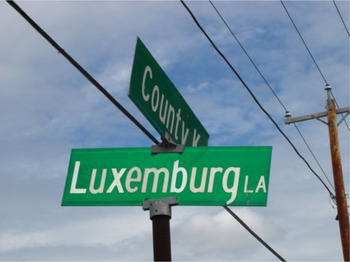
Along the shores of Lake Michigan to the north of Chicago and Milwaukee lies Ozaukee County, Wisconsin, home to one of the largest concentrations of people of Luxembourgish descent in the United States. In the mid-19th century and coinciding with the beginning of Wisconsin statehood, settlements were established in the towns of Belgium, Dacada, Holy Cross, and Lake Church, all of which are clustered in the northeastern corner of Ozaukee County in Belgium Township.Footnote 2 The latter three towns are sometimes still referred to by their Luxembourgish equivalents, Niklos, Kräiz Kierch/Helleg Kräiz, and Lak(k)e Kierch, which correspond to the respective Catholic churches whose cemeteries are dotted with tombstones bearing similar family names to those found in Luxembourg. Inscriptions of family names and birthdates in the stained glass windows of the Catholic churches—in English and standard German—also bear witness to the origins of the European immigrants as well as some insight into their linguistic practices. Moreover, traces of the immigrants’ origins exist in the form of company names such as Peiffer Oil and Propane, Inc. in Belgium and street signs such as Luxemburg Lane in Dacada, across from the St. Nicholas church and parallel to the cemetery.
Luxemburg Lane in Dacada, Wisconsin.Footnote 3

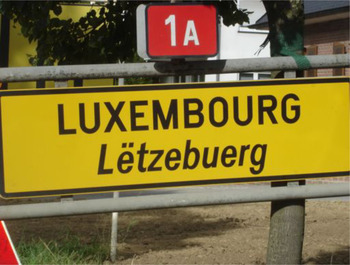
To frame the analysis of Luxembourgish heritage displays in section 4, I would like to flag the fact that material traces of 19th century European settlement in the Ozaukee County landscape are incongruous with signage in the contemporary Grand Duchy of Luxembourg in some respects. On the one hand, the orthographic rendering of Luxemburg in standard German on the Wisconsin street sign in figure 1 typically does not appear on public signs in present-day Luxembourg. On the other hand, such signs regularly utilize the French spelling of Luxembourg and/or the Luxembourgish spelling of Lëtzebuerg, sometimes appearing together on bilingual signs, as shown in figure 2.
Municipal sign in Luxembourg City, Luxembourg.

There was no widespread view among its speakers that Luxembourgish constituted a language separate from standard German during the mid-19th century, which stands in stark contrast to the present-day situation (Horner & Weber 2008). In a manner not dissimilar to linguistic boundaries, perceptions of spatial boundaries have also shifted over time. Of major relevance to this study is the place name Belgium in combination with that of Luxembourg on Ozaukee County signage, which is indicative of the state of affairs in Europe at the time when the earliest of the transatlantic immigrants arrived in (what was to become) Belgium, WI. This was immediately following the partition of Luxembourg in 1839, when the western part of the Grand Duchy was ceded to the newly formed country of Belgium and the eastern part remained the Grand Duchy of Luxembourg. Following this turn of events, an autonomous government was set up in Luxembourg, but it remained under the reign of the Dutch king and a member of the German Confederation. The European immigrants who settled in Belgium, WI during the mid-19th century came from towns and villages in the present-day Belgian Province of Luxembourg and the present-day Grand Duchy at a time when there was no deeply entrenched and widespread consensual feeling of allegiance to one particular country in this European borderland (see Péporté et al. 2010:154–155). Because the immigrants left an area marked by fluctuating political boundaries, the boundary between the present-day countries of Luxembourg and Belgium has not borne the same salience for descendants of immigrants from the (former) Grand Duchy of Luxembourg to Belgium, WI as it has—and continues to do—for descendents of individuals who remained in Europe.
Notwithstanding certain divergences concerning linguistic and spatial boundaries, collaborative activities organized by Ozaukee County locals and members of the transatlantic LACS board are proliferating; this collaboration is most notably marked by the decision for the Luxembourg Fest of Belgium to take place under the new name of Luxembourg Fest of America in August 2011. In the analysis, I examine the ways that a sense of ethnic Luxembourgish place in Belgium, WI has been constructed over the past few decades, and also how heritage displays are being reconfigured in light of increased transatlantic cooperation. Before focusing on these displays of cultural and linguistic heritage, the following section provides discussion of key contextual issues and theoretical concepts that inform the analysis.
3. Global Processes, Ethnic Heritage, and Discourses in Place
The genesis of the Luxembourg Fest of Belgium is not an isolated or unusual event; rather, it is part and parcel of an overarching momentum to celebrate (European) ethnicities and weave them together with local practices in various locations in the United States. For example, the Wisconsin Ethnic Settlement Trail (WEST) project, sponsored by the National Trust for Historic Preservation and the Wisconsin Division of Tourism in the 1990s, created a slate of tours focused on diverse ethnic groups in Wisconsin, including a Luxembourg tour in Ozaukee County. Predating the WEST project are multiple ethnic festivals in Wisconsin, including the Holland Festival in Cedar Grove, which lies just a few miles north of the town of Belgium.Footnote 4 Hoelscher (1998:13) points out that if we focus on descendants of European immigrants, “a map of ethnic heritage festivals across the American heartland reveals an archipelago of cultural displays that corresponds well with the region of heaviest nineteenth-century European immigration.” In his cultural geographic and ethnographic study on Swiss ethnic heritage in New Glarus, Wisconsin, Hoelscher (1998:16ff.) illustrates how a constellation of social and economic changes, together with incentives on the part of key social actors, gradually transformed the southern Wisconsin town into a heritage tourism destination. He maintains that these developments in New Glarus are best understood in relation to tensions between the dual processes of modernity: traditionalization and invention (see also Hobsbawm & Ranger 1983).
In a related vein, Harvey (1989) asserts that the 1970s constitute a critical moment in the transition from modernity to postmodernity, and that this transition is marked by intensified time-space compression, arguably the most prominent feature bound up with the accelerated process of globalization. Besides time-space compression, Coupland (2003a) flags three further key global processes: community inter-dependence, commodification, and disembedding. In addition to serving as a reminder that globalization is not synonymous with homo-genization, Coupland's discussion of global processes constitutes a useful point of departure for examining displays of Luxembourgish linguistic and cultural heritage. Compression of time and space enables the disembedding, or “lifting out,” of dominant national narratives in Luxembourg in ways that mesh with local Ozaukee County narratives on Luxembourgish immigration. It may be argued that the increasing degree of transatlantic cooperation and community interdependence has facilitated the commodification of Luxembourgish heritage in the United States, which is being “packaged and sold” in creative ways as part of the Luxembourg Fest and at the LACC. However, as Hoelscher (1998:22, original emphasis) points out, this process of commodification is by no means a unique process in the contemporary United States:
Any investigation on the changing role of tradition and memory in American culture must deal directly with the selling or commodification of place. Commodification—the process by which objects and activities come to be valued primarily in terms of their value in the marketplace and for their ability to signify an image—can take place as its starting point. Distinct places and the qualities they imbue, in other words, may be turned into commodities in their own right.
In tandem with the commodification of place is the heightened sense of identity and search for belonging that many people are experiencing in response to major transformations affecting their daily lives; there is sometimes a perceived need for a well-defined sense of place as a counterweight to change. Cultural and social geographers have pointed out that identity and a sense of place are frequently bound up with one another (Rose 2005). Debates over essentialist and constructivist approaches to senses of place (Feld & Basso 1996) and to ethnicity (May 2001) have been responded to most sensibly with calls for a middle ground between the two positions. Although all forms of identity are malleable to a certain degree and operate in similar ways, ethnicity is characterized by mutual perceptions of “cultural stuff,” including shared perceptions of a territory, or origin, or an ancestral language passed down from generation to generation (Jenkins 1997, see also Barth 1969). Indeed, displays of Luxembourgish linguistic and cultural heritage in Ozaukee County that commemorate past immigration from the Grand Duchy of Luxembourg are created from a palette of presumably shared “cultural stuff.”
Hoelscher (2006:202) conceptualizes heritage as “present-day uses of the past for a wide array of strategic goals, some economic and some more a matter of identity.” With that central point in mind, he discusses seven premises of heritage, “each of which articulates different levels of political, cultural, and social organization around the act of using the past” (2006:202). With the goal of contextualizing and understanding heritage practices, Hoelscher (2006) underlines the importance of the ways that these seven premises combine in various case studies: display, place, time, politics, popular appeal, development strategies, and authenticity. The latter four premises point to the unifying and divisive potential of heritage. For example: whose heritage is commemorated and whose is not? Which narration of events is considered credible? Which items are regarded as authentic? At the center of any analysis of heritage are displays, including objects, images, events, representations, and so on (Hoelscher 2006:203), and they all have the potential to evoke solidarity or protest. Although heritage displays commemorate the past, they are products of the present. Moreover, they “bear a definitive relationship to space” and are “nearly always grounded in place” (Hoelscher 2006:204).Footnote 5
While space and place are inherently central concepts in the fields of cultural geography and museum studies, the so-called spatial turn in sociolinguistics is marked, in particular, by a growing interest in how language is used in the public space. This booming area of research has been referred to variably as “linguistic landscapes” (Gorter 2006) and “semiotic landscapes” (Jaworski & Thurlow 2010), with the former drawing primarily on the work of Landry & Bourhis (1997) and the latter on the work of Scollon & Wong Scollon (2003:160), who—in this groundbreaking monograph—insist on the importance of contextualizing the analysis by incorporating a historical and ethnographic dimension:
The understanding of the visual semiotic systems at play in any particular instance relies crucially on an ethnographic understanding of the meanings of these systems within specific communities of practice […] Each of these discourses [the discourses of semiotic systems] would have its own history, its own trajectory by which it came to be in that place, perhaps through architectural plans or municipal ordinance.
The analysis of displays of Luxembourgish linguistic and cultural heritage draws on history, ethnographic fieldwork, and geosemiotics, which Scollon & Wong Scollon (2003:2ff.) define as “the study of the social meaning of the material placement of signs and discourses and of our actions in the material world.” Their approach combines scholarship in sociolinguistics and discourse analysis with research in cultural and social geography. Scollon & Wong Scollon stress three principles, the first of which is indexicality—it is based on the fact that much of the meaning of semiotic signs is dependent on how they are placed. They go on to stress the principle of dialogicality, pointing out that signs have double indexicality because on the one hand they index a discourse that authorizes their placement, and on the other hand, there are dynamics or intersemiotics between signs. Finally, they underline the principle of selection, or the ways in which certain meanings are foregrounded whereas others are backgrounded (Scollon & Wong Scollon 2003:23ff.).
4. Shifting Displays of Luxembourgish Heritage in Belgium, WI
This section provides a historically sensitive and ethnographically grounded analysis of Luxembourgish linguistic and cultural heritage displays in Belgium, Wisconsin, drawing on the previous discussion of global processes (Coupland 2003) and premises of heritage (Hoelscher 2006), as well as on the geosemiotic principles outlined by Scollon & Wong Scollon (2003). Shifting from the focus on historical traces of European immigrants’ origins in section 2, this section deals with culturally reflexive displays of Luxembourgish heritage that explicitly recall the past and actively celebrate immigration to Belgium from the Grand Duchy of Luxembourg. I begin by exploring how Luxembourgishness is indexed in the public space, and how the town of Belgium has been constructed as an ethnic Luxembourgish place during the final decades of the 20th century. The analysis then moves to recent forms of transatlantic cooperation and the ways in which this cooperation has been reshaping certain heritage displays. The final part of the analysis zooms in on the grand opening of the LACC and how it has consolidated the transformation of the town of Belgium into the key Luxembourg heritage site in the United States, which, in turn, is impacting upon localized practices in Ozaukee County.
4.1. Signs of Fluidity: Floating Signifiers and Linguistic Hybridity
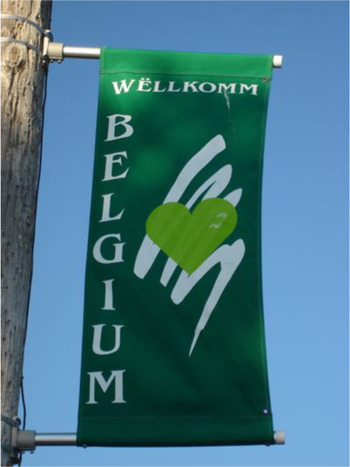
Next to the Belgium village hall, adjacent to the Belgium village park, a Belgian, an American, and a Luxembourgish flag wave in the breeze, with the American flag in the center and hoisted slightly higher than the other two. On the front of the neighboring municipal garage is a sign with the text “Luxembourg Heritage” in letters painted in green to match the green hearts that also appear on the sign. Also painted in green is the Luxembourgish motto “Mir Wolle bleiwe Wat mir sin” (‘we want to remain what we are’) on a somewhat worn, wooden sign affixed to the gazebo in the village park that commemorates the activities of the Luxembourg Society of Wisconsin founded in 1977 by Anita Kultgen Becker and Dorothy Schanen Simpson.Footnote 6 The Society recognizes the seven towns of Belgium, Dacada, Holy Cross, Lake Church, Port Washington, Fredonia, and Waubeka as “authentic Luxembourgish” and designates them as forming the “Green Heart of Luxembourg in Wisconsin” (Krier 1987:39).Footnote 7 The main streets of the town of Belgium are lined with dark green banners bearing the lighter green heart logo together with the Luxembourgish word Wëllkomm and the place name of Belgium.
Street banner in Belgium, WI.

While these banners as well as the combination of American, Belgian, and Luxembourgish flags would appear out of place in the Grand Duchy of Luxembourg due to contemporary perceptions of national boundaries in Europe, the semiotic combination of the green heart logo with the use of the Luxembourgish word Wëllkomm constructs a sense of ethnic Luxembourgish place in Belgium, WI. The placement and materiality of these banners resonates with the wider upper-Mid-western practice of adorning telephone poles on main streets with colorful, localized banners. What sets the banners in Belgium apart from those in neighboring towns—for example, in nearby Waubeka and Port Washington—is the display of a language other than English. Also differentiating the town of Belgium from nearby municipalities is the act of flying other national flags in addition to that of the United States. As Coupland & Garrett (2010:21) put it, the “visual pairing of flags […] performs cultural comparison or cultural hybridity.” In this way, the combination of these three national flags works to create a hybrid sense of ethnic place, unique to Belgium, WI. The flags are in dialogical relationship with the other signs, including the local green banners along the main streets.
The three flags of the United States, Belgium, and Luxembourg appear once again in animated “waving” format on the Belgium website, together with the following text:
The bright green hearts seen above the village's welcome signs symbolize the community's Luxembourg heritage. The Grand Duchy of Luxembourg is known as the “Green Heart of Europe” and the province of Luxembourg exits in the country of Belgium, Europe. While the first immigrants came from Luxembourg, neighboring settlers referred to this as “the Belgium area” because at that time much of Luxembourg was ruled by Belgium. The current residents still celebrate their heritage throughout the year. (Village of Belgium)
The green heart, highly visible throughout the town of Belgium, is immediately foregrounded as indexical of Luxembourgishness in this text. The “Green Heart of Europe” slogan was part of a tourist campaign in Luxembourg at the time when the Luxembourg Society of Wisconsin was founded, and it was taken on board as a logo for the first Luxembourg Fest of Belgium. When the Fest committee was searching for a logo suitable for decorations and publicity materials, the green heart served as logo that was relatively unproblematic to graphically reproduce in large quantities.Footnote 8 To the inhabitants of the Grand Duchy of Luxembourg, the green heart does not index Luxembourgishness, and few people in the Grand Duchy even recollect the existence of the green heart campaign, which was aimed at foreign tourists. However, in Ozaukee County, the green heart is omnipresent. It functions as a “floating signifier” (Leeman & Modan 2009:353) that has been disembedded from its original context and filled with new meaning in the act of being relocated to Belgium, WI.
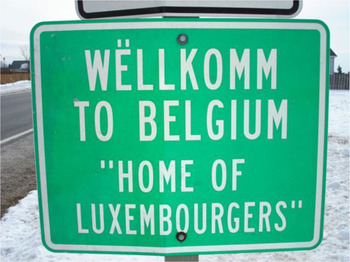
Wëllkomm to Belgium sign in Belgium, WI.

A further point I wish to flag in relation to the Village of Belgium website is the discursive choice to depict Luxembourg as one area (most of which was “ruled by Belgium”) rather than two separate areas (the Grand Duchy of Luxembourg and the Province of Luxembourg in Belgium). This representation of historical events differs from those on official websites of the Grand Duchy of Luxembourg where the emphasis is typically on the “loss” of territories to Belgium as a result of the so-called third partition of Luxembourg in 1839.Footnote 9 On the opposite side of the Atlantic Ocean, however, the town of Belgium, WI is regarded by many of its inhabitants as an ethnic Luxembourgish place, despite the fact that many of the European immigrants came from territory that does not lie in the contemporary Grand Duchy of Luxembourg. In chorus with the green banners, signs bearing the text “Wëllkomm to Belgium ‘Home of Luxembourgers’” were erected in 1988 in six locations along the borders of the town of Belgium, establishing visible markers indexing the fusion of Luxembourgish ethnicity and town Belgium locality.
With the visual indexes of Luxembourgishness in the form of Wëllkomm banners and signs adorning the town—together with the ubiquitous green heart—the town of Belgium stands in the limelight as an ethnic Luxembourgish place, during the annual Luxembourg Fest of Belgium that has taken place on the second weekend of August since 1987. The Fest showcases displays of honored families descending from 19th century immigrants to the area, as well as the reading of a Catholic mass—mainly in English, but with some parts in Luxembourgish. The day prior to the Fest participants also have the opportunity to take part in a parade showcasing farming machinery. In this way, the Fest unites celebrations of Luxembourgish heritage with localized northern Ozaukee County practices. In the park, green heart T-shirts are sold at the souvenir stand, and Luxembourgish cuisine, in particular Mustr(e)ipen “blood sausage,” is savored by locals and visitors who are in town for the Fest. People dance to the music of the longtime favorite musicians at the Fest, Die Freistadt Alte Kameraden Band, who play lively German music in a jovial manner. Sometimes, visitors from Luxembourg find a band playing German music at the Fest out of place. However, this has been common practice in Belgium for many years, and it is bound up with the sociohistorical trajectory of the United States rather than that of Europe. In Wisconsin, boundaries between the countries of Luxembourg and Belgium, as well as Luxembourg and Germany, do not bear the same salience as they do in Europe.
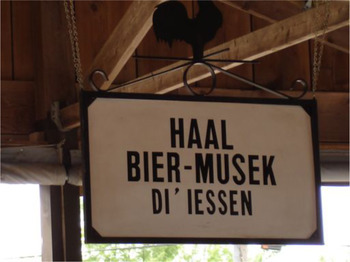
The fluidity of boundaries extends from spatial to linguistic boundaries. This is illustrated, for example, by one of the signs found on display in the eating and drinking area of the Fest (see figure 5). This sign blurs the boundaries between Luxembourgish and German, as well as between different varieties of Luxembourgish. It is written in a vernacular variety of Luxembourgish mixed with some German. Bier “beer” is the German spelling, whereas the Luxembourgish equivalent is Béier. Moreover, di’ Iessen “food” is a nonstandard spelling of d'Iessen. It involves a representation of a double initial vowel sound of Iessen, which might be due to the influence of the orthographic rendering of the feminine definite article in German die (although the noun is neuter in German and Luxembourgish alike). In the early years of the Fest, handmade posters bearing words for Luxembourgish numbers and food items were on display, but this is no longer the case. Some locals at the Fest are indeed speakers of Luxembourgish although they tend to be of retirement age. Moreover, some Fest participants wear pins with the words Ech schwätzen och Lëtzebuergesch (‘I also speak Luxembourgish’) and/or other locally produced items that index Luxembourgishness in the context of the Fest, including T-shirts thematizing Mustr(e)ipen.
Sign at the Luxembourg Fest of Belgium.

4.2. Signs of Transition: Negotiating Luxembourgish Indexicality
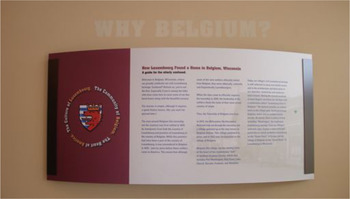
County Road D, less than a mile from the park, is the location of Chrissy's Now and Then Pub. It was formerly known as Smitty's Belgium House, and later, in 2006 when it was fully renovated—as Curley's Restaurant. Until the grand opening of the LACC, Curley's and an adjacent property served as a kind of interim location for the LACS, together with a site in Port Washington. Upon full renovation of Curley's, the establishment was filled with Luxembourgish paraphernalia, with items ranging from photos of the Grand Ducal family to locally produced green-heart imagery. Still hanging on one of the walls in the dining area just underneath the text “Why Belgium?” is a sign with a visually striking replica of the red lion of the Luxembourg coat of arms. This is an interesting choice because the coat of arms of the Province of Luxembourg in Belgium is identical to that of the Grand Duchy of Luxembourg. At the same time, for many residents of the Grand Duchy the red lion is highly indexical of Luxembourgishness, and flags bearing this coat of arms are routinely waved at sporting events in Luxembourg and further afield, including the Tour de France.Footnote 10 Forming a circle around the red lion on the left-hand side of the sign is the text: “The Culture of Luxembourg. The Community of Belgium. The Heart of America.” On the right-hand side, juxtaposed to the large red lion is a tiny green heart that is barely noticeable to the human eye.
“Why Belgium?” Sign in Chrissy's Now and Then Pub.

Between these two parallel yet disproportionate indexes of Luxembourgishness there is a narrative explaining the naming of Belgium:
Welcome to Belgium, Wisconsin, where we proudly celebrate our rich Luxembourg heritage. Confused? Believe us, you're not the first […] The area around Belgium (the township, not the country) was first settled in 1845 by immigrants from both the country of Luxembourg and province of Luxembourg in the country of Belgium. While this province had once been a part of the country of Luxembourg, it was surrendered to Belgium in 1839—just six years before these settlers came to America. This meant that although some of the new settlers officially hailed from Belgium, they were ethnically, culturally, and linguistically Luxembourgers.
Not only does the green heart take a visible back seat to the red lion on this sign, but also it is not mentioned in the narrative. Furthermore, this representation of Luxembourg differs from the representation on the Village of Belgium website, as the boundary between the “country of Luxembourg and the province of Luxembourg in the country of Belgium” is foregrounded. This shift of emphasis can be understood in relation to increased transatlantic contacts between certain individuals in Ozaukee County, Wisconsin, and the Grand Duchy of Luxembourg. Unlike other signs adorning the landscape of the town of Belgium, this sign was not entirely locally produced. In the same room in Curley's, the Luxembougish motto is painted on another wall: “Mir wölle bleiwe wat mir sin.” The appearance of the Luxembourgish words is intertextual with those on the sign in the gazebo in the park, although in Curley's a diacritic appears on the word wölle.
During the few years between the founding of LACS in 2004 and the grand opening of the LACC in 2010, Curley's Restaurant and the office in Port Washington served as main gathering points for related events and meetings, with the exception of the Green Heart Gala dinner. In a similar fashion to the sign in Curley's, the logo for the Green Heart Gala dinner combines indexes of Luxembourgisness: a red, white, and light blue banner reminiscent of the Luxembourg national flag wraps around the green heart. In this way, the green heart is no longer the same one that appears in the town of Belgium. This large-scale fundraising event for the LACC originally took place in Belgium in 2005 and 2006, and then in Port Washington in 2007, both of which are located in the “Green Heart of Luxembourg in Wisconsin.” In later years, it was organized in more exclusive establishments in Mequon in 2008 and 2009, and then in West Bend in 2010, both of which are approximately a half hour's drive from Belgium.
4.3. Signs of Fixedness: Key Symbols and Standardized Language
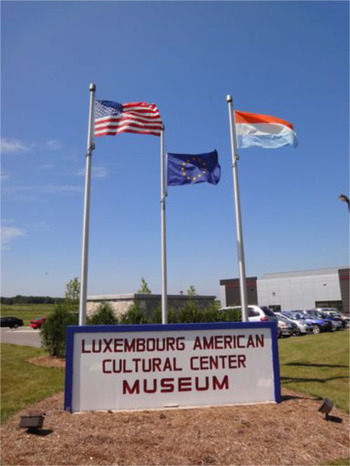
Forming the heart and soul of the property development called New Luxembourg is the Luxembourg American Cultural Center situated along highway LL just on the edge of the town of Belgium.Footnote 11 An American and a Luxembourgish flag wave in the breeze, and a third flag—of the European Union or the state of Wisconsin—flies in the center, hoisted slightly lower than the other two. At the base of these flags is a sign with the text Luxembourg American Cultural Center Museum in bright red letters painted on a white background. This is the only sign linked to the LACC clearly visible from the main road. The Luxembourgish national flag, together with the sign, indexes Luxembourgishness, albeit in a manner somewhat different from the heritage displays in other locations in the town of Belgium.
Sign at the Luxembourg American Cultural Center, Belgium, WI.

Other signage becomes visible upon approaching the entrance to the building, which does not face Highway LL. There the visitor is greeted by a series of signs, including the state of Wisconsin landmark to Luxembourgish settlements in Ozaukee County that forms part of a series of cognate landmarks along the Wisconsin Ethnic Trail. Predating the construction of the LACC, this sign was originally erected in 1998, along Highway LL, near the intersection with Highway D. Thus, it was situated marginally closer to the Belgium town center in comparison to where it stands now. Among the newly created signs on the LACC grounds, one pays homage to the achievements of the Luxembourg Society of Wisconsin. This sign bears the same Luxembourgish motto that appears on the sign in the park and in (what is now) Chrissy's Now and Then Pub: “Mir Welle Bleiwe Wat Mir Sin/We Want To Remain What We Are.” The choice to include an English translation of the motto—as opposed to the monolingual Luxembourgish text in the park and in the pub—presupposes that the visitor may well not understand Luxembourgish. Also indexing the historical use of Luxembourgish in Wisconsin is the retention of the old Luxembourgish spelling, as illustrated, for example, by the single rather than double final consonant in the verb sin ‘to be’, which stands in contrast with the orthography on signage inside the museum welcome area.
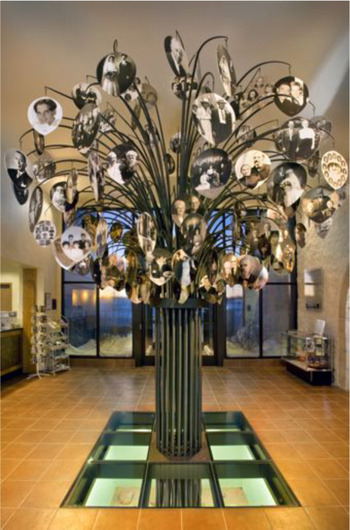
In the J. B. Krier Wëllkomm Centre, named in honor of the Luxembourg American founder of Krier Preserving Company, the focal point of the main entrance is the Luxembourg American Family Tree that displays over 150 photographs of Luxembourg Americans (see figure 8 below).Footnote 12 The roots of the tree are made of steel imported from Luxembourg. They are set atop a class-enclosed case built-in beneath the floor, filled with rock and soil also transported from Luxembourg.
Biological metaphors take center stage in the LACC Wëllkomm Centre, and the plaque entitled “In Gratitude to the GRAND DUCHY OF LUXEMBOURG” takes a similar tack:
The exhibit panels, décor and furniture showcased in the Mamer-Hansen Barn and elsewhere in this building are a gift of the people and government of the Grand Duchy of Luxembourg, in commemoration of the lasting ties of blood which, over the last two centuries, have bound the Luxembourg people to their American sons and daughters.
D'Panneauën, d'Géigestänn and d'Miwwele fir d'Ausstellung an der Mamer-Hansen Scheier an anerwäerts an dësem Gebai sinn e Cadeau vom Lëtzebuerger Vollek a senger Regierung, an Erënnerung un déi enk Relatiounen an de leschten zwee Joerhonnerten tëschent dem Lëtzebuerger Vollek a senge Kanner a Kandskanner an Amerika.
Luxembourg American Family Tree. (Photograph ©Luxembourg American Cultural Society.)

Diverging somewhat from the sign posted in Curley's Restaurant in 2006 that foregrounds Luxembourgish group membership in terms of ethnicity, culture, and language, the text posted in the LACC Wëllkomm Centre points directly to lineage, which may be interpreted as an ethnic, and perhaps even a cultural link, but linguistic links between Luxembourgers in the United States and Europe are not foregrounded. As Shenk (2007:201) explains, the language prerequisite as a means of authentification is unstable because “speech errors occur” and “speakers may not successfully maintain their heritage language over time.” What counts as an “error” is, of course, a matter of perspective, and it is often claimed that people who (still) speak Luxembourgish in the United States speak “old” Luxembourgish, different from the Luxembourgish spoken in the contemporary Grand Duchy. Indeed, the above sign breaks direct links between linguistic practices in the United States and Luxembourg by displaying a highly standardized form of Luxembourgish that is in sync with the rules of the officially recognized 1999 spelling. It is the word Wëllkomm alone that symbolically links the LACC to displays of Luxembourgish linguistic heritage in the Belgium landscape.
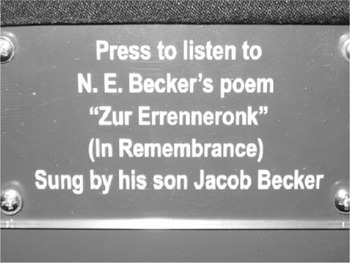
Housing the Roots and Leaves museum is the main showpiece of the LACC, the 1872 Mamer-Hansen stone barn, dismantled in its original site in Port Washington and restored as part of the LACC. The museum hosts traveling exhibits, as well as the Immigrant Family Sculpture that appears on permanent display. The sculpture is modeled after a family that immigrated to Minnesota during the mid-19th century. In the planning phase, it was proposed that the statue would include an audio feature of the immigrant family narrating their story in Luxembourgish, but this never came to light, perhaps because it was difficult to determine whose voice/s and, more broadly, what kind of Luxembourgish should be heard. It is only at the Nicholas E. Becker display that visitors can “press to listen to” the voice of a Luxembourg American speaking Luxembourgish.
Display commemorating the Luxembourg American poet, Nicholas E. Becker. (Photograph ©Luxembourg American Cultural Society)

The renowned poet and writer, Becker worked closely with Gonner, the editor of the Luxemburger Gazette that was based in Dubuque, Iowa. Becker contributed poems to the Gazette, among other publications, and it is one of his poems that the visitor can listen to in the LACC. There is a recording of the poem Zur Erreneronk (‘In Remembrance’) sung by Becker's son. The retention of the original spelling on the plaque and the glass-encased display of Becker's key works—together with the dated recording—portray the Luxembourgish language as a treasured relic of the past. It may be argued that this representation is reinforced by the location of the museum in a restored barn which bears a plaque inscribed with the text “Reconstructed in New Luxembourg, Belgium Wisconsin, Luxembourg American Cultural Society.”
Along with the augmented emphasis on certain spatial boundaries—signaled by the naming of the site of the LACC as New Luxembourg—there is a similar process in motion with respect to linguistic boundaries, in particular between Luxembourgish and German. On the whole, there is a great deal of discursive work taking place to convey the widespread view in contemporary Luxembourg that there is a clear boundary between all things Luxembourgish and German. For example, a session entitled “Aren't All Luxembourgers German?” was held at the 2008 Luxembourg American Cultural Conference. More recently, LACS Executive Director Kevin Wester is quoted in a local Illinois paper as follows: “We have people contact us every day who thought they were German” (Daily Herald, June 20, 2011). In this context, it is perhaps not surprising that the Die Freistadt Alte Kameraden Band is not on the program of the newly branded Luxembourg Fest of America in August 2011, thus departing from past practice of organizing and celebrating the Luxembourg Fest of Belgium in 1987–2010.
Moreover, the theme of the 2011 Luxembourg Heritage Weekend is “Let's Learn Some Lëtzebuergesch!” and there will be a series of language learning workshops to be led by teachers from Luxembourg. No American teachers appear on the program, despite the fact that there exist Luxembourgish speakers in the United States. On the program, the name of one of the most indexical items of Luxembourgishness for Ozaukee County locals has been changed from Mustr(e)ipen to Treipen. It appears with a photo from a supermarket in Luxembourg rather than a local shop in Wisconsin. A commodified red lion that adorns the T-shirts on sale in the LACC gift shop and is due to make a live appearance at the 2011 Fest for the first time is being transformed into the key symbol of a globalized sense of Luxembourgishness. Resonating with Scollon & Wong Scollon's (2003:145) discussion of the semiotics of product branding and logos, the goal “is to produce universal and decontextualized recognition of their names and products, so that their symbols become as instantly recognized as the Christian cross, the red cross, the Islamic crescent, or national flags.” It remains the task of future research to explore the ways that people are experiencing the transformation of the Fest and whether indeed the green heart imagery will move into the shadow of the red lion.
5. Conclusion: Language, Place, and Heritage in Late Modernity
The analysis has shown that the geosemiotic ways by which Luxembourgishness is indexed in Belgium, WI are in a process of fluctuation due, in part, to increased contacts with the citizens of the Grand Duchy of Luxembourg. While the fuzziness of certain spatial and linguistic boundaries originally enabled the construction of Belgium as an ethnic Luxembourgish place, there now exist attempts to harden these boundaries and index Luxembourgishness in Ozaukee County in ways that are more directly aligned with related processes in the Grand Duchy of Luxembourg. One of the locally produced signs on Highway LL, near the LACC, reads “Wëllkomm to Belgium ‘Home of Luxembourgers’;” yet, the property development where the LACC was built—set back from the main road—was named New Luxembourg, even though technically it still lies within the town of Belgium.
It is the linguistic boundary between Luxembourgish and German that is the potential source of greater tension. A two-pronged strategy is in place to attempt to reconcile divergent linguistic practices and language ideologies: 1) portraying Luxembourgish in the United States as a relic of the past and 2) shifting from hybrid forms of language use to standardized Luxembourgish on contemporary signs. These strategies may be regarded as creating a wedge between establishment authenticities and vernacular authenticities, although Coupland (2003b:420) points out that “claims to a traditional form of linguistic authenticity” are put forward by proponents of both poles, and we need to explore the ways that they intersect. This line of argumentation resonates closely with Bodnar's (1992:13) claim that “public memory emerges from the intersection of official and vernacular expressions.”
This brings us full circle to heritage or the way that people strategically recall and enact aspects of the past, be it for economic or more symbolic purposes (Hoelscher 2006). The analysis shows how different premises of heritage combine in the construction of ethnic Luxembourgish place and how heritage displays are being transformed in the context of increased transatlantic cooperation. An understanding of heritage in action and, more specifically, grappling with questions of authenticity allows us to unpack the relationship between language and place in present-day Belgium, WI. As Coupland & Garrett (2010:24) put it,
[A]uthenticity is a felt or negotiated quality of social experience rather than (paradoxically enough) an absolute and pre-discursive quality of experience, and to that extent we would avoid assuming that cultural constructions in heritage frames are inauthentic.
Researcher reflexivity enables us to understand how authenticity is experienced and negotiated by social actors, rather than make judgments as to what counts as authentic or inauthentic. This reflexivity, together with a historically sensitive and ethnographically grounded approach, brings us a step closer to understanding migration experiences. Combining sociolinguistic approaches to discourses in place and indexicality with cultural geography research on senses of place and heritage displays allows us to discover how global processes are reshaping the multifaceted relationship between language and migration. Migration experiences need to be viewed not only from multiple perspectives, but also through the lenses of various disciplinary paradigms in order for us to understand the changes that real people are experiencing in the age of late modernity.