Translational significance
Problem addressed: Older people who experience high levels of self-ageism are more likely to experience physical and cognitive decline, as well as reduced mental wellbeing.
Main outcome: In this study, we found that older people use different forms of subjective age in their self-presentation, thus reflecting/reinforcing their self-ageism.
Implications for translation: This research highlights the connection between subjective age and self-ageism as well as the nuances associated with the role of age in older people’s self-presentation.
Introduction
The role of age in the self-presentation of older people is important because older adults’ self-perceptions of age and aging can influence their wellbeing and quality of life (Kotter-Gruhn et al., Reference Kotter-Gruhn, Kornadt and Stephan2015). Specifically, research has shown that older people who experience high levels of ageism directed toward themselves are more likely to experience physical disability, cognitive decline and even die earlier, compared with people who report more positive views of aging (e.g. Bodner et al., Reference Bodner, Ayalon, Avidor and Palgi2017; Levy, Reference Levy2009; World Health Organization, 2021). Consistently, the place that age and aging play in people’s self-presentation is likely to reflect the overall societal view of people’s age and aging process (Hausknecht et al., Reference Hausknecht, Low, O’loughlin, Mcnab, Clemson and Heyn2020). Theoreticians have asserted that we can gain a better understanding of human development by examining alternative criteria of age in addition to chronological age (Montepare, Reference Montepare2009). One of the alternative structures in the field is subjective age – which relates to the way in which people experience and feel themselves (as similar, younger or older than their chronological age) (Bodner et al., Reference Bodner, Ayalon, Avidor and Palgi2017). Subjective age is a psychological construct. It is defined by self-image, emotions, attitudes and sense of age of the individual: the person may be one age, chronologically speaking and another age, in terms of perception (Kwak et al., Reference Kwak, Kim, Chey and Youm2018). In recent years, the idea of subjective age is emphasized in gerontological studies because the subjective perspective of aging does not mesh with one’s chronological age and exhibits great variability among older people (Kwak et al., Reference Kwak, Kim, Chey and Youm2018). Research has shown that a younger subjective age is a predictor of improved physical and cognitive functioning, positive mental health and a longer lifespan (e.g. Kotter-Gruhn et al., Reference Kotter-Gruhn, Kornadt and Stephan2015; Kwak et al., Reference Kwak, Kim, Chey and Youm2018; Palgi et al., Reference Palgi, Shrira, Avidor, Hoffman, Bodner and Ben-Ezra2019) and therefore is considered desirable.
The present study
The present study examined the question of age in the self-presentation of older people in Israel, a country where the older population has grown relatively quickly (Frilozki and Choen, Reference Frilozki and Choen2015). A study that examines the question of age in the self-presentation of older people from a specific country is important because the self-presentation and the place of age and aging are not only influenced by demographic characteristics and the psychological functioning of the person but also by the way in which different societies relate to and perceive the older person (Barnhart and Peñaloza, Reference Barnhart and Peñaloza2013). This study has the potential to contribute to the existing knowledge concerning the position of age in the self-presentation of older adults by using the combined perspective of the individual and society (Kotter-Gruhn et al., Reference Kotter-Gruhn, Kornadt and Stephan2015). Hence, the findings are important, both as a means to understand the individual and the role that age plays in one’s self-presentation and as a means to understand the role that age plays in society at large, as a reflection of people’s desired self-presentation.
Methods
In order to examine the place of age and subjective age in the self-presentation of Israeli older adults, we used an online survey. The survey was widely distributed during the summer of 2020 via social networks, e-mail and different social organizations in the field of aging and old age. The survey was approved by the university’s ethics board. This paper focuses on two main questions from this online survey, that specifically emphasize perceptions of age and aging among senior citizens.
The first question asked: “How do you define yourself?” Seemingly, this question is very general and abstract, especially when it appears at the top of an online survey, without the respondents being given a detailed explanation of its purpose. However, this is exactly the magic of the simplicity of this question. After all, the variety of answers presented below, including their length and depth, testify to a person’s subjective choice of how to present him/herself in such an authentic and spontaneous way. The second question, that appeared later in the survey, asked the participants to choose and rank the old age terms that they prefer from a list that included the eight most common terms in the Hebrew language: senior citizens, golden years, third age, pensioners, adults, retired people and older persons. The presentation of the old age terms in a random order means that we avoided selection bias.
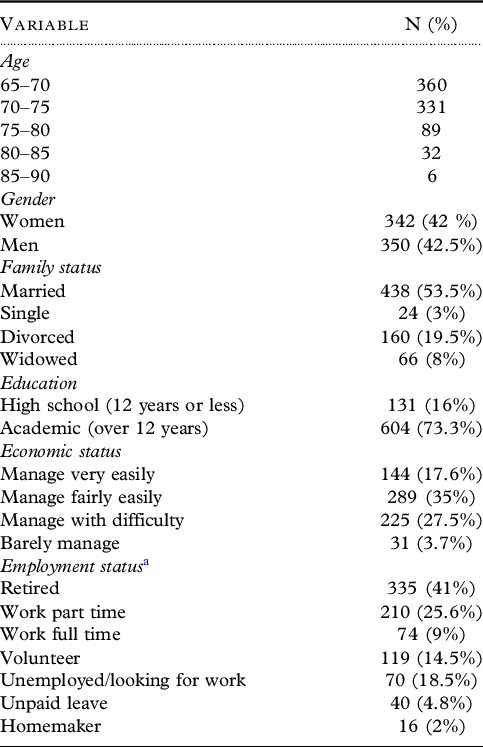
The sample included Israeli men and women, who speak Hebrew, and were 65 and older. The reason for focusing on this age group was based on the definition of old age, according to the World Health Organization (2015), and on the idea that the topic of study would be more relevant to this age group. In the survey, 818 Israelis, 65–90, (84.5% aged 65–75), participated, about half from each gender (342 women and 350 man). Of the participants, 438 (53.5%) were married, 160 (19.5%) divorced and 66 (8%) widowed. Overall, 335 (41%) said that they were pensioners and 210 (25.6%) were working part time. See Table 1 for additional demographic information.
Demographic data of the 818 survey respondents

a In the question about employment status, a person could mark more than one response.
Data analysis
The question of self-presentation (the opening question) was examined by using a mix-methods design. First, we used Atlas-8 software to identify and enumerate numeric and verbal expressions of age in participants' self-presentations. More specifically, we looked for whether and in which of the self-presentations age appears as a numeric value or in words, as well as the extent of use of eight common Hebrew age terms to describe old age. This processes was done to prepare the responses to the next stage of analysis, named word cloud.
Word cloud is a systematic tool that calculates the frequency and proportions of words in the text (Davis and Fingerman, Reference Davis and Fingerman2016). Despite its limited sensitivity to linguistic phrases and complexities, word cloud helps to identify layouts in which words are arranged into semantically and visually distinct zones which are effective for the understanding of people’s responses (Hearst et al., Reference Hearst, Pedersen, Patil, Lee, Laskowski and Franconeri2020). The goal of using this method was to learn about the main contents and messages of the participants, by counting the dominant words in their self-definitions and interpreting their meaning.
The dominant words in the word cloud were analyzed through linguistic inquiry and thematic analysis. Thematic analysis is a qualitative analytical method that is widely used in social psychology (Braun and Clarke, Reference Braun and Clarke2019). The heart of the analysis concerns the identification of central themes (categories) and sub-themes (sub-categories) discerned in the data. The thematic analytical process was undertaken as a joint investigation by the two authors. First, the analysis and interpretation were undertaken by each researcher independently. The independent analyses were then reviewed and discussed by the two authors.
Simultaneously, the question that examined old age terms (the closed-ended question) was descriptively analyzed in order to learn about the selection frequency of each term as an indicator of respondents’ preference. The preferred old age terms identified in the statistical analysis were compared to the dominant age terms identified in the response to the open-ended question concerning one’s self-presentation, which was analyzed through thematic analysis. Comparing and contrasting the two sets of responses pointed to the gap between “real life” and “ideal” older age terms.
Findings
The analysis revealed the possible confusion and unease concerning one’s self-presentation of age and aging. This complexity is reflected in the three research findings, each of which presents a somewhat different way of coping with the issue of chronological age in one’s self-presentation: The absence of old age – older people who ignore / avoid / conceal age in their self-description; Camouflaged aging – older people who emphasize their age through statements of self-ageism; and Multiplicity of old age terms other than standard terms.
Absence of old age (a self-presentation lacking old age)
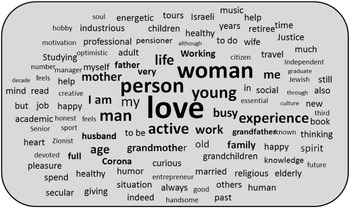
Using the Atlas-8 software, we found a total of 650 respondents (75%) who chose not to note at all their chronological age and 539 (66%) did not use one of the eight most common Hebrew age terms to describe old age. Moreover, the word cloud (see Figure 1) showed that the most prominent expressions in the self-definitions (without counting conjunctions) were as follows: love (276 times), man/woman (234 times), person (172 times), young (147 times), active (144 times), age (121 times), mother/father (87 times), work/to work (81 times), experienced (77 times) and grandmother/grandfather (31 times). The hierarchy and frequency of the expressions in the word cloud paint a self-presentation lacking old age. This is evident by the fact that the three most common words were not related at all to old age. Moreover, the most common word that referred to age was “young” (147 times). The word “age” appeared 121 times, half the times not in the context of chronological age.
The word cloud created from the self-presentation of the respondents.

A loving person
The word count demonstrates that the three most popular words – love, woman/man and person – are unconnected to aspects of age. The word, love, appeared the most in the self-definitions of the older adults; it was usually written with positive connections, for example: “I am a strong, independent, very optimistic woman, who loves to travel in Israel and the world” (a 72-year-old, woman) or “I am an intelligent woman, I am energetic and up-to-date, with a lot of mental strength, desire, I love people, life, I have a sense of humor and love of life and, in addition, I look good!” (66, w), “A people’s person. Honest, reliable, humble, self-content” (76, man), “An experienced and rational person. Loves people and nature, loves his life and satisfied with life” (75, m), “I am an independent woman, I love friends, I love family, I love to work… in short, I’m an active woman” (69, w), “I’m a social person who is willing to help others. I am a loving family man” (73, m) or “Active, working, traveling, exercising, and interested in current affairs” (75, w). The dominance use of the term – love – in their self-presentations possibly alludes to the “positivity effect” in later life (Carstensen, Reference Carstensen1992). That is, older adults usually focus on positive emotional and social features of their experiences and thus may be more likely to define themselves in positive terms. This finding raises a question: Did older adults use the word “love” because they really are in the period of glamor and charm of their lives or did they define themselves with this optimistic and positive term out of a desire to meet the social expectations of being satisfied, optimistic and full of love in later life?
Young and active
The dominant age term, found in the word cloud, was young (as noted above, it appeared 147 times). For example, people said: “I am young and active” (67, w); “I am razor sharp, with excellent physical fitness. I grasp things quickly and have a sense of humor. I am young in spirit and body and soul” (69, m); “Young and essential” (75, m). There were also participants who chose to define themselves only by the word “young.” Alongside this term, and in almost an identical manner in terms of frequency, there was much use of the term “active.” For example, people said: “Curious, active, athletic. Loves people” (69, w) or “Independent, active, frame-breaker, frame-lover, curious, opinionated, accomplished, task-oriented, social, loves sports activities” (77, m). The present terms imply subjective age expressions, which aim to reflect positive qualities and a positive self-identity. One possibility is that after a lifetime of exposure to ageist language, social negative attitudes and thoughts about aging may be directed inward and a younger self-presentation, which is in discordant from one’s chronological age, is seen as reflecting positive qualities.
Working, experienced and a family wo(men)
Other prominent terms in the self-definitions of older people were “working,” “to work” or “experience.” For example, people said: “I am a sociologist” (70, w), “I am an independent pensioner. I’m not limited. I work as a freelancer advisor” (75, m), “I am a pensioner who is working in civil service. I have been working in the theater and now I am on unpaid leave…” (69, w), “I am experienced in the field I work in and I have education and life experience” (66, m) or “I have a lot of experience and knowledge, with a mission to help people who are in the third age to reach their essence and direct them to take care of their health” (70, w).
In addition, based on the frequency rankings, there was also a prominent self-definition that included family status (mother/father/grandfather/grandmother/married). For example, “Married man, father of three, company manager” (66, m), “A wonderful mother and grandmother. good friend. Excellent interpersonal. Fluent. Intelligent. Conversation woman. Diligent. Has work ethics” (70, w) or “I am a farmer, a father, a grandfather, a friend, involved, I love life, I love the cold and I don't like the heat” (69, m). It should be emphasized that the reference to grandmothers/grandfathers in these quotations was more in relation to one’s family roles and less in relation to one’s age group.
Based on the frequency of use of these self-definitions, work, experience and family are of high importance to older adults. These likely reflect norms, which view education, employment, marriage and parenthood/grandparenthood as important milestones. These terms also reflect the internalization of active aging or successful aging models which are common in Western societies (Rowe and Kahn, Reference Rowe and Kahn1997; World Health Organization, 2002).
This finding may suggest that many older adults choose to hide, ignore, repress or conceal their age(ing) identity. We concluded this from the numerical data, as well as the hierarchy and frequency of the expressions in the word cloud, which paint a self-presentation which is lacking old age. Many participants chose not to mention their chronological age and did not describe themselves in classical age terms, but rather in indirect age descriptions, such as work, active, mother/father, experienced, grandmother/grandfather. In other words, the number, character and the emotional charge of these expressions reflect the identity of “a person who is loving, has a young spirit, active and working, experienced and a family owner.” That is, the age(ing) identity was positive and sympathetic and lacking the notion of old age.
Nonetheless, there can be other reasons for this finding as well. For example, it is possible that age may not be such a strong component of one’s sense of identity, and therefore, the participants identified themselves by their interests, professions, social standing or family links. It is also possible that respondents did not use old age terms such as “retired,” “senior citizens,” “aged” and “third age” because these terms represent formal or legal terms which might be used to describe others but are not assimilated into one’s sense of self. Likewise, a term such as “golden years” may represent a more poetic usage that is appropriate for the literature but not in every day life. Last, the generic nature of the question might also account for the findings as respondents did not receive any guidelines other than a simple request for self-presentation.
Camouflaged old age (self-ageism in old age)
In addition to the self-definitions in which one’s chronological age was absent, another complex way for older people to deal with age(ing) is by presenting their age and/or using the main terms of old age, while also mentioning expressions of self-ageism. This way was reflected in approximately 460 respondents who referred to their age, usually accompanied by three strategies of self-ageism: expressions of subjective age terms which contrast chronological age; use of linking words which reflect apology and reservations; and self-presentations of “I am my age,” among older adults who presented themselves only through numerical or verbal age expressions.
Subjective age
The self-presentation included over 200 expressions of subjective age, which may suggest a high degree of self-ageism. When a person compares her/his chronological age to her/his subjective age, s/he, in essence, reflects awareness of the stereotypes and the stigmas in society (and within her/him) about the way in which one should feel, behave and act when old. For example, the latent message that arises from the definition “age is only what is written in the identity card. I feel and function like a 50 years old” (67, w). This 67 year-old woman says that people should feel and function differently than someone who is 50. In a similar fashion, the definition, “I am 65 who feels 45 and enjoy life” also suggests ageism toward older people, according to which there is an expectation that people who are 65 will enjoy life less than younger people.
Additionally, participants often used terms which reflect “old” versus “young,” in order to emphasize their subjective age. By doing so, they stressed their self-ageism. For example, a 77-year-old man wrote: “I am old by age and young in actions.” This reflects the idea that an old person’s actions are worth less than those of a young person. One participant introduced herself with the words: “an older adult with youthful thinking” (71, w), thus, suggesting that she thinks that an older person does not have the same cognitive level a younger person has. When an 82-year-old man wrote, “I am old in terms of age and young in spirit,” he was asserting, in essence, that he agrees with the ageist stereotype which suggests that, not only is there a difference in actions, but also the spirit of an older person differs from that of a younger person. A similar idea was also expressed in the following self-presentation: “I am an older adult, full of life, just like a younger person” (69, m), which echoes an ageist perception that an older person does not feel the same levels of joy a younger person feels.
These examples suggest that people refer to old chronological age as inferior to younger age in relation to thought, spirit, behavior, appearance and wellbeing. This finding is important because in most studies the subjective age was assessed quantitatively, using a numerical estimate of how old one feels. In this study, respondents spontaneously reverted to using a subjective age definition, without being directly asked about it.
Linking words
We counted 103 linking words that emphasized the reluctance, wonderment or apology about one’s chronological age or age group. Respondents said that they feel, act, look or think in a way that does not match their chronological age or is more suited to a younger age. For example, when a woman shared her self-definition, she wrote: “In spite of the fact that I am 65, I live an active life.” Here, in essence, she had the viewpoint that people who are 65 usually do not have active lives. Another participant responded “Although already retired, still very active” (71, w). By emphasizing the words “although” and “still,” she expressed that, after retirement, the norm is to feel fatigue, heaviness or inaction. In a similar fashion, a 68-year-old man wrote: “I am a new pensioner who still works in my profession as an advisor for engineers.” The use of the word “still” demonstrates that this person relates to professional employment at age 68 as an exceptional situation. As a result, he also reinforced the expectation that people should stop working in old age. Another man wrote: “I am a professional, family-oriented and socially active person even at the age of 77.” The use of the word “even” shows that he perceived old age as a period in life in which a person is no longer active in almost any field.
The use of the Linking Words possibly identified a new configuration of the language of ageism. After all, the use of connectors – in spite of, indeed/however, but, although, also, even, still – demonstrates that the stigmas and the stereotypes connected to older age have deeply penetrated the discourse of some of the older people. In other words, emphasizing one’s chronological age, in the context of apology, reticence or wonderment teaches about the unease and the socially negative perceptions concerning chronological old age, which is differentiated from one’s subjective experiences of functioning.
“I am my age”
Self-ageism was also evident in those who self-identified as “I am my age.” That is, there were respondents who characterized their identity only via expressions connected to age. The most prominent example was the choice of 33 respondents who described themselves solely via their chronological age or by using one term that represents old age. For example, “I am 73,” “I am an older person” (66, w) and “I am in my seventh decade” (77, w). Furthermore, there were 25 respondents who chose to define themselves by only citing expressions connected to age. For example, “I am a technologically challenged retiree” (69, w) or “I have a fertile past and a short and limited future” (84, m).
Presenting one’s age as the only criterion for identity reflects a certain degree of self-ageism because, after all, it is not possible that the age or belonging to a later period in life are the only parameters that characterize the entirety of identity and personality. Moreover, although survey participants did not know the purpose of the self-definition question and the extent of detail required of them, and perhaps precisely because the question was general, their choice to define themselves solely through numerical or verbal age expressions may emphasize ageist perceptions.
Multiplicity of old age terms (a gap between the real life and the ideal in terms of age)
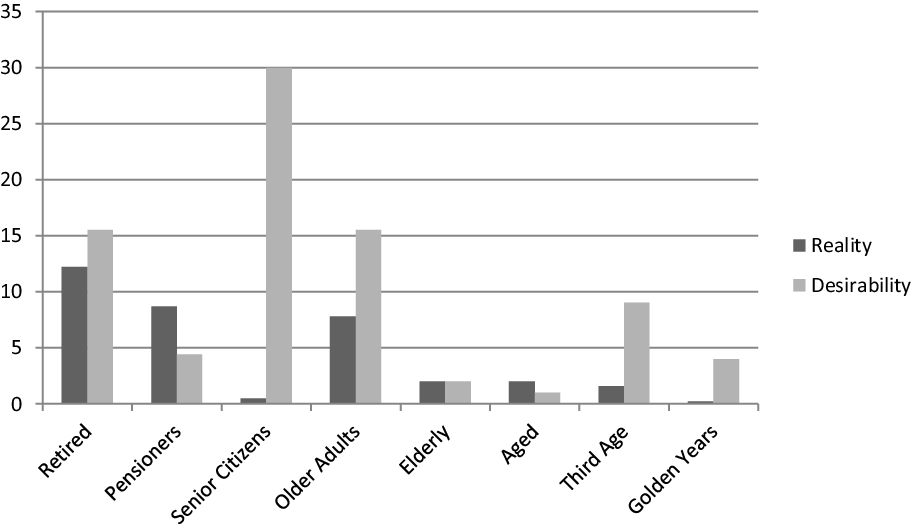
The third major finding emphasizes the multiplicity of the old age terms. Here, we found a gap between using terms that describe the real life-use and what older Israelis desire, concerning the term old age. In spite of the fact that old age and aging were missing from some of these definitions (as described in the first finding) or were concealed/negated (as described in the second finding), 44% of the participants in the survey did use common old age terms in their self-definitions. Out of the 818 respondents, 94 used the term “retired” (11.5%), 67 used the term “pensioner” (8%), 60 used the term “older adult” (7.3%) and only five used the term “senior citizen” (0.6%). After the open (qualitative) question about self-presentation, the respondents answered a closed-ended (quantitative) question in which they were asked to state their preferences concerning the term used for people their age. Out of the 1450 terms (some of the respondents made more than one choice), 427 chose the term “senior citizen” (30%), 227 chose “retired” (15%), 227 chose “older adults” (15%) and only 20 chose “older person” (2%). (See the details of the preferences in Figure 2.)
Differences between old age terms – the real life versus ideal among survey respondents.

Figure 2 compares the two rankings and presents the lines of similarity and differences between the commonly used old age terms in self-presentations of senior citizens and their desired preferences concerning such terms. The comparison shows that there is some consensus among the survey respondents concerning terms that are less common and that they like less (e.g. older people, older person, golden years, the third age). Furthermore, there was some consensus concerning the more useful and desirable terms (older adults, retired people, pensioners), and there was prominent variance concerning the term, “senior citizen,” because on the preference scale, which represents the ideal, the term was positioned in first place, while on the scale of self-definitions, it was rarely noted.
Discussion
We examined the role of age in the self-presentations of Israeli older people and the terms they use to describe their age. After undertaking a deep and critical reading of the self-presentations and the place that the respondents gave to age and aging, we identified difficulty, challenges and complexity that characterize older people’s relation to their chronological age. The complexity identified in relation to age(ing) self-presentations is evident through the concealment or blurring of one’s chronological age, as well as through a gap between the prevailing old age terms and the desired terms. Above all, we recognized how verbal expressions of subjective age have deeply penetrated the self-presentations of older people, and we even propose to possibly view them as an additional sign of self-ageism.
The first finding according to which some of the older people chose to conceal or blur their age suggests that Kaufman’s (Reference Kaufman1986) notion of the “ageless self” is still relevant today. Gendron et al. (Reference Gendron, Inker and Welleford2018) asserted that this disassociation from one’s chronological old age may be driven by self-preservation and a wish to maintain an identity and self-concept consistent with that of one’s perceived/subjective younger self and body. This practice is also a reminiscent of gender and age neutrality. That is, the choice to use general and neutral language has the goal of preventing discrimination, on the basis of arbitrary characteristics (Fiske, Reference Fiske2017). Either way, it remains unclear whether leaving out one’s chronological age from the self-presentation and use of the terminology of “age blind” provides evidence of a more positive perception of age(ing) or whether it teaches us about the lack of acceptance and non-identification with one’s chronological age.
The complexity identified in relation to age(ing) self-presentations is sharpened because when older adults choose to hide or blur their age, they simultaneously emphasize that they are young, loving, active, working, experienced and family people. The choice of hiding age(ing) and painting, in its place, a young and active identity, may be consistent with the “positivity effect,” which represents an age-related trend that older people attend to and remember more positive than negative information (Reed and Carstensen, Reference Reed and Carstensen2012). However, the similarity in the positive self-presentations can also reinforce the criticism of the concept “successful aging,” according to which the older population is divided into those who age successfully and those who do not (McLaughlin et al., Reference McLaughlin, Connell, Heeringa, Li and Roberts2010). In this way, the specific terms that the participants chose to emphasize demonstrate how the concept, successful aging, has replaced negative stereotypes of aging and old age with overly positive stereotypes, that, for the most part, are neither realistic nor achievable (Ayalon, Reference Ayalon, Tesch-Römer and Hans-Werner2021).
The complexity that older adults reflect about their age(ing) also resonated through the extensive use of subjective age expressions. One notable example of this was the widespread use of the term “young” in contrast to one’s chronological age. This finding expands the results of the research undertaken by Gendron et al. (Reference Gendron, Welleford, Inker and White2016) and shows that in later life the representation of oneself and others is communicated by expressions of “old” as negative and “young” as positive. Apparently, after a lifetime of exposure to ageist negative attitudes toward aging, ageism penetrates the language and words and affects the age(ing) identity (Gendron et al., Reference Gendron, Welleford, Inker and White2016).
There also were many older adults who emphasized their age in their self-presentations as the main or the only component. We assume that by emphasizing one’s chronological age, its continual comparison to the subjective age and the frequent use of expressions of apology, reticence or wonderment teaches us about the unease and the social negative perceptions concerning old age. This finding is important because it adds to the literature on subjective age (Chopik et al., Reference Chopik, Bremner, Johnson and Giasson2018; Gendron et al., Reference Gendron, Inker and Welleford2018; Kwak et al., Reference Kwak, Kim, Chey and Youm2018; Palgi et al., Reference Palgi, Shrira, Avidor, Hoffman, Bodner and Ben-Ezra2019) as it reflects how verbal expressions of subjective age have deeply penetrated the self-presentations of older people and even proposes to see them as an additional sign of self-ageism.
However, the use of subjective age terms stresses the existence of a paradox. On the one hand, contrasting one’s chronological age with one’s subjective age might represent an active attempt to conceal one’s chronological age and, as a result, reflect self-ageism. If this is so, it is problematic because ageism is described in the literature as a phenomenon that impairs wellbeing in old age (e.g. Ayalon and Tesch-Römer, Reference Ayalon and Tesch-Römer2017; Ayalon, Reference Ayalon, Tesch-Römer and Hans-Werner2021; World Health Organization, 2021). On the other hand, however, studies have shown that when a person uses subjective age, which is lower than her/his chronological age, it makes a positive contribution to the person’s physical and mental health (e.g. Kotter-Gruhn et al., Reference Kotter-Gruhn, Kornadt and Stephan2015; Kwak et al., Reference Kwak, Kim, Chey and Youm2018; Palgi et al., Reference Palgi, Shrira, Avidor, Hoffman, Bodner and Ben-Ezra2019). That is, we are left with the question: is the use of a younger subjective age in one’s self-presentation positive or negative?
This question supports and strengthens Gendron et al.’s (Reference Gendron, Inker and Welleford2018) work, who claimed that subjective age could be measuring the extent to which a respondent has internalized the effects of ageism. Moreover, they explained that researchers and scholars may be inadvertently perpetuating ageism and the stigma associated with being an older person by asking questions, such as – “how old do you feel?” Such questions could be interpreted as a negative message about being, feeling, thinking or appearing “old” (Gendron et al., Reference Gendron, Inker and Welleford2018).
The findings are consistent with the narrow representation of older adults accompanied by anti-aging messages (Gewirtz-Meydan and Ayalon, Reference Gewirtz-Meydan and Ayalon2018), as well as the complexity of self-presentations (Awah-Manga, Reference Awah-Manga2018) on online dating sites for older people. Apparently, older adults display greater complexity in their online dating profiles compared with younger adults (Awah-Manga, Reference Awah-Manga2018). This could be possibly due to greater ambivalence about their advanced age. This ambivalence is directed toward older people by society and is also internalized and directed inwardly toward older people themselves and possibly affects their self-presentation (Gewirtz-Meydan et al., Reference Gewirtz-Meydan, Opuda and Ayalon2022).
The multiple terms of old age are another way to present ambivalence concerning one’s age. The discrepancy between the age group terms one used for self-presentation (“real life”) vs. the terms identified as ideal (“the desired state”) reinforces this paradox by demonstrating that the “dilemma of terms” (Manor, Reference Manor2017) is a widespread phenomenon in society. In both rankings, the terms, retired and pensioners were the most prominent, perhaps because they reflect the contribution of employment and professional activities and, in this way, conceal or camouflage aging. The term, adult, was also quite prominent in both rankings, most likely for the same reason of denial of aging and, perhaps, also because of its neutrality (in Hebrew, the term, adult, includes all people, 18 years old and older).
The biggest difference between the two rankings was the placement of the concept, “senior citizen.” On the one hand, the term probably did not penetrate the self-presentations of older people in Israel because it is a translated term and is relatively new in the Hebrew language (Frilozki and Choen, Reference Frilozki and Choen2015). On the other hand, the term is being commonly used by the Ministry for Social Equality and by the National Insurance Institution. It appears as if the public relations that the term receives in the Israeli media (Manor, Reference Manor2017), in comparison to other terms, have led to its popularity on the preference scale.
Either way, we are concerned that the abundance of Hebrew terms used to describe the later period in life confuses the Israeli public and contributes to an internal dissonance in the age(ing) identity of older adults. The significance of this is that the time has come to choose a term, which describes older age, for which there is agreement and acceptance. Such an applied move is important because social perceptions, norms and expectations shape how language is used. The way that we use language is extremely important because words convey levels of meaning that are deeper than the words themselves (Gendron et al., Reference Gendron, Welleford, Inker and White2016).
The ranking of terms is another example of the paradox about subjective age, because the preferred age(ing) terms (that are used or ideal) are precisely those that disguise or obscure old age (e.g. senior citizens). The best example was the low number of votes that the word “older adults” received. This word explicitly expresses one’s belonging to a late life period. That is, older adults preferred to be described in ways that reflect their subjective age. According to subjective age researchers, this choice is associated with improved mental and physical health (e.g. Kotter-Gruhn et al., Reference Kotter-Gruhn, Kornadt and Stephan2015; Kwak et al., Reference Kwak, Kim, Chey and Youm2018; Palgi et al., Reference Palgi, Shrira, Avidor, Hoffman, Bodner and Ben-Ezra2019). At the same time, however, this possibly reflects and perpetuates their self-ageism and may also impair their wellbeing (Ayalon, Reference Ayalon, Tesch-Römer and Hans-Werner2021).
When considering these findings, it is important to acknowledge the study’s limitations. One such limitation concerns the sampling method, which relied on older people who were relatively comfortable in taking an online survey. These individuals likely represent a highly educated and affluent group. Hence, the question remains concerning the self-representation of older people of less affluent backgrounds. Secondly, as the study was conducted in Israel, it is expected that many of the responses reflect cultural norms unique to Israeli society. Future research will benefit from examining older people’s self-presentations in different countries and contexts. Despite its limitations, this research highlights the existing paradox about subjective age and calls to change the negative perceptions of old age and decreases self-ageism. If this step succeeds, then one day the title of this paper will be changed to “Age is Just a Number!”
Conflict of interest
The authors do not have any conflicts of interest to report.
Description of authors’ roles
The study was conducted by two researchers from the Impact Center for the Study of Ageism and Old Age at Bar-Ilan University in Israel. S. Okun designed the study, supervised the data collection and wrote the paper. L. Ayalon assisted with collected the data and writing the paper. The thematic analytical process was undertaken as a joint investigation by the two authors. First, the analysis and interpretation were undertaken by each researcher independently. The independent analyses were then reviewed and discussed by the two authors.
Acknowledgements
This work was supported by a grant from the Impact Center for the Study of Ageism and Old Age donated by Mrs. Gabi Weisfeld
Institutional Review Board
Before we commenced data collection, the institutional review board at the author’s university examined and approved the study.