Introduction
Trichotillomania (TTM) is a rare but serious psychiatric syndrome that is characterised by the inability to control repetitive hair pulling and is part of the spectrum of disorders that have aspects of both compulsion and impulsion (Reference Sadock and Sadock1). In 1889, for the first time, a French dermatologist reported the case of a man who pulled out his hair (Reference Hallopeau2). Since then, TTM has entered medical articles and gradually physicians have begun to recognise its psychiatric origin.
TTM is derived from three simple Greek words: thrix (hair), tillein (to pull), and mania (madness).
According to dermatologists, it is a type of traumatic alopecia (Reference Siddappa3). Its prevalence in the general population has not been studied. In children its clinical prevalence is 1.24% (Reference Malhotra, Grover, Baweja and Bhateja4). There is no difference between male and female patients with respect to prevalence; the mean age of affliction is 13.6 ± 9.4 years, ranging from 2 to 49 years (Reference Grant and Odlaug5,Reference Bhargava, Kuldeep, Mathur and Mathur6).
It is noteworthy that most patients with TTM initially consult dermatologists, which leads to a lower estimation of prevalence compared with reality.
In a study in Poland it was found that 67.8% of dermatologists during their clinical trial had encountered at least one case of TTM (Reference Szepietowski, Salomon, Pacan, Hrehorów and Zalewska7).
A study on children shows that scalp is the most common site of TTM (Reference Tay, Levy and Metry8).
Psychiatric references reveal that TTM is not usually prevalent among the family members of patients; further, in literature only one case report of familial TTM has been reported (Reference Kerbeshian and Burd9).
Here, we report a case of familial TTM that afflicted four sisters.
The case of the R family is the second report on familial TTM and provides important insight into this disorder.
Case report
First sister
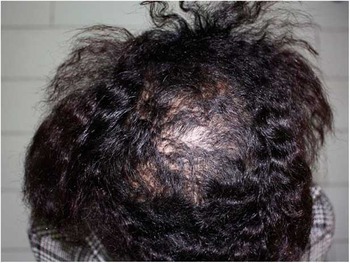
Miss R, the fourth child of a family with seven children, referred herself to a psychiatric clinic because of chronic hair pulling since the past 7 years. She was 28, single and held a diploma in photography. She pulled out the hair of a large part of her scalp without pulling out the hair of other parts such as eyebrows, eyelashes, etc. (Fig. 1). She emphasised that the tension she faced at work worsened pulling. As a solution to this problem, she shaved off the hair of that part of her scalp; however, this was not successful because in stressful situations she pulled out her hair with tweezers.
Sister 1, before treatment

Her mental examination revealed an obsessive–compulsive disorder (OCD) with contamination theme. Her other examinations were not remarkable and she was diagnosed with TTM plus OCD in axis I on the basis of DSM-IV-TR. She had never consulted a psychiatrist, nor had she been treated.
Second sister
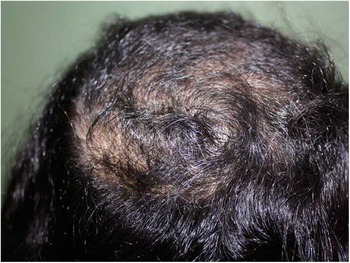
Miss R, 22 years old, the younger sister, single and working as a secretary, had also been suffering from repetitive pulling of hair since the past 5 years (Fig. 2). She also chewed and swallowed hair follicles (trichobzoar). Her psychiatric examinations revealed depression and her psychiatric history revealed crying spells, loss of interest, terminal insomnia, suicide ideation, and one unsuccessful suicide attempt with drug overdose. She was diagnosed with major depressive disorder and TTM on the basis of DSM-IV-TR.
Sister 2, before treatment

Sister 3
Miss R, 20 years old, the youngest sister, single and unemployed, visited the clinic with similar symptoms. She pulled out her hair from a similar area but did not permit her photographs from being taken. In addition to TTM, she had a history of a self-limited episode of major depressive disorder, which had been cured without any treatment, and a history of attention deficit hyperactivity disorder 10 years ago.
Sister 4
Miss R has an older sister who had TTM with symptoms similar to those of the other sisters; however, she stopped pulling out hair 2 years ago without undergoing any treatment and therefore was not referred to a doctor.
The authors treated Miss R with 300 mg fluvoxamine and 2 mg Pimozide daily. At 6 months’ follow-up the symptoms were seen to have decreased and she pulled out her hair rarely. The patient was completely satisfied with the treatment and she referred her other two sisters who were also treated in the same manner and as expected showed a positive response to treatment.
Conclusion
The R family is the second report on familial TTM, providing the following important insights.
First, the aetiology of TTM is unknown. Different studies consider racial identity, genetic factors, grey matter abnormality, and even child abuse as being related to TTM (Reference Chamberlain10–Reference Saraswat15). This report suggests that, similar to many other psychiatric disorders, TTM can be detected in other family members and genetic factors have a significant role not only in the development of such disorders but also in determination of the disorder subtype. TTM subtypes have been distinguished on the basis of the region from which hair is pulled out. All four sisters pulled out hair from the same area on the scalp and not from other parts of their body. As the sisters were not aware of each other's disorder, the probability of mimicking the action would have been small, suggesting the role of genetic factors in determining the subtype of TTM.
Second, different studies have found significant comorbidity associated with TTM, such as OCD, bipolar mood disorder, Tourette's syndrome, mental retardation, schizophrenia, bulimia nervosa, and other psychiatric disorders (Reference Malhotra, Grover, Baweja and Bhateja4,Reference Rajmohan16–Reference Parakh and Srivastava20).
The correlation between OCD and TTM was studied more than that with other disorders. Although these two disorders are very similar, patients with OCD suffer from greater disability in their lives, and fewer TTM patients respond to treatment (Reference Chamberlain, Fineberg, Blackwell, Robbins and Sahakian21–Reference Lochner, Seedat and du Toit23).
In these cases, two sisters suffered from depression, one had OCD, and the fourth sister, who did not follow through with further examinations, might have a comorbidity disorder. This shows that comorbidity in one of the family members might predict the existence of comorbidity in other patients in the family.
Third, TTM could be associated with complications. Trichophagia and, consequently, tricobzoar, both arising from its main complications, may result in serious and even life-threatening situations (Reference Bouwer and Stein24–Reference Salaam, Carr, Grewal, Sholevar and Baron26).
However, all patients do not eat their follicles. What factor can predict trichophagia in such patients? Out of our four patients, only one had trichophagia – the patient suffering from major depression, anhedonia, and who had attempted suicide. As a result we conclude that trichophagia is not necessarily related to genetic factors but can be related to the intensity of comorbidity.
Finally, there is no accepted or approved treatments for TTM.
There are many reports that discuss the effectiveness of various drugs on TTM, such as N-acetylcysteine, rispridone, quetiapine, naltrexone, fluoxetine, and olanzapine (Reference Rodos27–Reference Potenza, Wasylink and Epperson31).
One study shows, following resistance to one selective serotonin reuptake inhibitor (SSRI), another drug from that type can be useful (Reference Palmer, Yates and Trotter32).
Some studies have shown the positive effect of behavioural therapy (BT), which, in one study, proved more useful than fluoxetine (Reference Salama and Salama33–Reference Minnen, Hoogduin, Keijsers, Hellenbrand and Hendriks36). As a result, some researchers suggest BT to be the first line of treatment (Reference Trainor37), whereas others prefer cognitive-BT (CBT) in combination with SSRI (Reference Swedo, Lenane and Leonard38).
In general, the common belief is that neurotransmitters of serotonin and dopamine are probably the mediators of TTM. Out of our four patients who underwent the same pharmacotherapy with fluvoxamine and pimozide, three responded appropriately and similarly to treatment, which suggests that such a disorder can be the outcome of a genetic disorder like polymorphism in serotonin receptors or dopamine.