1 Introduction
Nasal sounds are thought to be universally present in the phoneme inventories of the world’s languages. Nasals, like other speech sounds blend or coarticulate with surrounding phones in ways that combine both universal properties of speech and language specific configurations shared by a group of speakers. This paper looks at patterns of nasalization in one language of Australia and describes the relationships between nasals and their surrounding sounds to investigate the claim that in order to maximize place of articulation cues coarticulatory processes are highly controlled in key prosodic positions (Butcher Reference Butcher, Harrington and Tabain2006).
The role of coarticulation in language comprehensibility and sound change is one of the prevailing and fundamental questions in phonetics today (Harrington, Kleber & Reubold Reference Harrington, Kleber and Reubold2013). The path toward sound change is initiated when listeners misinterpret the synchronic co-production of adjacent segments and re-phonologize them over time (Ohala Reference Ohala1993, Hajek Reference Hajek1997). The typical phoneme inventory of an Australian language has voiced nasals matched with oral stops at up to seven places of articulation (Butcher Reference Butcher, Harrington and Tabain2006), and have a higher proportion of sonorants than obstruent consonants when compared with the majority of the world’s languages (Lindblom & Maddieson Reference Maddieson1988). The similarity in the phonologies across Australian languages, despite the high degree of typological diversity in terms of linguistic structure and social organization for both Pama-Nyungan and non-Pama-Nyungan language groups, would indicate that these phonologies have been relatively stable across at a very great time depth (Evans Reference Evans and Goldsmith1995, Koch Reference Koch, Koch and Nordlinger2014, Harvey & Mailhammer Reference Harvey and Mailhammer2018).
The central question raised by this claim is what are the set of phonetic conditions that would serve to maintain this kind of long-term phonological stability? We conjecture that by limiting coarticulation at certain prosodic locations, the opportunity for speakers of Australian languages to apply phonological re-analyses that result in sound change, could also be limited. A synchronic stability may be achieved by resisting coarticulation in between vowels and consonants after the most prominent prosodic peak, thus enhancing syntagmatic place of articulation cues within segment transitions. We examine the phonetic patterns found in Bininj KunwokFootnote 1 (BKw) [ˈpɪnɪɲ ˈkʊnwɔk], an Indigenous Australian language spoken by the First People of the Western Arnhem Land region in the Northern Territory in order to test these hypotheses.
Bininj Kunwok has a phoneme inventory with consonants at five places of articulation. A striking observation, is that nasal segments in Bininj Kunwok and across Australian languages more generally show very little anticipatory – right-to-left – coarticulation of nasalization, and also show extensive perseverative – left-to-right or carryover – coarticulation (Butcher Reference Butcher, Ohala, Hasegawa, Granville and Bailey1999). This resistance to nasal coarticulation is most tightly controlled at a prosodic position that contains the majority of contrasts in the language. Butcher (Reference Butcher, Ohala, Hasegawa, Granville and Bailey1999) has observed that delay of nasalization is a widespread phenomenon amongst Australian languages which was based on a small corpus of aerodynamic recordings of a Burarra speaker along with acoustic recordings from a variety of reports that delay in nasalization is a widespread phenomenon amongst Australian languages. To date there has been no multi-speaker instrumental analysis or statistical support to this claim, however.
This paper presents data on nasal articulation in a single Australian language using an aerodynamic analysis of vowel and nasal sequences with the aim of establishing the extent and directionality of nasal coarticulation in Bininj Kunwok. Furthermore, we explore the phonetic realization of nasals and the primacy of sonorants and voiced consonants in Indigenous Australian languages more generally.
2 Background
2.1 Coarticulation and nasalization across languages
Many speech gestures, such as lip rounding (Benguerel & Cowan Reference Benguerel and Cowan1974) and nasalization (Moll & Daniloff Reference Moll and Daniloff1971) show that the co-ordination of coarticulation resulting from interges-tural timing is language specific (Beddor & Krakow Reference Beddor and Krakow1999). Coarticulatory patterns cannot be explained in terms of physiological mechanisms alone however, and there is increasing evidence that resistance to coarticulation could be described as a paradigmatic enhancement that forms part of the phonetic grammar (Scarborough et al. Reference Scarborough, Zellou, Mirzayan and Rood2015: 290). Unchecked coarticulation often results in phonetic realizations that are harder to keep phonemically distinct (Manuel Reference Manuel1990), and it is the maximization of phonemic distinctiveness in a perceptually important prosodic position that is thought to be a major motivation for the tight control of anticipatory coarticulation in Australian languages. It has been assumed that in languages such as BKw, which do not have contrastive nasalized vowels, there would be extensive anticipatory coar-ticulation allowed, as there is no phonological reason to keep these phones distinct. Huffman (Reference Huffman1988) shows for Akan, a language with contrastive nasalization of vowels, and Agwagwane, a language without contrastive vowel nasalization, that patterns of anticipatory nasalization are intrinsic to the phonology of a language rather than related to articulatory constraints.
Language-specific control of coarticulatory gestures gives an insight into the planning of complex inter-gestural movements and their function within the speech system (Whalen Reference Whalen1990). A central question explored in this paper is whether coarticulation is actively controlled to increase language comprehensibility and to ensure phonemes remain phonologically contrastive and additionally whether there are prosodic positions in which this enhancement is more likely to occur?
The co-ordination of two independent gestures is essential for nasal articulation and these events are rarely synchronous (Flege Reference Flege1988: 534). Nasalization, associated with a nasal phoneme, blends with surrounding sonorant segments possibly leading to the obfuscation of acoustic place of articulation cues transitions into and out of, the segment. The co-ordination of two gestures, closure in the anterior oral cavity and velum lowering, is shown to be highly language specific with the resulting articulation under the influence of both muscular and aerodynamic constraints (Proctor et al. Reference Proctor, Goldstein, Lammert, Byrd, Toutios, Narayanan, Bimbot, Cerisara, Fougeron, Gravier, Lamel, Pellegrino and Perrier2013).
The phasing of gestures can result in nasalization either anticipating the oral gesture in a nasal or spreading into following segments. Anticipatory nasalization is reported as being under the conscious control of the speaker and may require significant preplanning as the velum has been described as a ‘sluggish’ articulator (although see below). English in particular has extensive anticipation of nasal gestures and this has been shown to be common across many languages (Bladon & Al-Bamerni Reference Bladon and Al-Bamerni1982, Bell-Berti Reference Bell-Berti1993, Bell-Berti, Krakow & Ross Reference Bell-Berti, Krakow and Ross1993, Cho, Kim & Kim Reference Cho, Kim and Kim2017). Rather than being slow, the muscular movement required to lower the velum may in fact be relatively rapid. Ohala (Reference Ohala, Ferguson, Hyman and Ohala1975) argues that there is little experimental evidence to demonstrate that the velum articulates more slowly than the lips or larynx and its movement is likely to be less slow than the tongue body (Hudgins & Stetson Reference Hudgins and Stetson1937, cited in Ohala Reference Keating, Cho, Fougeron, Hsu, Local, Ogden and Temple1975). In addition to active muscular control, the velum can lower rapidly in response to changes in aerodynamic state of the vocal tract, independent of closure in the oral cavity.
In contrast to anticipatory nasalization, carryover or perseverative nasal coarticulation is considered a by-product of inherent biomechanical (or mechano-inertial) properties within the velopharyngeal system (Chafcouloff & Marchal Reference Chafcouloff, Marchal, Hardcastle and Hewlett1999: 75). As introduced above, anticipatory nasalization has been shown to be under the active control of a speaker (Recasens Reference Recasens1989) whereas this is not the case in carryover situations. In a study of Standard Italian, Farnetani & Kori (Reference Farnetani and Kori1986) found aerodynamic evidence that nasality for apico-alveolar nasals was more prolonged and more visible during the following vowel rather than during the preceding vowel. Similar patterns are found in Spanish, where vowels before nasals also have velar port opening timed with the oral gesture of the nasal (Solé Reference Solé1995). Carryover coarticulation in French follows a similar pattern to that of Spanish and Standard Italian, with non-phonemically-nasalized vowels showing very little anticipatory nasalization but with the presence of extensive carryover in a post-nasal vowel environment (Delvaux et al. Reference Delvaux, Demolin, Harmegnies and Soquet2008). Anticipatory nasalization is not inevitable however and a study that used an aerodynamic corpus of read speech utterances in French showed that there was also very little anticipatory nasalization in the non-nasalized vowels before a nasal, although vowel quality was a factor with the nasal gesture anticipated slightly sooner for high vowels when compared with low vowels (Basset et al. Reference Basset, Amelot, Vaissière and Roubeau2002). Relatedly, Dixit & MacNeilage (Reference Dixit and MacNeilage1972), supporting observations by Ohala (Reference Ohala1974), showed, using evidence from Hindi, that anticipatory velic opening was similar in magnitude for vowels that have both ‘distictive’ and ‘non-distictive’ nasalization.
In Austronesian languages, Riehl (Reference Riehl2008) examined the phonetic properties of nasal obstruent sequences in Tamambo and Erromangan, spoken in Vanuatu, and Pamona and Manado Malay, spoken in the Indonesian archipelago. Cohn & Riehl (Reference Riehl2008) extend this analysis to examine nasals and stops in two environments: clusters and what they term unary sequences, equivalent to pre-stopped or post-ploded nasals. Riehl (Reference Riehl2008) argues that a clear description of the differences between these sequences is a gap in the phonological literature (see Maddieson Reference Maddieson1988, Reference Maddieson1989; Maddieson & Ladefoged Reference Maddieson and Ladefoged1993; Riehl & Cohn Reference Pisoni2011). A similar complex nasal articulation is often found phonetically and sometimes phonologized in some Australian languages.
Results from American English show that speakers use extensive anticipatory vowel nasalization before nasal segments. This has been demonstrated experimentally by Clumeck (Reference Clumeck1976), Krakow (Reference Krakow1999) and Solé (Reference Solé1992, Reference Solé1995) amongst others. It should be noted that the methods employed in these studies do not directly measure the physiology of the velopharyngeal mechanism but instead infer its movement using a combination of acoustic and aerodynamic observations. This is also true of the current study and consequently interpretation of these data must be undertaken with caution.
Languages such as Brazilian Portuguese show similar patterns of extensive anticipatory nasalization, whereas in languages such as French, Chinese, Swedish and Hindi the velum is opened far later, with less anticipation of the following nasal (Clumeck Reference Clumeck1976). American English listeners are also highly attuned to the presence or absence of nasalization in the speech signal and listeners ‘attend to the acoustic effects of overlapping articulations in realtime processing’ (Beddor et al. Reference Beddor, McGowan, Boland, Coetzee and Brasher2013: 2365). This research concurs with previous studies by Fowler & Brown (Reference Fowler and Brown2000), that ‘listeners are highly accurate in identifying consonants as oral or nasal regardless of whether the preceding vowel is oral or nasal’ but ‘their reaction times were faster when the vowel had appropriate nasality’ (Beddor et al. Reference Beddor, McGowan, Boland, Coetzee and Brasher2013: 2351). The question remains whether these coarticulatory patterns are used as a way to recognize word meanings or whether the co-articulation is biomechanical and filtered out from the signal.
2.2 Nasal coarticulation in Australian languages
The focus of this paper is to investigate whether, in order to control anticipatory gestures, advanced planning is needed, motivated by a need to preserve place of articulation cues. In Australian languages nasals are prevalent and can be found in both syllable onset and coda positions, with almost no restriction on place of articulation although there is neutralization of retroflexion in word-initial position for many languages (O’Grady, Voegelin & Voegelin Reference O’Grady, Voegelin and Voegelin1966: 139–144; Dixon Reference Dixon1980; Hamilton Reference Hamilton1996). A nasal can form part of either homorganic or heterorganic word-medial clusters, with very limited regressive place assimilation (Fletcher & Butcher Reference Fletcher, Butcher, Koch and Nordlinger2014). There is a strong tendency to produce sequences of non-nasal segments followed by nasal segments, with a delay in the opening of the velar port until after the oral closure of the nasal stop (Butcher Reference Butcher, Ohala, Hasegawa, Granville and Bailey1999, Reference Butcher, Harrington and Tabain2006; Butcher & Loakes Reference Butcher and Loakes2008). A temporal delay in anticipatory nasalization may limit the extent of coarticulation of a nasal with the surrounding segments and thus enhance place of articulation cues for the nasal consonant. This restriction on nasal coarticulation may be essential for preserving phonemic cues at an interface between two adjacent phones that has the maximal possible number of contrasts in the language and maximizing contrastiveness.
In the majority of Australian languages that have had close phonetic study, phonological distinctions are found within the coronal class (Butcher Reference Butcher, Harrington and Tabain2006, Tabain et al. Reference Tabain, Butcher, Breen and Beare2016). Vowel systems tend to be compact with between two and six vowels, with three or five the most common count, showing no phonological nasalizationFootnote 2 (Butcher Reference Butcher and Togneri1994, Fletcher & Butcher Reference Fletcher, Butcher and Bow2002, Fletcher et al. Reference Fletcher, Stoakes, Loakes and Butcher2007). The tendency is to only have a full range of place of articulation contrasts intervocalically and word-medially, and consequently the transition from vowel to medial consonant is thought to be very perceptually important at a lexical level as these cue meaning differences. In terms of prosodic information, accentual prominence tends to fall on the first or second syllable of a prosodic word. When all of this information is combined with the relatively small vowel systems, the importance of the nasal transitions in ensuring comprehensibility comes to the fore.
Cues to place of articulation are often marginal in nasals, with the spectral changes that signal consonant identity found mainly within the transition between vowels and nasals (Recasens Reference Recasens1983). This indicates that formant transitions at the periphery of the nasal convey the bulk of the place of articulation information. The low frequency murmur in nasals alone may not be sufficient to cue place of articulation (e.g. Miller & Nicely Reference Miller and Nicely1955, Benkí Reference Benkí2003 for American English, and Recasens Reference Recasens1983 for Catalan), although Tabain et al. (2016: 890) find that there are differences between bilabial and velar nasals in terms of spectral shape and frequency of the anti-resonances which may be used contrast the peripheral with coronal consonants (see Repp & Svastikula Reference Repp and Svastikula1988). A delay in velum opening, however, provides the maximum opportunity for the retention of transitional cues within the speech spectrum and this may also aid in the perception of consonant place of articulation (Butcher Reference Butcher, Harrington and Tabain2006, Fletcher et al. Reference Fletcher, Butcher, Loakes, Stoakes, Tabain, Fletcher, Grayden, Hajek and Butcher2010).
A subset of Australian languages with highly polysynthetic morphology such as BKw, allow for a large range of heterorganic clusters involving nasals. It is speculated that the need to preserve place of articulation in both clusters and singletons will determine the degree and extent of coarticulation (Butcher Reference Butcher, Harrington and Tabain2006). An electropalatographic study of BKw (Kune dialect) involving a sequence of an /n/ followed by /k/ in the word Ankabadbirri (geographical location), shows very little place anticipation of the velar stop in the articulation of the preceding alveolar nasal (Butcher Reference Butcher, Harrington and Tabain2006). This constraint on anticipatory coarticulation extends to languages without a polysynthetic structure such as Warlpiri (Fletcher, Loakes & Butcher Reference Fletcher, Loakes and Butcher2009) and Iwaidja (Fletcher et al. Reference Fletcher, Butcher, Loakes and Stoakes2011), both of which allow a certain degree of temporal coproduction but limited spatial modification of the apical nasal in apical nasal + dorsal clusters (Fletcher et al. Reference Fletcher, Butcher, Loakes, Stoakes, Tabain, Fletcher, Grayden, Hajek and Butcher2010). Some examples of words in Warlpiri that illustrate a preference for anticipatory coarticulatory resistance include yinka /ˈjɪnka/ ‘laughter’ which is phonetically realized as [ˈjɪnkɐ], but never *[ˈjɪŋkɐ] even in connected speech (Butcher Reference Butcher, Harrington and Tabain2006). This pattern is thought to be unusual amongst the world’s languages as there is considerable cross-linguistic experimental evidence to show that synchronic place assimilation is predominantly anticipatory, rather than perseverative. This anticipation of the following gesture is thought to be a result of preplanning in order to increase intelligibility but in Australian languages this tendency would obscure vital phonetic cues to phonemic differences meaning that alternative strategies may be required.
2.3 Positional effects and post-tonic consonants
Both synchronic and diachronic evidence across languages shows that syllable-final consonants are more unstable than syllable-initial consonants and this effect extends to higher order prosodic domains, for example domain-initial strengthening and associated domainfinal weakening (Fougeron & Keating Reference Fougeron and Keating1997, Keating et al. Reference Keating, Cho, Fougeron, Hsu, Local, Ogden and Temple1998), although this weakening effect can apply differently for different manners of articulation. For French, Fougeron (Reference Fougeron2001) observed that phrase-initially nasal airflow in /n/ was reduced when compared with the same sound phrase-medially. Cho & Jun (Reference Cho, Jun, Okrent and Boyle2000) explain this effect by noting that with weaker nasal airflow nasals become less sonorant, and ‘more consonantal in domain-initial positions’ (Cho & Jun Reference Cho, Jun, Okrent and Boyle2000: 58). This is cited as an example of a syntagmatic contrast enhancement whereby ‘what is strengthened domain-initially is “consonantality” of the segment, thus enhancing the syntagmatic contrast with the following vowel’ (Cho & Jun Reference Cho, Jun, Okrent and Boyle2000: 58; Cho et al. Reference Cho, Kim and Kim2017). This can be used together with a paradigmatic contrast which uses more extreme phonetic cues to keep phonemes in a language distinct.
For Australian languages, observations indicate an articulatory strengthening of oral consonants after prominent vowels, rather than those in the initial position, which serve to enhance place of articulation cues. This contrast between vowel and consonant allows a syntagmatic contrast between the two adjacent segments. But the increase in prominence is achieved by preserving phonetic cues which allow the enhancement of a linguistic contrast in both a syntagmatic (structural) and paradigmatic (lexical and phonemic) manner (Pierrehumbert Reference Pierrehumbert1990, Cho Reference Cho2001). This is assumed to aid language comprehensibility. This has been found in Warlpiri where there is lengthening of consonants after stressed vowels. Crucially pre-boundary lengthening is not prevalent which is in contrast to languages such as English (Pentland Reference Pentland2004). This phonetic lengthening phenomenon that is found across Australian languages is termed post-tonic lengthening by Butcher (Reference Butcher, Harrington and Tabain2006). The term posttonic refers to the consonant found immediately after the vowel hosting a major intonational prominence in Australian languages. It has been further argued that the prominent ‘posttonic’ consonant is part of the segmental sequence that hosts the accentual prominence gesture (Fletcher et al. Reference Fletcher, Stoakes, Singer and Loakes2016). This post-tonic position is usually morpheme- or word-medial and very important for lexical comprehension as it is the site of the majority of the phonetic contrasts in Australian languages (Hamilton Reference Hamilton1996).
2.4 Aims and research hypotheses
The aim of this study is to report patterns of nasalization in Bininj Kunwok and examine the coarticulation of nasals in three intervocalic positions which are in the ‘post-tonic’ position. Measurements are taken from a singleton nasal found between two vowels (VNV) and from a nasal phone forming part of a cluster with an oral plosive (VNCV or VCNV). The aim is to test the extent and directionality of nasalization in the language in each of these environments as a precursor to perceptual investigation.
The primary research question asks whether speakers of BKw anticipate a nasal in a V1 NV2 sequence by lowering the velum before the onset of the oral closure of the nasal or whether there is a delay in this gesture. The extent of anticipatory nasalization is measured by labelling the first rise in airflow relative to oral closure. The degree of velum opening will be inferred by measuring any increase in nasal airflow during the first vowel (V1) in a V1NV2 sequence. The directionality will be inferred using a combination of acoustics and aerodynamics which as discussed above can be difficult to interpret as this is an indirect inference of velar movement. Does a delay in velum opening and an associated lack of anticipatory nasalization correlate with a delay in peak nasal flow with respect to oral closure?
Based on earlier findings for BKw, we predict that nasals will also have a longer duration in intervocalic nasal + consonant (NC) clusters (Fletcher et al. Reference Fletcher, Butcher, Loakes, Stoakes, Tabain, Fletcher, Grayden, Hajek and Butcher2010). Recall from earlier discussion that this has previously been interpreted as a strategy to block extensive anticipatory coarticulation. It remains to be seen, however, whether the non-nasal consonant in a V1 NV2 sequence shares similar timing patterns to initial nasals in VNC sequences and this hypothesis will not be tested here.
3 Method
3.1 Speakers and word list
The recordings in this study are from five femaleFootnote 3 speakers of BKw (Kunwinjku variety) made in situ at Mamardawerre outstation, Central Arnhem Land in Australia’s Northern Territory. All participants were compensated for their time. Participants repeated a list of BKw words comprising disyllabic lexical items containing both word-initial and word-medial nasals as singletons and in clusters. The phonotactic structure of BKw allows nasals to be articulated in many positions within a phonological word and consequently stop clusters are numerous, with nasals produced in both syllable-initial and syllable-final position (Evans Reference Evans2003a: 96). Intervocalic nasals, which are not common in the lexicon, were measured. Clusters in contrast, are very common and the language allows homorganic and heterorganic with nasals found in the first and second position within the cluster. This high prevalence of clusters is due to the polysynthetic structure of the language and the fact that common morphemes are usually nasal-final (Evans Reference Evans2003a).
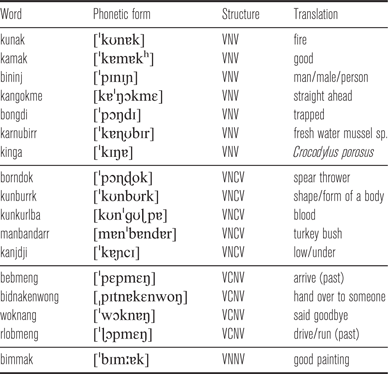
The word lists were compiled by the first and third authors, consulting a comprehensive pan-dialectal Bininj Kunwok dictionary (Garde forthcoming) and additionally the Kunwinjku learners’ dictionary (Manakgu & Etherington Reference Manakgu and Etherington1996). The list was then checked and revised by the first author in consultation with BKw speakers at the field site to ensure both semantic and phonological accuracy. During each experiment, the participating speaker completed three repetitions of the entire word list (95 words), giving a total of 1710 tokens. A subset of this word list (shown in Table 1) provides the 106 tokens from the five speakers included in this study.
Words containing intervocalic medial nasals used as stimulus for this study.

V = vowel, N = nasal, C = oral plosive consonant
Each target word was embedded in a carrier phrase and the participant uttered the word in the following way, with the target word in bold:
-
(1)


The design of the word list controls for place of articulation and word stress as far as is possible in an elicited task. The target words were spoken in two positions within the carrier phrase: a corrective focus position which was utterance-final, in a phrase location most likely to attract a major intonational prominence in the language, and also in utterance-medial position where the word was more likely to attract informational focus. For some speakers, a clear intonational break was produced after the first phrase. Prior analyses suggest that there is no major difference in degree of accentual prominence between the two utterance locations, medial and final (Fletcher et al. Reference Fletcher, Butcher, Loakes, Stoakes, Tabain, Fletcher, Grayden, Hajek and Butcher2010). Only tokens that were uttered in an intonational focus position without an intonational break after the first phrase were included in the analysis, however. The final list used in this experiment comprised words containing singleton nasals and homorganic and heterorganic clusters of nasals and stops. When surveying the available dictionaries of the language and after extensive elicitation and consultation with Kunwinjku first language speakers, it was found that some stop and nasal sequences – and nasal and stop sequences – are entirely absent from the lexicon. Notably missing are heterorganic sequences involving apico-alveolar and apico-post-alveolar (retroflex) consonants (Carroll Reference Carroll1976, Manakgu & Etherington Reference Manakgu and Etherington1996, Etherington & Etherington Reference Etherington and Etherington1998, Evans Reference Evans2003b, Garde forthcoming). Apico-alveolar homorganic clusters (/dn/) are commonly found within the Eastern dialects of BKw such as Kuninjku. This is due to the addition of the nominal suffix -no which is cognate to the Class-IV nominal prefix kun- in Kunwinjku used in the language to indicate non-human, non-vegetable objects. The -no morpheme is common word-finally (Evans Reference Evans2003b). The proper noun Kundedjnjenghmi (the name of a Bininj Kunwok variety) contains a homorganic palatal cluster /cɲ/ that spans a morpheme boundary and is an example of a sequence that is under-represented in the language (homorganic plosive plus nasal). In general, homorganic plosive–nasal sequences are far less common than heterorganic sequences in BKw.
All target words apart from the word bininj ‘male/person’, contain a word-initial velar oral stop [k] to control for phonetic effects that may arise from segments preceding the nasal. From impressionistic surveys of these data, voiceless oral plosives reset the velum to the closed position particularly when spoken in word-initial position. In this word list, it was not possible to control for vowel quality due to the small sample size and restricted number of available target words. In addition to these considerations, nasal-initial words also were excluded due to the possible effects of carryover nasalization from the initial nasal. There are nasals present in the carrier phrase which may introduce long range carryover nasalization effects, but as the carrier phrase is kept constant the potential effect on the results is assumed to be minimal.
3.2 Recordings and measurements
Aerodynamic techniques are amongst the most reliable methods for indirectly inferring the velar port movement (Krakow & Huffman Reference Krakow and Huffman1993). The speaker specific nature of aerodynamic data, however, makes cross-speaker comparisons non-trivial. Each speaker has an inherent lung volume, and the flow rate during speech is dependent on the rate and intensity of the speech act. These speaker and utterance specific parameters cannot be estimated by observation of the gender and morphology of a speaker. Despite these interspeaker differences, the flow-rates are generally highly stable for any given speaker in a controlled speech task, with multiple repetitions showing very similar peak values (Baken & Orlikoff Reference Baken and Orlikoff2010: 355). A general observation of flow rates across speakers is that nasal airflow is a considerably lower volume when compared with oral airflow due to the smaller aperture of the nasal cavity and velar port. Ladefoged (Reference Ladefoged2003) reports that nasal flow comprises on average 13% of the total airflow in the speech system. The reduced airflow in nasals means that there can be a low signal to noise ratio which can be highly affected by glottal pulsing during voicing. The combination of these factors can make interpretation of nasal signals relatively challenging.
The method used in this study during the data gathering phase follows that of Yanagihara & Hyde (Reference Yanagihara and Hyde1966) in their study of bilabial stops. Multichannel articulatory recordings were gathered via a Scicon R&D airflow mask (OM–2) containing an inbuilt microphone and nasal mask (NM–2) connected via catheters to an EIPF–4 transducer base. This was then interfaced with a Scicon R&D 916 capture device (Scicon R&D, Inc. California, USA). These were attached to a Dell Latitude D510 laptop running Microsoft Windows XP Professional (Service Pack 2). The airflow acquisition hardware was controlled using PCQuirer software (Version 7, Scicon R&D California, USA). Oral and nasal airflow was recorded via separate masks with the speaker holding a mask over their mouth and a separate mask attached to the nose by means of a strap around the head. This experimental design eliminates the risk of leakage between chambers that is possible with a partitioned mask, although side leakage was possible and was checked for during recording. A microphone mounted within the oral mask enables the capture of the audio signal directly from the oral cavity this lacks the acoustic output of the nose, however.
Prior to fieldwork, the aerometric system was calibrated for oral flow oral flow (Uo), nasal flow (Un) and oral pressure (Po) following the method described in Ladefoged (Reference Ladefoged2003). Calibration was performed before commencement of fieldwork and then re-calibrated upon return to the Phonetics Laboratory at The University of Melbourne. Airflow transducer calibration was completed by placing the masks onto the Perspex cylinder of the Scicon calibration device (Scicon R&D CAL220). Initial calibration was performed at sea level with an air temperature of approximately 20°C. During transducer calibration, the air passes from the calibration device into the mask at eight set rates (0, 5, 10, 15, 20, 25, 30 and 35 l/min) recorded with an arbitrary gain on the capture equipment of five units (millivolts). As the transducer response is not linear it must be calibrated using the polynomial equation — (2.10−8)x2 + 0.0011x + 0.3846, where x is measured in millivolts (mV). The millivolt values were then converted into l/min using the output of the calibration device as reference.
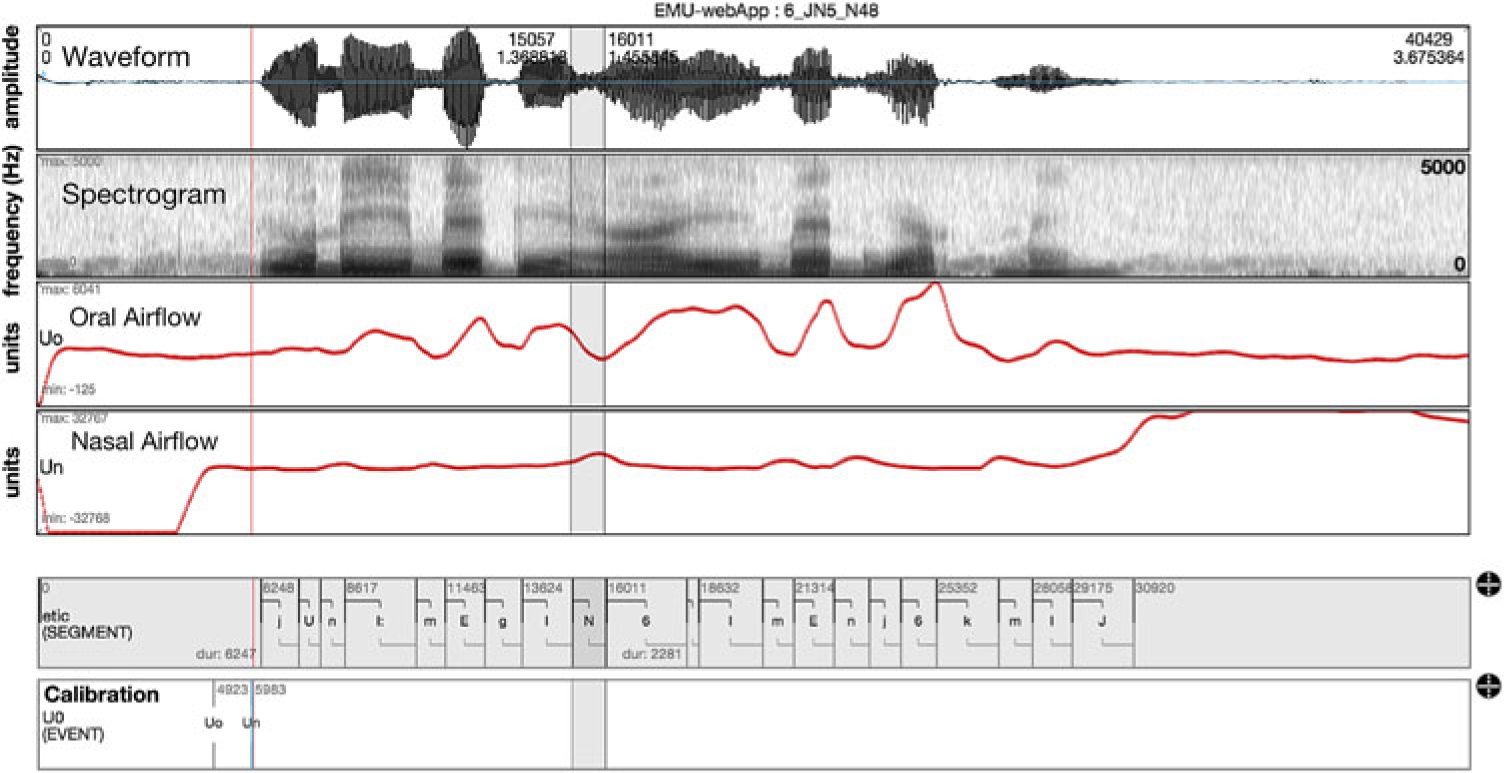
Air temperature at the field site fluctuated between 29°C–43°C during recording sessions and all measurements were taken 27 m above sea level. For the nasal channel, the zero level was very variable, however and consequently in the majority recordings the signal has been offset from the zero baseline. This offset is recalibrated to zero by measuring a steady-state portion of the signal away from obvious respiration (see Figure 1). This zero-correction is considered during the analysis and did not cause us to question the resulting signals in terms of timing of the airflow rise from zero (see below for method). The volume velocity of flow in both the oral and nasal channels is measured in litres per minute (l/min) and then converted to millilitres per second (ml/s or the equivalent SI unit, cm3 s−1).
Labelling criteria – in the word kinga [ˈkɪŋɐ] ‘estuarine crocodile (Crocodylus porosus)’ with four signals shown in the Emu Labeller: The acoustic waveform, the spectrogram, the oral airflow and the nasal airflow. The zero- rectification for both channels is also indicated on an Event level (Uo and Un). The oral closure in the nasal is marked based on labelling landmarks in the acoustic waveform.

A percentage of total flow rather than an absolute nasal flow measure would account for interspeaker variation and offset differences in inherent lung capacities (Baken & Orlikoff Reference Baken and Orlikoff2010), and additionally to control for overall vocal effort differences due to speech style of the source material (Krakow & Huffman Reference Krakow and Huffman1993, Delvaux et al. Reference Delvaux, Demolin, Harmegnies and Soquet2008). Using a proportional measure would also ensure that during the nasal articulation there is complete closure in the oral cavity. Additionally, the change in nasal flow due to oral impedance would be measurable. The current study did not use proportional flow measure, however although we did visually inspect plots of Un/Uo+Un and found no obvious effects. We use the change in nasal flow (∆Un) in to normalize across speakers. These data were relatively controlled in terms of overall speech amplitude between tokens and speakers. As noted by the reviewers of this paper, future studies should include this measure as part of the experimental design.
All acoustic data were recorded either directly from the aerodynamic mask as mentioned above using the inbuilt microphone in the Scicon R&D airflow mask (OM–2) or high-quality audio recordings with a hand-held Sony ECM-MS957 Electret Condenser microphone place 10 cm from the mouth and recorded onto a Marantz PMD690 Portable Flash Recorder, as mono, uncompressed Broadcast WAV files at a 48 kHz sample rate and a bit depth of 16 bits. The aerodynamic acoustic data were recorded with at a significantly lower 11 kHz sample rate with a bit depth of 16 bits. The lower quality precluded their use in a spectral or formant analysis. Additionally, the aerodynamic audio channel had marked attenuation in the higher frequencies (>1000 Hz) due to the design of the oral mask and the lack of nasal information in the signal. The spectral information in the higher frequencies was sufficient, however to act as a guide for the subsequent segmentation and labelling of the sound files and synchronous airflow signals but unfortunately not for further acoustic analysis (see Stoakes Reference Stoakes2013: 143 for further details on channel processing and filtering).
3.3 Database and analysis
The database of sound files, time-aligned physiological signals and hierarchical label files were managed within The Emu Speech Database (emuR, Version 0.2.3) (Winkelmann et al. Reference Winkelmann, Jaensch, Cassidy and Harrington2018). All recordings were initially segmented and labelled with Praat (versions 5.0.0–5.4.02; Boersma & Weenink 2015) and the Text Grid label files were converted into the latest Emu Database format using a function that is part of the emuR package (emuR::convert_TextGridCollection()) (Winkelmann et al. Reference Winkelmann, Jaensch, Cassidy and Harrington2018). All data were analyzed within the R environment (R Core Team 2018). The statistical analyses were computed using the lme4 (Bates et al. Reference Bates, Mächler, Bolker and Walker2018), gss (Gu Reference Gu2014) and fda (Ramsay et al. Reference Ramsay, Wickham, Graves and Hooker2017) R packages. Visualization and plotting of the aerodynamics were output using the ggplot2 package (Wickham Reference Wickham2009). The aerodynamic channels were exported from PCQuirer as standard WAV files and downsampled from 11 kHz to 300 Hz, then converted from WAV to SSFF format (see https://ips-lmu.github.io/The-EMU-SDMS-Manual/, Section 15.1.3) using a custom script created by Winkelmann (personal communication).
3.3.1 Acoustic duration measurements
The duration measurements are based on the acoustic signal and this experiment examines both single nasals and nasals that form part of a cluster. The physiological experiment uses aerodynamic recordings and is divided into three sub-experiments, all of which test the extent and directionality of nasalization in BKw.
Nasalization is a gradient phenomenon and as voiced nasals are relatively sonorous, with acoustic energy found throughout the speech spectrum it is difficult to place discrete boundaries at the transitions between vowel and nasal. It is particularly difficult if nasalization begins before the onset of oral closure although this can be measured using changes in spectral information (Chen Reference Chen1997). As with all phonetic labelling, strict measurement criteria must be employed to ensure replicable results. With these considerations in mind, initial segmentation was based on the acoustic waveform and associated spectrographic information rather than with explicit reference to the aerodynamic channel. The duration of a nasal was measured at the offset of the vowel at the cessation of regular high frequency spectral activity (>2000 Hz) read from the spectrogram, which was assumed to be the moment that oral articulators form closure (see Figure 1). The closure phase is taken to be the time in which the oral tract was fully occluded with the articulators held in place. In this phase, there is acoustic evidence of strong anti-formant activity resulting in spectral zeros (Repp & Svastikula Reference Repp and Svastikula1988; Harrington Reference Harrington1994, Reference Harrington, Hardcastle, Laver and Gibbon2012). The offset of the nasal is measured from the onset of high frequency spectral energy in the following vowel. Duration was measured for all vowels, nasals that were word-medial, and stops that formed part of an intervocalic cluster. Acoustic measures of nasalization such as A1-P0 and A1-P1 (see Chen Reference Chen1997 and Scarborough et al. Reference Scarborough, Zellou, Mirzayan and Rood2015) are not included in the current study mainly due to the degraded acoustic signal. Aerodynamics is the preferred method as it gives direct information on nasalization, although it is much more challenging to gather articulatory recordings under field conditions when compared with acoustic recordings due to the possibility of environmental fluctuations.
The following duration and aerodynamic measurements were extracted from the corpus and associated Emu Speech Database. The durational results derive from a larger set of words from the same five speakers than those used in the aerodynamic results. Only experimental tokens were measured and all nasals found within the carrier phrase were excluded. The measurements for this study include:
-
1. The duration of singleton nasals in a VNV sequence (see Table 2).
-
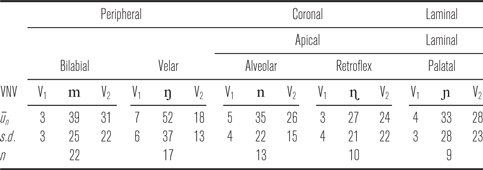
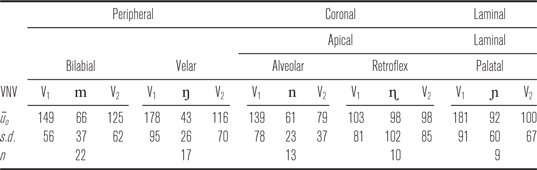
2. Mean oral and nasal flow in VNV sequences separated by place of articulation (see Tables 3 and 4).
-
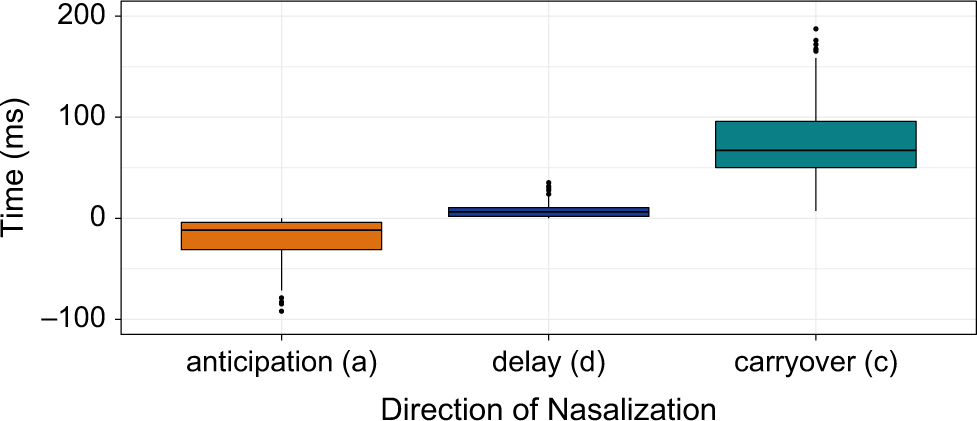
3. The interaction between the timing of the onset of nasalization and the timing of oral closure in nasals (see Figure 2).
-
4. Level of peak nasal airflow (Un) in VNV sequences using the SSANOVA technique (see Figures 5 and 6).
-
5. Registered b-splines averages for time normalized Un curves in VNV sequences, registered by Oral onset (Figure 7a) and proportional nasal airflow maximum (Figure 7b).
-
6. The duration and peak nasal airflow of the nasals as part of a VCNV and VNCV sequence (Figures 9–12).
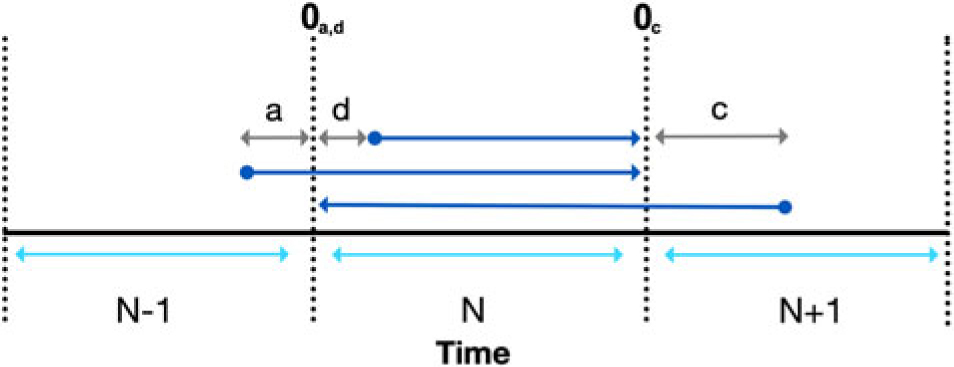
Measurements for the Anticipation (a), Delay (d) and Carryover (c) of nasal airflow with respect to the acoustic labelling of oral closure (0a,d) and oral release (0c) (after Basset et al. Reference Basset, Amelot, Vaissière and Roubeau2002). The dark blue line indicates the extent of nasal ‘a’.

3.3.2 Aerodynamic timing measurements
It is possible to quantify the magnitude of anticipatory and carryover nasalization present using the nasal flow channel (Un) by measuring the time at the onset of nasal airflow in relation to the point of closure using information from the nasal flow channel (Un) (see Basset et al. Reference Basset, Amelot, Vaissière and Roubeau2002). In Figure 2, the value a represents the duration of anticipatory nasal airflow. The interval a is measured as the time between the onset of nasal airflow represented in the nasal flow channel (Un) and the onset of the nasal consonant, determined from the acoustic signal when there is significant dampening of formant activity and no high frequency energy. The onset is the zero point, marked in the figure using a dotted line. The interval a will return a negative value if the nasal airflow anticipates the oral closure. A delay in the onset of nasal airflow is measured as the interval ‘d’ which will be a positive value if nasal airflow only starts to increase after the oral closure. The nasal segment is marked ‘N’, and the preceding segment, usually a vowel, is marked ‘N-1’; the following segment, also usually a vowel, is marked ‘N+1’. The interval marked ‘c’ is the time of carryover nasalization from the offset of the oral closure in the nasal until either a minimum in the nasal flow channel or the end of the vowel (V2) which ever come first.
3.4 Statistical measures
3.4.1 Smoothing Spline ANOVA
When comparing multiple aerodynamic recordings across multiple speakers it is necessary to average the signals not only for peak nasal airflow but also for time due to differences in speech rate and amplitude. In this experiment, the averaging of the peak airflow was calculated using a spline smoothing algorithm. For further information on the technique, see Davidson (2006) for an overview of the applications of spline smoothing algorithms for dynamic speech data. This method is based on the Smoothing Spline ANOVA (SSANOVA), introduced by Gu (Reference Gu1990) as a way of averaging complex time-series data. Each speech segment must be temporally normalized prior to an SSANOVA being calculated and then the smoothing spline function can be successfully applied. There have been several previous studies applying this technique to a variety of dynamic speech data, the most prevalent being the analysis of ultrasound tongue splines (Davidson Reference Davidson2006, Billington 2014, Heyne & Derrick Reference Heyne and Derrick2015, Mielke Reference Mielke2015), as well as acoustic data which have enabled the contours of dynamic formant trajectories (Nycz & De Decker Reference Nycz and De Decker2006, Haddican et al. Reference Haddican, Foulkes, Hughes and Richards2013, Docherty, Gonzalez & Mitchell Reference Docherty, Gonzalez and Mitchell2015, Kirkham Reference Kirkham2017, Fruehwald Reference Fruehwald2017) and f0 (Yiu Reference Yiu2015) across speakers, enabling a direct comparison. Related to nasalization, Carignan (Reference Carignan2017) uses a smoothing spline averaging method to calculate statistics for nasalance and contact quotient over proportional time. For additional information about applying the spline smoothing technique to aerodynamic data, see Stoakes (Reference Stoakes, Carignan and Tyler2016).
The nasal airflow for each phoneme (V1NV2) was measured independently and then averaged over 100 time points. As previously discussed, in order to obtain a consistent baseline value for the subsequent averaging of the peak nasal airflow, the zero level for each phoneme sequence containing a nasal was set using a hand labelled point in a steady-state portion of the signal away from obvious respiration (see the U0 event tier in Figure 1). The peak nasal airflow rate for the other phonemes was then calculated relative to this steady-state airflow level (see vertical line marked in Figure 1). A reviewer of this paper noted that this method assumes that correcting the zero-offset values found in the raw airflow recordings results in a linear shift to the signal and this assumption should be tested in any further analyses.
The ssanova function, which forms part of the R library gss (Gu Reference Gu2014), was applied using a 95% Bayesian confidence interval (shown as a ribbon on the plots below). The resulting plot shows the nasal airflow rate over time for each of the nasal phonemes. This is separated by place of articulation.
As we are most concerned with the temporal domain rather than with cross-speaker comparisons in the magnitude of nasal flow, a further spline smoothing was applied to ensure that each place of articulation was temporally registered both relative to the onset of the oral closure and then also relative to the absolute maximum of nasal flow. These were calculated separately for each place of articulation. A ‘Functional Data Analysis’ approach for approximating a curve using discrete points was computed as b-splines (or basis-splines) using the fda package within R (Ramsay et al. Reference Ramsay, Wickham, Graves and Hooker2017). B-splines are used because they are very computationally efficient with the resulting curve a good representation of the averaged data. As with an SSANOVA, these data are first linear time normalized resulting in a proportional time over 100 points across the entire VNV sequence. In addition, within this analysis, flow values are calculated as proportional flow using the minimum flow value for each sequence as zero and the maximum flow value in the sequence as 1 which is expressed as ∆Un. The use of proportional flow enables airflow for different speakers to be compared directly giving information about the timing of the peak flow relative to the onset of oral closure in the nasal.Footnote 4 There is the potential of a great deal of variation in the slope of the airflow contours, but our observations suggested that these were relatively consistent if separated by place of articulation of the nasal.
3.4.2 General linear mixed effects models
For static measures, general linear mixed effects models (GLMM) were used to compare durational measurements and used to correlate the aerodynamic and acoustic measurements. This procedure was only applied to static measures rather than dynamic measures such as airflow over time. The lme4 package (Bates et al. Reference Bates, Mächler, Bolker and Walker2018) as well as the base R environment was used (R Development Core Team 2018). After each linear mixed effect model was constructed, a check of the validity of the model was examined using a likelihood ratio test comparing the null model to the alternative model. To test this fully, two analyses of variance (ANOVA) were computed: one with a model that includes the fixed effects (the alternative model) which was then compared with the null model that includes only the random intercepts. The model with the least degrees of freedom was selected. Throughout this study, measurements of statistical significance are reported as Chi squared (χ2) with subsequent p-values calculated using the Sattherwaite approximation and Bonferroni Correction (as per the method in Harrington & Schiel Reference Harrington and Schiel2017) These p-values are considered significant at the α = 0.01 level. The language-as-a-fixed-effect fallacy – as noted by Clark (Reference Clark1973) – was avoided by including both Speakers and Tokens (Items or Words) as random intercepts (see Baayen, Davidson & Bates Reference Baayen, Davidson and Bates2008 for a discussion).
4 Results
As described in the methodology section above, the second experiment follows a similar procedure to that of Basset and colleagues when measuring patterns of nasalization in French (Basset et al. Reference Basset, Amelot, Vaissière and Roubeau2002). The results of this study are presented in several parts. The first section reports the duration and aerodynamic results for nasals found in various positions and then looks at the timing of airflow rises in relation to the oral closure. The next section examines VNV sequences within the first disyllable in a word presenting SSANOVA results. Following on from this coarticulatory nasalization is measured using a Functional Data Analysis by looking at anticipatory nasalization for each place of articulation using a registered proportional signal. This is done in order to initially normalize for inter-speaker variation and to check that the observations we found in individual airflow curves was representative when averaged across speakers.
4.1 Durational and aerodynamic measurements
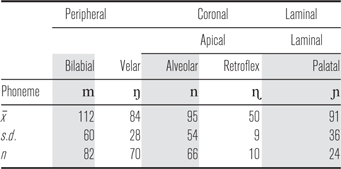
Table 2 shows the mean duration, standard deviation, and number of word-medial intervocalic medial nasals broken down by place of articulation.
The alveolar and bilabial nasals have the longest oral closure duration with mean durations of 95 ms and 112 ms, respectively. The post-alveolar (retroflex) nasal has a duration of between 45 ms and 55 ms. The bilabial and velar (peripheral) nasals are often found in BKw high frequency words and the retroflex nasal is a rarer phoneme as it does not occur, or is neutralized along with retroflex stops, in word-initial position. An LMM was calculated and when a main effect of an interaction of duration by place of articulation was tested, using speaker and item as random intercepts, all places of articulation except palatal and velar had durations that were significantly different to one other (p > .001).
Mean nasal oral closure duration in VNV sequences (measured in ms).

Mean nasal airflow (Un) of segments in VNV sequences (measured in cm3 s−1).

Mean oral airflow (Uo) of segments in VNV sequences (measured in cm3 s−1).

Tables 3 and 4 show the mean, the standard deviation (s.d.) and number of tokens (n) for nasal airflow (Un) and oral airflow (Uo). The tables are arranged according to nasal place of articulation with the peripheral, coronal and laminal consonants grouped separately. As can be seen in Table 3, the aerodynamic results show very little observable mean nasal airflow during the initial vowel (V1) compared to (V2). After zero-rectification (see method above), the flow rates for V1 before all nasals except the velar (/ŋ/) are within the error threshold set at ±5 cm3 s−1. This indicates that the average nasal flow over the whole sequence is very low. The oral flow results, in Table 4, show the flow rate is lower during the first vowel (V1) when compared to V1 in the same V1NV2 sequences, reflecting the higher nasal flow observed in the same context.
It is clear from these flow results that although there are very low levels of anticipatory nasal flow there are greater levels of carryover nasalization in vowels following nasals. These average values make it difficult to generalize patterns and show the precise timing of the velum opening gesture, however.
4.2 Nasalization onset and the relationship with oral closure
The timing of onset of nasal gesture shows considerable variability in the inter-articulator timing between articulator closure and velum lowering. The hypothesis is that nasalization, observed by an increase in nasal airflow occurs in advance of oral closure. This experiment examines the timing differences looking at whether the oral closure is before the nasal gesture or whether it is after. Figure 3 shows the duration of anticipation and delay in milliseconds from all measured speakers (see Figure 1 for a schematic diagram). The three sequences measured include a singleton nasal between two vowels (VNV), a cluster of a nasal followed by a stop also between two vowels (VNCV) and a cluster of a stop followed by a nasal between two vowels (VCNV). In the case of the clusters it has been assumed that there is a morpheme boundary between the nasal and the stop in each case based on Evans’ (Reference Evans2003a) grammatical analysis. A morpheme boundary cannot be posited for intervocalic singleton nasals as these are not morphologically transparent in the language. Of the total number of tokens, 73% that have anticipatory nasal airflow and 27% that have a delay in the nasal airflow. As shown in the aerodynamics, the duration of both anticipation and delay very short and the onset of nasal air flow is virtually synchronous with the oral closure and well below a ‘just noticeable difference’ set at approximately 30 ms (Pisoni Reference Pisoni1977, Pastore & Farrington Reference Pastore and Farrington1996). Apparently, the velum is lowered very quickly in these examples which does not accord with descriptions of the velum as a sluggish articulator (Ohala Reference Stevens1975: Stevens Reference Stevens1998: 43: Butcher Reference Butcher, Simpson and Pätzold1999).
Magnitude of Anticipation (a), Delay (d) and Carryover (c), in VNV sequences.

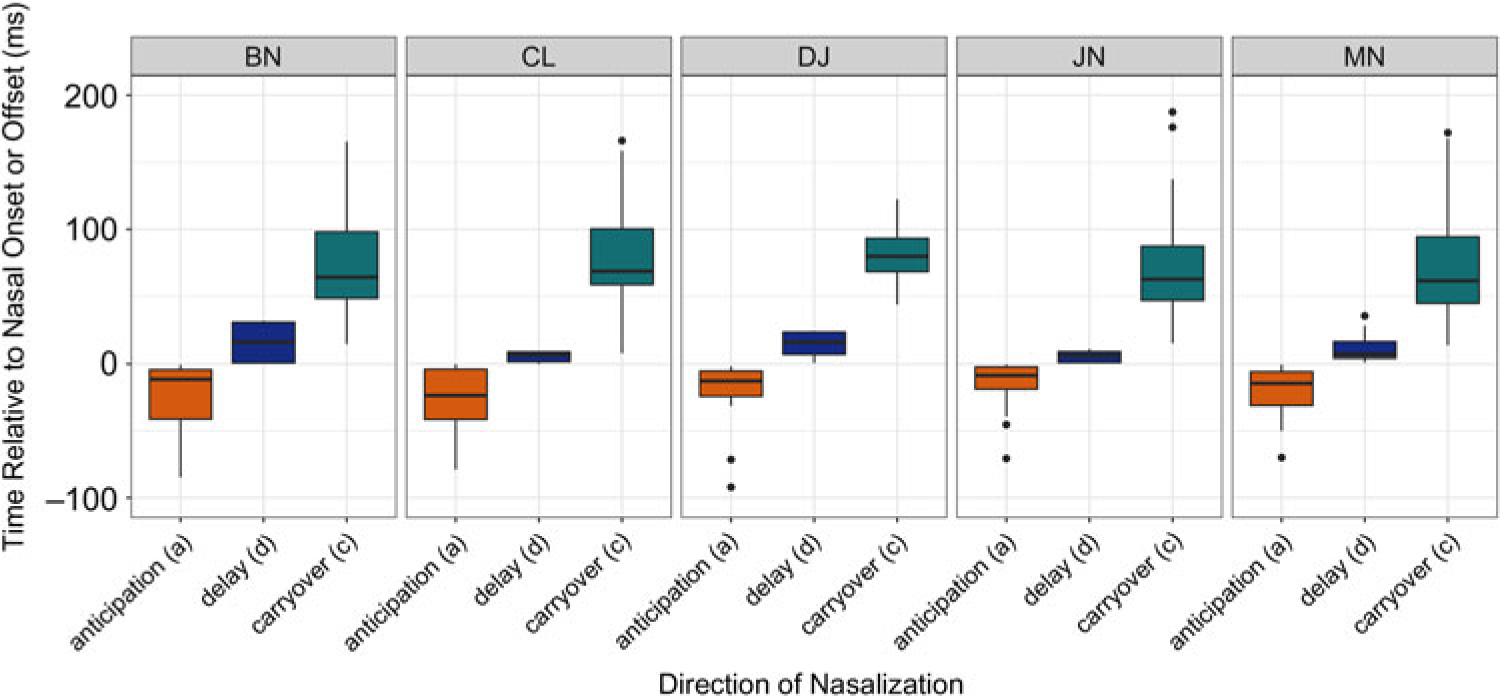
A linear mixed effect model (χ2 (6,435) = 227, p < .001) shows that a main effect of directionality of nasalization (anticipation, delay or carryover) has a statistically significant duration effect (with speaker and token included as random intercepts). A post-hoc Bonferroni test shows that the mean of the Anticipation (a) differs from the mean of the Delay (d) by 28 ± 8 ms (p = .004). Carryover (c) is 109 ± 6 ms greater than Anticipation (a) (p > .001) and carryover is 81 ± 8 ms (p > .001) greater in duration than Delay (d). The mean anticipation and delay are short enough to be considered co-incident whereas the carryover shows significant nasalization in the following vowel. Figure 4 shows that this pattern is largely consistent across all speakers with some speakers having greater variability of the co-ordination of the oral closure to the velar port opening gesture (BN in particular and some showing tight co-ordination of the two gestures).
Magnitude of Anticipation (a), Delay (d) and Carryover (c), in VNV sequences separated by speaker.

To show the precise timing of the onset of nasal flow we can calculate this as a function of time and the plot the resulting signal. In the next section, dynamic plots of peak nasal flow are calculated using a SSANOVA analysis, and the results are presented in the following sections.
4.3 Nasalization in VNV sequences
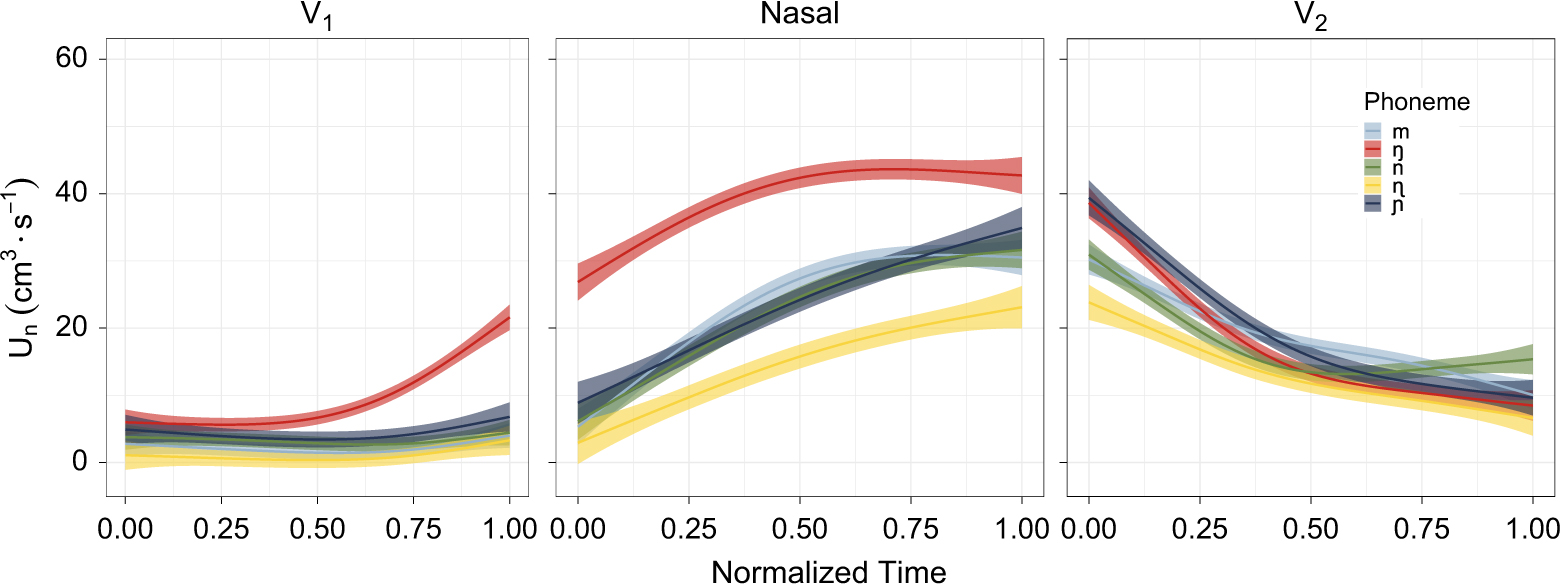
Figure 5 summarizes the calculations for average nasal airflow (Un), measured for single intervocalic nasals. Adjusted airflow (cm3 s−1) averaged over five speakers is plotted against normalized time (shown on the x-axis). The boundaries between the normalized segments are based on the hand-labelled division of vowel (V1) and nasal (N1), relying on the acoustic signal and spectrogram as reference. The nasal onset is assigned at the point of full oral closure and when the overall sonorance is reduced, damping the high frequency spectral information (see Figure 1 above). The time normalizing procedure is achieved by first using temporal-averaging across the entire segment (n = 100). A spline smoothing ANOVA (SSANOVA) is then calculated for each time normalized data vector resulting in an averaged plot for each nasal phoneme.
An SSANOVA of nasal airflow (Un) calculated separately for a Vowel (V1) – Nasal – Vowel (V2) sequence plotted by place of articulation.

In Figure 5 the airflow rises for the majority of places of articulation occur during the final 25% of the initial vowel. The velar nasal has greater anticipation in the vowel of the following nasal segment. In the vowel following the nasal (V2) there is positive nasal flow throughout the entire segment for tokens regardless of place of articulation. For all nasals, the average peak nasal flow rate occurs after 50% of the oral closure, well within the nasal segment (central panel of Figure 5). This plot is consistent with the averaged flow values reported above in Table 3. These results suggest that the velar place of articulation is patterning differently to the other nasals with respect to velar port opening.
4.4 Group and interaction effects
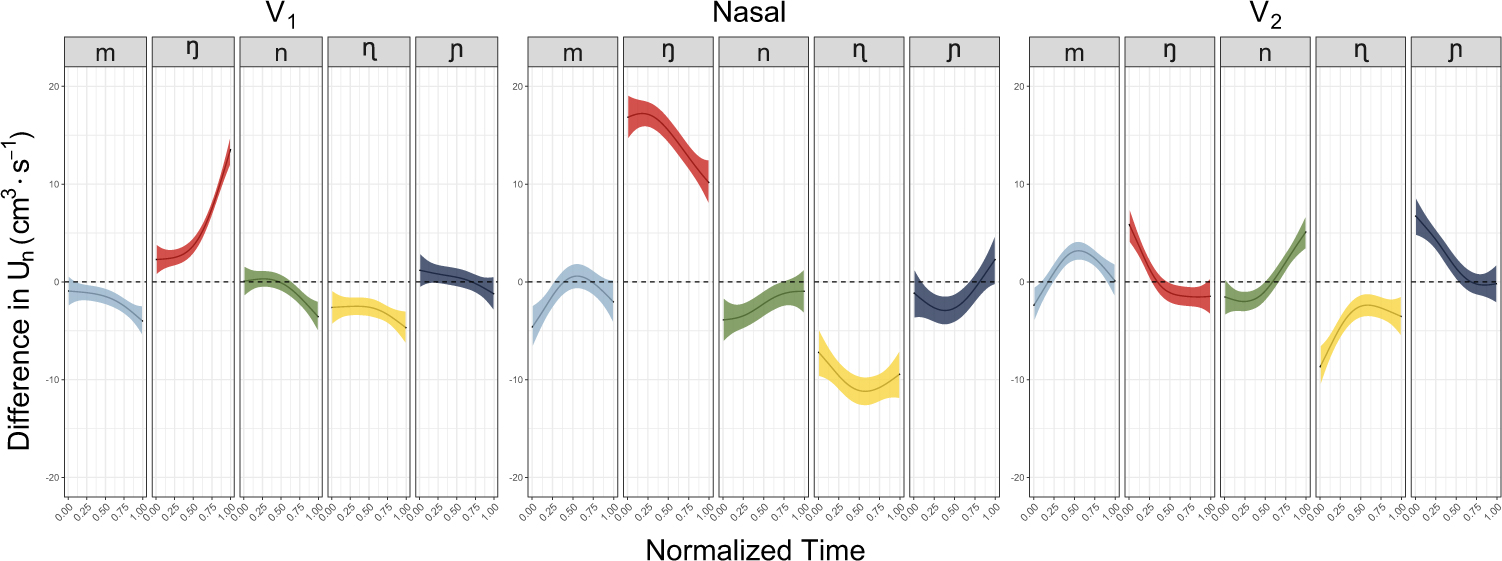
The plot in Figure 5 shows the flow with respect to proportional time. In order to show statistical significance in an SSANOVA plot, a group interaction is calculated that shows each of the nasal phonemes individually. This plots the mean difference in peak nasal airflow (Un) between each of the phonemes when compared with the group mean over time. The values of the initial vowel (V1), nasal and following vowel (V2) are shown, separated by the label of the medial nasal phoneme. Any ribbons that intersect with the 0 line indicate that the phoneme is statistically significantly different from the group for that nasal phoneme at that particular time point. The velar place of articulation has a mean nasal airflow across the entire segment that is considerably higher than the group mean, whereas the remaining phonemes all have values showing that they very close to the group mean. The calculated mean difference across the nasal is small at approximately 2.5–10 cm3 s−1 although as can be seen in Figure 6 that the main difference is restricted to the end of the vowel.
Interactions between peak flow and phonemes Vowel (V1) – Nasal – Vowel (V2) sequences.

In the pre-nasal vowel V1 the velar nasal has a higher flow overall when compared with the other phonemes and that the difference begins at approximately 60% into V1. This increased flow for the velar is maintained within the nasal closure and into the final vowel. The bilabial nasal has a maximum peak nasal flow that is early when compared to the other nasals and the palatal nasal has a late peak of nasal flow. This interaction shows that the velar nasal is patterning separately in comparison to the other places of articulation. This confirms the results shown in Figure 5.
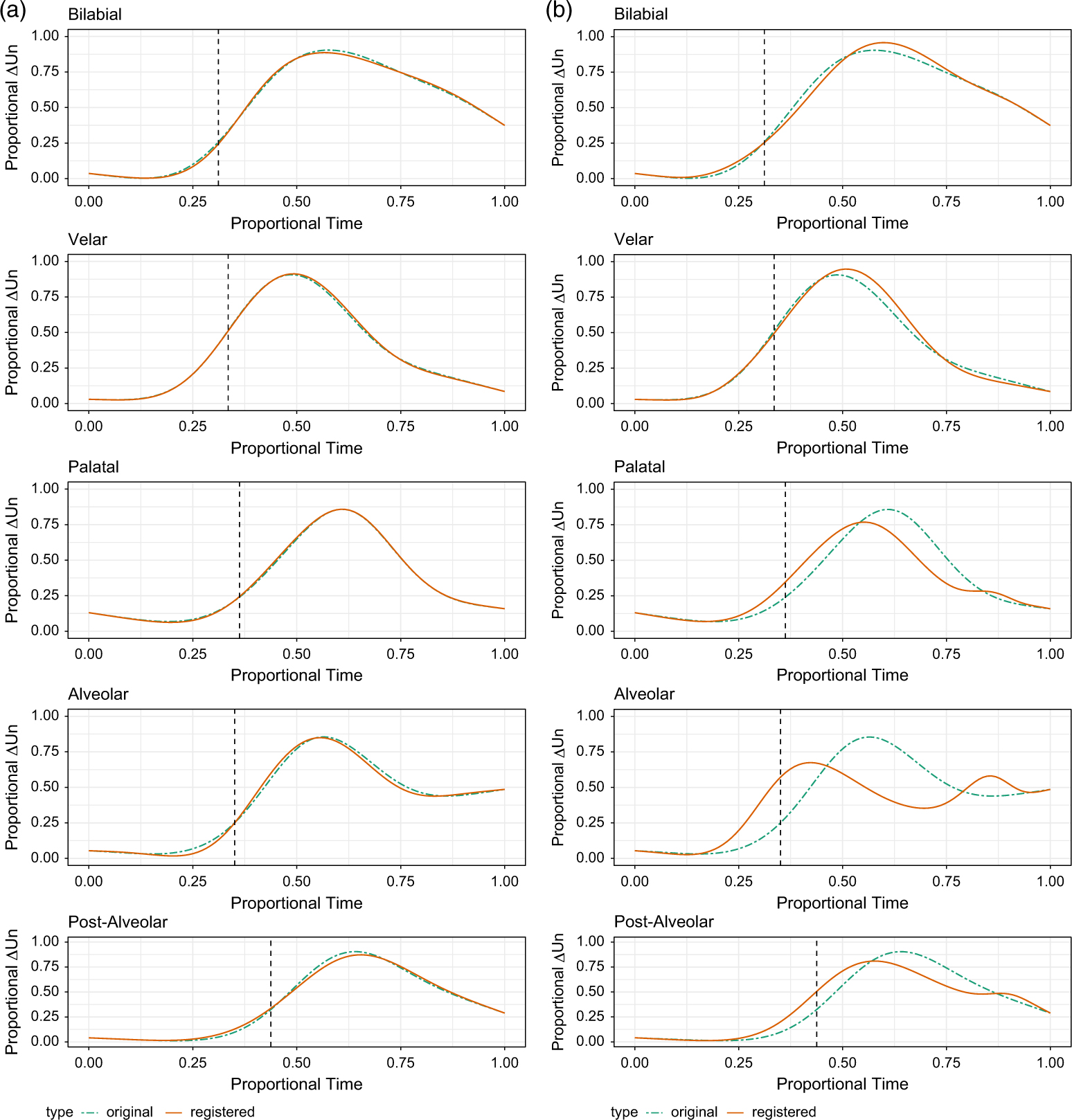
The SSANOVA analysis shows that the onset of the first rise in nasal airflow is toward the end of the vowel for all places of articulation. The plot does not adequately show the variation present in the sample in terms of the timing of the airflow maximum. As discussed in the method there is considerable variation in the amplitude of the signal across speakers. Utterances with higher overall amplitude may be contributing more to the shape of the plotted curve, despite the SSANOVA for each segment being calculated separately for Figures 5 and 6 above. In order to control for these differences in the amplitude of peak flow a further spline smoothing measurement has been applied and the entire sequence of Vowel-Nasal- Vowel has been registered in terms of oral closure in the nasal (Figure 7a) and proportional nasal maximum (Figure 7b). The Un channel is transformed into a proportional value (∆Un), with 0 set as the absolute minimum flow value for the sequence and 1 the absolute maximum. This measure does not look at the carryover condition. The vertical dashed line on each plot in Figure 7 illustrates the average moment of full oral closure in the nasal.
(a) The proportional change in nasal airflow (∆Un) registered by oral closure in the nasal. (b) The proportional change in ∆Un registered by maximum flow. Both over proportional time of an entire VNV sequence. In each plot the dashed vertical line shows the average time of the onset of oral closure based on the acoustic signal. The dashed curve shows the unregistered Un signal.

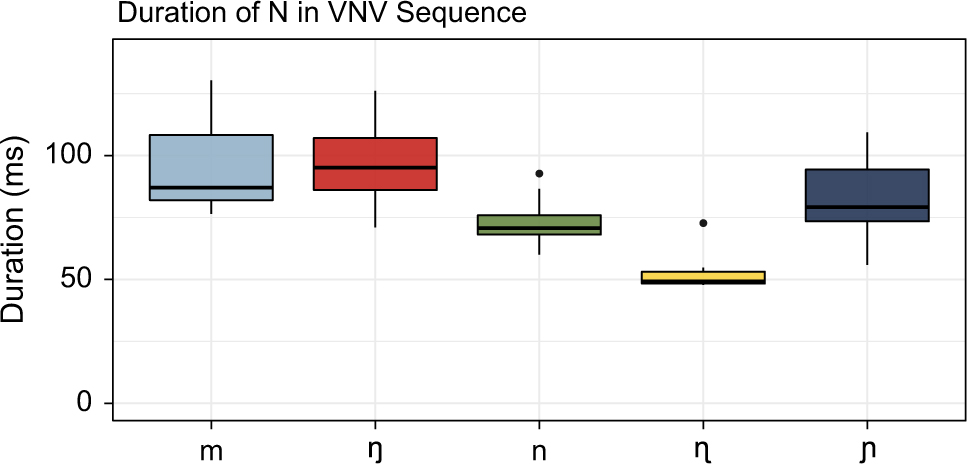
Figure 8 shows the duration of each nasal place of articulation in the aerodynamic analysis. The apical nasals are significantly shorter than the peripherals or laminals (p < .001). When considered together with Figure 7b we see that for the apico-alveolar and apico-post- alveolar nasals there is a bimodal nasal maximum pattern which is evidence of the greater levels of pre-stopping at this place of articulation. The short duration of these articulations also makes them harder to synchronize with the velum lowering gesture and consequently they both anticipate and delay more than the other places of articulation leading to an increase in pre-stopping at this place of articulation (see discussion below). This information is not available in Figure 5 or 6 but the delay in airflow rise is clear in Figure 7, showing that while the SSANOVA can be very informative regarding timing it is influenced by domain of measurement and thus must be supported with further analyses.
The duration of the intervocalic nasals in the aerodynamic subset separated by phoneme.

4.5 Average nasal airflow in clusters
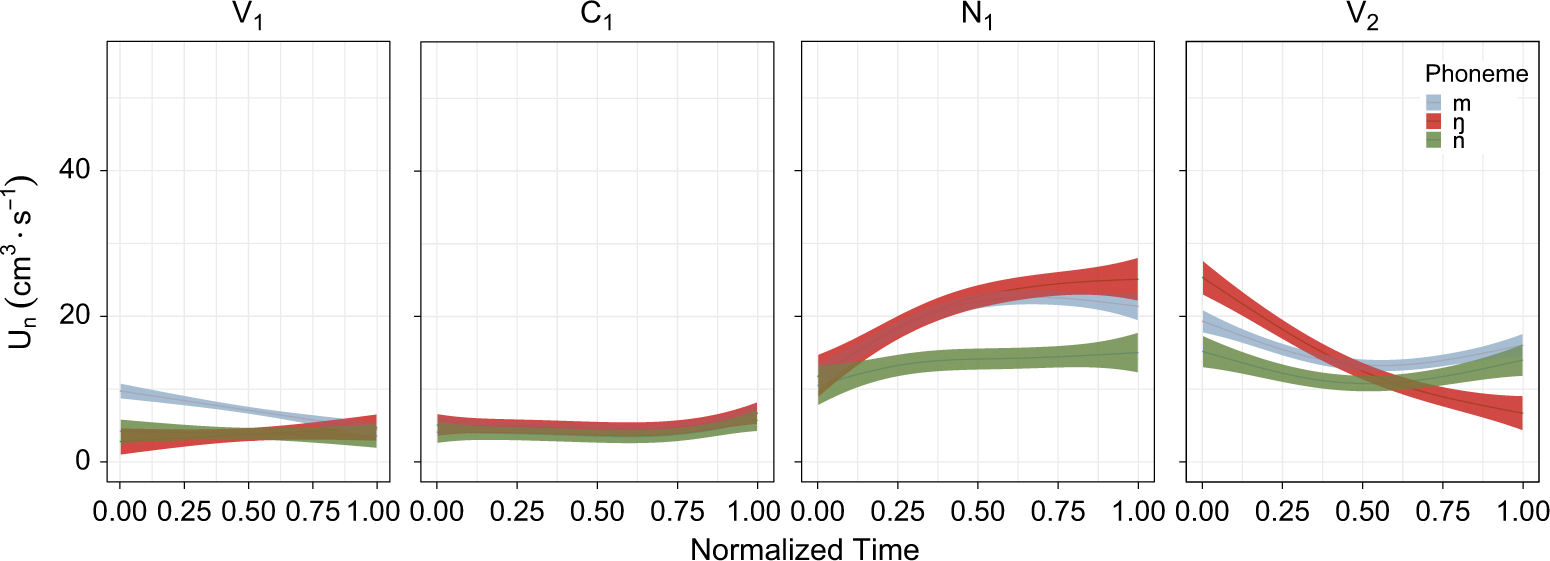
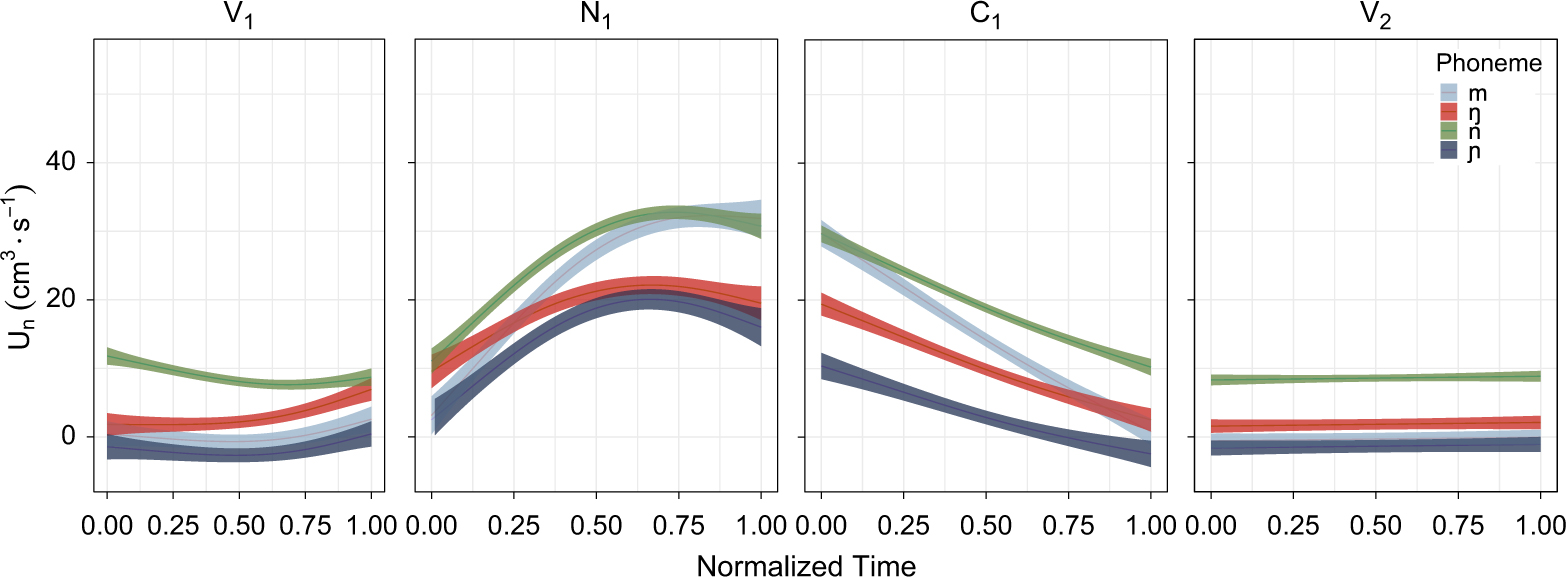
Intervocalic singleton nasals are rare in BKw and nasals occurring in cluster environments are much more prevalent. To examine nasal articulation in clusters, word-medial nasals preceded by a consonant between two vowels (VCNV) were measured (shown in Figures 9 and 10) as well as medial nasals followed by consonant between two vowels (VNCV) shown in Figures 11 and 12.
Airflow of bilabial nasals in time normalized Vowel – Oral Stop (C1) – Nasal Stop (N1) – Vowel sequences.

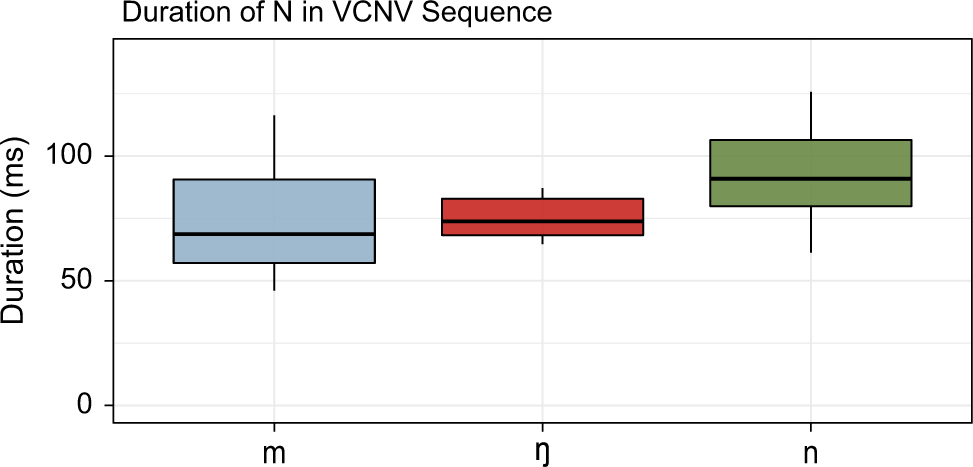
Duration of a nasal in VCNV sequence, separated by place of articulation.

Airflow of bilabial nasals in time normalized Vowel – Nasal Stop (N1) – Oral Stop (C1) – Vowel sequences.

Duration of a nasal in VNCV sequence, separated by place of articulation.

As with the intervocalic nasals shown in Figure 5, the dynamic averages of nasal flow are plotted in a VNCV sequence using an SSANOVA. This summarizes the three places of articulation, bilabial, apico-alveolar and dorso-velar found in in both heterorganic and homorganic clusters. As with the other non-nasal environments there is minimal anticipatory nasal airflow, although there is greater carryover nasal flow in V2 which carries over into non-nasal vowel environments.
In VCNV environments the preceding stop is always voiceless with a long duration and nasal airflow increases just prior to the nasal onset (shown in Figure 9). The preceding voiceless consonant ensures that the velar port is closed and suppresses nasalization. The positive nasal flow in the sequence that includes the bilabial nasal /m/ is due to carryover nasalization from the nasal in the carrier phrase. This is due to the voiced-initial post-alveolar lateral /ɭ/ not interrupting voicing or carryover nasalization from the carrier phrase [ˈɭɔpmɛŋ] (see the word list in Table 1 above).
When the nasal is in the first position of the cluster the following consonants is invariably voiced and there is extensive carryover nasalization as shown in Figure 11. The positive nasal airflow in the token containing the apico-alveolar nasal [n] is from an initial [m] in the word [mɐnˈbɐndɐr] which is in the prefix man-. There is considerable variation in the amount of nasalization in the V2 position which confounds the SSANOVA measure, possibly due to other nasal phonemes in the word. The durations shown in Figure 12 are marginally longer than those shown above in Figure 10. Notably the coronal consonants are much longer than they are in the singleton VNV environment.
In addition to a longer duration, the nasal also has a higher magnitude signal than in the VCNV environment. This is significant for all places of articulation. This suggests that the C1/N1 (first) position of a cluster is strengthened in terms of manner of articulation cues and as this is the site of most phonological contrasts in the language, also indicates strengthening of place of articulation cues.
The consonants preceding a nasal in VC1N1V sequences invariably voiceless and although the durations are not as long, they have many of the characteristics of fortis stops occurring in post-tonic, word-medial positions (Stoakes Reference Stoakes2013). In VN1C1V sequences the nasal is marginally longer for the coronal consonants /n/ and /ɳ/ (p < .01), longer for the velar /ŋ/ (p < .001) when compared with singleton consonants. The second consonant in the cluster is fully voiced and the nasalization is carried over into V2.
5 Discussion and conclusions
Phonetically, Bininj Kunwok speakers use language specific strategies in order to limit anticipatory nasalization in prosodically prominent positions, a pattern of coarticulatory resistance thought to be common across Australian languages (after Butcher Reference Butcher, Harrington and Tabain2006). By reducing the nasalization in the preceding vowel, the transitional place of articulation information can be enhanced allowing many places of articulation to remain contrastive.
In BKw, peak nasal airflow measurements show very little anticipatory flow in vowels preceding a word-medial nasal and these air flow patterns suggest that there is a delay in full velum lowering until after oral closure in a nasal phoneme articulation and that this sometimes results in pre-stopping particularly for an apical-alveolar nasal. The nasalization patterns in each of these environments suggest that there is a process of contrast enhancement and coarticulatory resistance in these prosodically prominent VN and VNC sequences.
Broadly the results are similar to those observed in phonologically non-nasalized vowels preceding nasals in French where vowels are produced with less nasal airflow in order to avoid perceptual confusion with phonemically nasal vowels. It should be noted that there is also an interaction with vowel height (Delvaux et al. Reference Delvaux, Demolin, Harmegnies and Soquet2008). In BKw, a similar effect is found at the onset of intervocalic singleton nasals and in clusters of nasal plus stop. These patterns also accord with Beddor’s (Reference Beddor2009) findings that there is an inverse relationship between nasal duration and peak flow although the latter was only observed in nasal codas. What is clear from these results is that the observed patterns are found regardless of the syllable affiliation of the nasal.
The presence of nasalization in the carryover context shows that rather than simply compressing or speeding up the velum-lowering gesture, the entire gesture is delayed, as evidenced by the patterns shown in Figures 7a and 7b. The temporal delay of a velum raising gesture causes significant nasal airflow to be present in the post-nasal vowel and as there is no phonological nasalization contrast in vowels the nasalization is not fully stopped until a following voiceless (non-sonorant) consonant. If the following consonant is also a nasal the velum will remain open throughout the vowel.
When examining the timing of peak of nasalization, coronal nasals (apico-alveolars and apico-post-alveolars) have a peak in nasalization that is synchronous with the offset of oral closure which is possibly due to the short duration at this place of articulation in intervocalic nasals. The laminal nasal /ɲ/ has a more delayed peak of nasalization with respect to the onset of oral closure (Figure 7a). The velar nasal shows an increased nasal airflow starting after 50% of the initial vowel (V1) and reaches its peak of earlier than the other nasals. The coronal and laminal consonants have their maximum peak of nasalization at the acoustic offset of the nasal (centre panel of Figure 5). Figure 6 shows that for velars (/ŋ/) the difference in flow is greater in V1 and N than the other phonemes. The palatal (/ɲ/) has a marginally higher peak flow at the onset of the second vowel (V2) indicating that it has the highest carryover nasalization although this effect is not seen in Figure 7a when the entire sequence is normalized. This carryover effect may be due to the greater contact area of the laminal articulator meaning that coordination between oral closure and nasalization is more difficult to maintain. In velars, velum lowering is less delayed because, unlike with coronal articulations, the velum may need to be lowered to make a tight closure with the tongue dorsum within the articulation. Following on from this, the velar is the only place of articulation that shows consistent anticipation of nasalization in the preceding vowel. In each of the aerodynamic analyses, the velar place of articulation has a higher overall flow that is anticipated in the preceding consonant. Word-initial velar nasals are highly unstable in BKw and are the segment most likely undergo significant lenition in word-initial position particularly when preceding a low vowel (see Blevins Reference Blevins, Simpson, Nash, Laughren, Austin and Alpher2001). These positions are prefixing morphemes which are common and lexically predictable. In order to investigate the interaction between vowel quality (height), morphological structure and prosodic position in BKw and beyond, further research is required which control for these variables.
Despite the large proportion of sonorant segments in the language, intervocalic nasals are rare in the language. A natural utterance may contain many word-medial clusters often straddling morpheme boundaries, with each member of the cluster possibly associating with a different syllable. This cluster environment provides many interesting durational and coarticulation patterns. To summarize, duration is greater in the first C1/N1 position of a cluster for both oral stops and nasals. As outlined above, we observe a delay in the nasal gesture inferred from the nasal airflow patterns. In other words, in word-medial clusters the C1 position shows articulatory strengthening in both plosives and nasals which is manifest in consonant lengthening. The results presented in this study also suggest that the entire nasal gesture is delayed relative to the oral closure phase in VN sequences.
One consequence of this delay, particularly when the velum is lowered very late in a nasal phoneme, is a gap in the speech stream occurring after oral closure which results in an epenthetic oral stop. These articulations are commonly termed pre-stops and as mentioned above are very similar phonetically to the post-ploded nasals found in some Austronesian languages Cohn & Riehl (Reference Riehl2008). This process is widespread for nasals and laterals in Australian languages (Hercus Reference Hercus1972, Reference Hercus1994; Maddieson & Ladefoged Reference Maddieson and Ladefoged1993; Butcher & Loakes Reference Butcher and Loakes2008; Loakes et al. Reference Loakes, Butcher, Fletcher and Stoakes2008; Harvey et al. Reference Harvey, Lin, Turpin, Davies and Demuth2015) and is present phonetically in BKw (Stoakes Reference Stoakes2013), Warlpiri (Fletcher et al. Reference Fletcher, Loakes and Butcher2009) and Kaytetye (Harvey et al. Reference Harvey, Lin, Turpin, Davies and Demuth2015). In Eastern and Central Arrernte languages, the prevalence and consistency of pre-stopped articulations gives them phonemic status (Breen & Pensalfini Reference Breen and Pensalfini1999), although there is significant inter-speaker variation. The majority of Australian languages however, do not have phonologically pre-stopped nasals despite significant delays in velar port opening. Importantly for this analysis, pre-stopping is not phonological in BKw, and there has been no suggestion in various grammars of the language and subsequent descriptions that this pattern is linguistically important to a speaker of the language (Oates Reference Oates1964, Harris Reference Harris1969, Carroll Reference Carroll1976, Evans Reference Evans2003a, Stoakes Reference Stoakes2013). Also, there is no break in voicing in these sequences so pre-stops do not interrupt the pitch excursion from a vowel into a nasal.
The coronal places of articulation (the apico-alveolar and apico-post-alveolar) have the greatest tendency to delay velum opening until after oral closure resulting in pre-stopping and the airflow patterns shown in Figure 7b show two peaks in the registered curves suggesting that the entire gesture is delayed. The alveolar nasals are generally relatively short and the tongue gesture in nasals described as a tap-like gesture. The apico-alveolar tap [ɾ] is a common allophone of the stop [t/d] and the retroflex (post-alveolar) flap [ɽ] is an allophone of the stop [ʈ/ɖ]. Although the oral gesture is quite short at these places of articulation, in the nasal articulations the whole velum opening gesture is delayed rather than being compressed so there is considerable carryover coarticulation.
In summary, the results of this study indicate that for a word containing an initial nonnasal the velar port is tightly closed until the just before or slightly after the oral closure in a following nasal. This allows phonetic pre-stopping at certain places of articulation which is in some languages extreme enough to become phonologized.
Tight temporal control of velum lowering ensures place of articulation information is phonetically retrievable in an intervocalic environment. As mentioned above, consonants in the post-tonic intervocalic position are sites for the majority place of articulation distinctions, so it is imperative to prevent masking of the phonetic cues (Butcher Reference Butcher, Harrington and Tabain2006).
We find a contrast enhancement in this environment in BKw and as argued earlier this is a site of prosodic enhancement (e.g. Fletcher et al. Reference Fletcher, Stoakes, Loakes and Singer2015). In sum, these findings also show a link between patterns of coarticulatory resistance and prosodic prominence in ‘V–N sequences, suggesting that speakers exert explicit control over the vowel nasalization process by delaying the velum lowering gesture so that there is no anticipatory nasalization in the accented vowel. Similar to findings by Cho et al. (Reference Cho, Kim and Kim2017) in English, prosodic position thus effects the degree of nasalization with enhancement of the orality of the vowel preceding a nasal and enhancement of the consoantality of the nasal although this does not reduce the sonorance.
Anticipatory coarticulation is very tightly controlled in the production of BKw nasals which serves to enhance the place of articulation cues in consonants and possibly to improve overall contrastiveness for phonemes in prosodically prominent positions within a word. This occurs in the ‘post-tonic’ position, associated with a preceding high pitch accent which can extend across sonorant phones into a syllable coda. In Lakota, Scarborough et al. (Reference Scarborough, Zellou, Mirzayan and Rood2015) find that degree of coarticulation is strongly dependent on maintaining paradigmatic phonological contrast and that differences in the nasal patterns are not evidence of a language specific constraint on coarticulation, but instead, a contrast in vowels is ‘enhanced to overcome, or to coexist with, coarticulation’ (Scarborough et al. Reference Scarborough, Zellou, Mirzayan and Rood2015: 306). In BKw the resistance to nasal coarticulation may primarily be in order to enhance place of articulation information in this highly phonologically contrastive position. This syntagmatic contrast between adjacent phones is restricted to the ‘post-tonic’ prosodic position suggesting that paradigmatic contrasts are used together with syntagmatic contrasts to enhance language comprehensibility. The tight control of anticipatory nasal coarticulation may serve to give us insight into some of the mechanisms the led to the stability of phoneme inventories in Australian languages over potentially vast time scales.
Acknowledgements
We would like to thank first, and foremost the participants in this study as well as all of the residents of Mamardawerre outstation for their patience, generosity and guidance. Many thanks to the editor Amalia Arvaniti, three anonymous reviewers, Debbie Loakes, Rosey Billington, Raphael Winkelmann and the Postdoc Reading Group at The University of Melbourne for their comments; all errors remain our own. Thanks also to Prof. Nick Evans and Dr. Murray Garde for assistance at the inception of this project. This research formed part of the Ph.D. dissertation of Hywel Stoakes submitted to the Department of Linguistics at the University of Melbourne. Funding was provided by the ARC Discovery Project, DP0557540 and the Centre of Excellence for the Dynamics of Language, CoE14010004.