1 Introduction
The main goal of this paper is to present data that forces a revised account of the distribution of downstep and pitch reset in the pitch-accent variety of Basque spoken in Lekeitio. In the light of the new data, previous analyses of pitch reset in Lekeitio Basque (Elordieta Reference Elordieta, Martínez-Gil and Morales-Front1997a, Reference Elordieta1998) make wrong predictions. On the one hand, pitch reset is predicted where downstep occurs, and, on the other, an ordinary reset is predicted where a large reset occurs. Evidence will be provided that the occurrence of downstep and pitch reset, as well as the amount of pitch reset observed, is best accounted for under the assumption that languages possess a hierarchical prosodic structure that (roughly) matches the surface syntactic structure of a sentence, including levels of embedding or nesting of syntactic constituents. Since syntax is recursive in nature, prosodic structure is predicted to be recursive as well. Match theory (Selkirk Reference Selkirk2009, Reference Selkirk, Goldsmith, Riggle and Yu2011) is a theoretical model that advocates a direct mapping between syntactic phrases and phonological phrases, using constraints such as MatchPhrase. This constraint interacts with prosodic markedness constraints that may override a direct translation from syntactic phrases to phonological phrases.
MatchPhrase and relevant prosodic markedness constraints define the recursive phonological phrase structure that is accessible to the phonetic commands realising pitch scaling across phonological phrases in Lekeitio Basque. This general model is complemented by the idea of Ito & Mester (Reference Ito, Mester, Borowsky, Kawahara, Shinya and Sugahara2012, Reference Ito and Mester2013) that recursion-based subcategories of prosodic categories like phonological phrase (ᵠ) can be identified by phonological constraints or phonetic interpretation. In Lekeitio Basque, pitch reset is argued to apply at the left edge of a non-minimal phonological phrase (ᵠnon-min), i.e. a ᵠ that dominates at least another ᵠ.
Lekeitio Basque is a variety of Northern Bizkaian Basque. In a word-prosodic typology, Northern Bizkaian Basque varieties belong to the pitch-accent type.Footnote 1 The features of this prosodic dialect of Basque that are relevant for our paper are summarised in (1).
-
(1)

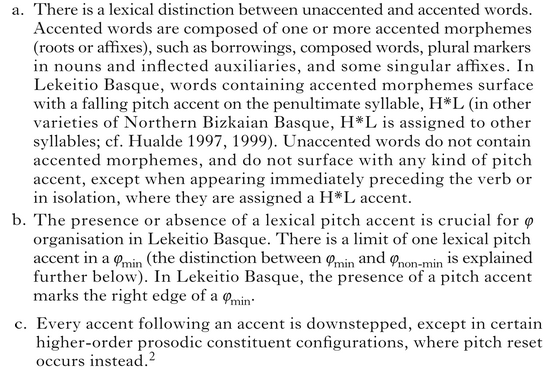
At this point, it is important to discuss the issue of the notion of ‘phonological phrase’. In classic Prosodic Phonology (cf. Nespor & Vogel Reference Nespor and Irene1986, Selkirk Reference Selkirk1986), the ᵠ is a level or constituent in the prosodic hierarchy, dominated by the intonational phrase (ι) and dominating the prosodic word (ω). In subsequent work, other prosodic constituents above the ω have been proposed, often as alternatives to the ᵠ. McCawley (Reference McCawley1968), Selkirk & Tateishi (Reference Selkirk and Tateishi1988, 1991) and others use the terms Minor and Major Phrase (MiP and MaP respectively) to refer to prosodic constituents above the word level in Japanese. A MiP is characterised as a prosodic constituent containing one or more ω's, which is distinguished intonationally by the presence of boundary tones and/or pitch accents at the left and right edges. A MaP dominates the level of MiP, and is claimed to be the domain of downstep. In their analysis of Japanese intonational phonology, Pierrehumbert & Beckman (Reference Pierrehumbert and Beckman1988) coin the terms Accentual Phrase (ap) and Intermediate Phrase (ip) to refer roughly to the levels of MiP and MaP respectively. Elordieta (Reference Elordieta, Martínez-Gil and Morales-Front1997a, Reference Elordieta1998, Reference Elordieta, Riad and Gussenhoven2007) and Jun & Elordieta (Reference Jun, Elordieta, Botinis, Kouroupetroglou and Carayiannis1997) also use the levels of the ap and ip in their work on the intonational phonology of Northern Bizkaian Basque. Other work that have used ap and ip for languages like English, Korean, French and Arabic include Beckman & Pierrehumbert (Reference Beckman and Pierrehumbert1986), Jun (Reference Jun1996, Reference Jun1998), Jun & Fougeron (Reference Jun, Fougeron and Botinis2000), Hellmuth (Reference Hellmuth2007), Michelas & D'Imperio (Reference Michelas, D'Imperio, Lee and Zee2011) (see papers in Jun Reference Jun2005, Reference Jun2014 for additional references).
Ito & Mester (Reference Ito, Mester, Borowsky, Kawahara, Shinya and Sugahara2012, Reference Ito and Mester2013) argue that such proliferation of levels and constituents between the ω and the ι is not warranted. On the one hand, they argue that prosodic constituents should respond to general or organisational aspects, evidenced on the basis of the distribution of phonological phenomena of different type (segmental and suprasegmental). However, labels such as ‘Accentual Phrase’ convey the meaning that they are defined simply on the basis of accentual phenomena, making specific reference to a particular prosodic aspect or feature that occurs within it, namely a pitch accent.
On the other hand, Ito & Mester claim that the terms ‘Minor’ and ‘Major Phrase’ suggest reference to sublevels of the same category. They defend a recursive model of prosodic constituency, in which ι, ᵠ and ω can have more than one layer. The idea would be that there exists only one prosodic constituent between the ω and the ι, which is the ᵠ. A ᵠ contains minimal and non-minimal layers (ᵠmin and ᵠnon-min respectively), and these layers constitute prosodic domains. ᵠmin is a ᵠ that dominates no other ᵠ, and ᵠnon-min is a ᵠ that dominates some other ᵠ (see Elfner Reference Elfner2012, Reference Elfner2015). MiP and ap are ᵠmin and MaP and ip ᵠnon-min. In this paper, I will assume the model of minimal and non-minimal levels of prosodic structure, avoiding the use of labels such as ap and ip.
The rest of the paper is organised as follows. In §2, the patterns of downstep and pitch reset of the four sentence types that are the focus of the paper will be introduced, with the quantitative results supporting the main observations. §3 presents an analysis based on theoretical proposals advocating recursive prosodic constituency, and §4 is devoted to a discussion of alternative characterisations of the crucial constituent structure factors involved in reset. Finally, §5 offers a summary and a conclusion.
2 Distribution of downstep and pitch reset
2.1 Sentence types and generalisations
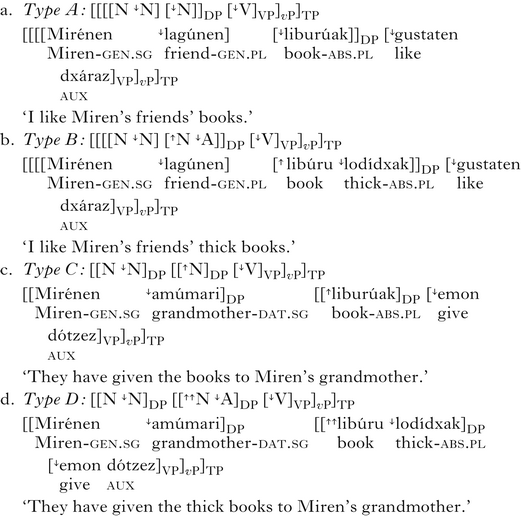
In (2), I present four sentence types and example sentences, with schematic syntactic representations and their associated patterns of downstep and degree of pitch reset.Footnote 3 The sentence types all contain two overtly expressed syntactic phrases preceding the verb. They differ (a) in whether the second phrase is syntactically grouped with the first phrase or with the following verb, and (b) in whether the second phrase contains one or two words. The first phrase always contains two words. In these sentences, the subject is never expressed (Basque is a pro-drop language allowing for any argument not to be overtly realised). The direct object (DO) always precedes the verb. If there is another syntactic phrase preceding the DO, it will be the indirect object (IO). These are sentences in which the phrases that are overtly realised constitute new information, as answers to open questions like What happened?, in which the subject may or may not constitute given information, but is not considered relevant for the sentence.
In sentence type D there are two ‘↑↑’ diacritics, to indicate that there is a higher degree of pitch reset in these cases. Since the main goal of this paper is to offer an analysis of the distribution of downstep and pitch reset in Lekeitio Basque, and since downstep depends on the presence of a pitch accent, all the words appearing in the examples mentioned in this paper are lexically accented.
Sentence type A is composed of a single DP, a DO, containing three nouns. The first two nouns are possessor phrases, and the third is the head noun (i.e. ‘Miren's friends’ books’). Type B is syntactically equivalent to type A, but the DO contains an extra word, an adjective following the head noun. Type C is composed of two DPs preceding the verb, namely an IO and a DO. The IO contains two words (i.e. ‘to Miren's grandmother’), and the DO contains one word (‘the books’). Type D is syntactically equivalent to type C, but the DO contains an extra word, an adjective following the head noun. In short, types A and B differ from types C and D in that the former only have a DO preceding the verb, whereas the latter have an IO and a DO. In types A and C the head noun preceding the verb is not accompanied by a following modifier, whereas in types B and D it is.
-
(2)
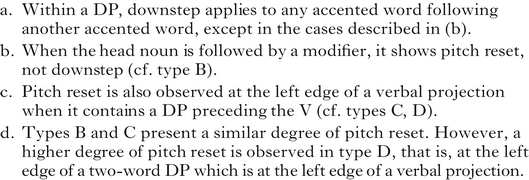
The generalisations on the distribution of downstep and pitch reset in the four structures above are summarised in (3).
-
(3)
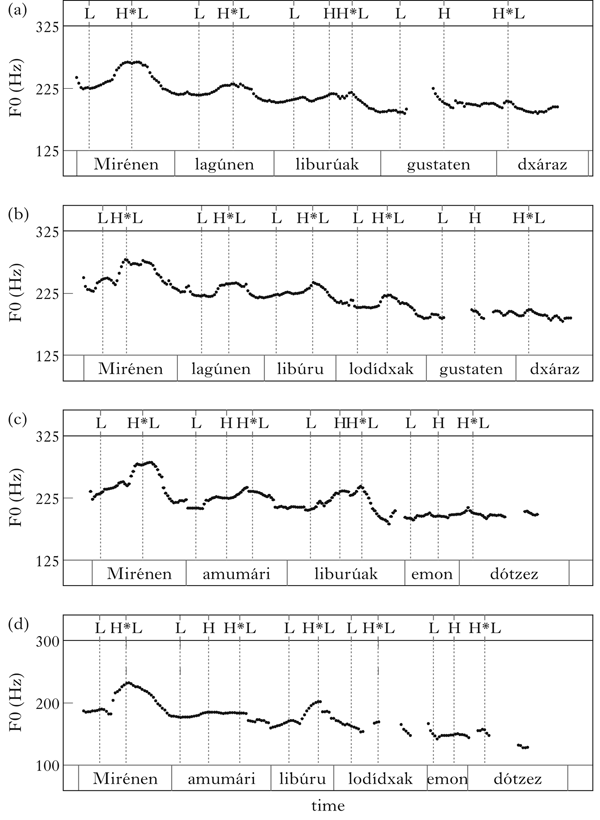
Figures 1a–d contain sample F0 contours of types A–D respectively. The topmost tier specifies the tones that are realised within each accented word, which forms a ᵠmin. In each ᵠmin there is a L tone associated to the initial syllable, and a H*L pitch accent to the penultimate syllable. In words in which there is at least one syllable intervening between the initial syllable and the accented syllable, a phrasal H tone is associated to the second syllable, and may spread rightwards (cf. Elordieta Reference Elordieta1998, Jun & Elordieta Reference Jun, Elordieta, Botinis, Kouroupetroglou and Carayiannis1997).
Illustrative F0 contours for the four sentence types in (2): (a) type A displays downstep on Peak 3 with respect to Peak 2); (b) and (c): types B and C display absence of downstep (i.e. pitch reset) on Peak 3 with respect to Peak 2); (d) type D displays a higher degree of pitch reset on Peak 3 with respect to Peak 2).

2.2 Quantitative data on the distribution of downstep and pitch reset
The analysis of the four sentence types that reveal the patterns of distribution of downstep and pitch reset in (2) is part of a larger project on the effects of syntactic constituency on the phonology and phonetics of intonation in Lekeitio Basque. An experiment was designed that consisted of the four sentence types, together with seven sentence types not relevant for the purposes of this paper. There were three examples of each type, read four times by four female native speakers of Lekeitio Basque (ages 18–47). Of the total of 792 utterances, 192 correspond to the four types analysed in this paper (4 sentence types×3 sentences×4 readings×4 speakers).
The sentences were written in the ad hoc dialectal orthographic representation used in this paper, with accents on accented syllables. The sentences were presented to the subjects in random order, on sheets of paper. Sentences representing the seven types that were not relevant to this paper were interspersed among them. The speakers were instructed to read each sentence in a natural mode, with neutral intonation, as if the sentences were answers to questions triggering broad focus responses such as ‘What happened?’. The recordings were preceded by a short training session.
For the purposes of this paper, the relevant portion of each utterance is the difference in pitch between the second and third accented words. In order to determine whether downstep or pitch reset had occurred between the second and third accented words in an utterance, the F0 maxima of the accented syllables were compared. Concretely, the F0 maximum of the third word (Peak 3) was subtracted from the F0 maximum of the second word (Peak 2), e.g. in type A the F0 maximum of the accented syllable of liburúak was subtracted from that of lagúnen. A positive value would indicate that the pitch level on the third word was lower than that on the second word, i.e. that downstep had applied to the third word. On the other hand, a negative value would suggest that the pitch level was reset on the third word.Footnote 4
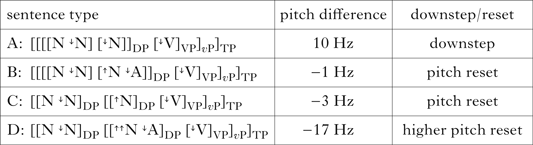
Let us start by comparing types A and B, to show the importance of the presence of the post-head noun modifier in type B. For type A, the mean of the pitch difference between Peaks 2 and 3 was 10 Hz (SD=7·38), whereas for type B it was –1 Hz (SD=8·046). Thus in type A the pitch level was significantly lower on Peak 3 than in Peak 2, whereas in type B there was virtually no difference in pitch height between the two peaks or accents. A univariate ANOVA with ‘Peak2−Peak3’ as dependent variable and ‘Type’ and ‘Speaker’ as factors revealed that the difference was statistically significant at p<0·001 (F(1,91)=49·922). There was no interaction between the two factors ‘Type’ and ‘Speaker’ (p=0·203), indicating that all speakers maintained significant differences in pitch fall between the two syntactic conditions.Footnote 5 Thus these results show that there is an asymmetry between types A and B regarding the relationship between Peak 2 and Peak 3, namely that downstep is observed in type A, whereas pitch reset is observed in type B. This significant difference indicates the relevance of the multiword status of the second DP in type B.
Types A and C were compared, in order to test the relevance of the syntactic affiliation of the second DP with the verbal constituent in Type C vs. its affiliation with the preceding DP constituent in Type A. The pitch difference between the second and third accents in type C was –3 Hz (SD=7·38). That is, there was no downstep, but rather pitch reset on the third accent. A univariate ANOVA revealed that the difference was statistically significant at p<0·001 (F(1,90)=63·478). There were no significant differences between the four speakers (p=0·445). The absence of downstep on the third accented word of type C (i.e. the appearance of pitch reset on this word) and its presence in type A highlight the role of the difference in syntactic grouping of the two DPs.
Finally, types C and D were compared. In type D there is an adjective in the direct object DP. Whereas the pitch difference between the second and third accents in type C was –3 Hz, in Type D the difference was substantially bigger, –17 Hz. An ANOVA of the differences showed that the difference was statistically significant at p<0·001 (F(1,93)=41·954), with no significant differences among the four speakers (p=0·102). These results show that pitch reset is greater when the left edge of the verbal constituent coincides with a DP with two words.
Table I summarises the differences in pitch between the second and third accents across the four sentence types for the four speakers, showing whether pitch reset has applied.
Pitch difference between the F0 maxima of the second and third accented nouns across sentence types as evidence for the occurrence of downstep or pitch reset.

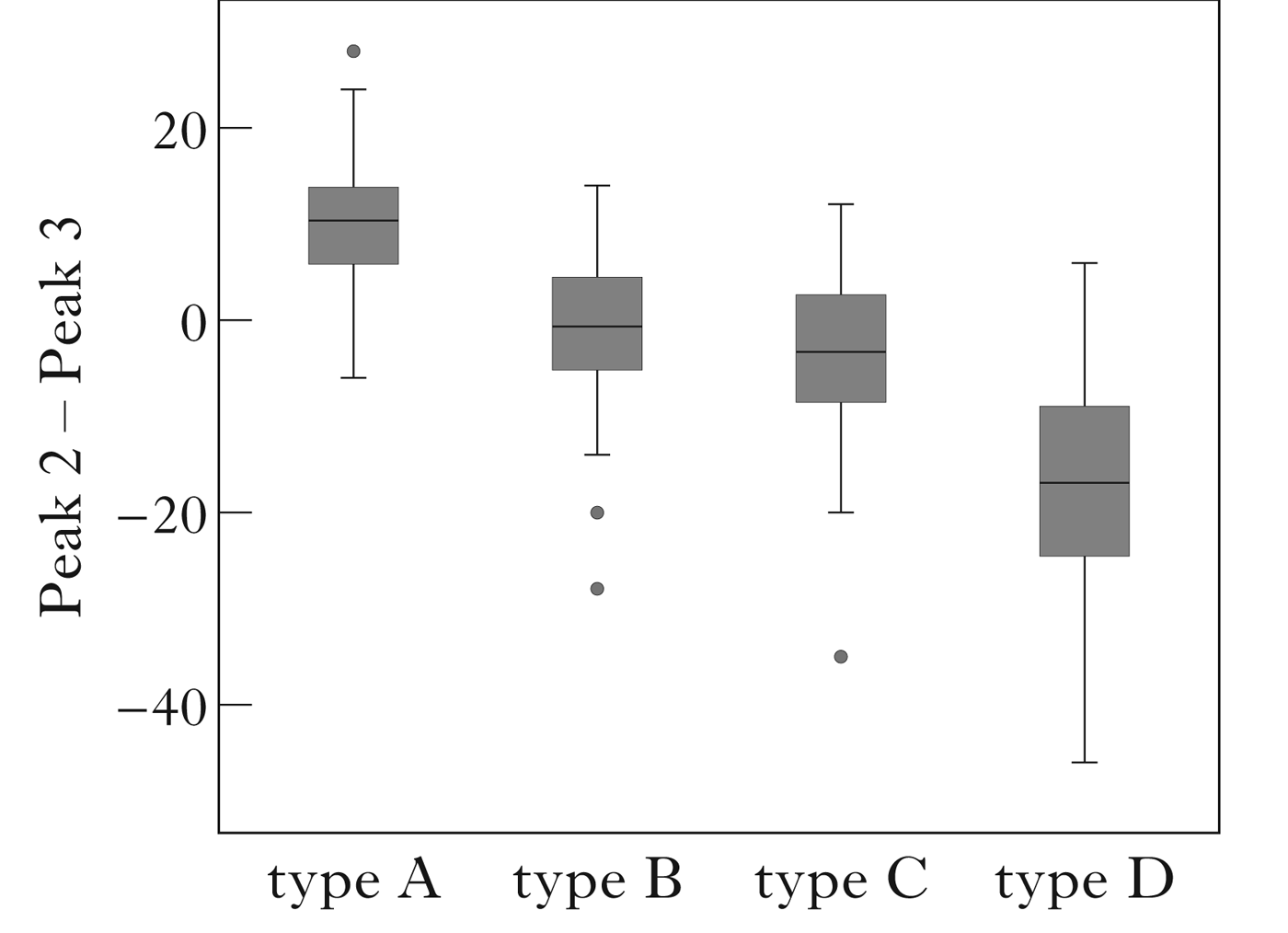
Figure 2 illustrates the mean values for the difference in pitch between the second and third accents (Peak 2−Peak 3) for the four types of sentences. The positive value for type A indicates that Peak 3 (the third accent) is downstepped with respect to Peak 2 (the second accent). The slightly negative values for types B and C indicate that Peak 3 has on average a slightly higher pitch than Peak 2 (although see note 5 above), and the significantly negative value for type D indicates that Peak 3 is clearly higher than Peak 2.
Boxplot of the the mean differences in pitch height between the second and third accents (Peak 2–Peak 3) for each sentence type.

3 An analysis based on recursive prosodic structures
3.1 Match theory
Match theory is a recent development in prosodic phonology (see Selkirk Reference Selkirk2009, Reference Selkirk, Goldsmith, Riggle and Yu2011 and Elfner Reference Elfner2012, Reference Elfner2015) which advocates a straightforward correspondence between syntactic and prosodic constituents, in the sense that both the left and the right edges of syntactic constituents align with the edges of prosodic constituents. The prosodic constituents considered by Match theory are ω, ᵠ and ι, in correspondence with the syntactic head, the syntactic maximal projection and the syntactic clause. I give here only the Match constraint for the correspondence between a syntactic phrase and a phonological phrase (from Selkirk Reference Selkirk, Goldsmith, Riggle and Yu2011).
-
(4)

Match theory assumes only three levels of prosodic constituency at the word level and above: ω<ᵠ < ι.Footnote 6 However, in the creation of prosodic constituency the Match constraints may interact with prosodic markedness constraints such as rhythm or minimum/maximum size (e.g. binarity) (cf. Selkirk & Elordieta Reference Selkirk and Elordieta2010, Selkirk Reference Selkirk, Goldsmith, Riggle and Yu2011).
A consequence of assuming a direct correspondence between syntactic and prosodic constituency is that the latter displays recursive structures, mirroring syntactic structures. Since one syntactic phrase may dominate another phrase, a natural assumption in this theory is that recursion is regular in prosodic structure as well. One of the early ideas of the proponents of the theory of the prosodic hierarchy was that prosodic structure is non-recursive, under the assumptions of the Strict Layer Hypothesis (cf. Selkirk Reference Selkirk, Myers, Laver and Anderson1981, Reference Selkirk1984, Nespor & Vogel Reference Nespor and Irene1986, Hayes Reference Hayes, Kiparsky and Youmans1989). However, there have been many proposals arguing for a recursive prosodic constituency (cf. Ladd Reference Ladd1986, Reference Ladd1988, Kubozono Reference Kubozono1989, Reference Kubozono, Docherty and Ladd1992, Féry & Truckenbrodt 2005, Wagner Reference Wagner2005, Reference Wagner2010, Ito & Mester Reference Ito, Mester, Borowsky, Kawahara, Shinya and Sugahara2012, Reference Ito and Mester2013, Selkirk Reference Selkirk, Goldsmith, Riggle and Yu2011, Elfner Reference Elfner2012, Reference Elfner2015, among others).
Ito & Mester (Reference Ito, Mester, Borowsky, Kawahara, Shinya and Sugahara2012, Reference Ito and Mester2013) argue that the different layers within recursive ι, ᵠ and ω are distinguishable, in the sense that they may be visible for the application of phonological processes or constraints. In Ito & Mester (Reference Ito and Mester2013) and Elfner (Reference Elfner2012, Reference Elfner2015) a distinction is made between non-minimal and minimal projections. Non-minimal projections are those ι, ᵠ or ω levels which are not dominated by another ι, ᵠ or ω level.
Elfner's work on Match theory is relevant for the analysis of pitch reset in Lekeitio Basque. First, she adopts the position that the general assumptions of Match theory determine that all words and phrases should be visible to the Match constraints, irrespective of whether they are lexical or functional.
The second noteworthy aspect of Elfner's work is the restriction on the nature of the syntactic phrases that are mapped as phonological phrases. Only an XP that exhaustively dominates phonologically overt terminal nodes may be mapped as an ᵠ. In the schematic syntactic structure in (5), for instance, XP cannot be mapped as a ᵠ, as it would contain a phonologically empty terminal node (the trace t), apart from a subsumed ᵠ corresponding to YP. Hence, only one ᵠ, corresponding to YP, is formed, as it exhaustively dominates phonologically overt terminal nodes (i.e. the set of terminal nodes that are the phonological exponents y and z).
-
(5)
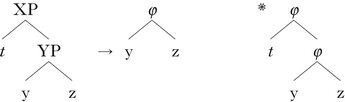
This restriction on the embedding of ᵠ's except when the phonological strings that they dominate are distinct contributes to a significant ‘flattening’ of phonological phrase structure as compared to syntactic phrase structure.
A functional head that does not constitute an independent ω, but rather forms a ω with an adjacent lexical head due to prosodic cliticisation, will be part of the ᵠ that dominates that ω. MatchPhrase will not produce a ᵠ corresponding to the functional projection, because the syntactic terminal node is not phonologically overt in that position. This issue will be crucial for Lekeitio Basque, as determiners are encliticised onto a noun or adjective, and hence the DP projection is not mapped as a ᵠ.
3.2 Pitch reset at the left edges of non-minimal phonological phrases
3.2.1 Explaining the distribution of downstep and pitch reset within DPs
Since prosodic structure is mapped from syntactic structure, the syntactic structures of the four sentence types must be described first.
Basque is an SOV language, where heads are linearly preceded by their complements (cf. Hualde & Ortiz de Urbina Reference Hualde and de Urbina2003), and I assume syntactic structures where heads are final, to the right of their complements (cf. (6) below). All the syntactic analyses in the literature agree that the indirect object DP (DP-io) is higher in surface representations than the direct object DP (DP-do). I assume that the DP-io moves to the specifier position of the Applicative Phrase, following the proposals in Rezac (Reference Rezac2008), Oyharçabal (Reference Oyharçabal, Duguine, Huidobro and Madariaga2010) and Etxepare & Oyharçabal (Reference Etxepare, Oyharçabal, Fernández and Etxepare2012), among others.Footnote 7 I also follow the work mentioned above in assuming that the DP-do leaves its in situ position as a complement to the left of the verb to raise to Spec,vP for case assignment.
In types A and B, the only DP is a DP-do in Spec,vP, as explained above. The head noun of the complex direct object is libúru, and Mirénen lagúnen is a complex genitive DP preceding the head noun. A standard assumption in Basque syntax is that genitive case is assigned structurally in Spec,DP, and hence this complex genitive DP is in the specifier position of the whole DP-do (cf. Artiagoitia Reference Artiagoitia and Etxeberria2012b and others, after Abney Reference Abney1987).Footnote 8 The complex genitive DP is formed by a head noun lagún and a genitive DP, Mirénen, in the specifier position of that DP. Determiners in Basque are phrasal affixes, i.e. they attach as affixes of the rightmost word in the NP preceding them (cf. Elordieta Reference Elordieta1997b, Hualde & Ortiz de Urbina Reference Hualde and de Urbina2003, Artiagoitia Reference Artiagoitia and Etxeberria2012a, among many others). Thus the determiners in the tree diagrams in this section are represented with a preceding hyphen.Footnote 9
As described in (3a) and (3b) in §2, sentence types A and B display a minimal contrast in the occurrence of downstep and pitch reset. In A, there is downstep on the noun liburúak, whereas in B there is pitch reset on the word libúru, as shown in (2a). The presence of the adjective in type B is crucial. The explanation I propose for the difference in the occurrence of downstep and pitch reset between these two sentence types is based on the hierarchical difference between non-minimal and minimal phonological phrases. The analysis I propose is that pitch reset applies at the left edge of a ᵠnon-min in Lekeitio Basque. This analysis is justified by the correspondence between the syntactic and prosodic structures of types A and B. Let us start with A. The relevant XP in the syntactic structure in (6a) is circled. The prosodic structure corresponding to this syntactic structure is presented in (6b), following the principles described in the previous section. The syntactic phrases mapped as ᵠnon-min or ᵠmin are indicated in (6b) by an arrow beside the corresponding ᵠ.
-
(6)
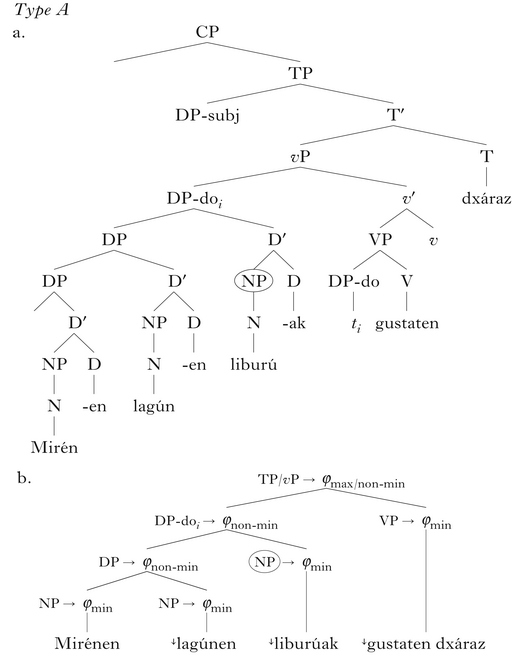
The topmost ᵠ is the one mapped from TP and vP, indicated as ᵠmax (which is also a ᵠnon-min). TP contains the inflected auxiliary in T, but I am assuming that in neutral declarative sentences the verb remains in situ (e.g. Ormazabal et al. 1994, Uriagereka Reference Uriagereka1998, Haddican Reference Haddican2004, Reference Haddican2007, Vicente Reference Vicente, Arteatx, Artiagoitia and Elordieta2008, Etxepare & Uribe-Etxebarria Reference Etxepare and Uribe-Etxebarria2009), and that the auxiliary merges with the verb postsyntactically, in a process of prosodic cliticisation.Footnote 10 The auxiliary is not an independent ω, but a bound expression that needs a ω that can host it, so it merges with the verb in one ω and appears with the verb in a ᵠ corresponding to VP.Footnote 11 The consequence of such cliticisation is that TP contains a vacuous terminal node, T, with no phonological exponent. Under the principles stated in the previous section, TP cannot be mapped as an independent ᵠ, and forms a ᵠ with the next maximal projection below it, vP.
A similar proviso is appropriate for determiners and case markers in Basque, which in the syntactic structure in (7a) appear occupying the head D, but which are morphologically and prosodically affixes on the word that precedes them within the DP. This has the consequence that in prosodic structure the terminal D node is empty, and hence a DP that only contains an empty head cannot be mapped as an independent ᵠ.
The ᵠmax/non-min mapped from TP/vP branches into a ᵠnon-min mapped from DP-doi, and a ᵠmin formed by the VP. VP is mapped as a ᵠmin, because it does not dominate any other ᵠ (the DP-do in situ is empty). DP-doi in turn branches into a ᵠnon-min corresponding to the DP in its specifier and a ᵠmin corresponding to the circled NP. The lefthand ᵠnon-min branches into two more ᵠmin's, corresponding to the two NPs dominated by the DP in Spec,DP-doi. The DP projection dominating Mirénen does not match a ᵠ, because the determiner head is cliticised onto the noun and hence DP does not contain overt material. Only the lower NP dominating Mirénen matches a ᵠ. In consequence, if the NP dominating liburúak is mapped as a ᵠmin, not a ᵠnon-min, it is predicted correctly that pitch reset should not apply to this ᵠ. Rather, downstep applies.
Another fact explained by this proposal is the absence of pitch reset on the verbal complex formed by the lexical verb and the auxiliary. Indeed, the VP where the verbal complex stays is not ᵠnon-min, but ᵠmin. This account applies to all sentence types.
Let us now consider type B. It has basically the same structure as type A, with the addition of an adjective following the head noun. Since the adjective is the rightmost word before the determiner head, it is to this adjective that the determiner is cliticised, giving the surface form lodídxak. I follow Artiagoitia's (Reference Artiagoitia2006) treatment of attributive adjectives as heads of layers of functional projections above NP. Thus the adjective lodídxak would be the head of a functional projection (FP) which takes NP as a complement. As stated in (3b), downstep does not apply to head nouns followed by an adjective, and pitch reset applies instead, as indicated by the ‘↑’ to the left of the head noun libúru.
-
(7)
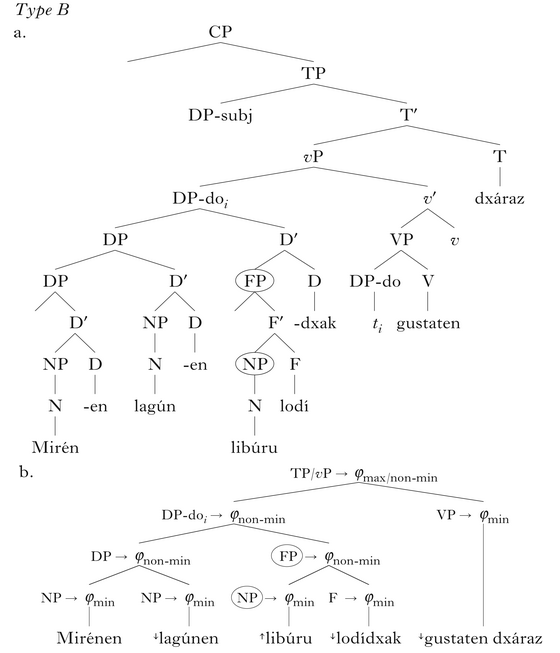
In type B the head noun libúru is dominated by an NP and an FP, the projection of the adjective. FP is mapped as a ᵠ, since it contains an overt terminal node by itself (the adjective), and it is non-minimal, because it dominates the ᵠmin corresponding to NP and the ᵠmin corresponding to the adjective (see the explanation below for this ᵠmin). This confirms the prediction that pitch reset will apply on the first accent of the ᵠnon-min corresponding to FP, the word libúru.Footnote 12
In (7b), the adjective head in F (lodídxak) matches a ᵠmin, despite not being a syntactic phrase. As explained in §1, in Lekeitio Basque there is a lexical distinction between unaccented and accented words. Tokyo Japanese has a similar lexical distinction. Ito & Mester (Reference Ito and Mester2013) suggest that the Japanese pitch accent is a head feature, in the sense that each accent must be the head of some minimal prosodic phrase, a ᵠmin. This prosodic well-formedness constraint guarantees that there is at most one accent per ᵠmin. Ito & Mester (Reference Ito and Mester2013) express this constraint as in (8). Similar constraints or formulations can be found in Yip (Reference Yip2002), Hellmuth (Reference Hellmuth2007) and Selkirk & Elordieta (Reference Selkirk and Elordieta2010).
-
(8)

3.2.2 Explaining the distribution of downstep and pitch reset across distinct argument DPs
Types C and D contain a DP-io and a DP-do before the verb. As stated in (3c), pitch reset is observed on the head noun of the DP-do, which forms a constituent with the following verb. However, as observed in (3d), a higher degree of pitch reset is observed on the head noun in type D.
For type C, the tree diagrams in (9) show the mapping from syntactic to prosodic structure. The NP containing the noun liburúak is a ᵠmin, and it is dominated by another ᵠ, mapped from the maximal projection vP. This ᵠ is thus a ᵠnon-min. Hence pitch reset applies at its left edge, i.e. on the word located at this edge, liburúak. The DP-doj projection above the NP does not constitute a ᵠ, because the DP is vacuous, i.e. it does not contain an overtly realised head D, as the determiner is affixed to the rightmost word preceding it.
The DP-ioi Mirénen amumári is in the specifier position of ApplP, as explained in the previous subsection, and contains a genitive DP, Mirénen, and a head noun, amumári.
-
(9)
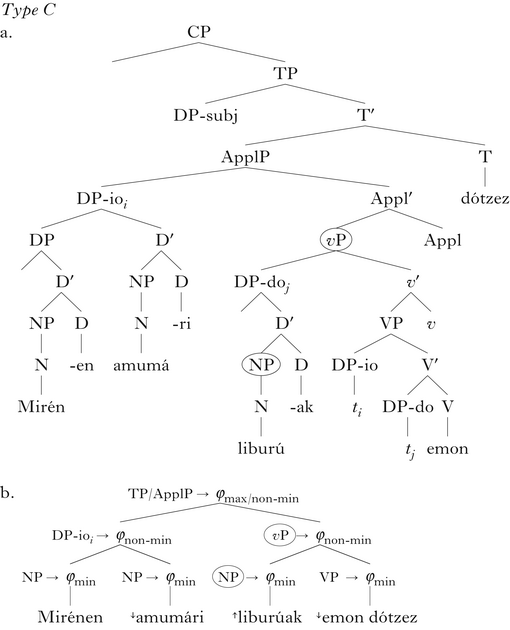
It is important to point out that in order for vP to qualify as a ᵠ it is necessary to assume that the verb stays within vP/VP in broad-focus sentences like the ones analysed in this paper. If the verb was raised out of vP/VP to T, vP and VP would be phonologically vacuous, i.e. they would contain no phonologically overt terminal node, and MatchPhrase would not map these maximal projections as ᵠ's. vP would also be prevented from matching an independent ᵠ, because it would not dominate phonologically overt material apart from that already dominated by NP. The ᵠmin corresponding to NP would not be aligned with the left of a ᵠnon-min. Rather, it would constitute a ᵠmin as a right-hand daughter of the topmost ᵠmax/non-min. The prediction would be that pitch reset would not apply, contrary to the facts. Hence the prosodic patterns of downstep and pitch reset in Lekeitio Basque support the idea that there is no V-to-T movement in Basque neutral sentences.
Let us now turn our attention to type D. This sentence type has the same syntactic structure as type C, but the direct object DP contains an adjective following the head noun. Like type B, the adjective occupies the head F of a functional projection dominating the NP of the head noun. Thus, in the prosodic structure in (10b) there are two ᵠnon-min's, corresponding to vP and FP, dominating the ᵠmin corresponding to the NP of libúru. In (9b) there was only one ᵠnon-min dominating a ᵠmin. As indicated by the ‘↑↑’ to the left of libúru, a higher degree of pitch reset is observed at the left edge of this word than for liburúak in type C.
-
(10)
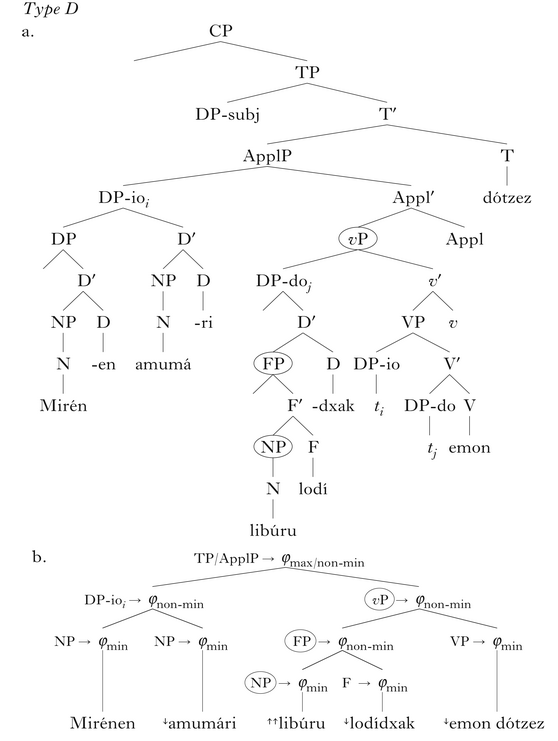
It is relevant to recall the quantitative results of the pitch differences between the second and third accented words reported in §2.2. The pitch difference between the second and third accents in type C is –3 Hz, indicating the application of pitch reset on the third accented word, but in type D the pitch rise is substantially bigger, –17 Hz (as reported in §2.2, the difference is statistically significant at p<0·001). This difference correlates with a difference in the number of ᵠnon-min's dominating the third accent. In type C there is one ᵠnon-min, and in type D there are two. In fact, the amount of pitch reset in type D is also significantly different from that in type B (–1 Hz), which also has just one ᵠnon-min dominating the third accented word (F(1,94)=62·787, p<0·001). Types B and C are the two sentence types with just one ᵠnon-min dominating the third accent, and they do not differ significantly in the amount of pitch reset between the second and third accents: –1 Hz in type B and –3 Hz in type C (F(1,93)=1·766, p=0·187). That is, B and C are rather different syntactically, but they share the fact that the accented word marking pitch reset is aligned with just one ᵠnon-min, and the same degree of pitch reset applies in both sentence types.
There is thus a three-way distinction among the four sentence types in the occurrence of downstep and pitch reset in the relevant context, the pitch-level difference between the second and third accents. The three-way distinction is also represented in the graph in Fig. 2, where three distinct pitch-height differences between Peaks 2 and 3 are observed, for type A, types B and C, and type D respectively. This distinction correlates with the presence and the number of ᵠnon-min's aligned at the left edge of the third accented word. The three patterns are presented in (11).
-
(11)
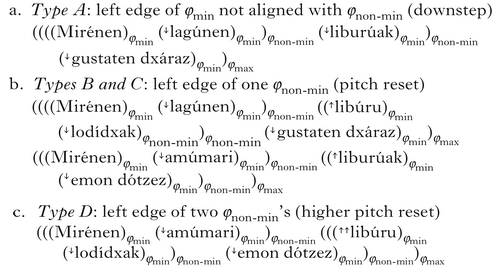
This three-way distinction suggests that there is a cumulative effect of the number of ᵠnon-min's on pitch reset, as manifested phonetically in the degree of pitch reset observed in the F0 contour. In other words, a higher number of non-minimal phonological phrases correlates with a higher degree of pitch reset (cf. also the discussion of Kubozono Reference Kubozono1989, Reference Kubozono, Docherty and Ladd1992 in §4.2 below).Footnote 13 This could be implemented through instructions to the phonetic component such as ‘raise the pitch level by n Hz or n semitones at the left edge of each ᵠnon-min’.
In the following section I will compare the analysis proposed in this paper for the distribution of downstep and pitch reset with the predictions that other proposals of the occurrence of downstep and pitch reset make with respect to the Lekeitio Basque data.
4 Alternative approaches
4.1 Prosodic phrasing in the Edge-based theory
Elordieta (Reference Elordieta, Martínez-Gil and Morales-Front1997a, Reference Elordieta1998, Reference Elordieta2006) and Jun & Elordieta (Reference Jun, Elordieta, Botinis, Kouroupetroglou and Carayiannis1997) propose an analysis of the distribution of downstep and pitch reset in Lekeitio Basque based on the Edge-based theory of the syntax–prosody interface of Selkirk (Reference Selkirk1986) (cf. also Gussenhoven Reference Gussenhoven2004: 179–180). The main proposal in this theory is that the edges of syntactic heads and phrases are aligned with the edges of prosodic words and phrases respectively. At the phrasal level, the left or right edge of a syntactic phrase is mapped onto prosodic structure as the left or right edge of a ᵠ. This view can be represented schematically as in (12), where (a) and (b) respectively represent the alignment of the left and right edges of a syntactic maximal projection (XP) with the left edge and right edges of a phonological phrase.Footnote 14
-
(12)
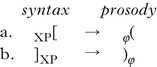
Elordieta (Reference Elordieta, Martínez-Gil and Morales-Front1997a, Reference Elordieta1998, Reference Elordieta2006), Jun & Elordieta (Reference Jun, Elordieta, Botinis, Kouroupetroglou and Carayiannis1997) and Gussenhoven (Reference Gussenhoven2004: 179–180) claim that downstep can be stopped or that partial pitch reset can occur at the left edge of a prosodic constituent which coincides with the left edge of a syntactic phrase or maximal projection. Elordieta's proposal is that downstep is limited to a ᵠ whose left edge is aligned with the left edge of a syntactic maximal projection (cf. Selkirk & Tateishi Reference Selkirk, Tateishi, Georgopoulos and Ishihara1991 for a similar treatment of pitch reset in Japanese).Footnote 15 This mapping is achieved through (13), one of the family of constraints for the correspondence of syntactic and prosodic structure (cf. McCarthy & Prince Reference McCarthy and Prince1993a, Reference McCarthy and Princeb, Truckenbrodt Reference Truckenbrodt1995, 1999, and subsequent work).
-
(13)

The Edge-based approach considers only flat, non-recursive structure for ᵠ's, in accordance with the principle of Strict Layering. One of the principles subsumed under the classical form of Strict Layering is non-recursivity, which forbids the formation of more than one level of a given prosodic category. This will prove to be a crucial shortcoming of the Edge-based approach in providing correct ᵠ structures for Lekeitio Basque.
The ᵠ structures predicted by Align-L(XP, ᵠ) for the four types that are the object of study in this paper are shown in (14). In each case, the syntactic structure is provided first, followed by the ᵠ structure that derives from Align-L(XP, ᵠ) and the predicted patterns of downstep and pitch reset for this ᵠ structure. The actually attested patterns of downstep and pitch reset are given below the predicted patterns.
-
(14)
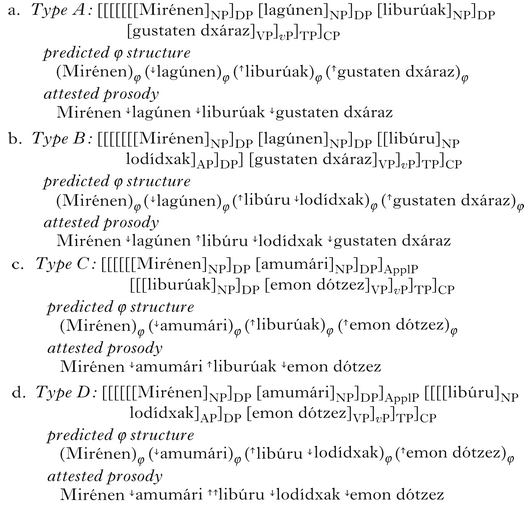
The comparison between the predicted and attested patterns shows that an analysis based on Align-L(XP, ᵠ) makes wrong predictions for the patterns of downstep and pitch reset observed in Lekeitio Basque. In type A, pitch reset should occur on liburúak, rather than downstep. For type D, the analysis based on the alignment constraint has no way of predicting a higher degree of pitch reset on libúru. For all sentence types, the verbal complex is predicted to show pitch reset instead of the attested downstep.
Thus an account in terms of the Edge-based approach to the syntax–prosody fails to define the contexts of application of pitch reset (and downstep) in Lekeitio Basque. The main reason for the failure is the assumption that ᵠ structure is entirely flat, i.e. non-recursive, consistent with the Strict Layer Hypothesis.
4.2 Pitch reset relies on syntactic branchingness?
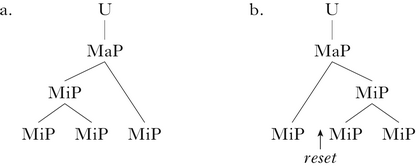
The (Tokyo) Japanese data analysed by Kubozono (Reference Kubozono1989, Reference Kubozono, Docherty and Ladd1992) has interesting parallels with the Lekeitio Basque data. Kubozono shows that there is a distinction in the distribution of downstep and partial pitch reset in Japanese between left-branching and right-branching syntactic structures. The experimental work reported by Kubozono is carried out mainly on the internal structure of DPs. The assumption is that prosodic structure directly reflects syntactic structure, and that syntactic branchingness is mapped as prosodic branchingness. Two accented words in a syntactic phrase are two minor phrases (MiPs) that combine to form a recursive minor phrase. Kubozono argues that pitch reset applies at the left edge of a right-branching minor phrase, a process he calls ‘metrical boost’.
The prosodic diagrams in (15), adapted from Kubozono (Reference Kubozono, Docherty and Ladd1992: 385), represent the distinction between left and right-branching prosodic structures (which reflect the direction of syntactic branching) and the distribution of downstep and pitch reset associated to these structures. (15a) is a schematic example of a left-branching prosodic structure, and downstep applies on the second and third MiP. (15b) is a schematic example of a right-branching structure, and pitch reset applies on the second MiP, which is branching. The Major Phrase (MaP) is the prosodic constituent above the level of MiP.Footnote 16
-
(15)
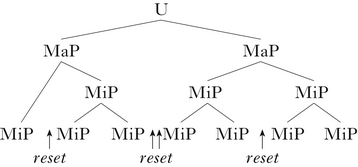
According to Kubozono, the magnitude of reset is derived from the depth of embedding of the branching constituents in the right branch. A schematic representation is provided in (16), adapted from Kubozono (Reference Kubozono, Docherty and Ladd1992: 386). This is an utterance consisting of two MaPs, with the right-hand MaP being branching. The branchingness of the MaP guarantees one degree of pitch reset or metrical boost. In turn, the MiP on the left branch of the MaP is branching as well. This brings another degree of reset. Kubozono suggests that pitch reset is cumulative, in the sense that the number of dominating branching constituents is counted in order to assign the correct size of pitch reset to the constituent aligned with the left edge of the branching constituents. This cumulative effect is represented in (16) by two upward arrows to the left of the terminal MiP aligned with the branching constituents.
-
(16)
A question which arises here is whether pitch reset – the phonetic pitch scaling found in left edge contexts – is a function of the branching nature of the phonological phrases whose left edges coincide in such contexts, or whether it is the character of those phrases as non-minimal that is relevant to pitch reset. The data from Lekeitio Basque does not permit us to decide between these two approaches, which would give equivalent degrees of reset in the four Lekeitio Basque sentences types discussed above. However, both Lekeitio Basque and Tokyo Japanese offer the possibility of deciding this question empirically, given that in both languages unaccented words may fail to form a ᵠ on their own, as illustrated in the ᵠ structure in (17), for example, where two sister unaccented words are grouped into a ᵠ that counts as minimal.
-
(17)
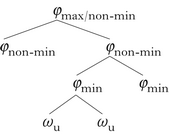
It has been pointed out (Leland Kusmer, personal communication) that the two approaches make different predictions about the degree of reset to be found with a structure like that in (17). If the theory of pitch scaling makes reference only to the branchingness of the constituents whose left edges coincide at the relevant point in the string, there should be two degrees of reset at the left edge of the right-hand ᵠnon-min: one for the branchingness of the ᵠmin dominating the two unaccented words, and one for the higher ᵠnon-min. In contrast, an account of phonetic pitch reset which makes appeal to the non-minimal status of a ᵠ would predict only one degree of reset in such a case. We can therefore look to future research into cases of this sort in Lekeitio Basque or in Tokyo Japanese to decide the question whether it is the branching status or the non-minimal status of a ᵠ that determines the presence of pitch reset.
4.3 Pitch scaling relies on prosodic sisterhood?
Building on Ladd's (Reference Ladd1988) work on downstep relationships among nested syntactic clauses, van den Berg et al. (Reference Berg, Gussenhoven, Rietveld, Docherty and Ladd1992) argue that downstep applies not only between accents but also between phrases. They propose the existence of horizontal top lines marking the initial pitch level of each phrase, which they call reference lines, and they claim that downstep operates between reference lines. They explain partial pitch reset as downstep of a phrase after another phrase, or more accurately, as downstep of the reference line of a phrase with respect to the preceding reference line. The appearance of pitch reset is due to the low pitch level on the last accent of the preceding phrase, after iterative downstep. The diagram in (18) (from Truckenbrodt & Féry Reference Truckenbrodt and Caroline2015: 21) constitutes a schematic representation of the process of partial pitch rest.
-
(18)
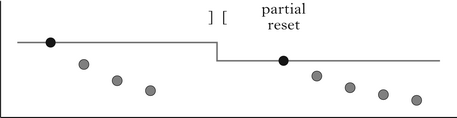
Truckenbrodt (Reference Truckenbrodt2002, Reference Truckenbrodt, Gussenhoven and Riad2007) and Féry and Truckenbrodt (Reference Féry and Truckenbrodt2005) find evidence from upstep and pitch scaling between ι and ᵠ in German that support van den Berg et al.'s (Reference Berg, Gussenhoven, Rietveld, Docherty and Ladd1992) idea of downstep of reference lines, i.e. phrasal downstep. In an innovative proposal, Féry & Truckenbrodt (2005: 235) argue that ‘prosodic sisterhood among adjacent constituents is, by default, phonetically interpreted as register lowering’. The schematic representation in (19) illustrates the working of this principle.
-
(19)
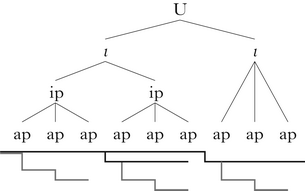
In (19), each prosodic constituent (ap, ip, ι) has its own horizontal reference line. Downstep of reference lines occurs among sister constituents, although it is relatively stronger for constituents relatively lower in the hierarchical representation (Féry & Truckenbrodt 2005: 238). The second ι has its reference line downstepped with respect to the first ι. Within the first ι, there are two ips. The reference line of the first ip is at the level of the ι reference line, but the second ip has its reference line downstepped with respect to the previous ip. Finally, the reference line of an ap following another ap within the same ip is downstepped. Pitch reset occurs at the left edge of an ap that is not a sister of a previous ap. In other words, pitch reset occurs at the left edge of an ap that belongs to a different ip or ι. The reference line of the new ap reaches the reference line of its ip or ι, which is higher than the reference line of the last ap in the previous ip or ι.
Within the first ι in (19), there is pitch reset at the left edge of the ap at the beginning of the second ip. The reference line of the second ip is downstepped with respect to the one of the previous ip, but it is still higher than the reference line of the ap ending the preceding ip. There is pitch reset at the left edge of the initial ap in the second ι, because the ap reaches the reference line of its ι, which is higher than the reference line of the previous ap (even though the reference line of the second ι is downstepped with respect to the first ι).
It is worth exploring whether this model can account for the distribution of downstep and pitch reset in Lekeitio Basque. The potential analysis would be that downstep applies between two sister ᵠ's, and that reset is observed at the left edge of a ᵠ that belongs to a different higher mother node. A crucial aspect to bear in mind is that Féry & Truckenbrodt assume that prosodic sisterhood mirrors syntactic sisterhood. Thus, prosodic sisterhood in Lekeitio Basque will be identified through the syntactic structures provided in §3.2.
Space limits prevent me from reproducing the syntactic structures and corresponding ᵠ structures of the sentence types considered in this paper. However, a review of the sisterhood relations holding between the relevant constituents reveals that the model outlined above does not make correct predictions for the distribution of downstep and pitch reset in Lekeitio Basque. The crucial data from all the different sentence types in Lekeitio Basque involves the pitch difference between the third word of the sentences (e.g. libúru or liburúak) and the immediately preceding word, which in all cases falls at the end of a two-word DP constituent. That third word itself is always phrase-initial. In sentence types A and B the third words initiate a phrase that is sister to a preceding possessive DP within a higher DP. But in the A type liburúak is downstepped with respect to the preceding phrase, while in type B it instead shows pitch reset. This pitch-scaling contrast is not predicted on the Féry & Truckenbrodt account: the right-sister status of the constituent initiated by libúru/liburúak in types A and B predicts identity of pitch scaling in the two cases. The same is true of types C and D, where the third word again initiates a constituent that is sister to the preceding DP. It is a verbal projection that contains the DP whose head noun is libúru/liburúak and the following verb. The difference in pitch reset on libúru/liburúak in type C vs. type D correlates with the presence of a following modifier within the DP. The Féry & Truckenbrodt sisterhood account does not predict this difference in pitch scaling.
5 Summary and conclusion
This paper has provided an account of the occurrence of downstep and pitch reset in Lekeitio Basque that is based on the Match theory of the interface between syntactic and prosodic constituency (cf. Selkirk Reference Selkirk2009, Reference Selkirk, Goldsmith, Riggle and Yu2011, Elfner Reference Elfner2012, Reference Elfner2015) and on the theory of recursion-based prosodic subcategories advocated by Ito & Mester (Reference Ito, Mester, Borowsky, Kawahara, Shinya and Sugahara2012, Reference Ito and Mester2013). MatchPhrase calls for a general mapping of syntactic XPs as phonological phrases, with the refinement by Elfner (Reference Elfner2012, Reference Elfner2015) that only XPs that exhaustively dominate phonologically overt terminal nodes may be mapped as ᵠ's (cf. §3.1). Since XPs may dominate other XPs, a prosodic structure with recursive ᵠ's is predicted. Non-minimal and minimal ᵠ's are distinguished in recursive prosodic ᵠ's. A ᵠnon-min is a ᵠ dominating another ᵠ, and a ᵠmin is a ᵠ which does not dominate another ᵠ. The claim in this paper is that the factual generalisations drawn from the experiment described in §2.2 can be explained by assuming that pitch reset applies at the left edge of ᵠnon-min. Conversely, downstep applies at the left edge of a ᵠmin not aligned with the left edge of a ᵠnon-min. Finally, a stronger degree of pitch reset occurs where two left edges of ᵠnon-min (one dominating the other) are aligned. This fact suggests that there is a cumulative effect of the number of non-minimal phonological phrases on pitch reset.
The predictions are confirmed under the assumption that the verb does not move out of the vP/VP projection in broad-focus contexts. Otherwise, vP would not constitute a ᵠnon-min, and the account would not be successful. An interesting consequence of the prosodic analysis proposed in this paper is that it provides an independent argument for the absence of verbal head movement in broad focus in Basque.
The final section of the paper was devoted to a discussion of possible alternatives to the model and the analysis advocated in this paper. First, Elordieta (Reference Elordieta, Martínez-Gil and Morales-Front1997a, Reference Elordieta1998), Jun & Elordieta (Reference Jun, Elordieta, Botinis, Kouroupetroglou and Carayiannis1997) and Gussenhoven (Reference Gussenhoven2004: 179–180) claim that pitch reset applies at the left edge of an XP. Their proposal was couched within the Edge-based approach to the mapping from syntactic to prosodic structure. This proposal makes wrong predictions, because the Edge-based approach only considers flat levels of prosodic structure, without distinctions between different layers. A model that acknowledges the recursive nature of syntactic structure is better suited to explain the patterns of distribution of downstep and pitch reset in Lekeitio Basque.
Secondly, Kubozono's (Reference Kubozono1989, Reference Kubozono, Docherty and Ladd1992) analysis of the distribution of pitch reset in Japanese was considered. This analysis suggests that pitch reset (or ‘metrical boost’) occurs at the left edge of right-branching prosodic constituents. Such a proposal could be compatible with the data analysed in this paper, as ᵠnon-min is a branching prosodic constituent. Additional sentence types will have to be devised in such a way as to help test different predictions made by each model.
The final comparison was with the model of pitch scaling among prosodic constituents based on prosodic sisterhood at different levels of the prosodic hierarchy (Féry & Truckenbrodt 2005, inspired by Ladd Reference Ladd1988, van den Berg et al. Reference Berg, Gussenhoven, Rietveld, Docherty and Ladd1992 and Truckenbrodt Reference Truckenbrodt2002). In this view, pitch reset (or reference line shift, in their model) occurs at the left edge of an ip/ᵠ which is not the sister of a previous word. On the assumption that prosodic sisterhood directly mirrors syntactic sisterhood, however, it turns out that the relations of syntactic and prosodic sisterhood between the second and third words are the same in types A and B, as well as in types C and D. Hence it is unclear how a difference in reference line shift can be established.