Introduction
In this study we focus on the foliose cyanolichen Lobarina scrobiculata (Scop.) Nyl. ex Cromb., previously included in the genus Lobaria but placed in Lobarina based on recent phylogenetic studies (Moncada et al. Reference Moncada, Lücking and Betancourt-Macuase2013). It is a widespread species, distributed in the Northern Hemisphere and in oceanic areas of Africa, Australia, New Zealand and South America (Nimis Reference Nimis1993; Smith et al. Reference Smith, Aptroot, Coppins, Fletcher, Gilbert, James and Wolseley2009). In the Iberian Peninsula, it is frequent in central Spain, common in oceanic areas of the north-west, and progressively rarer elsewhere (Burgaz & Martínez Reference Burgaz and Martínez1999). This species is preferentially epiphytic, occurring on deciduous trees and sometimes on mossy siliceous rocks. Although L. scrobiculata has been traditionally associated with old epiphytic communities (James et al. Reference James, Hawksworth and Rose1977; Burgaz et al. Reference Burgaz, Fuertes and Escudero1994), recent studies have shown that relatively young and/or slightly managed forests host more abundant populations of this species (Merinero et al. Reference Merinero, Rubio-Salcedo, Aragón and Martínez2014). The most frequent mode of reproduction in L. scrobiculata is asexual via soredia, whereas sexual reproduction via apothecia is rather infrequent (Burgaz & Martínez Reference Burgaz and Martínez1999; Smith et al. Reference Smith, Aptroot, Coppins, Fletcher, Gilbert, James and Wolseley2009). Habitat destruction and air pollution have reduced the distribution of this species in Europe (Hallingbäck Reference Hallingbäck1989; Nimis Reference Nimis1993; Smith et al. Reference Smith, Aptroot, Coppins, Fletcher, Gilbert, James and Wolseley2009; Pentecost & Richardson Reference Pentecost and Richardson2011). Consequently, it has been included in numerous European Red Lists under different threat categories (Sérusiaux Reference Sérusiaux1989; Clerc et al. Reference Clerc, Scheidegger and Ammann1992; Randlane et al. Reference Randlane, Jüriado, Suija, Lõhmus and Leppik2008; Gärdenfors Reference Gärdenfors2010). The conservation status of L. scrobiculata in the Iberian Peninsula is unknown, and although some studies have suggested classifying it as “endangered” or “vulnerable”, threatened by forestry and agriculture (Burgaz et al. Reference Burgaz, Fuertes and Escudero1994; Martínez et al. Reference Martínez, Aragón, Sarrión, Escudero, Burgaz and Coppins2003), we lack demographic and genetic data supporting these assertions.
Molecular studies contribute to an understanding of the population history and dynamics of lichen-forming fungi, providing information related to gene flow, dispersal and mating systems, which is essential for lichen conservation. Compared to other genetic markers, microsatellites show higher levels of variation, and they have been used for population studies in several lichen species (e.g. Otálora et al. Reference Otálora, Martínez, Belinchón, Widmer, Aragón, Escudero and Scheidegger2011; Mansournia et al. Reference Mansournia, Wu, Matsushita and Hogetsu2012; Scheidegger et al. Reference Scheidegger, Bilovitz, Werth, Widmer and Mayrhofer2012; Werth et al. Reference Werth, Cornejo and Scheidegger2013). However, major drawbacks of microsatellite markers are that they might not work for other species and they may show less genetic variability than in those species for which they were originally developed (Werth Reference Werth2010). Thus, new specific microsatellites and primers must be developed in order to work with new taxa. Here, we have developed and characterized new microsatellite markers for L. scrobiculata to assess its genetic diversity, connectivity and population structure across its distribution area in the Iberian Peninsula and Europe.
Methods
Total fungal genomic DNA of seven specimens of L. scrobiculata was isolated from different populations and mixed for library production. These populations are scattered across the Iberian Peninsula (Ávila, Ciudad Real, Gipuzkoa, Huelva, Palencia and Tarragona in Spain, and Coimbra in Portugal). The distances between populations range from 180 to 820 km. In these populations, L. scrobiculata presents mainly asexual propagules (i.e. soredia) and almost never reproduces sexually.
Before DNA extraction, the cyanobiont was manually removed from thalli under a dissecting microscope. Genomic DNA was extracted from the mycobiont tissue using DNeasy Plant Mini Kit (Qiagen) following the manufacturer's instructions. To test if the DNA extractions contained the cyanobiont, we performed PCR amplifications using the fungal nuITS ribosomal primers ITS1–ITS4 (White et al. Reference White, Bruns, Lee and Taylor1990) and the cyanobacterial specific primers rbcLX CW-CX (Rudi et al. Reference Rudi, Skulberg and Jakobsen1998). In these tests we used three samples in which DNA was extracted from complete lichen thalli, containing both myco- and cyanobiont DNA, as positive controls. Amplifications were performed in 20 μl volumes containing a reaction mixture of 6 μl of Multiplex PCR Master Mix (Qiagen), 1 μl of primer mixture (10 μM), 10 μl dH2O and 3 μl of genomic DNA. Amplifications were carried out in a PTC-100 Peltier thermal cycler with the same PCR conditions as in Prieto et al. (Reference Prieto, Martínez, Aragón, Otálora and Lutzoni2010) for the nuITS region, and with the following cycling conditions for the rbcLX: initial denaturation at 94°C for 15 min, followed by 3 cycles of 94°C for 30 s, 40°C for 30 s and 72°C for 2 min, 38 cycles of 94°C for 30 s, 55°C for 30 s and 72°C for 2 min, ending with an extension step at 72°C for 10 min. PCR products were stained with SYBR Green and visualized by electrophoresis through a 1% agarose gel.
The DNA libraries, highly enriched in microsatellite loci, were prepared using GS-FLX titanium pyrosequencing (Roche Diagnostics) at GenoScreen (Lille, France). The pooled DNA was used for creating GS-FLX libraries performed on the PCR product obtained as follows: fragmentation of genomic DNA, DNA enrichment in microsatellite loci and amplification with a High Fidelity Taq polymerase.
From the sequences obtained, 240 pairs of primers were validated bioinformatically with QDD software (Meglécz et al. Reference Meglécz, Costedoat, Dubut, Gilles, Malausa, Pech and Martin2010). Primers were designed for 24 microsatellite inserts using Primer3 (Rozen & Skaletsky Reference Rozen and Skaletsky2000). We carried out a BLAST search of these primer candidates to exclude any match with cyanobacteria. These primers were tested to validate efficiency and specificity of PCR with the following conditions: PCR in a total volume of 25 μl, containing 2 μl of genomic DNA, 1 pmol of each primer, 1 U Taq DNA polymerase, 6 pmol dNTP and 37·5 pmol MgCl2. PCR reactions were performed as follows: 10 min at 95°C, then 40 cycles of 30 s at 95°C, 30 s at 55°C, 1 min at 72°C, and a final extension of 10 min at 72°C.
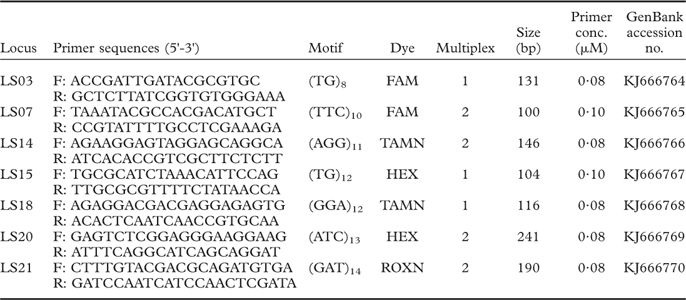
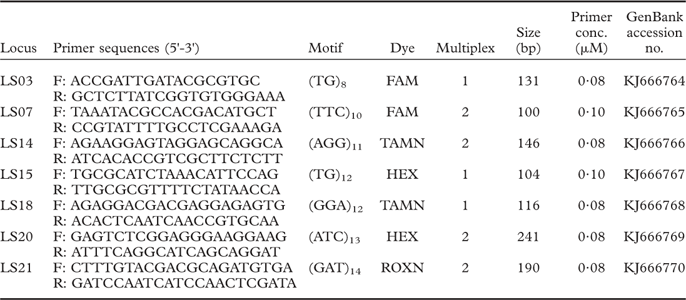
Of the 18 successful pairs, 12 were selected for a polymorphic analysis at GenoScreen. Finally, we performed a broader polymorphism analysis using seven successful loci in four Iberian populations (80 thalli in total) from Ciudad Real (Robledo), Coimbra (Sicó), Navarra (Irati) and Palencia (Brañosera), 270–700 km apart from each other. Coordinates and further information on the localities can be found in Merinero et al. (Reference Merinero, Rubio-Salcedo, Aragón and Martínez2014). For this purpose, two multiplexed PCR reactions were carried out in a total volume of 10 μl containing 1 μl of genomic DNA, 2 μl of a primer mix of variable concentration, 5 μl of Multiplex PCR Master Mix (Qiagen) and 2 μl of distilled water (Table 1). PCR conditions were identical to those used for testing the markers (see above). The PCR products were electrophoresed on an ABI3130 capillary sequencer using the size marker GS400HD-ROX, and product sizes were estimated using Gene Mapper v5 (Applied Biosystems).
Microsatellite loci identified and screened for Lobarina scrobiculata. For each locus the following is provided: primer pairs (F: forward, R: reverse), repeat motif, fluorescent dye used, multiplex reaction, size of the original fragment (bp: base pairs), concentration of each primer (conc.) and GenBank accession number
Results
Positive results were obtained in all samples with the nuITS fungal specific primers, whereas nothing was amplified using the cyanobacterial specific primers rbcLX, except for the three positive controls. Therefore, the cyanobiont was absent in our fungal extractions.
From the library production, out of the 35 471 raw data sequences obtained, 2594 sequences contained microsatellite motifs. Six of the 24 screened primer pairs did not produce visible PCR products. Among the 12 pairs selected for the polymorphic analysis, seven loci amplified successfully and were polymorphic. In the broader polymorphism analysis conducted on four Iberian populations, all primer pairs tested successfully for amplified unambiguous products.
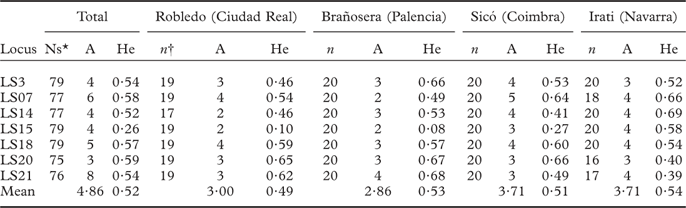
The number of alleles and Nei's unbiased gene diversity were calculated using GenAlEx 6.501 (Peakall & Smouse Reference Peakall and Smouse2006). The number of observed alleles ranged from 3 (locus LS20) to 8 (locus LS21) with a mean of 4·86, and the Nei's unbiased gene diversity ranged from 0·26 (locus LS15) to 0·59 (locus LS20) with a mean of 0·52 (Table 2). Over the four populations, the average gene diversities varied from 0·49 to 0·54 (Table 2).
Number of alleles (A) and Nei's gene diversity (He) in four populations of Lobarina scrobiculata
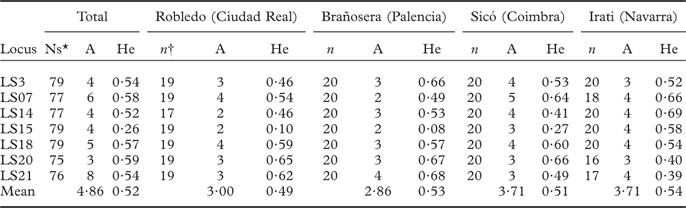
*Number of successful amplifications; †=total number of samples analyzed per population.
These novel microsatellite markers are of paramount importance for genetic analyses and the conservation assessment of L. scrobiculata. We will investigate the population genetics of L. scrobiculata in the Iberian Peninsula and Europe, and will compare the fungal and cyanobacterial partners to determine if their genetic structures are coupled.
This study was supported by the Spanish Ministerio de Ciencia e Innovación (EPICON, CGL2010-22049). We thank I. Olariaga and the reviewers and editor of The Lichenologist for useful comments on the manuscript.