Introduction
Pleurotus djamor is an edible mushroom mostly considered a gourmet food. As such, a meticulous selection process based on colour, shape, and texture is generally required before reaching consumers (Salmones and Mata Reference Salmones, Mata, Sánchez and Royse2017). Hence, compared to other mushroom species, a high proportion of discarded material is expected (Pacheco-Ancona et al. Reference Pacheco-Ancona, Ancona-Méndez, Flores-Novelo and Pech-Martínez2005). Thus, revalorising discarded P. djamor mushrooms, or the spent substrate generated from this agroindustry, in the form of animal feed for small ruminants, would allow these waste materials to be efficiently re-used. The latter may also promote a circular economy that benefits mushroom farmers and small ruminant producers. Identifying the value of the discarded mushrooms and the spent substrate is an essential step towards their potential use as a nutraceutical material that provides macronutrients and secondary compounds (SCs) to control the gastrointestinal nematode (GIN) populations of small ruminants (Aguilar-Marcelino et al. Reference Aguilar-Marcelino, Sánchez, Mendoza-de-Gives, Sánchez and Royse2017; Castañeda-Ramírez et al. Reference Castañeda-Ramírez, Torres-Acosta, Sánchez, Mendoza-de-Gives, González-Cortázar, Zamilpa, Al-Ani, Sandoval-Castro, de Freitas Soares and Aguilar-Marcelino2020; Pineda-Alegría et al. Reference Pineda-Alegría, Peña-Rodríguez, Cardoso-Taketa, Sánchez, Torres-Acosta, Hernández-Bolio, Ortiz-Caltempa, Villarreal and Aguilar-Marcelino2024). The latter is particularly important in the current post-anthelmintic era when most small ruminant farms host GIN populations that can resist the effect of conventional anthelmintics (AHs) (Torres-Acosta et al. Reference Torres-Acosta, Hoste, Sandoval-Castro, Torres-Fajardo, Ventura-Cordero, González-Pech, Mancilla-Montelongo, Ojeda-Robertos and Martínez-Ortíz-de-Montellano2019).
Fungi species such as P. djamor exhibit SCs with a wide range of activities, including antioxidant, immunomodulatory, and antitumoral (Sánchez and Royse Reference Sánchez and Royse2017). Some of the SCs that have been identified from basidiomes include pentadecanoic acid, hexadecanoic acid, 9,12-octadecadienoic acid, octadecanoic acid, ß-sitosterol, uracil, and allitol (González-Cortázar et al. Reference González-Cortázar, Sánchez, Huicochea-Medina, Hernández-Velázquez, Mendoza-de-Gives, Zamilpa, López-Arellano, Pineda-Alegría and Aguilar-Marcelino2021; Pineda-Alegría et al. Reference Pineda-Alegría, Sánchez-Vázquez, González-Cortázar, Zamilpa, López-Arellano, Cuevas-Padilla, Mendoza-de-Gives and Aguilar-Marcelino2017, Reference Pineda-Alegría, Peña-Rodríguez, Cardoso-Taketa, Sánchez, Torres-Acosta, Hernández-Bolio, Ortiz-Caltempa, Villarreal and Aguilar-Marcelino2024). In recent years, this species of mushroom gained attention as a potential alternative to conventional AHs against small ruminant GINs such as Haemonchus contortus. Several studies evaluated the in vitro activity of different extracts and fractions obtained from P. djamor against H. contortus. Those studies evaluated hydroalcoholic extracts from the basidiomes (Ambrosio-Bautista et al. Reference Ambrosio-Bautista, Rodríguez-Labastida, Sánchez-Vázquez, Torres-Acosta, Castañeda-Ramírez and Aguilar-Marcelino2023; González-Cortázar et al. Reference González-Cortázar, Sánchez, Huicochea-Medina, Hernández-Velázquez, Mendoza-de-Gives, Zamilpa, López-Arellano, Pineda-Alegría and Aguilar-Marcelino2021; Pineda-Alegría et al. Reference Pineda-Alegría, Sánchez-Vázquez, González-Cortázar, Zamilpa, López-Arellano, Cuevas-Padilla, Mendoza-de-Gives and Aguilar-Marcelino2017) or the spent substrate (Colmenares-Cruz et al. Reference Colmenares-Cruz, González-Cortázar, Castañeda-Ramírez, Andrade-Gallegos, Sánchez and Aguilar-Marcelino2021). As with any other organism, P. djamor must allocate the SCs to the different structures where they are required. The mycelium must produce SCs designed to interact with the mycosphere, while the basidiomes need SCs to interact with the aerial surroundings. Moreover, different compositions of macronutrients and phenolic compounds change during the growth and fruiting processes of Pleurotus spp. (Cui et al. Reference Cui, Li, Yang, Sun, Wu and Ping2014; Pineda-Alegría et al. Reference Pineda-Alegría, Peña-Rodríguez, Cardoso-Taketa, Sánchez, Torres-Acosta, Hernández-Bolio, Ortiz-Caltempa, Villarreal and Aguilar-Marcelino2024; Zhou et al. Reference Zhou, Ma, Zhang and Zhang2016). Therefore, the bioactivity of the respective SCs from mycelium or basidiome must also be different. However, only one bioguided study has evaluated an ethanolic mycelium extract (Pineda-Alegría et al. Reference Pineda-Alegría, Peña-Rodríguez, Cardoso-Taketa, Sánchez, Torres-Acosta, Hernández-Bolio, Ortiz-Caltempa, Villarreal and Aguilar-Marcelino2024). Also, most of those studies focused on the effect against the infective larval stage (L3), with very limited research addressing the potential ovicidal effect of P. djamor against H. contortus eggs (González-Cortázar et al. Reference González-Cortázar, Sánchez, Huicochea-Medina, Hernández-Velázquez, Mendoza-de-Gives, Zamilpa, López-Arellano, Pineda-Alegría and Aguilar-Marcelino2021; Pineda-Alegría et al. Reference Pineda-Alegría, Sánchez-Vázquez, González-Cortázar, Zamilpa, López-Arellano, Cuevas-Padilla, Mendoza-de-Gives and Aguilar-Marcelino2017).
The egg hatching test (EHT) has been used to screen the AH activity of different plant and fungal materials against eggs of different GIN species (Castañeda-Ramírez et al. Reference Castañeda-Ramírez, Rodríguez-Labastida, Ortiz-Ocampo, González-Pech, Ventura-Cordero, Borges-Argáez, Torres-Acosta, Sandoval-Castro and Mathieu2018, Reference Castañeda-Ramírez, Torres-Acosta, Cruz-Arévalo, Leyte-Lugo, García-Rubio, Aguilar-Marcelino and García-Rubio2022; Pineda-Alegría et al. Reference Pineda-Alegría, Sánchez-Vázquez, González-Cortázar, Zamilpa, López-Arellano, Cuevas-Padilla, Mendoza-de-Gives and Aguilar-Marcelino2017). That tool was also used to demonstrate that crude extracts of some tropical plants, and some fractions, can cause two distinct effects: (i) the death of H. contortus eggs at the morula stage (ovicidal activity), and (ii) the egg-hatching failure of L1 larvae (larvated eggs (LE) activity). Thus, it is important to determine whether the materials and fractions from P. djamor basidiomes and mycelium display one of those types of activity against H. contortus eggs. Therefore, this study evaluated the in vitro activity against H. contortus eggs of crude ethanolic extracts and the four fractions of different polarities obtained from either the basidiomes or the mycelium of P. djamor.
Materials and methods
Study site
The study was conducted at the Facultad de Medicina Veterinaria y Zootecnia de la Universidad Autónoma de Yucatán (FMVZ-UADY), Mérida, Yucatán, Mexico (20°52′07.2″N and 89°37′24.5″W).
Obtention of mycelium and basidiomes of P. djamor
The mushroom strain used in this study was P. djamor ECS-0123 (GenBank number GU722265), guarded at the mycological strain bank of El Colegio de la Frontera Sur (ECOSUR) located in Tapachula, Chiapas, Mexico. The mycelium and the basidiomes were produced by the Tropical Fungi Laboratory of ECOSUR. The mycelium was obtained by reseeding the P. djamor inoculum in Petri dishes with whole wheat flour medium. The dishes were incubated in darkness at 28°C. After 14 days, the mycelium was recovered from the medium surface and subsequently lyophilised (Pineda-Alegría et al. Reference Pineda-Alegría, Peña-Rodríguez, Cardoso-Taketa, Sánchez, Torres-Acosta, Hernández-Bolio, Ortiz-Caltempa, Villarreal and Aguilar-Marcelino2024). The basidiomes were produced by inoculating 2.5% P. djamor seed in a substrate containing sorghum grains (Sorghum bicolor L.), Pangola grass (Digitaria decumbens), and coffee pulp. The mixed materials were incubated in polyethylene bags with holes to allow air exchange with natural light-dark cycles at 85% humidity and 22°C. After 40 days, the basidiomes were harvested for further use (Pineda-Alegría et al. Reference Pineda-Alegría, Peña-Rodríguez, Cardoso-Taketa, Sánchez, Torres-Acosta, Hernández-Bolio, Ortiz-Caltempa, Villarreal and Aguilar-Marcelino2024).
Extracts and fractions of mycelium and basidiomes of P. djamor
The production of extracts obtained from mycelium and basidiomes of P. djamor and the respective fractions were obtained using reactive-grade solvents in a concurrent study (Pineda-Alegría et al. Reference Pineda-Alegría, Peña-Rodríguez, Cardoso-Taketa, Sánchez, Torres-Acosta, Hernández-Bolio, Ortiz-Caltempa, Villarreal and Aguilar-Marcelino2024). Briefly, the samples of the mycelium or the basidiomes were macerated in ethanol for 72 h at room temperature. The respective crude ethanolic (Et) extracts were filtered and concentrated. Each Et extract was dissolved in a water: methanol solution (3:2 v/v) and placed in a separated funnel to perform a consecutive fractionation with hexane (Hx), ethyl acetate (EA), and saturated butanol (Bu). Each fraction, including the remaining aqueous (Aq) fraction, was concentrated under reduced pressure and stored at 4°C until its use. Two 50-μg aliquots of each material were used at the FMVZ-UADY Parasitology laboratory for the in vitro AH evaluation.
Donor animals
Two six-month-old growing goats, raised free of GIN from birth, and weighing 15 kg of live weight, were used as donor animals. Physical exams, including body condition score, egg counting test, and body weight, were performed weekly, and the diet was adjusted for a weight gain of 100 g/d. The diet consisted of a concentrate feed and fresh Brosimum alicastrum leaves, which were balanced to meet the donors’ nutrient requirements (AFRC 1993). Water intake remained ad libitum. When the donor animals finished the egg recovery phase, they were drenched with levamisole and albendazole. Then, they were returned to the FMVZ-UADY farm as part of a donor animals exchange program. Goats were incorporated into a breeding group to start their reproductive life.
Monospecific infection
Once donor animals were confirmed to be free of GIN infection by means of the flotation technique, the donors were orally infected with 10,000 L3 of H. contortus Paraiso isolate (resistant to benzimidazole (BZ), levamisole (LEV), and ivermectin (IVM); Encalada-Mena et al. Reference Encalada-Mena, Torres-Acosta, Sandoval-Castro, Reyes-Guerrero, Mancilla-Montelongo, López-Arellano, Olmedo-Juárez and López-Arellano2024). The infective dose was divided into 3 daily doses. Twenty-eight days after the infection protocol, the presence of nematode eggs in the donor faeces was confirmed with a McMaster test. Then, faecal samples of the respective donor animals were incubated for 5 days. After that, the faecal culture was placed in a Baermann apparatus to recover the L3. The morphology of the L3 was confirmed as per the identification keys (van Wyk and Mayhew Reference van Wyk and Mayhew2013).
Haemonchus contortus eggs recovery
Faeces were collected directly from the rectum of donor animals using new plastic bags. The plastic bags were tied to remove the air and to prevent early egg development before the EHT. Once the faecal samples were obtained, they were macerated in purified water using a plastic mortar. To remove large particles, a gauze filter was used, and the filtrate was recovered in an Erlenmeyer flask. This mixture was collected in two 50 mL conical tubes and centrifuged at 453 g for 5 min. The resulting sediments were mixed and homogenised with a saturated sugar solution (relative density: 1.28). It was centrifuged again at 453 g for 5 min. Finally, with the help of a bacteriological loop, the eggs were recovered from the top of the liquid and were collected in another tube containing phosphate-buffered saline solution (PBS; pH 7.4). The concentration of the raw suspension of eggs was estimated. Then, using a micropipette, the eggs were diluted in PBS to adjust the concentration to 400 eggs per mL for immediate use in the EHT.
Egg hatching test
The biological activity of the P. djamor basidiome and mycelium extracts, and that of their fractions, was evaluated using EHT against H. contortus eggs following the methodology described by Jackson and Hoste (Reference Jackson, Hoste, Vercoe, Makkar and Schlink2010). Stock solutions of the extracts and fractions were prepared in PBS. Hydrophobic fractions, Hx and EA, required the addition of 1% Tween-80 or 2% dimethyl sulfoxide (DMSO), respectively. Respective 24-well plates were used to dilute the stock solutions with PBS to reach 500 μL of different final concentrations (20, 40, 80, 150, 300, 600, 1200, 2400, and 3600 μg/mL). PBS or the respective pre-diluent solution was used as a negative control, and thiabendazole was used as a positive control (50 μg/mL; 100% egg hatching inhibition). An equal volume with 200 H. contortus eggs suspension was added to each well, completing a final volume of 1 mL. The plates were incubated for 48 h at 28°C. After this time, hatching was stopped by adding three drops of Lugol’s solution to each well. The contents of eggs and larvae in each well were observed and counted under a microscope (10× objective) using McMaster slides. When the contents of the wells were not visible enough to distinguish eggs and larvae, the suspension was diluted and homogenised with water, using as many McMaster slides as necessary to count the entire volume of contents. Egg counts were performed by differentiating between morulated eggs (ME), which indicates an ovicidal activity, and larvated eggs (LE) for the basidiomes and mycelium extracts and fractions (Castañeda-Ramírez et al. Reference Castañeda-Ramírez, Torres-Acosta, Sandoval-Castro, Borges-Argáez, Cáceres-Farfán, Mancilla-Montelongo and Mathieu2019). Each treatment was performed with three repetitions and two replicates.
Data analysis
The statistical software RStudio (dose–response curve (drc) package) (R Core Team 2020; Ritz et al. Reference Ritz, Baty, Streibig and Gerhard2015) was used to determine the effective concentrations required to inhibit 50% (EC50) or 90% (EC90) of egg hatching, with a 95% confidence interval (95% CI). Differences in EC50 between the extract and its fractions were considered significant if the 95% CIs did not overlap (P < 0.05) (Jeske et al. Reference Jeske, Xu, Blessinger, Jensen and Trumble2009).
Results
Effective concentrations to inhibit 50% and 90% of H. contortus egg hatching obtained with the extracts and fractions of P. djamor
Table 1 presents the EC50 and EC90 values with their respective 95% CIs, obtained from the EHT using Et extracts of basidiomes and mycelium of P. djamor, as well as their respective polar and non-polar fractions. Both Et extracts were active, with EC50 < 230 μg/mL and EC90 < 600 μg/mL (Table 1). The aqueous and the EA fractions of basidiomes exhibited lower EC50 and EC90 values than the respective mycelium materials. The Bu fractions of both materials presented similar EC50 and EC90 values. Meanwhile, the Hx fraction of basidiomes showed lower activity compared to the mycelium Hx fraction.
Effective concentrations inhibiting 50% (EC50) and 90% (EC90) of Haemonchus contortus egg hatching, with their respective 95% confidence intervals (95% CIs), obtained from the egg hatching inhibition test using crude ethanolic extracts of basidiomes and mycelium of Pleurotus djamor and their respective polar and non-polar fractions

Table 1. Long description
The table compares the E C sub 50 and E C sub 90 values in micrograms per milliliter for Basidiomes and Mycelium across five extract or fraction types. Each value includes a 95 percent C I in brackets.
* Ethanolic extract: Basidiomes E C sub 50 is 155.98 (149.56–162.39) and E C sub 90 is 386.46 (363.80–409.13). Mycelium E C sub 50 is 229.19 (220.68–237.71) and E C sub 90 is 595.09 (560.07–630.12).
* Aqueous fraction: Basidiomes E C sub 50 is 140.03 (134.77–145.27) and E C sub 90 is 305.33 (287.07–323.60). Mycelium E C sub 50 is 537.99 (511.69–564.29) and E C sub 90 is 2547.83 (2327.04–2768.62).
* Butanol fraction: Basidiomes E C sub 50 is 141.41 (135.53–147.30) and E C sub 90 is 274.41 (258.04–290.78). Mycelium E C sub 50 is 138.38 (134.12–142.63) and E C sub 90 is 261.45 (248.80–274.10).
* Ethyl acetate fraction: Basidiomes E C sub 50 is 114.13 (110.07–118.20) and E C sub 90 is 214.88 (201.7–228.06). Mycelium shows no activity for both.
* Hexane fraction: Basidiomes E C sub 50 is 378.93 (357.57–400.29) and E C sub 90 is 1915.54 (1723.91–2107.17). Mycelium E C sub 50 is 121.38 (115.02–127.73) and E C sub 90 is 323.02 (292.62–353.42).
Asterisks indicate significant differences (P < 0.05) between Basidiomes and Mycelium within the same solvent.
* Significant differences between ECs of basidiomes and mycelium using the same solvent (P < 0.05)
In vitro mode of action of P. djamor extracts and fractions
It was not possible to identify the mode of action of the basidiomes Et extract and its fractions against H. contortus eggs. On the one hand, the morula inside the ME appeared shrunk and blackened and, similarly, the larvae inside the LE also appeared shrunk, blackened, and compressed. Furthermore, the low-polarity fractions (EA and Hx) were opaque, particularly at high concentrations (2400–3600 μg/mL), which limited the visibility of the eggs’ interior in the microscope. Thus, the differentiation between the ovicidal effect (ME) and the hatching inhibition effect (LE) could not be established.
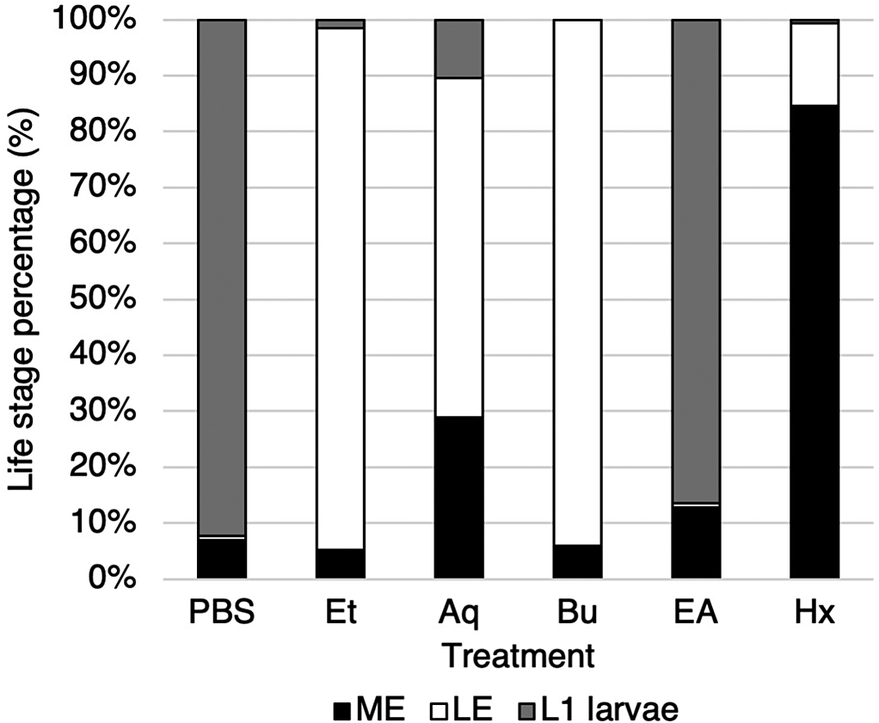
The mode of action of the mycelium Et extract and its fractions is shown in Figure 1. The Et extract and the Bu fraction exhibited a clear hatching inhibition effect, as indicated by the high percentage of LE. The Aq fraction also induced a hatching inhibition effect (high percentage of LE), with some evidence of ovicidal activity (moderate proportion of ME). In contrast, the Hx fraction demonstrated a strong ovicidal effect, as suggested by the high proportion of ME. Finally, the EA fraction did not show activity against the eggs of H. contortus (71% egg hatching at 2400 μg/mL).
Mode of action of the Pleurotus djamor mycelium crude ethanolic extract (Et), the aqueous (Aq), butanol (Bu), ethyl acetate (EA), and hexane (Hx) fractions at 3600 μg/mL on the in vitro egg hatching of Haemonchus contortus. The activity is described as the percentage of morulated eggs (ME), larvated eggs (LE), and L1 larvae observed for each treatment. Phosphate-buffered saline (PBS) solution was used as negative control.

Figure 1. Long description
A stacked bar chart with the y-axis labeled Life stage percentage % ranging from 0 to 100 in increments of 10. The x-axis is labeled Treatment and includes six categories. A legend at the bottom identifies three life stages: M E (black), L E (white), and L1 larvae (gray).
* P B S: Approximately 7% M E, 1% L E, and 92% L1 larvae.
* Et: Approximately 5% M E, 93% L E, and 2% L1 larvae.
* Aq: Approximately 29% M E, 61% L E, and 10% L1 larvae.
* Bu: Approximately 6% M E, 94% L E, and 0% L1 larvae.
* E A: Approximately 13% M E, 1% L E, and 86% L1 larvae.
* Hx: Approximately 85% M E, 14% L E, and 1% L1 larvae.
Discussion
Edible mushrooms have been investigated as an alternative to conventional AHs for the control of GIN in small ruminants. However, research on the AH activity of edible mushrooms such as P. djamor is still in its early stages. The two studies evaluating its AH activity against H. contortus eggs or larvae focused on the effect of hydroalcoholic (70 or 60% aqueous ethanol) extracts and the respective chromatographic fractions obtained from the basidiomes (Pineda-Alegría et al. Reference Pineda-Alegría, Sánchez-Vázquez, González-Cortázar, Zamilpa, López-Arellano, Cuevas-Padilla, Mendoza-de-Gives and Aguilar-Marcelino2017) or the spent substrate (Colmenares-Cruz et al. Reference Colmenares-Cruz, González-Cortázar, Castañeda-Ramírez, Andrade-Gallegos, Sánchez and Aguilar-Marcelino2021). Therefore, it is essential to study other parts of the chemical spectrum, such as the resulting fractions obtained by liquid–liquid extraction such as those generated in this study. On the other hand, a mycelium extract or its fractions have never been tested against H. contortus eggs.
Activity of P. djamor Et extracts against H. contortus eggs
The crude P. djamor Et extracts from both the basidiomes and the mycelium exhibited significant AH activity against H. contortus eggs. The AH activity against H. contortus eggs from the mycelium and basidiomes Et extracts in this study can be considered one of the most potent recorded so far, when compared to any material previously evaluated against eggs. These results are only comparable to some methanol:water extracts from tropical legume plant leaves (Castañeda-Ramírez et al. Reference Castañeda-Ramírez, Torres-Acosta, Sandoval-Castro, González-Pech, Parra-Tabla and Mathieu2017). The latter showed AH activity between 140 (Leucaena leucocephala) and 260 (Acacia collinsii, Piscidia piscipula) μg/mL, which were close to the EC50 values in the present study. It is possible that this increased activity is due to the chemical characteristics of methanol and ethanol, which have a protic character forming hydrogen bonds with compounds different from those that can be attracted by the acetone:water mixture. However, it is important to consider that an acetone:water extraction protocol does not necessarily imply that the tested materials will not display activity against GIN eggs. There are studies where acetone:water extracts resulted in EC50 values between 400 and 800 μg/mL (Senegalia gaumeri, Acacia pennatula, Theobroma cacao; Castañeda-Ramírez et al. Reference Castañeda-Ramírez, Rodríguez-Labastida, Ortiz-Ocampo, González-Pech, Ventura-Cordero, Borges-Argáez, Torres-Acosta, Sandoval-Castro and Mathieu2018; Mancilla-Montelongo et al. Reference Mancilla-Montelongo, Castañeda-Ramírez, Gaudin-Barbier, Canul-Velasco, Chan-Pérez, De la Cruz-Cortazar, Mathieu, Fourquaux, Sandoval-Castro, Hoste, Ventura-Cordero, González-Pech and Torres-Acosta2021), which are better than other plant extracts obtained with methanol:water (Castañeda-Ramírez et al. Reference Castañeda-Ramírez, Torres-Acosta, Sandoval-Castro, González-Pech, Parra-Tabla and Mathieu2017). The latter shows that the solvents and the extraction methods are just as important as the materials tested in the bioprospection process. In other words, the bioprospection of an active material with an incorrect extraction process or extraction system can lead to results that can be confused with a lack of biological activity.
Ethanol:water extracts from the same strain of P. djamor basidiomes (Pineda-Alegría et al. Reference Pineda-Alegría, Sánchez-Vázquez, González-Cortázar, Zamilpa, López-Arellano, Cuevas-Padilla, Mendoza-de-Gives and Aguilar-Marcelino2017) were less active than the Et extracts used in the present study. A possible cause for the latter could be the difference in the SCs extracted using an aqueous ethanolic solution vs the pure ethanol used in this study. However, it is important to consider that the changes in the SCs production of the same material could be the result of different conditions, such as season of the year, availability of nutrients in the substrate, or microclimatic factors (Ortíz-Ocampo et al. Reference Ortíz-Ocampo, Sandoval-Castro, González-Pech, Mancilla-Montelongo, Ventura-Cordero, Castañeda-Ramírez, Tun-Garrido and Torres-Acosta2022). Moreover, the differences between biological activities could also be due to the fungi species, the isolate, and the extraction process. The present study showed greater activity of the Et extract of basidiomes and mycelium of P. djamor (100% total inhibition of H. contortus egg hatching at concentrations between 600 and 1200 μg/mL) compared to the hydroalcoholic (ethanol:water) extract of P. ostreatus basidiomes, which exhibited 100% inhibition at 1600 μg/mL after 48 h of incubation (Valdez-Urióstegui et al. Reference Valdez-Urióstegui, Sánchez-García, Sánchez, González-Garduño, Mendoza-de-Gives, Castañeda-Ramírez, González-Cortázar and Aguilar-Marcelino2021). Finally, an additional element to consider is the evaluation technique, which makes it impossible to compare the effects, including the evaluation of other types of extracts such as a protein extract against H. contortus eggs in a 72-h incubation (Cuevas-Padilla et al. Reference Cuevas-Padilla, Hernández-Velázquez, Cardoso-Taketa, Sánchez, Vargas-Uriostegui, Dantan-Gonzalez, Castañeda-Ramírez, de Freitas Soares, Páez-León and Aguilar-Marcelino2024).
Activity of P. djamor fractions against H. contortus eggs
If a crude extract shows biological activity, bioassay-guided fractionation is typically recommended. With this methodology, it is possible to obtain and evaluate fractions of varying polarity derived from the crude extract, with the goal of identifying the SCs responsible for the activity (Castañeda-Ramírez et al. Reference Castañeda-Ramírez, Torres-Acosta, Sandoval-Castro, Borges-Argáez, Cáceres-Farfán, Mancilla-Montelongo and Mathieu2019; Weller Reference Weller2012). Thus, the present study evaluated the AH effect against H. contortus eggs of polar and non-polar fractions of the crude Et extracts of P. djamor basidiomes or mycelium. All these materials were previously evaluated against H. contortus larvae and analysed by proton nuclear magnetic resonance (1H-NMR) metabolomics (Pineda-Alegría et al. Reference Pineda-Alegría, Peña-Rodríguez, Cardoso-Taketa, Sánchez, Torres-Acosta, Hernández-Bolio, Ortiz-Caltempa, Villarreal and Aguilar-Marcelino2024).
Except for the mycelium EA fraction, which was inactive, all basidiome and mycelium fractions were considered effective, suggesting that polarity does not negatively influence the activity of the P. djamor fractions against H. contortus eggs. Notably, all basidiome fractions, except Hx, exhibited greater activity than their crude extract. This might be attributed to a higher concentration of one or more SCs present in the fractions, or to synergistic effects resulting from their interaction (Klongsiriwet et al. Reference Klongsiriwet, Quijada, Williams, Mueller-Harvey, Williamson and Hoste2015).
Unlike the basidiome fractions, not all mycelium fractions surpassed the activity of their respective crude extract. For example, the Aq fraction had a higher EC50 than its respective crude extract, suggesting that this fraction still contains active SCs, albeit in lower concentrations. Despite this, the Aq fraction still exhibits a noticeable effect, as it is more active than the crude extracts obtained from plant leaves (Castañeda-Ramírez et al. Reference Castañeda-Ramírez, Rodríguez-Labastida, Ortiz-Ocampo, González-Pech, Ventura-Cordero, Borges-Argáez, Torres-Acosta, Sandoval-Castro and Mathieu2018; Mancilla-Montelongo et al. Reference Mancilla-Montelongo, Castañeda-Ramírez, Gaudin-Barbier, Canul-Velasco, Chan-Pérez, De la Cruz-Cortazar, Mathieu, Fourquaux, Sandoval-Castro, Hoste, Ventura-Cordero, González-Pech and Torres-Acosta2021), cacao husks (Mancilla-Montelongo et al. Reference Mancilla-Montelongo, Castañeda-Ramírez, Gaudin-Barbier, Canul-Velasco, Chan-Pérez, De la Cruz-Cortazar, Mathieu, Fourquaux, Sandoval-Castro, Hoste, Ventura-Cordero, González-Pech and Torres-Acosta2021), and other P. djamor materials (Sánchez-Salgado et al. Reference Sánchez-Salgado, Castañeda-Ramírez, Sánchez, Gómez-Rodríguez, Morales-Soto and Aguilar-Marcelino2021).
On the other hand, the EA mycelium fraction was inactive and, therefore, unlikely to contain SCs of interest against H. contortus eggs. This fraction also had significant technical challenges related to solubility due to its low polarity, requiring the use of detergent solvents such as 2% DMSO and additional techniques like sonication to achieve complete dissolution. Interestingly, this fraction had the highest activity against the larval exsheathment of the same H. contortus isolate (EC50 = 290.8 μg/mL) (Pineda-Alegría et al. Reference Pineda-Alegría, Peña-Rodríguez, Cardoso-Taketa, Sánchez, Torres-Acosta, Hernández-Bolio, Ortiz-Caltempa, Villarreal and Aguilar-Marcelino2024). The mycelium EA fraction represented a different group of 1H-NMR signals, indicating different SCs, when all the fractions were analysed by PCA (Pineda-Alegría et al. Reference Pineda-Alegría, Peña-Rodríguez, Cardoso-Taketa, Sánchez, Torres-Acosta, Hernández-Bolio, Ortiz-Caltempa, Villarreal and Aguilar-Marcelino2024). That difference between the biological activities of this EA fraction, to inhibit the egg hatching or L3 exsheathment, points to a clear affinity of the respective SCs for the egg or the L3 sheath membranes. Hence, further bioassay-guided isolation studies are needed to elucidate the active or synergistic compounds.
In vitro mode of action of P. djamor extracts and fractions
Typically, an ovicidal activity is consistent with an ME where the egg maintains a well-defined morula after exposure to AH drugs such as thiabendazole or plant extracts. Meanwhile, those eggs with a hatching inhibition effect usually maintain their oval form with a well-defined L1 inside, which fails hatching and has been described as a LE (Vargas-Magaña et al. Reference Vargas-Magaña, Torres-Acosta, Aguilar-Caballero, Sandoval-Castro, Hoste and Chan-Pérez2014). However, those reported features were not evident for the extracts and fractions of P. djamor basidiomes or mycelium. The structures present within the eggs acquired a dark colour and an irregular shape after the incubation protocols. Furthermore, during the EHT performed with the basidiome fractions, the microscopic observation and identification of the ME and the LE were further obscured by a dark colouration acquired by the contents inside each well, particularly for the EA and Hx fractions. Hence, the precise assessment of the ovicidal or the hatching inhibition activities was not possible for basidiome materials. Interestingly, both non-polar fractions demonstrated superior in vitro efficacy compared to other reported nutraceutical materials described earlier. The darkening observed in the wells may be linked to the SCs oxidation.
In contrast, the mycelium extract and its fractions did not darken the suspensions contained in the wells, allowing to identify the ovicidal or hatching inhibition effects. The mycelium Et extract, as well as its Aq and Bu fractions, exhibited a hatching inhibition effect with abundant LE, while only the Hx fraction demonstrated an ovicidal activity with abundant ME (Figure 1). The differences observed in the effects produced by the extract and its fractions could be due to the presence of different SCs in each one. This is consistent with their metabolic profiles, whose 1H-NMR PCA analysis grouped Et, Aq, and Bu together, while the Hx was part of a different group (Pineda-Alegría et al. Reference Pineda-Alegría, Peña-Rodríguez, Cardoso-Taketa, Sánchez, Torres-Acosta, Hernández-Bolio, Ortiz-Caltempa, Villarreal and Aguilar-Marcelino2024).
Other studies evaluating the AH activity of acetone:water extracts obtained from tree leaves used tannin-blocking agents such as polyvinylpolypyrrolidone (PVPP) to suggest that antagonistic interactions may exist between polyphenols and other SCs with an ovicidal effect (Vargas-Magaña et al. Reference Vargas-Magaña, Torres-Acosta, Aguilar-Caballero, Sandoval-Castro, Hoste and Chan-Pérez2014). It is possible that the types of SCs present in the Et extract and the Aq and Bu fractions may only bind to the lipoproteins of the eggshell membrane, preventing changes in its permeability and thereby inhibiting larval hatching (Perry Reference Perry and Lee2002). Other hypotheses suggest that SCs may inhibit enzymes involved in membrane degradation (Molan et al. Reference Molan, Waghorn and McNabb2002) or might competitively bind to hatching factors on the membrane (Doncaster and Shepherd Reference Doncaster and Shepherd1967), resulting in a delay or interruption of the hatching process. Regarding the activity of the mycelium Hx fraction, the exact mechanism or the specific SCs responsible for its ovicidal activity are unknown, and further investigation is needed.
The feasibility of using Pleurotus spp. as an AH agent to control GIN of small ruminants has been reinforced by the data obtained in this in vitro study. There is already data confirming that sheep can consume the mycelia contained in the spent substrate as part of their daily diet (Miss-Caro et al. Reference Miss-Caro, Torres-Acosta and Aguilar-Marcelino2025). It is important to note that there are no published studies on its in vivo effects in small ruminants infected with H. contortus or other GIN species. However, a preliminary in vivo study was conducted in gerbils ( Meriones unguiculatus ) artificially infected with H. contortus and treated with purified fractions from P. djamor basidiomes, reporting a 92.56% reduction in larvae counts (González-Cortázar et al. Reference González-Cortázar, Sánchez, Huicochea-Medina, Hernández-Velázquez, Mendoza-de-Gives, Zamilpa, López-Arellano, Pineda-Alegría and Aguilar-Marcelino2021). Notably, both the therapeutic use as an AH agent and the method for obtaining P. djamor spent substrate containing mycelium were patented (Colmenares-Cruz et al. Reference Colmenares-Cruz, González-Cortázar, Castañeda-Ramírez, Andrade-Gallegos, Sánchez and Aguilar-Marcelino2021). Together, these findings highlight the need for future in vivo evaluations of P. djamor basidiomes and mycelium as alternative AH materials that could be used in small ruminants as part of a sustainable strategy to control GIN in small ruminants.
In summary, this study confirms that (i) different parts of P. djamor produce SCs with potential anthelmintic activity against H. contortus, including the mycelium whose extract was evaluated for the first time in this work; (ii) the extraction of SCs with activity against eggs is favoured with alcoholic solvents; and (iii) the efficacies of the crude extracts tested here are comparable to previously tested crude extracts of tropical forages. However, further bioassay-guided isolation is required to identify active SCs and to test their efficacy as a nutraceutical under in vivo conditions.
Acknowledgements
The authors thank Secihti for the IxM project number 692, responsible for obtention, characterisation, and permanent maintenance of the FMVZ-UADY gastrointestinal nematodes collection, including the isolate used in this study. The authors also acknowledge the technical staff Lilia Moreno Ruíz, René H. Andrade Gallegos, and José Ernesto Sánchez Vázquez, of the Tropical Fungi Laboratory of ECOSUR for providing the fungi material.
Financial support
The present study was financed by the Secretary of Science, Humanities, Technology and Innovation (Secihti), Mexico. Project number: CBF2023-2024-387.
Competing interest
The authors declare none.
Ethical standard
Animal use in this study was approved by the Bioethics Committee of FMVZ-UADY (protocol code CB-CCBA-D-2021-005). The protocol complies with the ARRIVE 2.0 (Animal Research: Reporting of in vivo experiments) guidelines to report animal research (Percie du Sert et al. Reference Percie du Sert, Hurst, Ahluwalia, Alam, Avey, Baker, Browne, Clark, Cuthill, Dirnagl, Emerson, Garner, Holgate, Howells, Karp, Lazic, Lidster, CJ, Macleod, Pearl, Petersen, Rawle, Reynolds, Rooney, Sena, Silberberg, Steckler and Würbel2020).