In tropical climates, nest movements by mature ant colonies are probably widespread but the phenomenon of nest relocation is poorly described (McGlynn Reference MCGLYNN2007, McGlynn et al. Reference MCGLYNN, CARR, CARSON and BUMA2004, Smallwood Reference SMALLWOOD1982a). For species that nest in soil, the costs and risks associated with excavating and establishing new nests are consequential, and it is assumed that relocation occurs when the costs are offset by a more advantageous nest location (Avargues-Weber & Monnin Reference AVARGUES-WEBER and MONNIN2009, Banschbach & Herbers Reference BANSCHBACH and HERBERS1999). Nest movements may occur to areas with greater availability of food resources or to a more favourable microclimate. Here we provide the first report of nest relocation in one of the most widespread and well described ant species in the Neotropics, Ectatomma ruidum (Roger), and we perform a manipulative experiment to test whether food availability or light environment influence nest movement.
The ant Ectatomma ruidum is a dominant feature of tropical wet and moist forests throughout the Neotropics. Colonies of E. ruidum nest in exceptionally high densities, and it is well established that the species is thermophilous on the local scale, as unshaded areas support much higher colony densities than adjacent shaded areas (Lachaud Reference LACHAUD1990, Santamaria et al. Reference SANTAMARIA, ARMBRECHT and LACHAUD2009, Schatz & Lachaud Reference SCHATZ and LACHAUD2008). In north-eastern Costa Rica, densities are at least 1 colony m−2 and often much higher, though colonies are rarely found in old-growth forests with closed canopies. The pattern of shade provided by canopies of secondary forests and partially cleared areas is stochastic (Nicotra et al. Reference NICOTRA, CHAZDON and IRIARTE1999), and nest movements of E. ruidum may be directed toward increasing insolation, as is the case with the temperate ants in the Aphaenogaster rudis complex (Smallwood Reference SMALLWOOD1982b). Anecdotal observations by the first author and another investigator (B. Guenard, pers. comm.) suggest that nest movements by E. ruidum may be directed towards increased food availability.
The foraging ecology and behaviour of E ruidum are well described, and this knowledge is useful for interpreting the causes and consequences of nest movements. Ectatomma ruidum is a generalist forager and collects a diversity of arthropod prey and often forages on low vegetation collecting nectar and honeydew. Ectatomma ruidum individuals and colonies are highly attuned to the availability and acquisition of food. Ectatomma ruidum demonstrates the ability to remember the time and place of prior food-availability events, returning to specific locations or orientations at moments of predictable food availability (Franz & Wcislo Reference FRANZ and WCISLO2003, Schatz & Lachaud Reference SCHATZ and LACHAUD2008, Schatz et al. Reference SCHATZ, LACHAUD and BEUGNON1999). Ectatomma ruidum workers ambush sweat bees at their nest entrances (Schatz & Wcislo Reference SCHATZ and WCISLO1999) and colonies house specialized intraspecific thieves that remove high-quality food items after they enter the nests of adjacent colonies (Breed et al. Reference BREED, MCGLYNN, STOCKER and KLEIN1999).
We hypothesize that nest movements by E. ruidum are carried out to increase insolation and access to food resources. To evaluate the relative import of microclimate and food access, we designed a factorial manipulation of food and light, with independent and overlapping treatments of food supplementation and artificial shading. We expect that shading will result in the emigration of E. ruidum colonies, and that the provision of supplemental food will diminish the effect of shade on emigration.
Work was conducted June–July 2009 in La Selva Biological Station, located in a tropical rain forest in north-eastern Costa Rica. More information about La Selva is available at www.ots.ac.cr. We created 17 sites in two locations with high densities of E. ruidum, both areas maintained with scant understorey cover which facilitated comprehensive location of all E. ruidum colonies. With respect to the La Selva trail system, one location was centred c. 50 m east of the Sendero Oriental at the 550-m mark, and the other was located along both sides of the Sendero Sura near the 500-m mark. Each site contained four plots located at least 3 m from one another, for a total of 68 plots. Each site was at least 5 m from all other sites. Each plot was 1 m2 and a focal nest was located in the centre of the plot.
We measured the density of nests at the outset of the experiment with a careful search for nest entrances and foragers at times of high foraging activity, as well as the use of several baits m−2. At least one person-hour m−2 during peak time of active foraging was spent on each plot, and plot designation occurred haphazardly without respect to nest densities.
Four treatments were designated in equal frequencies, such that there was one plot per treatment per site: unmanipulated (control), shade, food, or shade + food. In the shade treatment, the plot was shaded for 21 d with a heavy shade cloth elevated 0.5 m above ground level and extending 0.5 m beyond around the perimeter of the plot, mounted on a frame of PVC tubing. Food supplementation plots received daily supplemental food for 21 d using resources that have attracted E. ruidum to baits in prior studies. A variety of foods were used, including peanut butter, sucrose solution, crumbled cookies and canned tuna, with one kind of food proffered each day. All four treatments were monitored on 7-d intervals to check for occupancy of focal nests and for the arrival of immigrant colonies, obvious from nest excavation activity within the previous 7 d. Shade + food plots received shade and food treatments simultaneously. Throughout the 21-d treatment period, three plots were excluded from the experiment because of anomalous events (including erosion from flooding) that would have interrupted normal nest movement patterns.
Statistical analyses were conducted with JMP 8.0.1 (SAS Institute, Cary, North Carolina, USA). To ensure comparability of treatments, initial nest densities of plots were compared using a Kruskal–Wallis test. We used a Generalized Linear Mixed Model (Bolker et al. Reference BOLKER, BROOKS, CLARK, GEANGE, POULSEN, STEVENS and WHITE2009) to evaluate the effect of treatments and nest density on the number of nest movements.
Nest movements were inferred when a new nest was detected after plot establishment in a plot in which we had previously exhaustively searched, with evidence of fresh excavation activity. Nest movements were not directly observed, even though we spent substantial time in the research plots. We suggest that relocation events occurred rapidly or that they only occurred under the cover of darkness when we did not work in the plots; the latter is likely in the gypsy ant Aphaenogaster araneoides (McGlynn Reference MCGLYNN2007).
Mean initial nest density was 1.96 nests m−2. There were no significant differences among the four treatment categories at the outset of the experiment (χ2 = 4.57. df = 3, P = 0.22). Contrary to our predictions, no focal nest (nor any other nests inside the plots to our knowledge) emigrated from any of the control and treatment plots. However, there were a number of immigrations into the plots from colonies outside the treatment plots, which were non-randomly distributed among treatments.
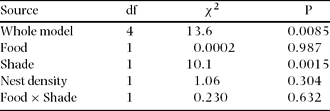
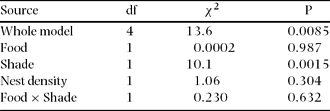
A search of the plots revealed a total of 26 immigrant nests in the plots 2 wk after commencement of treatment, with the following distribution: control: 4; food: 4; shade: 9; food + shade: 9. Of these immigration events, only the shade and shade + food plots received multiple immigrant event colonies, with three colonies moving into one of the shade plots, and two colonies moving into two of the shade plots, two colonies into three of the shade + food plots. The GLMM (Table 1) indicated a positive effect of shade on colony immigration, but not an effect of food, initial nest density, or a shade × food interaction.
Results from a Generalized Linear Mixed Model evaluating the effect of food, shade, nest density and an interaction between food and shade on the number of immigrant nests into treatment plots.
We were surprised to find that colonies overwhelmingly moved under the artificial shade. Colonies preferentially preferred the shade treatment in the open area to adjacent naturally shaded areas. We infer that the high density of E. ruidum in open areas is not caused by a preference for high light levels as a preferred microclimate. One potential though unlikely explanation for higher densities of E. ruidum in sunny areas is that the shaded plots may have provided higher availabilities of food, including insect prey, nectar and honeydew. The diet of E. ruidum is rich in carbohydrates by choice (Cook & Davidson Reference COOK and DAVIDSON2006) and there was an appreciable quantity of carbohydrate available in our supplemental food. We are partial to other possible explanations, as our manipulation of food supports the hypothesis that the relocation behaviour is independent of food availability.
What are the characteristics of open habitats that facilitate high nest densities even though E. ruidum prefers to nest in shade? Classic ant ecologists will be quick to suggest competitive exclusion from shaded areas (Hölldobler & Wilson Reference HÖLLDOBLER and WILSON1990). The foraging strategy of E. ruidum features opportunistic food collection and agonistic interactions are avoided (McGlynn & Kirksey Reference MCGLYNN and KIRKSEY2000). In a temperate forest, ants with a broader range of thermal tolerances are competitively subordinate to those with narrow thermal ranges (Lessard et al. Reference LESSARD, DUNN and SANDERS2009). However, E. ruidum is known to occur at very high densities alongside many other species, even in shaded old-growth environments (Levings & Franks Reference LEVINGS and FRANKS1982). Relative to other species in Neotropical forests, E. ruidum has a broad tolerance for light conditions, as the species ranges from southern Mexico to Amazonia (Kugler & Brown Reference KUGLER and BROWN1982). Rather than moving into the shade treatments out of constraint, we suspect that next movements occurred to optimize nesting conditions. One working hypothesis is that shaded environments are preferred over sunny environments, and that higher nest densities in the sun are the consequence of smaller colony sizes in sunny environments as a result of thermal stress that can reduce foraging opportunities.
The creation of a shade apparatus in a sunny clearing does not provide an environment equivalent to that provided by the long-term shade of a tree. The nests of E. ruidum in sunny and shaded areas in our site was presumably at equilibrium because nest movements are otherwise apparently rare. We altered this equilibrium by providing an immediate shade opportunity that was distinct from established shade and sun regimes.
The present study provides a note of caution against broad applications of macro-ecological theories to single species on the local scale. Macro-ecologists disagree whether the large-scale patterns in ant diversity are structured by resources, or by temperature limiting resource access (Kaspari et al. Reference KASPARI, WARD and YUAN2004, Sanders et al. Reference SANDERS, LESSARD, FITZPATRICK and DUNN2007). This question cannot be wholly answered by any single approach or at the scale of the present study. Nevertheless, the present results suggest that the interaction between trophic ecology and behavioural ecology complicates community assembly. Observed patterns in the abundance and distribution of species with respect to productivity and energy access do not necessarily inform predictions at the level of individual species. We conclude that competitive asymmetries, niche breadth and complexities in foraging behaviour must inform predictions of occupancy and density.
ACKNOWLEDGEMENTS
This research was conducted under the support of the National Science Foundation (OISE-0749047; OISE-0854259) and the Louis Stokes Alliance for Minority Participation award to the California State University. John Thomlinson and Bill Wcislo provided useful remarks to improve the manuscript. Fieldwork and logistics were assisted by Thuy-Tien Hoang, Kim Hoffmann and Orlando Vargas.