



Introduction
The treatment of patients with CHD has evolved over the past decades. As a result, more and more patients are achieving a longer life expectancy. Reference Moons, Luyckx and Kovacs1,Reference Dulfer, Bossers and Utens2 Living with a CHD affects patients not only physically but also emotionally and socially. Quality of life has become a frequently researched aspect of assessing the quality and outcome of health care. Reference Moons, Budts and De Geest3 It is often used in the literature as an umbrella term for various factors, such as health, functional ability or social living conditions, Reference Moons4 and also interpreted as the degree of general life satisfaction, which is positively or negatively influenced by the individual perception of different aspects of life. Reference Moons, Van Deyk and Marquet5
Quality of life is an important endpoint in medical and health research, and quality-of-life research encompasses a variety of audiences and research designs. The term health-related quality of life refers to the health aspects of quality of life (and is used as a scale unit in test instruments: SF-36 = Health Status Questionnaire, HADS-D: Hospital Anxiety and Depression, EQ-5D-5L: Quality of Life Questionnaire) Reference Bullinger and Kirchberger6,Reference Herrmann, Buss and Snaith7,8 which is generally thought to reflect the impact of illness and treatment on disability and daily functioning. It has been hypothesised to show the impact of perceived health on an individual’s ability to lead a fulfilling life. More specifically, however, health-related quality of life is a measure of the value assigned to life expectancy, which is modified by impairments, functional conditions, and perceptions, as well as opportunities, and influenced by illness, injury, treatment, and policy. Reference Kovacs, Brouillette and Ibeziako9
Moons et al Reference Moons, Luyckx and Kovacs1 analysed patient-reported outcomes of adult patients with CHD from 15 different countries and included the domains of medical factors, age and sex, behavioural factors, psychological factors, and social factors. It was postulated that adult patients with CHD want to be taken seriously in their needs and experience multidisciplinary care.
At the Children’s Heart Center Linz, it was found that patients with hypoplastic left heart syndrome at the age of 6–13 years rated their quality of life (physical and psychosocial) lower than healthy children of the same age, but in adolescence (13–16.9 years), no difference was perceived anymore. Reference Oberhuber, Huemer and Mair10
Therefore, the aim of the study is to compare the quality of life of adult patients (older than 18 years) with CHD within the sample depending on the vitium (mild/moderate–severe) and to investigate it compared to the general population. Furthermore, trends toward increased anxiety and depression parameters in patients with CHD will be investigated. Targeted clinical-psychological treatments and support can be derived from the results of the study, concretised, and offered if necessary.
Materials and method
Patients
From June 2021 to June 2022, a total of 81 patients with a CHD at Med Campus III. of Kepler University Hospital were recruited for the questionnaire study. The survey was conducted after the annual medical check-up. Patients with CHD and over 18 years of age were included. Language skills in German were a prerequisite for answering the questionnaire.
Methods
The four questionnaires, provided as German adaptions, used for assessing the psychologic and social situation of the patients were:
The EQ-5D-5L health questionnaire 8 is a patient-reported outcome instrument and includes five items in each of five dimensions and a visual analogue scale. It measures the quality of life of individuals regardless of the presence of diseases.
The Hospital Anxiety and Depression ScaleReference Herrmann, Buss and Snaith 7 measures anxiety and depression in patients with physical illnesses or (possibly psychogenic) physical complaints using 14 items. The scale measures the degree of anxious and depressive symptoms during the past week by means of self-report, which is recorded on two subscales with seven items each. The total sum score can be used as a measure of general psychological impairment.
The SF-36 on health status Reference Bullinger and Kirchberger6 consists of 36 questions and provides a profile of two summary health components by assessing the patient’s health status on eight different dimensions: vitality, physical functioning, physical pain, general health perception, physical role functioning, emotional role functioning, social role functioning, and psychological well-being.
Furthermore, a sociodemographic questionnaire prepared by the study team was used.
Statistical analyses
Baseline characteristics are presented as nominal and ordinal variables and also absolute and relative frequencies are reported. For metric variables, mean and standard deviation as well as minimum and maximum are reported. The normal distribution of variables is tested using the Kolmogorov–Smirnov test. The difference in ordinal or non-normally distributed variables between two groups. Differences between mild/moderate and severe CHD and sex differences were calculated using the Mann–Whitney U test. To compare our results to normal values, the German norm sample 1998 was used as the norm sample for the SF-36, and the German norm sample 2011 was used as the norm sample for the HADS-D. 12 The Belgian population Reference Van Wilder, Charafeddine and Beutels11 is used as the norm sample for the visual analogue scale of the EQ-5D-L because surveys in Belgium report similar directional life satisfaction, self-perceived health, and life expectancy as in Austria. 12,13
For this exploratory study, the statistical programme SPSS 25.0 14 was used and significance level was set to 0.05.
For the statistical calculation of the differences, symptom severity was grouped into mild/moderate and severe, since only three subjects had mild symptomatology. So two independent variables were defined for the calculations, namely sex (male/female) and diagnosis (mild/moderate and severe). These were compared with the following dependent variables: SF-36 subscales (physical functioning, role physical, bodily pain, general health, vitality, social functioning, role emotional, mental health), HADS – Scale scores (depression and anxiety), and EQ-5D-5L subscales (health today, mobility, self-care, usual activities).
Results
Sample description
From June 2021 to June 2022, a total of 81 patients with a CHD were examined at Med Campus III of Kepler University Hospital by means of a questionnaire survey. The survey was conducted after the annual medical check-up. At this medical check-up, the patients have been asked by the attending doctor if they are ready to be part of the survey. Patients with CHD and over 18 years of age were included. Language skills in German were a prerequisite for answering the questionnaire. The patients were subsequently presented with the questionnaires by clinical psychologists. All patients were also offered the opportunity to take advantage of a clinical-psychological consultation.
One patient had to be excluded due to poor completion of the questionnaire and therefore the results of 80 patients are included in the analysis (n = 80). In total, 43 male and 37 female patients were interviewed. According to the European Guidelines for the management of adult CHD (2020), Reference Baumgartner, De Backer and Babu-Narayan15 the patient group was subsequently divided into mild, moderate and severe heart defects with regard to their CHD.
Patients age ranged between 18 and 58 years. Detailed information about our sample can be found in Table 1.
Baseline characteristics of patients with CHD (n = 80 or lower when there are missing data)

* Keynote for Level of Education: no degree: less than 9 school years, Compulsory school: 9 school years, apprenticeship diploma: learned profession for 3 to 4 years, technical college: technical school for 3 years without high school diploma, A-Levels: in total 12 or 13 school years with high school diploma, University degree: completed university study.
Quality of life outcome
Quality of life on the day of the interview was reported as good, with scores ranging from a minimum of 70 to a maximum of 90 (out of 100; assessment in the EQ-5D-5L). The variables were not normally distributed (Kolmogorov–Smirnov test p < 0.05). There was a significant difference in psychological well-being (p = 0.046), in that those with less severe CHD (mild/moderate) reported higher psychological well-being (Mean: 77.38; standard deviation: 15.82) than those with more severe CHD (Mean: 64.86; standard deviation: 25.17) (see Fig 1).
Differences in psychological well-being depending on severity of CHD (p = 0.046). Patients with mild/moderate disease severity showed a better psychological well-being compared to patients with severe CHD.

No significant differences were observed in any of the additionally recorded scales: Anxiety total (p = 0.310) and depression total (p = 0.635), mobility (p = 0.414), self-care (p = 0.539), usual activities (p = 0.213), health today (p = 0.891), physical functioning (p = .353), role physical (p = 0.855), bodily Pain (p = 0.170), general health (p = 0.429), vitality (p = 0.336), social functioning (p = 0.272), and role emotional (p = 0.147) in relation to heart disease severity (mild/moderate and severe).
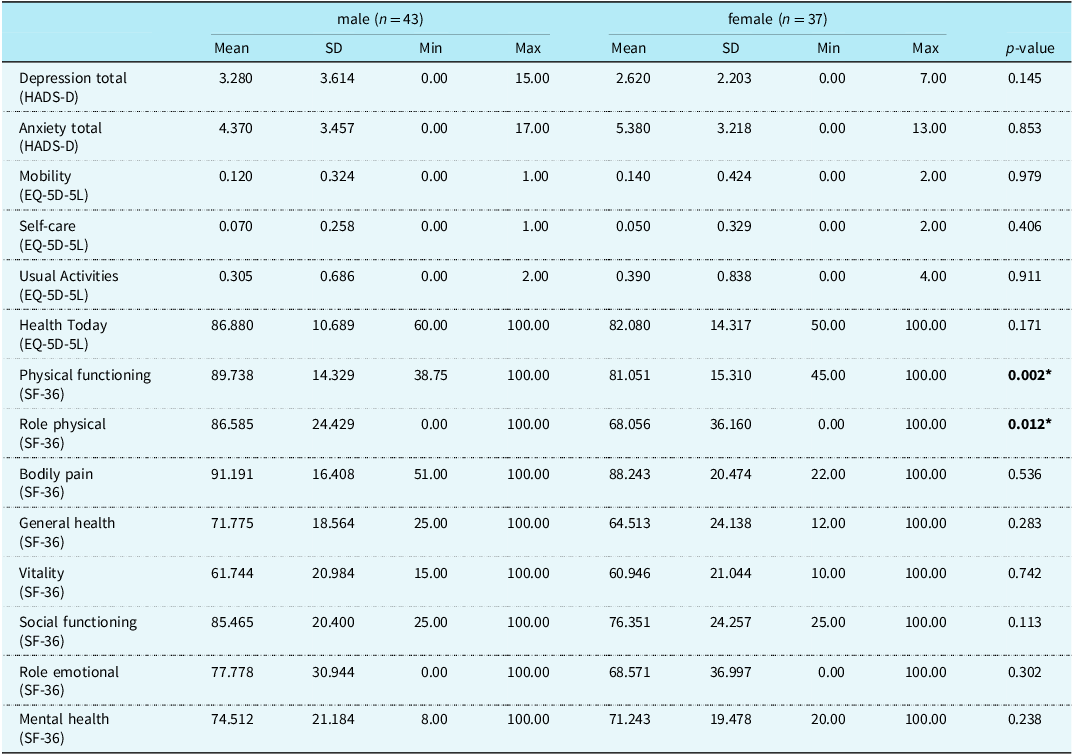
The sex-specific analysis showed significant differences are observed in the scales physical functioning (p = 0.002) and role physical (p = 0.012), both of which are higher among men (physical functioning: mean: 86.59, standard deviation: 14.33; role physical: mean: 86.59, standard deviation: 24.43) than among women (physical functioning: Mean: 81.05, standard deviation: 15.31; role physical: Mean: 68.06, standard deviation: 36.16) (see 2).
The sex-specific results in detail for all variables surveyed are presented in Table 2.
Sex-specific analysis of the results
Discussion
In this survey of 80 patients, we found that our patients with CHD overall have a high quality of life. It is evident that physical health is an essential component of well-being. Living with a CHD affects patients not only physically but also emotionally and socially.
Quality of life, anxiety, and depression
We found no significant differences in quality of life parameters and anxiety and depression indices between adult CHD mild/moderate and adult CHD severe. Also between adult CHD and the general population, no differences were observed. The results are largely consistent with those of Loup et al, who described that adult individuals with CHD have a comparable quality of life to a healthy control group. Reference Loup, Von Weissenfluh and Gahl16
It is encouraging that the adult CHD patients treated at the Department of Cardiology of the Kepler University Hospital Linz have the same good quality of life as the general population and do not differ within the cohort (mild/moderate-severe). However, it is known from studies of larger and older heart centres that the challenges, for example, in relation to work ability and reduction in physical strength, become greater with increasing age. Reference Moons, Van Bulck, Daelman and Luyckx17 Only educated patients have realistic expectations regarding their future health as well as life-threatening complications. They can make reasonable long-term decisions, develop strategies to live with a chronic, potentially life-threatening disease, and express their wishes about advance care planning. Wichert–Schmitt Reference Wichert-Schmitt and Oechslin18 attests to the “mistaken belief” of physicians that only patients with CHD of moderate or great complexity might be willing to discuss life expectancy and advance care planning. Therefore, sensitive discussion about life expectancy and advance care planning should be encouraged among all patients and should not be reserved for patients with complex CHD. In addition, appropriate discussion should not be delayed until faced with life-threatening complications or even avoided in more anxious patients. Although many adults are willing to discuss advance care planning early, health care providers have difficulty initiating this important conversation. Difficult prognosis is one reason for this delay. Reference Loup, Von Weissenfluh and Gahl16
Mental health and disease severity
A significant difference in mental health (p = .046) was observed between patients with lower disease severity (mild/moderate) (Mean: 77.38; standard deviation: 15.82) compared to higher disease severity (severe) (Mean: 64.86; standard deviation: 25.17).
Moons et al Reference Moons, Van Bulck, Daelman and Luyckx17 have shown that mental disorders and mental health problems are common in people with CHD. Traumatic experiences due to invasive procedures and lengthy intensive medical treatments, existential issues, and also genetic factors may increase the likelihood of developing mental disorders. Depression, anxiety, bipolar disorder, psychosis, attention deficit hyperactivity disorder, and autism spectrum disorders are more common in people with CHDs than in unaffected individuals, at rates up to five times higher. Mental health problems change with age. Early data show better mental health and less anxiety in older patients with CHDs. Further research into this growing group of ageing patients is needed to provide appropriate care tailored to their needs. Psychological interventions should be an indispensable component of care for adult CHD patients.
Physical functioning and role function and sex
Significant sex differences could be found in the scales physical functioning and role physical, which are both more pronounced in men than in women. Presumably, the pressure of suffering and their own expectations of themselves are more pronounced in female patients than in men.
Having a CHD that may limit one’s ability to perform, or having surgical scars that make one feel less attractive, appears to have an increased negative impact on role function in women.
Relation to the clinical setting and clinical implications
When discussing the results, it must be kept in mind that the Department of Cardiology of the Kepler University Hospital Linz has only been in existence for 27 years, and our patient cohort is very young compared to other adult CHD centres (see Table 1: n = 1, older than 58). The sample may be too young to show a negative impact of age and worsening clinical situation on their quality of life. On the other hand, the considerable improvement of perioperative management, treatment algorithms, surgical techniques, and standardisation of follow-up in the last decades certainly contributes to an optimisation of the quality of life of this group of patients.
Further essential findings from our results and from studies of other heart centres with a longer duration are significant for the further care of adult CHD patients at our heart centre:
Diller et al Reference Diller, Kempny and Alonso-Gonzales19 have outlined that adult CHD has persistent morbidity and reduced long-term survival. The highest mortality rates were observed in patients with complex adult CHD, Fontan physiology, and Eisenmenger syndrome.
Talking to patients about life expectancy issues and short- and medium-term mortality risks can be challenging. Apart from obvious psychological barriers and anxieties associated with this difficult topic, there may also be a cognitive problem in understanding risk. Diller et al Reference Diller, Kempny and Alonso-Gonzales19 show data on equivalent age. Mortality in adult CHD patients can be illustrated by comparison with people without heart disease. Although equivalent ages for simple lesions are comparable to those in the general population, patients with complex univentricular vitiation had greatly increased values. Beyond direct medical applications, these data could be particularly useful for clinical-psychological follow-up.
Quality of life depends on a variety of factors, and psychosocial adjustment to adult life depends not only on the type and severity of the CHD but also on the attitude and support of family, friends, community, and the medical care team. Sensitive handling, advocacy, and education are enormously valuable. Ongoing multidisciplinary care for adult CHD patients should be provided throughout their lives. In fact, most of these patients are at risk of complications resulting from their initial lesion, treatment, or repeated surgical procedures and are at risk of premature death. It is therefore essential to have a professional transition from paediatric to adult care and a close collaboration between paediatric and adult cardiology.
On the one hand, it is important to repeat the quality of life study at the Department of Cardiology of the Kepler University Hospital Linz at regular intervals in order to assess the psychological and holistic state of health of the adult CHD patients in addition to the medical parameters. On the other hand, the continuation of the clinical-psychological and psychosocial support of these patients in addition to the medical treatment is an important component of a holistically successful support, so that the patients can sustainably maintain the quality of life despite possibly developing cardiological difficulties and risk factors—and can adequately deal with anxiety and depression parameters.
Limitation
The data were collected in an average life situation of the patients and after a medical check-up. When the data were collected, the patients were relaxed and relieved that no further surgical intervention was expected for the year ahead until the next examination. As a result, the quality of life may have been assessed more positively than if they had been surveyed in a crisis situation.
In addition, patients could voluntarily participate in the study, thus this study includes only those who consented to it.
As already mentioned, the majority of the study participants are younger than 39. Thus, the results are limited to this age range at this point in time.
Conclusion
It is worth noting that quality of life is dependent on physical functionality. Thus, as soon as the cardiac surgical interventions have resulted in the heart’s function being restored to such an extent that an active life can be lived, the quality-of-life parameters are also indistinguishable from the healthy norm sample.
Based on the findings to date, it can be concluded that patients with CHDs, as vulnerable individuals, develop a high level of resilience and a good quality of life in the course of their development. A successful cooperation of all professional groups, especially medicine, nursing, clinical psychology, physiotherapy, and social work, contributes to the fact that within the framework of continuous support, not only physical (survival) life is prolonged and made possible but also quality of life is increased, and anxiety and depression parameters can be reduced.
Sex differences in physical functioning (p = 0.002) and physical role functioning (p = 0.012). Men showed a higher physical functioning and physical role function compared to women.

Acknowledgements
The authors thank Corinna Webersdorfer for translation and the team of KKS Linz for providing statistical support.
Financial support
This research received no specific grant from any funding agency, commercial or not-for-profit sectors.
Competing interests
None
Ethical standards
The authors assert that all procedures contributing to this work comply with the ethical standards of the relevant national guidelines on human experimentation (1103/2021) and with the Helsinki Declaration of 1975, as revised in 2008, and has been approved by the institutional committees Ethics Committee of the JKU Medical Faculty.



