Spanish syllable final /s/ lenition—illustrated in (1)—is one of the most widely studied variables in sociolinguistic research and by far the most widely studied in the Spanish language.
(1) ¿Dónde están los libros?
¿Dónde e[h]tán lo[h] libro[Ø]?
Where are-3pl the-pl book-pl
‘Where are the books?’
S-lenition is found in many varieties of Spanish, including those varieties spoken in southern Spain, the Canary Islands, and throughout Latin America, with the exception of the Mexican highlands and the Andean regions of South America (Alba, Reference Alba and Alba2000, Reference Alba2004; Brown & Torres Cacoullos, Reference Brown and Torres Cacoullos2002; Cepeda, Reference Cepeda1995; File-Muriel & Brown, Reference File-Muriel and Brown2011; Hammond, Reference Hammond and Scavnicky1980; Lipski, Reference Lipski1994; Poplack, Reference Poplack and Labov1980).
Previous investigations of Spanish /s/-lenition have focused exclusively on adult-to-adult speech (sociolinguistic interviews); no studies, as far as I know, have examined the acquisition of /s/-lenition during childhood. Nevertheless, studies on s-lenition in adult speech can gain from understanding how s-lenition emerges during childhood. For example, we might ask what role child-directed speech (CDS), as opposed to adult-directed speech (ADS), plays in the various factors contributing to s-lenition across the lifespan, from early childhood to late adulthood. Or, whether there is a universal order to the acquisition of articulatory, grammatical, and stylistic constraints—a question first posed by Labov (Reference Labov1989) and later supported by Roberts (Reference Roberts1994) and Smith, Durham, and Fortune (Reference Smith, Durham and Fortune2009)—and what effect this ordering might have on the relative strength of the constraints in the adult speech.
The recently renewed interest in developmental sociolinguistics is a testament to its importance for understanding sociolinguistic variation more generally (Miller, Reference Miller2007, Reference Miller2012a, Reference Miller, Biller, Chung and Kimbal2012b, in press; Roberts, Reference Roberts1994, Reference Roberts1997; Smith et al., Reference Smith, Durham and Fortune2007, Reference Smith, Durham and Fortune2009). Roberts (Reference Roberts1997) stated, “it is clear that the rule-governed variation which has been found time and time again to be a part of the language of adult speakers is also a part of the overall linguistic competence which a child must acquire in order to be a speaker of her language” (354). Early on, Labov (Reference Labov and Shuy1964) proposed stages in the acquisition of sociolinguistic variation. Although his proposal includes stages for early childhood (i.e., children under 5 years of age), the children examined in his study were much older (between 8 and 19 years of age). Nevertheless, in the decades that followed, there was a move to include younger children (Kovac & Adamson, Reference Kovac, Adamson, Sankoff and Cedergren1980; Labov, Reference Labov1989; Miller, Reference Miller2007; Roberts, Reference Roberts1994, Reference Roberts1997; Smith et al., Reference Smith, Durham and Fortune2007, Reference Smith, Durham and Fortune2009). More recently, these studies have found that children's use of variable forms depends on a variety of factors, including the type of linguistic variation under investigation (e.g., phonological variation, morphological variation) (Smith et al., Reference Smith, Durham and Fortune2007), whether variation only occurs in a subset of linguistic contexts (e.g., loss of agreement on English auxiliary do when attached to negative clitic n't—She don't/doesn't want a dog) (Miller, Reference Miller2012a, in press), and the prevalence of variable forms in CDS as opposed to adult-to-adult speech (Smith et al., Reference Smith, Durham and Fortune2007, Reference Smith, Durham and Fortune2009). Going a step further, we can also ask how variation in the input might affect acquisition of the target grammar; in particular, how variation at one linguistic level—for instance, phonological variation such as s-lenition in Chilean Spanish—might affect acquisition of the plural marker /-s/ (see Johnson, Reference Johnson2005; Miller, Reference Miller2007; Miller & Schmitt, Reference Miller and Schmitt2012). The present paper contributes to developmental sociolinguistics by examining s-lenition in Spanish-speaking children and CDS. For comparative purposes, the methods of data collection and analysis follow closely those employed by Smith et al. (Reference Smith, Durham and Fortune2007, Reference Smith, Durham and Fortune2009).
In what follows, I first discuss the previous literature on Chilean Spanish s-lenition and the acquisition of variable input. Second, I present a multivariate analysis on caregiver and child speech in order to examine whether similar factors constrain variation in both groups. Finally, I discuss what the results indicate about how children acquire Spanish s-lenition.
SPANISH /S/-LENITION
Spanish s-lenition is a phonological process that affects both morphological /-s/ (i.e., the nominal plural marker and the second-person singular [2sg] verbal affix) and nonmorphological /s/, as shown in (2a–2c), and in Chilean Spanish it is generally described as resulting in either a deletion or aspiration of /s/ in syllable-final position.
(2)


Although s-lenition has been described in terms of aspiration and deletion of final /s/, Widdison (Reference Widdison1995) argued that this classification into [s], [h], and zero does not reflect the precise physical nature of the sounds involved. Instead, he argued that aspiration [h] refers to breathy phonation near the vowel margins that precede /s/ and that aspiration arises due to coarticulation between /s/ and its preceding vowel. In particular, from the transition of the vowel to /s/, the glottis begins to open partially in anticipation of the upcoming [s]. As such, a partially devoiced vowel occurs even with the [s] variant. When the [s] variant is lost or shortened, the remaining [h] is perceived as an aspiration. Widdison (Reference Widdison1995) argued, “the [h] is always present in the environment of [s] but is only detected when essential attributes of the [s] are degraded beyond some minimal value” (187). He reformulated in (4) the traditional rule of s-lenition (shown in (3)) and noted that “(4a) represents the physical reality of speech, while (4b) corresponds to the listeners’ misattribution of lexical importance to the automatic vocalic murmur in the absence of a good [s]” (Widdison, Reference Widdison1995:187).
(3) s → h/ _____ C
(4)
a. /Vs/ → [Vhs]
b. [Vhs’] → /vh/
Widdison's (Reference Widdison1995) representation in (4) motivates classifying both [s] and [h] as retention of /s/ and omission as something different. This is the perspective I will take for the multivariate analysis later in the paper.
Research on Chilean adult-to-adult speech has indicated that the use of s-lenition reaches all levels of society, with aspiration being more common in the speech of middle-class speakers and deletion more common in the speech of working-class speakers (Cepeda, Reference Cepeda1995; Miller, Reference Miller2007). The various factors constraining s-lenition are similar across varieties of Spanish, and most differences between dialects are related to frequency of usage rather than context of usage. Lipski (Reference Lipski1985) noted that the differences in s-lenition across various dialects of Spanish are “merely numerical, gradations of a single process” (36). Here I focus on the main factors, paying special attention to previous analyses of Chilean Spanish. Internal factors reported for Chilean adult speakers are following phonological segment, morphological function, and word position. External factors include speech style, sex, and age.
Following phonological segment
Various studies have reported an effect of following phonological segment on s-lenition (Cepeda, Reference Cepeda1995; Lipski, Reference Lipski1984, Reference Lipski1985; Poplack, Reference Poplack and Labov1980). Cepeda (Reference Cepeda1995)—one of the few studies on Chilean Spanish—reported that speakers from Valdivia, Chile, show fewer omissions of /s/ when there is a following [-continuant] consonant (only 16% omissions) than in any other context.
Word position
Many studies have highlighted the effect of word position on s-lenition (File-Muriel & Brown, Reference File-Muriel and Brown2010; Hammond, Reference Hammond and Scavnicky1980). The general finding is that preconsonantal and prevocalic word-final position (e.g., el lápiz de Pedro ‘the pencil of Pedro’) shows a higher proportion of omissions than does word-medial position (e.g., pescado ‘fish’) and that phrase-final position (e.g., Tengo lápiz ‘I have pencil’) shows an increase in the full variant [s] (Cepeda, Reference Cepeda1995), which is consistent with Lipski (Reference Lipski1984), who noted that “phrase-final position will typically be more resistant, since it gives the final consonant prominence in the speech chain” (34). This means that phrase-final position is predicted to show both an increase in omissions (because it is word-final) and an increase in the full variant [s]. Aspiration is less common in phrase-final position.
Morphological function
It has been proposed that semantically relevant information should be retained at the surface level (Kiparsky, Reference Kiparsky1982), which predicts retention when /s/ is a morphological marker; however, this sort of functional hypothesis has received mixed support. Poplack (Reference Poplack and Labov1980) found evidence against functionality; in her study, /s/ was retained more often when it was lexical (e.g., bus ‘bus’) than when it was a plural marker (e.g., vacas ‘cow-pl’) or a 2sg verbal affix (e.g., tienes ‘have-2sg’). Cepeda (Reference Cepeda1995) reported similar findings for Chilean Spanish; however, she also reported that adult speakers omit plural /-s/ less frequently when it occurs on the first element in the noun phrase than when it occurs on the second or third elements, suggesting that redundancy in number marking is avoided and, as a result, the input evidence for agreement in the noun phrase is weakened for Chilean children. Evidence in favor of functionality comes from Hochberg (Reference Hochberg1986), who showed that Caribbean speakers produced overt 2sg pronominal subjects more often when the 2sg verbal affix was reduced. Nevertheless, this did not result in more retention of the 2sg verbal affix in comparison to lexical /s/. It only resulted in more overt 2sg pronominal subjects.
Social constraints
The variants of /s/ covary as a function of speech style—retention increases in formal speech styles, such as reading tasks and repetition tasks (Alba, Reference Alba2004; File-Muriel, Reference File-Muriel2009; Miller, Reference Miller2007). Miller (Reference Miller2007) found that in Chilean Spanish (Punta Arenas, Chile), adult speakers produce the plural marker as [s] more frequently when naming sets of objects and when repeating sentences with complex noun phrases than in spontaneous speech with another adult speaker.
Finally, numerous studies have indicated that the speaker's sex is predictive of their use of s-lenition. Cepeda (Reference Cepeda1995) reported that adult Chilean males omit /s/ more often than adult females do (see also Terrell, Reference Terrell and Sankoff1981, among others). Though age effects have been reported for other varieties—showing younger speakers reduce /s/ more often than older speakers do—these studies have focused only on children over 14 years of age (Cepeda, Reference Cepeda1995; Poplack, Reference Poplack1979).
ACQUISITION OF VARIATION
Sociolinguistic variation in CDS
Numerous studies have indicated that CDS tends be slower than ADS and involves simplified lexical items (one and two syllable words), wider pitch ranges, and longer pauses (Fernald & Kuhl, Reference Fernald and Kuhl1987; Fernald & Simon, Reference Fernald and Simon1984; Garnica, Reference Garnica, Snow and Ferguson1977; Snow & Fergusun, Reference Snow and Ferguson1977; Stern, Spieker, & MacKain, Reference Stern, Spieker and MacKain1983). The finding that CDS tends to be slower is relevant for the investigation of s-lenition as studies have indicated that faster speaking rate favors /s/ deletion and slower rate favors /s/ retention (File-Muriel & Brown, Reference File-Muriel and Brown2010, Reference File-Muriel and Brown2011; Lipski, Reference Lipski1985). This predicts that Chilean CDS will show a decrease in omissions and an increase in the full variant [s].
There are only a few studies that have examined sociolinguistic variation in the input to children and the results have been mixed. Foulkes, Docherty, and Watt (Reference Foulkes, Docherty and Watt2005) examined English mothers’ use of the standard voiceless stop [t] versus the more local glottal variants in word-medial intersonorant position and found that mothers produced more standard variants in CDS than in ADS. Similar findings come from Smith et al. (Reference Smith, Durham and Fortune2007), who studied the alternation between the diphthong /ʌu/ and the monophthong /u:/ in speakers from Scotland. They found that in ADS, speakers produced the local variant /u:/ almost categorically, but in CDS, they produced the nonlocal, more standard variant /ʌu/ at much higher levels. Both of these studies also show that as the age of the children increases, adult usage of the more local variant also increases and they suggest that caregivers used the more standard form in CDS, especially in CDS to very young children, in order to “bias children toward the more positively evaluated variant” (Foulkes et al., Reference Foulkes, Docherty and Watt2005:199). Nevertheless, Smith et al. (Reference Smith, Durham and Fortune2007) examined a second variant—the third person singular verbal affix –s with third-person plural subjects—and found no difference between CDS and ADS. They suggest that caregivers did not modify their linguistic behavior for the verbal affix because they were not “consciously aware of the forms they [were] using” (Smith et al., Reference Smith, Durham and Fortune2007:29). This indicates, along with the findings of Foulkes et al. (Reference Foulkes, Docherty and Watt2005), that differences in the use of variable forms in CDS versus ADS are linked to the speaker's perception of the social value of those forms.
Going a step further and examining variable forms within different contexts of CDS, Smith et al. (Reference Smith, Durham and Fortune2007, Reference Smith, Durham and Fortune2009) found an effect of situational context (e.g., teaching, reading, playing, discipline) on the caregiver's speech to children. In particular, they found that the more standard (nonlocal) variants increased in more formal contexts—such as teaching and reading—and decreased in contexts of play and routine, which they suggest supports Labov's (Reference Labov2001) proposal “that linguistic variation is transmitted to children as stylistic differentiation on the formal-informal dimension . . . formal speech variants are associated by children with instruction and punishment, informal speech with intimacy and fun” (437). In summary, previous research indicates that stigmatized, local forms are sometimes used less often in CDS than in ADS (although Smith et al., Reference Smith, Durham and Fortune2007, showed this to be variable-dependent) and, that within CDS, usage varies across situational contexts that differ in formality.
Acquisition of sociolinguistic variation
Even though there are only a few studies that have examined young children's acquisition of sociolinguistic variation, there are some commonalities that we can glean from these studies. The first is that children appear to use variable forms early in acquisition, but they do not completely pattern with adults on the contexts of usage, and sometimes children show near-categorical use of one of the variant forms, at least in a subset of contexts (Guy & Boyd, Reference Guy and Boyd1990; Kovac & Adamson, Reference Kovac, Adamson, Sankoff and Cedergren1980; Smith et al., Reference Smith, Durham and Fortune2007, Reference Smith, Durham and Fortune2009).
Labov (Reference Labov1989) hypothesized that if there is a universal order to the acquisition of variable rules, then internal constraints (e.g., phonological context, morphological function) should be acquired before external constraints (e.g., social class, sex, age, speech style). Labov (Reference Labov1989) found instead that children first acquire social and stylistic constraints on variation and then later the grammatical and phonological constraints, but subsequent research has shown support for this universal ordering in the acquisition of variable rules (Miller, Reference Miller2007; Roberts, Reference Roberts1994; Smith et al., Reference Smith, Durham and Fortune2007, Reference Smith, Durham and Fortune2009).
The age at which stylistic constraints are acquired differs across studies. Smith et al. (Reference Smith, Durham and Fortune2007) showed very early acquisition of stylistic constraints whereas Miller (Reference Miller2007) and Roberts (Reference Roberts1994) showed much later acquisition. The differences may depend on how different speech styles were obtained. In Miller (Reference Miller2007) (and also Roberts, Reference Roberts1994), different speech styles were elicited through a variety of speech production tasks (e.g., naming tasks, repetition tasks, book-reading), and speech interactions were between the child and a university researcher. On the other hand, Smith et al. (Reference Smith, Durham and Fortune2007, Reference Smith, Durham and Fortune2009) collected naturalistic speech between children and their caregivers and determined speech style based on the activities that caregiver and child were involved in (e.g., discipline, routine, reading, teaching). This latter methodology seems to have been more successful at finding variation in children's speech as a function of speech style and will be employed in the present study.
Acquisition of Spanish plural –s and 2sg –s
In Spanish, the nominal plural marker and the 2sg verbal affix map to the phonological form /s/. Across all varieties of Spanish the nominal plural marker has two allomorphs—/-s/ and /-es/. The /-s/ allomorph attaches to determiners, nouns, and adjectives that end in an unstressed vowel and /-es/ attaches to nouns that end in a consonant or a stressed vowel.Footnote 1 This is illustrated in (5–8). Most Spanish nouns and adjectives end with an unstressed vowel making /-s/ the most common allomorph. All plural determiners also take the /-s/ allomorph.
(5) gallina gallinas
hen-fem-sg hens-fem-pl
(6) perro perros
dog-masc-sg dos-masc-pl
(7) ratón ratones
rat-masc-sg rat-masc-pl
(8) maní maníes
peanut-masc-sg peanut-masc-pl
All elements inside the noun phrase agree in number and gender, and the subject noun phrase agrees in person and number with the verb.
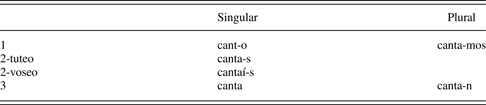
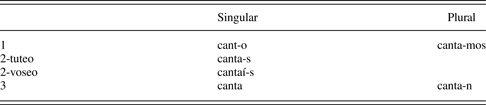
In terms of verbal morphology, Chilean Spanish has two 2sg forms of the verb that end in /-s/, both of which generally occur with the 2sg pronoun tú (‘you’).Footnote 2 The most common form is referred to as tuteo and is generally used among children and their parents. The second form is referred to as voseo and, although not as common in the speech of children and caregivers, has become increasingly common over the last few decades and has been associated with informal speech (Rivadeneira & Clua, Reference Rivadeneira and Clua2011).Footnote 3 In the Miller-Schmitt corpus that is used in the present study, we find interspeaker and intraspeaker variability in the use of the tuteo and voseo forms of the verb. The verbal paradigm is shown in Table 1.
Verbal paradigm in Chilean Spanish
The acquisition of plural morphology happens relatively early in languages such as English and Spanish where there is only one plural marker (but appears to take longer in languages with a more complex system; see Kauschke, Kurth, & Domahs, Reference Kauschke, Kurth and Domahs2011; Szagun, Reference Szagun2001, for acquisition of plural morphology in German, for example). Marrero and Aguirre (Reference Marrero, Aguirre, Montrul and Ordoñez2003) reported on two Madrileno Spanish-speaking children who started producing the plural marker by 1;09 years of age, and in my own work I've found systematic plural marking in Mexican children (from Mexico City) by 3 years of age, the youngest age I tested (Miller, Reference Miller2007). There is some work indicating that children exposed to s-lenition take longer to begin producing the plural marker (Marrero & Aguirre, Reference Marrero, Aguirre, Montrul and Ordoñez2003). However, it is unclear whether this is because children are omitting final /s/ variably or because they have not yet acquired plural morphology due the variability in the input, as has been argued by Miller (Reference Miller2007).
Verbal morphology is produced by Spanish-speaking children from the earliest ages examined (1;07–1;08) (Montrul, Reference Montrul2004); however, children produce very few tokens of the 2sg form of the verb at these early ages. It is difficult to know whether the absence of the 2sg verb form in early child Spanish indicates that children have not yet acquired it, as there are various other reasons—including the genre of the spontaneous speech that was collected—that may explain the low occurrence of this form. There is some evidence that by 3 years of age, Mexican Spanish-speaking children (from Mexico City) can associate the 2sg verb form –s to a 2sg subject in comprehension tasks (Miller & Schmitt, Reference Miller and Schmitt2013).
Because grammatical morphology is acquired at the same time that children are acquiring the factors constraining s-lenition, it is important to examine morphological function on /s/ omission. If /s/ is omitted more often when it is a plural marker than when it is lexical, this may indicate that plural morphology is still being acquired. The present study allows comparison to previous research on t/d deletion by Smith et al. (Reference Smith, Durham and Fortune2009) and Roberts (Reference Roberts1997) in that s-lenition, like t/d deletion, is a phonological process that also affects the morphology of the language (i.e., English t/d deletion may result in the omission of the English past tense marker).
I will address the following research questions in this paper:
1. How does s-lenition in CDS compare to that in adult-to-adult speech?
2. Do children use all variants (i.e., [s], [h], and zero) at the earliest stages of production, and if not, do they over-regularize to one of the variant forms?
3. How are the different constraints on s-lenition acquired throughout development?
DATA AND METHODOLOGY
Participants
Children and their caregivers were recorded in Punta Arenas, Chile (population approximately 120,000), which is a town located in the south of Chile on the Strait of Magellan. The data come from the Miller-Schmitt Corpus,Footnote 4 which contains approximately 260 hours of spontaneous speech between 52 Chilean children and their caregivers. The recordings were made in a small home that was converted into a lab space in a working-class neighborhood. Child-caregiver dyads visited the lab 5 to 9 times for about 45–60 minutes each time. Because transcription and coding efforts are still underway, for the present paper, I report the production of 10 working-class children and their caregivers. There are five boys—Nico (2;08), Jorge (3;06), Pablo (4;04), Diego (5;04), and Pedro (5;09)—and five girls—Sofía (2;04), Pilar (3;08), María (4;04), Maite (5;00), and Elena (5;04). Children were divided into two age groups for the multivariate analysis. The younger group comprises children ages 2;04–3;08 and the older group, children ages 4;04–5;09. Although this is a somewhat arbitrary division, it was made for two reasons. First, previous work by Smith et al. (Reference Smith, Durham and Fortune2009) examined children ages 2;10–3;06. This allows comparison of our younger children to those in their study. Second, this division allows us to maintain similarities in age span between the two age groups (younger group: 2;04–3;08; span of 16 months; older group: 4;04–5;09; span of 17 months) and a large break in age between the two age groups (3;08 to 4;04 shows an 8-month break in the ages between the two groups).
Data collection
Caregivers and children were invited to participate in the study and were compensated for their participation. The lab playroom contained several toys including puzzles, a toy train set, play dough, stamps, baby dolls, play food and kitchenette, craft activities (e.g., puppet making, beading necklaces, finger painting), children's books, and felt boards. In this way a variety of linguistic genres (e.g., giving instructions, reading books, puppet voices, play) could be obtained. Caregivers and children were left alone in the playroom during each recording session.
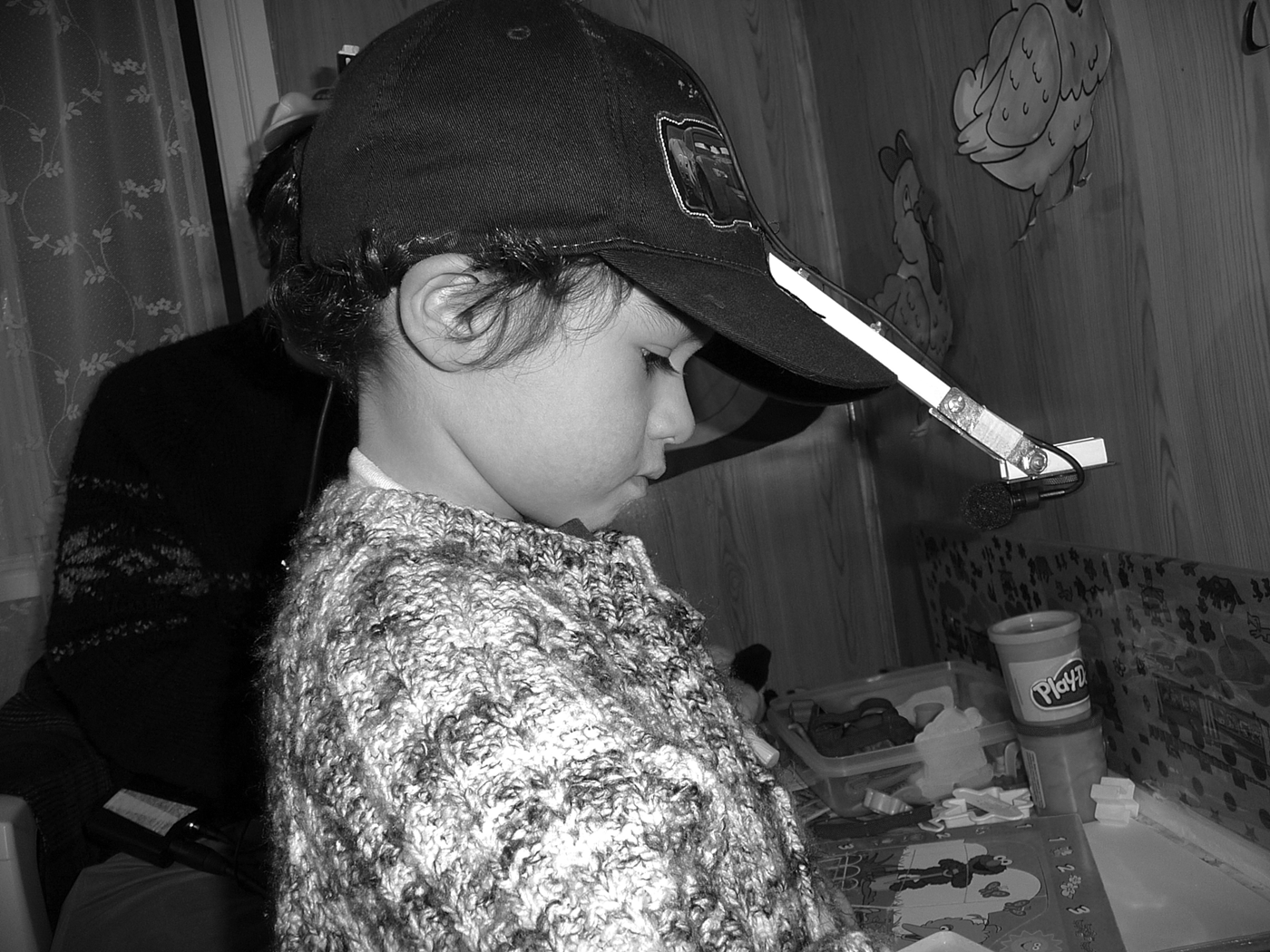
Distinguishing between [s], [h], and omissions can be difficult. For this reason, participants were recorded in a lab space setting and not in their homes so that ambient noise could be controlled. Background noise was reduced by turning off all electronic equipment in the lab space, with the exception of the video camera and audio recording device, and by using oil heaters that produced virtually no sound whatsoever (as opposed to the more standard gas heating system of southern Chile, which produces a hissing noise). Recordings were made with a Marantz PMD660 compact flash recorder (recorded at 48 kHz) that was connected to two AT831b cardioid lavalier condenser microphones that were each connected to a baseball cap—one for the parent and one for the child. This placed the microphone approximately 7 inches in front of the participant's mouth (Figure 1).
Microphone placement.

Although there are obvious disadvantages in terms of obtaining vernacular speech given our recording procedures, we believe that by locating our lab in a working-class neighborhood, recording our participants over a series of sessions, and also by leaving caregiver and child alone in the playroom during the recording sessions, we created a context in which parents would feel comfortable interacting with their children. The alternative method of recording participants in their homes or schools would have resulted in audio files that would have been difficult to code for aspiration and omissions.
Circumscribing the variable context
This study is based on two 1-hour recording sessions for each child–caregiver dyad, representing a total of approximately 20 hours of speech (approximately 128,000 words). The first 80–120 tokens of syllable-final /s/ was extracted for each child and the first 100–150 tokens for each caregiver. In total, there were 2898 tokens (1793 caregiver tokens; 1105 child tokens). Tokens that were excluded from the beginning include those that were followed by an alveolar fricative or a velar fricative, as is the case with las and cebras in (9a), tokens where the entire syllable was omitted (9b), pluralia tantum, which have final /s/ in other varieties of Spanish but not always in Chilean Spanish (e.g., la tijera ‘scissors’, el patalón ‘pants’), and the high-frequency interjection pues ‘well’, which generally is pronounced as [po] or [pu] by working-class speakers of Chilean Spanish (9c).
(9)
a. las cebras son parecidas a los caballos (María-1; line 104)
the-pl zebras-pl are.3pl similar-pl to the-pl horses-pl
‘zebras look like horses’
b. (es)pérate po (Maite-1, line 933)
wait-imp intj
‘well wait’
c. toma po (María-1, line 770)
take-impintj
‘well take it’
In keeping with previous studies on s-lenition in adult-to-adult speech, auditory inspection was used to code all tokens of syllable final /s/ as [s], [h], and omission [zero].Footnote 5 Two highly trained research assistants who were native speakers of Chilean Spanish coded the tokens. The first research assistant coded all tokens of syllable-final /s/ by ear over a period of about 1 year. Reliability was ensured by having the second research assistant code a subset (10%) of the tokens (20 participants × the first 15 tokens each = 300 tokens coded for reliability out of 2898 tokens total). In this second coding, the research assistant relied on both auditory and visual inspection of the waveform and spectrogram using Praat (Boersma & Weenink, Reference Boersma and Weenink2013) to code for [s], [h], and zero. Reliability on the 300 tokens reached 89% (267 of 300).
RESULTS
Overall distributions
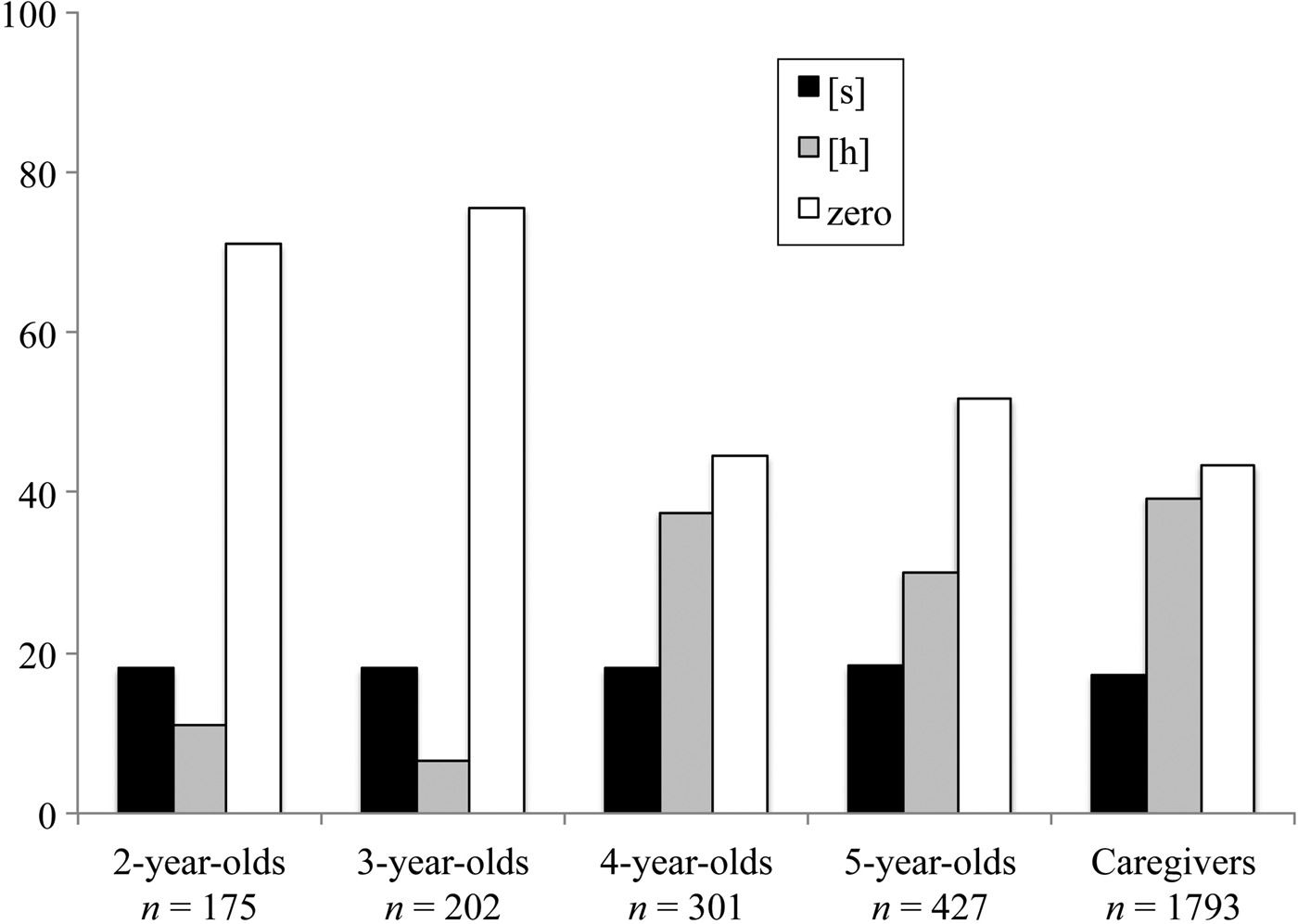
The overall distribution of [s], [h], and zero for the 10 children and their caregivers is shown in Figure 2. Of the 1793 /s/ tokens, caregivers produced 18% as [s], 39% as [h], and 43% as zero. Of the 1105 /s/ tokens produced by children, 24% were pronounced as [s], 25% as [h], and 51% as zero. The overall distribution in the caregiver speech is similar to what has been reported for Chilean adult-to-adult speech (see Cepeda, Reference Cepeda1995; Miller, Reference Miller2007). In addition, only the 4- and 5-year-old children, but not the 2- and 3-year-old children, pattern with adults in the distribution of the three forms. In particular, the 2- and 3-year-old children produce much less [h] and more zero than the 4- and 5-year-olds and the caregivers do.
Overall distribution of [s], [h], and zero in the 10 child–caregiver dyads.
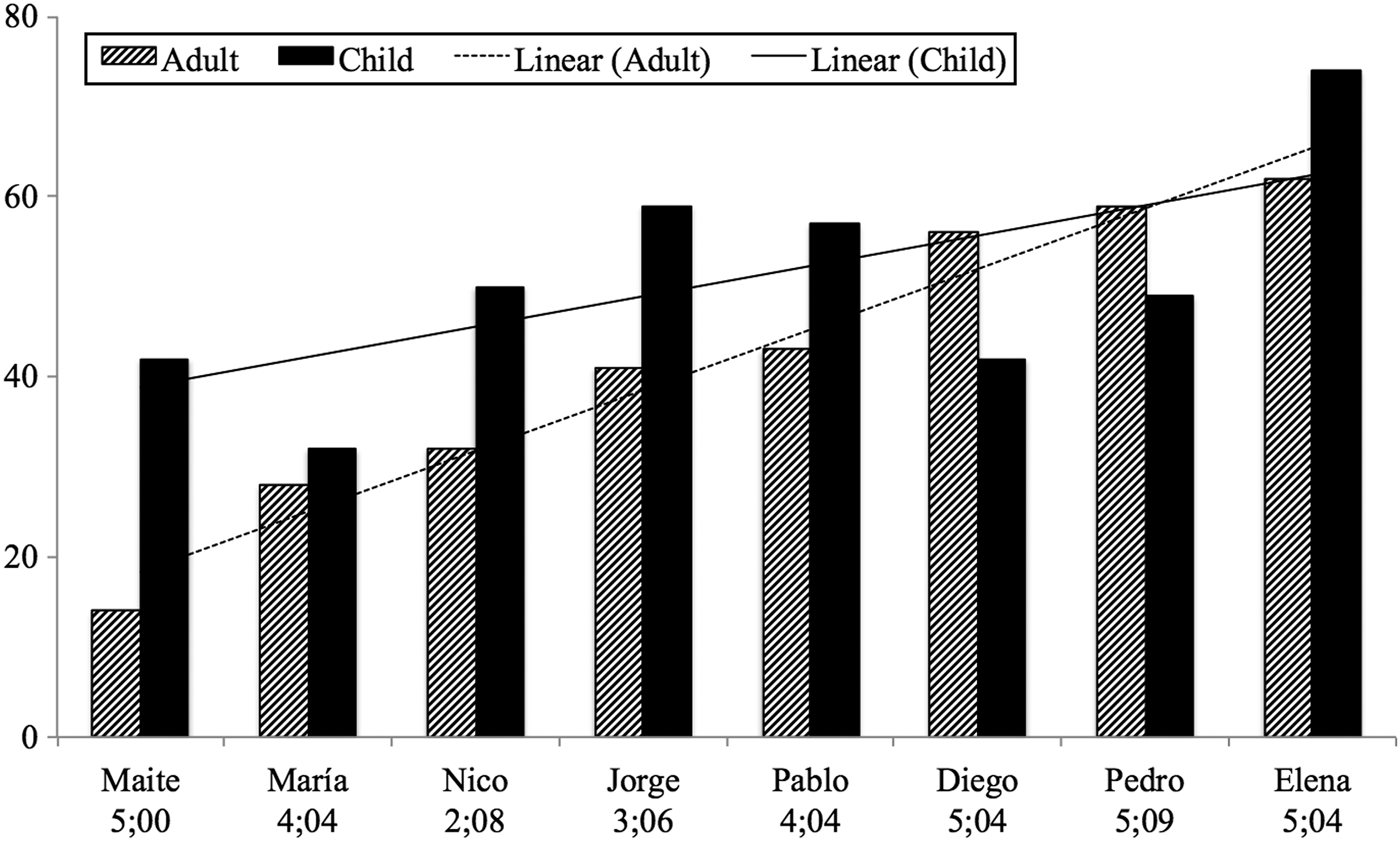
Following Smith et al. (Reference Smith, Durham and Fortune2009), individual child–caregiver pairs were examined to determine how closely individual children match their input. Figure 3 shows the percentage of omissions for individual child and caregiver pairs. Two children are not included in Figure 3 because they showed near-categorical omissions of final /s/. These children are Sofía (2;04) and Pilar (3;08), who both omit final /s/ 92% of the time while their caregivers only do so 41% (Sofía's caregiver) and 48% (Pilar's caregiver) of the time. The data in Figure 3 indicate that, for those 8 children who show variable production of s-lenition, omission rates are similar between children and caregivers.
Percentage of final /s/ omission for each child–caregiver pair (Sofía and Pilar not included).

Taking out Sofía and Pilar and looking just at the 8 children who show variable production, we find a correlation between omission rates in individual children and their caregivers that trends toward significance (r = .578, df = 7, p = .06). In other words, for all children except two—Sofía and Pilar—there is a match between the overall frequencies of omissions found in the input and in child speech.
Multivariate analysis
I used a comparative variationist methodology (Labov, Reference Labov1972; Tagliamonte, Reference Tagliamonte2012) to examine children and caregiver omissions of syllable final /s/, comparing patterns of /s/ omission in the following internal and external environments: following phonological segment, word position, morphological function, age of child speaking or being spoken to, sex of child speaking or being spoken to, and speech style as measured by situational context. Sofía and Pilar and their caregivers were not included in the multivariate analysis because these two children showed near-categorical rates of omissions. Nevertheless, they are included in the discussion of the overall distribution of /s/-lenition that follows.
Word position
A three-way distinction was made—word-medial position (e.g., listo ‘ready’, este ‘this’), word-final position (preconsonantal and prevocalic) (e.g., las arañas de Pedro ‘the spiders of Pedro’), and phrase-final position (prepausal) (e.g., Tiene perritos ‘He has dogs’). This coding is consistent with the generally accepted contexts of syllable-final Spanish /s/-lenition (see Brown & Torres Cacoullos, Reference Brown and Torres Cacoullos2002, and references therein).
Following phonological segment
Cepeda (Reference Cepeda1995) and our preliminary analyses revealed that in the contexts of a following [-continuant] consonant there were fewer omissions than in all other phonological contexts. As such, I divided data into two contexts: following [-continuant] consonant and other.
Morphological function
A three-way division was made—lexical (nonmorphological), plural marker, and the tuteo 2sg verbal affix.Footnote 6
Situational context
For comparative purposes, division of data into situational context was closely aligned to Smith et al. (Reference Smith, Durham and Fortune2007, Reference Smith, Durham and Fortune2009), who divided their data into the categories of play (e.g., playing with toys, hide and seek, make-believe), routine (e.g, getting dressed, going for a walk, tidying up, eating, general talk), teaching (e.g., learning colors, reading books), discipline (e.g., where the child is being rebuked for bad behavior), and intimacy (e.g., when the child is being cuddled). Because our recordings were made in a lab playroom and not in the child's home, there were no tokens for the ‘routine’ category. Instead, data were divided into play (e.g., playing with toys, playing board games, casual conversation about daily school- and home-life activities), teaching (e.g., reading, singing, learning numbers and colors, giving instructions when making crafts), discipline (e.g., where the child is being warned to be careful or not to misbehave), and intimacy (e.g., when the child is being cuddled or when the caregiver and/or child are cuddling or talking affectionately to the stuffed animals or baby dolls in the lab playroom). There were fewer overall tokens for discipline and intimacy. For that reason, in the multivariate analysis, tokens of discipline were excluded and tokens of intimacy were combined with tokens of play because preliminary analyses showed similar rates of omissions in these two categories.
Sex of child
Similar to Smith et al. (Reference Smith, Durham and Fortune2007, Reference Smith, Durham and Fortune2009), data were divided into sex of the child speaking or being spoken to in order to determine whether caregivers change their production of /s/ when speaking with boys versus girls.
Age of the child
Children were divided into two age groups. The younger group included 2- and 3-year-old children (i.e., Jorge and Nico). The older group included 4- and 5-year-old children (i.e., Pablo, María, Maite, Elena, Diego, Pedro).
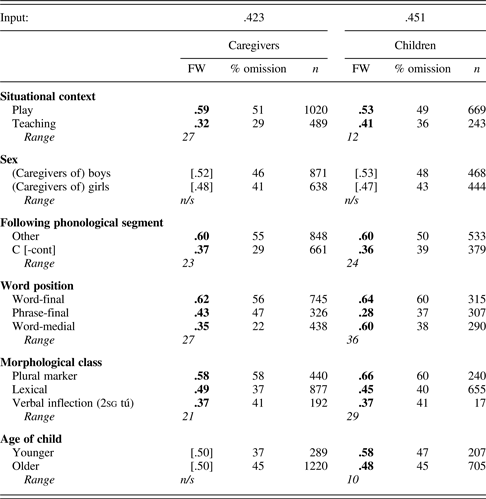
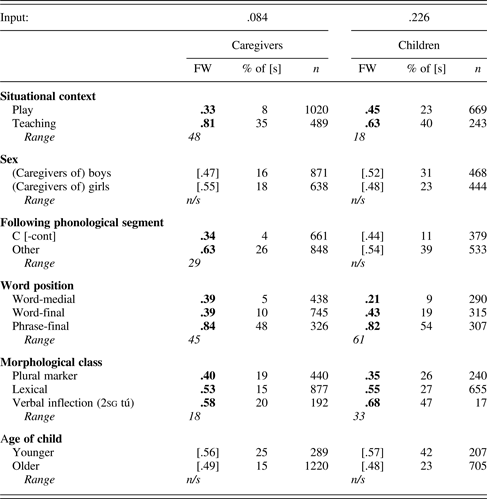
Table 2 shows the results of the multivariate analysis for omission of final /s/.Footnote 7 After additional exclusions were made (i.e., removing Sofía's and Pilar's data, tokens of the voseo, and the situational context of discipline), there were 912 child tokens and 1509 adult tokens entered into the multivariate analysis. The factors that contributed significantly toward the omission of final /s/ are listed in bold—nonsignificant factors are in brackets. In Table 2, the input (caregivers: .423; children: .451) refers to the overall likelihood for the occurrence of omissions. In the first column labeled factor weight (FW), the number represents the probability that the corresponding factor contributes to the occurrence of an omission. The closer the number is to 0, the less likely it is that an omission will occur. Numbers closer to 1 indicate more likelihood for omissions. The range typically indicates the relative strength of the factor group to the analysis; however, caution must be taken in the interpretation of the range if one of the factors within a factor group has a very small number of tokens and shows a near-categorical effect. In such cases, the range of this factor group might be greater than that of another factor group even when the other factor group actually has more effect on the variation (Tagliamonte, Reference Tagliamonte, Bayley and Lucas2007). The second column in Table 2 shows the percentage of omissions for each factor, and the third column indicates the total number of tokens for each factor. A common problem with multivariate analyses is the potential of intercorrelations between the predictor variables, a phenomenon known as collinearity. Appendix B reports collinearity measures for the variables analyzed in the present study and—as can be seen—collinearity is not a major issue in the present study.
Variable-rule analysis of /s/ omission in eight caregivers and their children (Sofía and Pilar not included)
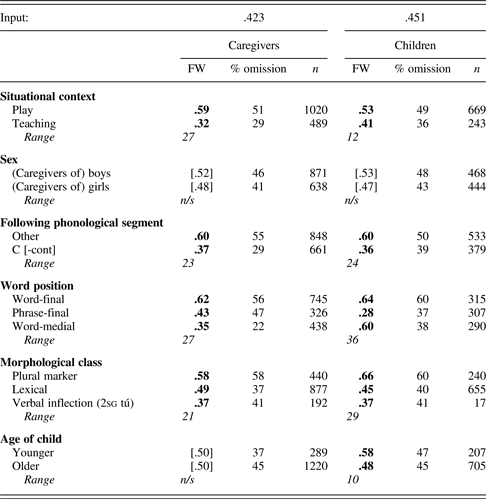
Note: Bold values are statistically significant. n/s = not significant.
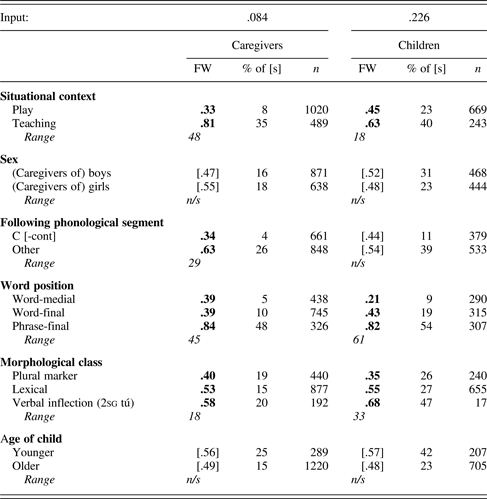
The results in Table 2 indicate that for adults situational context, following phonological segment, word position, and morphological class are significant predictors of omission of final /s/. These same factors are also significant predictors of retention of the full [s] variant, as shown in Appendix A. Notice that in Appendix A, the full variant [s] is strongly favored in contexts of teaching (FW = .81) and in phrase final position (FW = .84) in adult speech. For children, the same four factor groups were found to be significant predictors of /s/ omission. In addition, age was significant in children, indicating that younger children omit /s/ more than older children do. In what follows, I will focus on the factor weights, which indicate the direction of the effect.
Internal constraints
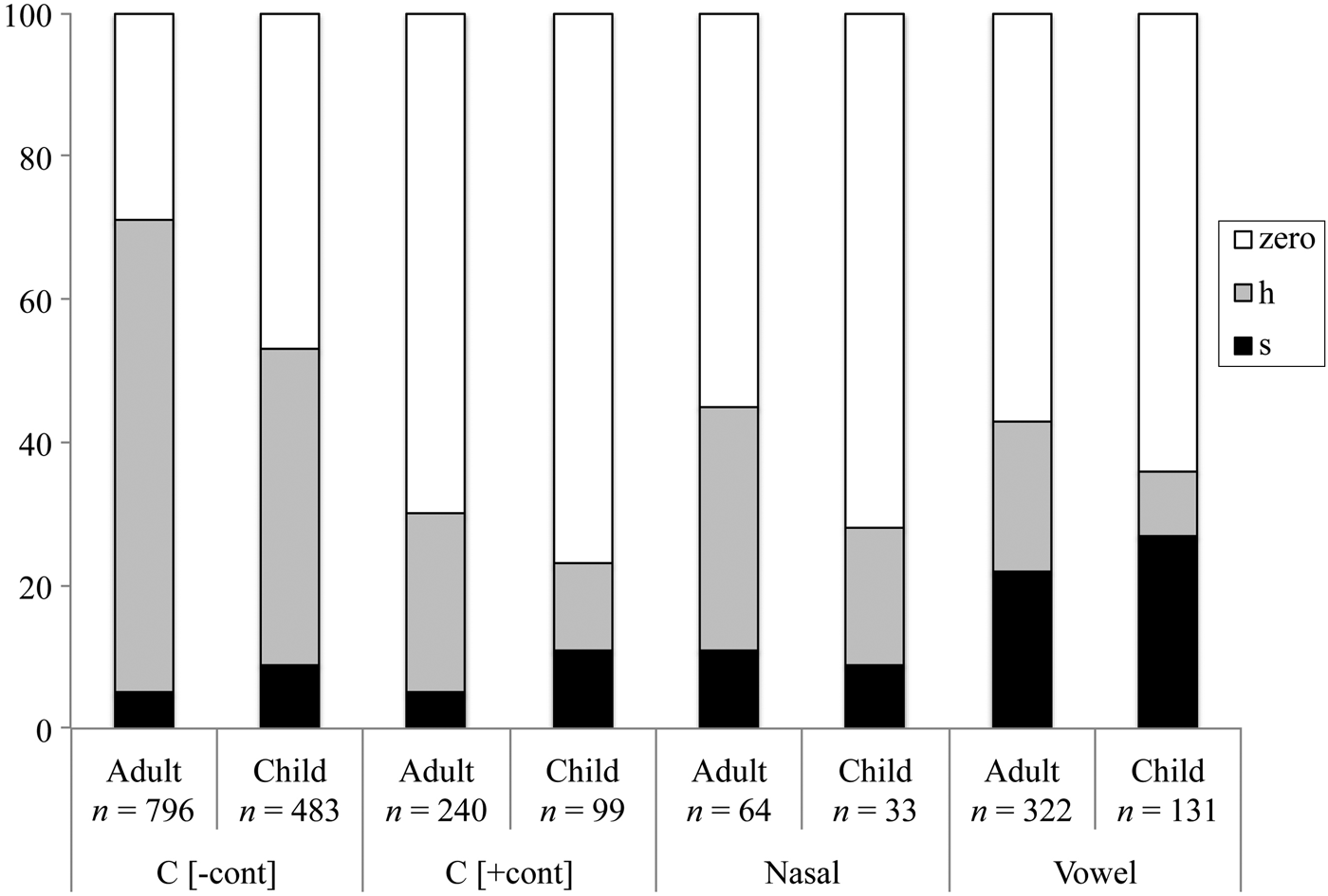
The multivariate analysis shows that variability in the omission of final /s/ is phonologically conditioned the same way among children as it is among caregivers. For children and adults, /s/ is less likely to be omitted before a [-continuant] consonant than before any other phonological context ([+continuant] consonant, nasal, and vowel), as illustrated in Figure 4.
Percentage of /s/-lenition by following phonological segment in the 10 child–caregiver dyads.

Cepeda (Reference Cepeda1995) reported similar rates of omissions across phonological contexts in Chilean adult-to-adult speech. These findings indicate that across these phonological contexts, s-lenition in CDS and children's speech is similar to that found in adult-to-adult speech.
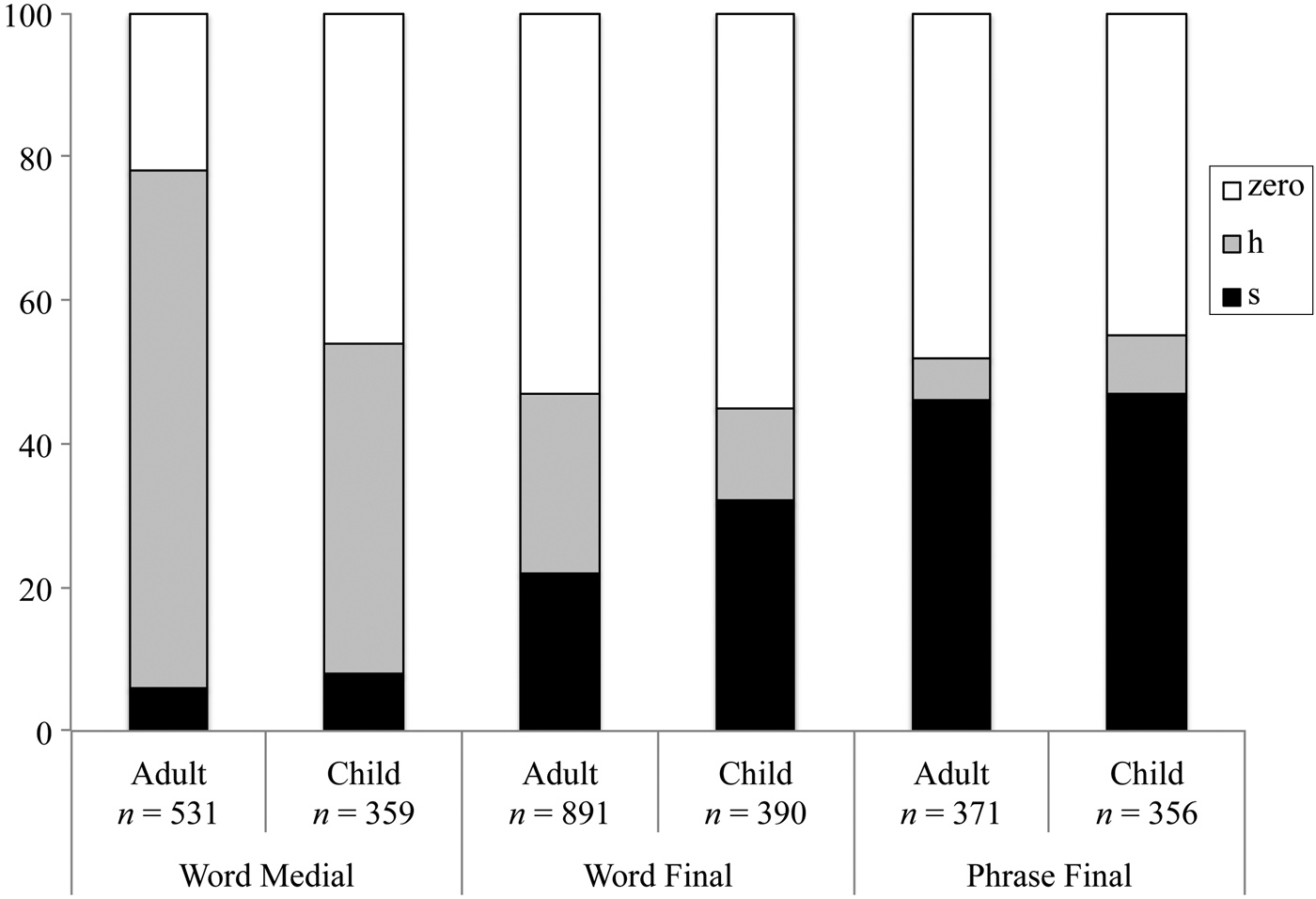
Word position also played a role in both children's and caregivers’ production. Aspiration was more frequently produced word-medially, whereas omissions were more frequent in word-final position (prevocalic and preconsonantal). As predicted earlier in the paper, both the full form [s] and omissions were favored in phrase-final position (see Table 7 in Appendix A and Table 2). The main difference between children and adults is that children show more omissions in word-medial position (see Figure 5).
Percentage of /s/-lenition by word position in the 10 child–caregiver dyads.

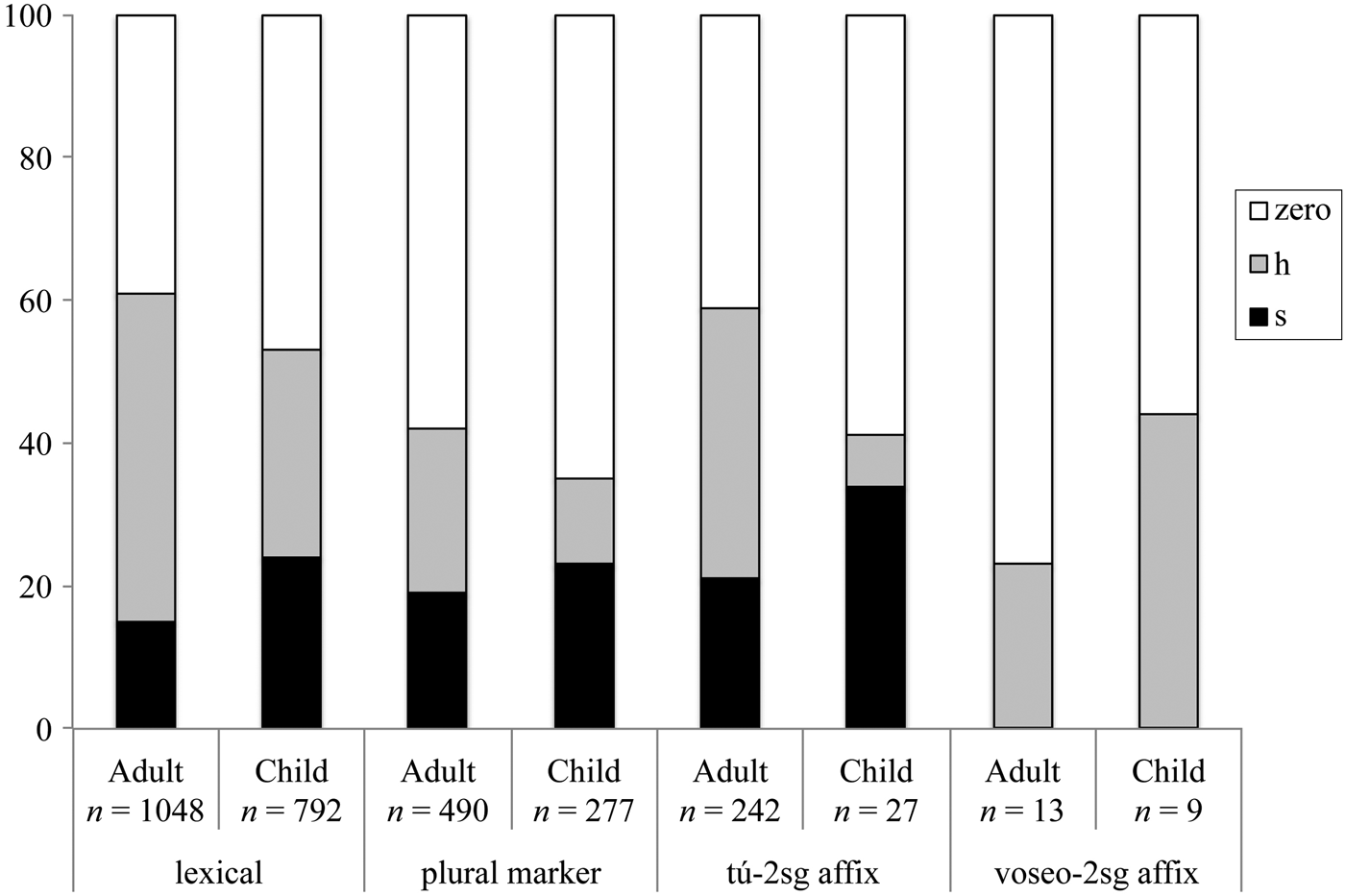
With respect to morphological function, omissions were more frequent on the voseo-2sg form of the verb (e.g., cantaís ‘sing-2sg’) than on the tú-2sg form of the verb (e.g., cantas ‘sing-2sg’) in adult speech, as shown in Figure 6. This may support a functional explanation because when the tú-2sg affix is deleted, the 2sg verb form becomes identical to the third-person singular (3sg) verb form (e.g., canta ‘sing-3sg’), whereas the voseo-2sg form is different regardless of omission of final /s/ (e.g., cantaís or cantaí). The multivariate analysis—which did not include the voseo-2sg form of the verb—found that the plural marker favored omissions, whereas the tú-2sg verb form disfavored omissions in both children and adults. The higher omission rate for the nominal plural marker may be attributed to number agreement in the noun phrase. Even if speakers omit the plural marker on one of the elements in the noun phrase, they can still mark number on another element.
Percentage of /s/-lenition by morphological function in the 10 child–caregiver dyads.

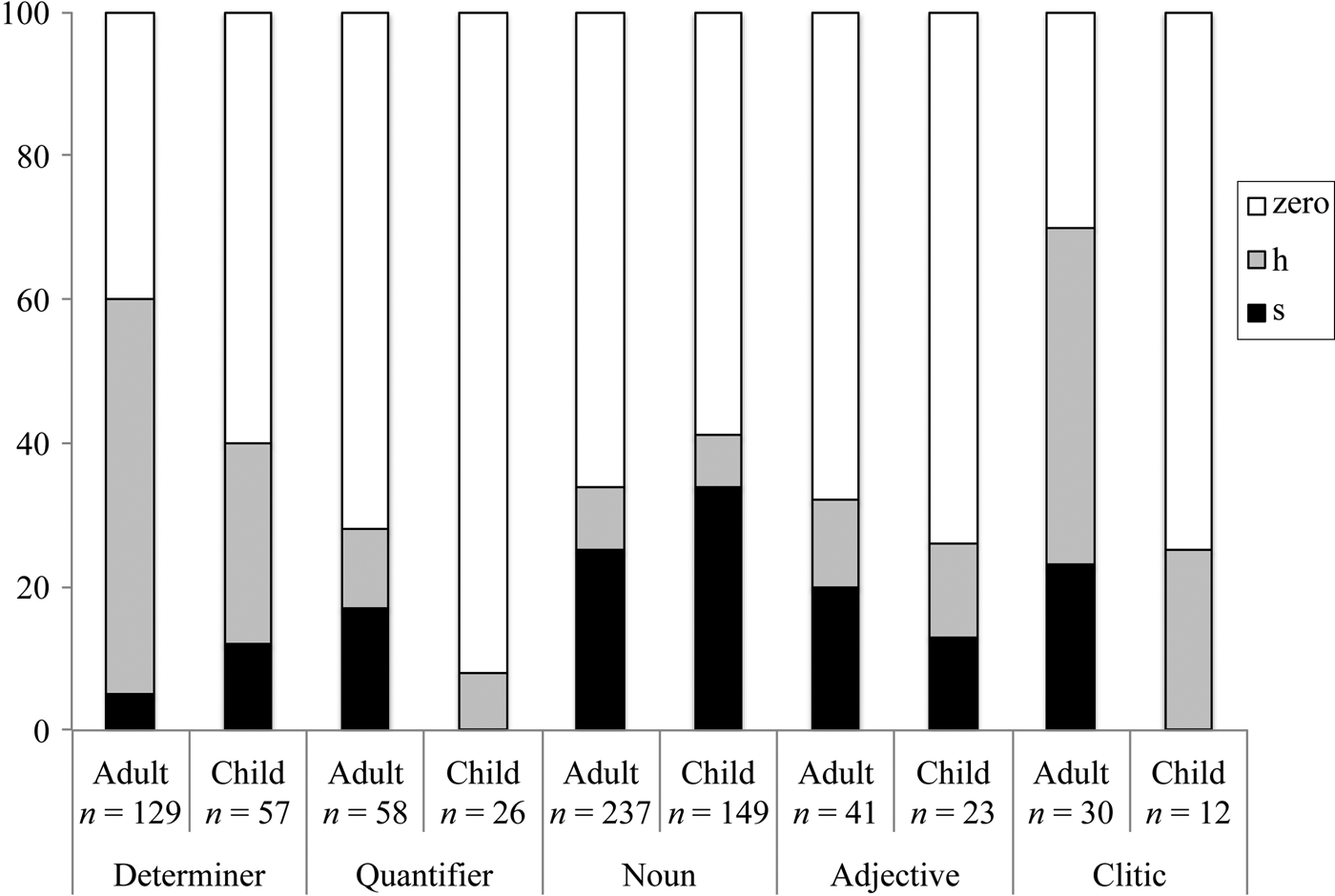
To address whether certain elements in the noun phrase showed more omissions than others, I divided the plural marker data into five categories: determiner, quantifier, noun, adjective, and clitic. The results are shown in Figure 7 and indicate that in caregiver speech omissions of the plural marker are lower on determiners (occurring only 29% of the time) than on nouns (66%). The highest level of omissions in caregiver speech was on quantifiers (70%). Children show a different distribution for determiners, with a much higher omission rate of 58%. Children's rate of omissions on nouns (60%) is similar to caregivers' omission rates. Moreover, like their caregivers, children also show a very high omission rate of the plural marker on quantifiers (91%). This may be evidence in favor of a functional account because the quantifier indicates more-than-one even when the plural marker is omitted (e.g., todos los días → todo lo día ‘all-pl the-pl day-pl’).
Percentage of /s/-lenition by noun phrase category in the 10 child–caregiver dyads.

It was predicted earlier in the paper that if children are still acquiring plural morphology, they may omit final /s/ more often when it is a plural marker than when it is nonmorphological. However, the data show that this is exactly what caregivers do; so, an increase in omissions in plural morphology does not necessarily mean that children have not yet acquired the plural marker. Instead, they may just be following adult patterns. A closer look at the production of the plural marker across age groups in the eight children showing variable production shows that the full form [-s] is retained at higher levels in the 2- and 3-year-old children (71% of the plural markers were produced as [-s] for Nico, the youngest child) than in the 4- and 5-year-old children (38% for Pedro, the oldest child).Footnote 8 This developmental pattern appears stronger for morphological [-s] than for nonmorphological [s], which shows a change from 40% for Nico (youngest child) to 27% of the full [s] variant for Pedro (oldest child). As such, this provides some evidence that omissions of the plural marker in children's production are related to the phonological process of s-lenition and not to acquisition of the plural morphology. Nevertheless, more investigation is needed as there may be confounding factors—for example, morphological /-s/ occurs phrase finally more often (where retention is favored) than nonmorphological /s/. And, younger children produce shorter sentences which may result in more phrase-final positions.
External constraints
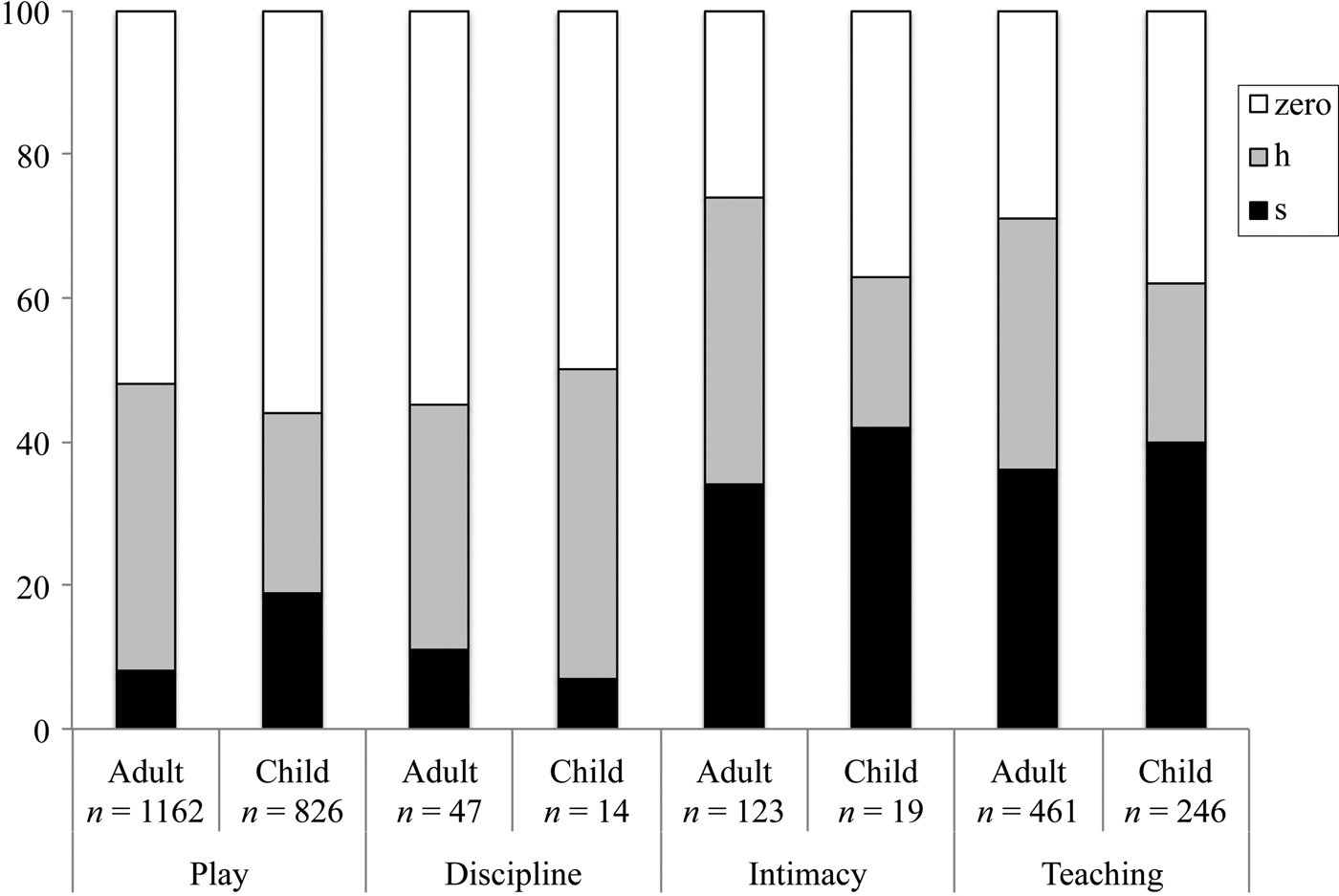
Both age-of-child and situational context contributed significantly toward the omission of final /s/ in child speech, whereas only situational context was significant for predicting /s/ omission in caregiver speech. Table 2 indicates that contexts of teaching disfavor omissions in both child and caregiver speech, and Table 7 of Appendix A illustrates that teaching contexts strongly favor the full form [-s]. In contrast, contexts of discipline (shown in Figure 8) and contexts of play favor omissions. Similar findings for contexts of teaching and play have been reported in Smith et al. (Reference Smith, Durham and Fortune2007, Reference Smith, Durham and Fortune2009); however, contrary to this previous work, caregivers in the present study omit /s/ more often (i.e., produce the less formal variant) in contexts of discipline (see Figure 8). It is possible that Chilean caregivers are increasing their speech rate when disciplining their children and this may lead to higher levels of omissions. In addition, previous studies indicate that caregivers use more local variants in contexts of intimacy (Labov, Reference Labov and Shuy1964; Smith et al., Reference Smith, Durham and Fortune2007, Reference Smith, Durham and Fortune2009), but this is not found in the present study (Figure 8). In the present case, intimacy contexts often involved the use of a motherese register, which generally involves slower speech rate—this may account for the increase of the [s] variant. The caregivers of the younger children used motherese more often and a few children even used motherese themselves when talking to or about the baby dolls in the lab space. These cases of motherese resulted in a much lower proportion of omissions in the situational context of intimacy.
Percentage of /s/-lenition by situational context in the 10 child–caregiver dyads.

Finally, the multivariate analysis on /s/ omissions revealed that sex of the child was not a significant predictor in child speech nor in adult speech to their children. This is true for Spanish s-lenition, but it may not be true for all variable forms, as past studies on other forms have found that caregivers of girls show lower rates of the local variant in CDS when compared with caregivers of boys (Foulkes et al., Reference Foulkes, Docherty and Watt2005). The data from the present study indicate that not only is CDS not different to boys and girls with respect to s-lenition, but boys and girls at 5 years of age have not yet begun to change their use of s-lenition in relation to their sex.
Individual lexical items
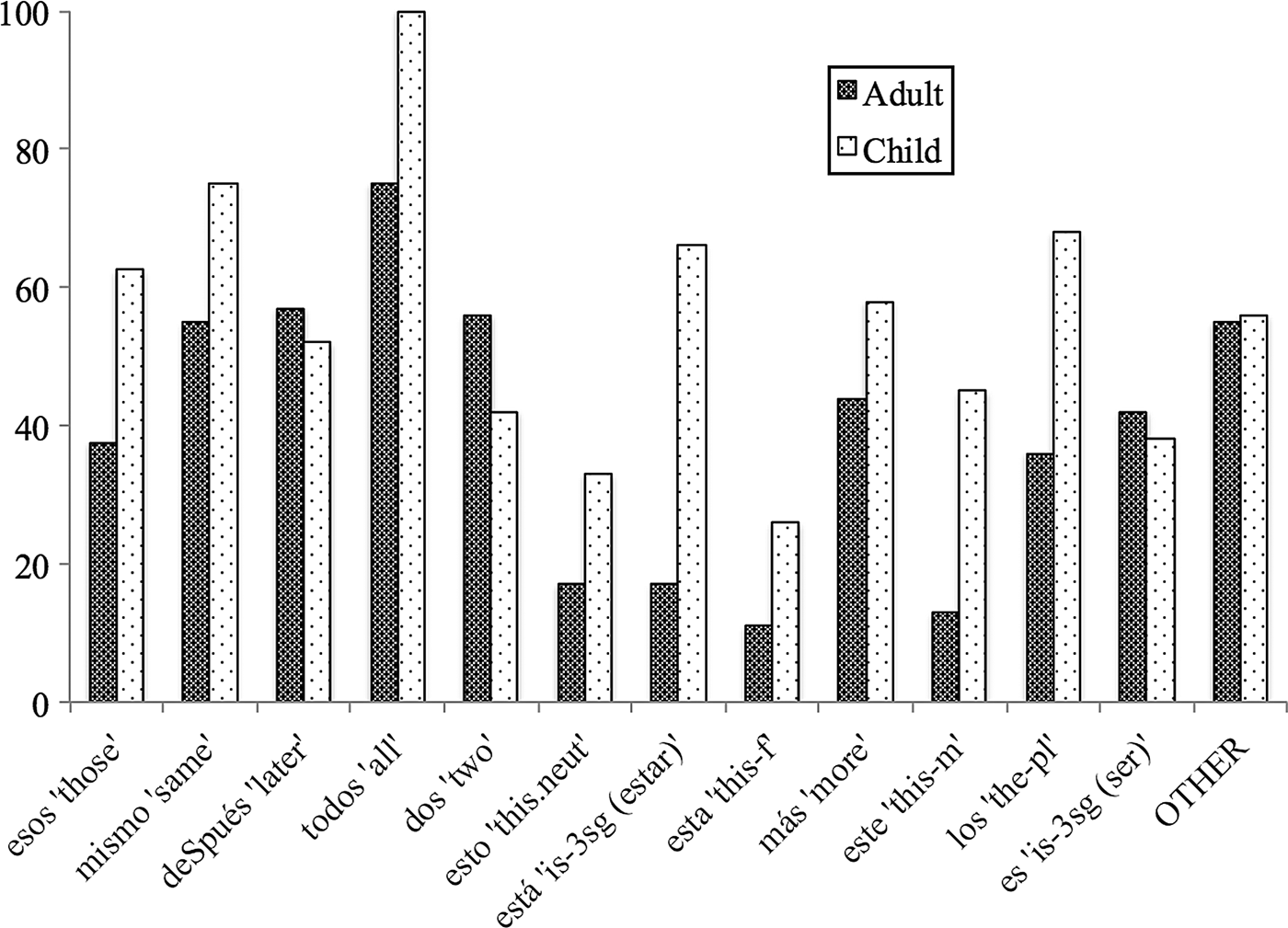
One final analysis that merits attention is lexical frequency. File-Muriel (Reference File-Muriel2009, Reference File-Muriel and Brown2010) showed that speakers tend to weaken /s/ in high-frequency words. To examine this in caregiver and child speech, I followed procedures similar to those used in Smith et al. (Reference Smith, Durham and Fortune2009). Data were divided into frequently occurring lexical items (those words that appear more than eight times in the data), and those words that are less frequent (labeled as the “other” category) to examine whether lexical frequency correlates with omission. The x-axis in Figure 9 shows from left to right the least frequent to most frequent words with syllable-final /s/ in the caregiver speech, running from 8 tokens of esos (‘those’) to 207 tokens of es (‘be-3sg’) for caregivers. The category labeled ‘other’ indicates all other words (i.e., the least frequent words in the corpus). The results show two things. First, similar to Smith et al. (Reference Smith, Durham and Fortune2009), there is little evidence that the most frequent tokens in the corpus show higher omission rates of /s/. However, overall children tend to pattern with their caregivers in the proportion of omissions for each word. This correlation is significant (r = .608, df =13, p = .03).
Percentage of omissions by lexical frequency in the 10 child–caregiver dyads.

DISCUSSION
The goal of this paper was to examine the use of s-lenition in the speech of children and their caregivers. Three questions were posed at the beginning of this paper and, in what follows, I will address each of them in turn.
How does s-lenition in CDS compare to that in ADS?
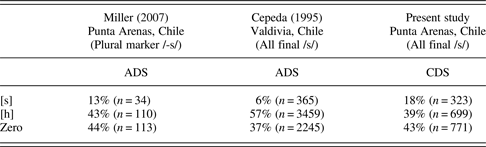
The analysis revealed that the overall distribution of the three variants across the different linguistic and extralinguistic contexts in CDS was similar to that found in previous studies on Chilean adult-to-adult speech (Cepeda, Reference Cepeda1995; Miller, Reference Miller2007). Table 3 compares usage in the present study on CDS to two previous studies on Chilean ADS. The data from the present study most closely aligns with the ADS data in Miller (Reference Miller2007), which comes from the same local area and is more recent. The data from Cepeda (Reference Cepeda1995) was collected two decades ago and was from a different region of Chile. As such, the lower omission rates and less frequent use of the full form [s] in Cepeda (Reference Cepeda1995) may be due to these differences. The data also show that the factors constraining s-lenition in Chilean ADS are similar to those found for Chilean CDS and the direction of the ordering of factors within each group (i.e., the constraint hierarchy) was the same. In particular, in Cepeda (Reference Cepeda1995), Miller (Reference Miller2007), and in the present study, omissions were favored more in casual speech (e.g., play) than in formal speech (e.g., teaching), contexts of following [-continuant] consonants disfavored omissions, word-medial position disfavored omissions, and phrase-final position favored the full form [s] and omissions, and plural morphology favored omissions while the 2sg verbal inflection did not. Although the data are not completely comparable because of differences in data collection and data analysis, the similarities suggest that Chilean speakers may not be consciously aware of their use of s-lenition across the different linguistic contexts and, as such, they do not modify their usage when speaking to children (see Smith et al., Reference Smith, Durham and Fortune2009, for similar findings).
Overall distribution of s-lenition in three studies (present study includes all 10 caregivers)
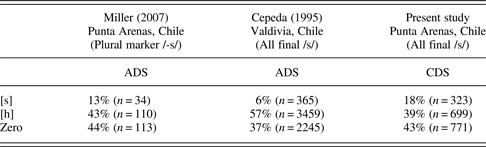
Note: Adapted from Miller (Reference Miller2007) and Cepeda (Reference Cepeda1995).
Nevertheless, in contexts of intimacy and teaching there is a striking increase in the use of the full form [s]. Because this is also the case for more formal contexts in ADS, the increase in [s] can be attributed to the slower speech rate that is typical of motherese (Fernald & Kuhl, Reference Fernald and Kuhl1987; Fernald & Simon, Reference Fernald and Simon1984; Garnica, Reference Garnica, Snow and Ferguson1977; Snow & Fergusun, Reference Snow and Ferguson1977; Stern, Spieker, & MacKain, Reference Stern, Spieker and MacKain1983).
Do children use all variants (i.e., [s], [h], and zero) at the earliest stages of production, and if not, do children over-regularize to one of the variant forms?
The findings for the youngest child group indicate that at 2 and 3 years of age, some Chilean children are already showing variable usage of s-lenition (Nico and Jorge), while other children show omission rates at near-categorical levels. In other words, these latter children—Sofía and Pilar—do not match the probability of omissions found in their input.Footnote 9 However, even in the eight children who show variable production of the three variants, there appears to be more use of the full variant [s] than is found in caregiver speech. A similar finding was reported in Miller (Reference Miller2007) for both middle-class and working-class 4- to 5-year old Chilean children's production of the plural marker [-s].Footnote 10Table 4 shows the findings of both studies. The data in Table 4—along with the near-categorical omission rates in two of the youngest children—suggests that children initially over-regularize to zero, producing near-categorical levels of omissions and—once they acquire the variable production of s-lenition—they start out producing more tokens of the full form [s] (along with omissions) and fewer tokens of aspiration.
Distribution of s-lenition in the present study (all 10 child–caregiver dyads) and Miller (Reference Miller2007)

Note: MC = middle class; WC = working class.
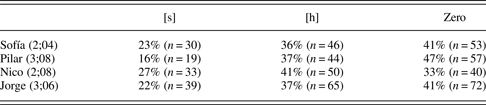
One important question is why—of the four youngest children—two appear to have acquired s-lenition while the other two have not yet acquired it. One way to address this question is to examine the input (caregivers’ speech) to these four children to see whether there are differences that might explain the difference found in their acquisition patterns. The data show that the overall use of s-lenition in the input is not different for the four children. In fact, Jorge's caregiver and Sofía's caregiver use an almost identical proportion of [s], [h], and zero, as illustrated in Table 5.
Overall distribution of s-lenition in caregivers’ speech (2- and 3-year-olds)
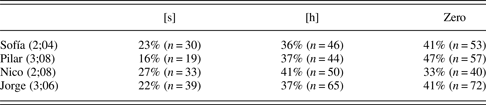
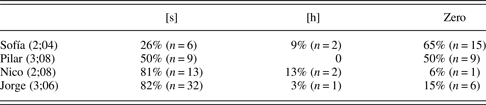
The analysis also found no differences between the four caregivers in their use of s-lenition in the different situational contexts, phonological contexts, or morphological contexts examined in this paper. Instead, the main difference in the input to these four children is related to the rate of omissions in phrase-final position (i.e., utterance-final position). In particular, the data show that in phrase-final position, final /s/ is omitted roughly half of the time in the input to Sofía and Pilar, whereas it is rarely omitted in this position in the input to Jorge and Nico. When /s/ is not omitted in phrase-final position, it is typically produced as the full form [s]. The multivariate analysis in Table 7 of Appendix A, which does not include Sofía's and Pilar's mothers, indicates that phrase-final position is a strong predictor of [s] retention (FW = .84). Table 6 shows s-lenition in phrase-final position for the caregivers of the four youngest children.
Distribution of s-lenition in phrase final position in caregivers’ speech (2- and 3-year-olds)
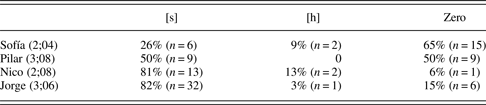
Is it possible that the higher rate of [s] in phrase-final position in the CDSFootnote 11 to Nico and Jorge provided the input necessary to allow them to acquire s-lenition more quickly? In other words, did their input involving a higher percentage of [s] in utterance-final position allow them to move beyond omissions and acquire the use of [s] and [h]? We cannot know this for sure because there are various other possible differences in the input that children received outside the recording sessions in the lab. Nevertheless, there is some evidence in support of this interpretation of the data. Several studies have highlighted the special status of phrase-final (or utterance-final) position in language acquisition. According to Shady and Gerken (Reference Shady and Gerken1999), elements in utterance-final position are prosodically highlighted and this can facilitate children's acquisition of language. This is supported by recent research indicating that utterance-final position influences perception. Sounds are perceived more clearly utterance-finally than utterance-medially (Theodore, Demuth, & Shattuck-Hufnagel, Reference Theodore, Demuth and Shattuck-Hufnagel2012) and, perhaps even more important, is that production studies with children have demonstrated that speed of acquisition in children is affected by how frequently an item occurs in the utterance-final position (Naigles & Hoff-Ginsberg, Reference Naigles and Hoff-Ginsberg1998; Slobin, Reference Slobin, Fergusun and Slobin1973; Verlinden & Gillis, Reference Verlinden and Gillis1988). With respect to grammatical morphology, Slobin (Reference Slobin, Fergusun and Slobin1973) predicted that children will acquire grammatical inflection more rapidly when it occurs word-finally (i.e., as a suffix rather than a prefix), because it will occur in utterance-final position more often (see Slobin, Reference Slobin, Fergusun and Slobin1973, and references therein). Moreover, studies have indicated that, in the speech of children, plural marking and verbal morphology are more frequently produced in utterance-final position than in utterance-medial position (Song, Sundara, & Demuth, Reference Song, Sundara and Demuth2009; Theodore et al., Reference Theodore, Demuth and Shattuck-Hufnagel2012). Although the dataset is small in the present study and should be interpreted with caution, the findings here suggest that /s/ production in utterance-final position in CDS may be key to the acquisition of s-lenition in young Chilean children. If the input contains high rates of the full form [s] in phrase-final position, children will show variable production of s-lenition by at least 2;08 years of age.
How are the different constraints on s-lenition acquired throughout development?
I addressed this question by carrying out a multivariate analysis in order to compare the strength of each factor group in child and caregiver speech and the ordering of factors within each group by their factor weights (or probability). A difference in patterning between two languages—in the present case, child language and adult language—could be instantiated as a difference in constraint hierarchy—that is, in the direction in the ordering of factors within each group.
The multivariate analysis indicates that variability in s-lenition is conditioned in a similar way among children as it is in their caregivers. Both speaker groups show significant effects for phonological context, morphological function, word position, and situational context, and the factors within each of these groups have similar orderings. However, there were differences between children and their caregivers, which might provide insight as to the acquisition of variable rules. One difference was related to word position—children produced many more omissions word-medially than adults did (see Table 2 and Figure 5). Another difference between children and adults is related to situational context, which seems to be stronger in adults than in children, and in children it seems to be not as strong as the other factor groups. As such, there is some indication that children acquire the factors of phonological context and morphological function earlier than the extralinguistic factor of situational context, which may be indicative of a universal ordering to the acquisition of variable rules, as first suggested by Labov (Reference Labov1989).
CONCLUSIONS
In summary, this paper has documented the use of syllable-final /s/-lenition in the naturalistic speech of Chilean Spanish-speaking children and their caregivers. This study reveals that s-lenition in CDS shows similar patterns as s-lenition in ADS. The analysis also shows that 4- and 5-year-old children pattern with their caregivers in their use of s-lenition; although some of the adultlike constraints on usage are still being acquired and the overall distribution of the variants [s], [h], and zero are not yet completely adultlike. The results for the youngest children are mixed; two of the 2- and 3-year-old children are variable in their production, whereas the other two children show near-categorical use of omissions, indicating that they have not yet acquired s-lenition. I propose that this latter finding may be related to the use of s-lenition in phrase-final position. Young children who are exposed to an input with higher rates of the full form [s] in phrase-final position acquire s-lenition earlier and show variable usage by (at least) 2;08 years of age.
APPENDIX A: RETENTION OF [S]
Variable-rule analysis of [s] retention in eight caregivers and their children (Sofía and Pilar not included)
APPENDIX B: CORRELATIONS BETWEEN FACTORS
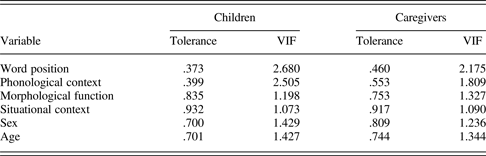
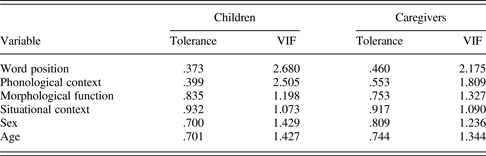
Table 8 shows the variance inflation factors (VIFs) and the tolerance values for every predictor variable that was entered into the multivariate analysis (i.e., the logistic regression). VIFs measure the strength of inter-relationships among predictor variables in a multivariate analysis. VIFs exceeding a value of 10 are commonly considered to indicate multicollinearity, but even values above 2.5 may indicate a minor collinearity issue (Szmrecsanyi, Reference Szmrecsanyi2005). The tolerance value indicates the percentage of variance in the predictor variable that cannot be accounted for by the other predictors; as such, very small values indicate that a predictor is redundant. Values that are less than .10 may merit further investigation (the VIF value = 1/tolerance value). As can be seen in Table 8, there is only a minor collinearity issue in the child data between word position and phonological context.
Multicollinearity statistics for multivariate analysis of /s/ omission