

1. Introduction
Migration of skilled labor from the developing to the advanced countries has been the subject of extensive research over the last four decades. Efforts to measure these flows, including the works of Docquier and Marfouk (Reference Docquier, Marfouk, Ozden and Schiff2006), Artuc et al. (Reference Artuc, Docquier, Ozden and Parsons2015), and Arslan et al. (Reference Arslan, Dumont, Kone, Moullan, Ozden, Parsons and Xenogiani2015), indicate that skilled emigration, as a proportion of the economy's skilled population, is particularly large in the case of relatively poor and small developing countries. Island economies, as well as countries in Central America, sub-Saharan Africa, and South-East Asia, exhibit the highest skilled-emigration rates.Footnote 1 Availability of new migration data has triggered renewed interest in assessing the costs and benefits that these migration flows generate for developing countries.Footnote 2 At the same time, however, policy implications of the brain drain have been understudied.
This paper investigates the effect of skilled emigration on the optimal education policy of developing countries. Given that the cost of education and training represents a disproportionate financial burden for such economies [Lucas (Reference Lucas2005)], the exodus of skilled workers can be expected to induce education-policy responses. In a number of studies, it has been argued that skilled migration reduces the optimal level of public education [see Justman and Thisse (Reference Justman and Thisse1997), Stark and Wang (Reference Stark and Wang2002), Docquier et al. (Reference Docquier, Faye and Pestieau2008), Poutvaara (Reference Poutvaara2008)]. This argument is based on the notion that skill-biased emigration prospects increase the expected benefits of education and decrease the gap between the social and private returns to education.
Our paper revisits this issue by hypothesizing that the production of human capital results from a combination of two complementary inputs, namely students' efforts to accumulate human capital and the provision of public education. In our framework, the quality of education is determined by the amount of public expenditures per student [as in Fernandez and Rogerson (Reference Fernandez and Rogerson1998)], which affects both the quantity and the productivity of educational inputs. This includes teachers' quality, which is commonly perceived as a key determinant of education outcomes [e.g., Tamura (Reference Tamura2001); Hanushek (Reference Hanushek2013)]. Hence, in the context of our model, an increase in public education expenditures raises the marginal return to schooling and increases student effort (or enrolment in education). This is in line with Oketch and Somerset (Reference Oketch and Somerset2010), who show that the higher provision of public education in Kenya in 2003 increased enrolment rates in many schools, or with Blankenau and Camera (Reference Blankenau and Camera2009), who study the complementarity between public education quality and students' efforts to acquire productive skills.
Highlighting this complementarity is particularly relevant when considering the problem of investment in education in poor developing countries, where credit markets for the purpose of funding private education are underdeveloped and, as noted by the World Bank (2000, p. 54), higher education systems are heavily dominated by public universities with the costs falling predominantly on the state.Footnote 3 Hence an important distinction between our framework of analysis and that of earlier studies is with respect to the conditions under which a potential migrant accumulates human capital. Previous contributions address the problem under the assumption that education is privately funded, with agents having access to credit markets [as in Mountford (Reference Mountford1997), Docquier et al. (Reference Docquier, Faye and Pestieau2008), Bertoli and Brücker (Reference Bertoli and Brücker2011)], or facing liquidity constraints [as in Beine et al. (Reference Beine, Docquier and Rapoport2008), Docquier and Rapoport (Reference Docquier and Rapoport2012)], while the role of the authorities is to set the level at which they subsidize the optimally-chosen private expenditures on education. We assume instead that only fully subsidized public education is available, as in Wong and Yip (Reference Wong and Yip1999). Instead of deciding on how much money to invest in acquiring education, students in our model optimally choose their study effort as a function of their academic and occupational opportunities, while the authorities choose the level of expenditures on education so as to maximize the net national income.
Our primary objective is to characterize the relationship between the optimal amount of public education and the (exogenous) emigration flow of skilled workers. We subsequently extend the model to account for the endogeneity of the immigration policy of the (rich) host country. This enables us to study the interaction between the optimal immigration policy of the host country and the optimal education policy of the source country and to examine the comparative statics properties of the Nash political equilibrium.
There is already a large and growing literature on skilled emigration and human capital formation.Footnote 4 One strand of this literature shows empirically that incentives for human capital accumulation in developing countries are based, to a significant extent, on migration opportunities. Using data on 127 developing countries, Beine et al. (Reference Beine, Docquier and Rapoport2008) estimate that a doubling of a country's emigration rate of highly-skilled workers is associated with a 20% increase in the long-run stock of human capital possessed by its nationals, including emigrants. Their findings suggest that under certain conditions the stimulus to skill formation may be strong enough to bring the economy's stock of human capital to a higher level in the post-migration equilibrium. Studies by Chand and Clemens (Reference Chand and Clemens2008) on Fiji, by Gibson and McKenzie (Reference Gibson and McKenzie2011) on Tonga and Papua New Guinea (2011), by Batista et al. (Reference Batista, Lacuesta and Vicente2011) on Cape Verde, by Shrestha (Reference Shrestha2017) on Nepal, or by Theoharides (Reference Theoharides2017) on the Philippines provide micro-level evidence of a positive impact of emigration on the net stock of human capital in the source country.
Closer to the theme of our paper, the effect of skilled migration on education policies has been addressed in several theoretical contributions. Justman and Thisse (Reference Justman and Thisse1997) study the effect of labor mobility on local public funding of education. In a fiscal-competition framework with multiple jurisdictions, they show that the mobility of highly-skilled workers reduces the incentives for public spending on education and leads to global under-investment in human capital. In the same vein, Djajić et al. (Reference Djajić, Michael and Vinogradova2012) determine the optimal education policy in a non-cooperative framework with homogenous agents where the source-country government sets the level of public education subsidies and the host-country government sets the level of restrictions on cross-border mobility. Other studies examine the optimal education-policy response to the brain drain within the framework of a small-open economy. Stark and Wang (Reference Stark and Wang2002) explore how migration and education subsidies may substitute for one another and be optimally combined as policy tools. They demonstrate that, by allowing a certain proportion of highly-skilled individuals to emigrate to a richer country, the government of the home country can stimulate expected returns to schooling so as to obtain the socially desirable level of human capital without having to rely on education subsidies. More precisely, emigration prospects and education subsidies can be substituted one for the other as policy tools in order to boost education investment to its optimal level. Docquier et al. (Reference Docquier, Faye and Pestieau2008) revisit this argument by assuming that the source-country government is concerned about the number of educated individuals remaining in the home country as well as fiscal distortions induced by the education policy. Poutvaara (Reference Poutvaara2008) develops a similar model where the possibility of brain drain distorts the provision of public education away from internationally transferable education (e.g., exact sciences, engineering, economics, medical professions) and toward country-specific skills (e.g., law, humanities), with the source country possibly ending up training too few engineers and too many lawyers.Footnote 5 One common feature of these studies is that the optimal level of education spending decreases with the size of the brain drain. A confirmation of this is provided by Docquier et al. (Reference Docquier, Faye and Pestieau2008), who find a negative relationship between skilled emigration rates and the levels of public per-student spending on tertiary education using data covering 108 middle-income and low-income countries.
Our investigation proceeds in three steps. In section 2, we solve for the equilibrium levels of educational spending and students' effort in the source country under autarky. In section 3, we open the economy to migration and assume that higher wages per unit of skill are available abroad. Given the complementarity between students' efforts to acquire human capital and public spending on education, skilled emigration has an ambiguous effect on the optimal provision of public education. On the one hand, it reduces the social return to education spending, as a fraction of the domestically-produced human capital benefits a foreign rather than the home country. On the other hand, it increases the marginal productivity of public spending on education as students' effort increases. To assess the relative importance of these two opposing forces, we parameterize our model on 120 developing countries. Our calibrated model matches a set of country-specific characteristics as well as the average elasticity of human capital formation to skilled migration estimated in Beine et al. (Reference Beine, Docquier and Rapoport2008). Numerical experiments that we conduct show that the second effect dominates in a large number of countries. Under the benchmark calibration and assuming that the authorities do not care about emigrants' income abroad, skilled emigration increases the optimal level of public spending on education as well as the time spent in education by students in 33% of our sample. More precisely, public education spending and skilled migration act as complements (rather than substitutes) in countries where the international earning differential with high-income destinations is large and when the emigration rate is relatively low (what we refer to as a “low migration” or LM equilibrium). A marginal increase in skilled emigration from these countries can be expected to have a positive impact on the net stock of human capital. Still, the optimal amount of public spending increases proportionately less than the number of hours spent in education by students. Hence, the average amount of public expenditure per hour of education decreases, which is in line with the empirical findings in Docquier et al. (Reference Docquier, Faye and Pestieau2008).
In section 4, our third step consists of analyzing the interaction between the optimal immigration policy of the host country and the optimal education policy of the source country. In this game-theoretic framework, we compute the Nash political equilibrium and examine the implications of (i) a reduction in the cost of providing educational services in the source country, (ii) a shift in preferences on immigration in the host country, and (iii) a change in the degree of international transferability of human capital. Our focus is on the amount of effort exerted by students in school, the optimal level of source-country spending on education, and the optimal immigration quota of the host country in the Nash equilibrium. One of our findings is that in an LM equilibrium, an increase in the international transferability of human capital entails an expansion of the immigration quota of the host country and an increase in spending on education in the source country. By contrast, in a “high-migration” (HM) equilibrium, defined as an environment in which a higher emigration rate reduces the economy's net stock of human capital, an increase in the transferability of human capital may entail a reduction in spending on education by the source country. We conclude the paper in section 5 by highlighting its principal contributions.
2. Optimal education policy under autarky
We consider a small developing country, S, producing a single commodity with the aid of skilled labor. It provides education to its citizens with the view of maximizing its GNP, net of expenditures on education. After completing studies, some of the graduates may be able to migrate to an advanced country F, depending on the regime governing international migration. Before considering the implications of labor mobility, however, let us begin by defining the environment facing individuals and the authorities in S under autarky.
Consider the problem of an individual in a closed economy. Her lifetime consists of two phases of given durations. In the first phase, she is supported by her parents and has to decide on how to optimally divide her time, normalized to unity, between leisure, l, and study effort, z. The skills acquired in the first phase affect her income and consumption in the second phase. Utility is derived from leisure, l, in this first (formative) phase and consumption of commodities, C, in the second (career) phase according to a separable utility function U(l,C) = v (l) + u (C). We adopt the standard assumptions: v′ (l) > 0, v′′(l) ≤ 0, u′ (C) > 0, and u′′(C) < 0. By investing more of her time in education, a student can acquire more skills, H, which allows for a higher income and consumption, C, in the second phase. More precisely,

where $\bar{w}$ is the real wage in S per unit of skill (or efficiency labor) acquired by the student and ε is the level of educational services dispensed by the authorities of S. Only public education is available and it is provided to students free of charge [see Glomm and Ravikumar (Reference Glomm and Ravikumar1998, Reference Glomm and Ravikumar2003), Glomm and Kaganovich (Reference Glomm and Kaganovich2003)]. We assume that H z > 0, H ε > 0, H zz < 0, H ε ε < 0, and H z ε > 0. The labor market is perfectly competitive and there is full employment.
The optimization problem of a student is to

taking $\bar{w}$ and ε as given. The first-order condition reads:

which provides an implicit solution for the optimal study effort, z, as a function of ε and the real market wage, $\bar{w}$ , per unit of skill. This relationship implies that the effect of the wage on study effort is positive, assuming that the elasticity of marginal utility of consumption, θ = −u′′(C)[C/u′(C)], defined to be positive, is less than unity:

as both the denominator and the numerator are then negative. Only if θ<1, does the substitution effect dominate the income effect, so that an increase in $\bar{w}$ (or any other exogenous change that generates a higher level of future income) induces students to exert more effort in acquiring human capital. On the basis of evidence documented in the literature on risk aversion and labor supply behavior, we consider this to be the relevant case. As for the effect of ε on student effort, we have

where the denominator is unambiguously negative, while the two terms in the numerator have conflicting signs: both (∂C/∂z) (∂C/∂ε) and ∂2C/∂z∂ε are positive, while u′′(C) < 0 and u′(C) > 0. Let us consider the case of iso-elastic utility functions

and assume that

where μ > 0 is a parameter reflecting the efficiency of the skill-formation technology, β ∈ (0, 1), and γ ∈ (0, 1).Footnote 6 We can then write

indicating that if the authorities choose to provide a higher ε, this triggers more effort on the part of students. As one would expect, the elasticity of z with respect to ε is positively related to the elasticity of H(z, ε) with respect to both z and ε, but negatively related to the degrees of concavity, χ and θ, of the utility functions in the first and second phases of the planning horizon, respectively. Higher degrees of concavity of the utility functions make students less responsive to educational and occupational opportunities under autarky and, as we shall see in the next section, to migration opportunities in an open economy. This is an important point as most of the literature on the impact of migration opportunities on skill formation in a developing country with an endogenous educational policy is based on the assumption that the utility function is either logarithmic or linear.Footnote 7
In sum, in the context of our model with endogenous study effort, the skill level of an agent depends positively on ε through two channels: one direct and another indirect, through the interaction between the education policy of the authorities and the study effort, z, optimally chosen by each student. We thus have $H(\varepsilon, z(\bar{w},\varepsilon ))$ , with dH/d ε = ∂H/∂ε + (∂H/∂z) (∂z/∂ε), where the first term is the direct effect and the second term corresponds to the indirect “effort” effect, both being positive.
In a closed economy, the objective of the authorities is to maximize GNP, net of official expenditures on education. We assume that the marginal product of a unit of efficiency labor is constant at the level determined by the technology of production and institutional arrangements in S. Each of the country's N citizens is assumed to go through the educational system, receiving ε units of training. From the perspective of the authorities, we take the per-student cost of providing an extra unit of training to be a constant x. Education is assumed to be funded by collecting taxes in a way that does not distort the decision of students with respect to the optimal study effort, z. An example might be a tax on land, real-estate, or a tax on royalties in the mining industry or other resource-based activities.
In an autarky regime, signified by the superscript a, we can write the objective function of the authorities as

where $\bar{w}$ is the exogenously-given marginal productivity of a unit of efficiency labor and L is the stock of skilled labor, measured in efficiency units:

Maximizing V a with respect to ε requires that

On the basis of equation (7), we have

Thus, maximization of V a with respect to ε implies that

so that x, the marginal resource cost of an extra unit of training is equal to the marginal contribution of a unit of training, taking into account both its direct effect on skill formation and the indirect effect through its influence on students' effort.Footnote 8
3. Optimal policy with immigration quotas
Let us now open our economy to international migration. The advanced foreign country, F, is assumed to differ, when compared with S, in terms of the technology of production and institutional structures that render the marginal productivity of labor in F higher than that in S.
Although migration from S to F is now possible, it is not unrestricted. We shall assume that F sets its optimal immigration quota that allows only M ≡ pN workers to immigrate and become permanent residents, where p is the fraction of skilled workers from S that can be admitted in F.Footnote 9 Since all workers in S are identical, they are all equally productive [as in Vidal (Reference Vidal1998), Stark and Wang (Reference Stark and Wang2002), Docquier et al. (Reference Docquier, Faye and Pestieau2008)]. We can then think of migrants as being selected on the basis of a lottery and allocated to employers in F also on the basis of a lottery. Let us assume, in addition, that skills are not perfectly transferable from S to F, so that a migrant with the skill level H gets credit for only ϕH units of skill in the labor market of F, where ϕ ≤ 1. Moreover, the immigration policy of F is designed to benefit the country's employers. In some countries, including the rapidly-growing East-Asian economies, as well as in many of the labor-importing countries in the Middle East, regulations allow foreign workers to be systematically underpaid in relation to native workers.Footnote 10 In other economies, such as the United States, the underpayment is more subtle, although it can be quite substantial. As noted by the former Secretary of Labor, Robert B. Reich, in the early days of the H1-B program, “We have seen numerous instances in which American businesses have brought in foreign skilled workers after having laid off skilled American workers, simply because they can get the foreign workers more cheaply” [Branigin (Reference Branigin1995)].Footnote 11 In what follows, we shall assume that while the natives earn w*, foreign workers earn only (1 − σ) w* per unit of transferable skills, where σ < 1 is an exogenous parameter of the model. Having specified the conditions facing potential migrants abroad, we derive in section 1 the optimal level of public spending on education in the source country and investigate how it varies with the immigration quota of the host country. In section 2, we parameterize the model and proceed to a set of numerical experiments for 120 developing countries.
3.1 Theory
In an open-economy framework, the optimization problem of a student becomes

where E [u(C)], the expected utility of consumption of a representative student in S at the beginning of the planning horizon, is given by

which depends on p ≡ M/N, the probability that a skilled graduate in S will be able to migrate to F and earn w*(1 − σ)ϕH (ε, z(.)) instead of $\bar{w}H(\varepsilon, z(.))$ . We naturally assume that $w^*(1-\sigma )\,\phi \gt \bar{w}$
 . Note that once we allow for the possibility of working in F, z becomes a function of not only $\bar{w}$
 and ε, as under autarky, but it also depends on the probability of ending up abroad, M/N, and on the conditions in the foreign labor market, as reflected in w*, σ, and ϕ.
Maximizing (11) subject to (12) and assuming that the marginal utility of leisure is constant (i.e., χ = 0),Footnote 12 we have

When S is open to emigration, let us assume that the aim of the authorities is to maximize the contribution of skilled labor to the economy's output, net of educational expenditures, not taking into account the earnings or welfare of those who work abroad. In making this assumption, we follow the mainstream of the literature on the brain drain [Vidal (Reference Vidal1998), Stark and Wang (Reference Stark and Wang2002), Docquier et al. (Reference Docquier, Faye and Pestieau2008)]. A notable exception is Bertoli and Brücker (Reference Bertoli and Brücker2011), where the weight attached by the authorities of the source country to the utility of migrants is a parameter of the model. We thus have:

For a given M, the optimal education policy of S must satisfy the following condition:

In comparing equation (15) with (10), we immediately notice that (N − M) < N, which implies that the optimal provision of educational services must be such that $\left( {H_\varepsilon + H_z\displaystyle{{\partial z} \over {\partial \varepsilon}}} \right)$ is larger when migration is permitted. This, however, does not necessarily call for a lower ε. As we shall see below, an increase in the educational efforts of students following the opening of the economy to emigration will, for a given ε, result in an increase in $\left( {H_\varepsilon + H_z\displaystyle{{\partial z} \over {\partial \varepsilon}}} \right)$
 .Footnote 13 This can more than offset the difference between N − M and N, in which case a larger ε is required to maximize the welfare of S when migration is permitted.
Using equations (4) and (5) along with the assumption that χ = 0, the first-order condition writes as:

and the second-order condition is satisfied as


Moreover, we have:

where 0 < Δ < 1 is the expected period-two gain in the utility of a skilled worker stemming from being born in S when S is open rather than closed to international migration, divided by the expected period-two utility of a skilled worker when S is an open economy:

In what follows, we shall refer to Δ as a skilled worker's “normalized” utility gain of being in an open economy rather than in one closed to international migration.
According to (19), in response to an increase in M, it may be optimal for the authorities of S to spend either more or less on education, depending on the parameters of the model. An increase in ε is the optimal response if

Alternatively, if Γ(p) < 1, it is optimal for S to spend less on education following an increase in M.
As $w^*\,(1-\sigma )\phi \gt \bar{w},{\rm \Gamma (}p{\rm )}$ is clearly a decreasing function of p, such that Γ(1) = 0 and ${\rm \Gamma (}0{\rm )} = \displaystyle{\gamma \over {1-\gamma (1-\theta )}}\left[ {\displaystyle{{w^*} \over {\bar{w}}}{[(1-\sigma )\phi ]}^{1-\theta} -1} \right]{\lessgtr} 1$
 . We thus have:
Proposition 1
If Γ(p) is greater (less) than unity, then the optimal expenditure on education in S increases (decreases) with an expansion of immigration opportunities in F. Two possible configurations can be obtained:
(i) If Γ(0)<1, emigration always decreases the optimal level of public education spending; this condition holds if the international earning differential and γ are small.
(ii) If Γ(0)>1, emigration up to a certain critical rate $\tilde{p}$ , such that ${\rm \Gamma (}\tilde{p}{\rm )} = 1$
 , increases the optimal level of public spending. If p exceeds this critical rate $\tilde{p}$
 , emigration always decreases ε.
From (21), the critical value $\tilde{p}$ is positively related to the international earnings differential $w^*\,(1-\sigma )\phi /\bar{w}$
 and to the elasticity, γ, of the human-capital production function with respect to the amount of study effort expended by a student. Both a larger wage differential and a bigger γ provide students with a stronger incentive to accumulate human capital in response to an increase in migration opportunities. On the other hand, the critical value of p is inversely related to θ, the degree of concavity of the utility function. A larger θ makes students' effort in school less sensitive to occupational opportunities later on in life.
In sum, an increase in official spending on education in S is more likely to be the optimal response to an expansion of an immigration quota in F, (i) the smaller is the skilled emigration rate, (ii) the greater is the international earnings differential, $w^*(1-\sigma )\phi /\bar{w}$ , (iii) the greater is γ, and (iv) the lower is θ. An expansion of migration opportunities can then have a large impact on the effort of students in school, as well as a large impact on their subsequent productivity at the workplace. It then pays for the authorities of S to raise ε, considering the fact that when p is small, the vast majority of students will end up in the labor market at home. In section 4 below, we shall refer to an environment in which Γ(p)>1 and hence V ε M > 0, as a low-migration (LM) equilibrium and the opposite case in which Γ(p)<1 and V ε M < 0 as a high-migration (HM) equilibrium.
If we compare these findings with those reported in the key contributions to the literature, such as the work of Beine et al. (Reference Beine, Docquier and Rapoport2008), we find strong similarities with respect to the role of the emigration rate and the international wage differential in determining whether a country enjoys a net increase in its stock of human capital. Beine et al. (Reference Beine, Docquier and Rapoport2008) assume, however, that education is privately funded, with the cost of acquiring a standard unit of human capital dependent on an agent's innate ability. This brings into the analysis the distribution of ability within the population and the question of whether or not a person interested in acquiring human capital is liquidity constrained. In our model with publicly-funded education and students of identical abilities, these factors do not play a role. The question is, instead, how do education authorities and students react to an expansion of migration opportunities, which in turn depends in our model on θ, β, and γ.
3.2 Quantitative assessment
Our theoretical analysis shows that the education policy response to the brain drain, ε(p), is ambiguous. In this section, we apply quantitative theory to a set of 120 developing countries around the year 2010, and identify the cases where the optimal level of public education spending increases or decreases with emigration. We distinguish between structural parameters (θ, β, γ) that are assumed to be common to all countries, and other parameters (p, w, w*, σ, ϕ, μ, x) that exhibit some country variations. For a given set of parameters, the equilibrium of our model is a triplet of endogenous variables (H, z, ε) that solves three conditions, namely equations (5), (13), and (16). As a by-product of this equilibrium, the level of human capital of a resident skilled worker can be written as h ≡ H (1 − p). We explain below how we confront the theoretical model to real-world data, by successively discussing its parameterization, the benchmark results, and their robustness.
3.2.1 Calibration
Practically, our calibration method consists of three steps. First, we assign values to common parameters (θ, β, γ) relying on the existing literature. As far as the concavity of the utility function is concerned, estimates of θ vary significantly, depending on the data used and the empirical strategy. Chetty (Reference Chetty2006) examines some of the factors that explain this wide range of estimates, and reports that the mean estimate in the literature is θ = 0.7. We use this value as a benchmark. Although our assumption that θ < 1 may be viewed as somewhat restrictive, it is motivated by (i) the fact that only three out of the 33 estimates of θ reported by Chetty (Reference Chetty2006) are above unity, and (ii) the observation that, within the present model, a value of θ > 1 implies counterintuitive and empirically unsupported results.Footnote 14 As for the human capital technology, Glomm and Ravikumar (Reference Glomm and Ravikumar1998, Reference Glomm and Ravikumar2003) and Glomm and Kaganovich (Reference Glomm and Kaganovich2003) consider a specification with a unitary elasticity of human capital to the individual effort, and an elasticity to public education ranging from 0.05 to 0.30. In line with these studies, our benchmark calibration assumes γ = 1.0 and β = 0.15. The latter elasticity is in line with Card and Krueger (Reference Card and Krueger1992), who find an elasticity of human capital to school quality of 0.12. Other values are used in the robustness checks (see Table 1 below).
Sensitivity analysis

The second step of our parameterization strategy consists of swapping two observed endogenous variables for which country-specific observations exist, ε and H, for two unobserved exogenous variables, μ and x. Hence, we collect data on observables (p, w, w*, σ, ϕ, ε, H) and calibrate the level of the unobservable variables (z, μ, x) that are compatible with the data by backsolving the system (5)–(13)–(16). In particular, we substitute μ ε β by Hz −γ from (5) into (13) and obtain

which allows us to identify the level z for each country. Then, when z is known, we calibrate μ to match H from (5): this gives μ = H ε −βz −γ. Finally, we calibrate x to match data for ε using (16):

As far as data collection is concerned, we use proxies that capture the size of the brain drain and decisions of the highly educated population. Hence, p is proxied with the fraction of college-educated natives that emigrated to one of the OECD destination countries in the year 2010; the data are taken from the DIOC database described in Arslan et al. (Reference Arslan, Dumont, Kone, Moullan, Ozden, Parsons and Xenogiani2015). As for income variables, we use data on GDP per capita in 2010 (y) from the Maddison project, data on the wage ratio between college graduates and the less educated (s) from Hendricks (Reference Hendricks2004), and data on the proportion of college graduates in the labor force (h) from Barro and Lee (Reference Barro and Lee2013). The average income of college graduates is then computed as sy/(h s + 1 − h) for all developing countries and for the United States. We then compute the income ratio between the United States and each developing country, and compare it with the data on international earnings differentials between the United States and a set of 42 developing source countries covered by the study of Clemens et al. (Reference Clemens, Montenegro and Pritchett2009). On average, the latter is 5% smaller. For our 120 countries, we thus use the adjusted ratio [i.e., 0.95sy/(h s + 1 − h)] as a proxy for w*(1 − σ)ϕ, and we normalize the domestic wage $\bar{w}$ to unity. Regarding ε, we use the 2010 amount of public education spending as the percentage of GDP provided in the WDI database (World Development Indicators). Finally, H is proxied with h(1 − p)−1 and is meant to represent the fraction of college graduates in the native (i.e., before-migration) population.Footnote 15
The third step is the validation one. Step 2 uses all the degrees of freedom of the data to identify the needed parameters. Consequently, our model is exactly identified and cannot produce a test of its assumptions. In order to establish the relevance of our identification method, we examine whether our calibrated model is in line with the empirical (brain gain) literature on skilled emigration and human capital formation. We simulate shocks on p (equalizing p with the emigration rate of less educated workers, p min), and compute the elasticity of H to p as dlnH/dlnp for each country. The empirical paper of Beine et al. (Reference Beine, Docquier and Rapoport2008) provides an estimate of 0.05 for the short-run elasticity, and an upper-bound of 0.20 for the long-run elasticity. In our benchmark calibration, we obtain a mean level of dlnH/dlnp of 0.08, which implies that our model matches very well the sensitivity of pre-migration, human capital formation to migration.
3.2.2 Benchmark results
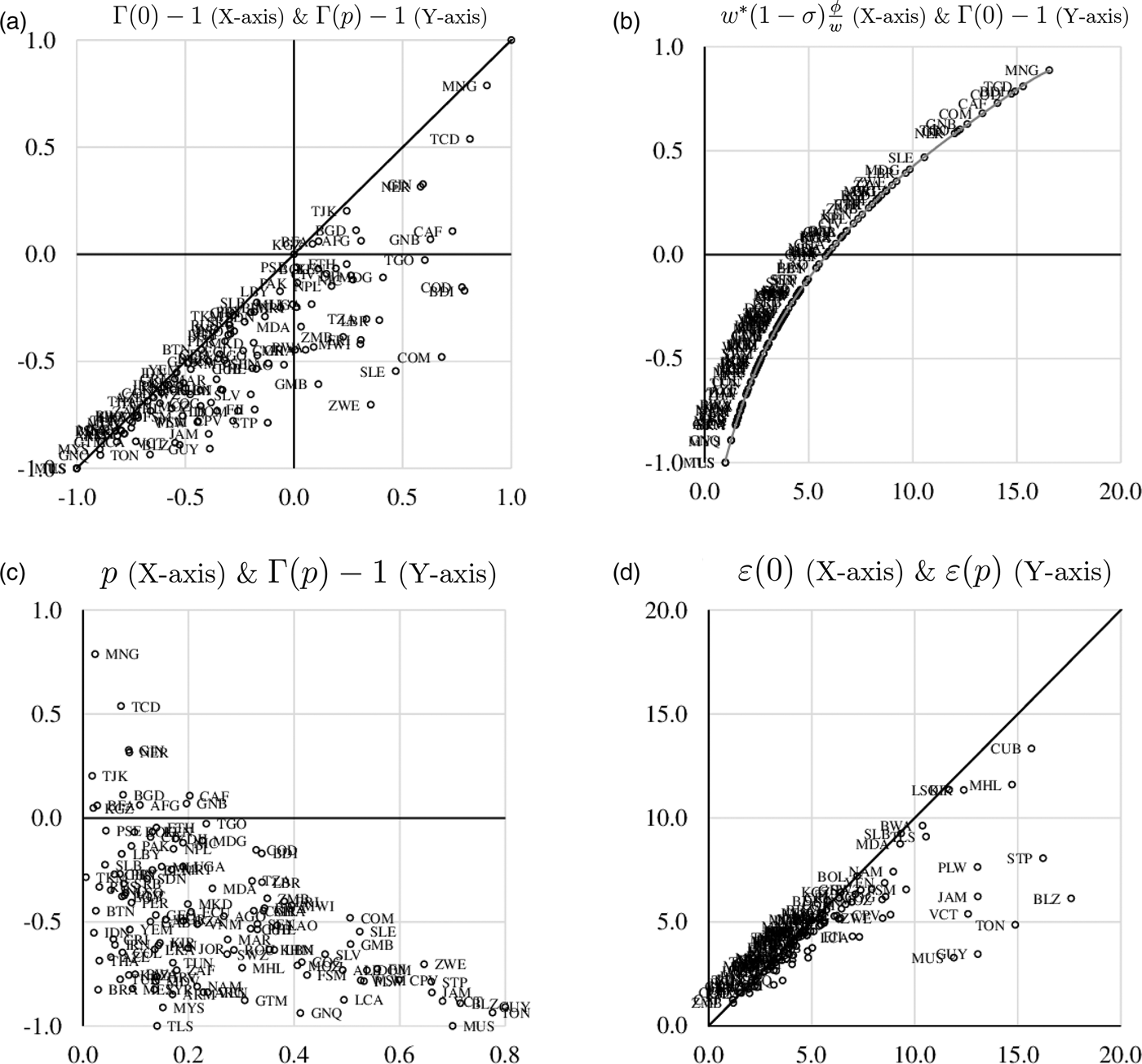
Using the calibrated model, we simulate the value of d ε/dp for each developing country. At the current level of brain drain (p), equation (21) says that this derivative is positive if Γ(p) − 1 > 0. In this case, sending an additional high-skilled migrant abroad increases the optimal level of public education. The derivative can also be evaluated at p = 0. If it is positive [i.e., if Γ(0) − 1 > 0], this means that a small level of brain drain pushes the government to increase ε compared to a closed economy situation. Figure 1(a) provides the values of Γ(p) − 1 (on the vertical axis) and of Γ(0) − 1 (on the horizontal axis) for all countries in our sample. As Γ(p) is decreasing in p, all points are below the 45 degree line. We identify 81 countries (67% of the sample) for which both Γ(0) − 1 and Γ(p) − 1 are negative. In these countries, increasing emigration always reduces the optimal level of ε. On the contrary, in 39 countries (33% of the sample), a limited emigration rate increases ε [i.e., Γ(0) − 1 is positive]. In this latter group, Γ(p) − 1 is positive for 11 countries, implying that $p \lt \tilde{p}$ : sending one more migrant abroad still increases the optimal level of ε; in the remaining 28 countries, Γ(p) − 1 is negative, implying that $p \gt \tilde{p}$
 : at the margin, sending an additional migrant abroad reduces ε.
Brain drain and optimal public education spending.

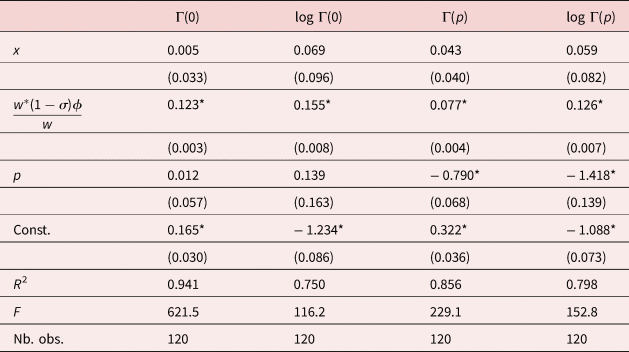
Figure 1(b) illustrates the concave relationship between Γ(0) − 1 and the migration premium, w*(1 − σ)ϕ/w.Footnote 16 From equation (21), the elasticity of Γ(0) − 1 to the migration premium is equal to 1 − θ. Under our benchmark calibration scenario, when the income ratio is below 6.0, Γ(0) − 1 is negative and any level of brain drain decreases ε. Γ(0) − 1 is positive when the migration premium is larger than 6.0. This situation arises in 39 countries. As for Figure 1(c), it illustrates the relationship between Γ(p) − 1 and the emigration rate, p. It shows that Γ(p) − 1 tends to decrease with p, implying that emigration reduces the optimal level of public education spending when p is large. Heterogeneity across countries is due to the fact that Γ(p) − 1 also depends on the international earning differential. In Table A.1 in Appendix (columns 3 and 4), we regress Γ(p) on the set of country-specific determinants [x, w* (1 − σ)ϕ/w, p]. In line with equation (21), we find that Γ(p) is positively influenced by the skill premium (capturing the migration-induced changes in students' efforts to accumulate human capital), and negatively influenced by the emigration rate (capturing the loss of human capital due to migration).Footnote 17 Hence, the condition Γ(p) − 1 > 0 is satisfied when w*(1 − σ)ϕ/w is sufficiently large and when the brain drain is relatively low. In our benchmark setting, this situation arises in only 11 countries (i.e., Afghanistan, Bangladesh, Burkina Faso, Central African Republic, Chad, Guinea, Guinea-Bissau, Kyrgyzstan, Mongolia, Niger, and Tajikistan). Third, instead of focusing on marginal changes in p, Figure 1(d) compares the optimal level of public spending at the current level of emigration, ε(p), with that of the closed economy, ε(0). We identify 21 countries above the 45 degree line where the current levels of brain drain call for higher levels of public education. In these countries, the difference ε(p) − ε(0) is rather small. The 99 countries below the 45 degree line are those where current emigration entails lower levels of public spending on education. The difference is large in some countries. These results seem to contradict the empirical findings of Docquier et al. (Reference Docquier, Faye and Pestieau2008), where a negative relationship is found between the levels of public expenditures on tertiary education per student and skilled emigration rates. Nevertheless, our simulations reveal that the optimal ratio ε/H at the current level of p is always smaller than in the closed economy. Hence, our results suggest that emigration increases the optimal amount of public spending on education in many developing countries, but increases it less than in proportion to the amount of time spent by students in education [as in line Docquier et al. (Reference Docquier, Faye and Pestieau2008)].
3.2.3 Robustness checks
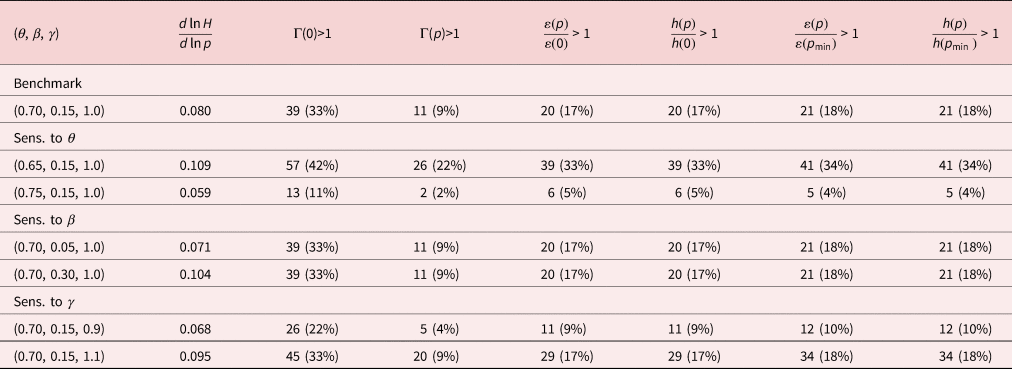
Finally, we proceed to a sensitivity analysis. Table 1 documents the sensitivity of our results to the three structural parameters, θ, β, and γ. It reports the mean elasticity of human capital to emigration in column 1. Columns 2 and 3 provide the number and percentage of countries where Γ(0) − 1 and Γ(p) − 1 are positive, respectively. In columns 4 and 5, we report the number and percentage of countries where public education spending and after-migration human capital stocks increase compared to the no-migration, counterfactual equilibrium. Finally, columns 6 and 7 provide similar results when considering an alternative counterfactual which consists of equalizing p to the observed emigration rate of low-skilled workers (denoted by p min). This counterfactual is the one used in Beine et al. (Reference Beine, Docquier and Rapoport2008) to identify the cases of net brain gain.
Under the benchmark calibration scenario, we match the elasticity of human capital to emigration; we identify 20 countries (respectively, 21 countries) where emigration increases the stock of human capital compared to the closed economy counterfactual (respectively, compared to the p min scenario). These results are very much in line with those of Beine et al. (Reference Beine, Docquier and Rapoport2008). The first robustness check reveals that an increase (respectively a decrease) in θ reduces (respectively increases) the number of countries where the optimal level of ε and the after-migration stock of human capital is positively affected by the brain drain. On the contrary, the middle part of the table shows that a change in β has no effect on public education responses to emigration and on the number of brain gain cases. Finally, the bottom part of the table shows that an increase (respectively a decrease) in γ increases (respectively decreases) the number of countries where the optimal level of ε and the after-migration stock of human capital is positively affected by the brain drain. Compared to the estimated level of d ln H/d ln p (comprised between 0.05 and 0.20), changes in θ or in β induce moderate deviations in the elasticity of human capital formation to emigration (see column 1). This is a nice property of our model although it also means that there is a big deal of uncertainty surrounding the number of countries where skilled emigration increases the optimal investment in public education. Qualitatively, however, cases with d ε/dp > 0 are obtained under all parameter sets. In addition, the results in Table 1 indicate that the number of brain gain cases [i.e., countries such that h(p) > h(0) or h(p) > h(p min), respectively] is exactly identical to the number of countries where emigration increases the optimal provision of public education [i.e., ε(p) > ε(0) or ε(p) > ε(p min), respectively]. Hence, the conditions for ε(p) > ε(0) are equivalent to those under which an increase in emigration induces a net brain gain. In line with Beine et al. (Reference Beine, Docquier and Rapoport2008), a positive response in public education is called when the international earning differential with destination countries is large, and when the emigration rate is relatively low.
4. Extension with endogenous quotas
Our analysis to this point is based on the assumption that the probability that a skilled worker is able to migrate is exogenously given. We now extend our model to endogenize both the education policy of the source country and the immigration policy of the host country. The optimal immigration policy of the host country is described in section 1. Section 2 characterizes the Nash equilibrium where both countries simultaneously choose their optimal policies in a non-cooperative manner. A comparative statics analysis is subsequently provided in section 3.
4.1 Endogenizing the optimal immigration quota
Let us begin with the hypothesis that the admission of immigrants in the host country is for the purpose of enabling the employers to benefit from the opportunity to hire foreign labor. Expansion of immigration programs for the admission of skilled migrants is typically driven by employer lobbies, as recently documented by Facchini et al. (Reference Facchini, Mayda and Mishra2015). In examining the data on lobbying expenditures of organizations trying to influence immigration policy in the United States over the period 1998–2005, they find that Microsoft was the single largest spender ($3,564,231) followed by Motorola ($2,660,473). Noting that the national cap on H-1B visas was 115,000 in the year 2000 and then raised to 195,000 in the years 2001–2003, it would be difficult to argue that these firms have not benefitted from the increase in the quota.Footnote 18
To capture the notion that the inflow of migrants is expected to generate rents for their employers, we assume that the objective of F is to choose M that maximizes

where the first term on the right represents total employers' rents generated by F's immigration policy and Q(M) is the perceived cost for the society, including the costs imposed on skilled native workers, of hosting M immigrants. In most of the host countries, the attitude of the native population (in contrast with that of employers) is negative when asked if more immigration is preferable. Facchini and Mayda (Reference Facchini and Mayda2008) find that in over 20 high- and middle-income economies, less than 10% of respondents who gave an opinion about migration were in favor of increasing the number of immigrants to their country. Moreover, regions with a higher percentage of immigrants tend to have a higher probability of natives expressing negative attitudes on immigration.Footnote 19 Although in Western countries these negative attitudes pertain primarily to unskilled migrants, asylum seekers, and undocumented foreign workers, there is also resistance to skilled migration in countries where university graduates feel that they are unable to find their first job because they are obliged to compete with foreign skilled workers or, as in the United States, where native skilled workers have been laid off while their employer is adding hundreds of new H-1B workers to the payroll [see Hira (Reference Hira2010), p. 9]. In some countries, there is resistance to skilled migration even in the presence of a severe shortage in some occupations. One example is Japan, which has bilateral migration agreements with the Philippines, Indonesia, and Vietnam, allowing for immigration of nurses under country-specific quotas. There is considerable resistance throughout their health services sector to the employment of foreign nurses as patients have a very strong preference to be treated by Japanese nurses [Kobayashi (Reference Kobayashi2014)].
In what follows, we shall assume that Q′(M) > 0 and Q′′(M) > 0. Maximization of V* with respect to M requires that

where $R = w^*\sigma \phi H\,(\varepsilon, z(\bar{w},\varepsilon, M/N,w^*,\sigma, \phi ))$ is the per-worker rent enjoyed by the employers of skilled immigrants, γ is the elasticity of H(.,.) with respect to z [see equation (5)] and η zM is the elasticity of z with respect to M:

An expansion of the immigration quota stimulates students' effort in S by increasing the probability of being able to migrate. The optimal immigration policy implied by equation (23) therefore requires the admission of skilled workers beyond the point where the rent, R, generated per migrant is equal to the marginal cost, Q′(M), of admitting an extra worker. This is because a more generous admission policy implies a higher level of skill in possession of each immigrant and hence larger rents enjoyed by F's employers on the entire stock of foreign labor employed in the economy. In terms of the parameters of the model, a lower degree of concavity of the utility function (θ), a higher elasticity of H(.,.) with respect to a student's effort in school (γ), and, recalling the definition of Δ, a larger international wage differential, all work in the same direction to provide F with a stronger incentive to admit immigrants beyond the point where R = Q′(M).
If the degree of convexity of Q(M) is sufficiently high, which we assume to be the case,Footnote 20 the second-order condition for the maximization of V* is satisfied.

Also note that

which states that the higher the provision of educational services in S, the stronger the incentive for F to admit more immigrants. This completes the presentation of our model's structure.
4.2 Nash equilibrium
We consider the case of both countries simultaneously choosing their policies in a non-cooperative manner so as to maximize their individual welfare. For the source country, the optimal provision of education (ε) is implicitly given by equation (15), which is its reaction function, V ε = 0, while the host country sets its optimal immigration quota (M) on the basis of its own reaction function, $V_M^* = 0,$ as given by equation (23). The slope of V ε = 0 is

Noting that β + γ(1 − θ) < 1 in the denominator, the slope of V ε is positive for parameter values corresponding to an LM equilibrium (i.e., Γ>1) and negative in an HM equilibrium (i.e., Γ<1).
The slope of F's reaction function is unambiguously positive.

as $V_{MM}^* \lt 0$ and $V_{M\varepsilon} ^* \gt 0$
 . Note that 1 − Δ is a positive fraction representing the ratio of the period-two utility of working at home for the real wage $\bar{w},$
 to the expected period-two utility when the probability of migration is M/N.
4.3 Comparative statics
Let us examine the implications of changes in the key exogenous variables on the Nash-equilibrium values of the policy instruments of the two countries. By totally differentiating the reaction functions (15) and (23), we obtain

Where $V_{\varepsilon x} = -N,V_{\varepsilon \phi} = \lpar {N-M} \rpar \bar{w}\beta \gamma H[{\rm \Delta} + \lpar M/N \rpar \lpar {1-{\rm \Delta}} \rpar \left] {/\varepsilon \phi} \right[1-\gamma \lpar {1-\theta} \rpar ]^2 \gt 0,$ $V_{M\phi }^* \! = \! R\{ \gamma \left( 1\! - \!\theta \right)\left[ \left( 1-{\rm \Delta} \right)\left( {\rm \Delta } \! + \lpar M/N \rpar \left( 1-{\rm \Delta} \right) \right) \right]\! + \left(1 + \gamma \eta _{zM} \right)\left[ 1-\gamma \left( 1 \! - \!\theta \right)+ \gamma \left( 1-\theta \right) [\left( 1-{\rm \Delta} \right) \left( {\rm \Delta} + \lpar M/N \rpar \left( 1-{\rm \Delta} \right) \right)]\right]\} /\phi \left[1-\gamma \left( 1-\theta \right) \right] \gt 0,$
 and $V_{M{Q}^{\prime}\lpar M \rpar }^* = -1.$

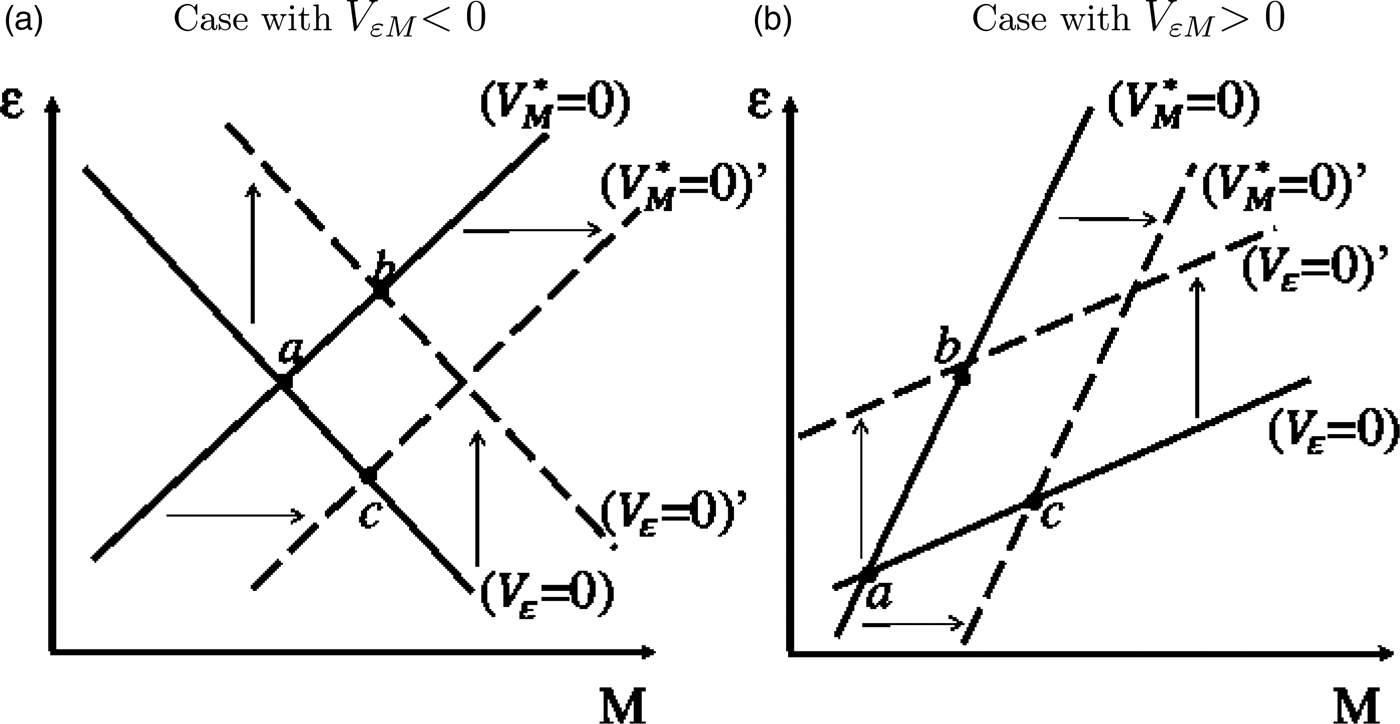
The system (29) enables us to solve the impact of changes in the exogenous variables, including x, ϕ, and the perceived marginal cost of admitting immigrants into F, Q′(M), on the equilibrium values of M and ε. Stability of the Nash equilibrium requires that the determinant ${\rm \Omega} = V_{\varepsilon \varepsilon} V_{MM}^* -V_{M\varepsilon} ^* V_{\varepsilon M} \gt 0$ . This implies that in an LM equilibrium, depicted in Figure 2(b), the positively sloped $V_M^* = 0$
 schedule must be steeper than the V ε = 0 schedule. In an HM equilibrium, depicted in Figure 2(a), the V ε = 0 schedule is negatively sloped.
Comparative statics—change in x.

In this context, some of the key comparative statics results may be summarized in the following proposition:
Proposition 2
Accounting for the interaction between the optimal immigration policy of a host country and education policy of a source country:
(i) A decline in the cost of education in S increases the Nash-equilibrium levels of both educational spending in S and the immigration quota in F.
(ii) A decrease in the marginal cost of hosting immigrants in F increases the Nash-equilibrium level of the immigration quota and increases (decreases) educational spending in a low- (high-) migration equilibrium.
(iii) In a high-migration equilibrium, an increase in the international transferability of skills from S to F raises the Nash-equilibrium level of the immigration quota and has an ambiguous effect on educational spending.
(iv) In a low-migration equilibrium, an increase in the transferability of skills from S to F has a positive effect on the level of spending on education as well as on the immigration quota.
The proofs and analytical developments are provided in the following subsections.
4.3.1 Change in the cost of providing education
Let us suppose that improvements in communications and information technologies lower the cost of transmitting information through the educational system, giving both teachers and students more efficient and lower-cost access to knowledge and educational tools. In the context of our model, we can think of such new technologies as being instrumental in lowering the cost, x, that the authorities face in providing a unit of educational services to students in S.
Using the system of equation (29), the effects of a change in x on the Nash-equilibrium values of ε and M are as follows.


The best response of S to a decline in the cost of education is to provide more ε to its students. With the now higher level of education in S and a correspondingly greater effort on the part of students to acquire skills, the best response of F is to admit more immigrants. In Figures 2(a) and 2(b), a reduction in x gives rise to an upward shift of the reaction function of S from (V ε = 0) to (V ε = 0)′, while leaving the $V_M^* = 0$ schedule unaffected. The Nash equilibrium therefore moves from point a to point b. In both panels, this entails an increase in the equilibrium levels of ε and M, but more so in an LM equilibrium of Figure 2(b), as the vertical shift of the V ε = 0 schedule is of the same magnitude in both panels (i.e., V ε x = −N).
A reduction in the cost of providing education can therefore be expected to have a positive impact on the provision of educational services in S and on the level of skills possessed by its graduates. This effect is reinforced by the endogenous immigration-policy response of F in an LM equilibrium of Figure 2(b) and mitigated in an HM equilibrium of Figure 2(a). Since the conditions in the relatively poorer developing countries, with low wages, are more likely to meet the criteria for a “low-migration” equilibrium (when compared with the conditions in the relatively more prosperous developing economies, other things being equal), our model suggests that technological improvements that lower the cost of providing educational services are likely to have a greater positive impact on human capital formation in such economies. This follows from the model's implication that for a country in an LM equilibrium, the interaction between education and immigration policies of S and F helps to stimulate educational spending and study the effort of students, while for one in an HM equilibrium, this interaction has a negative impact that offsets to some extent the positive direct effects on ε and z.
4.3.2 Drop in the marginal cost of hosting immigrants
Suppose that the population of F undergoes an exogenous shift in its attitude toward immigration. To be more concrete, let us assume that the perceived cost of hosting immigrants is given by Q(M) = q 0 + q 1M 2, where q 0 and q 1 are positive, exogenously given parameters and Q′(M) = 2q 1M. A change in the perceived marginal cost of hosting immigrants in that case corresponds to a change in q 1.
On the basis of equation (29), we can solve for the effects of a change in Q′(M) on ε and M. Noting that $V_{M{Q}^{\prime}(M)}^* = -1$ , we have


Equation (33) shows that when the perceived marginal cost of hosting immigrants decreases, the Nash-equilibrium level of F's immigration quota increases. The effect on the provision of educational services in S is ambiguous, however, as indicated in equation (32). In an HM scenario, with a negatively sloped V ε = 0 schedule, the source country's best response to an expansion of the immigration quota in F is to lower ε. This can be seen in Figure 2(a), where starting from an initial HM equilibrium at point a, a reduction in Q′(M) shifts the $(V_M^* = 0)$ schedule to the right so that the new $(V_M^* = 0{)}^{\prime}$
 schedule intersects the unaffected V ε = 0 locus at point c. This results in a higher Nash-equilibrium value of M and a lower ε. Alternatively, in an LM equilibrium, an increase in M raises the level of education provided in S. This is illustrated in Figure 2(b), where the Nash equilibrium moves from point a to c in response to a rightward shift of the $V_M^* = 0$
 locus.
4.3.3 Change in ϕ
Improvements in information and communications technologies are also contributing to the globalization of the education industry. What students and trainees are learning across countries in any given field of study or occupation is becoming increasingly more similar. This is also driven to a significant extent by the expansion of trade in goods and services and the spread of technological knowledge across the globe. In terms of our model, this phenomenon can be captured by an exogenous increase in ϕ, which measures the degree to which skills possessed by a migrant are transferable from S to F. Using the system of equation (29), we find that the effects on the Nash-equilibrium values of ε and M are as follows:


where we recall that $V_{M\phi} ^* \gt 0,$ V ε ϕ > 0, $V_{M\varepsilon} ^* \gt 0$
 , $V_{MM}^* \lt 0,$
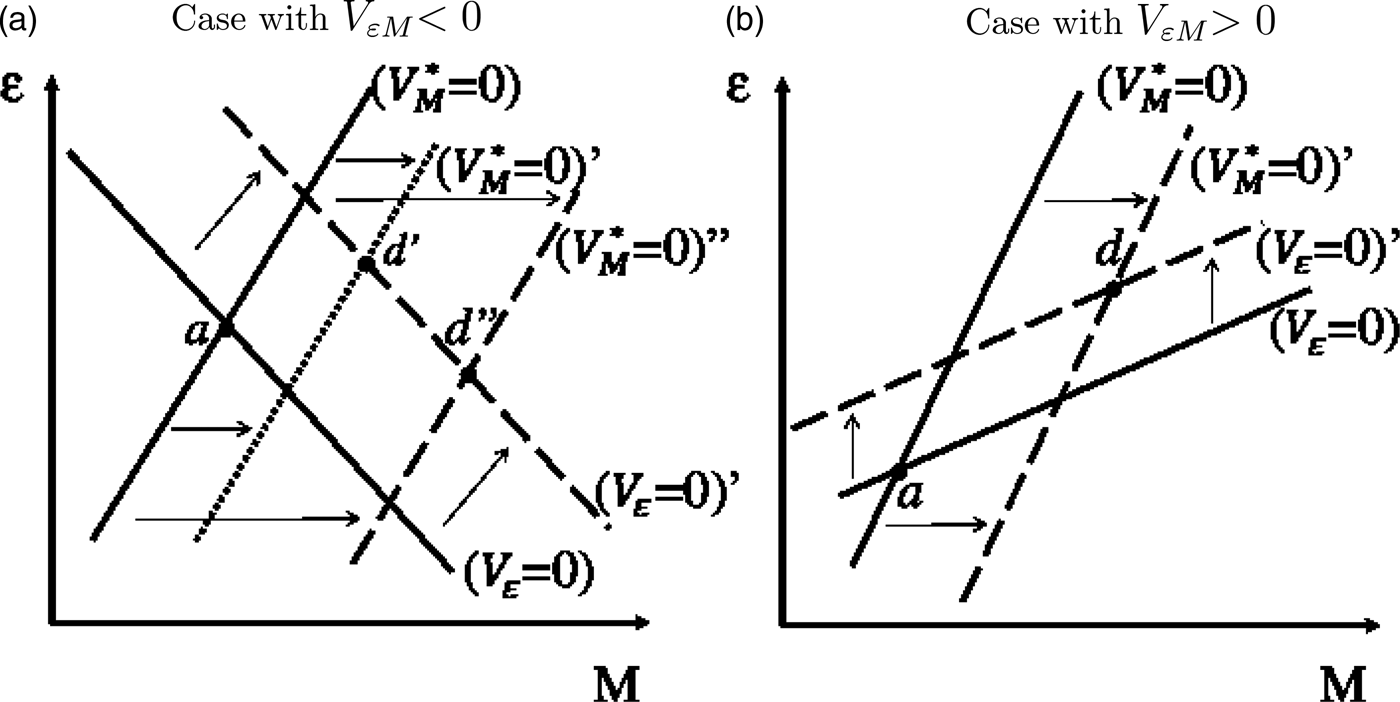
 V ε ε < 0, and the sign of V ε M is the same as that of Γ − 1. The effect of an increase in ϕ on the Nash-equilibrium level of spending on education is ambiguous and depends on the slope of the reaction function of S. Figure 3(a) illustrates the case of an HM equilibrium with a negatively sloped V ε = 0 locus. An increase in ϕ shifts the V ε = 0 schedule up and to the right and the $V_M^* = 0$
 schedule down and to the right. In relation to the original equilibrium at point a, we find that the immigration quota of F is unambiguously higher. Depending on the relative magnitudes of the two shifts, however, the new equilibrium can feature either a higher or a lower ε. The rightward shift of the $V_M^* = 0$
 schedule is greater than that of the V ε = 0 locus if $-V_{M\phi} ^* /V_{MM}^* \gt -V_{\varepsilon \phi} /V_{\varepsilon M}.$
 The Nash equilibrium then moves to $d{^{\prime \prime}}$
 , where the level of ε is lower. This would be the case, for instance, if the size of the immigration quota of F is highly sensitive to the amount of (marketable) human capital in possession of potential immigrants, which makes $V_{M\phi} ^*$
 relatively large. Alternatively, if the sensitivity of F's quota to the stock of human capital that immigrants bring into the economy is sufficiently low, the rightward shift of the $V_M^* = 0$
 schedule is smaller than that of V ε = 0. The new equilibrium is then at $d^{^{\prime}}$
 , where it is optimal for S to raise ε in response to an increase in ϕ triggered by the globalization of the education industry.
Comparative statics—change in ϕ.

The implications of an increase in ϕ in an LM equilibrium are illustrated in Figure 3(b) by a shift of the Nash equilibrium from point a to d. More spending on education is then optimal for S and more immigration is optimal for F. A higher ε and a higher M, as well as the increase in ϕ that triggered the changes in policies, all serve to provide students in S with stronger incentives to study, contributing to a more skilled and more productive labor force both at home and abroad.
5. Conclusions
Instead of repeating the principal findings of this study, which are conveniently summarized in the form of Propositions 1 and 2, we conclude the paper by discussing its main contributions at a more general level. There are two key elements and both of them flow directly from the model's structure. The first relates to the way we model skill formation. Instead of having to purchase human capital, as is typically assumed in the earlier contributions to the literature on education policies and the brain drain, we assume that students in the source country have free access to public education, while the authorities choose the optimal provision of training. Students then maximize their utility from consumption and leisure by choosing the optimal amount of effort they apply in the process of human-capital accumulation. Within this framework, the concavity of the utility function (θ) plays an important role in terms of how students respond to educational and occupational opportunities at home and abroad. Expansion of migration opportunities increases the source-country's gross stock of human capital in the empirically relevant case of θ<1. Whether or not it increases the net stock, depends on the magnitude of θ, as well as that of the elasticity, γ, of the human capital production function with respect to a student's effort, the international wage differential, and the emigration rate, M/N, in the initial equilibrium. Our model implies that there is a net brain gain in a “low-migration” equilibrium, characterized by a large γ, a low θ, a low M/N, and a sufficiently large gap between earnings of a skilled worker at home and abroad. Previous contributions to the brain-drain literature assume that the utility function is either linear or logarithmic, which precludes an analysis of the role of θ in the process of human capital accumulation. Our model is also the first in this literature to focus on the effort of students in the system of higher education and hence the role of γ in the transformation of that effort into human capital.
Calibrating the model on the basis of data pertaining to 120 developing countries around the year 2010, we proceed to identify cases where it would be optimal to raise public spending on higher education in response to an increase in the emigration rate of skilled workers. Of the 120 countries in our sample, we find 81 cases where an increase in emigration always reduces the optimal public expenditure on education. In the 39 remaining countries, limited emigration of skilled workers (starting from the zero emigration rate) calls for an increase in public spending on education. In 11 of these economies, even an increase in emigration from the current rate calls for an increase in public spending on education, while in the other 28 countries it calls for a decrease. By contrast, former studies suggest that governments should respond to an increase in skilled emigration by reducing per-capita spending on public education. Our analysis shows that this may not always be the optimal response.
Finally, we examine the interaction between the host country's immigration policy and the source country's education policy when both are endogenous and where students optimally choose how much effort to apply in the process of human capital accumulation. While we are aware that the two-country structure has its limitations in the present context, it enables us to investigate the impact of exogenous shocks, such as a technological improvement that lowers the cost of providing educational services in the source country, a shift in preferences on immigration in the host country, and a change in the degree of international transferability of human capital, on the amount of effort expended by students in school, the optimal level of source-country spending on education, and the optimal immigration quota of the host country. With a growing number of bilateral migration agreements covering skilled workers, particularly in the health services sector [e.g., bilateral Economic Partnership Agreements (EPA) between Japan and Indonesia (2008), Japan and the Philippines (2008), Japan and Vietnam (2009), or Venezuela and Cuba], a two-country model of migration of skilled workers becomes increasingly relevant.
Appendix
A. Determinants of ${\Gamma} (0)$ and ${\Gamma} ({\bi p})$


To help interpret our results, we propose a linear approximation of our model. In Table A1, we regress Γ(0) and Γ(p) on the set of country-specific characteristics (x, w*(1 − σ)ϕ/w, p). We use standard OLS regressions with Γ(.) taken in level or in log. The model in level gives a better fit. In columns 1 and 2, we regress Γ(0) on the set of country-specific determinants. In line with equation (21), w*(1 − σ)ϕ/w is the only significant determinant of Γ(0). In columns 3 and 4, we regress Γ(p) on the same determinants. The linear model suggests that Γ(p) − 1 > 0 when 0.322 + 0.077 (w*(1 − σ)ϕ/w) − 0.790p > 1, or equivalently when p < 0.097 (w*(1 − σ)ϕ/w) − 0.858.
OLS regression results

B. Country-specific results
Table A2 provides country-specific calibration and simulation results obtained under the benchmark scenario. The first 11 rows list countries where both Γ(0)>1 and Γ(p)>1. The next 28 rows include countries where Γ(0)>1 and Γ(p)<1. The last 81 rows include countries where emigration always reduces the optimal provision of public education.
Calibration and simulation results for 120 countries