Implications
Animal-based observations give the most direct insight into how animals are coping within their own environment, but it is essential that farmers understand their significance. A welfare assessment system should provide information to assess and compare the relative strengths and weaknesses of a production system, as well as identify which factors are the main sources of variation within a given production system. In addition to being fundamental in an intervention programme, a risk assessment can reveal the existence of possible confounding factors that should be taken into consideration to prevent misinterpretations. This study presents a descriptive epidemiological approach in animal welfare science across countries.
Introduction
Many studies seek to compare the welfare of pigs in different production systems. Since the Green Revolution, conventional farms with concrete floors and relatively high stocking densities displaced more traditional systems and greatly predominate throughout Europe. Recently, consumer concerns about animal welfare led to an increasing interest in alternative production systems. Special attention has been given to the straw-bedded system, as straw is considered as one of the most appropriate ways of meeting the behavioural needs of pigs in intensive conditions (Directive 91/630/European Economic Community). Several studies have been conducted to compare the welfare of growing–finishing pigs in conventional system and straw-bedded accommodation (Lyons et al., Reference Lyons, Bruce, Fowler and English1995; Scott et al., Reference Scott, Chennells, Campbell, Hunt, Armstrong, Taylor, Gill and Edwards2006; Courboulay et al., Reference Courboulay, Eugène and Delarue2009). Both systems show advantages and disadvantages that should be focused specifically in each production system. The proportion of farms using housing with straw bedding varies widely between countries. At present, around 7% of growing pigs in France are housed on straw bedding, whereas very few Spanish farms use deep litter systems for its a priori incompatibility with high environmental temperatures and limited availability of the material. Parallely, increasing attention is given to outdoor production systems, which are usually found in specific locations. Mallorcan Black pigs and Iberian pigs represent approximately 15% of the overall population of growing pigs in Spain and are found in specific areas of the country. In both systems, pigs are reared extensively; nevertheless, noticeable differences between those two systems are seen in the way the animals are fed and managed (Jaume and Alfonso, Reference Jaume and Alfonso2000; Rodríguez-Estévez et al., Reference Rodríguez-Estévez, García, Peña and Gómez2009). Currently, the Iberian pig system has greatly intensified, leading to a reduction of the production cycle and the systematic use of fodder. Intensive Iberian pigs are housed in a wide variety of accommodations ranging from indoor slatted pens to outdoor paddocks. Such intensification is generally associated with a decrease in animal welfare; however, much knowledge still remains to be transferred, especially in the Iberian pig sector (Aparicio Tovar and Vargas Giraldo, Reference Aparicio Tovar and Vargas Giraldo2006).
Despite a general interest to compare production systems, few studies have been developed on commercial farms across countries. One of the main reasons is the lack of harmonized information that makes reliable the comparison of data from different sources. Welfare Quality® protocols provide the tool that makes possible the assessment of farms through Europe in a standardized way by observers who received an identical training. Moreover, the assessment system should be applicable and valid in a wide variety of farming systems (Blokhuis, Reference Blokhuis2008). Welfare Quality® contemplates four main principles of animal welfare: (i) good feeding, (ii) good housing, (iii) good health and (iv) appropriate behaviour. Each of these four principles comprises several independent but complementary criteria (Botreau et al., Reference Botreau, Veissier, Butterworth, Bracke and Keeling2007), which are in turn characterized by one or various measures. Preference was given to animal-based measures for being more valid when measuring the state of the animal with regard to its attempts to cope with its environment (Capdeville and Veissier, Reference Capdeville and Veissier2001; Whay et al., Reference Whay, Main, Greent and Webster2003). Animal-based measures give an indication of the performance of a husbandry system at a certain moment of the production cycle. Nonetheless, resource-based factors are still essential for the provision of advice on the prevention of a welfare problem and on the evaluation of the risk of deficient welfare. It is accepted that the most valid assessment of welfare is obtained combining both types of measures (Johnsen et al., Reference Johnsen, Johannesson and Sandoe2001).
In addition to the comparison between production systems, much attention has been given recently to the study of risk factors in animal welfare (Smulders, Reference Smulders2009). Within the same housing system, farms can differ for many welfare indicators, and intra-farm variability may also be high (Courboulay et al., Reference Courboulay, Eugène and Delarue2009; Temple et al., Reference Temple, Dalmau, Ruiz de la Torre, Manteca and Velarde2011). Although a given housing system may constitute a risk factor for the welfare of the animal by itself, possible explanations should be given to understand the differences between farms from a given production system. Some variables may represent a risk in all production systems, whereas others simply make no sense in a specific system. Those causal factors can be useful to offer proper advice to farmers to improve the welfare of their animals. Key causal factors can also give an estimation of which type of welfare problem is more likely to appear on a given farm. The visit could then be focused on the target animal-based measures. Finally, identification of possible causal factors may reveal possible confounding factors.
Good feeding and housing are the first two principles contemplated by the Welfare Quality® protocol. Good feeding includes the absence of prolonged hunger and absence of prolonged thirst and good housing refers to three criteria – comfort around resting, thermal comfort and ease of movement. Poor body condition represents a valid and feasible indicator for malnutrition or under nutrition. Dehydration could not be defined in terms of animal-based measures into the Welfare Quality® project for its lack of feasibility. Several animal-based measures as indicators of good housing have been selected for their validity and repeatability in pilot studies. Bursitis has been widely studied either in epidemiological surveys (Mouttotou et al., Reference Mouttotou, Hatchell and Green1999; Gillman et al., Reference Gillman, KilBride, Ossent and Green2008) or in experimental conditions (Lyons et al., Reference Lyons, Bruce, Fowler and English1995; Scott et al., Reference Scott, Chennells, Campbell, Hunt, Armstrong, Taylor, Gill and Edwards2006). Prevalence of pig dirtiness has been compared between different types of flooring (Courboulay et al., Reference Courboulay, Bregeon, Massabie and Meunier-Salaün2003; Scott et al., Reference Scott, Chennells, Campbell, Hunt, Armstrong, Taylor, Gill and Edwards2006), and factors that affect excretory behaviour and lying behaviour have been identified under controlled conditions (Geers et al., Reference Geers, Goedseels, Parduyns and Vercruysse1986; Hacker et al., Reference Hacker, Ogilvie, Morrison and Kains1994). However, as it happens for huddling behaviour, pig dirtiness has been little studied under commercial conditions.
This paper reports part of a welfare assessment study carried out on a sample of commercial farms from five different production systems of growing pigs by a team of French and Spanish researchers. It does not pretend to define what should be considered as good or bad welfare. Instead, it presents a description of several welfare outcomes and possible causal factors on a wide variety of farms. Such a descriptive approach may form the basis of hypotheses that could be tested in future explanatory studies. The overall Welfare Quality® protocol was applied on 91 farms, and the results from the good feeding and housing principles are presented in this paper.
Material and methods
Farm selection and housing systems
A total of 91 farms of growing pigs were assessed applying the Welfare Quality® protocol over a 2-year period (from 2007 to 2009). Of these farms, 61 were evaluated in Spain and 30 in France. Selection of farms was based on management practices, farm size and veterinary records. Farm sampling concerned the main production systems of growing pigs found either in France or in Spain. Intensive systems included 52 Spanish and French conventional farms with concrete floor, eight straw-bedded farms in France and 10 intensive farms of Iberian pigs in Spain. Extensive systems included 11 Iberian extensive units and 10 extensive Mallorcan Black pig exploitations. Data were collected on the feeding system (liquid feed in trough, dry hopper, wet feed hopper, turbomat, dry food on the ground, on pasture), average environmental temperature and on the type of floor (fully slatted floor, partly slatted floor, solid concrete floor, straw or sand). All fully slatted floors were concrete slatted floors. Space allowance was calculated taking into account the length and the width of the pen or paddock in relation to the number of animals housed in that pen or paddock.
Sampling of animals
On each intensive farm, 10 pens of growing pigs were randomly selected. If there were less than 15 pigs in a pen, all pigs were assessed; however, if there were more than 15 pigs in the pen, 15 were arbitrarily selected. Pigs were categorized into three growing stages:
• First growing stage: at the beginning of the growing process (less than 90 days old).
• Second growing stage: mid-growing period from 90 to 130 days old.
• Third growing stage: at the end of the growing process and before leaving to the slaughterhouse (from 130 to 180 days old).
Among intensive Iberian pigs, as well as extensive pigs, a fourth category included pigs older than 180 days. Information on whether or not male pigs were surgically castrated was also taken into account.
Pig and pen characteristics
A total of 11 647 pigs from 719 pens or paddocks were evaluated.
In the conventional system, 7030 pigs from 530 pens were assessed. On the day of assessment, pig age ranged from 29 days to 180 days (s.d. = 34). Among pigs kept on concrete floor, 64% were housed on fully slatted floors and 36% on partly slatted floor without bedding. Space allowance ranged from 0.20 to 1.56 m2 per pig (median = 0.68, Q1 = 0.58, Q3 = 0.75). As for the feeding system, 22% of the pigs were liquid fed in a trough two to four times a day, 38% were fed by dry hopper ad libitum, 37% by wet feed hopper ad libitum and 3% by turbomat once or twice a day. Finally, environmental temperatures ranged from 16°C to 29°C (median = 23, Q1 = 21, Q3 = 25). French and Spanish conventional systems were considered as the same production system; however, some differences in the distribution of several environmental variables should be considered. More than 90% of concrete floors on French farms were fully slatted floors; liquid feeding system in trough was only seen in France; and all the temperatures were recorded above 21°C in France.
In the straw-bedded system, 1110 pigs of an average age of 112 days (s.d. = 42.0), ranging from 41 to 194 days, were assessed in 74 pens. Space allowance ranged from 0.3 to 3.0 m2 per pig (median = 1.2, Q1 = 0.7, Q3 = 2.9). Approximately 19% of the animals were liquid fed in trough, 59% were fed by dry hopper and 22% by wet feed hopper. Feed allowance was the same as in the previous production system. In straw-bedded pens, environmental temperatures ranged from 15°C to 40°C (median = 23, Q1 = 20, Q3 = 24). This system was assessed only in France.
A total of 1255 Iberian pigs kept in intensive conditions were evaluated in 58 pens or paddocks. Pig age ranged from 37 to 280 days (s.d. = 80). Approximately 16% of intensive Iberian pigs were housed on fully slatted floors, 18% on partly slatted floors without bedding, 47% on concrete floor with either a resting area on straw or an outdoor access and 19% housed in outdoor paddocks on deep sand or straw. Space allowance ranged from 0.30 to 5.4 m2 per pig (median = 1.4, Q1 = 0.8, Q3 = 2.6). All the pigs were dry fed ad libitum by dry hopper (86%) or by trough (14%). Environmental temperature ranged from 12°C to 24°C (median = 22, Q1 = 19, Q3 = 23). This system was assessed only in Spain.
Under extensive conditions, 1428 Iberian pigs of an average age of 250 days (s.d. = 97), ranging from 42 to 420 days, were assessed in 31 different paddocks. The average space allowance per pig was 430 m2 (s.d. = 578). On the days of assessment, pigs were supplemented with fodder, as the availability of natural resources was insufficient. Supplementation was given manually once or twice a day either on the floor (55%), in a trough (26%) or dry hopper (19%). The Mallorcan Black pig production system was the second extensive system assessed. A total of 824 Mallorcan Black pigs of an average age of 220 days (s.d. = 100), ranging from 75 to 405 days, were evaluated in 24 paddocks. The average space allowance per pig was 692 m2 (s.d. = 818). All pigs were on pasture and were supplemented with household refusals, bran, legume seeds, cereals and figs. Supplementation was done manually, once or twice a day, either on the floor (18%) or in a trough (30%) and given ad libitum in dry hopper (47%). The remaining 5% were entirely reliant on pasture. During the days of assessment, the average environment temperature was 18°C and 25°C in extensive Iberian and Mallorcan Black pigs, respectively.
Measurements
Assessments were performed by four observers, two of them in Spain and the other two in France. In order to minimize the difference between observers and to standardize the scores from the visits, observers followed the same training before beginning the assessment.
Poor body condition
Pigs were visually examined in the pen and any pig with a poor condition (visible hip bones and backbone) was counted. The assessment was done as follows: 0 – no visible hip bones and backbone; 2 – visible hip bones and backbone.
Bursitis
Bursitis was visually examined from a maximum distance of 1 m from the animal. Only one side of the animal was inspected. Each animal was considered using the following individual scale: 0 – no evidence of bursa/swelling; 1 (moderate) – one or several small bursa (comparable in size to a grape; 1.5 to 2.0 cm) or one large bursa (comparable in size to a walnut; 3.0 to 5.0 cm diameter); 2 (severe) – several large bursa, or one extremely large bursa (comparable to a tangerine; 5.0 to 7.0 cm diameter), or any eroded bursa.
Pig dirtiness
Pig dirtiness (manure on the body) was defined as how soiled the pig was with faeces. Only the presence of manure was assessed; pigs soiled with mud were not considered as dirty. Only one side of the body of the individual pig was assessed. The three categories were: 0 – less than 20% of the body surface was soiled; 1 (moderate soiled body) – more than 20% but less than 50% of the body surface was soiled; 2 (severe soiled body) – more than 50% of the body surface was soiled.
Huddling, shivering and panting
Huddling was the first measure done, only in resting animals, just before the animals began to stand up as a response to the observer's presence. This measure was assessed visually from the corridor. It was considered huddling when a pig was lying with more than half of its body in contact with another pig and any part of the body was on top of the other. It was not considered huddling when an individual was just beside another animal.
Shivering was defined as the slow and irregular vibration of any body part, or the body as a whole. This measure was assessed visually from the corridor and considered for each animal assessed as present or absent.
Panting was defined as a rapid breath in short gasps. This parameter was assessed visually from the corridor and considered for each animal assessed as present or absent.
More detailed information about the overall methodology of assessment can be found in the Welfare Quality® Assessment protocol for pigs (2009).
Statistical analysis
The pen or paddock was the experimental unit. Data were expressed as the number of animals affected out of the total number of animals assessed in each unit. To account for the possible dependence between observations on pens from the same farm, random farm effects were included into the model. Data were also clustered at pen level and modelled for over-dispersion. Multiple Generalized Linear Mixed Models for binomial data were performed separately for each welfare measure using the GLIMMIX procedure of the SAS statistical package Version 9.1 (SAS Institute Inc., 2002, Cary, NC, USA). Residual pseudo-likelihood was used as an estimation technique (Wolfinger and O'Connell, Reference Wolfinger and O'Connell1993).
The general form of the model was

where y is the number of animals affected, n the number of animals assessed, β 0 the intercept, βk the regression coefficient predictors, Xki are the causal factors and u farm and v pen are the residual variances of the random effects.
First, models were built to compare the five production systems of growing pigs: conventional, straw bedded, intensive Iberian, extensive Mallorcan Black pig and extensive Iberian. Then, to avoid misinterpretations, separate models were developed for each intensive system in order to identify the possible causal factors such as the type of floor, the feeding system, the growing stage, stocking density and environmental temperature. At the expense of throwing away information, these two last continuous variables (density and temperature) were converted into categorical variables by means of quartiles in order to avoid strong assumptions about the linear relationship between the outcome measure and the causal factor (Altman et al., Reference Altman, Lausen, Sauerbrei and Schumacher1994). Causal variables were entered into the model as fixed effects.
Statistical analyses consisted of initial univariable screening to determine variables statistically associated with each welfare indicator. Variables were taken forward for multivariable analysis when significant at P < 0.2 (Dohoo et al., Reference Dohoo, Martin and Stryhn2009). Where variables were highly correlated (PROC SPEARMAN) or showed a strong association (PROC FREQ with the CHISQ option), the most biologically plausible variable was selected for inclusion in the final model. Stepwise backward selection was performed to identify the variables that had a significant association (P < 0.05) with the outcome measure. The country effect was considered into each model of the conventional system. When the country effect vanished in the analysis while other factors were added to the model, ‘country’ ceased to be of interest as a separate factor. Observer effect was also included into each final model and taken out when it did not alter the interpretation of fixed effect. The ratio of the generalized χ 2 statistic and its d.f. was considered to check how well the variability in the data had been modelled and that there was no residual over-dispersion. Goodness of fit was also assessed visually by means of standardized Pearson residuals (Lee et al., Reference Lee, Nelder and Pawitan2006). When data did not allow a proper modelling, identification of causal factors was not done.
Spearman correlation coefficients were calculated to investigate the association between the different animal-based measures from the good housing principle.
Results
Poor body condition
Differences in the prevalence of poor body condition between production systems
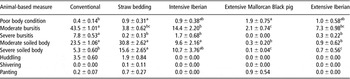
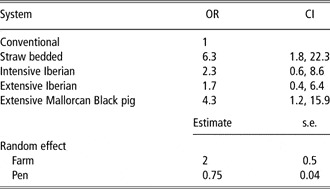
Prevalence of poor body condition among pigs from different production systems is shown in Table 1. There was an increased prevalence of poor body condition in pigs in the straw-bedded system and extensive Mallorcan Black pigs compared with pigs in the conventional system (Table 2).
Prevalences and standard errors according to the production system studied, for each animal-based measure of the good feeding and housing principles of Welfare Quality®

a,b,cValues within rows with different letters are significantly different.
Logistic-regression model of poor body condition of growing pigs for production system

OR = odds ratio; CI = 95% confidence intervals; s.e. = standard errors.
Intercept coefficient = −6.2.
Prevalence associated with poor body condition
Among extensive Mallorcan Black pigs, the highest prevalence of poor body condition was recorded in pigs entirely dependent on pasture (3%), whereas pigs supplemented with cereals in trough showed the lowest prevalence (0.4%). In the straw-bedded system, pigs that finalized their growing period presented the lowest prevalence of poor body condition (0.1%). Prevalence and variability of poor body condition were considered insufficient to undergo a correct modelling for this measure to detect possible causal factors.
Bursitis
Differences in the prevalence of bursitis between production systems
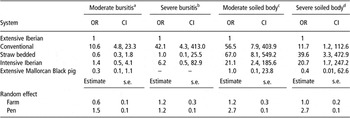
Prevalence of moderate and severe bursitis among pigs from different production systems is shown in Table 1. Pigs on conventional farms presented the highest prevalence of moderate bursitis, whereas extensive Mallorcan Black pigs presented the lowest prevalence. Considering severe bursitis, pigs housed on conventional farms presented the highest prevalence. No case of severe bursitis was registered among extensive Mallorcan Black pigs. The odd of having severe bursitis was estimated as being 42.1 times greater in pigs housed in the conventional system than in extensive Iberian pigs (Table 3).
Logistic-regression models of moderate and severe bursitis as well as for both types of pig dirtiness (moderate and severe soiled body) for production system of growing pigs

OR = odds ratio; CI = 95% confidence intervals; s.e. = standard errors.
aIntercept coefficient = −2.7.
bIntercept coefficient = −2.9.
cIntercept coefficient = −5.4.
dIntercept coefficient = −5.7.
Prevalence and possible causal factors associated with moderate and severe bursitis
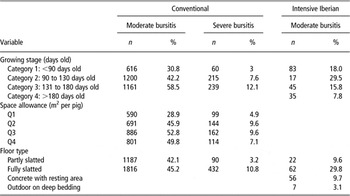
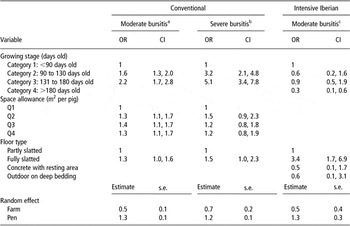
In the conventional system, prevalence of moderate and severe bursitis varied by growing stage, stocking densities and type of floor, as detailed in Table 4. There was an increased risk of moderate and severe bursitis (Table 5) in pigs in the mid-growing period (average 107 days old) and finishing pigs (average 150 days old) compared with pigs that initiate their growing period (average 68 days old). Moreover, pigs housed in concrete pens with higher stocking densities (Q1: average 0.58 m2/animal) presented a lower risk of moderate bursitis; however, space allowance did not have a significant effect on the appearance of severe bursitis. There was a trend for increased bursitis among pigs on fully slatted floors; however, the confidence interval (CI) contained the unity.
Number and prevalence of growing pigs in the conventional system and intensive Iberian pigs with moderate and severe bursitis by variable selected for multivariate analysis

Multivariate logistic binomial mixed models of possible causal factors associated with moderate and severe bursitis in the conventional system and intensive Iberian pigs

OR = odds ratio; CI = 95% confidence intervals; s.e. = standard errors.
aIntercept coefficient = 0.002.
bIntercept coefficient = −3.1.
cIntercept coefficient = −3.6.
The prevalence of moderate bursitis among intensive Iberian pigs varied by growing stage and floor type (Table 4). The risk of moderate bursitis (Table 5) increased among Iberian pigs housed on fully slatted floor. The odd of moderate bursitis decreased as the pigs get older (average 267 days old).
In the straw-bedded system, the highest prevalence of moderate bursitis was registered in the mid-growing period (6.0%) and finishing period (4.5%), whereas pigs that entered the growing period showed the lowest prevalence (0.9%). Pigs on straw in their mid- and final growing stages presented an increased risk of moderate bursitis compared with pigs that initiate their growing stage (odds ratios (OR) 6.9; 2.1, 22.1).
Pig dirtiness
Differences in the prevalence of manure on the body (pig dirtiness) between production systems
The prevalence of manure on less than 50% of the body (moderate soiled body) was significantly higher in intensive systems compared with extensive systems (Table 1). Considering manure on more than 50% of the body (severe soiled body), extensive Mallorcan Black pigs and extensive Iberian pigs presented the lowest prevalence as well. Moreover, among intensive systems, the straw-bedded system presented significantly a higher prevalence of manure on more than 50% of the body compared with the conventional system. The odd of being moderately soiled was estimated as being 67 times greater in pigs on straw than in extensive Iberian pigs (Table 3).
Prevalence and possible causal factors associated with pig dirtiness
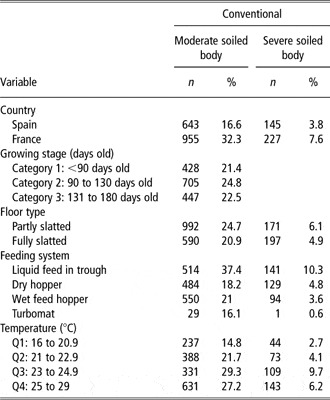
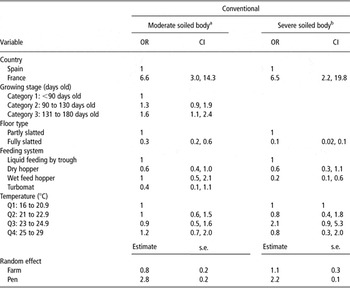
The prevalence of manure scored as 1 (moderate soiled body) and scored as 2 (severe soiled body) in the conventional system varied according to the type of floor, the feeding system and environmental temperature levels, as detailed in Table 6. Manure scored as 1 also varied depending on the growing stage, whereas it was not identified as a possible causal factor for manure scored as 2. In the conventional system, there was an increased risk of both scores of manure on the body (Table 7) in partly slatted floor compared with pigs housed on fully slatted floor. Pigs in their final growing stage presented higher odds of moderate soiled body compared with pigs that entered the growing period. There was a significant increased risk of severe soiled body among liquid-fed pigs in trough compared with pigs fed by wet feed hopper. Environmental temperatures did not have a significant effect on the apparition of pig dirtiness. The factor country was included into the final models of both types of pig dirtiness, as it had a relevant effect on the final results of the analysis.
Number and prevalence of growing–finishing pigs in the conventional system with moderate soiled body and severe soiled body by variable selected for multivariate analysis

Multivariate logistic binomial mixed models of possible causal factors associated with both types of pig dirtiness (moderate and severe soiled body) in the conventional system

OR = odds ratio; CI = 95% confidence intervals; s.e. = standard errors.
aIntercept coefficient = −2.1.
bIntercept coefficient = −3.9.
Among intensive Iberian pigs, the highest prevalence of moderate soiled body and severe soiled body (16% and 32%, respectively) was found in pigs housed on partly slatted floor, whereas the lowest prevalence was observed in pigs on fully slatted floor (0.4% and 0.0%, respectively). The type of floor was the sole significant causal variable. Iberian pigs on partly slatted floor presented a significantly higher odd of moderate soiled body compared with pigs on fully slatted pens (OR 36.1; 2.9, 448.8).
In the straw-bedded system, the highest prevalence of severe soiled body (27%) was registered among finishing pigs compared with pigs that initiate their growing period (8%). The growing stage was the sole variable identified as a significant causal variable of the prevalence of pig dirtiness in pigs on straw bedding. The odds of moderate soiled body (OR 2.1; 1.2, 3.7) and severe soiled body (OR 4.6; 1.8, 11.8) increased among older pigs compared with younger ones.
Huddling
Differences in the prevalence of huddling between production systems
No huddling animal was registered among extensive Iberian pigs, intensive Iberian pigs and extensive Mallorcan Black pigs (Table 1). The prevalence of huddling animals housed on conventional farms was not significantly different from the prevalence found in pigs in the straw-bedded system (OR 1.7; 0.4, 7.0).
Prevalence and possible causal factors associated with huddling behaviour
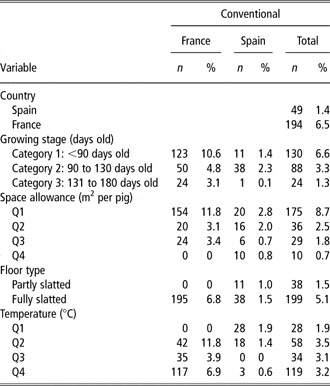
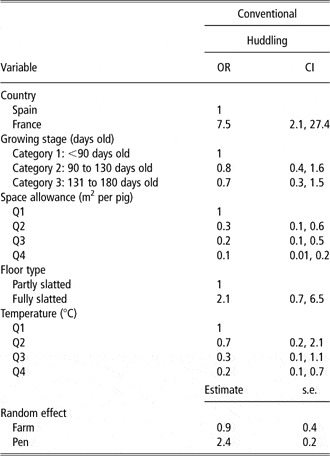
The prevalence of huddling animals in the conventional system varied by growing stage, stocking densities, type of floor and temperature levels (Table 8). The prevalence of huddling animals by causal variable is shown for each country to have a better view of the patterns of prevalences. There was an increased risk of huddling behaviour (Table 9) associated with the highest stocking densities. Moreover, there was an increased risk of huddling among pigs housed in the lowest environmental temperatures compared with pigs housed in the highest environmental temperatures. There were no significant differences in the risk of huddling between growing stages and between types of floors as the CIs included unity (P > 0.05). The factor country was included into the final model of huddling behaviour as it had a relevant effect on the final results of the risk analysis of this measure, presenting a much higher prevalence in France. No significant causal factor could be identified among pigs in the straw-bedded system.
Number and prevalence of growing–finishing pigs huddling in the concrete conventional system by variable selected for multivariate analysis

Logistic binomial mixed models of possible causal factors associated with huddling behaviour in the conventional system

OR = odds ratio; CI = 95% confidence intervals; s.e. = standard errors.
Intercept coefficient = −7.8.
Shivering and panting
The prevalence of shivering and panting was under 1% and no significant differences between systems were found for any of these measures (Table 1). Identification of possible causal variables was not possible for these measures.
Associations between animal-based measures of ‘good housing’
In the conventional system, the strongest statistical correlation was found between both scores of pig dirtiness (r = 0.5; Table 10). Other correlated variables were statistically significant at low values (r = 0.02 to 0.30). In intensive Iberian pigs, the highest statistical correlation was also found between both types of pig dirtiness (r = 0.6; Table 11). In addition, both scores of manure on the body were negatively correlated with moderate bursitis in intensive Iberian pigs (r = −0.5). In the straw-bedded system, the highest correlation was found between moderate soiled body and huddling (r = −0.2, P < 0.05).
Spearman correlation coefficients between the different animal-based measures from the good housing principle evaluated on 52 intensive conventional farms in France and in Spain

**Correlated at P < 0.01.
***Correlated at P < 0.001.
Spearman correlation coefficients between the different animal-based measures from the good housing principle evaluated on 10 intensive Iberian pig farms

***Correlated at P < 0.001.
Associations between possible causal factors
In the straw-bedded system, the growing stage and space allowance were highly correlated (r = 0.7, P < 0.001). This correlation was weak in the conventional system (r = 0.3, P < 0.001). Among intensive Iberian pigs, there was an association between the type of floor and the space allowance. Fully slatted and partly slatted floors were associated with lower space allowance, whereas concrete floor with bedding or outdoor access and outdoor deep-bedding floors housed pigs in higher space allowance (χ 2 = 63, d.f. = 9, phi-coefficient = 0.9, P < 0.001). Inclusion of the observer effect did not alter the interpretation of any of the fixed effect.
Discussion
Body condition
Poor body condition has been little studied as a welfare indicator of growing pigs. In the Welfare Quality® protocol, poor body condition is the sole animal-based measure indicator of ‘good housing’. Extensive Mallorcan Black pigs presented a higher risk of poor body condition compared with pigs in the conventional system. Mallorcan Black pigs are reared following traditional methods based on profitability of resources. Five percent of the pigs were entirely dependent on pasture, which might have increased the risk of poor body condition. On the other hand, pigs in the straw-bedded system that were fed in more controlled conditions were also associated with an increased risk of poor body condition. Scott et al. (Reference Scott, Chennells, Campbell, Hunt, Armstrong, Taylor, Gill and Edwards2006) reported more prevalent loss of body condition in the straw-bedded system than in the fully slatted system and associated it with poorer hygiene and wasted animals, generally associated with Postweaning Multisystemic Wasting Syndrome (PMWS). Knowing that PMWS most commonly affects pigs at 2 to 4 months of age (Segalés et al., Reference Segalés, Allan and Domingo2006), this hypothesis is reinforced in the study by the fact that few cases of poor body conditions were recorded at the end of the growing period.
Bursitis
A bursa is a fluid-filled sac that arises in the subcutaneous connective tissue as a result of exudation of fluid from traumatized capillaries and lymphatic vessels after pressure on the skin over a bony prominence (Smith, Reference Smith1993; Mouttotou et al., Reference Mouttotou, Hatchell and Green1998). Moderate and severe bursitis are indicators of comfort around resting; however, each type of bursitis was considered separately for reflecting different aspects of discomfort. Pigs in the conventional system presented the highest prevalence of moderate bursitis whereas extensive Mallorcan Black pigs showed the lowest prevalence. Intensive Iberian pigs had an intermediate prevalence of moderate bursitis between the conventional and the straw-bedded systems. The highest prevalence of severe bursitis was also recorded in the conventional system; however, no significant differences were seen between pigs in straw bedding, intensive Iberian pigs and pigs in extensive conditions. Severity of bursitis is associated with a hard environment that increases pressure and impact on pigs’ limbs (Lyons et al., Reference Lyons, Bruce, Fowler and English1995; Mouttotou et al., Reference Mouttotou, Hatchell and Green1998). Severe bursitis is therefore expected to be less sensitive than moderate bursitis when comparing production systems with smooth flooring.
The differences between production systems found in this study were in accordance with previous studies on the conventional system, straw-bedded accommodation and outdoor housing (Guy et al., Reference Guy, Rowlinson, Chadwick and Ellis2002; Gillman et al., Reference Gillman, KilBride, Ossent and Green2008). Nevertheless, the variability within intensive systems was high, even in the straw-bedded system, and should be explained by several causal factors. Among intensive Iberian pigs, fully slatted floor was clearly a causal factor for moderate bursitis; however, no significant differences were observed between partly slatted floor, concrete floor with resting area and outdoor access and outdoor paddocks with deep sand bedding. Solid concrete floor without bedding was identified as a risk factor of bursitis in previous studies (Gillman et al., Reference Gillman, KilBride, Ossent and Green2008). In addition Mouttotou et al. (Reference Mouttotou, Hatchell and Green1999), showed that bedding that covered the lying area was the most important factor that reduced the risk of bursitis. Therefore, a significantly higher risk of bursitis would have been expected in partly slatted floors compared with soil or bedded floors. Moderate bursitis and manure on the body were negatively correlated among intensive Iberian pigs. Detection of moderate bursitis may have been underestimated in floors where pigs were found dirtier. Contrary to intensive Iberian pigs and to the results found by Gillman et al. (Reference Gillman, KilBride, Ossent and Green2008), in the conventional system, fully slatted floor was not identified as a significant causal factor of bursitis compared with partly slatted floor. As commented by Mouttotou et al. (Reference Mouttotou, Hatchell and Green1999), it is possible that the floor quality accounts for such differences instead of the type of floor per se. The growing stage was the predominant confounding factor of moderate and severe bursitis in the conventional system. As commented by Guy et al. (Reference Guy, Rowlinson, Chadwick and Ellis2002) and Gillman et al. (Reference Gillman, KilBride, Ossent and Green2008), older animals housed on concrete floors presented a higher risk of bursitis, as greater BW exert additional pressure of the concrete on the limbs. Opposite results were observed in intensive Iberian pigs, where the risk of moderate bursitis decreased in pigs that finalized their growing period (average 267 days old). Iberian pigs are housed in different types of floor through their growing period going from one type of paddock to the other and in this study older pigs were more likely to be kept on smooth surfaces. It appears, then, that when pigs are housed at a high BW on smooth surfaces, the risk of bursitis is more likely to decrease. Smith (Reference Smith1993) also noted that as the amount of time spent on bedded floors increased, the prevalence of bursitis decreased. In the conventional system, pigs housed at the highest stocking densities presented the lowest prevalence of moderate bursitis. On the other hand, stocking density had no effect on the apparition of severe bursitis among conventional pigs and was not detected as a causal factor in intensive Iberian pigs and pigs in the straw-bedded system. Smith (Reference Smith1993) reported that pigs kept at high stocking densities tended to have an increased prevalence and severity of bursa lesions, whereas Gillman et al. (Reference Gillman, KilBride, Ossent and Green2008) did not find any effect of the density on bursitis. The effect of density on the apparition of bursitis is unclear. Even though the relationship between density and age of pigs was weak in the conventional system, age might have a confounding effect on the stocking density.
Pig dirtiness
Faeces can be a source of infectious agents; therefore, reducing the contact between pigs and their excrements is important in terms of prevention of diseases. If possible, pigs excrete in a localized part of their pen and prefer to separate their dunging area from their lying area (Meunier-Salaün, Reference Meunier-Salaün1989; Hacker et al., Reference Hacker, Ogilvie, Morrison and Kains1994). If pigs are dirty with faeces, it is because some factors have temporarily forced them to lie in their excrement. Both types of manure on the body were correlated moderately; however, this correlation was not strong enough to decide whether to analyse them as a sole measure. Although no differences were seen in the prevalence of manure on less than 50% of the body (moderate soiled body) between intensive production systems, pigs in straw bedding presented a significantly higher risk of manure on more than half of the body (severe soiled body) than pigs in the conventional system. Scott et al. (Reference Scott, Chennells, Campbell, Hunt, Armstrong, Taylor, Gill and Edwards2006) also reported a lower hygiene in pigs in the straw-bedded system compared with pigs in conventional housing. Excretions are absorbed by the bedding material and require much more cleanliness management than slatted floors. Moreover, as straw maintains a temperature warmer than concrete, upper critical temperature is reached before. Pigs are then more likely to dissipate heat wallowing in their own excrements. Intensive Iberian pigs showed an intermediate prevalence of severe soiled body, between the conventional and the straw-bedded systems. Overall, severe soiled body appeared to be more sensitive to differences between production systems than moderate soiled body. However, when studying the sensitivity of pig dirtiness between conventional farms (Temple et al., Reference Temple, Dalmau, Ruiz de la Torre, Manteca and Velarde2011), moderate soiled body allowed a better discrimination between farms than severe soiled body.
Effective temperature results from the interaction of many factors such as the type of floor, the relative humidity, air velocity and the weight of the pigs with the room temperature (Geers et al., Reference Geers, Dellaert, Goedseels, Hoogerbrugge, Vranken, Maes and Berckmans1989). Those interactions make the prediction of pig dirtiness difficult, especially under commercial conditions. The fact that manure on the body presented over-dispersion and the country appeared to have a significant effect reflects this complexity. Nevertheless, several possible causal factors that would contribute to pigs lying in their dunging area could be identified for each intensive production system. The type of flooring was the predominant causal factor for the apparition of both scores of manure on the body in the conventional system. It was also identified as a significant causal factor of moderate soiled body among intensive Iberian pigs. In both production systems, pigs on fully slatted floor presented a decreased risk of dirtiness than pigs on partly slatted floor. High effective temperatures increase lying in the slatted area, and pigs use the foul area of the solid floor as a dunging area (Courboulay et al., Reference Courboulay, Bregeon, Massabie and Meunier-Salaün2003; Huynh et al., Reference Huynh, Aarnink, Gerrits, Heetkamp, Canh and Spoolder2005). They may use this area to cool themselves by wallowing in excrement (Huynh et al., Reference Huynh, Aarnink, Gerrits, Heetkamp, Canh and Spoolder2005). The age of the pigs was a second possible causal variable of moderate soiled body in the conventional system, as well as for both types of dirtiness in the straw-bedded system. Older pigs presented higher risk of poor hygiene than younger ones. Older pigs spend more time lying and they are more likely to adopt a fully recumbent position (Ekkel et al., Reference Ekkel, Spoolder, Hulsegge and Hopster2003). Moreover, several studies on pigs in conventional conditions have found that dunging on the solid floor increases when pigs are heavier (Hacker et al., Reference Hacker, Ogilvie, Morrison and Kains1994). Thereafter, a higher evaporative heat loss in heavy pigs in addition to a greater space occupational area may increase the probability of an older pig lying on a dunging area. Severe soiled body was not influenced significantly by the growing stage in conventional pigs; instead, the feeding system appeared to be a significant causal factor of severe soiled body. In the conventional system, liquid-fed pigs in trough presented a higher prevalence of severe soiled body than pigs fed by wet feed hopper, in accordance with the results of Scott et al. (Reference Scott, Chennells, Armstrong, Taylor, Gill and Edwards2007). The increase in water excretion originated by the ingestion of large volumes of water can make worse the accumulation of excretion, especially on the solid zones of the concrete.
Huddling, shivering and panting
Huddling, shivering and panting are animal-based indicators of thermal comfort. Shivering and panting showed low prevalences (<1%) in all production systems, and no huddling animals were detected among intensive Iberian pigs and among pigs in extensive conditions. Moreover, pigs in the conventional and straw-bedded systems did not display a significant difference in the prevalence of huddling behaviour. On the days of assessment, pigs were not subjected to extremely cold environments as temperatures ranged from 12°C to 24°C in intensive Iberian pigs, from 15°C to 40°C in the straw-bedded system and from 16°C to 29°C in the conventional system. In addition, observations in extensive conditions were not done during winter months. Estimations of the thermal comfort zone ranged from 15°C to 24°C and from 14°C to 21°C in growing and finishing pigs, respectively (Gonyou et al., Reference Gonyou, Lemay and Zhang2006). Thereafter, the ranges of temperatures recorded in this study appeared to be insufficiently low to observe a high variability of huddling behaviours and possible differences between production systems.
In the conventional system, the prevalence of huddling animals was highly dependent of the country and, as it happens for pig dirtiness, an important variability in the prevalence of this measure could not be explained by the model. It is possible that the type of floor accounts for differences between countries; however, it is more likely that a combination of other factors such as the air velocity, the floor temperature and the variation in environmental conditions (Geers et al., Reference Geers, Goedseels, Parduyns and Vercruysse1986) originate such differences. The degree of huddling occurring in a group was also affected by the stocking density that represents an important confounding factor. Nevertheless, the risk of huddling in this study decreased at high room temperatures (from 25°C to 29°C).
Conclusions
Important differences between production systems can be established based on animal-based measures of the good feeding and housing principles of the Welfare Quality® protocol. Pigs in the conventional system presented the lowest prevalence of poor body condition, whereas extensive Mallorcan Black pigs and extensive Iberian pigs were associated with a decreased prevalence of bursitis and pig dirtiness. The straw-bedded system presented a lower prevalence of bursitis but poorer hygiene and more susceptibility of poor body condition than the conventional system. Several possible causal factors of animal-based measures of good housing were identified and their respective impact should be interpreted based on the production system studied. Some prevalences were largely affected by the age of the animals being a confounding variable that has to be taken into account when assessing a farm. The recording of resource-based measurements could be useful to identify farms that are more likely to show a welfare deficiency for a given measure and to interpret levels of prevalences for advisement purposes.
Acknowledgements
This study is part of the Welfare Quality® research project that has been co-financed by the European Commission, within the 6th Framework Programme, Contract no. FOOD-CT-2004-506508. The text represents the authors’ views and does not necessarily represent a position of the Commission who will not be liable for the use made of such information. The authors are grateful to the farmers, veterinarians and pig associations for their cordial collaboration. Déborah Temple was supported by an FPU scholarship from the Ministerio de Ciencia e Innovación of Spain.