1. Introduction
There is sometimes a sense in which two theories are equivalent. Equivalent theories say the same thing about the world but might go about saying it in different ways. They are the same theory, just presented to us in different guises; they might, for example, use different mathematics or be formulated in different languages. The standard examples of equivalent theories are the Heisenberg and Schrödinger formulations of quantum mechanics and the Hamiltonian and Lagrangian formulations of classical mechanics.Footnote 1
Since equivalent theories are supposed to be the same in all significant respects, we have a way to tell when two theories are inequivalent. If two theories differ in some significant respect, then they must be inequivalent. One way in which two theories might differ is in the structure that they ascribe to the world. For example, the Newtonian and Galilean theories of space-time ascribe different amounts of structure to the world. Newtonian space-time has the structure necessary to single out a rest frame, while Galilean space-time does not come equipped with this structure. Since they ascribe different structure to space-time, these two theories say different things about the world, and therefore they must be inequivalent.
There are different standards of equivalence that are currently on the table, and the question of which one we should adopt is currently a subject of significant debate. The considerations about structure outlined above suggest a desideratum that we might use to evaluate standards of equivalence. In order for a particular standard of equivalence to be satisfactory, it should be the case that if two theories are equivalent according to that standard, then they ascribe the same structure to the world.
Desideratum. If theories T 1 and T 2 are equivalent, then models of T 1 have the same structure as models of T 2.
A standard of equivalence fails to satisfy this desideratum just in case two theories can be equivalent according to that standard while nonetheless having models with different structure. Intuitively, if two theories ascribe different structure to the world, we can only infer that they are inequivalent if the standard of equivalence that we adopt satisfies this desideratum. Because we should be able to make this inference, the standard of equivalence that we adopt should satisfy the desideratum.
North (Reference North2009) has recently relied on the desideratum to argue, contrary to the standard view, that Hamiltonian and Lagrangian mechanics are inequivalent. If, as North argues, there are “differences in structure” (72) between the state spaces of two theories, then they must be inequivalent. Curiel (Reference Curiel2014) agrees with North that Hamiltonian and Lagrangian mechanics are inequivalent. His argument is different from North’s, but it also relies on something like the desideratum too. It turns on the idea that the two theories are inequivalent because “the underlying geometrical structures one uses to formulate each theory are not isomorphic” (269).
In what follows I consider two standards of equivalence that are currently on the table and ask whether they satisfy the desideratum. In order to say whether they do, we need to make precise what it is for models of different theories to have the same structure. There are different ways to do this. My aim is to address these two issues—what standard of equivalence between theories we should adopt and what notion of sameness of structure between models we should adopt—in tandem and work toward a reflective equilibrium between the two.
2. The Model Isomorphism Criterion
We begin with a basic question: Under what conditions should we consider two theories equivalent? At the very least, equivalent theories should make the same empirical predictions. If we can distinguish between two theories on the basis of some observation, then we should not consider those theories equivalent.
The logical positivists are often credited with the view that empirical equivalence is not only necessary but also sufficient for full equivalence of theories. Their idea was that the content of a theory is exhausted by its empirical content, so if two theories agree about the observable, this means that they have exactly the same content, which is just another way of saying that they are equivalent theories. It is now usually thought, however, that empirical equivalence is by itself too weak a standard of equivalence. In order to be equivalent, theories must share more in common than just their empirical predictions.
The first standard that we will consider provides one way of making precise what else must be shared by two theories in order for them to be equivalent.
Criterion. Theories T 1 and T 2 are equivalent according to the model isomorphism criterion if every model of T 1 is isomorphic to a model of T 2 and vice versa.
The thought is that if two empirically equivalent theories are also equivalent according to the model isomorphism criterion, then this gives us good reason to think of them as saying the same thing about the world.
Two mathematical objects are said to be isomorphic if there is a bijection between them that preserves their basic structures. Isomorphism is the standard notion of ‘sameness of structure’ between mathematical objects. One therefore trivially sees that the model isomorphism criterion satisfies the desideratum. Indeed, there is a strong sense in which the desideratum leads one directly to this standard of equivalence. It is the standard that one arrives at when one uses the concept of isomorphism to make precise the relation ‘same structure as’ that appears in the desideratum.
It has recently been argued by Halvorson (Reference Halvorson2012) that adherents to the semantic view of theories are forced to endorse this standard of equivalence. And regardless of one’s views on the debate between the semantic and syntactic views of theories, the idea behind the model isomorphism criterion is tempting. It is motivated by a desire to interpret a theory ‘literally’ or ‘at face value’. If one interprets a theory this way, then one understands the mathematical structure of a theory’s models as directly mirroring the structure of the world. Theories whose models are isomorphic are therefore ‘saying the same thing’ about the world. They are ascribing precisely the same structure to it. Conversely, theories whose models are not isomorphic must ‘say different things’ about the world.
Although the model isomorphism criterion satisfies the desideratum, it is a poor standard of equivalence. It judges too few pairs of theories to be equivalent. There are a number of examples of this, but for our purposes the following two will suffice. This first example was used by Winnie (Reference Winnie and Colodny1986) to demonstrate a similar point.
Example. The theory of linear orders can be formulated in two different ways. One formulation uses the concept of a nonstrict order, while the other uses the concept of a strict order. In the first case, let
 be a signature where ≤ is a binary relation. The theory of linear orders1 is the Σ1-theory with axioms saying that ≤ is transitive and antisymmetric and that any two elements are comparable under the relation. In the second case, let
 be a signature where < is a binary relation. The theory of linear orders2 is the Σ2-theory with axioms saying that < is asymmetric, transitive, and trichotomous.
One can easily see that these two theories are not equivalent according to the model isomorphism criterion. Suppose that M is a model of the theory of linear orders1 and N is a model of the theory of linear orders2. These two models are not isomorphic.Footnote 2 There cannot be a bijection between M and N that preserves their basic structures because ≤ on M is reflexive, while < on N is irreflexive (since it is asymmetric). Since models of these two theories are not isomorphic, they are not equivalent according to the model isomorphism criterion, despite the fact that they intuitively are the same. They both ascribe the same ‘linear order structure’ to sets, but they use different languages to do so.
The second example has been used to argue against the model isomorphism criterion before (Barrett Reference Barrett2015, Reference Barrett2019).
Example. It is well known that there are different ways to formulate general relativity. For example, it can be formulated on a smooth manifold with metric of signature 1–3, and it can be formulated on a smooth manifold with metric of signature 3–1. There is a strong sense in which these two formulations of general relativity are equivalent. Indeed, they only differ with respect to a choice of sign convention (i.e., a choice of whether to assign positive or negative length to time-like vectors).
These two formulations of general relativity are inequivalent according to the model isomorphism criterion. Manifolds with metric can only be isomorphic if their metrics have the same signature. Since models of these two formulations of general relativity employ metrics of different signatures, they are not isomorphic, and the two theories are therefore inequivalent according to the model isomorphism criterion.
These examples yield two conclusions. First, they show that the model isomorphism criterion is too strict a standard of equivalence. There are pairs of theories that are inequivalent according to the model isomorphism criterion that we nonetheless want to consider equivalent. In moving from our desideratum to the model isomorphism criterion, we have employed too strict a notion of ‘same structure’. One wants to say that a model of the theory of linear orders1 has the same structure as a model of the theory of linear orders2. Similarly, one wants to say that a model of 1–3 general relativity and a model of 3–1 general relativity have the same structure. These two examples simply do not strike one as cases in which the desideratum can be applied in order to conclude that the theories are inequivalent. But in both of the examples, the models of the theories in question are not isomorphic. This brings us to our second conclusion. When asking questions of equivalence—and when trying to clarify the desideratum—one should not make sameness of structure precise by using the concept of isomorphism. There are objects that are not isomorphic but that we nonetheless want to say have the same structure. Examples like the ones above demonstrate the “inadequacy of isomorphism as the criterion of structural equivalence” (Winnie Reference Winnie and Colodny1986, 128).
3. Categorical Equivalence
It is important to address both of these points. Before discussing how one might appropriately weaken the notion of isomorphism in order to capture a more adequate notion of ‘sameness of structure’, it will be useful to get a more liberal standard of theoretical equivalence on the table. There are many to choose from, but in the last few years one of the most discussed standards of equivalence has been categorical equivalence. This criterion traces back to Eilenberg and Mac Lane (Reference Eilenberg and Lane1942, Reference Eilenberg and Lane1945) but was only recently introduced into philosophy of science by Halvorson (Reference Halvorson2012, Reference Halvorson and Humphreys2016) and Weatherall (Reference Weatherall2016). It has since been applied to many cases of interest in physics.Footnote 3
We need to do a bit of work to define categorical equivalence. First note that the class of models of a theory often has the structure of a category. We will call this the category of models of the theory. A category C is a collection of objects with arrows between the objects that satisfy some basic properties. The arrows in a category C can be thought of as the ‘structure-preserving maps’ between the objects of the category. An object in the category of models of a theory is just a model of that theory. The arrows between objects in the category of models encode the relationships that different models of the physical theory might bear to one another. If T is a first-order theory formulated in a signature Σ, the category of models Mod(T) of T has models of T as its objects and elementary embeddings between models of T as its arrows.Footnote 4
A functor
 is a structure-preserving map between categories C and D. One can think of a functor as a ‘translation’ from objects and arrows of C to objects and arrows of D. A functor
 is full if for all objects c 1, c 2 in C and arrows
 in D there exists an arrow
 in C such that
 . Functor F is faithful if
 implies that
 for all arrows
 and
 in C. Functor F is essentially surjective if for every object d in D there exists an object c in C such that
 . A functor
 that is full, faithful, and essentially surjective is called an equivalence. The categories C and D are equivalent if there exists an equivalence between them. This gives us the following standard of equivalence between theories.
Criterion. Theories T 1 and T 2 are categorically equivalent if their categories of models Mod(T 1) and Mod(T 2) are equivalent.
When T 1 and T 2 are physical theories, one also requires that the functor realizing this equivalence ‘preserves the empirical content of the theories’ in some sense (Weatherall Reference Weatherall2016; Barrett Reference Barrett2019). This additional requirement is meant to guarantee that the theories in question are empirically equivalent and, moreover, that their empirical equivalence is respected by the functors that translate between the theories. Categorical equivalence is capturing a sense in which two theories are ‘intertranslatable’; one can convert models of the one theory into models of the other theory, and these translations preserve many of the theoretical properties that one might take to be significant.
In asking whether categorical equivalence satisfies our desideratum, we are asking whether the structure of the models of the theories is preserved under these translations. If we adopt isomorphism as our notion of sameness of structure, then categorical equivalence does not satisfy the desideratum. The two examples above show this. Models of the theory of orders1 are not isomorphic to models of the theory of orders2, but these two theories are nonetheless categorically equivalent. (It is well known that these two theories are definitionally equivalent, and definitional equivalence entails categorical equivalence [Barrett and Halvorson Reference Barrett and Halvorson2016b].) Similarly, models of 1–3 general relativity are not isomorphic to models of 3–1 general relativity, but these two theories are categorically equivalent too (Barrett Reference Barrett2019).
As we discussed above, however, these two examples give us good reason to refrain from adopting isomorphism as our notion of sameness of structure between models. One wants to say, for example, that a model of 1–3 general relativity and a model of 3–1 general relativity have the same structure, despite the fact that they are not isomorphic. This structure is simply displayed by the two models in two different ways, each corresponding to a choice of sign convention. We therefore want a more liberal notion of sameness of structure according to which these models have the same structure.
One such notion is suggested by the following considerations. A mathematical object comes equipped with more structure than just its ‘basic level’ of structure. It comes equipped with more structure than just that which we choose to display in its notation. In particular, it is natural to think of all of the structures that an object defines as ‘coming for free’ on the object. One example of this is the case of a metric space (X, d). A metric space naturally comes equipped with—indeed, the metric defines—a canonical topology τd. This topology τd is just as much a part of the structure of (X, d) as the metric d is.
Similarly, a model (M, gab) of 1–3 general relativity comes equipped with additional structures other than just the 1–3 metric gab. One of these additional structures that its basic level of structure defines is the 3–1 metric −gab. This means that a model of 1–3 general relativity can define all of the structures that a model of 3–1 general relativity has and vice versa. These models therefore have the same structure in the sense that each can define all of the structures of the other. The same holds for models of the two formulations of the theory of linear orders. The idea here is simple. Objects that are isomorphic have the same basic level of structure. But a mathematical object comes equipped with additional definable structures, and it might be—as in these two examples—that once we take these into account we see that two nonisomorphic objects have precisely the same structure.
In order to make this notion of sameness of structure precise, we need to say what it means for two objects to define each others’ structure. Suppose that Σ1 and Σ2 are signatures. (We assume without loss of generality that they only contain predicate symbols.) The elements of Σ1 and Σ2 encode the ‘basic structures’ on the two objects that we will consider. Let A be a Σ1-structure and B a Σ2-structure. If
 is one of the structures on B, then we say that the Σ1-structure A explicitly defines qB if there is a Σ1-formula ϕ such that
 . Similarly, the Σ2-structure A explicitly defines pA if there is a Σ2-formula ψ such that
 .
We can now state the following notion of sameness of structure.Footnote 5
Definition. Structures A and B are codeterminate if A explicitly defines qB for every
 and B explicitly defines pA for every
 .
Codeterminate objects can define each others structures, and intuitively, they “differ only in their choice of exhibited relations” (Winnie Reference Winnie and Colodny1986, 75). For example, the model
 of the theory of linear orders1 and the model
 of the theory of linear orders2, where ≤ and < are given their usual extensions on the natural numbers, are codeterminate, despite the fact that they are not isomorphic. One can easily verify that (
 , which means that A explicitly defines all of the elements of Σ2. One can also verify that B explicitly defines ≤. The models A and B have the same structure. Indeed, they are both simply the natural numbers under their usual ordering. The only difference between them is in the way that they choose to display this structure. The former displays it by exhibiting the relation ≤, the latter by exhibiting the relation <, and each of these defines the other.
We can now ask whether categorically equivalent theories have codeterminate models. In other words, we want to know whether the desideratum holds for categorical equivalence when we take codetermination as our standard of sameness of structure. The aim of the remainder of this section is show that if we restrict our attention to a particular class of ‘well behaved’ equivalences between theories, then the answer to this question is yes.
We need some basic preliminaries in order to characterize these well-behaved functors. A reconstrual F of Σ1 into Σ2 is a map from the elements of the signature Σ1 to Σ2-formulas that takes an n-ary predicate symbol
 to a Σ2-formula Fp(x 1, …, xn) with n free variables.Footnote 6 A reconstrual
 extends to a map from arbitrary Σ1-formulas to Σ2-formulas in the usual recursive manner. If T 1 and T 2 are theories in the signatures Σ1 and Σ2, then we say that a reconstrual
 is a translation
 if
 implies that
 for every Σ1-sentence ϕ. A translation F gives rise to a map
 , which takes models of the theory T 2 to models of the theory T 1. One can show that M and F*(M) are related to one another in the following way.
Lemma. Let M be a model of T 2 and ϕ(x 1, …, xn) a Σ1-formula. Then
 if and only if
 .
The map F* naturally extends to a mapping on elementary embeddings so that
 is a functor between the categories of models of T 2 and T 1. If
 is an arrow between models of T 2, then we define
 . One uses the lemma to verify that F*(f) is an elementary embedding. This means that a translation
 gives rise to a functor
 . Functors F* that arise from translations in this manner will be our ‘well behaved’ functors that we consider.
We can now state the following result.
Proposition. Let Σ1 and Σ2 be disjoint signatures. If
 is a translation from the Σ2-theory T 2 to the Σ1-theory T 1 such that
 is a categorical equivalence, then M and F*(M) are codeterminate for every model M of T 1.
We need a few more definitions before proving this proposition. If
 are signatures, we say that a Σ+-theory T + is an extension of a Σ-theory T if
 implies that
 for every Σ-sentence ϕ. When T + is an extension of a Σ-theory T, we can define the projection functor
 by

for every model M of T + and elementary embedding h between models of T +. Here
 is the Σ-structure obtained from M by forgetting the extensions of all the predicates not in Σ.
Proof. Let M be a model of T 1. If
 is a predicate symbol, then the lemma implies that
 , which means that M explicitly defines q.
It takes more work to show that F*(M) defines all of the structures of M. Consider the
 -theory
 that is defined as follows:

where
 is a definitional extension of T 1. Using the fact that F is a translation, one can show that
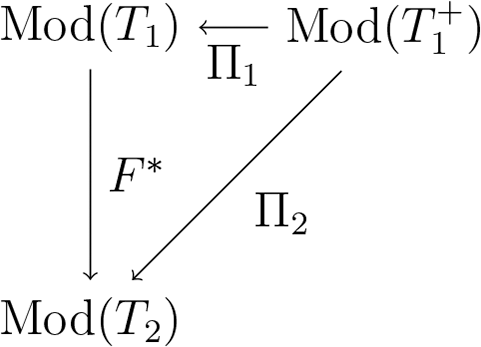
 is an extension of T 2. One can then verify using the lemma that the diagram in figure 1 commutes, where
 and
 are the projection functors. Since
 is a definitional extension of T 1, Π1 is an equivalence (Barrett and Halvorson Reference Barrett and Halvorson2016b, propositions 5.1–3). By assumption F* is an equivalence, so this means that Π2 must be an equivalence too.
Figure 1.

Now using the fact that Π2 is an equivalence, Beth’s theorem—in particular a simple corollary to it (Barrett Reference Barrett2017, corollary 1)—implies that for every predicate symbol
 there is a Σ2-formula ψ such that
 . This gives us the following string of equivalences:

where M + is the unique model of
 that satisfies
 . The first equivalence follows from the definition of Π1, the second from our choice of ψ, the third the definition of Π2, and the fourth from the fact that diagram in figure 1 commutes. This means that
 , so F*(M) defines all of the structures of M, and the two models are therefore codeterminate. QED
This proposition shows us that if two theories are categorically equivalent and the functor realizing the equivalence is suitably well behaved—in the sense that it arises from a translation between the theories—then their models are codeterminate.Footnote 7 This demonstrates a sense in which categorical equivalence satisfies our desideratum. Insofar as we take codetermination as our standard of sameness of structure, this result gives us reason to say that categorically equivalent theories have models with the same structure.
4. What Is It to Interpret a Theory Literally?
My aim in this last section is to address a worry that one might have about categorical equivalence and other liberal standards of equivalence. The worry is that if one endorses a standard of equivalence that is so liberal, then one is forced away from scientific realism.
In order to be a scientific realist, one needs to take our best scientific theories ‘literally’ or ‘at face value’ (van Fraassen Reference van Fraassen1980, 8). The most popular example of a nonliteral interpretation of our scientific theories traces back to the logical positivists, whose view van Fraassen describes as follows: “On the positivists’ interpretation of science, theoretical terms have meaning only through their connection with the observable. Hence they hold that two theories may in fact say the same thing although in form they contradict each other. (Perhaps the one says that all matter consists of atoms, while the other postulates instead a universal continuous medium; they will say the same thing nevertheless if they agree in their observable consequences, according to the positivists.) But two theories that contradict each other in such a way can ‘really’ be saying the same thing only if they are not literally construed” (10–11).
The positivists’ nonliteral interpretation of theories goes hand in hand with their commitment to empirical equivalence as the proper standard of equivalence between theories. One might therefore worry that proponents of liberal standards of equivalence like categorical equivalence are in a similar position as the positivists. If there are categorically equivalent theories that contradict one another, then this would mean that committing to categorical equivalence forces us to take our theories nonliterally, which in turn forces us away from realism.
At first glance, one might worry that there are categorically equivalent theories, like the following pair, that contradict one another when taken literally.
Example. General relativity is normally formulated geometrically by using a smooth manifold with various structures on it. But in the early 1970s, Geroch (Reference Geroch1972) noticed that general relativity could also be formulated in a purely algebraic fashion by using something called an “Einstein algebra.” One can think of the elements of an Einstein algebra as the smooth scalar functions on a space-time.
Rosenstock, Barrett, and Weatherall (Reference Rosenstock, Barrett and Weatherall2015) have recently shown that these two theories are categorically equivalent. But in this case one might be tempted to say that these two theories contradict one another if we take them literally. General relativity ascribes a kind of ‘geometric structure’ to the world, whereas the theory of Einstein algebras ascribes a kind of ‘algebraic structure’ to the world, and these are radically different kinds of structures. For example, when we draw models of these two theories (Barrett Reference Barrett2019), they look completely different, suggesting that the two theories contradict one another. Their models provide us with different pictures of the world.
There are other categorically equivalent theories that one might worry contradict one another, but this example will suffice for our purposes here. Simply put, the worry is as follows. Categorically equivalent theories might contradict one another in terms of the structure they ascribe to the world, and if so, then adopting categorical equivalence as our standard forces us into a form of antirealism.
I would like to suggest that this worry about categorical equivalence and other liberal standards of equivalence is misplaced. The claim that, for example, general relativity and the theory of Einstein algebras contradict one another is subtly rooted in the idea that we should use isomorphism as our standard for when two objects have the same structure. If one takes isomorphism as the proper standard of sameness of structure between models, then one does indeed have good reason to think that categorically equivalent theories do literally contradict one another. An Einstein algebra and a smooth manifold with metric are not isomorphic, so the theories contradict one another in virtue of ascribing different structure to the world. But we have seen that isomorphism is not a satisfactory standard of sameness of structure.
If we adopt a reasonable notion of sameness of structure, then the idea that categorically equivalent theories contradict one another disappears. General relativity and the theory of Einstein algebras have codeterminate models. From the starting point of a smooth manifold with Lorentzian metric, one can build an Einstein algebra, and conversely, from the starting point of an Einstein algebra, one can build a smooth manifold with Lorentzian metric. There is therefore a strong sense in which these two theories do not contradict one another in terms of the structure they posit, so long as we adopt an appropriate notion of sameness of structure. If one claims that general relativity and the theory of Einstein algebras are inequivalent in virtue of the former positing geometric structure and the latter positing algebraic structure, then one is taking these theories too literally.
The proposition in the previous section guarantees that categorically equivalent theories—so long as the functor realizing the equivalence is suitably well behaved—will have codeterminate models. So once we are clear about all of the structures that models have—in particular, by being clear about what structures are definable on these models—then we see that the models of categorically equivalent theories have precisely the same structure, despite the fact that they are not isomorphic. This means that adopting a more liberal standard of equivalence, like categorical equivalence, need not be understood as a move away from literal interpretation of our scientific theories. Rather, it seems that standards of equivalence that are much stricter than categorical equivalence are committing us to a kind of superliteral interpretation.