

For a long time, the study of the Cold War meant, could only mean, the study of confrontation. Conceived as a confrontation between two incompatible socio-economic systems, the cold war became, in the analysis of its interpreters, a series of conflicts, close calls, and subversive actions. The metaphor chosen by George Orwell and popularized by Walter Lippmann, it seemed, dictated the analytical focus of interpreters and scholars of the period. The Cold War confirmed itself in Berlin, China, and Korea, in McCarthyite politics and Stalinist repression. Cuba was its apotheosis; events there gave meaning to a discourse on bipolarity that American leaders used to win elections and discipline the free world they led, and that bestowed on the USSR a standing its economy could not underwrite. Here was the battle at its existentially clearest. A free people were under threat of subjugation, and humanity's beacon of freedom would make a stand—whether for liberty or justice depended on what “camp” you belonged to.Footnote 1 Its missile-fueled denouement was as clear and intelligible a narrative as the best of the Spaghetti Westerns Hollywood produced.
What allowed, and indeed required this focus on confrontation was the idea of autarky as the sine qua non of the Soviet socio-economic system. This encouraged a political study of the confrontation that subsumed capitalism itself as a dependent, constitutive category of the much larger schema that was the Cold War. The Soviet Union was understood to be an intentionally autarkic system that set itself up as an alternative to capitalism and that after World War II challenged the capitalist order first in Europe and then globally.Footnote 2 Later, in the midst of a social backlash against the Vietnam War, a small group of historians “revised” some of these assumptions and centered the debate on the global depredations of American foreign policy and its collusion with capital. Any focus on economy would necessarily downgrade bipolarity and ignore a superpower whose economic imprint on the world was mostly absent. But in accepting the idea of the Soviet Union as a universe apart, a place of opposition to the liberal world order, these revisionists missed a chance to analyze in depth the relationship between the Cold War and the capitalist world economy outside of the United States, Europe, and Japan.Footnote 3 As the neoliberal agenda asserted itself politically and socially in the West starting in the 1980s, so did the field slowly refocus its discussions on its original concerns about ideology and security, which led to a paroxysm of triumphalism in the 1990s in the wake of the Soviet collapse.Footnote 4 Today these continue to drive research agendas in the fields of Cold War and Soviet studies, while bipolarity continues to be the overwhelming framework for understanding the history of the second half of the twentieth century.Footnote 5
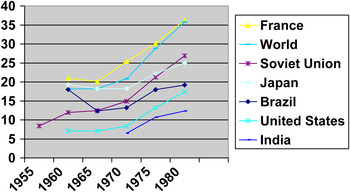
Yet the assumption of autarky crumbles at even the most cursory of looks at Soviet foreign economic policy. Autarky is wrong both as a matter of statistical fact and as a matter of clear and consistent political intent on the part of the Soviet leadership. Vladimir Treml, using domestic prices for foreign trade items rather than the foreign prices converted to rubles at the mandated official exchange rate that the official foreign trade statistics use, calculated that the share of foreign trade to national income increased from 12 percent in 1960, to 21 percent in 1975, and to about 27 percent in 1980. In other words, the Soviet Union had a level of “autarky” comparable to that of Japan, which followed a similar progression from the near autarky of the early 1950s to a more globalized economy two decades later.Footnote 6
Trade as percentage of national economy (calculated from Treml Reference Treml1983, table 1; and World Bank 2012).

The Soviet Union throughout the postwar era was more sensitive to changes in the world economy than were other large countries such as the United States, Brazil, India, and by the late 1970s even Japan. Treml's suggestive figures failed to percolate through the Sovietological field; there was no place to integrate them within existing master narratives of the “Soviet experiment.” Nonetheless, the fact is that the Soviet economy was in large measure embedded in global economic structures at all times in its history. Whether it was the gold standard system of the interwar era, the Bretton Woods system, or the post-Bretton Woods quasi-system that structured economic and political relations internationally, the Soviet Union participated mostly directly in the trends and tribulations of global financial and commercial exchange, if not necessarily in global financial and commercial governance, which was dominated by the much richer countries of Western Europe and the United States.
A trickle of studies, mostly in economic sociology and cultural studies, have lately broken through the narrative binary that structures so many Cold War texts and our understanding of the period.Footnote 7 This article takes this trend to the realm of commerce and finance where, it argues, bipolarity and autarky disappear as operational categories for understanding the Cold War and its nature.Footnote 8 In their place, the liberal capitalist project known as Bretton Woods takes center stage, relegating the well-known, conflict-based periodization of the Cold War to the background and imposing its own historical rhythm to Soviet political constraints, possibilities, and imaginations in the international arena.Footnote 9
To be clear, in this article I use the term Bretton Woods to denote the liberal project it embodied, rather than the actual institutions that more immediately defined it: the International Monetary Fund (IMF), the World Bank, and the General Agreement for Trade and Tariffs (GATT), later renamed the World Trade Organization. The interwar years had shown the dangers of an international financial system that allowed capital complete freedom of mobility, especially in a financial landscape beset by the large imbalances in capital reserves generated by World War I. This second postwar was not much different than the last one, in that in both the United States had accumulated inordinate amounts of capital. In 1948 the United States held two-thirds of global monetary reserves.Footnote 10 American capital flows to Europe had restored the European economies in the 1920s, and trouble had begun when these abruptly diminished. A perverse adjustment policy of austerity, coupled with an absence of international financial cooperation, had doomed the interwar financial system. The Bretton Woods system of the post-1945 era was designed with these mistakes in mind.
The 1944 talks in Bretton Woods, New Hampshire had as their objective the gradual reduction of barriers to trade and capital necessary for the smooth functioning of an international liberal economy, and the eventual convertibility of the European and Japanese currencies. These currencies were to be pegged to the dollar and the dollar was itself pegged to gold at $35 an ounce, which maintained one of the most clearly positive features of the gold standard: exchange rate predictability. Capital controls were to be widely used in order to achieve this goal while allowing governments the freedom to pursue domestic Keynesian policies without being dictated to make financial adjustments by international investors. This was a freedom they had not had under the much more stringent peg of the gold standard. The IMF and the World Bank would keep vigil over the good functioning of the system and provide the institutional space for the negotiated adjustment of exchange rates as the need arose.
The problem began when, in the immediate postwar years, Europe found it very difficult to earn dollars from the United States, or in other words, to export competitive goods to the United States. These dollars were sorely needed to import the raw and manufactured American products necessary for reconstruction. The corresponding deficits created a dollar shortage that compelled the European countries to implement stricter controls over capital as well as a draconian system of import-export licenses. A disastrous U.S. decision to restore the convertibility of the British pound in 1947 caused a run on sterling and decisively delayed the objective of a general restoration of currency convertibility, hastening instead the coming of the Marshall Plan.Footnote 11
In other words, the institutions negotiated at Bretton Woods quickly proved inadequate in confronting the challenges of the aftermath of World War II. During negotiations, the capital commitments that John Maynard Keynes had argued would be necessary to make them work were systematically watered down by his American counterpart at the conference, Harry Dexter White.Footnote 12 When the full extent of the ruin the war had inflicted on European economies became clear, the liberal project that the Bretton Woods system embodied had to adapt.Footnote 13 This adaptation took the form of a much more assertive American leadership steering its allies toward a coordinated response. The Marshall Plan muscled out the poorly capitalized World Bank, while ad-hoc institutions such as the European Payments Union (EPU), a European clearing house for trade payments developed in 1950, obviated the IMF in its work to balance payments among countries. American aid became aggressively conditional, and this overcame European recalcitrance in giving up the discredited system of imperial preferences and sparked European economic integration. It also gave the United States the leverage to discourage the nationalization of industry and liberalize prices in Europe. The dollar shortage was alleviated by the Marshall Plan, a widespread devaluation of European currencies in 1949 vis-à-vis the dollar, the Korean War, the EPU, and the use of the raw materials from Europe's troubled colonies to earn dollars for their respective colonial masters, but the monetary situation remained strained well into the 1950s.Footnote 14 Only the slow but constant rise in the competitiveness of Japan and the European economies eventually turned the tide. As the technological and productivity gap between them and the United States closed, imports into the United States picked up and dollars began to flow out of the country more freely. The consequent buildup of dollar reserves finally allowed European countries to achieve currency convertibility in December 1958, which resulted in the gradual dismantling of financial dikes that had constrained capital movement and trade. As the financial pressure attenuated, so did the political willingness of Europe and Japan to abide by American commercial and financial edict,Footnote 15 opening political space for the intensification of economic relations with the Soviet Union.
This then is the context I will use in my analysis of Soviet commercial and financial statecraft. If we use the prism of the Bretton Woods project and Soviet commercial and financial interactions with it, a very different account of the Cold War obtains from the one George F. Kennan codified in early 1946 when he warned that the Soviet Union was “a political force committed fanatically to the belief that with US there can be no permanent modus vivendi, that it is desirable and necessary that the internal harmony of our society be disrupted, our traditional way of life be destroyed, the international authority of our state be broken, if Soviet power is to be secure.”Footnote 16 Even as Stalin expected imperialist contradictions to erupt in another war,Footnote 17 the Soviets sought to buy into the very system of financial and commercial exchange that could guarantee the quick recovery of the USSR. Even as the United States ostracized the Soviet Union and surrounded it with military bases, the permanent U.S. occupation of West Germany meant that the Soviets would enjoy more security than they had known since coming to power in 1917.Footnote 18 Even as the official Soviet discourse hardened around an existential conflict with capitalism—in tandem with domestic repression—the financial and commercial practices of the Soviet state were marked not by enmity and subversion, the indispensable tropes of Cold War narratives, but rather by a search for accommodation, cooperation, and ultimately acquiescence. The Cold War signified stability such as the Soviet leadership had not known in the interwar period, but it was not the result of equilibrium in a bipolar world.Footnote 19 Soviet commercial and financial practices suggest a stability born of American—and then Western—economic hegemony with which the ostracized Soviets sought a modus operandi, and ultimately gainful participation.
BEFORE THE COLD WAR: MIKOYAN'S SEARCH FOR CREDITS
Like the rest of Europe, the Soviet Union saw the war ravage its balance of payments. By 1945, it was importing ten times the amount of goods that it was exporting.Footnote 20 As they had after the First World War, the Soviets found themselves rapidly depleting their gold reserves, and they would continue to use gold to settle accounts for several years.Footnote 21 It is thus no surprise that the Soviet leadership not only welcomed, but pursued American credit; Stalin and Molotov, in fact, had expected to get it ever since victory in Stalingrad allayed Stalin's fears of a possible détente between the Anglo-Saxon powers and Hitler.Footnote 22 The pursuit of Western credits was very much in keeping with prewar foreign economic policy.Footnote 23 Indeed, after having taken the brunt of the German war machine and shouldering most of the burden of war against the Nazis, and particularly given the excessive—from the Soviet perspective—delay of the second front, the expectation of a large credit took on a moral dimension.
As Mikoyan remembered it, his pursuit of postwar reconstruction credits took up a fair amount of his responsibilities during the latter stages of the war. The Roosevelt Administration authorized U.S. Ambassador Averell Harriman to talk about postwar credits as early as February 1944.Footnote 24 Mikoyan recalled that it was Harriman who first offered US$1 billion worth of credits to the Soviet Union sometime before the Yalta Conference.Footnote 25 Perhaps a quick Soviet acceptance of this offer might have actually produced an American loan, but Stalin insisted in asking for $6 billion instead. Stalin's position surprised Mikoyan, or so the Armenian later remembered. He had suggested asking for $2 billion, and counseled Stalin that asking for $6 billion would be a nonstarter. In fact, unbeknownst to Mikoyan, the State Department was willing to countenance “several billion” at that time.Footnote 26 Secretary of the Treasury Henry Morgenthau made a request to President Roosevelt for $10 billion.Footnote 27 But doubts over whether such quantities could pass through Congress fatally delayed the credit offer. Its importance was nevertheless clear to everyone, and Mikoyan would continue his stubborn pursuit for credits for as long as the two sides continued to talk to each other. “Being occupied in economic questions, and knowing well the domestic requirements of the country,” he wrote later, “I understood that postwar export resources would prove rather insufficient considering the economic destruction and the enormous domestic needs of the country. Therefore without large credits it would be impossible to develop foreign trade and have the large amounts of imports we needed.”Footnote 28
Throughout the Tehran and Yalta negotiations, Stalin dangled the possibility of great rewards for U.S. firms in business deals with the Soviet Union, a positive prospect for the U.S. leadership.Footnote 29 Although export potential could be expected to remain restricted in the immediate future, German reparations would speed up Soviet economic reconstruction, while American credits could expedite the restoration of its foreign trade sector.Footnote 30 Evidently both sides were of the same mind. In the many discussions in the State Department on this issue during the final year of the war, the only other constraining factor in the amount of the loan besides congressional approval was Soviet export capacity and consequently their ability to pay back the loan. The Roosevelt Administration expected in return to put the great wealth of Soviet primary resources at the service of the world economy and possibly to get some political concessions in the bargain.
It was a deeply embedded belief of the Soviet leadership that long-term credit arrangements would normalize trade and thus political relations. With tensions escalating rapidly through 1946, Stalin had compromised down to $1 billion on the credit request and prioritized it over most other items of discussion with the Americans. Whether it concerned talks on civilian aviation, free and open navigation on rivers of international significance, complaints from American citizens against the Soviet government, international copyright laws, or any cooperation between the two powers concerning economic aid to Europeans, no item suggested by the State Department was to go forward without a resolution on the American loan.Footnote 31 In the meanwhile, the Soviets were busy obtaining loans from other European countries. They were most successful with Sweden, which in mid-1946 offered a 200 million kronor (about $55 million) long-term credit line for the purchase of Swedish goods.Footnote 32
The main impediment, in the eyes of the Soviets, was America's progressively more transformative plans for the postwar period. Credit negotiations would come with many strings attached, the Soviets soon found out.Footnote 33 They might have saved themselves the disappointment if only they had taken notice of the British case; as early as 1941 the British had to compromise on imperial preference and tariff arrangements in order to receive lend-lease aid from the Americans. As American plans for the reconstruction of both Europe and the world economy became gradually more ambitious, the Soviets would increasingly come to be seen as a threat, rather than a partner, to these ambitions. The muscular exercise of American financial hegemony would come to delay the massive introduction of Soviet natural resources to the world economy by more than two decades, and then it would only come at the invitation of a less constrained, more independent, and more assertive Europe.
THE MARSHALL PLAN AND THE END OF SOVIET ILLUSIONS
It is an oft-repeated statistic that, at the end of the war, U.S. production made up about half of world economic output. And indeed, the alacrity with which the United States had become an economic behemoth is unparalleled in human history. Its economy, dominant already in 1939 at about half the size of the combined economies of Europe, Japan, and the Soviet Union, was larger than all of them put together seven years later. U.S. steel output by 1946, for example, was more than twice that of Germany, Great Britain, and the Soviet Union combined, whereas it had been at 85 percent in 1939.Footnote 34 The Great Depression, its subsequent war and, most of all, the sheer economic preponderance of the United States in trade and finance convinced American leaders that it was the United States that had the most to lose from a return to worldwide autarky and beggar-thy-neighbor policies. The more evident the economic weakness of other powers became, the more vigorously they took on the burden of leadership of the world economy.
In their postwar planning, Soviet leaders had failed to appreciate the extent to which the United States would take over the reins of leadership and transform the world's economic landscape. Stalin fully expected to maintain good relations with his wartime allies, which according to Marxist-Leninist predictions would soon become imperial rivals. But apocalyptic imperial rivalries were not without their silver linings. Stalin's beliefs had been reinforced by some of the early analytical reports of Vyacheslav Molotov's foreign policy team, which examined ways of weathering the coming storms and how to best secure the Soviet Union and the revolution's gains from the West's future economic struggles. These reports, written during the waning months of the war, all took Western good will for granted. In fact the Soviets expected to be wooed for support by the competing powers.Footnote 35 Moreover, they calculated that any economic revival in Europe, and America's continued economic prosperity, would require Soviet raw materials as well as its market, ever hungry for Western products and technology.Footnote 36
For two years, as political disagreements over Eastern Europe and Germany turned into impasses, Stalin continued to depend on that premise. It is thus no surprise that, even as lines on both sides hardened during those two years, Stalin and Molotov's first reaction to the Marshall Plan announced in June 1947 was to roll up their sleeves and get to the bottom of the American offer. That same month, upon meeting his British and French counterparts at the Quai d'Orsay in Paris, where they were to discuss the plan, Molotov's first words were to ask if they had received more information from the Americans other than that contained in Marshall's speech.Footnote 37 The Soviet minister of foreign affairs had come to Paris with a one hundred-strong delegation to negotiate the terms of inclusion, if not in the liberal world order then at least in a system of European economic exchange funded by American resources.
He was soon disappointed. As early as 23 May of that year, then Director of Policy Planning Staff George Kennan had written to Undersecretary of State Dean Acheson that any plan for the economic recovery of Europe should be written in a way by which “the Russian satellite countries would either exclude themselves by unwillingness to accept the proposed conditions or agree to abandon the exclusive orientation of their economies.”Footnote 38 As for Britain and France, as early as 18 June, the American Ambassador to France Jefferson Caffery was informing Secretary of State Marshall, “The British feel that Russian participation would tend greatly to complicate things and that it might be best if Russians refused invitation. They tell me the French also [appear] to share this feeling.”Footnote 39 This was followed later on that day by a much stronger commitment: “[British Foreign Secretary Ernest] Bevin and [French Foreign Minister Georges] Bidault also both told me separately that they hope the Soviets will refuse to cooperate and that in any event they will be prepared ‘to go ahead full steam even if the Soviets refuse to do so.’”Footnote 40
After a few days of negotiation in which Molotov had asked for secrecy and had been more accommodating than usual, according to Caffery, it soon became clear that the West fully meant to exclude the Soviet Union unless they were willing to completely give up control over Eastern Europe.Footnote 41 “Both Britain and France are now in dire straits and they do not have at their disposal any serious levers to overcome their economic difficulties,” Molotov wrote to Stalin while still in Paris. “Their only hope is the United States, which demands that Britain and France set up some kind of European body to facilitate U.S. interference in the economic and political affairs of European countries.”Footnote 42 Differing ideological lenses notwithstanding, both sides understood the situation in the same exact light. “We did not feel the Soviet Union would accept American verification of the use of the goods and funds,” Marshall's close assistant Charles Bohlen later wrote. “Furthermore, we did not think the Soviet Union would be able to maintain its control over Eastern Europe if those countries were able to participate in the cooperative venture.”Footnote 43 The United States indeed made great strides during the following years in breaking up imperial preferences. It was precisely that price that the Soviet Union, having finally acquired an empire in Eastern Europe, was unwilling to pay.Footnote 44
Instead the Soviets resolved to get the necessary resources through the wholesale pillaging of the defeated countries, and of some of their allies as well.Footnote 45 They did this in three ways. The bluntest was to simply uproot whole factories and replant them on Soviet soil. They also forced countries to sell resources to the Soviet Union at very low prices. And thirdly, they took a 50 percent stake on many large firms throughout Eastern Europe. It is difficult to measure the extent to which the Soviet Union benefited from these arrangements. Poland famously provided it with coal at prices well below world market prices, but the Soviet Union, in turn, also supplied goods at prices lower than those in the world market. This practice would in fact become endemic in communist-bloc trade; arbitrary pricing was one of its hallmarks. However, at least two ministers of foreign trade, in Bulgaria and Czechoslovakia, were executed for bargaining too hard with the Soviet Union,Footnote 46 and it is fair to say that the benefits accrued to the Soviet Union of the postwar reparations were significant.
Yet the pillaging soon abated. Even before the success of the Marshall Plan, the Soviet Union started normalizing trade relations with Eastern Europe, inasmuch as relations could be normal under Soviet military occupation. Already in early 1947, Soviet leaders were studying ways to ease the “excessive tax burden” on joint-stock companies throughout Eastern Europe.Footnote 47 From 1947 through 1948 the Soviets negotiated credit agreements with Bulgaria and Czechoslovakia and cut in half the Romanian and Hungarian reparations, and in 1950 they did the same for East Germany.Footnote 48 The Soviets also created the Council for Mutual Economic Assistance (CMEA) in 1949. This institution was supposed to coordinate production and help integrate the economies of the Eastern bloc, but it never really overcame the bilateral system of intra-bloc trade. Although the CMEA was based in Moscow and followed agendas set there, the Soviet Union, unlike the United States, was never able to persuade its allies to accept its commercial leadership. The reason was simple: as political scientist Randall Stone has argued, “the politics of trade in the Soviet bloc swirled and eddied around opportunities created by the distorted prices mandated by the Council for Mutual Economic Assistance.”Footnote 49 Although loosely based on prices quoted in world markets, CMEA prices largely benefited Eastern European countries and created perverse incentives to evade international obligations that might well have benefited everyone as a whole. That, coupled with the institutional disorganization in the Soviet Union, meant that the smaller satellites were able to consistently resist Soviet pressure for fairer trade.
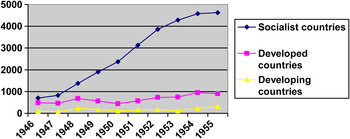
The Soviet leadership did succeed in one thing: it raised levels of trade with Eastern European countries. Presaging developments in the second half of the 1950s, when world political and economic developments finally allowed the Soviet leadership to engage the world in commercial exchange, Soviet trade with Eastern European countries expanded at an astonishing rate, albeit, as in the later expansion of trade with the rest of the world, from very low levels. From 1946 to 1950, foreign trade turnover more than doubled, from 1.3 billion to 2.9 billion rubles.Footnote 50 Over the next five years it again almost doubled. The growth, and particularly that up to 1950, came almost exclusively from the expansion of trade with Eastern Europe and China. Postwar Eastern Europe presented the Soviets with their first opportunity ever to trade with other countries without overwhelming economic or political complications. It was telling that they seized the opportunity; it heralded the Soviet Union's eventual irruption into the world economy.
Foreign trade turnover by region (in millions of 1961 rubles) (Source: Ministry of Foreign Trade 1967: 62).

THE ECONOMICS OF POLITICAL OSTRACISM UNDER HIGH STALINISM, 1947–1953
Even as the Soviet Union was orchestrating the rapid growth of trade within its new domains, economic exchange in the West was slow off the mark. Commercial and financial interaction between East and West would resume only when the system's dollar shortage resolved itself and the stringent European currency controls gradually receded. Until that time, the Soviets could do little else but complain about commercial discrimination and embargo—mostly rightly—and gripe about the import/export licensing system, which they bumped into as soon as economic relations with Western Europe started to pick up with Marshall's financial tonic. The few works that have been written about the economic Cold War have tended to focus on that first feature of the early Cold War era, the U.S.-orchestrated economic blockade that discriminated against the Soviets.Footnote 51 But the system of import licenses necessary for the functioning of Bretton Woods would prove a far more frustrating regime for the Soviets, who were apt to see politics whenever their deal making with private enterprises hit a licensing wall at the government level. Despite strenuous U.S. efforts to get Europe and Japan to comply with the embargo of strategic goods, their embargo lists would not survive the end of the dollar shortage at the end of the 1950s and the consequent resumption of freer trade in Europe, at least in anything close to their initial incarnation.
Systemic constraints, then, tended to delineate the space of Soviet economic action more forcefully than political ones. This was especially true of the system's most fundamental compulsion: as the Soviets sought to accumulate gold under the gold standard, so would they now strive to accumulate dollar reserves. A small episode of financial anxiety best captures the nature of power relations in the new liberal order the Soviets encountered against their best predictions. In the middle of 1948, with Cold War tensions at an all-time high and rising, the Soviets grew afraid that their as yet meager reserves were in danger. Of their $74.5 million in reserves, more than two-thirds lay in American banks, and almost half of that was already committed to imports of rubber. They feared the United States might block their hard-earned savings, famously achieved in no small part from sales of grain while Soviet citizens starved in 1947.Footnote 52 They decided to transfer the money to European banks, where the long arm of Uncle Sam might still prevail, but, it was hoped, at least friendly financial relations might be more expediently developed there than in the by-now hopeless atmosphere of the North American colossus.Footnote 53
Credit negotiations with the British also reveal a compromising Soviet leadership trying to get through a year that wreaked havoc on their balance of payments and thus on their ability to pay their war debts. As they had done during the Great Depression, they resisted defaulting in the hope of defending their credit within the liberal financial architecture of the postwar period.Footnote 54 It was in turn the British who first negotiated commercial agreements in earnest with the Soviets. This was a reflection not of the celebrated commercial instinct of the British but of the British Empire's endurance. When it came to multilateral trade and currency flexibility, the Bretton Woods system constrained Great Britain less than other European states. The pound sterling had a wider economic zone from which to draw, and England had, historically, a balance of payments deficit with the Soviets, which allowed the latter to use the surplus sterling in other regions in the zone. The upshot was that Great Britain could afford a negative balance of payments with the Soviets so long as the British could maintain a trade surplus with their colonies. The Soviets, in turn, were happy to accumulate pound sterling and spend it in those colonies.
Both trade officials and academic scholars have often assumed that because one of the defining aspects of Soviet economic life was an essential dearth of consumer goods, the Soviet state would be primarily interested in alleviating these shortages. It is with this assumption in mind that the British approached their commercial negotiations with the Soviets. Offering consumer trinkets in exchange for needful commodities, the British found themselves quickly dissuaded from this scheme, and scrambling to satisfy instead the Soviet Union's insatiable demand for industrial equipment and other technological inputs.Footnote 55 This pattern would invariably repeat itself during the course of negotiations with other rich countries over the next decade. Indeed, the British themselves would periodically try to sell consumer goods, only to be told, as they were by Stalin in June 1952, that the Soviet Union was interested only in the traditional Soviet-British exchange of raw materials for industrial equipment and technology.Footnote 56
With this misconception rectified, the exceptionally constrained situation of the early Bretton Woods period assured a continued rocky relationship with Great Britain. A trade plan between the two former allies had been drawn up in December 1947 and a year later the Soviets had fulfilled their end of the bargain. The British, however, had been forbidden by the Americans to sell the ships and industrial equipment necessary to cover Soviet commodity imports. Even after accounting for Soviet purchases in the sterling area, the Soviet government still had some 10 million pounds in British banks, which in the exasperated words of a report on the matter, “amounts to a forced extension of credit to Great Britain.”Footnote 57 The Soviets seemed unaware of the fact that they were merely echoing the discontented rumblings of those forced to accumulate another country's legal tender as reserve currency. For the Soviets, buying into this particular iteration of a liberal financial system started with 10 million unspent pounds.
Not all was sour. At least the 1949 devaluation of the British pound was probably profitable for the Soviets. That devaluation had not come as a surprise; it had been in the making ever since the U.S. recession the year before had wiped out the already diminutive U.S. demand for European goods, and European countries' dollar reserves along with it. The Soviets were assessing the damage that a general devaluation might have on Soviet reserves almost a month before it happened, and the assessment was positive. Their reserves in most European countries were protected by provisos that postulated payment in gold should the Soviets wish it. Only in England were their agreements unprotected. But there they stood to gain nonetheless, since the Soviets still had a large wartime debt to pay in sterling, and a devaluation would only make that debt cheaper.Footnote 58 Gains made in the debt repayment would offset the losses in the diminished purchase the Soviets would get from Sterling reserves that Gosbank held in foreign accounts. A report to Stalin on the matter advised a spending spree to reduce the balance on those Sterling accounts, and buying commodities in perennial demand like rubber and cotton would do nicely.Footnote 59
The 1949 devaluations put an end to the crisis situation in Europe, and the advent of the Korean War, like the Marshall Plan before it, pumped billions of dollars into the world economy, curbing the dollar shortage still further. But the road to convertibility would be a long one, and along the way the Soviet Union came to play a very useful role: that of barter partner. Barter obviated the need for dollars, which was constraining trade in many European countries and making it difficult for countries without empires to exploit to get a hold of basic commodities. Enter the Soviets, who under Stalin were bent on exploiting any advantage to improve their terms of trade. When in early 1950 excess grain supply from the Americas decreased the world price of grain well below Soviet expectations, the Soviets looked around for countries under balance of payments pressure. Then-Minister of Foreign Trade Mikhail Men'shikov suggested that Mexican, Austrian, and Egyptian firms might exchange their cotton production for grain, while Dutch and Ceylonese firms might be approached for their rubber, and even Belgian ones might be interested in an exchange of grain for rolled iron.Footnote 60
Men'shikov's suggestion had followed a request from an Egyptian firm that had received a license from its government for an exchange of Soviet grain for Egyptian cotton and rice. An initial request by the Egyptian ambassador in the summer of 1948 for economic exchange and a trade agreement had also been met with a positive response from the Soviets, but the Egyptian government had failed to follow up, perhaps fearing Western retaliation.Footnote 61 By early 1950 Egypt was a country with chronic balance of payments problems, tight hard currency reserves, and a sudden enthusiasm for a barter deal with the Soviets. Or three deals, as it turned out, all at the behest of the Egyptians, whose rising desperation over their dwindling reserves of dollars was matched by the rising price of wheat that the Soviets sold them.Footnote 62 The next year the relationship continued to grow, even when it meant cutting already negotiated deliveries to Belgian firms, which paid a lower price for grain than did the Egyptians.Footnote 63 The occasional payment in British pounds in times of emergency made the Egyptian relationship especially attractive.Footnote 64
In Italy, a thorny situation resolved itself after a standoff had arisen over the high price of Soviet grain. Both parties had agreed to exchange Italian rail for Soviet grain. The Italians, however, refused to pay the $90 per ton the Soviets demanded, since American grain could be bought much more cheaply. But a lack of dollar reserves meant that the Italians had to relent in the end and agree to the Soviet price when the communists threatened to pull out of the deal altogether.Footnote 65 The final deal allowed the Soviets to keep their purchases and add caterpillars, excavators, cranes, and an array of other Italian heavy construction equipment.
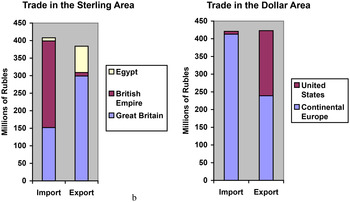
These kinds of barter exchanges were a harbinger of future relations with the new countries that appeared in the wake of Europe's imperial collapse. But widespread decolonization was still a decade in the future, and Stalin would not live to see it. In Stalin's time, expanding engagement with the world economy meant doing business with Europe, which in turn meant dealing with the United States. In the last years of Stalin's rule Soviet barter practices were merely mitigating a diminishing trade with Europe. But a snapshot of trade in June 1950 reveals an interesting picture. Within a general context of diminishing trade over the previous twelve months, the Soviets essentially operated evenly in two currency areas, of the sterling and the dollar.Footnote 66 In the Sterling area, they turned exports of grain and timber to England and grain to Egypt into imports of deficit resources such as rubber and cocoa from the empire, coupled with some imports of British industrial equipment and payments on the wartime debt to Britain. In Europe, the Soviets imported deficit resources—mainly from Europe's empires—and industrial equipment and technology with dollars earned from resource exports to both Europe and the United States. To a large extent, then, an increase in imports from dollar-strapped Europe would require and increase in trade with the United States itself, an ill prospect in the McCarthy Era. And even though the sterling area gave the British greater room to maneuver, much of the decrease in trade during those twelve months had come from a British refusal to go through with an exchange of Soviet manganese and asbestos for tin and uncut diamonds, after the Americans put pressure on them. The French had also been dissuaded from selling tankers to the Soviets in 1949.Footnote 67 And as the new decade dawned, prospects were about to get much worse.
Soviet Trade with the Capitalist World, June 1949 to June 1950 (calculated from RGASPI, f. 84, op. 1, d. 66, ll. 79–87).

The acute shortage of dollars, the principal currency used in intra-European trade, was making European economic integration nigh impossible, despite the creation of the Organization of European Economic Cooperation (OEEC) to manage the Marshall Plan funds coming from America. The solution was found in the summer of 1950 with the creation of the European Payments Union (EPU), which allowed member states to settle accounts multilaterally and committed them to the coordinated liberalization of commercial and financial barriers. What this meant for the Soviet Union was a more subtle and effective form of exclusion. Whereas earlier the Soviet Union had been one more participant in a hapless network of ineffective barter practices, the EPU lowered the cost of trade immensely within Western Europe, which now drew upon itself to accelerate trade and initiate the famous long economic boom. The upshot for the Soviets was a relative irrelevance. The suddenly slow-moving Soviets could only watch from the sidelines and rage about the subversive American influence as the “Marshallized countries” (marshallizirovannye strany) lowered tariffs and generally did away with obstacles to the intensification of economic exchange among themselves.Footnote 68
The success of the coordinated efforts under the auspices of Bretton Woods practices of cooperation and negotiation would soon eclipse the importance of the Victorian-era trade in raw materials, and with it the imperative for empire. As European empire gave way to decolonization and its political offspring, the Soviet Union would be able to finally establish direct links to the sources of those deficit resources that had played a significant role in Soviet-European commerce. This would be registered as “growth” in the Soviet Union's trade relations with the newfound “developing” countries, a mirage that would also register alarm among Western cold warriors. Ultimately this trade would lose importance for the Soviets as well; as they experienced their own 1950s economic boom, the future lay in the intensified import and exploitation of technological manufactures and services rather than in a nineteenth-century style mandate for raw materials. In time, the U.S. State Department would develop an anxious paranoia over the commercial links the Soviets developed in the global south from the mid-1950s in the midst of the vast political restructuring we call decolonization. But these new relations, proclaimed with much fanfare, obscured a much more portentous turn: for the Soviets, the future lay with the industrialized world and its productivity-enhancing technology.Footnote 69
For now, however, the problem was adaptation, but that proved a difficult task in the atmosphere of terror that pervaded Stalin's final years. The official policy was still very much welcoming of trade relations, even if frustrated by what the Soviets perceived as a lack of interest or political will among Europeans to export the types of products in actual demand in the Soviet Union.Footnote 70 But the vehemence of anti-Communism among the industrialized countries had made Stalin overly cautious in commercial matters. On one hand he wanted trade expansion, and fired Men'shikov as head of the Ministry of Foreign Trade for failing to exercise initiative and decisiveness toward that goal.Footnote 71 On the other, micromanagement, unclear directives, and a penchant for accusation froze the very initiative that would restore that nimble quality Stalin sought. Instead, Politburo members, as well as members of the Foreign Trade Ministry, acted in groups and in constant communication with the Politburo.Footnote 72 Fear of individual missteps congested the system.
A tentative rapprochement between Soviets and Japanese businessmen can serve as an example. On 29 October 1951, Vyshinskii and Men'shikov, trade minister still for one more day, petitioned the Politburo for the Soviet trade representatives in Japan to meet with a group of Japanese members of parliament and businessmen. They were to propose the reestablishment of the kind of trade both countries had carried out with each other before the war, namely an exchange of ships and other Japanese manufactures for timber and coal.Footnote 73 The Japanese, who had made the initial approach, invited the Soviet trade representatives to Osaka or Kobe to carry out the talks. Mikoyan, dressing himself in an extreme sense of caution that he would shed again as soon as Stalin died, advised against the trip, arguing that the foreign press would pick up on this and allege that the Soviet Union had a special interest in trade with Japan, an innocuous enough development that in the foreign press would often acquire a connotation of subversive goings on.Footnote 74 He was pessimistic that the Americans or Yoshida Shigeru's government would allow commerce to develop, but nevertheless the Soviet trade representatives were to acquaint the Japanese with Soviet exports, catalogues, and import interests, and study the Japanese market. Inasmuch as the Japanese also suffered from a taut situation with their balance of payments, they were to be informed of the barter system the Soviets had to offer, which excluded dollars and other hard currency.Footnote 75 Despite all the caution and deliberation, in the end the representatives got it all wrong. They had to agree on a later date to continue talks because the Japanese asked such a barrage of questions that the hapless Soviet representatives, unsure of how to answer and with very narrow guidance on what they were allowed to say, decided to check with the Politburo again. Less forgivably in the eyes of Stalin, they had not asked questions of the Japanese and failed to learn their intentions. With nothing to show for it, the press would now write about a Soviet initiative that, as Mikoyan asserted, was neither true nor politically advantageous.Footnote 76 The representatives were to be reprimanded, although the reason is unfathomable: perhaps they were too cautious, or perhaps they were not cautious enough.
SLOUCHING TOWARD CONVERTIBILITY: NEGOTIATING ENTRY IN THE LATE 1950S
In the mid-1950s, relations with the Soviet Union's more important trading partners remained hampered by politics and dollar shortages. Bretton Woods was still a project rather than an institution, and would remain so for as long as European currencies were not fully convertible. Western governments still had to carefully manage their dollar reserves through a strict system of import/export licenses, foreign exchange controls, and other administrative arrangements. These restrictions were making what few relations the Soviets had with the governments of the European West contentious. The Soviets preferred to trade through long-term agreements that were usually of three or five years and stipulated the general amount of trade and its growth over those years. They also stipulated the basic quantities to be exchanged of a variety of staple trade goods, which for the Soviets brought a measure of commercial stability and predictability with which to elaborate their own domestic economic plans. Every year, delegations from the two governments would meet to hammer out more specific lists of goods to be exchanged. The exchange had to be balanced on a clearing basis. In other words, once an agreed framework was instituted, the exchange was no longer the same as the opportunistic barter agreements of the 1940s. Generally, the Soviets would open an account in one of their partner's banks and use that country's currency to clear imports and exports. Balance could also be reached through the expense of dollars, preferably, or pound Sterling when necessary. Importantly, these lists, though more specific, were merely indicative of what was to be pursued as both governments set themselves to the task of contacting providers within each other's countries and negotiating prices with them.Footnote 77 They were not to be, indeed could not be, strictly followed, but they did provide a set of expectations. Of course, the Soviets could more easily mobilize what their partners asked for and so keep their end of the bargain. European governments, working as they did within more unruly market parameters, were not so efficient. Nor was the government bureaucracy in the West as focused and disciplined; often what the European trade delegates negotiated, another branch of that same government obstructed.
Scholars of Soviet trade, and indeed scholars in general, have long labored under the assumption that Soviet trade was always subordinate to its politics. Yet reading through their negotiations with Western European governments it is hard not to sympathize with Soviet officials in their claim that they were far more attuned to commercial considerations than their liberal European counterparts. The claim soon became a refrain and a rebuke: “In composing the list for French deliveries, the Soviet side was not ruled by political considerations,” a Soviet negotiator, in a common version of the practice, told his French counterpart in a meeting in 1956. The Soviets had been denied the purchase of radio relay equipment and machine tools, which fell within the lists of exports forbidden to the USSR. “We proceeded instead from commercial considerations and so stipulated the type of equipment we are interested in,” he pointedly informed when told he was being insensitive of French political commitments.Footnote 78 A suggestion later in the meeting bears out the pragmatism with which the Soviets approached relations with the economically developed world. In trying to persuade the French delegation to consider entering a long-term trade agreement, the Soviets had few illusions that the exchange would be one between industrial equals. The trade would entail “deliveries from France of various machinery and equipment, ferrous metals, cork, alcohol and citrus and from the USSR to France deliveries of oil, oil products, hard coal, timber, cotton, chromium and manganese ore, coal tar pitch, canned crab.”Footnote 79 This was to be a hardheaded attempt to get at French industrial technology as well as scarce goods controlled by the French Empire, not an exchange redolent of propaganda potential and political gain.
But then again, there was one overriding and enduring political aim that underlay the whole of Soviet commercial policy. This was the politics of the ostracized, the evicted seeking entry, the powerless and marginalized in search of recognition. The case was succinctly put by Deputy Minister of Foreign Trade Pavel N. Kumykin in his initial remarks during the 1957 talks that led to the long-term trade agreement between the Soviet Union and West Germany. He told his audience of Soviet and German negotiators, “We proceed from the fact that trade between countries allows for the use of advantages and profits that emanate from the international division of labor, and is also a good foundation for the improvement in mutual understanding and the strengthening of relationships among nations.”Footnote 80 This was not a simple case of dull diplomatic rhetoric devoid of substance. Kumykin, representing a state without significant economic leverage, had little time for guile. The Soviets were ready to buy West German equipment and boats worth 1.9 billion marks (1.8 billion rubles at the prevailing exchange rate) over the next four years, as well as 1.6 billion marks worth of ferrous metals, steel pipes, assorted cables, copper, and medicines and medical equipment. He offered in exchange an increase in those goods the Germans were already buying: timber, paper, cotton and flax fiber, oil and its derivatives, coal, manganese, chromium, zinc, and other such primary commodities.Footnote 81
The two sides implemented this general plan over the next half year. As would become routine in Soviet foreign relations, the fact that this trade was institutionalized in 1957 had little to do with the Soviet Union and much to do with the other side. For two years the Soviets had been using all channels in diplomatic and business circles to put pressure on the Adenauer government to sign a trade treaty. In this endeavor they could count on German industrialists and businessmen as partners. Everywhere Soviet specialists went in West Germany, they met German businessmen hoping for commercial relations to be revived between the two countries, and everywhere the Soviets fed wood to the fire.Footnote 82 Soviet officials and German businessmen had to wait for Konrad Adenauer to modify his “policy of strength” into a more accommodating attitude toward the USSR. It seems the chancellor's turning point came in the summer of 1957, that is, not before he achieved his overriding goal of integrating West Germany firmly within the European fold that March by signing the Treaty of Rome. As historian Robert Spaulding has argued, the Adenauer government was guided primarily by political goals in their consent to a long-term trade agreement with the Soviets.Footnote 83 The two countries had established diplomatic relations only two years earlier, after Adenauer parleyed a trip to Moscow into the repatriation of thousands of German POWs. In agreeing to conduct trade talks with the Soviets in 1957, the Adenauer government officials often invoked the political gains that might be had from the Soviets, particularly in the form of further repatriations.
But the outcome of the talks belied somewhat the Germans' assertions about the primacy of politics. Throughout the negotiations, the Soviets stubbornly refused to be drawn into political negotiations, focusing solely on commercial exchange and making concessions only, but not very extensively, on the commodities to be exchanged and their quantities. If the negotiations dragged on for seven months, it was the Germans who did the dragging, stalling when they found that their political demands were not being addressed.Footnote 84 Another point of contention was the German insistence that at least 10 percent of Soviet purchases in Germany be agricultural products such as cheese, fruit juice, and flour. It was left to the Soviets to be the voice of economic reason, noting that the product lists offered by the Germans often had no relation to the needs of the Soviet economy.Footnote 85 This attempt to dump consumer goods on the Soviet economy echoed that of the British ten years before, and would be repeated in turn by the Japanese in a few years. In the end, the Germans gave way on both these issues. In fact the Soviets ended up with the mutually beneficial commercial treaty they wanted, despite all private assertions by the chairman of the German Delegation, Rolf Lahr, and his colleagues that they were under less pressure to compromise than their Soviet counterparts.Footnote 86 It was not that Lahr was wrong when he noted that West Germany's less interested approach to the talks should have afforded the German side more leverage; it was that time was working against the capacity and ambition of the German government to have absolute control over international trade and finance.
In his welcoming speech, Kumykin had already pointed out the context of the negotiation: trade between the two countries had only started in 1954, and it was already at 450 million rubles.Footnote 87 As Spaulding has observed, this fast growth in the absence of a treaty made nonsense of the Soviet position that the long-term treaty was absolutely necessary for commercial growth. But it also meant that the Adenauer government's window to use the trade treaty in order to wrest political concessions from the Soviets was quickly closing. The dollar shortage that had incurred such a decisive government presence in all international economic transactions was quickly turning into a dollar glut. The full convertibility of the German mark, which would bring about the further liberalization of international commerce and finance, was a year away. In the final outcome, the Germans went back to Bonn with no resolution to the political questions they had brought to Moscow, and having compromised on most of the tough economic positions they had planned to take. But after seven months of haggling and wrangling they had come around to the opinion expressed by Kumykin at the very start of the process: ever increasing commercial exchange between the two countries would bring about ever greater mutual understanding and a strengthening political relationship. In the years ahead, the intensification of commercial exchange between them would shrug off successive crises over Berlin. By the 1970s, it would once again become the Soviet Union's most important economic relationship, resuming the position the Weimar Republic had occupied in the 1920s.
News of the Soviet-West German long-term commercial agreement, which came into effect in 1958, spurred others to approach the Soviets about making similar arrangements. The British were first off the mark, although they wondered out loud to Soviet officials whether such an agreement was possible given the British government's approach to capitalist production was less coordinated than that of the Germans.Footnote 88 Their qualms were baseless, and the treaty would operate in Great Britain as it did in Germany. A five-year Anglo-Soviet trade agreement was signed in May 1959. Many more soon followed.
THE USSR AS GLOBAL CAPITALISM'S FELLOW TRAVELER
There is a peculiar irony to the Soviet Union's attempts at overcoming its economic ostracism of the 1940s and 1950s. As we saw earlier, already in the first year of the Cold War the Soviets initiated measures to protect their participation in the liberal world system by moving their dollars out of American banks and into European ones. In time, this policy proved to be the single most harmful anti-systemic initiative the Soviets ever undertook against the Bretton Woods system.Footnote 89 A decade later, these pools of dollars held outside of the United States, and thus outside of its regulatory prescript, came to be known as the Eurodollar market. By the late 1960s that market would help tear down the Bretton Woods system, at least in its 1944 incarnation.
Convertibility in 1958 signaled the end of one temporary problem, the dollar shortage, and the beginning of a chronic one, a dollar glut. The problem was systemic. The United States had made a commitment to ensure the expansion of trade, but doing so required ever-greater quantities of dollars abroad that could not be matched by an expansion of gold reserves at home.Footnote 90 In this, as ever, the Soviet Union was yet one more participant in a specific conjuncture of the capitalist world system. To be sure, the Soviets had little inkling of what they were doing. And it is still unclear the extent to which the specific innovation at Midland Bank in London (now part of HSBC) that transformed stagnant pools of dollars into energetic, and ultimately destructive, Eurodollars directly involved Soviet reserves.Footnote 91 But at the very least the Soviet Union's fears for its dollar reserves played an important role in providing liquidity to the market through the late 1950s and 1960s. Over time, these growing pools of unregulated dollars grew to immense proportions, inciting in turn ever-growing flows of dollars, which undermined the credibility of the American gold peg and drowned the Bretton Woods system of capital controls.Footnote 92
By the time the system of pegged exchange rates expired in 1971, the Soviet Union had consolidated a political economy that would guide it to its end, and continues in Russia today. It started with the leadership's abiding desire to participate in global trade. The terms they proposed to the industrialized nations were reasonable. They wanted to resume the Soviet Union's traditional trade with them, which usually entailed an exchange of primary commodities for industrial goods. The main force working against this reconnection was a financial and commercial system that was still gestating. This both constrained economic interaction—especially relations between private firms and the Soviet government—and paradoxically encouraged Europe and Japan to explore the opportunity to conserve hard currency by establishing a limited trade with the USSR on a clearing basis. In the second half of the 1950s, dollar shortages, though quickly moving toward excess, were still compelling governments to keep a tight control over their balance of payments. These constraints attenuated with the 1958 move to currency convertibility in Europe, which greased the wheels of international trade and finance. But as trade grew, the Soviets—like the Bretton Woods project itself—began to experience the challenges of success. Domestic industry clamored for technologically superior foreign products, leading the Kremlin to make efforts to rationalize import priorities.Footnote 93 The desire for commercial exchange was fast exceeding the ability of the country to quench it. It is at this point that the Kremlin began to more purposefully elaborate a political economy and a relationship with the non-communist world—as a peddler of energy and other primary commodities—that would prevail over the more ephemeral ideological antagonism of the Cold War.
An analysis of the Soviet Union's interaction with the Bretton Woods project lays bare the abiding power of global capitalism and political systems to reciprocally mold one another. It also confirms the Cold War revisionists in their focus on the importance of an American hegemony born of economic preponderance for understanding the Cold War. None of this is meant to supplant the bipolar framework altogether. Rather, it is both a call for more bounded and tempered applications of such a framework to areas such as nuclear terror and European division where narratives of confrontation have greater explanatory power, and an encouragement for a renewed focus on the reciprocal interactions between the Cold War and global capitalism. Adding dimensions beyond themes of conflict and rivalry yields a more complex history of the Cold War, which should refashion our understanding in areas such as international security and power that all too often reproduce Cold War discourse without reflecting on the power of that very discourse to shape actions and worldviews.Footnote 94 This unreflective approach obscures the crucial importance both of America's overwhelming preponderance and of ascribing motivations to Soviet actions that reflected American fears rather than actual Soviet foreign policy.
Ultimately, the idea that the Soviet Union aspired to be self-reliant, an alternate universe to the liberal world order, has made the country into a Rorschach blot. Unmoored from the world, its history becomes a journey away from and back into the capitalist world. But in fact the Soviet Union never left. It shadowed the trajectory of the world economy and participated in all the world's economic trends. When world trade intensified, so did Soviet trade; when oil prices rose, the USSR became a petrostate. Through the 1970s and early 1980s, its institutions changed accordingly, and when oil prices fell in 1986, the Kremlin leadership radicalized its institutional reforms to confront its impoverished reality. Future Cold War studies will have to grapple with the fact that the Soviet Union has always been in and of the capitalist world order that the United States nurtured so jealously.