The meteoric growth of China–Africa links in the present decade has led to speculation about what Africans think of relations between their continent and the country which is now the world's largest manufacturer. Links are on many levels, but Africans often speak of trade of primary products for Chinese manufactures, China's building African infrastructure, Chinese migration to Africa, and solidarity on issues involving differences with Western powers. These are also China–Africa connections discussed in Western media, where “anti-China” voices often feature.Footnote 1 In response, Chinese leaders often avoid discussing many problems of links with Africa,Footnote 2 although complaints about the quality of some Chinese goods and firms and about some Chinese not wanting to mix with Africans have been acknowledged, as have “issues such as how to make more ordinary Africans benefit from the country's aid projects, and how to effectively protect the environment, and the interests of the workforce.”Footnote 3
We have elsewhere analysed empirically distinctive aspects of China's links with Africa and the political basis of the Western media's negative portrayal of China–Africa relations.Footnote 4 Here, we go beyond the discourse of a putative “African view” of China by presenting survey data. These polls – in African states by US-based firms and a Cameroonian researcher and our own survey of some 2,000 African university students and faculty in nine African countries – allow us to consider factors that may account for variation in African perspectives on China–Africa links.
The surveys have limitations. Some random sample polls were done only in a single country; the largest covered a fifth of African states. Ours was carried out only in universities. Despite the apparent limitation in its scope, it does allow us to gauge the thinking of a slice of the intelligentsia and the proto-elites they train and it is also one of the relatively rare examples of cross-national study of African opinion.Footnote 5 It also goes well beyond the range of questions asked in other surveys, to include many issues raised in the international China–Africa discourse. We also did surveys in several countries not previously polled, most notably Zambia, a country at the heart of the international discourse.
The surveys allow for three important conclusions about what Africans think of links with China. First, based on all surveys taken together, African views are not nearly as negative as Western media make out,Footnote 6 nor as positive as official Chinese sources imply. Instead, our findings show opinions are variegated and complex. Respondents eschew a binary view: if they are basically positive about China–Africa links they still recognize areas of tension; if they are basically negative they regard some aspects as beneficial. Next, the findings of the random sample surveys are at variance with the dominant Western media representation that only African ruling elites are positive about these links. Finally, based on our own survey, we find that among the university-connected respondents in Africa, the key variation is by country. All other variations, except gender, fade from significance when country is taken into account.
Beyond what Africans think of China–Africa links is the question of why they think as they do. We argue that the main determinants of variation in African perspectives are not “social” factors but how national political discourses of China–Africa play out in African states, where ruling elites and oppositions may or may not argue over how to interpret links with China. The national discourses are predicated not so much on Chinese activities in this or that country as by the internal political advantages that may accrue in raising the “Chinese problem.” Part of the population may have negative reactions to discrete aspects of the Chinese presence, involving business competition or labour relations, but no generalized “Chinese problem” exists until politicians decide to create it. In that process, media influences or variations in China's relations with African countries play an auxiliary, but important, role in opinion formation.
Our survey's polar cases, Zambia and Sudan, are countries where there is substantial Chinese trade and investment; they are also the countries where we did our most extensive fieldwork. We would expect Zambians to be more likely to fault links with China because the leading opposition party made these links an electoral issue and, to a lesser extent, because Western media pervade Zambia. The Sudanese, however, should be more positive, because opposition parties have not “played the China card” and Western media influence is much less prominent.
We first discuss several multi- and single-country random sample polls that have not been noted in the international discourse of China–Africa links, despite their encompassing coverage of populations. We next set out findings from our survey and explain national differences among our respondents. Finally, we analyse the significance of the findings for the international discourse and for future research on views of China–Africa links.
Multi-Country Random Sample Surveys
Africans have studied China–Africa links,Footnote 7 but there is as yet no empirically based literature on African views of China. At a late 2006 forum, David Shinn, former US Ambassador to Ethiopia and Burkina Faso, “questioned about how much we really know about African publics' perception of China.”Footnote 8 Until then there had been anecdotal reporting but no systematic research on African views.Footnote 9 The first relevant survey appeared in late 2006, just as the third Forum on China–Africa Co-operation (FOCAC) marked a new high in China–Africa links. In a Gallup poll of 1,000 adults each in 19 African states, 52 per cent approved of China's leaders and 60 per cent approved of US leaders. There were many “undecideds,” however, and the younger the age group the more likely it was to approve of Chinese leaders.Footnote 10
The 2007 Pew Global Attitudes Survey included polls of between 700 and 1,100 adults in each of ten African countries about the influences of China and the United States.Footnote 11 In this and the other random sample surveys we will discuss, respondents were typically asked about the effects of China and the US on their countries. Except for South Africa, whose disproportionately urban sample was overly white,Footnote 12 respondents were twice as much, or more, favourable than unfavourable to China. In Cote d'Ivoire and Mali, favourable views almost equalled the 93 per cent level of China itself. Nigeria had been the only African country where Pew in 2006 had asked views of China; then, 59 per cent of Nigerians were favourable; in 2007 it was 75 per cent.
Taking the whole survey, of the seven states where approval of China's economic effect on their countries was strongest, five were African. Four African countries were among the six states where approval of the effect of China's military power on their countries was strongest. No African state registered strong disapproval. When asked whether China's influence was a good or bad thing, from 52 per cent (South Africa) to 93 per cent (Mali) thought it good; the range for bad was 5 per cent (Ghana) to 33 per cent (Ethiopia).
The poll showed that views of China were more positive than views of the United States. Asked whether American influence was a good or bad thing, Africans (except in South Africa) favoured Chinese influence. In Tanzania and Ethiopia, many more thought American influence a bad thing than a good thing, a result absent from opinions of China in any African state. Elsewhere, most respondents approved American influence, but China enjoyed much larger majorities: in Senegal, 86 per cent said China's role in their country helps make things better, compared with 56 per cent for the US; 91 per cent of Kenyans said China affects their country for the good, compared with 74 per cent for the US.
The 2008 Pew survey of 24 countries included Tanzania, Nigeria, Egypt and South Africa. Its authors noted it was held during the unrest in Tibet but before the Sichuan earthquake, implying that the timing negatively influenced views of China. Ratings of China nevertheless became marginally more positive in Nigeria (2007: 75 per cent favourable, 18 per cent unfavourable; 2008: 79 per cent and 14 per cent) and Tanzania (2007: 70 per cent and 11 per cent; 2008: 71 per cent and 8 per cent). In Egypt (2007: 65 per cent and 31 per cent; 2008: 59 per cent and 29 per cent) and South Africa (2007: 44 per cent and 47 per cent; 2008: 37 per cent and 51 per cent) opinions became more negative.
With the exception of respondents in China's longstanding strategic partner Pakistan, those in the three sub-Saharan African countries were more likely than people anywhere to conceive of China as a partner (Nigeria 78 per cent, Tanzania 74 per cent, South Africa 53 per cent), rather than an enemy or neither. These three countries also made up three of the five countries whose respondents were most likely to affirm that “China consider[s] interests of countries like yours” (Nigeria 69 per cent, Tanzania 57 per cent, South Africa 52 per cent). Nigerians and Tanzanians (South Africans were not asked) rated China higher than the US in terms of willingness to consider their country's point of view.
The three sub-Saharan countries' respondents were more positive about China than those of all countries except Pakistan. Nigerians said China positively influences their country by a much wider margin than other respondents. More than all others except Pakistanis, Nigerians and Tanzanians were positive about China's military power in their countries, while South Africans were negative by a ratio of 3:2. Tanzanians, Nigerians and South Africans were among the five most positive groups about China's economic influence; 87 per cent of Nigerians said it is good and 5 per cent said it is bad.
While most South Africans (53 per cent) and strong majorities of Nigerians (87 per cent) and Tanzanians (77 per cent) saw Chinese economic influence as positive, only 36 per cent of Nigerians, 31 per cent of South Africans and 17 per cent of Tanzanians so rated the US. Among Egyptians, 59 per cent rated China favourably, 29 per cent unfavourably; for the US it was 22 per cent and 75 per cent. Some 36 per cent of Egyptians rated China a partner and 24 per cent an enemy; 17 per cent saw the US a partner and 39 per cent an enemy. As to economic influence on Egypt, 47 per cent thought China's influence a good thing and 33 per cent a bad thing; for the US it was 10 per cent and 49 per cent.
Single-Country Random Sample Surveys
Three single-country random sample surveys have been done. Gallup polled 1,000 adults in Chad in late 2006 on views of the United States, China and France.Footnote 13 For France 28 per cent were favourable and 54 per cent unfavourable; for China, 52 per cent and 19 per cent; for the US, 50 per cent and 28 per cent. Chadians rated China more favourably than the US despite armed Chad–Sudan clashes and China's ties with Sudan.Footnote 14 Asked about peoples, 53 per cent of Chadians were negative about the French, 24 per cent about Chinese and 29 per cent about Americans. A quarter favourably viewed the French; for Chinese it was 51 per cent and for Americans 48 per cent.
A late 2007 Gallup polled 1,000 adults in Sudan, excluding Darfur and parts of the south,Footnote 15 with 29 per cent favourable to the US, 51 per cent unfavourable; 48 per cent favourable to China, 26 per cent unfavourable. The US's “very unfavourable” ratings were three times those for China; “very favourable ratings” for China were twice those for the US. Some 40 per cent of respondents viewed Americans unfavourably and 38 per cent favourably; for Chinese it was 21 per cent and 51 per cent. The survey head attributed China's higher ratings to a US focus on political settlements in Darfur and the south, sanctions, and Sudan's listing as a terrorism sponsor. In contrast, China has recently been involved in efforts to resolve the Darfur crisis, but mainly undertakes economic co-operation with Sudan.
A Research Tour Cameroon survey of 100 people each in ten cities was in response to discussions of a Chinese migrant “invasion.”Footnote 16 There has been a sharp rise in Africa's Chinese population, but numbers are exaggerated where the Chinese presence is an issue between ruling and opposition parties.Footnote 17 In Cameroon, 70 per cent of respondents were disturbed by a Chinese influx, 25 per cent said they liked the Chinese coming, and for 5 per cent it did not matter; yet 92 per cent accepted that China helps Cameroon's economy, for example by building infrastructure. Only 8 per cent held that the relationship harms Cameroon's economy, while 81 per cent welcomed Chinese products, mainly as affordable to the poor and aiding locals to set up businesses; 35 per cent cited affordable Chinese motorbikes creating taxi jobs for young men, thus reducing the crime rate. Asked who benefits most from the relationship, 70 per cent said the government, mainly through China's grants; 30 per cent said the poor, mainly through affordable Chinese goods.
The Ruling Elites/People Binary Refuted: Interpreting the Random Sample Surveys
The discourse of China–Africa in Western media is often a binary that represents African rulers as authoritarian, inept, corrupt allies of China, attracted to it by mutual unconcern with Western-urged good governance, transparency, human rights and environmental protection.Footnote 18 Western governments that view China as a strategic competitor in Africa contribute to this depiction.Footnote 19 Some scholars position China on one side of a leaders/peoples dichotomy: a British specialist has put it that “[China is] not listening to the African people's wills; [it is] listening to African elites' will.”Footnote 20 Yet African leaders (except in Zimbabwe and Sudan) who are “friends of China” are usually also friends of Western powers, as shown, for example, by the US having much more developed military relations with African states than does China.Footnote 21
In Western media depictions, “the people,” through opposition parties, resist elite ingratiation of China. Yet where the Chinese presence is a domestic political issue (Zambia, Botswana, Namibia, South Africa, Lesotho, Senegal), ruling parties do win “free and fair” elections, making it anomalous to equate opposition parties with the vox populi. Parties in many African states are also often indistinguishable ideologically: Zambia's three major parties, for example, are all neo-liberalist.Footnote 22
The random sample surveys negate the binary of China's popularity with elites and unpopularity with average Africans. They show that most Africans approve of links with China and are more positive about the effect of China on their countries than the effect of the United States, although variation in opinion exists from country to country.
The Surveys of African Students and Faculty
We aimed to have 250 respondents (150 undergraduates, 50 postgraduates, 50 faculty) in nine countries. In seven, the survey was at the leading university. In Sudan, one survey was carried out at the University of Khartoum, Juba University and the University of Africa, and another at Sudan University of Science & Technology. Questionnaires were administered face-to-face and, except in Egypt, by black postgraduate students.
Regression analysis was used to find the factors responsible for the outcomes we report.Footnote 23 We first used variables for age, gender, education and father's occupation,Footnote 24 but not country, and took three key questions as examples.Footnote 25 We found few significant variations caused by social factors. Undergraduate students, compared to postgraduate students and faculty, were 17 per cent more likely to view China's policies as beneficial, rather than both beneficial and harmful. Males were 14 per cent less likely than females to see China's policies as harmful, compared to Western ones. Father's occupation made no difference. People over 55 were 9.6 per cent more likely to think China's policies more harmful than those of Western countries and 4.4 per cent more likely to view China as potentially harmful to Africa, compared to those under 25. To the extent that there were demographic variations, then, their main feature was that younger people and males tended to be somewhat more favourable to China than their elders and females.
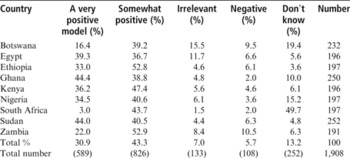
A striking result emerged in putting the country variable into regression equations for all questions: the effects of other variables, except gender, vanished. Variation thus mainly came from country differences. Kenyans, Sudanese and Ethiopians were most consistently positive about China–Africa links, Batswana and Zambians most negative, and Nigerians, Ghanaians, Egyptians and South Africans in between (Table 1). Except in South Africa, majorities in all countries viewed China's development as a positive model. As South Africa has a much higher per capita GDP than China,Footnote 26 respondents there tended not to see China's development as a model for emulation. Ethiopians (86 per cent), Sudanese (85 per cent), Kenyans (84 per cent) and Ghanaians (83 per cent) were most positive, with Zambians (75 per cent) and Batswana (56 per cent) somewhat less so.
For Your Country, is China's Path of Development

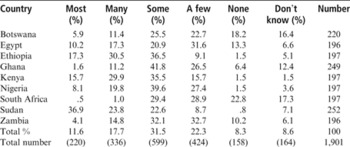
Ethiopian, Sudanese and Kenyan respondents (84 per cent, 83 per cent, 81 per cent) perceived that China has most, many or some common interests with Africa. South Africans, Batswana and Egyptians were least enthusiastic (31 per cent, 43 per cent, 48 per cent). Half of Zambian respondents saw most, many or some common interests with China; those who saw few or none often cited a fear of China reducing its population by sending migrants to Africa and/or cultural differences, mainly a supposed Chinese habit of keeping to themselves (Table 2).
How Much of China's and Africa's Interests are in Common?

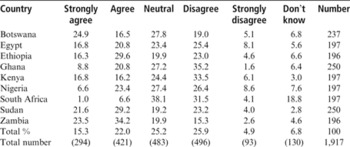
Zambia (58 per cent) and Sudan (51 per cent) top the list in strongly agreeing or agreeing that China is only interested in Africa's natural resources, followed by Ethiopia (46 per cent) and Botswana (41 per cent). Responses from Egypt, Kenya and Nigeria are divided between agree, disagree and neutral/don't know, but only 7.6 per cent of South Africans agree (Table 3). Zambia and Sudan are the two countries with large investments from China in natural resource industries. There is proportionately little Chinese investment in South Africa and little to modest Chinese investment in natural resources of the other countries.
China is Just in Africa for Natural Resources

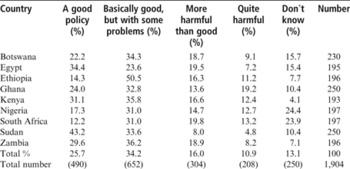
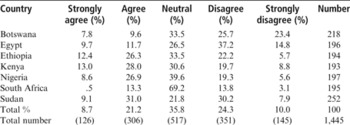
In each country, more people strongly approve or approve of “non-interference” than strongly disapprove or disapprove. Sudan is highest (77 per cent), but Botswana, Ethiopia, Egypt, Kenya and Zambia have roughly twice the proportion of approvals than disapprovals. Majorities approve in seven countries. South Africa and Nigeria have a narrower approval rate margin and many people chose “don't know” (Table 4).
For Africa, China's Policy of “Non-interference” Is

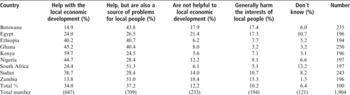
Western media emphasize the negative impact of Chinese small businesses in Africa, on the assumption that Chinese merchants take jobs from local people.Footnote 27 In all the countries we surveyed, however, most respondents viewed Chinese small businesses as providing help or problematic help to local economic development (Table 5). Kenya, Ghana, Nigeria and Sudan had more people choosing “help with the local economic development” than any other category, but only Kenya had this perspective as the majority view (60 per cent). Elsewhere, the presence of Chinese small merchants is viewed in conflicting ways. In Botswana, South Africa, Ethiopia, Egypt and Zambia, most respondents – with majorities in South Africa and Zambia – see the presence of Chinese small merchants as both a help and a source of problems for local people.
My View of Chinese Small Businesses in My Country Is That They

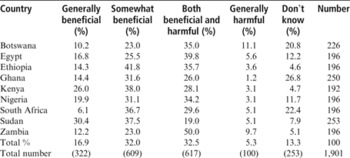
In seven of the nine countries – the exceptions are Botswana and Zambia – more people view China's policies in Africa as generally or somewhat beneficial than otherwise (Table 6). Such respondents are majorities in Sudan (68 per cent), Kenya (64 per cent), Ethiopia (56 per cent) and Nigeria (51 per cent). In Botswana and Zambia, however, most people (35 per cent and 50 per cent) chose “both beneficial and harmful.” While only 5.3 per cent of respondents on the whole chose “generally harmful,” a significant percentage in each country view China's policies as “both beneficial and harmful.”
China's Policies in the Continent Are

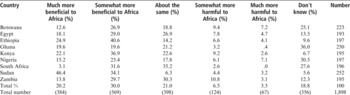
In all countries, more people view China's policies in Africa as much more or somewhat more beneficial than Western policies, with majorities in Sudan (80 per cent), Ethiopia (65 per cent) and Kenya (59 per cent) (Table 7). Botswana and Zambia, although more critical of China's policies on the continent (see Table 6), had more than twice the number choosing much more or somewhat more beneficial than choosing somewhat more or much more harmful. However, a significant minority of respondents in all countries except Sudan viewed Chinese and Western policies as about the same.
China's Policies in Africa Compared with Western Policies Are

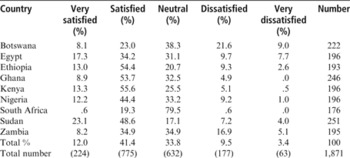
In all countries more people feel very satisfied or satisfied than dissatisfied or very dissatisfied with Chinese projects (Table 8). This is the majority view in Sudan (72 per cent), Kenya (69 per cent), Ethiopia (67 per cent), Ghana (63 per cent), Nigeria (57 per cent) and Egypt (52 per cent). The neutral position (“neither satisfied nor dissatisfied”) is a significant minority view in all countries and the most represented viewpoint in South Africa and Botswana.
Satisfaction with Chinese Companies that Work on Large Projects in My Country

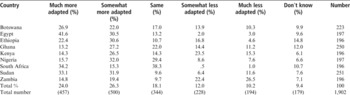
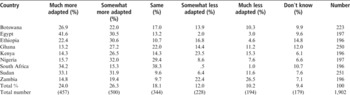
Chinese have been in Africa for a much shorter time than Westerners. Many live and work in remote areas, as infrastructure builders or small merchants, and most do not speak much of the European or native languages used in their host country. Thus it is remarkable that all countries except Zambia had more respondents who perceive Chinese as much more or somewhat more adapted than Westerners to local societies (Table 9). This perception is the majority view in Ethiopia (53 per cent) and is most pronounced in the two Muslim countries in the survey – Egypt (72 per cent) and Sudan (65 per cent). Kenyan respondents are almost evenly divided between two opposing views.
Adaption of Chinese to the Local Society, Compared to Westerners

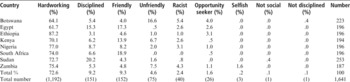
Majorities in all countries are impressed by the Chinese as hardworking. While Botswana and Zambia have 16.6 per cent and 7.5 per cent of respondents who think Chinese unfriendly, 18.9 per cent of South Africans, 17.3 per cent of Egyptians and 13.9 per cent of Kenyans have Chinese friendliness as their second choice. Chinese racism is the least remarked upon (Table 10).
What is Your Impression of the Chinese Present in Your Country?

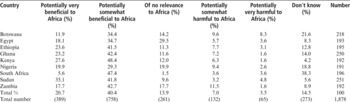
All nine countries have more people who think the rise of China is potentially very beneficial or beneficial to Africa than otherwise (Table 11). This is the majority view in seven countries, with the highest figures for Sudan (77 per cent) and Kenya (76 per cent). Nigeria (49 per cent) and Botswana (46 per cent) have a near-majority positive view about China's rise.
What Effect Do You Think China as a Rising Power Will Have on Africa?

“Some people say China practises neo-colonialism” is the most controversial of our questions (Table 12). It is confusing, as the question hinges on the concept of neo-colonialism, which lacks a definition for respondents and is, in the international media, often reduced to the exchange of manufactured goods for raw materials.Footnote 28 Respondents are thus left to their own varied understandings of the concept, with more in five of the countries – Botswana (51 per cent), Ethiopia (56 per cent), Egypt (39 per cent), Ghana (45 per cent) and Nigeria (54 per cent) – choosing “neutral” or “I don't know” than picking another position. More people in Botswana, Zambia and Egypt agree or strongly agree than disagree or strongly disagree. In six other countries, more disagree with this view. Interestingly, a majority in Sudan (60 per cent), the African country over which Western politicians and media claim China has the most influence, negate this view.Footnote 29
Some People Say China Practises Neo-Colonialism in Africa

Native opposition to migration and migrants is common, including in liberal Europe.Footnote 30 Among the seven countries where the question “Some people say increased Chinese migration would benefit Africa” was posed, Botswana, South Africa and Egypt are more negative than positive about Chinese migration (Table 13). There is a majority or near majority view in Egypt (52 per cent) and Botswana (49 per cent). Most in South Africa (69 per cent), however, were neutral, despite recent xenophobic attacks against African migrants there. Sudanese (40 per cent) slightly favour Chinese migration, while Kenyans (41 per cent), Ethiopian (39 per cent) and Nigerians (36 per cent) are about 10 per cent more positive than negative. Significant percentages of people in all countries take a neutral position. Note that the question is put in terms of increased Chinese migration; those who disagree with that may still be fine with current levels of Chinese migration.
Some People Say Increased Chinese Migration Would Benefit Africa

General observations
Our findings in the main agree with those of the random sample surveys, but are based on a much wider range of questions that relate directly to the international discourse and were asked in some countries where views had yet to be surveyed. Kenya, Sudan and Ethiopia respondents were generally most positive about China's links, development and policies. Positive perceptions in Sudan and Ethiopia of China's development, rise and common interests with Africa are, however, accompanied by perceptions that China is only in Africa for natural resources.
Botswana, Zambia and South Africa are held up in Western discourse as exemplars of negativity about China, but even in these countries and among university people expected to dissent from state perspectives, our survey shows that approval rates are generally higher than disapproval rates. For example, while Zambians have a more negative perception of China's policies in the continent, adaptation to local society and neocolonialism, they perceive considerable common interests between China and Africa (51 per cent), show enthusiasm about China's rise (60 per cent) and are more positive (66 per cent) about China's “non-interference” policy than those in five of the other countries.
Explaining national variations in our survey findings
Chinese policies and practices are adapted to national conditions, but are similar across Africa: infrastructure building, growing exports of African primary goods and imports of Chinese machinery and consumer goods, increased Chinese migration, and so on. We argue that rather than directly flowing from differing interactions with China, national attitudinal differences are mainly accounted for by parties making China–Africa links an electoral issue. International media influence, discussed below, is also significant, but secondary.
Because space limitations preclude examining politics in all countries surveyed, we focus on two more “negative” cases, Zambia and Botswana, and one of the most “positive,” Sudan. Ethiopians, Kenyans and Sudanese are all generally quite positive about China–Africa links, and political oppositions in their countries have not made these links an issue. Because international media have focused on Sudan, we compare it with Zambia and Botswana. Before turning to these cases, however, we need to touch briefly on the hegemonic presence of Western media in many African countries.
That Western media portray Africa as a series of disasters is often decried,Footnote 31 yet their hegemony in reportage and the shaping of journalists' worldviews remains.Footnote 32 One study has found that “the continent depends on the Western media and news agencies in particular for much of its knowledge of not only foreign affairs, but also African news.”Footnote 33 The then-president of South Africa, Thabo Mbeki, said in 1997:
For far too long we have relied on others to tell us our own stories. For that long we have seemed content to parrot the words and stories of others about us as if they were the gospel truth … Even when African broadcasters participate in the dissemination of news, it is always in the context of stories filed by foreign news agencies, with headquarters in Atlanta, New York, London …Footnote 34
A study of 543 stories on Africa from news agencies published in Ghana's two largest daily newspapers between May and July 2006 found that 64 per cent were from the BBC, 13 per cent from the Ghana News Agency and 23 per cent from other agencies.Footnote 35
Western media tend to be more negative than not about China–Africa links, as Cambridge University political geographer Emma Mawdsley found. She examined 230 British newspaper articles and found four narrative tropes “act to systematically endorse images of African weakness, Western trusteeship and Chinese ruthlessness”: “A tendency to homogenize China and Chinese actors … a decided preference for focusing on China's negative impacts on the continent … a tendency to portray Africans as victims or villains [and] a frequently complacent account of the role and interest of different western actors in Africa.”Footnote 36 Her study indicates that news articles in respected British broadsheets are mainly positive about Western actions in Africa and disparaging about Chinese activities. Media depictions of Chinese activities in Africa are influential: for example, a mid-2007 survey of Americans, most of whose knowledge of China–Africa links necessarily derives exclusively from the media, found that half regarded China's influence in Africa as a threat or a strong threat to the United States.Footnote 37
Western media depictions, including those that re-appear in local media, are likely to have a negative influence on African perspectives of China–Africa links. Most respondents in our sample are bound to form some understanding of such links largely through Western sources. Asked their chief source of information about China and the Chinese, half said international media – which in most African countries means Western media – 30 per cent chose local media and 20 per cent other sources (academic, personal, Chinese). Our university-connected sample is much more attuned to international media than are Africans generally, who “get their information about public affairs principally by listening to [local] news broadcasts on the radio.”Footnote 38
Despite what international media suggest, our findings show Africans are on the whole inclined to favour links with China. Yet, while these media are not determinative of how Africans think, their influence cannot be ignored, particularly when they amplify the voice of domestic opposition parties that play the China card.
Zambia
Zambia has rich resources, but 80 per cent of its people live below the poverty line and formal employment is 20 per cent. The neo-liberal Movement for Multi-Party Democracy (MMD) has ruled since 1991. President Levy Mwanawasa (2001–08) implemented “economic austerity and market-opening policies [that] drew support from the US, the World Bank, and lending institutions,” but also held that Africa needs China's aid.Footnote 39
International media depict Zambians as anti-Chinese mainly because the leader of the large opposition Patriotic Front (PF) party, Michael Sata, made the Chinese presence an issue in the 2006 presidential elections. As a minister in MMD governments associated with corruption and economic liberalization, Sata won just 2 per cent of votes in the 2001 presidential elections. He then became a “populist”Footnote 40 and in the 2006 election “campaigned on an explicitly anti-Chinese ticket,” arguing that Chinese are the “new colonizers of Africa.”Footnote 41 As a state official, he had praised the Chinese government during visits to China,Footnote 42 but ten months before the 2006 elections, he warned business people of Indian, Lebanese and Chinese origin that he would deport them if he took power.Footnote 43 In the final run-up, Sata focused on anti-Chinese mobilizationFootnote 44 and received contributions from Taiwanese business people in neighbouring Malawi. He stated that if elected he would recognize Taiwan and break ties with the PRC.Footnote 45
Sata lost the election, but won 29 per cent of the vote. The MMD, other opposition parties and the International Fellowship of Christian Churches criticized his anti-Chinese remarks.Footnote 46 He nevertheless won majorities in Lusaka and urban Copperbelt, which Zambian political scientist Neo Simutanyi attributed to Sata's mobilization of anti-Chinese sentiment.Footnote 47 His popularity was cited as indicative of the rising anti-Chinese sentiment in African countries that is fostered by politicians who “use the China card.”Footnote 48
The PF deputy leader, Guy Scott, has stated: “The Chinese are no longer welcome. They are seen as cheats and our government as crooks for allowing them to get away with it.”Footnote 49 In 2007, Sata engineered the expulsion from the PF of Lusaka's mayor and the loss of her post because she took part in an official welcoming party for China's President Hu Jintao.Footnote 50 He solicited funds from the Taiwan government to travel to London and Boston, where he argued that European colonialism was more benign than China's presence in Zambia and claimed 80,000 Chinese in Zambia had been issued work permits, although Zambia's Ministry of Home Affairs said Chinese had received only 2,340.Footnote 51 Sata spoke of a Chinese invasion and said he wants “any investment, but not Chinese human beings.” Most Chinese in Zambia, he averred, are “prisoners of conscience.”Footnote 52 Sata has vowed “to attack the Chinese all over the world”Footnote 53 and his “anti-China platform” continues to be cited sympathetically, especially in British media, despite his backing of Zimbabwean President Robert Mugabe and denunciation of Zimbabwean opposition leaders as Western puppets.Footnote 54
In April 2008, after receiving post-coronary medical aid facilitated by Mwanawasa, Sata announced his reconciliation with the president. Interviewees in Zambia in July 2008 told us he had mellowed; a PF leader in the party's Copperbelt stronghold said this applied to attitudes towards China as well. In an interview given at the same time, however, Sata said that “the Chinese are not here as investors, they are here as invaders … It is not only Zambia – it's all Cape to Cairo where the Chinaman is.”Footnote 55
Soon afterward, President Mwanawasa died and a presidential campaign loomed. Sata sought to reassure international and domestic elites of Zambia's stability.Footnote 56 He said he would not attack the Chinese because “we need their investments, we need their technology.”Footnote 57 Challenged about his changed stance, Sata stated it was “because the Chinese authorities were now working with authorities from Taiwan.”Footnote 58 Most remarkably, when Sata filed presidential nomination papers in September, he listed a debt of 45 million kwacha (about US$12,000) to the China Henan company, a mainland construction firm active since the late 1990s in key Zambia infrastructure projects.Footnote 59 He also stated that he would employ local youths on roads being constructed by Chinese firms, working under Chinese supervisors.Footnote 60
Our survey was done at the University of Zambia. Early in his presidential campaign, Sata had run-ins with student leaders, because he refused to take seriously their demands for increased financial support.Footnote 61 The university however is known as a PF stronghold, precisely because of conflicts with the government over resources. Prominent academics there endorsed Sata's candidacy and wrote the PF manifesto.Footnote 62
Zambian media heavily draw their international news, including about Africa and its links with China, from Western sources.Footnote 63 These sources may or may not play a greater role in Zambia than in other Anglophone African states. However, because Zambia's main opposition party has stridently played the China card, Western media have had intense and largely negative coverage of the Chinese presence in Zambia, creating a mutually reinforcing relationship between them and the opposition. This relationship, as well as Zambian Western-centricity, are probable factors in making the scapegoating of the Chinese in domestic politics coincide with Western anxieties about China's increasing involvement in the country.Footnote 64 Much the same process in which Western media and local opposition politicians have reinforced each other with regard to the “Chinese problem” can be found elsewhere in southern Africa.Footnote 65
Botswana
The one African “success story” neo-liberals cite is Botswana. With a diamond-rich territory larger than France and 1.8 million people, it is a stable, effectively one-party state at an upper middle level of development,Footnote 66 but with 20 per cent of its people jobless, a quarter living on US$1 a day and an equal proportion HIV positive.Footnote 67
From independence in 1966, the country has been ruled by the Botswana Democratic Party, which is solidly neo-liberal but regards the Chinese Communist Party as a “longtime political ally.”Footnote 68 At the 2006 FOCAC, President Festus Mogae, whose approach to governance and human rights “have endeared him to the British,”Footnote 69 stated, “China treats us as equals, while the West treats us as former subjects.”Footnote 70 The two main opposition parties together got almost half the vote in Botswana's 2004 elections. They often derogate China and the Chinese, as do media that tend to favour these parties, such as the Mmegi and Voice newspapers.
According to China's ambassador, ten of the country's 57 MPs have “worries or complaints about Chinese nationals here.”Footnote 71 The most vocal are from the opposition Botswana National Front (BNF), which has 11 MPs. Its founder Kenneth Koma admired Mao Zedong and it nominally endorses socialism.Footnote 72 It has said, however, that China is engaged “in the scramble for control of Africa.”Footnote 73 BNF MP Mephato Reatile has stated that he recognizes the sovereignty of Taiwan, which he claims “can invest in Botswana to create jobs, unlike China, which … only sees us as the market for its processed goods.” While a BNF spokesman distanced the party from Reatile's remarks, they were nevertheless compared to those of Michael Sata in Zambia.Footnote 74
MP Akayang Magama, a former BNF secretary-general, has said Chinese firms use short-term employment contracts to avoid benefits, “treat their employees like slaves” and bribe labour officers.Footnote 75 The most prominent BNF MP, Robert Molefhabangwe, has decried “shoddy jobs” by Chinese contractors and complains of “unwelcoming behaviour by some Chinese nationals.”Footnote 76 Chinese contractors, he says, practise deceit, are “rejects,” and “maybe … are sent to our country because they are a political embarrassment and a nuisance of some sort.”Footnote 77 He has stated that though people are concerned about Zimbabweans in Botswana, Indians and Chinese are also a problem and while Zimbabwe may someday help Botswana, India and China will not.Footnote 78
Botswana's third largest party, the Botswana Congress Party, won 16 per cent of the vote in 2004, but has only one MP. Dumelang Saleshando is, however, parliament's most outspoken member and has said that Botswana is experiencing a “flood” of unskilled Chinese labourers. Chinese are digging trenches at construction sites, and even in remote rural areas are doing jobs Batswana could do. He alleges that concessional loans from China are conditioned on only Chinese construction firms being allowed to tender on resulting projects, thereby depriving Batswana of contracts, and “lament[s] the harsh working conditions Chinese contractors subject Batswana labourers to.”Footnote 79
A Botswana Democratic Party MP has addressed the same issues of “the Chinese” raised by opposition politicians, but in a less inflammatory way. Responding to constituents who complain of exploitation by Chinese construction firms, Kavis Kairo holds that Batswana–Chinese labour conflicts result from language, cultural and work ethic differences. He proposes that foreign firms whose personnel do not speak English or Setswana be compelled to hire interpreters, and seeks to involve the Labour Commission more in disputes.Footnote 80
China's representatives assert that a wide variety of Chinese businesses employ 15,000 locals.Footnote 81 The ambassador has said it is hard to find skilled Batswana workers, who in any case refuse to work the long hours needed in construction, that the Chinese brought in are skilled and transfer skills to locals, and that it would be irrational to bring unskilled people from China. He has complained that Botswana authorities delay in issuing work permits, argues that Chinese small shops in rural areas are providing farmers with affordable goods for the first time and that 2,000 Batswana retailers visited China in 2007 to buy goods, and accuses local media of bias and inaccuracy.Footnote 82
Botswana's newspapers contain a surfeit of headlines and content that invite readers to draw “anti-China” and “anti-Chinese” conclusions.Footnote 83 They draw upon Western sources for their international analysis; indeed, some were founded or are managed by British or South African whites. The primary domestic sources for local journalists on politically charged questions tend to be politicians, as well as academics tied to opposition parties. Scholars at the University of Botswana, where our survey was done, are a strong power within the opposition BNF.Footnote 84
Sudan
Sudan is territorially the largest African state and China its largest investor, with $8 billion in 14 energy sector projects alone.Footnote 85 Chinese firms led the effort, with Malaysian, Canadian, Sudanese and later Indian partners, to build, in a decade, a structure for petroleum exploration, production, refining, transport and sales.Footnote 86 China National Petroleum Corporation (CNPC) has a 40 per cent stake in Sudan's largest oil firm, the Greater Nile Petroleum Operating Company; the remainder is owned by Indian (30 per cent), Malaysian (25 per cent) and Sudanese (5 per cent) firms.Footnote 87 CNPC also owns 41 per cent of Petrodar, the next largest consortium, along with the Chinese firm Sinopec (6 per cent), and Malaysian (40 per cent), Sudanese (8 per cent) and Gulf (5 per cent) firms. Some estimates are that Sudan has six decades of reserves,Footnote 88 but those presently proven (6.4 billion barrels) cannot last nearly that long.Footnote 89 CNPC claims to have provided jobs to more than 100,000 SudaneseFootnote 90 and that 50 per cent of its Sudan revenues go to Sudan's government.Footnote 91
Sudan's $4 billion in exports to “China” in 2007 included 40 per cent of the oil Sudan produced,Footnote 92 but contrary to media depictions, China's African oil is not mostly from Sudan. Of the 31 per cent of China's 2006 oil imports that came from Africa, Angola's share was 14 per cent, Sudan's 5 per cent, Congo (B)'s 4 per cent, and Equatorial Guinea's 3 per cent.Footnote 93 Even if all oil Chinese firms produce in Sudan went to China, it would be less than 2 per cent of China's consumption.Footnote 94 In fact, most of this equity oil goes to the world market.Footnote 95 No more than 45 per cent of China's 2006 equity oil from Sudan went to China,Footnote 96 less than the China-produced Sudan oil that went to Japan.Footnote 97 Thus, while China's access to Sudan oil is an issue in the West, based on the argument that it helps finance the Darfur war, it is not generally a question in Sudan, whose oil will always sell in a tight world market. Some Sudan opposition parties do however criticize China's political support of the regime on the Darfur issue, because it helps keep a weak government in power.Footnote 98
Chinese arms sales are also an issue for some. China's share of the international arms trade is 2 per cent and declining, but it is one of seven countries that sell arms to Sudan.Footnote 99 Western media portray it as Sudan's main arms seller, but from 2000 to 2007 China accounted for just 7 per cent of the value of arms sold to Sudan, while Russia's share was 87 per cent.Footnote 100 Sudan is also the third largest African producer of conventional weapons,Footnote 101 but China is Sudan's largest seller of small arms and some end up in Darfur. Criticism is naturally strongest among Darfur rebel groups.Footnote 102 Elsewhere in Sudan, however, many people accept China's arguments that there is no United Nations embargo on arms sales to Sudan, that arms purchases allow Sudan a “legitimate defence” against external foes (the US and Chad), and that given its stake, China seeks stability.Footnote 103
Despite Sudan's authoritarian regime, Sudanese can “be very critical of foreign powers, including China.”Footnote 104 There have been complaints about Chinese construction firms, traders and dumping.Footnote 105 None of Sudan's opposition parties (Democratic Unionist Party, Umma, Popular Congress Party), however, has made an issue of overall links with China. The autonomous government of southern Sudan, which many predicted would be anti-China because of arms sales to Khartoum during the decades-long civil war that ended in 2005, has not become so. Instead, in 2007, it agreed that China would build hydro-electric facilities, housing, roads, refineries, stadiums and cultural centres, and in 2008 China opened a consulate in southern Sudan.Footnote 106
Sudan's opposition has not generally played the China card because they deem other issues not directly related to the Chinese presence to be important, such as the unequal regional development that has precipitated civil wars in several parts of the country. Umma and the Democratic Unionist Party have also sought to reconcile with the ruling National Congress Party.Footnote 107 China is widely seen as having rapidly developed the country's oil industry and infrastructure, contributing to prosperity for upper and middle class Sudanese.
Western media have less influence in Sudan than in much of Africa. While English is common in the south, Arabic is the main language elsewhere. Sudan's regime is also authoritarian and isolated by Western states, except in its co-operation with Washington in the “global war on terror.” One study has found that “the government of Sudan tightly controls the broadcast media in Sudan to limit domestic debate over policy in Darfur and southern Sudan”Footnote 108; yet these subjects are publicly debated by political parties. Links with China are not much debated in Sudan's media, however, but this is probably less a result of repression as the absence of a critique by the parties.
These and other cases should be understood as indicating that wide latitude exists among Africans for interpreting China–Africa relations, but that the dynamics of national political mobilization, in which media sometimes play a catalysing role, often shape perspectives. Kenyans, for example, are at least as exposed to Western media influence as Zambians, and Kenyan media advance substantial criticisms of Chinese activities. Yet Kenyans have a very positive view of China's presence, chiefly because Kenyan political parties do not play the China card. In Nigeria, moreover, not only are political parties not “anti-China” but local media have not highlighted the Chinese presence as a problem.Footnote 109
This is not to argue that Africans are passive consumers of politics and media, but instead to underscore that, as in all parts of the world, political judgements and articulations in Africa are often not automatically derived from everyday experiences but are open to intervention and mobilization by larger political and media forces. For example, Zambian mine workers experience low pay and lack of safety measures at Chinese and other foreign-owned mines. Whether these experiences are articulated as a common issue of exploitation of labour or are seen in a racist way as an essential “Chinese” trait largely depends on what kind of framework has been created within the national political discourse. Even in Zambia, where Sata had strenuously campaigned on an anti-China platform, some mine workers have nuanced views of the Chinese presence, as Ching Kwan Lee shows in this volume.Footnote 110
Conclusion
In early 2007, when few surveys of how Africans see China–Africa links were available, a US newspaper carried an article on Africans' negative views of those links. It quoted Michael Sata, who said “Zambia is becoming a province – no, a district – of China,” and an Africa specialist, who stated “among ordinary [Africans], a very strong resentment, bordering on racism, is emerging against the Chinese. It's because the Chinese are seen as backing [African] governments in oppressing their own people.”Footnote 111 Sata's statement was part of his mobilization strategy and probably taken as such by non-partisans. The article's author, however, was not necessarily non-partisan: he chose Sata from among legions of African politicians. The scholar's statement was likely to have been a synecdoche, taking a part for the whole, reflecting what he observed among part of the populace in one or two African states.
Survey research does not bear out claims of strong African resentment. Even in states where politicians play the China card, there is more appreciation than not of China's role in Africa and China fares well compared to the West. It is also not clear that most Africans distinguish oppressive pro-China ruling elites and China-critical people's paladins, as do Western media. Surveys thus also tell us something of how the media interpret and seek to mould African perspectives: the media hesitate to acknowledge that Africans may see Chinese practices as more advantageous than those of the West, and imply that if Africans do see it that way, it is due to collusion and obfuscation by “the Chinese” and their African clients.
There are reasons why most Africans may be positive about China–Africa links. As a 2008 World Bank report details, China cheaply and efficiently builds much of Africa's infrastructure.Footnote 112 Chinese retailers also sell the Africans goods that many could not previously afford. A scholar has noted: “African consumers benefit from cheap products offered by Chinese firms. For instance, Chinese plastic sandals conquered the whole African continent in the last years. That changed the daily life of African women and children enormously in that way that going shoeless is [in] the past in poor African countries.”Footnote 113
Additional reasons why Africans may favour links with China exist and can be adumbrated from responses to our open survey questions. There is a boom in primary product exports to China from some African states, while earlier evident harm from Chinese competition with African exports to third countries has largely dissipated.Footnote 114 China presents for some Africans an example of development fostered by encouraging domestic savings, the factor most likely to sustain growth.Footnote 115 In contrast to Western aid, China's is not politically conditioned and, contrary to the prevailing discourse, its non-intervention policy may make China more, rather than less, popular among common Africans, as it obviates political obstacles to the speedy delivery of infrastructure.Footnote 116 China has no history of colonialism and has not recently invaded other states. It has supported developing country attempts to redress grievances such as subsidies that impair their exports.Footnote 117 Whether such understandings of Chinese practices are accurate is less significant than their being plausible enough to be found among many Africans we interviewed during seven research trips to nine African countries between 2005 and 2008.
It remains to be seen whether positive African perceptions of China–Africa links persist. Playing the China card has not proved sufficient to smooth a road to power for oppositions, as the Zambia case illustrates. In the future, playing it may not even be feasible, as the fruits of Chinese infrastructure building are realized, fewer Chinese and more Africans retail made-in-China goods, Chinese foster industrial enterprises, and China's leaders accept that arms sales are a reputational risk. Western media influences in Africa may also decline as other sources gain acceptance.
Research on African perspectives on China–Africa links should take in a wider range of countries and ask more about grassroots concerns, such as contributions to development. Because China–Africa interactions are rapidly evolving, it would be useful to have panel data, with multiple dimensions over time. Klaus Schwab, the World Economic Forum founder, has said “the world needs Africa as much as Africa needs the world,” but a Chinese scholar observed that “while Africa needs China, China needs Africa more.”Footnote 118 Knowing African perspectives on China–Africa links has thus become essential to understanding China's place in the world.