Paediatric metabolic syndrome is becoming as an emerging health problem even in low- and middle-income countries.Reference Kelishadi1 It is independently associated with arterial endothelial dysfunction and wall thickening, key early events in atherogenesis and markers of arterial damage that precede plaque formation. Atherosclerosis is a complex multifactorial disease, the earliest stages of which are known to commence in childhood.Reference Woo, Chook and Yu2
Patients with metabolic syndrome are at considerable risk for developing atherosclerosis-related diseases, including a two- to fourfold increased risk of stroke and a three- to fourfold increased risk of myocardial infarction compared with those without metabolic syndrome.Reference Sola, Mir and Cheema3
Lifestyle interventions, including healthy diet, have been shown to affect endothelial function.Reference Davis, Katz and Wilie-rosett4, Reference Hamdy, Ledburg and Mullooly5 Improvement of endothelial dysfunction is a potential mechanism by which antioxidants in the diet may prevent cardiovascular events.Reference Esposito, Nappo, Giugliano, Giugliano, Marfella and Giugliano6 The evidence suggests that those individuals with the highest flavonoid intake have modestly reduced risks for cardiovascular disease.Reference Beauloye, Zech, Tran, Clapuyt, Maes and Brichard7–Reference Vita9 Flavonoids are polyphenol derivatives of 2-phenyl-1-benzopyran-4 to 1 and are present in fruits, nuts, and seeds.Reference Sola, Mir and Cheema3 Pomegranate juice may have anti-atherosclerotic properties in mice and humans. It contains antioxidants such as soluble polyphenols, tannins, and anthocyanins, and may decrease carotid artery intima-media thickness after 1 year in humans.Reference Chou, Keevil, Aseschlimann, Wiebe, Folts and Stein10 Furthermore, the flavonoids found in grape juice are shown to be powerful antioxidants that improve endothelial function.Reference Sumner, Elliott-Eller and Weidner11
Considering the increasing prevalence of metabolic syndrome in youths and its association with endothelium dysfunction, and the lack of studies on the effect of dietary antioxidants on endothelium function in children and adolescents with metabolic syndrome, the present study aimed to determine the short- and long-term effects of the consumption of grape and pomegranate juices on endothelium function in adolescents with metabolic syndrome, and to compare the effects of these two kinds of juices.
Methods
Participants
This randomised controlled clinical trial was conducted in January and February, 2008 among 30 adolescents, aged 12–15 years, with metabolic syndrome. We used the definition of the International Diabetes Federation for paediatric metabolic syndrome, which includes the clustering of obesity, waist circumference equal to or more than age- and gender-specific 90th percentile; triglycerides equal to or more than 150 milligrams per deciliter; high-density lipoprotein-cholesterol less than 40 milligrams per deciliter; and systolic blood pressure equal to or more than 130 millimetre mercury, and or diastolic blood pressure equal to or more than 85 millimetre mercury, and fasting blood glucose equal to or more than 100 milligrams per deciliter.Reference Ford, Li, Zhao, Pearson and Mokdad12
By considering α = 0.05 and a power level of 0.8, the sample size was calculated as 14 in each group, but considering the attrition of participants during the follow-up period, 30 adolescents, 15 in each group, were included in the trial. Participants were selected through a randomisation procedure from among those children referred by health-care centres and schools to the Obesity and Metabolic Syndrome Research Clinic of the Pediatric Preventive Cardiology Department, Isfahan Cardiovascular Research Center, a collaborating centre of the World Health Organization. Those participants with syndromal obesity, endocrine disorders, the presence of any physical disability, and or history of chronic medication use were excluded from the survey.
The study was conducted according to the Declaration of Helsinki, and was approved by ethics committee of our research centre, National Institute of Health Code: FWA 0000t8578. After providing detailed oral information to children and parents, written informed consent was obtained from the parents of all eligible participants.
Anthropometric measurement and clinical examination
Age calculated from birth until the interview date was recorded. Height and weight were measured to the nearest 0.1 centimetre and 0.1 kilogram, respectively, by calibrated scale and stadiometer, Seca, Japan, with participants barefoot and lightly dressed. As a measure of obesity, body mass index was calculated as weight in kilograms divided by the square of height in metre. Waist circumference was measured at a point midway between the lower border of the rib cage and the iliac crest at the end of normal expiration.13 Blood pressure was measured using mercury sphygmomanometers after 5 minutes of rest in the sitting position. The participants were seated with the heart, cuff, and zero-indicator on the manometer at the observer’s eye level. All reading was taken in duplicate in the right arm. The readings at the first and fifth Korotkoff phase were taken as systolic blood pressure and diastolic blood pressure, respectively. The average of the two time measurements was recorded and analysed.14
Participants were instructed to fast for 12 hours before the screening, and compliance with fasting was determined by interview on the morning of the examination. One parent accompanied his/her child. Blood samples were taken from the left antecubital vein between 8:00 and 9:30 am. The blood samples were centrifuged for 10 minutes at 3000 revolutions per minute within 30 minutes of venipuncture. Fasting blood glucose, total cholesterol, high-density lipoprotein-cholesterol, low-density lipoprotein-cholesterol, and triglycerides were measured by an enzymatic method using an auto analyzer; Hitachi, Japan. High-density lipoprotein-cholesterol was determined after dextran sulphate–magnesium chloride precipitation of non-high-density lipoprotein-cholesterol.
Study of arterial reactivity
The same cardiologist conducted the measurement of brachial arterial reactivity. Using the method described previously,Reference Kelishadi, Hashemi, Mohammadifard, Asgary and Khavarian15 the diameter of the brachial artery was measured from high-resolution B-mode ultrasound images – ALOKA 5000 system, 7.5 megahertz transducer – at rest as basal brachial dimension, 90 seconds after cuff deflation in response to reactive hyperaemia, endothelium-dependent dilation or flow-mediated dilation, again at rest, and 3 to 4 minutes after receiving 400 micrograms sublingual nitroglycerin producing endothelium-independent dilation. The percent change of flow-mediated dilation was calculated as the ratio of the brachial artery diameter after reactive hyperaemia to the baseline diameter; similar calculation was carried out for nitroglycerin-mediated vasodilation.
The experiments were conducted in a quiet environment, and no significant changes in heart rate or blood pressure were observed. The cardiologist conducting the sonographic studies was not aware of the groups to which the participants had been assigned.
Intervention
After baseline testing, the participants were randomly assigned to two groups of equal number, by computer-generated random numbers using the children’s record’s numbers in our clinic. One group was asked to drink 18 millilitres per kilogram per day of natural grape juice,Reference Chou, Keevil, Aseschlimann, Wiebe, Folts and Stein10 and the other group was asked to drink 240 millilitres per day of natural pomegranate juiceReference Sumner, Elliott-Eller and Weidner11 for 1 month. Emphasis was placed on using homemade juice without added sweetener, rather than the concentrated juice that usually has a high-calorie content. Compliance with regular consumption of the recommended type of juice was determined by weekly phone calls to the participants’ homes, and by visiting the participants every 2 weeks.
The measurement of basal brachial dimension, flow-mediated dilation, and endothelium-dependent dilation was carried out before drinking grape and or pomegranate juices, and was repeated 4 hours and 1 month after regular consumption of these juice, in order to assess the acute and long-term effects of juice on endothelium dilation, respectively. The whole programme was offered free of charge.
Statistical analysis
Descriptive data are expressed as mean plus or minus standard deviation. Baseline characteristics and changes after intervention were assessed by Wilcoxon signed-rank test. The prospectively defined primary end points of the study were endothelium-dependent dilation and flow-mediated dilation and their changes after intervention. Statistical analyses were performed by Statistical Package for Social Science for Windows, version 15.0; SPSS Inc., Chicago, IL, USA, by using the Mann–Whitney U-test. Statistical significance was inferred at a two-tailed probability value of p less than 0.05.
Results
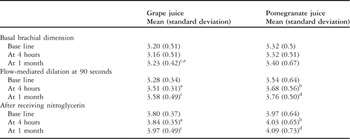
The study had no dropouts. The mean, standard deviation, age of participants was 13.4 (1.1) years. The mean, standard deviation, body mass index was 27.1 kilogram per square metre, corresponding to more than the 95th percentile, and there was no significant change after the trial. Flow-mediated dilation at 90 seconds and after nitroglycerin improved significantly within 4 hours of drinking juice in both groups. There was also significant improvement after 1 month of regular consumption of the aforementioned juices in both groups, but basal brachial dimension only improved significantly after 1 month of regular consumption of grape juice. Although flow-mediated dilation at 90 seconds and after nitroglycerin showed short- and long-term improvement in both groups, there was no significant difference between the two groups (Table 1).
Endothelium function at baseline, 4 hours and 1 month after daily consumption of grape and pomegranate juices.

No significant difference was found between the grape juice and pomegranate juice groups
ap < 0.05 at 4 hours versus baseline in the grape juice group
bp < 0.05 at 4 hours versus baseline in the pomegranate juice group
cp < 0.05 at 1 month versus baseline in the grape juice group
dp < 0.05 at 1 month versus baseline in the pomegranate juice group
ep < 0.05 at 1 month versus 4 hours in the grape juice group
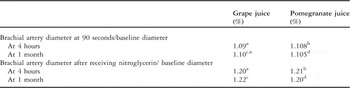
The percent changes in the brachial artery diameter at 4 hours and 1 month after daily drinking grape and pomegranate juices versus baseline diameter are presented in Table 2. The table shows that within each group the percent changes of brachial artery at 90 seconds and after receiving nitroglycerin versus the baseline diameter were significant in both the short- (at 4 hours) and long term (at 1 month). The percent change at 1 month versus 4 hours was significant only in the grape juice group. The percent changes were not significant between the groups.
Percent change in the brachial artery diameter at 4 hours and 1 month after daily consumption of juices versus baseline diameter.

No significant difference was found between the grape juice and pomegranate juice groups
ap < 0.05 at 4 hours versus baseline in the grape juice group
bp < 0.05 at 4 hours versus baseline in the pomegranate juice group
cp < 0.05 at 1 month versus baseline in the grape juice group
dp < 0.05 at 1 month versus baseline in the pomegranate juice group
ep < 0.05 at 1 month versus 4 hours in the grape juice group
Discussion
This study, which to the best of our knowledge is the first of its kind, demonstrates that the daily consumption of natural grape and/or pomegranate juice has acute and long-term benefits on endothelium-dependent dilation and or flow-mediated dilation of adolescents with metabolic syndrome.
Our findings are comparable to those of studies conducted among adults. Sumner et alReference Sumner, Elliott-Eller and Weidner11 have demonstrated for the first time that daily consumption of pomegranate juice for 3 months may decrease myocardial ischaemia and improve myocardial perfusion in patients who have ischaemic coronary heart diseases. The beneficial effects are induced via improvement in flow-mediated dilation or endothelial function. The study by Chou et alReference Chou, Keevil, Aseschlimann, Wiebe, Folts and Stein10 confirmed the beneficial effects of ingesting grape juice on endothelial function of patients with coronary heart disease. Similarly, Stein et alReference Stein, Keevil, Wiebe, Aeschlimann and Folts16 suggested that certain natural antioxidants or flavonoids may exert more dramatic effects on endothelial function, and that ingesting moderate amounts of grape juice each day may improve endothelial function in patients with atherosclerotic vascular diseases. Folts et alReference Folts17 suggested that moderate amounts of grape juice be included among the five– to seven daily servings of fruits and vegetables per day as recommended by the American Heart Association to help reduce the risk of developing cardiovascular diseases.
The inflammatory process associated with childhood obesity appears to play a pivotal role in the development of atherosclerosis.Reference Schwarzenberg and Sinaiko18, Reference Blüher19 We have previously documented that serum markers of inflammation and oxidative stress may be associated with the early inflammatory processes of atherosclerosis.Reference Kelishadi, Hashemi, Mohammadifard, Asgary and Khavarian15, Reference Kelishadi, Sharifi, Khosravi and Adeli20
The pro-inflammatory state of obese children is accompanied by changes in the flow-mediated dilation of the brachial artery, which shows early stages of endothelial dysfunction, and we previously documented that obesity-related oxidative status is reversible with a short-term weight-loss programme in children, even if ideal body weight has not been attained.Reference Kelishadi, Hashemi, Mohammadifard, Asgary and Khavarian15 Several previous studies have documented that antioxidant therapy by supplementation of vitamins can improve endothelial function in children with hyperlipidemia.Reference Mietus-Snyder and Malloy21–Reference Engler, Engler and Malloy22 Although because of the short duration of the trial, adolescents with metabolic syndrome had no significant weight loss, but consumption of natural anti-oxidants resulted to favorable changes in their flow-mediated dilation. This finding might provide new insights into the underlying process of the development of atherosclerosis; moreover it suggests that obese children, especially those with metabolic syndrome, should be encouraged to consume natural anti-oxidants. It is worthy of note that the natural juices used in this trial were homemade, with no added sweetener, rather than the concentrated types with a high-calorie content.
Conclusion
Daily consumption of diets rich in natural antioxidants can improve endothelial function in adolescents with metabolic syndrome. Such beneficial effects should be considered in dietary recommendations for the paediatric age group, notably those with overweight and metabolic syndrome.
Acknowledgements
The study was funded by the Bureau of Research, Isfahan University of Medical Sciences. The authors would like to forward their sincere thanks to all staff working on this project, as well as to the children and parents who participated in the study. The authors have no conflict of interest regarding the study.