1 Introduction
The Western dialect of Naxi (纳 西, a.k.a. Na 纳, Moxie 麽 些, Moso 摩 梭), a Tibeto-Burman language spoken in China, could appear as a textbook example of a level-tone language: each syllable carries a High (ݩ), Mid (-), or Low (ݨ) lexical tone (He & Jiang 1985: 10). A rising lexical tone is also reported on a small set of native monosyllables as well as on numerous (monosyllabic) loanwords, resulting in minimal quadruplets such as the following: /l / ‘to strike’, /la/ ‘tiger’, /l
 / ‘hand’, /l ݩ/ ‘candle’. Rising contours are also created in connected speech by a process of syllable reduction: some monosyllabic morphemes carrying High tone can undergo a form of reduction whereby their segments are deleted and their High tone associates to the preceding syllable. If the latter has a lexical Low or Mid tone, it acquires a rising contour; if it has a High lexical tone, this tone remains unchanged.
This is reminiscent of phenomena found in other languages – typically in languages of the Niger-Congo family, as described by Goldsmith (Reference Goldsmith1976), but also in other families, e.g., among creole languages, in the variety of Saramaccan studied by Good (Reference Good, Booij and van Marle2002) – which are now commonly modelled in terms of association lines between a tonal tier and a syllabic tier, as in (1a, b) below: when syllable σ2 undergoes reduction (full deletion of its segmental contents, i.e. disappearance of σ2 from the syllabic tier), its tone, T2, reassociates to syllable σ1.
-
(1)


Earlier accounts of Naxi (He & Jiang 1985: 15, 54; He 1987: 61) acknowledge only one rising contour. For instance, He & Jiang (1985: 15) state that example (2a) can simplify to (2b).
-
(2)

Both sentences have the same gloss but /t
 / ‘only’ in (2a) appears in a reduced form in (2b). The syllables involved in the reduction process are set in bold for the sake of clarity.
This notation reflects the assumption that the four lexical tones of Naxi are High ˥, Mid ˧, Low-falling  and Low-rising ⋋, and that the elliptical construction (2b) results in the creation of a Low-rising contour identical to the lexical Low-rising tone. By analogy with phenomena observed in Niger-Congo languages and elsewhere, we hypothesise that (i) the ‘Low-falling’ tone of Naxi is simply a Low tone, and (ii) two contours resulting from syllable reduction are to be distinguished, the rising contours observed in continuous speech corresponding either to Low plus High (ݨ ݩ), or to Mid plus High (ˉ´). Thus, (2b) would be transcribed as: /dɯ.ŋiݩ.gȳ.seݨ/. (Note in passing that the sound noted as [ɲ] by He & Jiang 1985 is to be analysed phonemically as /ŋ/, and their [dʑ] as /g/; for details, see Michailovsky & Michaud Reference Michailovsky and Michaud2006.) Likewise, in example (3), from our field data, what is underlyingly a Low-tone morpheme /kh
/ occurs with a rising fundamental frequency contour: in (3b), /kh
/ becomes /kh
ݩ/, bearing a Low-to-High contour. Example (3a) is taken from a dialogue translated from the Chinese; the explicit phrasing, (3b), was later elicited from the same language consultant.
-
(3)

Both sentences have the same gloss but /t/ ‘only’ appears in its unreduced form in (3b). The syllables involved in this process are typographically emphasised for the sake of clarity.
In (3a), the segments of adverb /t/ are deleted, and its tone is reassociated to the preceding syllable, /kh
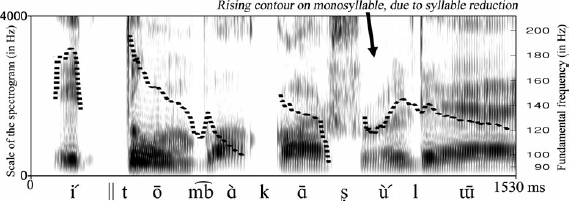
/ ‘moment’; the stylistic nuance is, predictably, that (3a) is more colloquial than (3b). This is frequent in connected speech, as illustrated in figure 1, which shows a spectrogram and fundamental frequency (hereafter F0) tracing of an excerpt from a narrative, (4):
-
(4)

Annotated wide-band spectrogram, with aligned F0, of utterance (4). Speaker M4. Arrow shows rising F0 contour on the monosyllable /ʂùݨ/, resulting from syllable reduction.

In (4), the rising contour on the verb ‘to fetch’ points to an added High tone; this High tone is due to the reduction of the grammatical word /puݩ/. As a verb, /puݩ/ means ‘to bring, to offer’; in its grammaticalised uses, it has been described as a ‘gerundiser’ by Pinson (Reference Pinson1998: 11). A synchronic overview of High-tone syllables that can undergo reduction to a High tone, which reattaches to the preceding syllable, is provided in Michaud (Reference Michaud2006a).
Section 2 describes experiments on High-tone syllable reduction. It is argued that the notions of floating tones and tonal reassociation can be usefully applied to the Naxi data. Section 3 aims at presenting the broader picture of syllable reduction in Naxi by investigating the reduction of Mid- and Low-tone syllables to a coalescent [ ] and [
 ], respectively. This process stops short of complete segmental deletion and ‘tonal de-linking’.
General overview of the research method
The analyses presented in this paper are essentially based on two dialects of Naxi: AS (for /a 

 /) and FK (for /f
 khō/); see Michailovsky & Michaud (Reference Michailovsky and Michaud2006) and Michaud (Reference Michaud2006b) for details. Unless otherwise stated, the utterances cited come from the AS dialect, which belongs to Western Naxi (see He & Jiang (1985: 104–116) on the division between Western and Eastern Naxi). First-hand data from other dialects are also adduced when they yield relevant evidence.
Production data were elicited from one main language consultant for each dialect: a list of 1000 words, 800 sentences translated from Chinese, and narratives. These data were scrutinised for examples of syllable deletion and tonal changes, rephrasings were tested with the language consultant and production and perception experiments involving more subjects (reported in detail below) were conducted to confirm and complement the observations. To obtain a precise measurement of F0 – and indications on voice quality, not reported here – an electroglottographic signal was recorded throughout recording sessions.
2 Experiments on High-tone syllable reduction, establishing a difference between the /MH/ contour and the /LH/ contour
Given that the /LH/ and /MH/ contours are not distinguished in previous descriptions of Naxi (e.g. He & Jiang 1985: 15, 54; He 1987: 61), which only report one rising contour, it appears necessary to provide evidence for the claim made here that they are distinct.
All the production data reported in this paper were elicited from the same language consultant, a native speaker of the AS dialect, aged 56 at the time of the recordings. He will be referred to here as M4, the label assigned in the Naxi database collected over several field trips; this label allows for unambiguous reference. In the course of work sessions, M4 developed an awareness of the tonal change in utterances such as (2a, b) and (3a, b) above. He indicated that there was no homophony between /LH/ and /MH/ sequences. His intuition alone is not sufficient to settle the issue, however. The experimental setup used for confirmation was the following: seven minimal pairs of M- and L-tone predicates (verbs and adjectives), such as: /ndz / ‘eat’, /ndzɯ ݨ / ‘sit’, were recorded in randomised order in carrier sentences where they received a floating High tone from the following morpheme. These M- and L-tone predicates were interspersed with 13 other predicates so that the M-vs.-L pairs would not be conspicuous. The list of recorded items is provided in the appendix, together with an internet link to the original audio and electroglottographic data. Two different carrier sentences were used, (5) and (6), with a view to obtaining evidence on the hypothesised contrast in two different contexts.
-
(5)

In (6), the target syllable follows a major group juncture:
-
(6)

The conditional/topic / ݩseݩ/ carries a floating High tone – tentatively placed to the left of the syllable in the transcription used here – which attaches to the preceding syllable, i.e. to the target syllable of the experiment; for details on this process, see Michaud (Reference Michaud2006a). In this sentence, the COND/TOP serves as topicaliser, and the predicate behaves as a noun; it can be glossed as follows, taking the verb ‘eat’ as an example: ‘But then, what about the eating?’, i.e. ‘How are we going to manage the meals?’
The conditions of recording (and playback, see Section 2.2 below) were optimal: high-fidelity equipment (TASCAM DA-P1 Digital Audio Tape, and EG2-PC glottograph, documented in Rothenberg Reference Rothenberg1992) and a quiet environment.
2.1 Production data
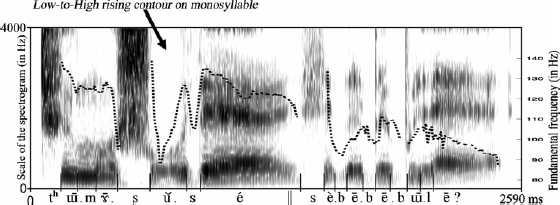
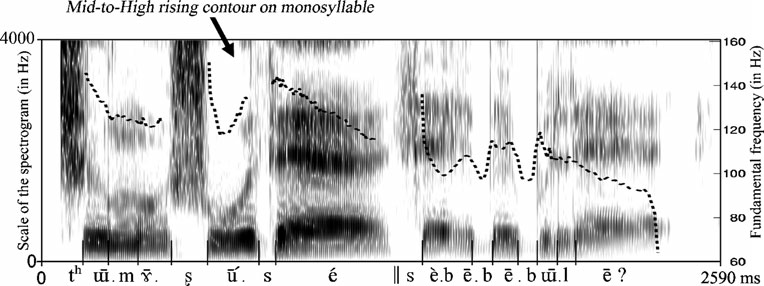
Figures 2 and 3 show verbs /ʂùݨ/ ‘to look for’ and /ʂu/ ‘to receive, to get’, respectively, in carrier sentence (5).Footnote 1
Annotated wide-band spectrogram, with aligned F0, of the monosyllable /ʂùݨ/ in carrier sentence (5). Speaker M4. Arrow shows rising F0 contour on /ʂùݨ/, resulting from syllable reduction. Compare this Low-to-High rise with the Mid-to-High rise in figure 3.

Annotated wide-band spectrogram, with aligned F0, of the monosyllable /ʂu/ in carrier sentence (5). Speaker M4. Arrow shows rising F0 contour on /ʂu/, resulting from syllable reduction. Compare this Mid-to-High rise with the Low-to-High rise in figure 2.

They show the presence of a rising F0 contour on the syllables at issue. The vowel that bears this rising contour has greater duration than the other non-group-final vowels in the sentence; this may be put down to physiological factors: raising F0 requires more time than lowering it (Ohala & Ewan Reference Ohala and Ewan1973, Ohala Reference Ohala and Fromkin1978: 30f., Sundberg Reference Sundberg1979). The degree of lengthening is not considerable, however. The vowel /ù/ is much shorter than the vowel of the group-final particle /seݩ/ and the sentence-final particle /le/, which are lengthened to indicate intonational junctures: vowel length, which is not phonemic in Naxi, is used extensively to signal intonational phrasing (Michaud Reference Michaud2005: 41–84). The F0 range in which the rising contour is realised appears to differ according to the lexical tone of the syllable: it is lower for /ʂùݨ/ (figure 2; see also figure 1, which contains the same verb) than for /ʂu/ (figure 3).
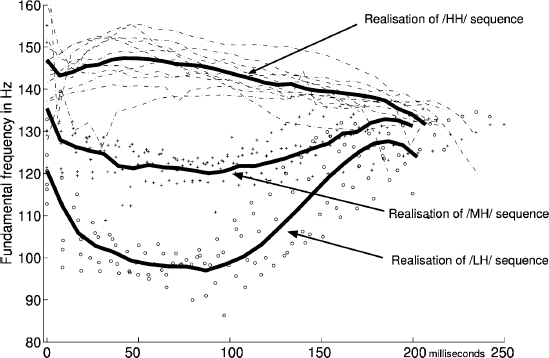
Averaged F0 curves for the syllables recorded within carrier sentence (5) are plotted in figure 4, which presents both the raw data and curves averaged under the technical computing environment matlab following a procedure described in Michaud (Reference Michaud2004). Due to some repetitions, the total number of items is 25.
Mean F0 curves, and individual curves, from sequences of HH, MH and LH tones realised on a single syllable. 25 syllables in carrier sentence (5). Speaker M4. The thick lines are averaged values. The thin lines, ‘+’ signs and circles correspond to the values calculated for individual tokens of the H, M and L tones, respectively.

From the figure, it is clear that a High tonal target is present, as predicted by the autosegmental tonal model. The /LH/ and /MH/ sequences are rising, without exception, whereas the /HH/ sequences are realised as a gently decreasing curve, similar to that of syllables with a simple H tone. (No experiment was set up to verify that the phonetic output of /H/ and /HH/ is actually identical.) The raw curves are not smooth due to the fact that they were obtained, not by autocorrelation, but by detection of each of the peaks indicative of glottis-closure-instants, on the derivative of the electroglottographic signal; this yields a precise estimation of the length of each glottal cycle, but no condition is placed on the continuity of the values from one cycle to the next (cf. Henrich et al. Reference Henrich, d'Alessandro, Castellengo and Doval2004 and references therein). The software that we developed is available online, with some documentation: see appendix.
The curves corresponding to /LH/ and /MH/ are clearly different, though final values are close. The final High target is perturbed in the expected direction by assimilation to the preceding tone, L or M. The results for the items in carrier sentence (6) are similar.
2.2 Perception data
Perception data were elicited to verify whether the difference between syllables with /LH/ and /MH/ contours is perceived by listeners. Five native speakers participated in the listening test. One of them was M4, the language consultant who had produced the utterances, and with whom the experimental setup had been discussed; the other four had no awareness of the purpose of the test. Forty-two sentences – twenty-one containing /LH/ contours, twenty-one /MH/ contours, inside frame 5 – were played once in random order through loudspeakers; the listeners were instructed to provide a translation into Chinese for each. The intended syllable was recognised in 204 cases out of 210. This warrants the conclusion that the /LH/ vs. /MH/ distinction exists.
3 Experiments on Mid- and Low-tone syllable reduction
This section investigates Mid- and Low-tone syllable reduction. With one illuminating exception (presented in Section 3.2.2), these reductions respectively result in [] and [], not in de-linking of the tone: deletion of the segments is not complete.
Naxi presents some cases of creation of new lexical items from the coalescence of two syllables: the first with Mid or Low tone, the second with High tone. This is phonetically unsurprising. Syllable-initial vowels have a potential for coalescence with the preceding vowel, as they have a soft onset: they begin by a semi-vowel in isolation, and link with the preceding syllable rhyme in connected speech. For example, ‘mung bean jelly’, a local dish, is called /h .aݩ/ in AS and other dialects outside the town of Lijiang, whereas the word has simplified to a monosyllable in the dialect of the old town of Lijiang 丽 江 (a.k.a. Dayanzhen dialect 大 研 镇): /haݨ ݩ/, carrying a rising contour tone. There is apparently a single lexical contour tone, which we transcribe as /LH/, thus yielding /haݨ ݩ/ and not /hā´/; this fact was not verified experimentally. The resulting vowel – in this case, /a/ – is identical to a simple vowel, i.e. the simplification to a monosyllable does not create new vowel phonemes.
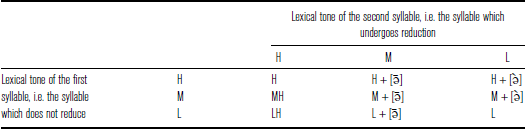
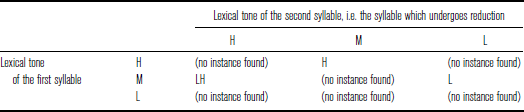
No parallel creation of falling contours is observed: in cases of coalescence, /ML/ sequences simplify to /L/, /HM/ sequences simplify to /H/; no examples of lexical items coming from H+L were observed. For example, ‘pickles’ is /kja.á/ in AS and other dialects outside Lijiang, /kjá/ in Lijiang. Likewise, the verb /b / ‘go’ in association with the perfect aspect particle /seݨ/ can simplify to /bɤݨ/; the tone of the resulting form is simply a Low tone, not a contour tone. The /HM/ pattern is illustrated by ‘money’: the conservative form (AS) is /kí.jɤ/, the coalescent form /kjɤݩ/ (old town of Lijiang), without any trace of the M tone. Comparison of tables 1 and 2 brings out the discrepancy between lexical and phrasal syllable-reduction patterns.
A summary of the syllable-reduction patterns (from two syllables to a single syllable) observed in continuous speech in Naxi.

A summary of the lexical syllable-reduction patterns (from two syllables to a single syllable) observed in the lexicon of Naxi.

Further evidence for an asymmetry in the tone system comes from the comparison of two dialects: in AS, the final particle cluster /m s / (which indicates ‘conjecture’) simplified to / ݩs/; in the dialect of /nda leݨ/ (丽 江, 金 山 乡, 贵 峰 大 来 行 政 下 村 / 大 来 二 村), following the inversion of all /H+M/ sequences on lexical items to /M+H/, this same particle cluster became /mv sɯ ݩ /, then simplified to /sɯ ݩ /, the Mid-tone syllable disappearing without trace.
It seemed interesting to gather further synchronic evidence on this issue. The results below show that, in contrast to High-tone syllables, Mid- and Low-tone syllables only reduce to [] and [], not to a Mid and Low tone, respectively – with one exception, presented in Section 3.2.2.
3.1 Reduction of Low-tone syllables results in a coalescent []
L-tone syllable reduction will be presented before M-tone reduction because it is more frequent. Low-tone syllables were observed to reduce to [].
3.1.1 Reduction of Low-tone grammatical words to []
The particle /theݨ/, which conveys ‘static aspect’ (Pinson Reference Pinson1998: 103), frequently simplifies to [], a process already reported by Fu (Reference 傅懋勣1984: 314). Fu's fieldwork dates back to the 1930s and 1940s; over half a century later, this morpheme shows no signs of simplifying further and becoming a floating Low tone.
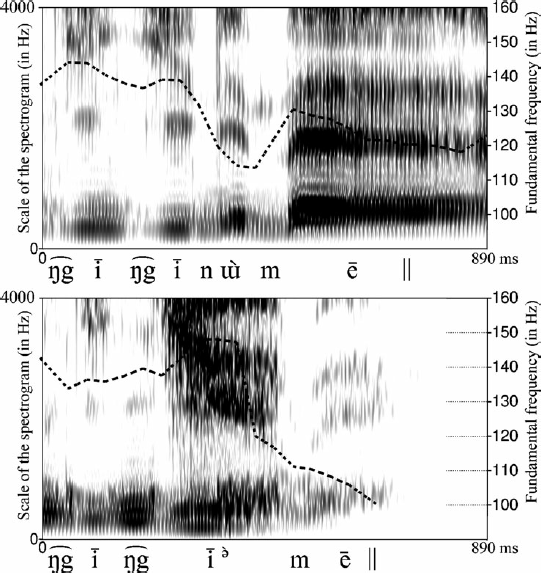
Our data show this pattern to extend to other grammatical words; by order of frequency: the copula /w/, the perfective aspect particle /seݨ/, the ongoing aspect particle /nɯ ݨ /, and the final particle /l/, which conveys invitation: ‘Let's . . .’. Figure 5 shows spectrograms and F0 tracings of two realisations of the same passage of a narrative (by the same speaker, M4), /ŋgi.ŋgi.nɯ.mé/, without syllable reduction in the first case, (7a), and with reduction in the second, (7b). The folk tale from which this sequence is excerpted was told twice from memory at a four-day interval; the phrasing of this passage is similar in both cases, but in the second recording, (7b), the ongoing aspect particle /nɯ ݨ / simplifies to [] and coalesces phonetically with the preceding syllable.
-
(7)

In (7b), the gloss is the same as in (7a) but particle /nɯ ݨ / reduces to //.
Wide-band spectrogram, with aligned F0, of the sequence /ŋɡi.ŋɡi.nɯݨ.me/ (from excerpt (7a) – top part of figure) and its reduced form /ŋɡi.ŋɡi
 .me/ (from (7b) – bottom), showing the F0 decrease and formant movement caused by Low-tone syllable reduction. Speaker M4. (Unlike in the other figures, the F0 curves are extracted from the audio.)

As is bound to be the case with examples taken from continuous speech, the two realisations that figure 5 aims to contrast do not provide an ideal illustration of the phenomenon of reduction: in (7b), the strong friction noise at the beginning of vowel [i] (which palatalises the initial / / to [

 ]) and the non-modal phonation towards the end of the vowel tend to blur the movement of the formants in the course of the vowel, which is expected to provide evidence of the presence of a final schwa-target. The change from a level F0 curve on /ŋgi/ in (7a) to a falling contour in (7b) is likewise difficult to assess from figure 5, as the decrease in F0 over the vowel /i/ in (7b) could in theory be put down to a gradual decrease towards an intonation-group-final low target on the final particle, i.e. a mere interpolation between the level pitch targets of successive syllables, rather than the effect of a coalescent []. (As the tales from which these passages are excerpted were recorded with a microphone only, the F0 curves in figure 5 were not calculated from electroglottography as in the other figures, but from the audio, using the software praat (Boersma Reference Boersma2001).) An experiment that aims to bring out more clearly the contrast between full forms and reduced forms is reported in Section 3.4; in a corpus of narratives, intermediate cases are in fact observed, e.g. /seݨ/ (which conveys perfect aspect) can reduce to [ɦ], with centralised vowel and weakened fricative, and further to []. This stands in contrast to High-tone syllable reduction, which in the present state of the language involves complete deletion of the segmental content of a syllable: in sentence pairs (2a, b) and (3a, b), no phonetically intermediate forms span the categorical gap between, e.g., /ʈʂh
.kh
.t/ ‘this-moment-only’ and /ʈʂh
.kh
ݩ/ (same meaning, with reduction of final syllable).
3.1.2 Reduction of an open set of Low-tone items
In addition to grammatical words, an open set of syllables can reduce to []. ‘Really, truly’ is pronounced /sɯ ݩ be/ in the AS dialect (where /be/ plays the role of an adverbialising particle). The language consultants perceive the form as trisyllabic and not quadrisyllabic, not dictating the [] as a separate syllable: [.sɯ ݩ .be]. Evidence from other dialects reveals the identity of the underlying syllable: quadrisyllabic /.sɯ ݩ .gɯ ݨ .be/ is standard in FK, and is in fact still intelligible in AS and the other Western dialects. The second syllable of a reduplicated verb was also observed to undergo occasional reduction:
-
(8)

In (8), the second syllable of the reduplicated word /khō khoݨ/ is simplified to []. The non-reduced form was dictated during the transcription session, the two informants consulted being unaware of the reduction.
3.2 Mid-tone syllables
Reduction of M-tone syllables in continuous speech is similar to L-tone syllable reduction in that it does not result in de-linking of the lexical tone. The only counterexample observed is presented in Section 3.2.2.
3.2.1 Non-categorical reduction of an open set of Mid-tone syllables to []
An open set of Mid-tone syllables can undergo reduction to [], e.g. /s / ‘yet, as yet’:
-
(9)

Sentence (9) can become [ha
 mí le]. The phenomenon is not restricted to grammatical words: it was observed in the case of syllable /d / ‘one (1)’, in the phrase (10b) [d pheݩ pheݩ], which constitutes a reduction of the full form (10a):
-
(10)

3.2.2 Categorical reduction of // before final particles results in Mid-tone reassociation
 / before final particles results in Mid-tone reassociation
There is one example where reduction of a Mid-tone syllable does result in M-tone reassociation: the reduction of the particle /i/ when it precedes utterance-final particles. The resulting tone sequences are /HM/, lengthened M, and /LM/ after H, M and L tones, respectively. In Naxi, the particle /i/ punctuates colloquial speech. In the AS dialect, it is almost systematically present, in the form of a floating Mid tone, before some final particles such as /m s / (conjecture), /m ݩ/ (certainty, strong affirmation), /tsɯ ݩ nɯ ݩ / (hearsay, indirect knowledge), /tsō w p/ (conjecture, call for confirmation), /n wa/ (surprise), /l/ (interrogation, call for confirmation), /mɤݨ l/ (pressing call for confirmation), /me/ (emphasis), /mɤݨ/ (affirmation). Most language consultants are unaware of the underlying syllable; its identity was arrived at by substitution tests.
It appears noteworthy that M-tone floating is confined to this very restricted context, and that the vowel involved is /i/. Following the reviewers’ recommendation, discussion of these facts is deferred until a later publication.
3.3 Perception data on the recognition of reduced Low- and Mid-tone syllables
A test was performed with six listeners to evaluate the recoverability of the syllable having undergone reduction. In a first task, 14 utterances containing Low- and Mid-tone syllable reduction were played through loudspeakers, and the hearers were asked to repeat each utterance carefully. Their performance was written down by the author. In a second task, the identity of the syllable was verified by playing again the stimuli, proposing that an underlying syllable was present, and suggesting several candidates.
It appeared that the language consultants’ awareness of the Mid- and Low-tone syllables having undergone syllable reduction varies from item to item, as is also the case for High-tone syllables having undergone reduction, described in Michaud Reference Michaud2006a. In the cases where a coalescent, tone-bearing schwa now systematically accompanies a certain word – typically final particles – the identity of the underlying syllable could not be indicated by the majority of speakers. Indeed, no extra syllable was felt to be present: when asked to repeat carefully, they brought out the added vocalic schwa-target very clearly, simultaneously emphasising the melodic movement corresponding to the tone borne by this schwa-element, but they did not split the words into two syllables. Conversely, in the cases of free variation – for example, (8) above, where the reduplicated word /khō khoݨ/ becomes /khō / – language consultants perceive the underlying syllable vividly, so much so that they are not aware that only a reduced form is pronounced, and dictate the full form during transcription sessions. Lastly, in some cases, a stylistic difference has crept in between full form and reduced form, and paraphrases have to be elicited before the underlying syllable can be arrived at and finally confirmed by the speakers.
3.4 Measurement of the downward tilt in F0 resulting from L-tone syllable reduction
The experiment reported here aims to quantify the changes in F0 that result from L-tone syllable reduction. Speaker M4 – recall that he is the speaker who produced the data for all the experiments – recorded 27 monosyllabic predicates (verbs or adjectives) within the following carrier sentences:
-
(11)
-
(12)


These two carrier sentences differ only in that the perfect aspect particle /seݨ/ is in the full form in (11) and in the reduced form in (12). If the target syllable is a verb, both (11) and (12) mean that the person referred to by the pronoun has performed the action referred to by the verb: ‘(S)he has ____ed’. If the target syllable is an adjective, these sentences mean ‘(S)he has become ____’.
The corpus is the same as for utterances (5) and (6) above. It was intended to select H–M–L series such as: /ndzɯ ݩ / ‘fell (a tree)’, /ndz / ‘eat’, /ndzɯ ݨ / ‘sit’, but such a minimal set could not be found in every case. The predicates were arranged in random order. The speaker was aware that the focus of the experiment was on the reduction of the aspect particle /seݨ/. He was instructed to produce each sentence once at a slow pace, as if repeating for someone who was hard of hearing (thus eliciting carrier sentence (11)), then repeat it more casually (eliciting carrier sentence (12)). A translation of the predicate into the local dialect of Chinese was used as a prompt.
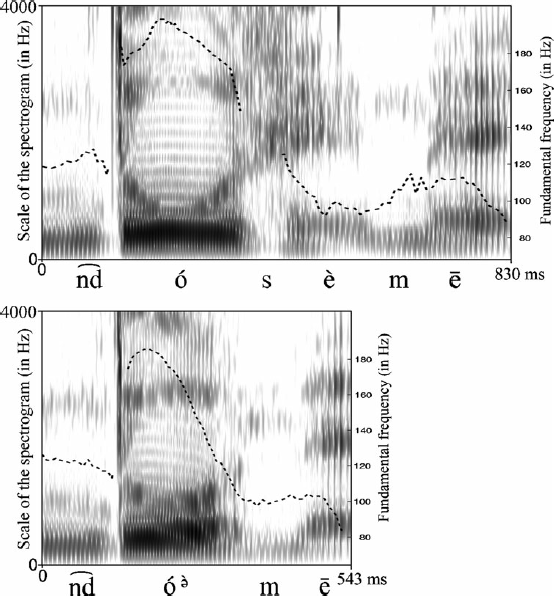
The effect of reduction of the following syllable on the target syllable is illustrated by figure 6, which shows the realisation of the verb /ndoݩ/ ‘to climb’ in carrier sentences (11) and (12).
Wide-band spectrogram, with aligned F0, of the sequence /ndóݩ.sēݨ.me/ (top – carrier sentence (11)) and its reduced form /ndóݩ.me/ (bottom – carrier sentence (12)), showing the F0 decrease and formant movement caused by Low-tone syllable reduction. Speaker M4.

In both cases, F0 decreases in the course of the vowel /o/; however, the decrease starts earlier and is greater when the syllable is in frame (12), i.e. when the following syllable is reduced. As for formant frequencies, when /seݨ/ is fully realised (top of figure 6), the only formant movement observed is a rise in F2, which is an effect of the following alveolar consonant (a similar movement is observable at the beginning of the vowel, after the alveolar initial / /), whereas in the case when /seݨ/ has undergone reduction and coalescence with /ndoݩ/ (bottom of figure 6), F1 increases from about 380 Hz to about 520 Hz in the course of the vowel, and F2 from about 850 Hz to about 1480 Hz, approaching the theoretical locus of schwa, namely F1 ≈ 500, F2 ≈ 1,500, F3 ≈ 2,500. For refined measurements, theoretical formant values of schwa may be calculated for a given speaker; a study of tongue movement for reduced vowels in English concludes that schwa has a target position, which corresponds to the mean of the positions for all the full vowels of the system (Barry Reference Barry, Docherty and Ladd1992, Browman & Goldstein Reference Browman, Goldstein, Docherty and Ladd1992).
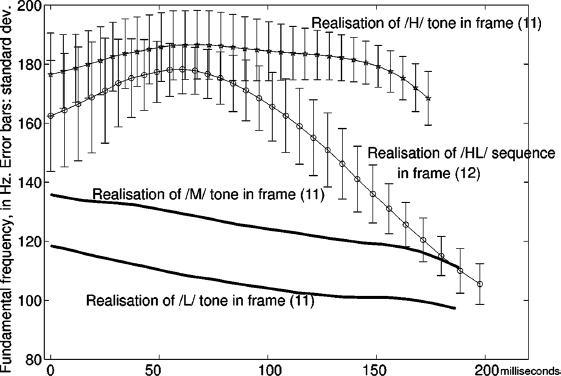
Figure 7 provides average F0 curves for the H tone, also plotting the other two tones as they appear in (11), taken as reference. The standard deviation is shown only for the two realisations of the High tones, which the figure aims to contrast.
Mean F0 curves from a /HL/ sequence (carrier sentence (12)), from a simple /H/ tone (carrier sentence (11)), and from M- and L-tones in carrier sentence (11), showing the difference between the realisation of /HL/ and /H/. Twenty syllables, speaker M4.

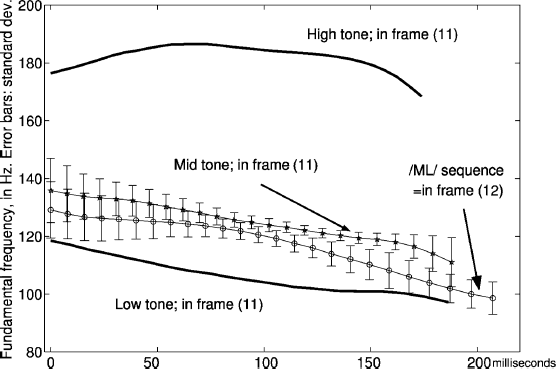
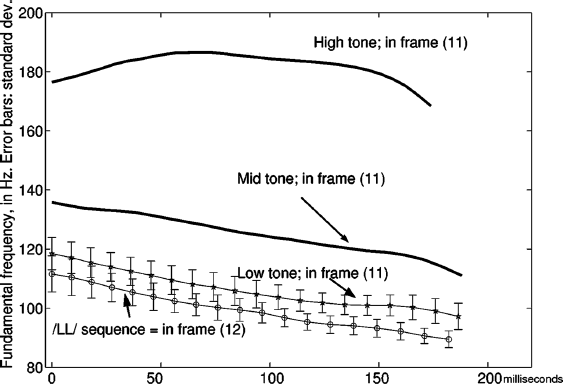
From figure 7, it is clear that tone H becomes falling when followed by a reduced L-tone syllable. By contrast, the results for tones M and L (in figures 8 and 9) do not show any clear change in F0; this small-scale experiment alone is not a sufficient basis to settle the issue whether the phonetic output of such /LL/ and /ML/ sequences are identical with /L/ and /M/, respectively. It appears reasonable to think that the underlying additional L tone does have some effect on F0 but that it is less salient than the effect on vowel quality.
Mean F0 curves from a /ML/ sequence (frame (12)), from a simple M-tone (frame (11)), and from H- and L-tones in frame (11), showing the difference between the realisation of /ML/ and /M/. Twelve syllables, speaker M4.

Mean F0 curves from a /LL/ sequence (frame (12)), from a simple L-tone (frame (11)), and from H- and L-tones in frame (11). Sixteen syllables, speaker M4.

3.5 Production data on Mid-tone syllable reduction
The production task designed to investigate the effects of Mid-tone syllable reduction was based on the following carrier sentence:
-
(13)

Slot A was filled by an adjective, and slot B by a final particle. Twenty-five adjectives were selected: see the appendix for the list of items and an Internet link to the original recordings. Fifteen particles were used, eight of which carry an accompanying floating Mid tone whereas the other seven do not have a floating tone. All the combinations were recorded (375 tokens in all; each token was said twice), in three separate recording sessions. The adjectives were arranged in randomised order; the 25 were elicited in succession (their Chinese equivalent being used as a prompt) with the same final particle, which was indicated to the speaker in Naxi before the beginning of the series. The speaker (again, M4) was not aware that the experiment focused on syllable reduction.
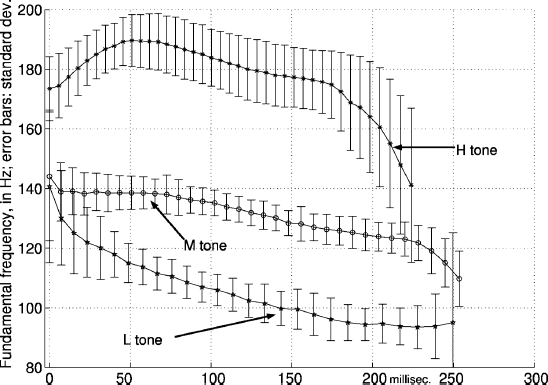
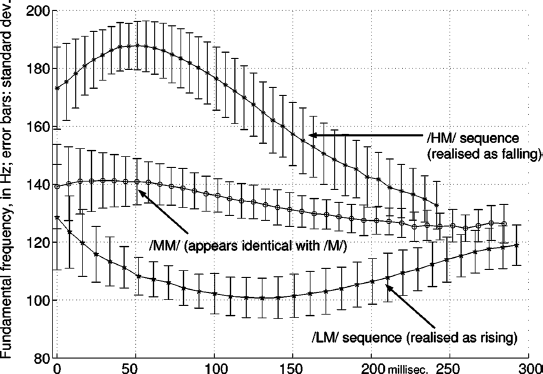
Figure 10 presents F0 curves of the High, Mid and Low tones as they are realised in the series whose final particle is not accompanied by a floating M tone. These data bring out the mean acoustics of the three basic tones. Figure 11 shows F0 curves of the same tokens in the series whose final particle is accompanied by a floating M tone. These results that the /HM/ and /LM/ contour tones have a straightforward phonetic implementation. They also suggest that the realisation of a /MM/ tone sequence is identical to that of a simple M tone, in the same way as /HH/ sequences were shown to be identical to /H/. The slight difference in length can hardly be significant, in view of the variation in length across items; the overall tendency for the /LM/ sequences to be longer can be explained in light of physiological factors, raising F0 requiring more time than lowering it, as was already mentioned in Section 2.1 In figure 10, the Low tone is phonetically falling, contrasting with its rise in figure 11. The High tone is falling in both cases, but the final downward tilt in figure 10 differs clearly from the steady fall in figure 11.
Mean F0 curves illustrating the realisation of the three basic tones: H, M and L. From frame (13), with final particle carrying no floating tone. 50 syllables, speaker M4.

Mean F0 curves from /HM/, /MM/ and /LM/ tone sequences on monosyllables (frame (13), with final particle carrying floating M-tone), illustrating the creation of tonal contours caused by Mid-tone syllable reduction. 100 syllables, speaker M4.

3.6 An issue which remains open: the difference among falling contours
The experiments in Section 2 provide experimental evidence for the difference between /LH/ and /MH/ tone contours. One may wonder whether /HL/ tone contours are likewise categorically different from /HM/ contours. Comparison of the production data in figure 7 and figure 10 suggests so. Straightforward experimental evidence could not be obtained because no plausible ‘minimal pairs’ of utterances could be found to contrast these contours. The AS and NL language consultants were asked whether the sequences /l/ + /seݨ/ (‘strike’ + perfect aspect) and /l/ + /jɤ/ (‘strike’ + particle indicating direct observation) ‘sound exactly the same or not’ after reduction of the second syllable; their intuition is that the contour is not the same, and impressionistic listening likewise suggests that there is a difference, though it may not be realised and perceived in all cases, its functional load being very light.
4 Conclusions
4.1 Conclusions concerning tonal contours in Naxi
The experiments can be taken to settle the first issue raised in the introduction, that of rising contours in Naxi: the /LH/ contour and the /MH/ contour are actually distinct. Sequences made up of a Mid or Low lexical tone followed by a High tone (either de-linked or floating) are realised as different dynamic F0 shapes which transparently show the tautosyllabic realisation of the High target after the Low or Mid tone. There is no separate realisation of the floating High after a lexical High.
Mid- and Low-tone morphemes can reduce to [] and [], respectively, and coalesce with the preceding syllable. Said differently, sequences made up of a High, Mid or Low tone followed by a Mid or Low can also be realised on a single syllable, as before, but this syllable acquires a schwa offglide. Thus, in Naxi, syllable-reduction patterns are asymmetrical: High-tone syllable reduction leads to tonal de-linking and reassociation, whereas Mid- or Low-tone syllable reduction stops short of complete tonal de-linking. Possible explanations of these processes, in light of universal phonetic tendencies and of language-specific factors, are being actively pursued.
4.2 On the typological validity of the notion of floating tone
As mentioned in the Introduction, phenomena of tone reassociation are now commonly modelled in terms of association lines between a tonal tier and a syllabic tier. Apart from the languages for which it was originally devised (essentially Niger-Congo languages), this analysis applies to the lexical tones of many languages. The present results go to show that the notions of floating tone and tonal reassociation are also applicable to Naxi. The present research aims to contribute data for the comparison of Far Eastern and sub-Saharan tone systems – a line of research which is only in its incipient stage now.
Acknowledgments
Many thanks to David Bradley, François Dell, John Esling, Larry Hyman, Guillaume Jacques, Randy LaPolla, Martine Mazaudon, Boyd Michailovsky, David Mortensen, Annie Rialland, Jackson T.-S. Sun, Jacqueline Vaissière, and to Philip Rose and an anonymous reviewer for very helpful comments and suggestions. Many thanks to researchers in China for their friendly cooperation: Guo Dalie 郭 大 烈, Huang Xing 黄 行, Kong Jiangping 孔 江 平, Xu Lin† 徐 琳, and to the Naxi language consultants and friends, in particular He Xixian 和 希 贤 and Mu Ruhua 木 汝 华. The authors alone are responsible for remaining shortcomings.
Financial support was given by the Fondation de France and by Université Paris 3. Professional recording equipment was lent by the Laboratoire de Phonétique et Phonologie (CNRS-LPP) and the Laboratoire Langues et Civilisations à Tradition Orale (CNRS-LACITO).
Appendix: Audio and electroglottographic data, and software for electroglottographic analysis
Audio and electroglottographic data
Part of the recordings on which this research is based are available online from http://halshs.archives-ouvertes.fr/hal-00144485.
The audio and electroglottographic (EGG) signals were simultaneously recorded into stereo files (audio in one channel, EGG in the other); as this format may not be convenient for all users, each stereo file was split into two: one audio file (name ending in _AUD.wav), one EGG file (name ending in _EGG.wav). There is no EGG recording for examples (7a) and (7b).
The file names are as follows: ‘Naxi_tones_’ + number of sentence in main text + AUD for audio, EGG for electroglottographic files; for instance, Naxi_tones_4_AUD.wav is the audio file for example (4).
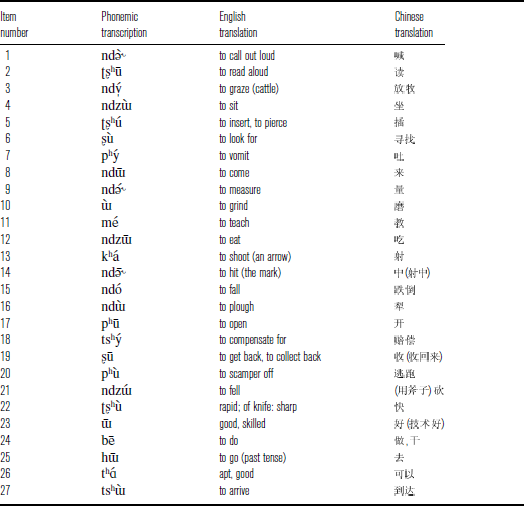
The list of items recorded in carrier sentences (5), (6), (11) and (12) is presented in table A1 (in the order of recording).
Items recorded in carrier sentences (5), (6), (11) and (12).

Doublets were removed from the sound files. Item 17 is missing from the recordings in frame 5, items 24 to 26 from the recordings in frame 6, and items 8, 24 and 25 from the recordings in frames 11 and 12.
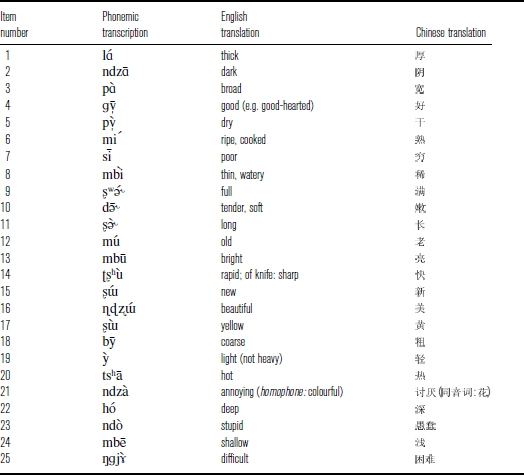
The list of items recorded in carrier sentence (13) is presented in table A2 (in the order of recording).
Items recorded in carrier sentence (13).

Due to restrictions of the vocabulary list available, this set is not phonemically or tonally balanced (10 L tones, 8 M tones, 7 H tones).
In order to illustrate the difference between final discourse particles with and without a floating M tone, two recordings are provided: (i) one with final particle /me/ – conveying obviousness – which carries a floating Mid tone that attaches to the syllable to its left; (ii) one with final particle /sjɤ/ – used when the speaker was an eye witness to what (s)he reports – which does not have such a floating tone. One single repetition is provided for each item.
Software for analysis of the electroglottographic signal
The software developed in collaboration with other researchers for the analysis of the electroglottographic signal (under the computing environment matlab) is available from http://voiceresearch.free.fr/egg (site created in 2005, maintained by Nathalie Henrich).