Introduction
Late Pliensbachian–early Toarcian ammonoid assemblages have been recognized in Lower Jurassic epicontinental deposits exposed in central and southwest Japan as follows: the Kuruma Group (Sato, Reference Sato1955; Kobayashi et al., Reference Kobayashi, Konishi, Sato, Hayami and Tokuyama1957), the Higuchi Group (Hirano et al., Reference Hirano, Mikami and Miyagawa1978), and the Toyora Group (Matsumoto and Ono, Reference Matsumoto and Ono1947; Hirano, Reference Hirano1971, Reference Hirano1973a, b; Nakada and Matsuoka, Reference Nakada and Matsuoka2009, Reference Nakada and Matsuoka2011). They provide important biostratigraphic and paleobiogeographic data and, therefore, play a significant role in analyzing the paleoceanographic environment, such as ocean anoxic events, during this period. However, most of these ammonoid assemblages are composed primarily of species endemic to the East Asian region. These faunal compositions have previously prevented detailed biostratigraphic and paleobiogeographic correlation of Japanese assemblages with faunas outside Japan.
Amaltheus, typically characterized by having an involute whorl, irregular ribbing, and a crenulated keel, has been regarded as one of the most important of the late Pliensbachian ammonoid taxa because of its biostratigraphic and paleobiogeographic utility. During the late Pliensbachian, the typical ammonoid assemblages from high-latitude areas of the Northern Hemisphere, such as the northern Northwest European, northern North American Cordillera, Arctic islands of Canada, and Russian regions, are dominated by the Amaltheinae, including Amaltheus, Amauroceras, and Pleuroceras. On the basis of this geographic distribution, the Amaltheinae has been designated as an index taxon of the late Pliensbachian Boreal Realm fauna (e.g., Dommergues, Reference Dommergues1987; Smith et al., Reference Smith, Tipper and Ham2001). In addition, species belonging to the genus Amaltheus are the most significant late Pliensbachian biostratigraphic index taxa because the standard ammonoid zonation of this period established in the Northwest European province has been discussed in detail on the basis of the well-established phylogeny of the genus (Howarth, Reference Howarth1958; Dean et al., Reference Dean, Donovan and Howarth1961; Meister, Reference Meister1988; Bardin et al., Reference Bardin, Rouget and Cecca2017).
In Japan, Amaltheus has been collected from two areas: the Kuruma Group in central Japan and the Toyora Group in southwest Japan. Sato (Reference Sato1955) described two specimens from the Kuruma Group as Amaltheus sp. indet. One specimen of Amaltheus sp. cf. A. stokesi (Sowerby, Reference Sowerby1818) was reported from the Toyora Group by Hirano (Reference Hirano1971). The biostratigraphic and paleobiogeographic significance of this genus in Japan has been recognized in previous studies (Sato, Reference Sato1955; Hirano, Reference Hirano1973b). Amaltheus has been used as the index fossil for the late Pliensbachian in the Kuruma and the Toyora groups (Sato, Reference Sato1955; Hirano, Reference Hirano1973b). Sato (Reference Sato1956) suggested a Boreal influence on the Kuruma Group fauna on the basis of the occurrence of this genus. However, detailed biostratigraphic and paleobiogeographic analyses of these Japanese Amaltheus occurrences have not been developed as the small number of well-preserved specimens collected has precluded taxonomic discussions until recently.
The aims of this study are to identify Amaltheus from Japan at the species level by utilizing 34 specimens and to discuss the biostratigraphic and paleobiogeographic significance of the four species identified, including a new endemic species. These materials involve every recognizable Amaltheus specimen in Japan, including all material described in previous studies.
Geological framework
As mentioned, Amaltheus specimens in this study were obtained from two areas: the Kuruma Group and the Toyora Group.
Kuruma Group
This unit comprises Lower Jurassic continental shelf sediments and is widely exposed in the northeastern part of the circum–Hida terrane of eastern Toyama, western Niigata, and northern Nagano prefectures, central Japan (Fig. 1). This group's distribution is divided into the Inugatake and the Kotakigawa–Akahageyama–Kuruma areas because of the difficulty of their lithostratigraphic correlation (Takeuchi et al., Reference Takeuchi, Tokiwa, Kumazaki, Yokota and Yamamoto2017) (Fig. 1), and the former yields numerous Early Jurassic ammonoid fossils (Sato, Reference Sato1955; Kobayashi et al., Reference Kobayashi, Konishi, Sato, Hayami and Tokuyama1957). Most of the studied materials were obtained from the Inugatake area. Detailed localities are shown in Table 1.

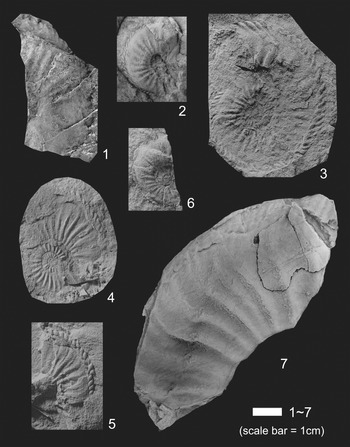
Occurrence and repository list of Amaltheus from Japan. All of the specimens included in this table are illustrated in Figures 4–7.

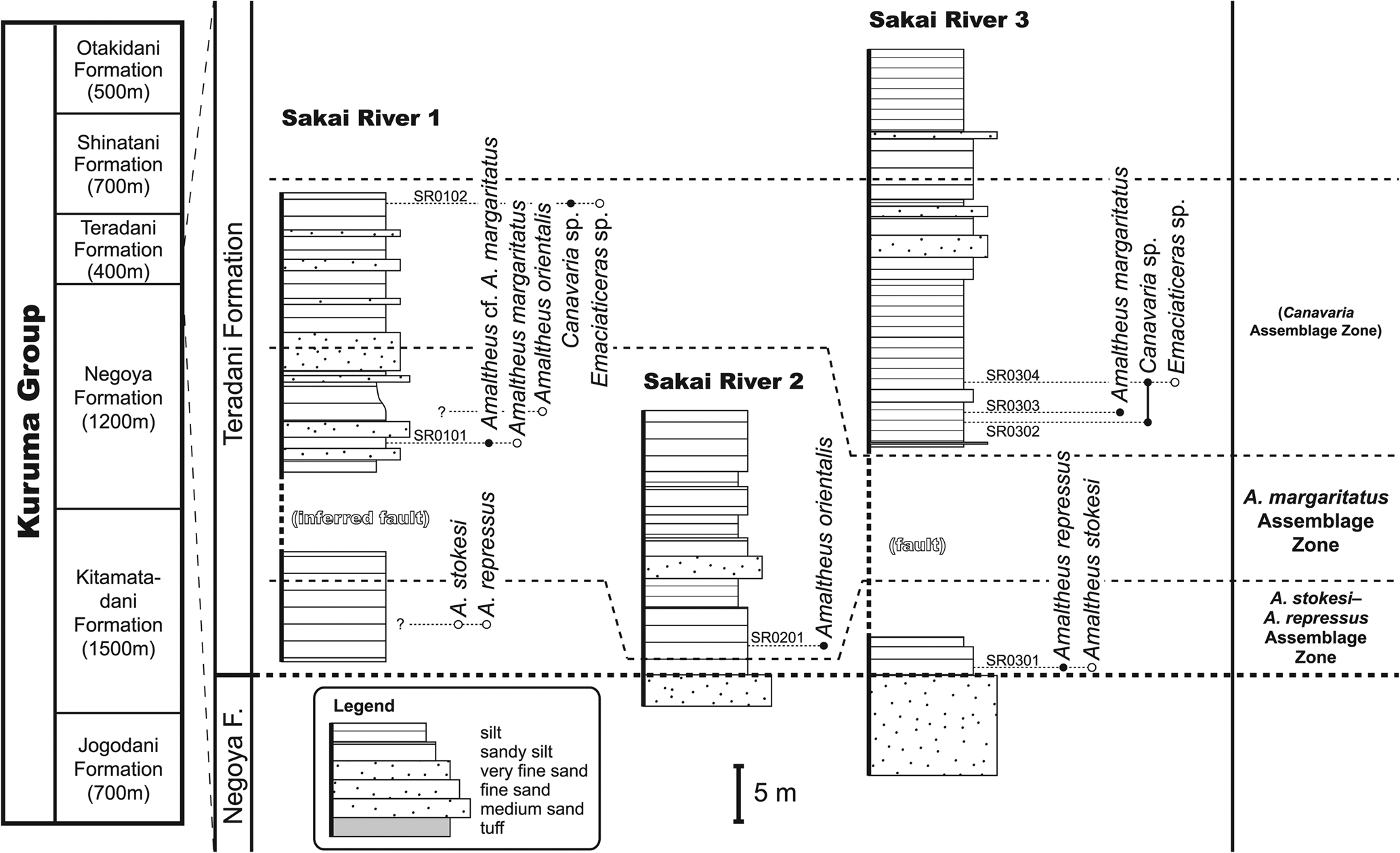
The lithostratigraphy of the Kuruma Group has been separately analyzed for each area. In the Inugatake area, the group was subdivided into seven formations by Kobayashi et al. (Reference Kobayashi, Konishi, Sato, Hayami and Tokuyama1957): the Jogodani, Kitamatadani, Negoya, Teradani, Shinatani, Otakidani, and Mizukamidani formations, in ascending order (Fig. 2). Later, Takizawa (Reference Takizawa1984) assigned the Mizukamidani Formation to the Tetori Group, which consists of epicontinental sediments of Early Cretaceous age. The Kuruma Group is composed mainly of sandstones, mudstones, and conglomerates with numerous fossils, including ammonoids, bivalves, gastropods, belemnites, crinoids, fish, turtles, and terrestrial plants and is characterized by alternation of marine and non-marine clastic sediments (Kobayashi et al., Reference Kobayashi, Konishi, Sato, Hayami and Tokuyama1957; Kimura and Tsujii, Reference Kimura and Tsujii1980–1984; Hayami and Akahane, Reference Hayami and Akahane1981; Goto, Reference Goto1983, Reference Goto1994; Kimura et al., Reference Kimura, Ohana and Tsujii1988; Sonoda et al., Reference Sonoda, Goto and Terada2015; Iba et al., Reference Iba, Sano and Goto2015). Ammonoid fossils have been collected from the Teradani Formation (Sato, Reference Sato1955), which is composed mainly of sandy siltstones, and the Otakidani Formation (Kobayashi et al., Reference Kobayashi, Konishi, Sato, Hayami and Tokuyama1957), which is composed mainly of black mudstones with thin sandstone and conglomerate intercalations. On the basis of these ammonoid faunas, the Teradani Formation has been roughly correlated to the upper Pliensbachian, and the Otakidani Formation is thought to correspond to the upper Toarcian to Aalenian (Sato, Reference Sato1955, Reference Sato and Westermann1992; Kobayashi et al., Reference Kobayashi, Konishi, Sato, Hayami and Tokuyama1957). In addition, Takeuchi et al. (Reference Takeuchi, Tokiwa, Kumazaki, Yokota and Yamamoto2017) reported that the U–Pb age of detrital zircon grains from four sandstone samples in the Jogodani and Kitamatadani formations in the Inugatake area were dated ca. 188–186 Ma and compared these data to Pliensbachian age.
Columnar sections, biostratigraphic succession of ammonoids, and the biostratigraphic framework of the lowermost part of the Teradani Formation, Kuruma Group, exposed along the Sakai River. The horizon numbers beside the columnar sections correspond to the horizon numbers in Table 1. The lithostratigraphic division of the Kuruma Group with the thickness of each formation utilized in this figure follows Kumazaki and Kojima (Reference Kumazaki and Kojima1996).

Almost all the additional Amaltheus specimens in this study were obtained from the lowermost Teradani Formation exposed along the Sakai River, except for some specimens from Mt. Kikuishi, the Teradani Valley, and the Kanayamadani Valley (Fig. 2; Table 1).
Toyora Group
This unit outcropping in the western part of Yamaguchi Prefecture, southwest Japan, consists of epicontinental sediments deposited during the Early and Middle Jurassic (Fig. 1). This group crops out separately in two regions, the northern and the southern districts (Hirano, Reference Hirano1971) (Fig. 1). The northern district is characterized by abundant occurrences of ammonoids (Matsumoto and Ono, Reference Matsumoto and Ono1947; Hirano, Reference Hirano1971, Reference Hirano1973a, b; Nakada, Reference Nakada2008; Nakada and Matsuoka, Reference Nakada and Matsuoka2009, Reference Nakada and Matsuoka2011), including all the materials used in this study.
The Toyora Group is composed mainly of sandstones, mudstones, and conglomerates. It has been divided into three formations in ascending order: the Higashinagano, Nishinakayama, and Utano formations; each formation has been further subdivided into several members (Matsumoto and Ono, Reference Matsumoto and Ono1947; Hirano, Reference Hirano1971; Nakada and Matsuoka, Reference Nakada and Matsuoka2011; Fig. 3). Ammonoid fossils are especially abundant in the Sakuraguchidani Mudstone Member, the lower part of the Nishinakayama Formation that is composed dominantly of black mudstone, and thus the ammonoid biostratigraphy has been analyzed frequently in this member (Matsumoto and Ono, Reference Matsumoto and Ono1947; Hirano, Reference Hirano1973b; Tanabe, Reference Tanabe, Kotaka, Dickins, Mckenzie, Mori, Ogasawara and Stanley1991; Nakada and Matsuoka, Reference Nakada and Matsuoka2009, Reference Nakada and Matsuoka2011). Nakada and Matsuoka (Reference Nakada and Matsuoka2011) proposed four successive ammonoid zones: the Canavaria japonica, Paltarpites paltus, Dactylioceras helianthoides, and Harpoceras inouyei zones, in ascending order. Two additional Amaltheus specimens described in this study (NU-MM0077 and NU-MM0078) were obtained from the lowermost part of the Sakuraguchidani Mudstone Member, corresponding to the lowermost part of the japonica Zone, exposed along the Sakuraguchidani Valley (Figs. 1, 3; Table 1). An Amaltheus specimen described by Hirano (Reference Hirano1971) was obtained from the lowermost part of the Kido Sandstone Member, which is composed mainly of bedded sandstones and sandy mudstones with thin coal beds, along the Chuzankei Valley (Fig. 3; Table 1).
Generalized geological column of the Toyora Group in the study area after Nakada and Matsuoka (Reference Nakada and Matsuoka2011) with Amaltheus-bearing horizons and the zonal framework proposed by Nakada and Matsuoka (Reference Nakada and Matsuoka2011) and this study.

Materials and methods
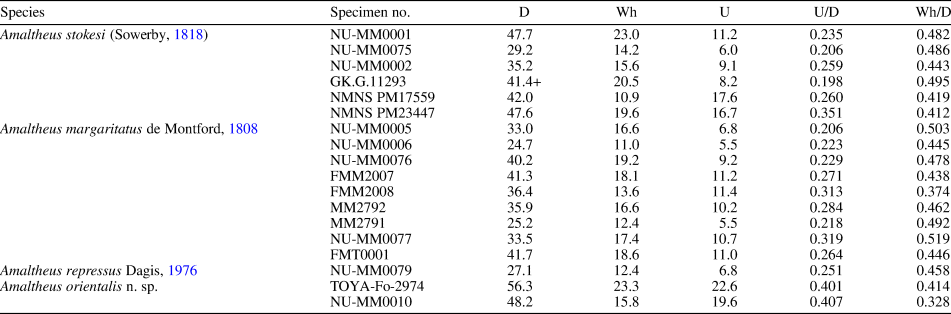
The abbreviations used throughout the descriptions are as follows: diameter, D; umbilical diameter, U; whorl height, Wh; ratio of umbilical diameter to diameter, U/D; and ratio of whorl height to diameter, Wh/D. All measurements are shown in Table 2. Almost all of the materials used in this analysis are flattened horizontal to bedding planes; the degree of compaction was almost similar in all specimens and thus shows poor preservation.
Dimensions of the ammonoid specimens utilized in this taxomomic analysis (mm).

Repositories and institutional abbreviations
The specimens described and illustrated in this study are deposited in the following institutions: Niigata University (NU-MM), the University Museum of the University of Tokyo (MM), Fossa Magna Museum in Itoigawa City (FMM), National Museum of Nature and Science (NMNS PM), Toyama Science Museum (TOYA-Fo), Kyushu University (GK.G.), and the Firefly Museum of Toyota Town in Shimonoseki City (FMT).
Systematic paleontology
Class Cephalopoda Cuvier, Reference Cuvier1798
Subclass Ammonoidea von Zittel, Reference von Zittel and von Zittel1884
Order Psiloceratida Housa, Reference Housa1965
(emended by Dommergues, Reference Dommergues2002)
Superfamily Eoderoceratoidea Neumayr, Reference Neumayr1875
Family Liparoceratidae Hyatt, Reference Hyatt1867
(emended by Dommergues and Meister, Reference Dommergues and Meister1999)
Subfamily Amaltheinae Hyatt, Reference Hyatt1867
Genus Amaltheus de Montfort, Reference de Montfort1808
Type species
Amaltheus margaritatus de Montfort, Reference de Montfort1808.
Remarks
The whorl section is compressed and subelliptical. Surface ornament is extremely varied; some species have smooth whorl flanks with sigmoidal ribs, and others are characterized by spiny or strong ribbing. Almost all species have a crenulated keel and a suboxycone coiling with moderately open umbilicus.
Amaltheus stokesi (Sowerby, Reference Sowerby1818)
Figure 4
- Reference Sowerby1818
Ammonites stokesi Sowerby, p. 205, pl. 190.
- Reference Imlay1955
Amaltheus cf. A. nudus (Quenstedt, Reference Quenstedt1858; Imlay, p. 87, pl. 10, fig. 5.
- Reference Howarth1958
Amaltheus stokesi; Howarth, p. 3, text–figs. 4–5, pl. 1, figs. 5, 7, 12–14, pl. 2, figs. 1, 3, 10, with synonymy.
- Reference Frebold1964
Amaltheus stokesi; Frebold, pl. 6, figs. 6, 13.
- Reference Frebold, Mountjoy and Tempelman-Kluit1967
Amaltheus stokesi; Frebold, Mountjoy, and Tempelman–Kluit, pl. 1, figs. 1, 7.
- Reference Hirano1971
Amaltheus cf. A. stokesi; Hirano, p. 101, pl. 17, fig. 11.
- Reference Repin and Sachs1974
Amaltheus (Amaltheus) stokesi; Repin, pl. 1, figs. 4–9.
- Reference Frebold1975
Amaltheus stokesi; Frebold, pl. 4, figs 3, 4.
- Reference Dagis1976
Amaltheus (Proamaltheus) stokesi; Dagis, p. 21, pl. 10, figs. 5–7.
- Reference Sey and Kalacheva1980
Amaltheus stokesi; Sey and Kalacheva, pl. 1, figs 4, 7, 8, 11, 13.
- Reference Kimura, Ohana and Tsujii1988
Amaltheus (Amaltheus) stokesi; Krymholts, Mesezhnikov and Westermann, pl. 2, fig. 1.
- Reference Poulton1991
Amaltheus stokesi; Poulton, p. 18, pl. 8, figs. 2, 7, 8.
- Reference Westermann1992
Amaltheus stokesi; Westermann, pl. 3, fig. 11, pl. 5, fig. 9, pl. 6, fig. 4 (cf.).
- Reference Pálfy and Hart1994
Amaltheus cf. A. stokesi; Pálfy and Hart, pl. 1, fig. 12.
- Reference Jakobs and Pálfy1994
Amaltheus stokesi; Jakobs and Pálfy, pl. 1, fig. 9.
- Reference Smith and Tipper1996
Amaltheus stokesi; Smith and Tipper, pl. 19, fig. 1, pl. 20, fig. 3.
- Reference Johannson, Smith and Gordey1997
Amaltheus stokesi; Johannson, Smith, and Gordey, pl. 2, fig. 13.
- Reference Géczy and Meister1998
Amaltheus stokesi; Géczy and Meister, p. 102, pl. 6, fig. 10.
- Reference Rakus and Guex2002
Amaltheus stokesi; Rakus and Guex, pl. 27, fig. 8.
- Reference Meister and Friebe2003
Amaltheus stokesi; Meister and Friebe, pl. 16, figs. 9, 14.
- Reference Schubert2004
Amaltheus stokesi; Schubert, pl. 1, fig. 1.
- Reference Callomon and Gradinaru2005
Amaltheus stokesi; Callomon and Gradinaru, pl. 2, fig. 2.
- Reference Fauré2006
Amaltheus stokesi; Fauré, p. 43, fig. 8.
- Reference Topchishvili, Lominadze, Tsereteli, Todria and Nadareishvili2006
Amaltheus stokesi; Topchishvili et al., pl. 11, fig. 4.
- Reference Rulleau, Guiffray and Dommergues2007
Amaltheus stokesi; Rulleau, Guiffray, and Dommergues, pl. 34, fig. 5, pl. 35, fig. 1.
- Reference Mouterde, Dommergues, Meister and Rocha2007
Amaltheus stokesi; Mouterde et al., p. 75, pl. 1, figs. 9, 14, with synonymy.
- Reference Repin2016
Amaltheus (Amaltheus) stokesi; Repin, p. 37, figs 4, 5.
- Reference Nützel, Schneider, Hülse, Kelly, Tilley and Veit2016
Amaltheus stokesi; Nützel et al., p.3, fig. 2.
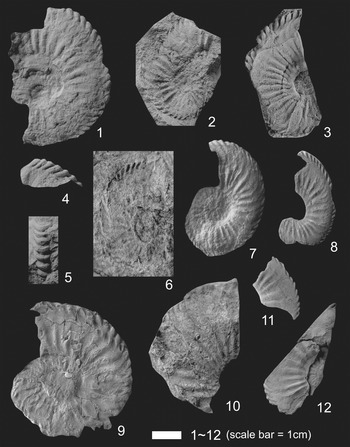
Amaltheus stokesi from Japan. The locality and the repository data are shown in Table 1. (1) NU-MM0001; (2) NU-MM0075; (3) GK.G.11293 (rubber cast); (4, 5) NU-MM0003: (4) lateral view; (5) ventral view; (6) NU-MM0002; (7) NMNS PM17559 (rubber cast); (8) FFM3051-4; (9) NMNS PM23447; (10) FMM3051-3; (11) TOYA-Fo-2992; (12) FMM3051-5.

Type
The holotype, OUM.J2248, was collected by J. Sowerby (Reference Sowerby1818) from Dorset.
Diagnosis (modified from Howarth, Reference Howarth1958)
Large oxycone with highly compressed elliptical whorl section. Ventral halves of the inside whorls are covered by the next outer whorls. The venter bears a barely developed keel with coarse crenulation. Each serration of crenulation is connected with ribs.
Occurrence
Amaltheus stokesi is the index species at the base of the late Pliensbachian in Northwest Europe.
This taxon has been recognized in the Northwest European province, the northern Tethys margin (Southern Alps, Austroalpine units, Carpathians), the Caucasus (Georgia), East Asia (Japan), North American Cordillera (British Columbia and northern Alaska), Arctic Canada, and Russia (the Northeast, the Siberian Platform, and the Far East regions).
Description
The whorls are moderately to extremely involute, with a high expansion rate; the umbilici are narrow. Detailed characteristics of the whorl section are unknown because of compression. The venter bears a broad and elevated keel with coarse crenulations (NU-MM0003; Fig. 4.4). The radial and sometimes irregular ribs are stronger on the inner two-thirds of the whorl flank and become slightly weak toward the venter. They are strongly projected forward in the ventrolateral part and pass on to the keel as a serration of the crenulation. Tubercles are not recognized on ribs.
Materials
Ten specimens, NU-MM0001, NU-MM0075, NU-MM0002, NU-MM0003, NMNS PM17559, NMNS PM23447, FMM3051-3, FMM3051-4, FMM3051-5, and TOYA-Fo-2992, from the Teradani Formation, the Kuruma Group, and one specimen, GK.G.11293, from the Higashinagano Formation of the Toyora Group.
Remarks
Amaltheus stokesi is distinguished from Amaltheus margaritatus de Montfort, Reference de Montfort1808, one of the most typical species of this genus, mainly by the characteristics of the keel and the connecting pattern between the ribs and crenulations. Amaltheus stokesi has a rounded keel and is characterized by ribs that are connected to each serration of the crenulated keel; a typical example of this is seen in NU-MM0075 (Fig. 4.2). The keel of Amaltheus margaritatus is more developed, the crenulation becomes finer, and the ribbing seems a little weaker. Moreover, the ribs of Amaltheus margaritatus are not connected individually with each serration of the crenulation. In Japan, the morphological variability of A. stokesi is rather high. If the classic morphology of Sowerby's species is represented in Figure 4.1–4.7, 4.10–4.12, a specimen illustrated in Figure 4.8 develops a more derived morphology with a “stokesi habitus” in the inner whorls and a “margaritatus habitus” in the outer whorls with a more differentiated keel. This kind of ontogeny was already illustrated by Poulton (Reference Poulton1991, pl. 8, fig. 5) and Frebold (Reference Frebold1964, pl. 6, fig. 7). For this specimen, we use the terminology A. stokesi (Sowerby, Reference Sowerby1818) transitional form to A. margaritatus de Montfort, Reference de Montfort1808.
Amaltheus sensibilis Dagis, Reference Dagis1976 and A. subbifurcus Repin, Reference Repin, Efimova, Kinasov, Paraketsov, Polubotko, Repin and Dagis1968 were both collected from the Northeast Russian region (Repin, Reference Repin and Sachs1974, Reference Repin and Zakharov2009, Reference Repin2016; Dagis, Reference Dagis1976) and are distinguished from A. stokesi by the larger umbilicus and stronger projection of the ribs in the ventrolateral part.
A. stokesi is quite similar to A. bifurcus Howarth, Reference Howarth1958. However, A. bifurcus is characterized by coarse ribbing and an undeveloped keel (see Howarth, Reference Howarth1958, pl. 1, fig. 6). NMNS PM23447 (Fig. 4.9) still evokes the ancestral morphology of A. bifurcus with a coarser and stronger ribbing, but the whorl section is already more compressed and the inner-to-middle whorls seem to develop a finer and more flexuous ribbing than does the true A. bifurcus. Due to the preservation, we prefer to keep this specimen in the variability domain of A. stokesi.
Amaltheus margaritatus de Montfort, Reference de Montfort1808
Figures 5, 6.1–6.6
- Reference de Montfort1808
Amaltheus margaritatus de Montfort, p. 90, fig. 91.
- Reference Sowerby1812
Ammonites acutus Sowerby, p. 51, pl. 17, fig. 1.
- Reference Buckman1845
Ammonites sedgwickii Buckman, p. 40 (nomen nudum).
- Reference Giebel1852
Ammonites foliaceus Giebel, p. 540.
- Reference Quenstedt1885
Ammonites amaltheus nudus Quenstedt, p. 321, pl. 41, figs. 1, 2.
- Reference Quenstedt1885
Ammonites amaltheus compressus Quenstedt, p. 327, pl. 41, fig. 17, pl. 42, fig. 8.
- Reference Sato1955
Amaltheus sp. indet. Sato, p. 114, pl. 18, figs. 1, 2.
- Reference Howarth1958
Amaltheus margaritatus; Howarth, p. 13, text–fig. 8 (neotype), 9 (lectotype), pl. 3, figs. 4–6, with synonymy.
- Reference Frebold1964
Amaltheus stokesi (Sowerby, Reference Sowerby1818); Frebold, pl. 6, fig. 7.
- Reference Elmi, Atrops and Mangold1974
Amaltheus margaritatus; Elmi, Atrops, and Mangold, pl. 1, fig. 1.
- Reference Pourmotamed and Motamed1976
Amaltheus margaritatus; Pourmotamed and Motamed, p. 106, fig. 3.
- Reference Sey and Kalacheva1980
Amaltheus margaritatus; Sey and Kalacheva, pl. 1, figs 5, 9, 10, 12.
- Reference Meister1988
Amaltheus margaritatus form margaritatus; Meister, pl. 1, figs. 2–4, pl. 2, figs. 1–3, 5, 10, pl. 4, figs. 1, 3, 4.
- Reference Meister1988
Amaltheus (Amaltheus) margaritatus; Krymholts, Mesezhnikov, and Westermann, pl. 2, fig. 5 only.
- Reference Poulton1991
Amaltheus stokesi (Sowerby, Reference Sowerby1818); Poulton, p. 18, pl. 8, fig. 1.
- Reference Westermann1992
Amaltheus (Amaltheus) margaritatus; Westermann, pl. 17, fig. 6, except for fig. 3 (A. (Amaltheus) nov. sp. in Repin, 2009).
- Reference Smith and Tipper1996
Amaltheus stokesi (Sowerby, Reference Sowerby1818); Smith and Tipper, pl. 19, fig. 1, pl. 20, fig. 3.
- Reference Johannson, Smith and Gordey1997
Amaltheus stokesi (Sowerby, Reference Sowerby1818); Johannson, Smith, and Gordey, pl. 2, fig. 12.
- Reference Géczy and Meister1998
Amaltheus margaritatus; Géczy and Meister, p. 103, with synonymy.
- Reference Fauré2002
Amaltheus margaritatus; Fauré, pl. 7, fig. 16.
- Reference Topchishvili, Lominadze, Tsereteli, Todria and Nadareishvili2006
Amaltheus margaritatus; Topchishvili et al., pl. 11, figs. 1, 2.
- Reference Fauré2006
Amaltheus margaritatus; Fauré, p. 43, figs. 1, 3, 4.
- Reference Rulleau, Guiffray and Dommergues2007
Amaltheus margaritatus; Rulleau, Guiffray, and Dommergues, pl. 35, figs. 3–5.
- Reference Mouterde, Dommergues, Meister and Rocha2007
Amaltheus margaritatus; Mouterde et al., p. 76, pl. 2, figs. 1, 8, with synonymy.
- Reference Dommergues, Dugué, Gauthier, Meister, Neige, Raynaud, Savary and Trevisan2008
Amaltheus margaritatus form margaritatus; Dommergues et al., p. 293, pl. 10, fig. 4.
- Reference Seyed-Emami, Fürsich, Wilmsen, Majidifard and Shekarifard2008
Amaltheus margaritatus; Seyed-Emami et al., p. 244, 246, fig. 4T.
- Reference Bardin, Rouget and Cecca2013
Amaltheus aff. margaritatus; Bardin, Rouget, and Cecca, p. 321, fig. 4A, B, p. 323, fig. 5A, B, E, F, fig. 6F, G.
- Reference Dommergues and Meister2017
Amaltheus gr. margaritatus; Dommergues and Meister, p. 302, fig. 175, with synonymy.
- Reference van de Schootbrugge2018
Amaltheus margaritatus; van de Schootbrugge, Richoz, Pross, Luppold, Hunze, Wonik, Blau, Meister, van der Weijst, Suan, Fraguas, Fiebig, Herrle, Guex, Little, Wignall, Piittmann and Oschmann, 2018, p. 10, figs 27, 28, 34.
- Reference Fauré and Teodori2019
Amaltheus margaritatus; Fauré and Teodori, pl. 23, fig. 8.
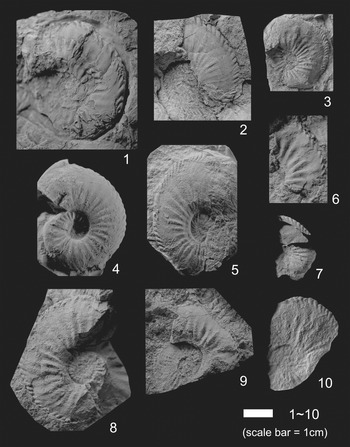
Amaltheus margaritatus from Japan. The locality and the repository data are shown in Table 1. (1) NU-MM0076. (2) NU-MM0005. (3) NU-MM0006. (4) MM2791 (rubber cast). (5) MM2792 (rubber cast). (6) FMM2009. (7) NU-MM0007. (8) FMM2007. (9) FMM2008. (10) FMM3051-2 (rubber cast).

Amaltheus from Japan. The locality and the repository data are shown in Table 1. (1–5) Amaltheus margaritatus: (1) NU-MM0011; (2) TOTA-Fo-3015; (3) FMT0001; (4) NU-MM0077 (rubber cast); (5) NU-MM0078 (rubber cast). (6) Amaltheus sp. cf. A. margaritatus, NU-MM0004. (7) Amaltheus sp. indet., NU-MM0008.

Type
The neotype, BM.37039, designated by Howarth (Reference Howarth1958), was obtained from Croisilles (France).
Diagnosis (modified from Howarth, Reference Howarth1958)
Large oxycone with a compressed triangular or elliptical whorl section. The venter bears a well-developed keel with fine crenulation, except for the large body chamber. Radial and sigmoidal ribs curve forward strongly in the ventrolateral part and are reduced to striae before reaching the keel.
Occurrence
This species is the index taxon of the Amaltheus margaritatus Zone for the standard zonation. It ranges from the Amaltheus subnodosus Subzone of the margaritatus Zone to the Pleuroceras apyrenum Subzone of the Pleuroceras spinatum Zone in the Northwest European zonation, late Pliensbachian.
Amaltheus margaritatus was distributed mainly in high-latitude areas of the Northern Hemisphere, approximating to the Boreal Realm in the late Pliensbachian, as follows. It has been documented from the Northwest European province, the Caucasus (Georgia), West Asia (Alborz Province in Iran), East Asia (Japan), the North American Cordillera (British Columbia), and Russia (the northeast, the Siberian Platform, and the Far East regions). In addition, a few specimens of this species have been recognized in the Mediterranean province (Sicily in Italy, and Algeria and Morocco in North Africa).
Description
The whorls are moderately involute and enlarge rapidly, and the umbilici are narrow. Detailed characteristics of the whorl section are unknown because of compression. The venter bears a well-developed and elevated keel with fine crenulation. The present species from Japan has characteristic ribbing. On the inner whorl, the radial and slightly sigmoidal ribs starting from the umbilical edge are well developed in the middle of the flank and tend to disappear near the venter, but do not completely fade out. They are projected forward strongly in the upper part of the flank until the keel, but each serration of the crenulated keel is not connected with the ribs. The ribs weaken and finally fade on the outer whorl. NU-MM0005 (Fig. 5.2) displays some longitudinal striae on the whorl's flank. Tubercles on the ribs are not visible in this species.
Materials
Eleven specimens (NU-MM0005, NU-MM0006, NU-MM0076, NU-MM0007, FMM2007, FMM2008, FMM2009, FMM3051-2, MM2791 [|T5303-1a; Sato, 1955], MM2792 [|T5303-1; Sato, 1955], and TOTA-Fo-3015) from the Teradani Formation of the Kuruma Group and three specimens (NU-MM0077 [SA36-1-1; Nakada and Matsuoka, Reference Nakada and Matsuoka2011], NU-MM0078 [SA36-1-2; Nakada and Matsuoka, Reference Nakada and Matsuoka2011], and FMT0001) from the Nishinakayama Formation of the Toyora Group.
Remarks
On the basis of recognizable characteristics of surface ornament and keel, all of the materials identified as the present species are similar to the Amaltheus from Europe (defined as A. margaritatus form margaritatus in Meister, Reference Meister1988). The present species is distinguished from A. stokesi by characteristics of the ribbing and keel, as mentioned in the preceding.
The Japanese specimens of Amaltheus margaritatus are quite similar to those described by Dagis (Reference Dagis1976, pl. 1–3) from the Northeast Russian region. However, the Northeast Russian specimens, especially those shown in Dagis (Reference Dagis1976, pl. 2, fig. 2, pl. 3, fig. 1), have more evolute whorls and less-developed (thicker and round) keels. Thus, these specimens are excluded from the synonymy of A. margaritatus in this taxonomic analysis.
Amaltheus conspectus Dagis, Reference Dagis1976 is similar to the present species in terms of ribbing characteristics, but it differs in that it has quite involute coiling of the whorls (e.g., Dagis, Reference Dagis1976, pl. 12, figs. 4, 5) and connections between the serration of the crenulated keel and the ribs (Dagis, Reference Dagis1976, pl. 13, fig. 2).
Amaltheus margaritatus also has some affinities with A. talrosei Repin, Reference Repin, Efimova, Kinasov, Paraketsov, Polubotko, Repin and Dagis1968, which likely represents varieties of A. margaritatus. However, A. talrosei is distinguishable from the present species by the more evolute whorl and stronger projection of the ribs in the ventrolateral part (Dagis, Reference Dagis1976, pl. 7, fig. 1).
The specimens collected from the japonica Zone of the Nishinakayama Formation, Toyora Group (NU-MM0077, Fig. 6.4; NU-MM0078, Fig. 6.5), and some specimens from the Teradani Formation (e.g., NU-MM0076, Fig. 5.1; NU-MM0011, Fig. 6.1) are characterized by an elevated and individual keel with well-prorsiradiated serrations and the direct connection between some ribs and the serrations of the crenulated keel. These characteristics are limited to the specimens obtained from the apyrenum Subzone of the Northwest European province (e.g., Meister, Reference Meister1988, pl. 4, fig. 3). The japonica Zone proposed by Nakada and Matsuoka (Reference Nakada and Matsuoka2011) in the Toyora Group was correlated with the apyrenum Standard Subzone on the basis of the occurrence of some specimens of Amaltheus margaritatus exhibiting these morphological characters.
A specimen obtained from the Kuruma Group, NU-MM0004 (Fig. 6.6), has some affinities with the present species—for example, the relatively fine serration of the crenulated keel. However, this specimen is small with inadequate preservation of ventrolateral surface ornament. In this description, the specimen is treated as Amaltheus cf. A. margaritatus.
A specimen derived from the Teradani Formation, Kuruma Group, NU-MM0008 (Fig. 6.7; Table 1) is similar to the present species in terms of ribbing characteristics, but lacks a venter and an inner whorl. Thus, this specimen is described as Amaltheus sp. indet. in this study.
Amaltheus repressus Dagis, Reference Dagis1976
- Reference Dagis1976
Amaltheus (Proamaltheus) repressus Dagis, p. 24, pl. 11, figs. 1–5.
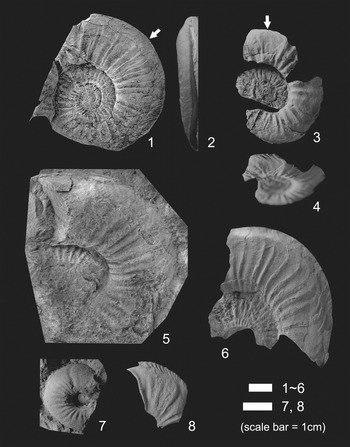
Amaltheus from Japan. The locality and the repository data are shown in Table 1. (1–6) Amaltheus orientalis n. sp.: (1, 2) TOYA-Fo-2974: (1) lateral view; (2) ventral view of gypsum cast photographed from the direction of the arrow of (1); (3, 4) NU-MM0010: (3) lateral view; (4) ventral view photographed from the direction of the arrow of (3); (5) TOYA-Fo-2986; (6) NMNS PM23448. (7, 8) Amaltheus repressus: (7) NU-MM0079 (rubber cast); (8) NU-MM0009.

Type
The holotype, no. 517–50, from Omolon Massif, Northeast Russia, was illustrated by Dagis (Reference Dagis1976, pl. 11, fig. 2).
Diagnosis (modified from Dagis, Reference Dagis1976)
The whorls are slightly involute. The flat whorl flanks have strong ribs that are radial along the dorsal part and curve forward in the ventrolateral part. This species characteristically exhibits a large number of constrictions. The venter bears a slightly developed keel with crenulations independent of ribs.
Occurrence
Amaltheus repressus co-occurs with A. stokesi in the Northeast Russian region, and thus the range of A. repressus is correlated with the Amaltheus stokesi Standard Subzone of the margaritatus Standard Zone, earliest late Pliensbachian (Dagis, Reference Dagis1976).
The present species was distributed in the Northeast Russian region and East Asia (Japan).
Description
The whorls are moderately involute and expand rapidly; thus, the umbilicus is relatively narrow (Fig. 8). Details of the whorl section are unknown. The venter bears a weak and crenulated keel, and the crenulations are very fine and prorsiradiated. However, surface ornaments on the whorl flank are generally weak. The present species is characterized by the presence of constrictions. On the early whorl of specimen NU-MM0079 (Fig. 7.7), the radial and irregular ribs starting from the umbilical edge are well developed in the inner half of the whorl and weaken rapidly toward the venter. They project strongly forward in the ventrolateral part and are connected to the keel. A slightly sigmoidal constriction is developed on the whorl flank, and it also projects strongly onto the ventrolateral part. In the outer whorls on specimen NU-MM0009 (Fig. 7.8), the ribs become very weak, and two constrictions per 45° of a whorl are developed near the aperture.
Variation in whorl height and umbilical width of Amaltheus specimens from Japan.

Materials
Two specimens, NU-MM0009 and NU-MM0079, from the Teradani Formation, Kuruma Group.
Remarks
In previous studies, characteristic Russian species of Amaltheus were recognized outside Russia only in the North American Cordillera. Imlay (Reference Imlay1955) and Smith et al. (Reference Smith, Tipper and Ham2001) described a Russian species, A. viligaensis (Tuchkov, Reference Tuchkov1954), from Alaska. The occurrence of the present species is the first recorded occurrence of the Russian Amaltheus outside of Russia.
The present species is similar to Amaltheus margaritatus and A. conspectus in surface ornament (e.g., the slightly sigmoidal, irregular, and weak ribbing and the strongly prorsiradiate crenulation of the keel). However, the former is distinguished from the latter by the presence of constrictions.
Amaltheus orientalis new species
Figure 7.1–7.6
Type
The holotype, TOYA-Fo-2974, and two paratypes, TOYA-Fo-2986 and NU-MM0010, were collected from the fossil localities Sakai River 2 and 3 (Fig. 2; Table 1). Another paratype, NMNS PM23448, is from Loc. 5303 (shown in Sato, Reference Sato1955) along the Teradani Valley.
Diagnosis
The whorls are moderately evolute. The whorl flanks have quite irregular, rigid (strong and rather tense), and generally radial ribs that are characterized by a strong projection in the ventrolateral portion. The ribs are irregular with some intercalations. The venter bears a not developed (thick and round) keel with coarse crenulations.
Occurrence
The detailed biostratigraphic distribution of the present endemic species is difficult to discuss because no index taxa have been obtained from the Sakai River 2 section (Fig. 2). However, NMNS PM23448 (Fig. 7.6) co-occurs with Amaltheus margaritatus (MM2791, Fig. 5.4; MM2792, Fig. 5.5) and Canavaria sp. ex gr. geyeriana (Haas, Reference Haas1913) from Loc. 5303 (Sato, Reference Sato1955) along the Teradani Valley (Fig. 1). On the basis of the biostratigraphic range of these latter two taxa (e.g., Howarth, Reference Howarth1958; Repin, Reference Repin, Efimova, Kinasov, Paraketsov, Polubotko, Repin and Dagis1968; Dagis, Reference Dagis1976; Meister, Reference Meister1988), the range of the present species seems to be comparable to the subnodosus Standard Subzone of the margaritatus Standard Zone to the spinatum Standard Zone, equal to the margaritatus and the Canavaria assemblage zones of the Kuruma Group (see Figs. 2, 9).
Biostratigraphic correlation for assemblage zones of the Teradani Formation recognized in this study with the upper Pliensbachian zonal schemes of the Northwest European province, the Northeast Russian region, and the Toyora Group area.

The present species is found only in East Asia (Kuruma Group, central Japan).
Description
The whorls are moderately evolute (Fig. 8). The umbilici are relatively large and shallow with steep umbilical edges, as seen in TOYA-Fo-2974 (Fig. 7.1). The whorl sections seem to be subelliptical with flat flanks, recognized in the holotype (TOYA-Fo-2974; Fig. 7.1), but details are unknown because of compression. The venter bears a broad and round keel.
This species’ surface ornaments show some intraspecific variations. First, the serrations of the crenulation are generally weak, fine, and strongly prorsiradiated (e.g., Fig. 7.1, 7.2, 7.6), but NU-MM0010 partly has coarse and strong serrations (Fig. 7.3, 7.4). Second, most ribs are radial, wide, strong, quite irregular, and projected toward the aperture on the dorsolateral edge, typically in the holotype (TOYA-Fo-2974; Fig. 7.1). However, the ribbing of NMNS PM23448 (Fig. 7.6) is partly rursiradiate near the umbilical edge and slightly projected backward at the dorsolateral part. Finally, the rib density also shows some variation. The holotype (Fig. 7.1) has a relatively high rib density with some intercalated ribs (19 ribs on half an outer whorl); however, NU-MM0010 (Fig. 7.3), TOYA-Fo-2986 (Fig. 7.5), and NMNS PM23448 (Fig. 7.6) are characterized by coarser and stronger ribbings without intercalations (16 ribs on half an outer whorl in TOYA-Fo-2986; Fig. 7.5).
The ribs start from the umbilical edge and become strong near the inner flank. They tend to disappear from the middle to the outer flank and are projected forward strongly in the ventrolateral part. Some of them pass through onto the crenulated keel and constitute a part of the serrations. The present species has no tubercles, spines, or constrictions on the surface ornament.
Etymology
The species name is derived from their distribution area, the oriental region (western Panthalassa area).
Materials
The four specimens mentioned in the preceding are from the Teradani Formation, Kuruma Group.
Remarks
The present species is quite similar to Amaltheus talrosei, described only from the Northeast Russian region by Repin (Reference Repin, Efimova, Kinasov, Paraketsov, Polubotko, Repin and Dagis1968) and Dagis (Reference Dagis1976). It displays evolute coiling, strongly prorsiradiate serration of the crenulated keel, the connection between the ribs and the serration of the keel, and the strong projection of ribs in the ventrolateral part. However, the present species has stronger and more irregular ribbing (see the holotype of the present species illustrated in Fig. 7.1) than A. talrosei, typical forms of which are illustrated by Dagis (Reference Dagis1976, pl. 6, figs. 2–6). Consequently, the present new species from East Asia is closely related to A. talrosei from the Northeast Russian region.
The present species, especially TOYA-Fo-2974 (Fig. 7.1), is very similar to Amaltheus sensibilis (illustrated by Dagis, Reference Dagis1976, pl. 4, fig. 1), another of the endemic species of the Northeast Russian region, in the rursiradiate, strong, and wide ribbing and the evolute coiling. Nevertheless, the present new species is different from A. sensibilis by its irregular ribbing, most typical in the holotype (TOYA-Fo-2974) and the larger umbilicus.
The present species is similar to some Russian species, Amaltheus (Nordamaltheus?) molodoensis Repin, Reference Repin2017 (pl. 1, figs. 2, 12) and Amaltheus striatus asiaticus Repin, Reference Repin and Sachs1974 (see Repin, Reference Repin and Zakharov2009), in terms of ribbing characteristics. However, the present new species is distinguishable from these species by the more evolute whorl.
Some specimens of the present species, TOYA-Fo-2974 (Fig. 7.1) and NU-MM0010 (Fig. 7.3), also have some affinities with A. margaritatus and A. viligaensis in terms of the characteristics of the ribbing; both of the latter species are characterized by weak and irregular sinuous ribs. In addition, A. viligaensis (e.g., Tuchkov, Reference Tuchkov1954, pl. 37, fig. 3; Repin, Reference Repin, Efimova, Kinasov, Paraketsov, Polubotko, Repin and Dagis1968) is similar to present species in the irregular ribbings. However, the present species is distinguishable from these two species by its more evolute whorl and the stronger projection of its ribs in the ventrolateral part.
The present specimens, especially NU-MM0010 (Fig. 7.3), are similar to Amaltheus (Nordamaltheus?) borealis Dagis, Reference Dagis1976 and Amaltheus (Nordamaltheus?) bulunensis Repin, Reference Repin, Efimova, Kinasov, Paraketsov, Polubotko, Repin and Dagis1968 (pl. 36, fig. 1) in terms of ribbing and crenulation characteristics. However, the present species differs from those Russian species in that it has more evolute whorl.
Biostratigraphic remarks
In previous studies, the Teradani Formation of the Kuruma Group has been thought to approximate to the upper Pliensbachian on the basis of the occurrence of Amaltheus sp. indet. and Canavaria sp. ex gr. geyeriana (Sato, Reference Sato1955, Reference Sato and Westermann1992). However, detailed ammonoid biostratigraphy has not been discussed for the Kuruma Group because of difficulty in specific identification with the specimens’ poor preservation and unrepresented fossil-bearing horizons. In the Amaltheus species identified in this study from the Kuruma Group, A. stokesi and A. repressus co-occurred in the Northeast Russian Amaltheus stokesi Zone, which is correlated with the stokesi Standard Subzone (Fig. 9) (Dagis, Reference Dagis1976; Repin, Reference Repin and Zakharov2009), and were not coeval with the longer range of A. margaritatus, which extends from the subnodosus through the apyrenum standard subzones (Fig. 9). On the basis of this biostratigraphic distribution, two successive Amaltheus-based assemblage zones are recognized in the Teradani Formation: in ascending order, the Amaltheus stokesi–Amaltheus repressus and the margaritatus assemblage zones (Fig. 9). As mentioned in the preceding, the range of Amaltheus orientalis n. sp. seems to be correlated with the margaritatus Assemblage Zone and the overlying Canavaria Assemblage Zone, which are middle–late late Pliensbachian (Figs. 2, 9). In addition, the occurrence of A. stokesi in the lowermost part of the Teradani Formation (Fig. 2) clearly demonstrates that the base of this formation biostratigraphically corresponds to the earliest late Pliensbachian.
In the Toyora Group, four successive ammonoid zones, the japonica, the paltus, the helianthoides, and the inouyei zones, in ascending order, were proposed for the Lower Nishinakayama Formation by Nakada and Matsuoka (Reference Nakada and Matsuoka2011). The lowermost part of the japonica Zone was characterized by a form of A. margaritatus (Fig. 6.4, 6.5) that is typical of the apyrenum Standard Subzone, as mentioned. The same morphological characteristics are also recognized in some specimens of A. margaritatus obtained from the Kuruma Group (see the description of this species). Therefore, the late specimens of A. margaritatus from the Kuruma Group are probably coeval with the early fauna of the japonica Zone (Fig. 9) and are thus included in the overlying Canavaria Assemblage Zone. Moreover, in this study, the Amaltheus stokesi Assemblage Zone is newly established in the Higashinagano Formation (Fig. 9) on the basis of the occurrence of A. stokesi (GK.G.11293; Fig. 4.3). The faunal association of this assemblage zone is similar to that of the stokesi–repressus Assemblage Zone in the lowermost Teradani Formation proposed in this study (Fig. 9).
Paleobiogeographic remarks
The paleobiogeographic distribution of Amaltheus is shown in Figure 10. The species of Amaltheus were divided into three groups—the pan-Boreal, the Northwest European, and the Arctic groups—on the basis of their paleobiogeographic distributions. The pan-Boreal group, represented by A. stokesi, A. bifurcus, and A. margaritatus, has been recognized across the Boreal Realm, including in the Northwest European province, the North American Cordillera, the Canadian Arctic, Russia, and Asia (Japan and Iran). The Northwest European group, represented by A. margaritatus form subnodosus (Young and Bird, Reference Young and Bird1828) and A. margaritatus form gibbosus (Schlotheim, Reference von Schlotheim1820), evolved from A. stokesi or A. bifurcus, and their distribution was limited to the Northwest European province (Meister, Reference Meister1988). The Arctic group, represented by A. repressus, A. talrosei, A. sensibilis, A. viligaensis, A. conspectus, and A. subbifurcus, also developed from the pan-Boreal group (Dagis, Reference Dagis1976). But they were distributed only in the Russian provinces, except for the occurrences of A. viligaensis in Alaska (Imlay, Reference Imlay1955) and a species formerly considered a Russian endemic reported from Japan in this study (Fig. 10).
Specific distribution of Amaltheus spp. in the stokesi and the Amaltheus gibbosus–Pleuroceras apyrenum standard subzones, the Northwest European margaritatus Standard Zone. The paleogeographic map of late Early Jurassic is modified from the reconstructions of Smith and Briden (Reference Smith and Briden1977), Damborenea (Reference Damborenea2002), Golonka (Reference Golonka2007), and Dera et al. (Reference Dera, Pellenard, Neige, Deconinck, Pucéat and Dommergues2009).

In the stokesi Standard Subzone, the faunal composition from the Teradani Formation is characteristic of mixing of the pan-Boreal group, A. stokesi, and the Arctic group, A. repressus. This faunal association is recognized only in the Japanese assemblage (this study) and the Northeast Russian assemblage (e.g., Dagis, Reference Dagis1976) during this time interval, and other faunas, such as the Northwest European province and the North American Cordillera, are composed of only the pan-Boreal group (Fig. 10). This faunal similarity shows a high paleobiogeographic correlation between the East Asian and the Northeast Russian faunas throughout the margaritatus Standard Zone. Smith et al. (Reference Smith, Tipper and Ham2001) suggested that the Arctic and northern North Atlantic (Viking Corridor) were the main dispersal routes of Amaltheus because of the poor occurrence of this genus from eastern Eurasia. The presence of the remarkable Amaltheinae assemblage from East Asia described in this study, which exhibit specific diversity equal to or higher than that of the coeval North American Cordillera fauna, probably indicates a strong Boreal influence from the Arctic to the middle-latitude areas of the western Panthalassa during the margaritatus Standard Zone. In addition, the morphological diversity of A. margaritatus was also recognized in middle- to low-latitude areas within the margaritatus Standard Zone. In North Africa, A. gr. margaritatus form volubilis and A. gr. margaritatus form idrissensis have some homeomorphic ornamentations of A. stokesi, fine and delicate ornaments (no tubercles) with a slightly rounded and not-individual venter, but they clearly correspond to the margaritatus Standard Zone (Dommergues and Meister, Reference Dommergues and Meister2017). These diversifications in Russia, Japan, and North Africa suggest that wide geological expansion seemed to increase endemism in Amaltheus during this period.
Conclusion
The taxonomy of Japanese Amaltheus is analyzed using already-reported collections and specimens newly obtained from the Kuruma and Toyora groups. Four species, including a new species, are described from the Kuruma Group in central Japan as follows: A. stokesi (Sowerby, Reference Sowerby1818), A. margaritatus de Montfort, Reference de Montfort1808, A. repressus Dagis, Reference Dagis1976, and A. orientalis n. sp. The first two species are also recognized in the Toyora Group in southwest Japan.
On the basis of the taxonomic analysis, two successive Amaltheus assemblage zones are recognized in the Lower Teradani Formation of the Kuruma Group: the stokesi–repressus and margaritatus assemblage zones. The former assemblage zone biostratigraphically corresponds to the stokesi Assemblage Zone, newly established in the Higashinagano Formation of the Toyora Group. The range of the late-type A. margaritatus from the Kuruma Group is perhaps coeval with the early fauna from the japonica Zone of the Toyora Group.
The faunal composition of the Japanese ammonoid assemblage from the lower upper Pliensbachian is characterized by mixing of pan-Boreal and Arctic Amaltheus species and is quite similar to that of the Northeast Russian region. This affinity suggests a high paleobiogeographic similarity between the East Asian and the Northeast Russian faunas throughout this time interval.
Acknowledgments
We thank T. Sato (Tsukuba University) for providing us with information about the Kuruma Group fossil localities. We also thank K. Miyakita (Niigata City), M. Kawaguchi (Koriyama City), K. Nagata (Niigata City), K. Terabe (JX Nippon Oil & Gas Exploration), H. Ishida (Mine City), Y. Kubo (Nagano City), and T. Aoki (Kawasaki City) for offering abundant ammonoid specimens.
We are grateful to T. Sasaki (University Museum, University of Tokyo), Y. Ibaraki (Fossa Magna Museum), Y. Shigeta (National Museum of Nature and Science), and Y. Tanaka (Toyama Science Museum, retired) for providing access to samples considered in this study.
We thank J. Bardin and T. Poulton for their constructive comments on the manuscripts as the reviewers. We also thank K. Tanabe (University of Tokyo), P. Neige (University of Burgundy), G. Dera (University of Burgundy), and J. Guex (University of Lausanne) for their helpful comments.