BACKGROUND
Non-small cell lung cancer (NSCLC) represents 80% of all the lung cancer diagnoses in both men and women.Reference Yun, Jia and Li 1 Radiation therapy (RT) is one of the most effective treatments for NSCLC; however, the treatment planning can be challenging due to the difficult balance between target coverage and healthy lung tissue sparing.Reference Zhao, Yang, Wang, Zhang and Li 2 , Reference Zhang, Yu, Zheng and Zhao 3 Nowadays, advanced external beam radiation therapy techniques such as intensity-modulated radiation therapy (IMRT) and volumetric-modulated arc therapy (VMAT) are widely used to treat a range of thoracic tumours, including NSCLC.Reference Rana 4 Several comparative studies have been conducted to address the advantages and disadvantages of both techniques in the treatment of NSCLC. Although most agree on comparable target coverage and dose conformity, the results regarding organ at risk (OAR) sparing are still controversial. For instance, some authors report a higher mean lung dose (MLD) for VMATReference Zhao, Yang, Wang, Zhang and Li 2 , Reference Rao, Yang and Chen 5 whereas others state that VMAT plans achieve lower MLD values, when compared with IMRT.Reference Bertelsen, Hansen and Brink 6 – Reference Holt, van Vliet-Vroegindeweij, Mans, Belderbos and Damen 9 The MLD is one of the most used predictors of radiation pneumonitis. Other parameters include the relative volume of healthy lung tissue receiving more than a dose threshold (V dose) and normal tissue complication probability (NTCP) calculations.Reference Shi, Zhu, Wu, Yu, Li and Xu 10 The aim of the present work was to compare IMRT and VMAT in terms of plan quality and OAR sparing, focussing on dosimetric and radiobiological predictors of radiation-induced pneumonitis.
MATERIALS AND METHODS
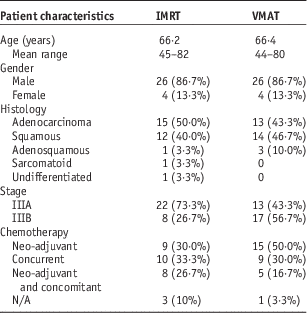
All patients diagnosed with stage III NSCLC treated with IMRT or VMAT between 2011 and 2013 were identified. Out of these, only radical treatments were included and patients undergoing respiratory motion control were excluded. The final sample comprised the plans of 60 randomly selected patients, out of which 30 had been treated with IMRT and the remaining 30 with VMAT, with curative doses ranging from 60 to 74 Gy. Patients’ characteristics are listed in Table 1.
Patient distribution and characteristics (n=60)

Abbreviations: IMRT, intensity-modulated radiation therapy; VMAT, volumetric-modulated arc therapy.
Planning computer tomography (CT) acquisitions were acquired in free-breathing and patient immobilisation was performed with arms raised above the head resting on a thorax immobilisation support (CIVCO Radiotherapy Inc., Coralville, IA, USA) and knee fixation to avoid patient discomfort and longitudinal offsets. Three CT reference points were tattooed in the patients’ skin and an additional tattoo was made for alignment. The clinical target volume to planning target volume (PTV) margin ranged from 1 to 2 cm, depending on the target motion susceptibility and the PTV volumes ranged from 138·2 to 1,517·2 cc, with an average of 492·0 cc. Treatment planning was performed according to patients’ anatomy, PTV shape and location in order to meet the ICRU guidelines and dose-volume histogram (DVH) objectives. The number of fields and arcs were defined by the dosimetrist on a case-by-case basis, avoiding the contralateral lung. The image verification protocol included two coplanar images (antero-posterior and lateral) performed on the three first fractions and on a weekly basis thereafter. Bony landmarks were used as reference for matching with the digitally reconstructed radiography.
The target coverage and dosimetric parameters associated with radiation pneumonitis were assessed for each patient, through DVHs exported from EclipseTM (Varian Medical Systems, Palo Alto, CA, USA). The dose was prescribed to PTV and, hence, the coverage was evaluated at the 95% level. In addition, V 109% was evaluated as a measure of homogeneity, in accordance with the institution’s protocol, adapted from ICRU 83. 11
The healthy lung tissue volume was defined as the total lung volume (right lung+left lung) subtracted by the gross target volume (GTV), hereinafter referred to as ‘Lung-GTV’.Reference Bertelsen, Hansen and Brink 6 , Reference Hedin and Back 12 – Reference Wennberg, Baumann and Gagliardi 14 The MLD, V 5, V 10 and V 20 were collected from the DVHs and assessed for each patient to predict the risk of radiation pneumonitis. Also, the NTCP associated with radiation pneumonitis was calculated using the Lyman–Kutcher–Burman (LKB) model. This model describes complication probability considering the dose received by the organ. To account for heterogeneities in dose distributions, a correction is performed according to the equivalent uniform dose (EUD) concept which dictates that an heterogeneous dose distribution is equivalent to a certain homogenous distribution if the radiobiological effect in the tissue is the same.Reference Niemierko 15 The NTCP for given volume, V, covered by an uniform dose, EUD, is given by following equation:
 $${\rm NTCP}\,{\equals}\,{1 \over {\sqrt {2\pi } }}{\int}_{{\!}{\!}{\!}{\!}{\minus}\infty}^t {e^{{\left( {{{{\minus}x^{2} } \over 2}} \right)}} {\!}\cdot dx} $$
where
 $$t{\rm \,{\equals}}\,{{{\rm EUD{\minus}TD}_{{{\rm 50}}} \left( v \right)} \over {m{\rm {\times}TD}_{{{\rm 50}}} \left( v \right)}}$$
 $${\rm TD}_{{50}} \left( v \right)\,{\equals}\,{\rm TD}_{{50}} \left( 1 \right) \cdot V^{{{\minus}n}} $$
 $$v{\rm \,{\equals}}{V \over {V_{{ref}} }}$$
where m is a dimensionless parameter that represents the steepness of the dose-response curve; TD50 (1) the dose tolerance of an organ at which there is 50% complication probability; TD50 (v) the dose tolerance for a partial volume v; n the parameter that determines volume-dependence of the complication in the organ, that is, n=0 indicates that the organ has a serial structure and the maximum dose determines the complication probability whereas n=1 indicates a parallel structure in which the mean dose is the predictor of the complication probability.Reference Niemierko 15 , Reference Gulliford, Partridge, Sydes, Webb, Evans and Dearnaley 16
To calculate the NTCP for radiation pneumonitis, the DVH of the Lung-GTV were imported to Biosuite (Clatterbridge Cancer Centre, Bebington, Wirral, UK).Reference Uzan and Nahum 17 The NTCP parameters for the prediction of radiation pneumonitis, TD50, n and m used in this study were those suggested by Seppenwoolde et al.,Reference Seppenwoolde, Lebesque and de Jaeger 13 depicted on Table 2. The dose distributions in the healthy lung tissue were corrected by using an α/β ratio of 3.Reference Bertelsen, Hansen and Brink 6 , Reference Wennberg, Baumann and Gagliardi 14 , Reference Bufacchi, Nardiello, Capparella and Begnozzi 18 This ratio derives from the linear-quadratic model for cell survival and determines the radiosensitivity of a given tissue.Reference Wedenberg 19
Seppenwoolde et al.Reference Seppenwoolde, Lebesque and de Jaeger 13 parameters for Lyman–Kutcher–Burman, for radiation pneumonitis

For the statistical purposes of this study, the Statistical Package for the Social Science (SPSS) software, version 21.0 (IBM Corp., Armonk, NY, USA) was used. A Student’s t-test for independent samples was performed to compare IMRT and VMAT in terms of plan quality, and dosimetric and radiobiological parameters associated with radiation pneumonitis. For all the statistical tests, a confidence interval of 95% was used.
RESULTS
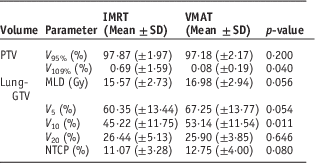
The comparison between IMRT and VMAT, regarding the variables in study for PTV and Lung-GTV is summarised in Table 3.
Mean values and respective standard deviations (SD) of the evaluated parameters, for both PTV and Lung-GTV

Abbreviations: IMRT,intensity-modulated radiation therapy; VMAT,volumetric-modulated arc therapy; MLD, mean lung dose; NTCP, normal tissue complication probability.
PTV coverage was comparable for both IMRT and VMAT (V 95%=97·87 and 97·18%, respectively), with no statistically significant differences being found between the two techniques (p=0·20). However, a significantly lower hotspot volume was observed for VMAT when compared to IMRT (V 109%=0·08 and 0·69%, respectively; p=0·04).
For the Lung-GTV, the MLD was lower when treating with IMRT, but no statistically significant difference was observed (MLD=15·57 and 16·98 Gy for IMRT and VMAT, respectively; p=0·056). Similar results were observed for V 5 and V 10, with the latter being significantly reduced for IMRT (p=0·054 and 0·011, respectively). On the other hand, VMAT reduces the V 20 in contrast with IMRT, but again no statistically significant difference was observed (V 20=25·90 and 26·44%, respectively: p=0·646).
Based on the performed NTCP calculations, a higher but not statistically significant risk of radiation pneumonitis was associated with VMAT plans (NTCP=11·07 and 12·75% for IMRT and VMAT, respectively; p =0·08).
DISCUSSION
VMAT is considered an advanced version of IMRT which provides high conformal dose distributions through a dynamic dose delivery. In recent years, several studies reported the potential of VMAT to reduce the treatment time and the monitor units (MUs), when compared with IMRT for lung cancer treatment.Reference Jiang, Li and Liu 8 , Reference Tesfamicael 20 However, due to the controversial results in OAR sparing, a consensus regarding a standard treatment technique for this pathology has not yet been reached.
The results of this work showed a comparable PTV coverage for IMRT and VMAT. Most authors agree on this matter, suggesting that the main differences between the two techniques rest mainly on the OAR sparing.Reference Rao, Yang and Chen 5 , Reference Bertelsen, Hansen and Brink 6 , Reference Jiang, Li and Liu 8 In this study, the analysis of V 109% as a measure of homogeneity suggests that VMAT is able to provide more homogeneous plans, although this might be of little clinical relevance since V 109% is <1% for both techniques. Verbakel et al. reported similar results (V 107%=1·6% for IMRT and 0·5% for VMAT).Reference Verbakel, van Reij, Ladenius-Lischer, Cuijpers, Slotman and Senan 21 However, Jiang et al. and Zhang et al.’sReference Zhang, Yu, Zheng and Zhao 3 , Reference Jiang, Li and Liu 8 studies report lower homogeneity indexes for VMAT.
Regarding healthy lung sparing, IMRT achieved a more favourable MLD, V 5 and V 10, whereas VMAT showed the lowest V 20. Several authors performed comparative studies between IMRT and VMAT for lung cancer and reported a reduction on the volume of healthy lung receiving low doses for IMRT while VMAT decreased the volume receiving higher doses, such as V 15, V 20 and V 30.Reference Zhao, Yang, Wang, Zhang and Li 2 , Reference Zhang, Yu, Zheng and Zhao 3 , Reference Jiang, Li and Liu 8
In this work, we have also used the LKB model to calculate the risk of radiation pneumonitis. NTCP estimations show a slightly higher risk associated with VMAT, when compared with IMRT. At the moment of this project, Bertelsen et al.’s work was the only publication in which IMRT and VMAT were compared in terms of NTCP for radiation pneumonitis, in patients diagnosed with NSCLC. The authors reported higher NTCP values, calculated with the LKB model, for IMRT, when compared with VMAT (10·2 versus 9·8%, respectively). Their results, as well as the results in this study, were not statistically significant (p=0·10).Reference Bertelsen, Hansen and Brink 6 As several studies suggest a strong correlation between MLD, V 5 and V 10 and radiation pneumonitis,Reference Zhao, Yang, Wang, Zhang and Li 2 the present results suggest that for this specific group of patients, IMRT was superior to VMAT in sparing the healthy lung. Moreover, our NTCP calculations support this assumption as the risk of radiation pneumonitis is higher for VMAT. However, out of all the lung dose parameters studied, only V 10 was statistically significant.
During the course of this work, some limitations were found that are worth noting. First, the results were based on a retrospective analysis and no follow-up was conducted. For future studies, a more extensive research is recommended to confirm the clinical relevance of the conclusions drawn. Second, although a specific tumour stage was chosen to standardise our sample, other important factors such as size and location of the primary lesion and chemotherapy protocols were not considered as variables. To overcome this limitation, a possible solution would be that each patient had both an IMRT and a VMAT plan. In addition, the planning technique used was specific of the institution where this study was conducted which limits the possibility of extrapolation of the results to other institutions. In this sense, a multicentre study and a bigger sample are recommended. Finally, the use of NTCP estimations constitutes a limitation itself as many authors insist on the uncertainties of these models, which include the lack of revision on NTCP parameters and the disregard of external factors that may influence the risk of a given radiation-induced complication. For these reasons, it is considered that NTCP calculations should not be used as sole criteria, but rather as a support tool for clinical decision making.
CONCLUSION
In summary, both IMRT and VMAT seemed suitable for NSCLC treatment. Nonetheless, IMRT might be suggested as the technique of choice when trying to reduce the risk of radiation-induced pneumonitis. Given that IMRT achieved lower doses in parameters reported as radiation pneumonitis indicators, patients with pre-existing risk factors such as poor pulmonary function, previous pulmonary diseases or history of heavy smoking may benefit from this technique. However, the advantage in terms of dose homogeneity and other aspects of VMAT that were not in the scope of this study (e.g., treatment time and MUs) should also be considered and, hence, a patient-based decision is recommended.
Acknowledgements
The authors would like to acknowledge Instituto Português de Oncologia (IPO) do Porto staff, in particular, Helena Pereira for authorising the data collection in the institution. The authors would also like to thank Alan Nahum and Julien Uzan for supporting them with technical issues regarding Biosuite.
Financial support
This research received no specific grant from any funding agency, commercial or not-for-profit sectors.
Conflicts of Interest
None.