Introduction
South American lizards of the family Teiidae are conspicuous members of the major biomes, occurring in a wide variety of habitats (Pianka & Vitt, Reference Pianka and Vitt2003). Although several aspects of many teiids have been studied in the past few years, such as reproduction, activity, diet and parasitism (Vitt, Reference Vitt1991; Vitt & Colli, Reference Vitt and Colli1994), there is a lack of knowledge of some genera (e.g. Tupinambis, Dracaena and Kentropyx). To our knowledge, the only records of helminths infecting Kentropyx species are those from K. altamazonica and K. pelviceps in Amazonian Peru (Bursey et al., Reference Bursey, Goldberg and Parmelee2005) and K. calcarata from the Pará state, in the Brazilian Amazon (see Vicente et al., Reference Vicente, Rodrigues, Gomes and Pinto1993; Goldberg et al., Reference Goldberg, Bursey, Caldwell, Vitt and Costa2007).
Kentropyx calcarata is a teiid lizard commonly found in open habitats and forest edges throughout central and eastern Amazonia, in Guyana, French Guiana, Suriname and six states of Amazonian Brazil (Ávila-Pires, Reference Ávila -Pires1995). Studies of helminths of a widespread host along their geographical distribution are important to highlight the importance of habitat types and biogeographical patterns of the parasites (Aho, Reference Aho, Esch, Bush and Aho1990; Rocha et al., Reference Rocha, Vrcibradic, Vicente and Cunha-Barros2003). Thus, the purpose of this article is to present data on the helminths of K. calcarata from the southern Amazon, Mato Grosso state, Brazil and, using available data, compare the helminth fauna of this population with those of other populations and congenerics.
Materials and methods
Lizards (n = 7) were collected by hand or pitfall traps in August 2007 in a tropical rain forest (Amazon) of Juara municipality (57°38′W, 10°25′S, datum: SAD69), Mato Grosso State, Brazil. The hosts were euthanized with a lethal injection of sodium thiopental, fixed in 10% formalin and stored in 70% alcohol. Lizards were deposited in the Coleção Zoológica de Vertebrados da Universidade Federal de Mato Grosso (UFMT 6876, 5982, 6562, 5986, 6761, 5985, 6003).
Subsequently lizards were necropsied and lungs, body cavity and digestive tract were surveyed under a stereomicroscope for endoparasites. Helminths were cleared in phenol, identified and deposited in the Coleção Helmintológica do Instituto de Biociências da Universidade Estadual Paulista Júlio de Mesquita Filho, Instituto de Biociências de Botucatu, São Paulo State, Brazil, under the acronym CHIBB (2647–2653 and 3044).
Prevalence was calculated as (infected lizards/examined lizards) × 100, mean intensity of infection as arithmetic mean number of worms from infected lizards, and mean abundance as total number of a particular parasite divided by total number of hosts (both infected and uninfected hosts) (Bush et al., Reference Bush, Lafferty, Lotz and Shostak1997). Means are ± 1 standard deviation.
Results
From the seven specimens of K. calcarata examined, 57.1% were found to harbour nematodes (table 1). Seventeen helminths of four nematode species were recovered and were identified as Oswaldocruzia sp., Piratuba digiticauda, Physaloptera retusa and Physalopteroides venancioi. Nematode cysts were also found in the lungs of one specimen. Of these, the body cavity parasite P. digiticauda presented the higher prevalence (42.9%), followed by the intestinal and stomach parasites, Oswaldocruzia sp. and P. retusa respectively, which had the same prevalence (28.6%). The species with the highest intensity of infection was the stomach parasite P. venancioi, and the highest abundance was shown by P. retusa. Three lizards (42.9%) had no parasites, one presented just one parasite species, two harboured two parasite species and one was infected by three parasite species (table 1).
Epidemiological data for seven Kentropyx calcarata and their nematode parasites from the rain forest of Juara municipality, Mato Grosso State, Brazil. For each nematode the total number (N), prevalence, intensity of infection (mean±one standard deviation), mean abundance and the sites of infection are given.

LI, large intestine; SI, small intestine; BC, body cavity; ST, stomach.
Discussion
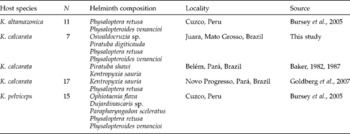
Despite the small sample size, the helminth richness found in K. calcarata in the Mato Grosso state was higher than those reported for other congeneric populations (table 2).
Comparison of helminths in different species and populations of Kentropyx.

Reports on endoparasites of Kentropyx species are scarce and restricted to the Pará State and Departamento Madre de Dios, Cuzco Amazonico in Peru (Baker, Reference Baker1982, Reference Baker1987; Vicente et al., Reference Vicente, Rodrigues, Gomes and Pinto1993; Bursey et al., Reference Bursey, Goldberg and Parmelee2005; Goldberg et al., Reference Goldberg, Bursey, Caldwell, Vitt and Costa2007). Thus, Mato Grosso state represents a new locality record for all the nematodes found and K. calcarata represents a new host record for Oswaldocruzia sp., P. digiticauda and P. venancioi.
The stomach parasites P. retusa and P. venancioi have been recorded in South America in a wide variety of reptilian and amphibian hosts (see Bursey et al., Reference Bursey, Goldberg and Telford2007). On the other hand, the body-cavity parasite P. digiticauda has been recorded only in sit-and-wait forager lizard hosts (Bursey & Goldberg, Reference Bursey and Goldberg2004); this is the first record of P. digiticauda in an active foraging lizard. In the present study we did not find Kentropyxia sauria, which is recorded only in K. calcarata in the Pará state. Another Molineidae nematode was found infecting K. calcarata in the Mato Grosso state: Oswaldocruzia sp. Differences in helminth communities in different populations of K. calcarata along their geographical range may be the result of changes in habitat characteristics and biological features of hosts, as noted by Rocha et al. (Reference Rocha, Vrcibradic, Vicente and Cunha-Barros2003) in the scincid Mabuya species.
The small sample size may be responsible for the low helminth richness found in the genus Kentropyx, because large sample size enhances the possibility of recording rare and accidental helminth species (Rocha et al., Reference Rocha, Vrcibradic, Vicente and Cunha-Barros2003). Also, all reports on Kentropyx endoparasites come from Amazonian sites and more helminth species would be recorded in other species inhabiting different habitats, such as the Cerrado and Pantanal in central Brazil.
Acknowledgements
We would like to thank the Instituto de Biociências da Universidade Federal de Mato Grosso, especially Ricardo A.K. Ribeiro and Marcos A. Carvalho, for providing lizards for this parasitological study. This study had financial support from FAPESP (process 06/59692-5). R.W.A. thanks CAPES for a grant.