Introduction
Approximately 20.6% of the US population smoke cigarettes (Centers for Disease Control and Prevention [CDC], 2011), making tobacco use the number one preventable cause of death in the United States. Among US smokers, up to 33% smoke nondaily (Tindle and Shiffman, Reference Tindle and Shiffman2011) or smoke between 1 and 29 days out of every 30 (American College Health Association [ACHA], 2009). Nondaily smoking may be a transitory pattern of smoking (Evans et al., Reference Evans, Gilpin, Pierce, Burns and Al1992, Okuyemi et al., Reference Okuyemi, Harris, Scheibmeir, Choi and Powell2002, Zhu et al., Reference Zhu, Sun, Hawkins, Pierce and Cummins2003, White et al., Reference White, Mason and Briggs2009a) or may continue for an indefinite period (Hassmiller et al., Reference Hassmiller, Warner, Mendez, Levy and Romano2003, Shiffman, Reference Shiffman2009, Hennrikus et al., Reference Hennrikus, Jeffery and Lando1996). Nondaily smokers suffer significant smoking-related morbidity and mortality compared to individuals who have never smoked (Luoto et al., Reference Luoto, Uutela and Puska2000, Jimenez-Ruiz et al., Reference Jimenez-Ruiz, Kunze and Fagerstrom1998, United States Department of Health and Human Services [USDHHS], 2004, Schane et al., Reference Schane, Ling and Glantz2010, Bjartveit and Tverdal, Reference Bjartveit and Tverdal2005, Pope et al., Reference Pope, Burnett, Krewski, Jerrett and Shi2009). Thus, nondaily smoking is a critical public health problem.
Young adults have been particularly affected by the increases in nondaily smoking, with 19.9% reporting nondaily smoking (Wortley et al., Reference Wortley, Husten, Trosclair, Chrismon and Pederson2003). Promoting smoking cessation among young adults is especially important given the health consequences of nondaily smoking and given that individuals who quit before the age of 30 will reduce their chances of dying prematurely by more than 90 per cent (USDHHS, 2004). However, measures designed to assess factors associated with the nondaily smoking pattern (e.g., reasons for smoking) in the young adult population are lacking.
One particularly important factor related to nondaily smoking is the tendency of nondaily smokers in the young adult population to deny being smokers (Berg et al., Reference Berg, Lust, Sanem, Kirch and Rudie2009) and be less likely to consider themselves to be addicted (Gilpin et al., Reference Gilpin, Cavin and Pierce1997), which has been associated with a decreased likelihood of recent quit attempts (Berg et al., Reference Berg, Lust, Sanem, Kirch and Rudie2009). Nondaily smokers may also discount personal health consequences (Moran et al., Reference Moran, Wechsler and Rigotti2004, Rollins et al., Reference Rollins, Schumacher and Ling2002, Luoto et al., Reference Luoto, Uutela and Puska2000, Woolcock et al., Reference Woolcock, Peat, Leeder and Blackburn1984). However, compared to daily smokers, nondaily smokers are more likely to be ready to quit in the next month and more confident that they can quit (Gilpin et al., Reference Gilpin, Cavin and Pierce1997), but nonetheless have difficulty quitting smoking (DiFranza et al., Reference DiFranza, Savageau, Fletcher, O'Loughlin and Pbert2007, Savageau et al., Reference Savageau, Mowery and DiFranza2009). While nondaily smokers can abstain without exhibiting signs of withdrawal (Rubinstein et al., Reference Rubinstein, Benowitz, Auerback and Moscicki2009), other findings indicate that they may experience signs of physiological addiction (DiFranza and Wellman, Reference DiFranza and Wellman2005, Rubinstein et al., Reference Rubinstein, Benowitz, Auerback and Moscicki2009, DiFranza, Reference DiFranza2011, DiFranza et al., Reference DiFranza, Savageau, Fletcher, Ockene and Rigotti2002, Ursprung and DiFranza, Reference Ursprung and DiFranza2010).
Difficulty quitting among nondaily smokers may also be due to external stimuli serving as triggers rather than nicotine dependence (Tindle and Shiffman, Reference Tindle and Shiffman2011). Social smoking, one subcategory of nondaily smoking, occurs among peers in social situations (Moran et al., Reference Moran, Wechsler and Rigotti2004). Problematically, social smokers do not show interest in quitting, as they often believe that they could stop at any time (Schane et al., Reference Schane, Glantz and Ling2009). Nondaily smoking may be associated with other high-risk substance use behaviors, particularly binge drinking, among young adults (White et al., Reference White, Mason and Briggs2009b, Harrison et al., Reference Harrison, Desai and McKee2008). One study found that, of the 74% of college students who report nondaily smoking, 86% report smoking while drinking compared with 63% of heavier smokers (White et al., Reference White, Bray, Fleming and Catalano2009b). Although some research has documented lower levels of alcohol and illicit drug use among nondaily smokers compared to daily smokers (Sutfin et al., Reference Sutfin, McCoy, Berg, Champion and Helme2012), other research (Pinsker et al., Under review) has documented the opposite. Thus, examination of how other substance use is related to nondaily smoking is needed.
Finally, prior research has documented that, while nondaily smokers report being less likely to smoke to regulate negative affect in comparison to daily smokers (Berg et al., In press), young adult nondaily smokers have been shown to report levels of depressive symptoms at rates similar to daily smokers (Pinsker et al., Under review). Thus, this may be a relevant factor associated with smoking among nondaily smokers.
Developing a measure to assess reasons for smoking among nondaily smokers in the young adult population is critical in the process of intervention development and testing. However, traditional models of addiction and assessments of smoking motives were developed based on the daily or more regular smoking pattern. One previously developed measure, the Motives for Smoking Scale (Piko et al., Reference Piko, Wills and Walker2007, Wills et al., Reference Wills, Sandy and Shinar1999), assesses several smoking-related motives, including social factors, self-confidence, boredom relief, and affect regulation as motives for smoking. While some of these items may be relevant to young adult nondaily smokers, these items were developed to assess substance use more generally among adolescents and thus lack specificity to the nondaily smoking population or to young adults. Similarly, other measures for assessing smoking motives among youth, such as the Adolescent Smoking Consequences Questionnaire (Myers et al., Reference Myers, McCarthy, MacPherson and Brown2003) or the Smoking Expectancy Scale for Adolescents (Hine et al., Reference Hine, Honan, Marks and Brettschneider2007), have the same limitations, and thus, may have limited utility in understanding and informing interventions targeting young adult nondaily smoking.
Given these limitations, the present study aims to develop and provide evidence of reliability and validity of a scale assessing reasons for smoking among nondaily smokers. This research builds upon prior qualitative research on young adult college students smoking an average of 13 days of the past 30 days (Berg et al., Reference Berg, Parelkar, Lessard, Escoffery and Kegler2010). Specific reasons or triggers for smoking included: (a) social aspects of smoking; (b) alcohol consumption or other drug use, specifically as smoking enhances the buzz (i.e., stimulation) of other substances; (c) emotional triggers for smoking (e.g. stress, anxiety, boredom, anger, sadness); (d) the habit or routine of smoking (e.g., driving, after a meal, doing homework, drinking coffee); and (e) not being concerned about their smoking or addiction. While some of these general factors are not unique to nondaily smokers, the framing of the issues raised within these themes are unique. Also, contrary to literature around daily smokers, few participants in this sample reported symptoms of addiction or withdrawal symptoms as motivators for smoking. The lack of concern about addiction is a unique phenomenon among nondaily smokers.
In the current study, we developed items, constructed a scale assessing motivation for smoking, and examined the reliability, factor structure, and concurrent validity of this scale. In terms of concurrent validity, we hypothesised that endorsing greater motivation to smoke across different domains would be associated with greater smoking frequency, less motivation to quit, and less confidence or self-efficacy in quitting, as well as less likelihood of making prior quit attempts, being a former smoker, and being ready to quit. We also anticipate specific subscales being correlated with specific to the domains (e.g., social smoking status, substance use, depression and stress levels).
Methods
Survey Participants and Procedures
In autumn 2010, students at six colleges in the Southeastern US were recruited to complete an online survey (for more details, see (Berg et al., Reference Berg, Lessard, Parelkar, Thrasher, Escoffery, Kegler, Goldade and Ahluwalia2011)). Then in autumn 2011, we selected 2,000 participants of the 2010 survey using a random number generator and recruited them to participate in a follow-up online survey using similar methods. To encourage participation, students received up to three e-mail invitations to participate and a $10 gift card for survey completion. Of the 2,000 students who received the invitation to participate, 718 (35.9%) completed the survey. The current analyses focused on the 105 participants who completed this 2011 survey, reported nondaily smoking (i.e., smoking between 1 and 29 days of the past 30 days), and provided complete data on their smoking behaviors. This sample size is deemed appropriate for the current analyses, as indicated by literature suggesting that the sample size needed for a factor analyses is the greater of the following: 1) five times the number of items or 2) 100 (Hatcher, Reference Hatcher1994, Kline, Reference Kline1979, Gorsuch, Reference Gorsuch1983). The Emory University Institutional Review Board approved this study, IRB# 00030631.
Measures
Demographic Characteristics
We assessed students’ age, gender, race/ethnicity, highest parental educational attainment (as a proxy for socioeconomic status), and type of school attended (two-year technical college vs. four-year university). Type of school was included, as it has been previously associated with higher smoking rates, lower parental education, and greater likelihood of parental smoking (Berg et al., Reference Berg, Lessard, Parelkar, Thrasher, Escoffery, Kegler, Goldade and Ahluwalia2011).
Reasons for Nondaily Smoking Scale
This scale was developed using results from the aforementioned formative research (Berg et al., Reference Berg, Parelkar, Lessard, Escoffery and Kegler2010) and was theoretically based on the Theory of Planned Behavior (Ajzen, Reference Ajzen1988). Specifically, items were framed in terms of theoretical constructs including the attitudes toward the behaviour (i.e., smoking), social norms related to smoking, and perceived behavioural control (e.g., volition, concern of addiction), as well as the impact and valence of these beliefs on smoking behaviour. The items were created by the research team and were screened for clarity and face validity by three experts in tobacco research. The Reasons for Nondaily Smoking Scale (RNS) consists of 19 items. Participants were instructed to “On a scale of 1 to 7, indicate the extent to which you agree with the following statements” with anchors of 1 = Not at all true, 4 = Somewhat true, and 7 = Very true. The stem leading into each statement was “I smoke cigarettes because. . . .” Each item is listed in Table 2. The RNS is scored by summing the Likert responses to each item resulting in a total score. The possible range of scores was 19 to 133, with higher scores indicating greater endorsement of reasons for smoking overall.
Smoking Behaviors
We asked, “In the past 30 days, on how many days did you smoke a cigarette (even a puff)?” (ACHA, 2008, CDC, 1997). We categorised students who reported smoking from 1 to 29 days of the past 30 days as nondaily smokers (ACHA, 2009, Office of Applied Studies, 2006). They were also asked, “Have you ever smoked cigarettes daily, that is, at least one cigarette every day for 30 days?” which was used to classify former daily smokers.
Previous Quit Attempts
We asked, ‘During the past 12 months, how many times have you stopped smoking for one day or longer because you were trying to quit smoking?’ (California Department of Health and Human Services. Tobacco Control Section, 1999). This variable was dichotomised as having made at least one quit attempt in the past year versus not.
Readiness to Quit
We asked, ‘What best describes your intentions regarding quitting smoking?’ Response options were ‘never expect to quit,’ ‘may quit in the future, but not in the next 6 months,’ ‘will quit in the next 6 months,’ and ‘will quit in the next month’ (Prochaska and DiClemente, Reference Prochaska and DiClemente1984). This variable was dichotomised as intending to quit in the next 30 days versus other responses.
Social Smoking
We asked, ‘In the past 30 days, did you smoke: mainly when you were with other people; mainly when you were alone; as often by yourself as with others; or not at all’ (Moran et al., Reference Moran, Wechsler and Rigotti2004). This variable was dichotomised as ‘social smoking’ (i.e., smoking mainly when with others) versus other responses. We also asked, ‘Out of your five closest friends, how many of them smoke cigarettes?’ (Maibach et al., Reference Maibach, Maxfield, Ladin and Slater1996).
Confidence and Motivation to Quit Smoking
Participants were asked, ‘On a scale of 0 to 10 with 0 being ‘not at all confident’ and 10 being ‘extremely confident,’ assuming you want to, how confident are you that you could quit smoking cigarettes starting this week and continuing for at least one month?’ and ‘On a scale of 0 to 10 with 0 being ‘I don't want to at all’ and 10 being ‘I really want to,’ how much do you want to quit smoking cigarettes?’ (Biener and Abrams, Reference Biener and Abrams1991, Maibach et al., Reference Maibach, Maxfield, Ladin and Slater1996).
Treatment Self-Regulation Questionnaire
Motivation to quit was measured using the 15-item Treatment Self-Regulation Questionnaire (TSRQ) (Ryan and Connell, Reference Ryan and Connell1989). The TSRQ contains items that measure autonomous motivation (six items), controlled motivation (six items), and amotivation (three items). Participants were asked to indicate the extent to which several motivators for change were relevant to them. Responses ranged from ‘not at all true’ to ‘very true’ on a 7-point scale. Scores ranged from 15 to 105, with higher scores indicating greater motivation. Construct validity was established for the scale (Ryan and Connell, Reference Ryan and Connell1989). In the present study, Cronbach's alphas for the Autonomous motivation, Controlled motivation, and Amotivation subscales were 0.88, 0.86, and 0.50, respectively.
Self-Efficacy Questionnaire
Self-efficacy was measured using the Smoking Self-Efficacy Questionnaire (SEQ-12) (Etter et al., Reference Etter, Bergman, Humair and Perneger2000). The SEQ-12 is a two-dimensional 12-item scale with six items that measure abstinence self-efficacy for internal stimuli (e.g., ‘When I feel nervous’) and six items that measure abstinence self-efficacy for external stimuli (e.g., ‘When having a drink with friends’). Responses ranged from ‘not at all sure’ to ‘absolutely sure’ and were on a 5-point Likert scale. SEQ-12 scores ranged from 12 to 60 with higher scores indicating greater self-efficacy. Reliability in test-retest procedures was established for the scale along with content validity, construct validity, and predictive validity (Etter et al., Reference Etter, Bergman, Humair and Perneger2000). In the present study, Cronbach's alphas for the Intrinsic and Extrinsic subscales were 0.93 and 0.82, respectively.
Other Substance Use
We asked, ‘In the past 30 days, on how many days did you: Drink alcohol? Use marijuana (pot, weed, hashish, hash oil)?’ (ACHA, 2008, CDC, 1997).
Patient Health Questionnaire – 2
Participants were asked to complete the Patient Health Questionnaire – 2 (PHQ-2) (Kroenke et al., Reference Kroenke, Spitzer and Williams2003), which is a two-item depression screening tool, based on DSM-4 diagnostic criteria, assessing frequency of depressed mood and anhedonia over the past two weeks. Responses were rated on a 4-point Likert scale and range from ‘not at all’ (0) to ‘nearly every day’ (3).
Data Analysis
Participant characteristics were summarised using descriptive statistics. Factor analyses were conducted to determine the underlying factor structure of the scale. In order to obtain internal consistency reliabilities for the scale and each subscale, we calculated Cronbach's alpha. As an additional measure of reliability, we also conducted a split-half reliability test. Scale scores were examined in relation to sociodemographic, smoking-related, and psychosocial characteristics using correlations for continuous variables and t-tests for categorical variables. SPSS 19.0 was used for all data analyses. Statistical significance was set at α = .05 for all tests.
Results
Factor Analysis and Reliability
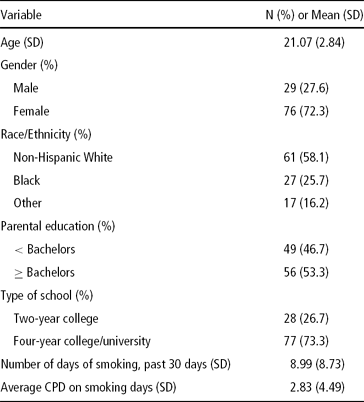
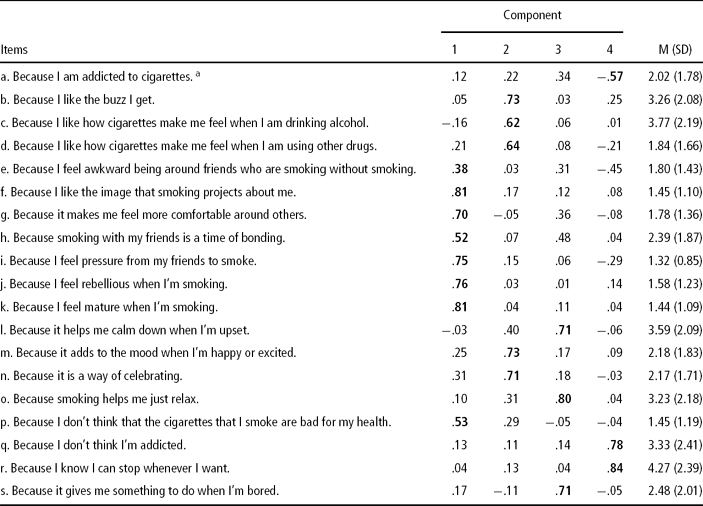
Participant characteristics are included in Table 1. Factor analysis using principal components extraction with varimax rotation was applied to the 19 items of the Reasons for Nondaily Smoking Scale (RNS). Following conservative guidelines for factor analysis detailed by Tabachnick and Fidell (Reference Tabachnick and Fidell1989), after the matrix was rotated, factors were retained whose eigenvalues were greater than 1.0 with high factor loadings (typically greater than .50). At least three items had to load onto a factor for it to be considered. Items included in the final scales, the factor loadings, and the means and standard deviations for each item are presented in Table 2.
Participant characteristics, N = 105

Reasons for Nondaily Smoking Scale factor analysis results
Note: Stem = ‘I smoke cigarettes. . . .’; a Reverse scored.
The average score on the RNS was 45.36 (SD = 15.55). The RNS yielded a Cronbach's alpha of 0.79. We tested the reliability of the scale using split-half reliability analysis, which indicated Cronbach's alphas of 0.93 and 0.82, with a correlation between forms of 0.89. The Spearman-Brown split-half coefficient was 0.94. Factor analysis of the items extracted four factors which accounted for 57.4% of the variance in scores. Eigenvalues and per cent of variance accounted for by each component are as follows: Component 1, eigenvalue = 3.59, 18.9%; Component 2, eigenvalue = 2.91, 15.3%; Component 3, eigenvalue = 2.35, 12.4%; and Component 4, eigenvalue = 2.05, 10.8%. All items had strong factor loadings. Component 1 was termed Social influences (Cronbach's alpha = .76), Component 2 was termed Enhancing buzzes and positive affect (Cronbach's alpha = .76), Component 3 was termed Negative affect regulation (Cronbach's alpha = .72), and Component 4 was termed Lack of concern of addiction (Cronbach's alpha = .67).
Concurrent Validity
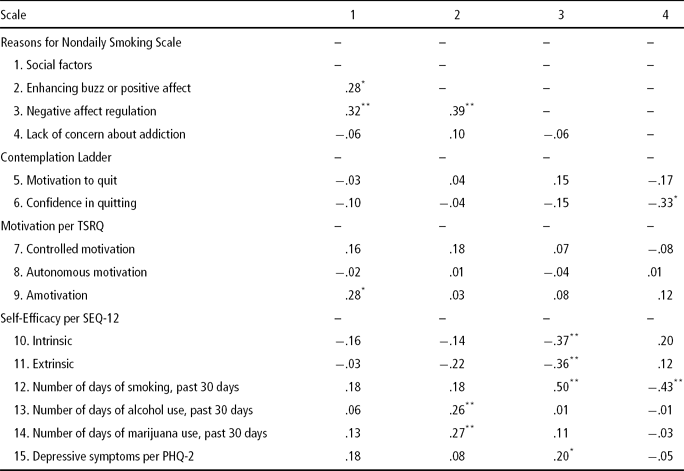
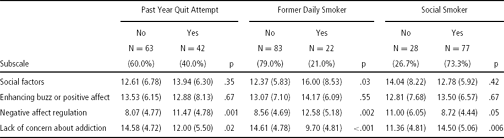
Table 3 presents correlations among the Reasons for Nondaily Smoking scores, as well as correlations with measures of Motivation and Confidence per the Contemplation Ladder, the subscales of the Treatment Self-Regulation Questionnaire, the subscales of the Self-Efficacy Questionnaire – 12 item, depressive symptoms level per the PHQ2, and the number of days of smoking, alcohol use, and marijuana use in the past 30 days. Table 4 presents bivariate relationships among the subscales and past year quit attempts, former daily smoking status, and social smoking status.
Correlations among Reasons for Smoking subscales and validated measures among nondaily smokers
* Indicates p < .05
** Indicates p < .01
Bivariate analyses relating Reasons for Nondaily Smoking to past year quit attempts, being a daily smoker in the past year, and social smoking status
Discussion
The current study is the first to develop and validate an instrument intended to assess reasons for nondaily smoking among young adult smokers. The RNS demonstrated internal consistency, other measures of reliability, face validity, and concurrent validity. It included four factors: Social influence (e.g., ‘Because I like the image smoking projects about me’), Enhancing buzzes and positive affect (e.g., ‘Because I like the buzz I get,’ ‘Because it is a way of celebrating’), Negative affect regulation (e.g., ‘Because it helps me calm down when I'm upset’), and Lack of concern about addiction (e.g., ‘Because I know I can stop whenever I want’). These subscales and items are in line with themes identified in our formative research (Berg et al., Reference Berg, Parelkar, Lessard, Escoffery and Kegler2010). Our findings and the resulting scale are also appropriately framed within the Theory of Planned Behavior (Ajzen, Reference Ajzen1988), such that attitudes toward smoking and the utility of smoking (e.g., to regulate affect or enhance physiological experiences), consideration of the social norms related to smoking, and perceived behavioural control (e.g., volition, concern of addiction) were important and distinct factors associated with nondaily smoking behaviour.
In terms of concurrent validity, several of the expected associations were found. Three of the RNS subscales were related to each other (Social influences subscale, Enhancing buzzes and positive affect subscale, Negative affect regulation subscale). This is likely because finding utility in some dimensions may not be completely isolated to those dimensions. For instance, those using cigarettes for social reasons may also be using cigarettes while using other substances or while celebrating with friends. Another example is that those using smoking to cope with negative affect may also reach out for social support during stressful times.
The RNS – Social influences subscale was related to the TSRQ – Amotivation subscale, which may indicate that nondaily smokers motivated by social pressures to smoke may be less motivated to quit, which aligns with prior research indicating that social smokers are less motivated for cessation (Schane et al., Reference Schane, Glantz and Ling2009). Higher scores on the RNS – Social influences subscale were related to being a former daily smoker, which may reflect prior findings that converted nondaily smokers (i.e., those who were previously daily smokers) have more friends that smoke (Pinsker et al., Under review). However, it was not associated with social smoker status or number of friends that smoke. These issues may be related to our definitions of what a social smoker is or what young adult perceptions of how they identify themselves (Berg et al., Reference Berg, Lust, Sanem, Kirch and Rudie2009) and potentially others as smokers (Berg et al., Reference Berg, Parelkar, Lessard, Escoffery and Kegler2010, Berg et al., Reference Berg, Nehl, Sterling, Buchanan and Narula2011).
The RNS – Enhancing buzzes and positive affect subscale was associated with frequency of alcohol use and marijuana use. This suggests that those who more frequently use other substances are the individuals most likely to report that smoking enhances these other buzzes. However, this subscale was not related to less depressive symptomatology. It was, however, related to the RNS – Negative affect regulation subscale, indicating that there might be some relationship between the use of cigarettes to enhance positive affect and the use of smoking to regulate negative affect.
The RNS – Negative affect regulation subscale was associated with greater frequency of smoking and higher levels of depressive symptoms, which indicates that this group may utilise cigarettes in order to cope. The relationship of this subscale to the SEQ-12 – Intrinsic subscale is likely directly related to the affect regulation component inherent to both scales, while the relationship to the SEQ-12 – Extrinsic subscale may be due to the overall higher rate of smoking, which may impact overall self-efficacy. Higher scores on the RNS – Negative affect regulation subscale were related to having made a quit attempt in the past year and having been a former daily smoker. Prior research has documented that daily smokers are more likely to use smoking to regulate negative affect (Berg et al., In press), and they may also be more likely to have made a recent quit attempt (Berg et al., In press, Pinsker et al., Under review). Lower scores on this subscale were associated with being a social smoker, which seems reasonable given that social smokers are less likely to smoke for negative affect regulation than other smokers (Berg et al., In press).
The RNS – Lack of concern of addiction subscale was correlated with lower confidence in quitting and less frequent smoking. This contradiction is difficult to interpret. It is reasonable given that those individuals smoking at low levels have a greater lack of concern about addiction. It is not intuitive why they also have less confidence in their ability to quit smoking. Perhaps they are subject to more contextual triggers than internal ones (Tindle and Shiffman, Reference Tindle and Shiffman2011), which reduces their confidence in quitting. Lower scores on this subscale (i.e., being more concerned about addiction) were related to having made a past year quit attempt and being a former daily smoker, whereas being less concerned was associated with being a social smoker. Previous research has found differences between nondaily smokers that are former daily smokers, termed ‘converted nondaily smokers’, and nondaily smokers that have always been nondaily smokers, termed ‘consistent nondaily smokers’ (Tindle and Shiffman, Reference Tindle and Shiffman2011, Pinsker et al., Under review). Consistent nondaily smokers smoke less days per month and smoke fewer cigarettes than converted nondaily smokers (Gilpin et al., Reference Gilpin, Cavin and Pierce1997). Thus, these findings also align with expectations, such that those individuals who have not previously smoked at a high level and tend to smoke in circumscribed situations (i.e., social situations) may be less concerned about cessation and thus less likely to attempt to quit smoking.
Implications for Research and Practice
This study extends our ability to understand nondaily smokers in the young adult population and to appropriately assess factors related to triggers or contextual factors related to nondaily smoking. In research, this scale could be used to identify intervention targets specific to nondaily smokers, particularly among young adults. For example, this instrument may inform targeted or tailored interventions to promote cessation among young adult smokers by delivering messaging related to social triggers, positive or negative emotional cues, or concerns about addiction. Moreover, further examination of this instrument's use in younger populations may also suggest its utility in informing interventions in this population. In the clinical setting, identifying smokers and intervening for cessation is standard of care (Fiore et al., Reference Fiore, Jaen and Baker2008). This instrument and the concepts assessed within it may be helpful to practitioners for better understanding and discussing the topic of nondaily or low-level smoking within the young adult population.
Limitations
Study limitations include a small sample size and the sample being largely female and drawn from colleges in the Southeastern United States. However, this sample reflects the characteristics of these school populations and has good representation of White and Black racial backgrounds. Second, the survey response rate may seem low and might suggest responder bias. However, previous online research has yielded similar response rates (29–32%) among the general population (Kaplowitz et al., Reference Kaplowitz, Hadlock and Levine2004) and a wide range of response rates (17–52%) among college students (Crawford et al., Reference Crawford, McCabe and Kurotsuchi Inkelas2008). We are also unable to ascertain how many participants did not open the email or had inactive email accounts, which impacts the true ‘denominator’ for this response rate. In addition, prior work has demonstrated that, despite lower response rates, internet surveys yield similar statistics regarding health behaviours compared to mail and phone surveys (An et al., Reference An, Hennrikus, Perry, Lein and Klatt2007). Also, we did not include additional items beyond the 19 items reported here. Thus, it is possible that other dimensions exist, but were not explored in this study. Finally, the cross-sectional nature of this study limits the extent to which we can make causal attributions. Future research should examine the predictive validity of this finding in longitudinal studies examining smoking motivation and its link to smoking cessation in this population.
Conclusions
This research aimed to develop and validate a scale designed to assess reasons, triggers, or situational factors related to nondaily smoking in young adults. Given this emerging public health problem and the lack of validated measures designed to assess factors associated with nondaily smoking, this assessment may be critical in informing our intervention strategies and potentially for predicting cessation among young adult nondaily smokers.
Acknowledgements
We would like to thank our collaborators across the state of Georgia in developing and administering this survey.
Financial Support
This work was supported by the National Cancer Institute (1K07CA139114-01A1; PI: Berg) and the Georgia Cancer Coalition (PI: Berg).
Conflict of Interest
The authors declare no conflicts of interest.
Ethical Standards
The authors assert that all procedures contributing to this work comply with the ethical standards of the relevant national and institutional committees on human experimentation and with the Helsinki Declaration of 1975, as revised in 2008.