Many have argued that achieving phonological awareness (PA), which is the understanding that words are made of smaller sounds, is a critical skill in early reading achievement, perhaps even a prerequisite to successful reading acquisition in languages that have an alphabetic writing system. Numerous studies have established a strong relationship between PA and reading in English and other Indo-European languages (see Ziegler & Goswami, 2005, for review) and emerging evidence confirms the relationship in Korean (Cho & McBride-Chang, 2005). However, it is only recently that researchers have undertaken a systematic and empirical examination of the relationship between oral language characteristics and salient phonological units (Durgonoglu & Oney, 1999) and possible origins of saliency of various phonological units (De Cara & Goswami, 2003). In this paper, data on Korean, a language that is typologically different from Indo-European languages and that has a relatively transparent alphabetic orthography, are presented to identify the roles of different levels of PA in reading and spelling acquisition in Korean and a possible source of the salient phonological units in Korean.
SALIENT INTRASYLLABIC UNITS AND THEIR RELATIONSHIP TO LITERACY ACQUISITION
Children's awareness of three phonological units (syllable, onset–rime, and phoneme) has been found to develop sequentially in English (Liberman, Shankweiler, Fischer, & Carter, 1974; Stahl & Murray, 1994; Treiman, 1985, 1992; Treiman & Zukowski, 1991). It is well established that the boundary between onset and rime is salient in English (Durgonoglu & Oney, 1999; Treiman, 1985, 1992; Treiman & Zukowski, 1991). Onset is a syllable-initial consonant or a consonant cluster, while rime refers to the syllable-final vowel or vowel–consonant(s) sequence. Onset–rime manipulation requires segmentation or substitution of the onset and the rime. For example, in a one-syllable word, cat, the consonant /k/ is the onset, and subsequent vowel and consonant /æt/ is the rime. The rime /æt/ is further segmented as two phonemes /æ/ and /t/. Many words in English are formed by replacing the onset (e.g., mat, hat, cat, and sat), and many language games and nursery rhymes segment onsets and rimes as units in English (Goswami, 2001).
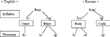
Although many other Indo-European languages (i.e., Swedish, German, Norwegian, and Dutch) also show that onset–rime segmentation is salient, whether onset–rime is a salient intrasyllabic linguistic awareness across languages has been questioned only recently. Indeed, some evidence has indicated that onset–rime analysis may not be universal (see Ziegler & Goswami, 2005). In particular, studies with Korean monolingual adults suggested that in Korean onset–rime (consonant–vowel–consonant [C-VC], e.g., g-ong) is not as salient as the body-coda subsyllabic structure (CV-C, e.g., go-ng; Derwing, Yoon, & Cho, 1993; Yi, 1998; Yoon, Bolger, Kwon, & Perfetti, 2002; Yoon & Derwing, 2001). Korean speakers showed a tendency to link vowels with the preceding rather than with the following consonant, indicating a preference for the body-coda analysis over the onset–rime structure. Figure 1 illustrates the proposed intrasyllabic structures of English versus Korean.

The proposed subsyllabic structure for English versus Korean.
In English, both rime awareness and phoneme awareness have received much attention for their contributions to reading and spelling (Bryant, MacLean, Bradley, & Crossland, 1990; Byrne & Fielding-Barnsley, 1993; Dixon, Stuart, & Masterson, 2002; Goswami, 1991; Goswami & Mead, 1992; Treiman & Zukowski, 1991). In particular, children's rhyming ability contributes directly and indirectly to reading and spelling development in English even after controlling for phoneme awareness (Bryant, MacLean, Bradley, & Crossland, 1990). Beginning readers are aware of the relationship between rime and its correspondent spelling patterns, and use this knowledge to infer the pronunciation of novel words (Goswami, 1986).
The significant relationship of the rime awareness to literacy acquisition in English is explained by the statistical properties of the English orthography (Goswami, Gombert, & Barrera, 1998). In English, the stable sound–spelling relationships in the rime unit help beginning readers become sensitive to onset–rime parsing in word reading as they make a connection between English phonology and orthography. In English, the spelling–sound relationship is the most consistent in onsets, followed by codas and rimes, and the most inconsistent in nucleus (vowels; Treiman, Mullennix, Bijeljac-Babic, & Richmond-Welty, 1995). Goswami and colleagues (1998) suggested that the variations in the path to reading acquisition across orthographies can be explained by these statistical properties of different orthographies.
A few studies that have examined the role of different phonological units in literacy development in languages other than English suggest that the predictive power of different phonological units may vary across languages. For example, rime awareness did not have as much predictive power as phonemic awareness in word reading in Norwegian and Swedish (Hoien, Lundberg, Stanovich, & Bjaalid, 1995; Lundberg, Olofsson, & Wall, 1980). Furthermore, syllable awareness was shown to play a significant role in orthographically transparent languages such as Greek, Portuguese, and Norwegian (Aidinis & Nunes, 2001; Hoien et al., 1995). In Korean, Cho and McBride-Chang (2005) showed that Korean kindergarteners' and second graders' syllable and phoneme awareness predicted their real word reading skills. Furthermore, Yoon et al. (2002) showed that Korean children may use an analogy of the body unit in reading nonwords. However, questions still remain about how different levels of PA in Korean are related to different measures of literacy skills (e.g., word reading, pseudoword reading, and spelling) when they are examined simultaneously. The present study addressed these questions.
UNDERSTANDING THE SOURCE OF EMERGENCE OF PA
Despite the critical importance of the PA in literacy development, our understanding of linguistic and cognitive bases on the source of PA is limited (McBride-Chang, 1995; Metsala & Walley, 1998). Lexical restructuring theory (Metsala & Walley, 1998; Walley, Metasala, & Garlock, 2003) proposes that children's phonological representation grows with vocabulary acquisition. As children are exposed to and acquire words, they implicitly compare words phonologically and recognize that sets of words share such phonological units as syllables, onsets, and rimes. One mechanism through which this operates is that children recognize similarity of sound units when they know many similar sounding words. These are called phonological neighbors, which are, by conventional definition in speech recognition models, words that differ by addition, deletion, and substitution of one phoneme (Goswami, 2001; Storkel, 2004). However, De Cara and Goswami (2002) expanded the definition to include consonant clusters in the onset and coda as a unit. In this alternative definition, words that share sounds in the rime but differ in the onset by more than one phoneme are classified as phonological neighbors. For example, for the word cat, both m

and fl

are rime neighbors,

p and

tch are body neighbors, and

i

is a consonant neighbor. Using this definition, it was demonstrated that in English many monosyllabic words have phonological neighbors in the rime unit, particularly, in dense neighborhoods (De Cara & Goswami, 2002) and this finding was extended to German, Dutch, and French (Ziegler & Goswami, 2005). Furthermore, De Cara and Goswami (2002) postulated that words with many similar sounds (or words in a dense neighborhood, e.g., hat, which has 45 neighbors) become more easily restructured. In fact, it was shown that the overrepresentation of rime neighbors in dense neighborhoods in English would pressure rime-level restructuring as children's vocabulary grows (De Cara & Goswami, 2003). Then, according to De Cara and Goswami's (2002) hypothesis, the saliency of the body-coda unit in Korean entails that many phonological neighbors should be found in the body-coda unit in Korean. For example, it predicts that the Korean corpus would have many phonological neighbors such as /

n/, /
t/, /
k/, /
l/, /
m/, /

/, /
p/ [

] compared to /k

/, /n
/, /t
/, /m
/, /p
/, /s
/, /c
/, /ph
/, and /h
/ [

].
Another proposal for different intrasyllabic segmentation across languages is the frequency of a certain syllable type. Share and Blum (2005) suggested that the frequency of the CV syllable in Hebrew may explain the saliency of the body-coda in PA tasks among Hebrew-speaking prereaders. However, no studies so far have examined these two hypotheses in explaining different patterns of emergence of PA in a language. The present study examined both phonological neighbors and frequency of different syllable types in Korean. Specifically, the study examined the predominance of body versus rime neighbors using monosyllabic Korean words. In addition, it investigated the role of phonotactic characteristics in Korean as a potential source of a salient intrasyllabic level of PA.
PHONOLOGICAL AND ORTHOGRAPHIC CHARACTERISTICS OF THE KOREAN LANGUAGE
The Korean language has simple syllable types and syllables are salient in oral language. It has four syllable types: V, VC, CV, and CVC (Kim, 2001). The nuclear vowel is obligatory, whereas the consonants in the onset (syllable initial position) and the coda (syllable final position) are optional; consonant clusters are not allowed in Korean. Furthermore, the syllable is a salient unit in the spoken language (Kang & Simpson, 1996; Taylor, 1980; Yoon & Derwing, 1995). Korean words have clear syllabic boundaries in oral language, and the syllable is the unit used when abbreviating words and constructing acronyms (Lee & Hahn, 1996). In addition, some evidence indicates the saliency of the body-coda unit. In fast speech a body unit can be deleted to construct abbreviated forms. For example, the body unit of /k

/ is deleted when forming an abbreviated word, /com/, from /cok
m/ (small amount; Cheun, 1980). Some poems and language games also show the manipulation and repetition of the body unit (Gim, 1987; Lee & Hahn, 1996).
An important feature in Korean is a phonotactic constraint on coda: only seven consonants are allowed in the coda while 18 consonants are allowed in the onset. This entails that there will be more rime neighbors for CVC syllables (a potential of 18) than body neighbors (a maximum of 7). Another critical phonotactic characteristic in Korean is that in oral language syllables are resyllabified depending on the phonotactic environments. When a coda is followed by a vowel, a glide + a vowel, or /h/ + a vowel, without a pause, the consonant is carried over to the following syllable as its onset (Sohn, 1999). In fact, a different set of particles (e.g., subject, object, and topic particles) is selected depending on whether the preceding syllable is a closed syllable (VC or CVC) or an open syllable (V or CV). This selection of different particles appears to augment resyllabifcation into the CV syllable type. Then how do these two phonotactic features interact?
The Korean language has a fairly shallow orthography with transparent letter–sound (grapheme–phoneme) correspondences. It has 8 vowel and 21 consonant phonemes (Korean language, 2006) and has an alphabetic writing system, Hangul, and therefore each phoneme is represented by a Hangul letter. However, the Korean writing system is syllabic as well as alphabetic (Kim, 1997; Sampson, 1985; Taylor, 1980). The Korean alphabet letters are written in blocks, each block representing a syllable, rather than being written as a string of letters in a linear format (Sohn, 1999). For instance, a word for a school, /hak.kyo/, is written in two syllable blocks

instead of as a string of five letters,

The body unit is also salient in Korean orthography. First, the body unit (CV) is a minimal syllable in writing so that when a syllable consists of only a vowel, a silent consonant letter,

, is used as a filler in the onset position. Second, the body unit is also visually prominent in its orthographic representation because consonant letters for codas are added to the bottom of the horizontal arrangement of body (CV) when the vowel letter is vertically oriented (half of the simple vowels are vertically oriented; Yoon et al., 2002). For example, the vowel /a/,

, is placed on the right side of a preceding consonant, forming a horizontal representation of a CV syllable (e.g., /ga/

) and a coda /m/

will be added to the bottom of the CV, composing

(Yoon & Derwing, 2001). The final critical evidence of the saliency of the body unit in Korean orthography is that the complexity of the letter–sound correspondence differs by the body-coda boundary. In the body unit, the grapheme–phoneme correspondences have a highly consistent one-to-one relationship. In other words, each consonant letter in the onset and each vowel letter represent one sound consistently, except for a very few complex vowels. However, the sound–letter correspondence in the coda is more complex because seven syllable-final phonemes (codas) are represented by multiple spellings: 16 letters and 11 digraphs
1The diagraphs occur in low-frequency words.

, and

). Thus, reading is relatively easy because these six letters in coda are always pronounced as /t/. However, mastering of the spelling of consonants in the codas requires more attention because of their multiple orthographic representations.
LITERACY INSTRUCTION IN KOREA
Compulsory education and official literacy education begins in first grade, but many children start their literacy acquisition either in preschool or kindergarten (Hangyeorae Times, 2002; Na & Moon, 2004; Organisation for Economic Co-operation and Development, 2004). There are three types of institutes that provide early childhood literacy education in Korea: kindergarten, child care centers, and hagwon (learning places). According to the estimation in year 2004 (Gyoyook Injuck Jawonboo, 2004), about 48% of 5-year-olds attended kindergarten. However, the estimate of children who receive early childhood education and care services is over 90% if all the three types of institutes were included (Na & Moon, 2004). The cost of these different institutes varies largely depending on the hours of the service provision, types of institutes, and locality.
Instructional approach and method may impact the PA acquisition process (Duncan, Seymour, & Hill, 1997). The predominant instructional approach to beginning reading in Korean since the 1990s is a tongmoonjagyoyook, whole language (word) approach (Aheeaegae Hangul, 2002; Hangul gyoyook, 2002). The instructional sequence is summarized as the following: whole words, correspondences between spoken and written syllables, and finally, individual consonants and vowels (Hangul gyoyook, 2002). In a nutshell, there is an emphasis on learning words as sight words in the initial stage, with analysis of within-word phonological components introduced in later stages of literacy education.
In summary, the present study was an attempt to expand our understanding of the relationship between oral language features and the emergence of PA in Korean and the role of PA in literacy development in Korean. Specific research questions for the study were the following: (a) What is the comparative level of difficulty of PA tasks in Korean using the following different units: syllable, onset–rime, body-coda, and phoneme? Is onset–rime a salient unit of analysis in Korean? (b) Is PA predictive of word reading and spelling in Korean? (c) If PA predicts word reading and spelling in Korean, does variation in a particular phonological unit(s) explain variation in reading and spelling better than other units? (d) Which phonological neighbors (body or rime) are more predominant in Korean monosyllabic words? Is the phonotactic constraint in Korean a potential source of the intrasyllabic level of PA in Korean? To address these research questions, two studies are presented: Study 1 addresses research questions (a) through (c) and Study 2 addresses the last research question.
STUDY 1: SALIENCY OF BODY-CODA VERSUS ONSET–RIME AWARENESS AND THE ROLE OF DIFFERENT LEVELS OF PA IN LITERACY SKILLS IN KOREAN
Method
Participants
The data were collected in Daegu, a metropolitan city located in the southeastern part of South Korea. The participants included 81 Korean monolinguals: 41 kindergartners (mean age = 5.8) and 40 first graders (mean age = 6.75), with an approximately equal number of boys and girls. The kindergartners in this study were from two private institutes. The first graders were from eight public neighborhood schools. The kindergartens and the public schools mainly serve inner city, mid- to low-income students.
Measures
The measures2
Full measures can be obtained upon request.
PA tasks
The PA tasks were adapted from Durgonoglu, Nagy, and Hancin-Bhatt's study (1993). All the words in the researcher-developed PA tasks were common Korean words that students encounter in everyday interactions. The PA tasks required blending and segmenting sounds. Each blending and segmenting test consisted of five subtasks that examined four different phonological units: syllable, onset–rime, body-coda, and phoneme. In the blending task and segmenting task respectively, one subsection (5 items) examined syllable awareness; another subsection (5 items) onset–rime awareness; another subsection (5 items) body-coda awareness; and two subsections (10 items: 5 items with two phoneme single syllable words and 5 items with three phoneme single syllable words) phoneme awareness. A total of 10 items examined syllable awareness; 10 items onset–rime awareness; 10 items body-coda awareness; 20 items phoneme awareness.
Directions for the PA tasks were presented orally. Children listened to audiocassette-recorded sounds and were asked to either combine or segment sounds. For example, in the onset–rime subtask of the segmenting task, the student listened to /ko

/ on tape and was asked to segment it into the onset–rime unit, /k/ and /o
/. Each subtask consisted of two training trials and five experimental trials. The students received feedback and explanations on their responses for the training items. For the first two experimental items, correct answers were provided without feedback. Answers and feedback were not provided for the other three experimental items. Each correct answer was scored 1 point with a total maximum score of 50. The Cronbach α coefficients for different phonological units were as follows: .70 for syllable tasks,
3The Cronbach alpha value for the syllable awareness tasks is lower than others because of lack of variance in a few items due to a ceiling effect.
Literacy measures
WORD READING. Fifteen common words were selected from Korean language arts textbooks. Children were asked to read each word aloud. Each correct answer was scored one point with a total maximum score of 15. The Cronbach α was .96.
PSEUDOWORD READING. To minimize the effect of visual reading, 15 nonwords were created based on Korean phonotactic rules. Pseudowords are reported to be a valid measure of word decoding (Carver, 2003). The nonwords followed permissible syllable types and sequences of sounds in the Korean language. The items were two-syllable words with CV, VC, and CVC structures. Children were asked to read each word aloud. Each correct answer was scored one point with a total maximum score of 15. The Cronbach α was .86.
SPELLING. The same 15 pseudowords were used for the spelling task. Children were asked to spell the words they heard as best as they could. Phonologically acceptable spellings were scored correct. Each correct answer was scored 1 point, with a total maximum score of 15. The total sample for the spelling task was 75 due to the absence of six children when the spelling task was administered. The Cronbach α was .84.
Control measures
LETTER IDENTIFICATION. Letter name knowledge has been shown to be closely related to reading acquisition in English (Bond & Dyskra, 1967; Chall, 1967; Treiman, Tincoff, & Richmond-Welty, 1996) and, thus, a letter identification measure was included to explore its role in literacy development in Korean. Furthermore, the letter identification measure was used as a control variable to examine whether PA predicts literacy skills even after controlling for the effect of letter name knowledge. All 40 Korean letters (14 basic consonants, 5 double consonants, 10 basic vowels, 11 complex vowels) were arranged in a random order. The child was asked to name each of them. Children who provided phonetic values of the letters were given full credit. Each correct answer was scored one point with a total maximum score of 40. The Cronbach α was .95.
KEY BACKGROUND VARIABLES. Parents' highest level of education was included because it has been shown to be highly correlated with children's literacy development in English speaking children (Bryant, MacLean, & Bradley, 1990). Either parent's highest years of education was classified as the following categories: elementary education (6 years), middle school education (9 years), high school education (12 years), junior college education (14 years), and college education (16 years). The average parent education was 12 years. Gender, age, and grade were also control variables.
Procedures
The assessment battery was administered individually in a quiet room by the researcher, a native Korean speaker from the same region as the participants. The researcher has experience with children as a classroom teacher and is experienced in administering assessments to children. The spelling task was administered to the group 2 to 3 weeks after the administration of the other instruments to minimize practice effects. To control for fatigue effects, the order of the measures in each session was varied. Twenty kindergartners (10 girls, 10 boys) and 20 first graders (10 girls, 10 boys) were given the battery in the following order: letter name, word reading, pseudoword reading, PA tasks. The other 41 students were presented the assessments in the reverse order. Each session took approximately 40 to 45 min, including breaks as needed.
Results
Descriptive statistics
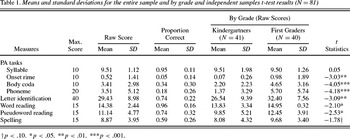
Table 1 shows summary statistics and independent sample t test results that compared the performances of kindergartners and first graders on the measures. The first graders significantly outperformed kindergartners on all the measures except the syllable tasks and the spelling task (albeit marginally significant). The word reading task showed a ceiling effect, with 90% of the students (73 out of 81 students) scoring perfectly, and thus the word reading measure was not included in the subsequent analyses. Furthermore, children's performance in the syllable tasks also has a ceiling effect (mean proportion correct = .95).

The difficulty of PA tasks
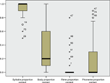
To answer the first research question regarding the difficulty in manipulating different phonological units (syllable, body-coda, onset–rime, and phoneme), children's mean performance on different phonological units was compared using one-way repeated measures analysis of variance. Because the tasks of different phonological units were measured on different scales, proportion correct for each unit was used. The results showed a significant main effect for different phonological units in Korean, F (3, 77) = 436.92, p < .0001. A Bonferroni post hoc analysis was performed to determine whether means of student performance with phonological units of different sizes were significantly different. Pairwise comparisons showed there were significant differences (all ps < .0001) between syllable awareness and body-coda awareness, between body-coda and onset–rime awareness, between body-coda and phoneme awareness, and between phoneme and onset–rime awareness. These results indicate that the syllable tasks (mean proportion correct = .95) were easiest for the children, followed by the body-coda tasks (mean proportion correct = .34). The body-coda tasks, in turn, were easier than the phoneme tasks (mean proportion correct = .17), and the onset–rime unit tasks (mean proportion correct = .05) were the most difficult4
A similar picture emerged when the analyses were performed separately for kindergartners and first graders.

Box plots that show the mean performance on the syllable, onset–rime, body-coda, and phoneme tasks. [A color version of this figure can be viewed online at www.journals.cambridge.org]
PA and literacy measures
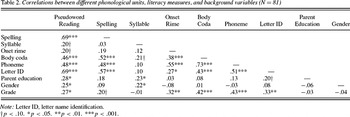
Table 2 below presents correlations between children's awareness of phonological units, literacy measures, and background variables. Both body-coda awareness and phoneme awareness were highly correlated with pseudoword reading and spelling. However, syllable awareness was not significantly correlated with any other levels of PA or literacy measures, possibly due to a ceiling effect. It is notable that the correlation between body-coda awareness and phoneme awareness is very high (r = .73). In addition, letter identification is highly correlated with pseudoword reading, spelling, and PA tasks, particularly body-coda and phoneme awareness tasks.

To examine the relationships between children's PA and their literacy skills while controlling for their background characteristics (i.e., gender, age, grade, and parents' education), regression models were constructed. Interactions were tested but only those that are significant are reported in the following.
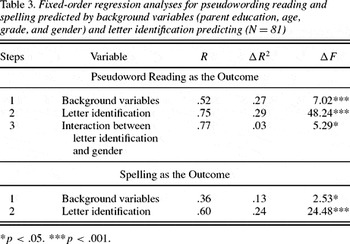
LETTER NAME KNOWLEDGE. Before examining of the role of PA in literacy development, the role of letter identification in word reading and spelling in Korean was examined first by performing fixed-order regression analyses. As presented in Table 3, in the first step four key background variables (parent education, age, gender, and grade) were entered simultaneously. In the second step, letter identification was entered into the model and a significant interaction effect was found between letter identification and gender in predicting pseudoword reading, but not in spelling. Thus, the interaction term was retained in the subsequent models in predicting pseudoword reading to examine the relationship between the pseudoword reading and predictors after accounting for the significant interaction effect between gender and letter name knowledge. The results showed that children's letter name knowledge is an important predictor of pseudoword reading and spelling after the effect of parent education, age, grade, and gender (and the interaction between gender and children's letter name knowledge for pseudoword reading) have been accounted for. In fact, letter name knowledge explained 32% of the variance in pseudoword reading and 24% in spelling after controlling for key background variables.

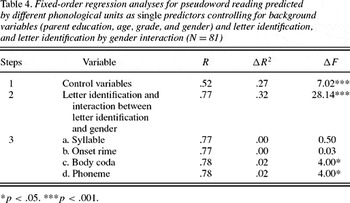
PREDICTING PSEUDOWORD READING. To examine whether PA predicts pseudoword reading, fixed-order multiple regression analyses were performed. As seen in Table 4, the total scores for each phonological unit were individually entered as single predictors at the third step while controlling for key background variables (parent education, age, gender, and grade), letter identification, and the significant interaction between letter identification and gender in the first and second step. The results in Table 4 revealed that both body-coda awareness (p = .05) and phoneme awareness (p = .05) significantly predicted pseudoword reading, whereas syllable awareness (p = .48) and onset–rime awareness (p = .87) did not, after the effects of background variables, letter name knowledge, and an interaction between letter name knowledge and gender had been accounted for.

To find out whether awareness of any particular phonological unit(s) explains additional variance in pseudoword reading while controlling for other phonological units, a series of ordinary least squares-fitted regression models were constructed. However, when children's performance in all the four phonological units was in the model simultaneously, none was significant, ΔR2 = .03, F (4, 70) = 1.42, p = .24. This appears to be primarily driven by the high correlation between body-coda awareness and phoneme awareness as they became nonsignificant when they are in a model simultaneously (model not shown).
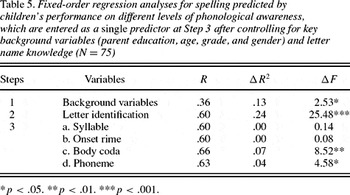
PREDICTING SPELLING. Table 5 presents the results of fixed-order multiple regression analyses with students' performance in each phonological unit as a single predictor of spelling, while controlling for key background variables and letter name knowledge. The results show that both body-coda awareness and phoneme awareness were significant (p = .005 and .04, respectively) in predicting students' performance in spelling.

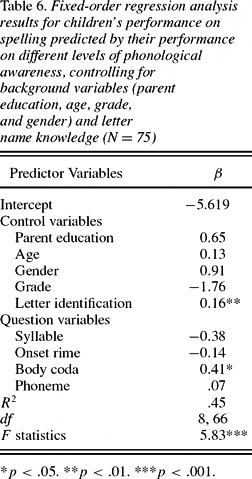
To examine whether students' performance in any particular phonological unit(s) makes a unique contribution to variation in spelling beyond other phonological units, all the phonological units were entered into the model simultaneously after background variables and letter identification had been controlled for. As shown in Table 6, only body-coda awareness made a significant contribution to explaining variance in spelling (p = .04) while controlling for the effects of the other three phonological units, background variables, and letter name knowledge. Finally, the results of the regression analyses show that onset–rime awareness did not predict either pseudoword reading or spelling in Korean.

Discussion
Although not the primary focus of Study 1, the large amount of variance in pseudoword reading and spelling explained by letter name knowledge is worth noting. The Korean letter names provide explicit information on the pronunciation of the letters. Letter names for vowels directly map to the sound values in Korean, and letter names for consonant letters, many of which have different sound values at the onset and the coda, represent those different values in a CVC syllable. For instance, knowledge of the letter name /ci

t/ for

would help Korean beginning readers understand that

is pronounced as /c/ in the onset, but as an unreleased /t/ in the coda.
The results of the Study 1 bolster previous findings that the body-coda boundary marks a salient subsyllabic phonological unit in Korean, hierarchically related to the larger syllable and the smaller phoneme. The floor effect shown by children's performance in the onset–rime tasks indicates that the onset–rime boundary is not marked for Korean beginning readers. The results confirm that the onset–rime boundary is not universally accessible across languages (Share & Blum, 2005; Ziegler & Goswami, 2005), indicating the importance of incorporating characteristics of oral language to understand the development of children's phonological acquisition across languages.
The results of the present study also extend a previous finding (Cho & McBride-Chang, 2005) about the role of PA in real-word reading to both pseudoword reading and spelling even after controlling for letter name knowledge and children's background variables such as parent education, age, gender, and grade. In particular, body-coda awareness was shown to play a prominent role in literacy development in Korean: it made a unique contribution to pseudoword reading beyond background variables and letter name knowledge and to spelling even after accounting for the effects of other phonological units. The significant role of body-coda awareness in Korean literacy acquisition indicates that Korean children's knowledge that words with common sounds in the body unit share the same spelling sequences may facilitate word reading and spelling development in Korean. These findings indicate that using the body analogy strategy may be beneficial for word reading for Korean beginning readers (Yoon et al., 2002).
STUDY 2: CORPUS ANALYSIS OF KOREAN MONOSYLLABIC WORDS
To examine what phonological features of the Korean language are responsible for the saliency of the body-coda awareness, phonological neighbors and frequency of syllable types were examined in Study 2. I examined phonological neighbors in two corpora of monosyllabic words and frequency of different syllable types in multisyllabic words and sentences in Korean.
Examination of monosyllabic words
Method and results
Two corpora of Korean monosyllabic words
5Two more corpora were examined but results are not reported due to a space limit (see note 7).

l/ [foot] was classified as a body neighbor, /k

/ [interval, liver] a rime neighbor, and /

u

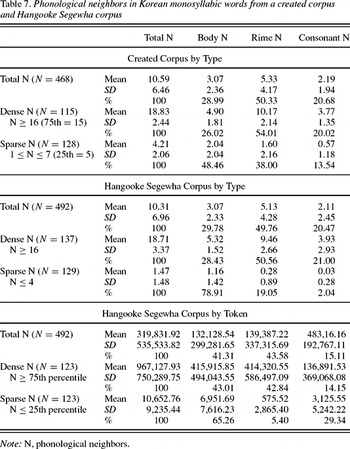
/ [minute] a consonant neighbor. The first corpus consisted of all possible real monosyllabic words in Korean, created by combining all the consonants and vowels according to phonotactic rules in Korean. A dictionary was consulted to affirm the meanings and legality of the words. Details about the analysis are found in Appendix A. A total of 468 one-syllable real words were analyzed to ascertain the frequency of body neighbors, rime neighbors, and consonant neighbors. Out of 468, 325 words (69.44%) were of CVC syllable type, 87 words of CV syllable type (18.59%), 42 words (9%) of VC syllable type, and 14 words (3%) of V syllable type.
6Words with V syllable type were excluded in the subsequent analysis.
As seen in Table 7, the results7
Two other published Korean corpora that reflect children's lexicon were also examined (Im, 1991; Lee, Kwon, & Jung, 1980). Lee et al.'s (1980) show a similar result to Table 7, whereas Im's corpus yielded slightly higher rime neighbors. Both corpora do not have frequency information. Both of these corpora also have limitations: although Lee et al.'s (1980) corpus, being a production data, lacks many high frequency words that 6-year-old Korean children are expected to know, Im's corpus (1991) suffers from some degree of subjectivity in the selection of the words.

Examination of multisyllabic words and connected text
Method and results
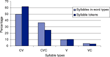
The examination of the corpora of monosyllabic words in Korea is informative but is seriously limited in providing a full picture of the phonotactics in Korean: the effect of resyllabification and the frequency of different syllable types. Thus, it is critical to examine frequency of syllable types in words, particularly high-frequency words for children, and also frequency of syllable types found in sentences. The examination of frequency of syllable types in sentences captures resyllabification phenomena in speech context where particles and verb endings are inflected. For the analysis of frequency of different syllable types in high-frequency words, words in the first half of the Korean official first grade reading textbook (Kyoyook Injuck Jawonboo, 2002, pp. 6–67) were examined. The words8
Nouns, particles, adverbs, modifying adjectives, and connectives were included, but verbs and verbal adjectives were excluded because verbs and verbal adjectives inflect with different endings and have multiple representations with various endings. Furthermore, the base form of verbal adjectives and verbs, /ta/, was excluded because it could skew the result with its multiple occurrences and it is less frequently used in speech.

The frequency of syllable types in the Korean first-grade reading textbook. [A color version of this figure can be viewed online at www.journals.cambridge.org]
As displayed in Figure 3, the results showed a similar picture in both analyses, an overwhelming prevalence of the CV syllable type (50 and 62% for words in citation forms and sentences, respectively). As expected, the CV syllable is more highly represented in sentences than in isolated words, because words are more highly resyllabified in sentence contexts. It is evident that the frequency of onsetless V and VC syllable types is extremely low compared to the CV syllable type, particularly in the sentences.
Discussion
The results of Study 2 showed the predominance of rime neighbors in the total and dense neighborhoods in Korean monosyllabic words. This predominance of rime neighbors in monosyllabic words can be explained by the phonotactic constraints placed on the coda in Korean. As noted earlier, in Korean only 7 consonants are allowed in the coda position so that a maximum number of body neighbors is limited to 7 at the most. However, in the onset, 18 consonants are allowed, yielding a maximum of 18 rime neighbors. For instance, /tal/ [moon, month] has seven body neighbors with all the allowed consonants at the coda, /

/, /
k/, /
n/, /
t/, /
m/, /
p/, and /
ng/ [

]. However, /tal/ has more rime neighbors because more words can be constructed by replacing the onset: /

/, /kal/, /n
/, /tal/, /m
/, /p
/, /s
/, /c
/, /kh
/, /th
/, /ph
/, /tt
/, and /ss
/ [

].
However, despite the fact that the phonotactic constraint placed on the coda results in a larger number of rime neighbors in CVC monosyllabic words in Korean, another phonotactic characteristic in Korean may play a critical role in explaining the saliency of the body unit in oral language context. Specifically, the CV syllable type, which corresponds to the body unit, appears to occur very frequently, especially through resyllabification phenomena in Korean. As the results above have shown, the CV syllable is highly represented in high frequency words and sentences in the Korean first grade reading textbook. If the saliency of the CV syllable type found in the words and sentences of the first grade textbook is generalizable to other high frequency words and sentences found in Korean speech, it appears logical to postulate that the high frequency/input of CV syllable may be a factor that influences children's sensitivity to the body unit in CVC words. Frequency of syllable types is worth noting in Korean because the limited number of syllable types in Korean (i.e., V, CV, VC, and CVC) entails recurrence of these syllable types. Then it is plausible that high frequency of a particular syllable type may influence phonological representations for Korean children. Frequent exposures to the CV syllable type may promote children's greater sensitivity to similar forms in the body unit in CVC words because normally developing children are reported to be perceptually sensitive to phonetically similar forms and accumulate them (Gierut, Morrisette, & Champion, 1999).
OVERALL DISCUSSION
The present studies confirm a previous suggestion that body-coda awareness is a salient subsyllabic level of PA in Korean. Study 1 further demonstrated that children's body-coda awareness is an important, prominent predictor of their pseudoword reading and spelling skills in Korean. The significant role of the intrasyllabic phonological units predicting reading and spelling, controlling for effects of students' knowledge in other phonological units, has been reported in English (Bryant et al., 1990). However, previous studies in Norwegian and Swedish reported a less explanatory power of the intrasyllabic phonological unit (onset–rime unit) in literacy development (Hoien et al., 1995; Lundberg et al., 1980). The difference in the amount of explanatory power may be explained by the statistical properties of orthography in each language as Goswami and colleagues (1998) proposed. Norwegian and Swedish have consistent letter–sound correspondences at the phoneme level so that the consistency at the rime level may not be as important as in English, which has higher consistency in the onset–rime unit. As mentioned earlier, in Korean the orthography is extremely consistent in the body unit and the body unit is visually prominent. Thus, children who have sophisticated understanding of the phonological structure of the Korean language (that is, having high body-coda awareness) may be able to link it to the consistent mapping to the body unit in the Korean orthography in literacy acquisition. Thus, Korean children who have highly developed body-coda awareness may benefit in literacy acquisition in Korean.
However, the findings that syllable awareness was not significant in explaining the variance in either pseudoword reading or spelling is discrepant from Cho and McBride-Chang's (2005) findings. However, it is highly likely that the nonsignificance was primarily due to the ceiling effect of the syllable awareness because previous studies demonstrated that syllable awareness plays a significant role in literacy acquisition in languages that have clear syllable boundaries with a small number of syllables (e.g., Greek and Norwegian; Aidinis & Nunes, 2001; Hoien et al., 1995). In Korean, due to the saliency of the syllable in spoken language (Yoon & Derwing, 1995), it is plausible that children become sensitive to the syllable as a unit of analysis, and knowledge of mappings between sound and spelling in the syllable unit facilitates their reading acquisition. A future study should examine the relationship of syllable awareness with other levels of PA and its role in literacy skills development after accounting for the effect of other levels of PA. Finally, the results of Study 1 also extended Cho and McBride-Chang's (2005) finding about the role of children's phoneme awareness in real-word reading to pseudoword reading and spelling (see Tables 4 and 5).
The results of Study 2 suggest the consideration of phonotactic features of a language for a potential source of the emergence of PA. The study demonstrated that differences in preferred segmentation of a syllable may be explained by some language specific factors, which may provide structural regularities in phonology children acquire. As elaborated above, it is postulated that phonotactic probability may explain the saliency of body-coda boundary for Korean children. The simple syllable structures in Korean may render each of the syllable types more prominent in oral language. In particular, the most complex syllable type, CVC, undergoes resyllabification, augmenting the open syllable, CV, in oral language. The results from Study 2 demonstrated, although phonotactic constraint on the coda yields more rime neighbors in the monosyllabic words in Korean, the prevalence and reinforcement of the CV syllable in multisyllabic words and sentences makes the CV syllable salient in Korean. Therefore, frequent exposure to the body unit may help children implicitly notice the same sounds in the body unit in the CVC syllable type whereas less frequent exposure to rime may entail fewer opportunities for phonological representation of rime as a salient phonological unit in Korean.
In contrast, in English, syllable types tend to be intact in multisyllabic context so that phonological neighbors in each syllable may be critical in the development of children's phonological representation. Furthermore, the role of phonotactics in English (e.g., the co-occurrence constraints between vowel and coda) in the saliency of rime was explored as a possible source by Kessler and Treiman (1997). For example, De Cara and Goswami's finding (2003) that there are more rime neighbors in English may be due to restrictions on the occurrence of lax vowels9
Tense vowels are [i, e, a, o, u] while lax vowels are [

] in English. In English, both lax and tense vowels are allowed in VC words (e.g., /il/ “eel,” /Il/ “ill” /el/ “Ale,” and /æ l/ “Al,” but lax vowels, not tense vowels, are restricted in CV words (e.g., /li/ “Lee,” /le/ “lay” are legal, but /lI/ /læ / are not).
LIMITATIONS OF THE STUDY
Although the findings reiterate the importance of PA in early literacy acquisition, the result that kindergartners and first graders in the study reached ceiling on the word reading task may be an indication of an early development of word reading skills in a language with a transparent orthography (Frith, Wimmer, & Landerl, 1998; Oney & Durgunoglu, 1997). However, it is also possible that the word reading task failed to discriminate among the students their knowledge of real word reading because it had only 15 common sight words, which may have been too easy for the students. Also, the limited variation in some of the PA tasks due to the near-ceiling effects (i.e., syllable awareness10
The regression results were identical when children's performance in the blending tasks where the ceiling effect was most pronounced was excluded in the regression models.
When regression was performed for first graders only because their performance had more variance than kindergartners (see Table 1), onset–rime awareness was still not significant in explaining variance in either pseudoword reading or spelling.
Furthermore, the results of the present study are limited in disentangling the effect of literacy instruction from linguistic features of Korean as a source of the saliency of the body-coda segmentation. An instructional effect rather than a linguistic effect has been suggested as a possible explanation for readers' developing PA of onset–rime or body-coda (Duncan, Seymour, & Hill, 1997). Goswami, Ziegler, and Richardson (2005) also demonstrated that literacy acquisition influences development of children's phonological representations. Although instructional approaches were not captured in the present study and whole-language approach is reported to be a dominant approach to literacy instruction, some efforts were made to identify the predominant approach in literacy instruction by examining four beginning literacy textbooks.12
The following four books were referred by teachers at the data collection sites: Hangul Chingoo, Hangul Jaraggi, Yeolin Hangul, and Little Hangul Wang (Hangook Yooah Gyoyook Yeongoowon, n.d.-a, n.d.-b, n.d.-c, 2003).
IMPLICATIONS
The results of this study suggest that explicit instruction in PA, particularly body-coda awareness, may benefit literacy acquisition for Korean children. Furthermore, explicit, systematic instruction in the correspondence between sound and spelling in the body unit may enhance Korean beginning reader's literacy acquisition. According to Muller and Brady (2001), transparency of orthography does not automatically make the link between phonemes and graphemes available to students. It was suggested that delay in explicit instruction of phoneme–grapheme correspondence in most whole-language teaching settings in English may cause an unnecessary lag in literacy development, particularly for less skilled readers (Frost, 2001). Therefore, explicit instruction in letter-sound relationship may be critical particularly for struggling beginning readers.
APPENDIX A
DETAILS OF THE ANALYSIS OF THE PHONOLOGICAL NEIGHBORS IN MONOSYLLABIC WORDS IN THE CREATED CORPUS
Homophonic homographs were considered as one entry (e.g., /kan/

has multiple meanings of different origin but has same orthographic representation). In Korean, adjectives and verbs inflect to mark tense and aspects, but these morphological markings were not included in the entry. For instance, an adjective base form /ssa-da/ is inflected to /ssan/,

, inexpensive, as a modifying adjective. A verb base form /ka-da/ is inflected to /kal/ to denote a future tense. These morphological markings (e.g., modifying adjectival ending, -/n/,

and nominalization ending with -/m/) were not included in the corpus.
To find out whether this trend is observed in words in dense and sparse neighborhoods, two subsamples were created. Words with more than 16 total phonological neighbors (N≥16, above 75th percentile) were considered to be in dense neighborhoods, yielding a total of 115 words. Words with total neighbors between 1 and 7 (6 was 25th percentile) were considered to be in sparse neighborhoods, yielding a total of 128 words. Although the 25th percentile for the total neighbors was 6, words with 7 total neighbors were included to have a fairly equal number of words in both dense and sparse neighborhoods.
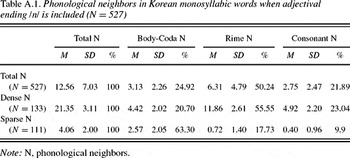
However, it should be noted that when the modifying adjectives with /n/ ending were included, the results yielded a similar result (see Table A.1). Words that have more than 18 neighors (75th percentile) were classified as a dense neighbor, and words that have neighbors between 1 and 7 neighbors (25th percentile) were classified as a sparse neighbor.

The author thanks Catherine E. Snow, Barbara A. Pan, Terry Tivnan, and three anonymous reviewers for their helpful comments.