On Tuesday, 19 September 1882, two women living on Cable Street in London's East End became involved in an altercation. Emma Griffiths alleged that her lodger, Elizabeth Dixon, accosted her on the stairs and assaulted her without provocation, cutting her head with a knuckle duster. Police constable John Raven was called to the house, but heard a very different story from the lodger. Dixon said that Griffiths had assaulted her and broke open the door to her room. Only after being abused by her landlady did Dixon strike Griffith, using a hairbrush. Faced with these conflicting narratives, the magistrate Thomas William Saunders fined Dixon 20s or fourteen days hard labor in default.Footnote 1 Existing scholarship on working-class life has revealed hierarchies and conflict among women in working-class neighborhoods.Footnote 2 Less scholarly attention, however, has been paid to these conflicts as crimes or to the response of the courts to them. Because the police, magistrates' courts, and the local press took note of this incident and many like it, we can learn a good deal about female violence in late-Victorian London and its treatment by the state and in the press.
Despite the limitations of historical crime statistics, most historians agree that violent crime declined across the nineteenth century.Footnote 3 As part of this overall trend, crime by women also declined.Footnote 4 According to government statistics, in 1857, 21.2 percent of those charged in summary courts in England and Wales were women; by 1885, this dropped to 18.1 percent.Footnote 5 However, records from East London's Thames Police Court in June and August 1884 reveal a far higher proportion of women: 28.3 percent of all accused, and 32.1 percent of those facing assault charges were female. A much larger data set, collected by Barry Godfrey in eleven English petty session jurisdictions from 1880 to 1914, reveals a similar proportion of female defendants. These data show 31.4 percent of those accused of common assaults were women.Footnote 6 At least in these jurisdictions, women made up a significant portion of those brought before magistrates on charges of assault.
Recent work on the overall decline in violent crime during the nineteenth century has attributed this trend to a “civilizing offensive” directed at male violence. The state (through courts and police forces), private reform organizations, and observers commenting in the newspaper and periodical press targeted violent behavior as uncivilized and unacceptable. Authorities and observers proscribed previously tolerated and accepted male behavior, which resulted, as Martin Wiener describes, in the courts' “rising hostility to interpersonal violence.”Footnote 7 The civilizing offensive condemned fighting, communal violence, unruly forms of leisure, and domestic violence. John Carter Wood explains that while this intolerance to patterns of violence common among the poor spread among elites, many working-class men continued to see such behavior as acceptable.Footnote 8
The civilizing offensive, according to scholars, focused overwhelmingly on men. Through the Victorian era, new forms of masculinity, emphasizing restraint, self-control, and the peaceable settlement of disputes found advocates in the courts and among commentators.Footnote 9 While many working-class men clung to earlier conceptions of masculinity that stressed toughness and a willingness to use violence, the justice system imposed standards of behavior based on more “refined” masculine ideals.Footnote 10 As this new ideal of masculinity became dominant, authorities defined long-established patterns of working-class masculinity as deviant and problematic.Footnote 11 At the core of the crackdown on violence in English society, then, lay a campaign against violent, aggressive masculinity.Footnote 12 A new conception of manliness, imposed through the criminal justice system and through criticism of unrestrained violent behavior, played a central role in the decline in interpersonal violence evident by the end of the nineteenth century.Footnote 13
Despite the fact that the literature on the civilizing offensive acknowledges that women also committed violent acts and appeared in the criminal justice system as a result, most scholars marginalize or dismiss female violence. Clive Emsley recognizes that some women fought with their husbands or other women, but he notes that violent offenders “have been overwhelmingly male.”Footnote 14 Wood notes that some women did use violence in their interactions with relatives, neighbors, and even strangers, yet he stresses that the civilizing initiative directed its “focus upon marginalized men as the instigators of violence, and upon their particular modalities and locations of violence.”Footnote 15 Wiener contrasts the increasingly harsh treatment of violent men with “surprisingly indulgent” treatment of violent women accused of assaulting their husbands.Footnote 16
Barry Godfrey, Stephen Farrall, and Susanne Karstedt have offered the most systematic consideration of gender and everyday violence in late-Victorian summary courts. Through the use of an extensive database of magistrates' court records from 1880 to 1920, they test the impact of gender on convictions and sentencing of men and women accused of minor assaults. Their finding that women generally received less harsh sentences than did men reinforces the view that a civilizing offensive focused on unruly men. Such men were punished harshly, as “the civilizing efforts of magistrates clearly targeted male offenders and male contexts of offending.” The authors argue that authorities were not particularly bothered by female violence, and thus women convicted of assaults were treated dismissively.Footnote 17 They recognize that factors that do not appear in the court records, including defendants' demeanor, expressions of remorse, and conformity with established gender roles may have influenced sentencing patterns.Footnote 18 They conclude, despite these caveats, that women's violence was not taken seriously as the courts and observers focused on the dangers of unreformed masculinity.Footnote 19
A more detailed study of newspaper accounts of petty assault trials complicates this picture, in part by revealing the factors that Godfrey, Farrall, and Karstedt could not access in court records. This article will analyze the role of gender in incidents of violence by women that appeared in East London police courts in the early 1880s, with particular focus on the context and character of assaults on the ground, their treatment by the local magistrates' court, and their coverage in local newspapers. Official records of summary courts, where they survive, offer some useful information on accusers, accused, charges and punishment, but newspaper reports provide context for the incidents themselves and often describe the proceedings at court as well. Details about the events that led to the trials and accounts of the trials themselves in newspaper reports allow historians an unparalleled window into crime and the justice system in the nineteenth century. They show that female violence was not simply marginal and easily dismissed. Women committed violent offenses, many of which occurred in public and targeted men. Alongside the civilizing offensive directed at reforming unruly working-class masculinity, authorities implemented a parallel campaign against violent and “unfeminine” women. Women who appeared in court negotiated a complex terrain of gendered expectations. The courts and newspapers viewed those who successfully performed a nonthreatening, acceptable femininity less harshly. Other women did not perform this femininity successfully, and their violent assaults met with condemnation in the press and punishments in the courts that echoed those of violent men. They were deviant, as were violent men, but not doubly deviant. Newspaper reports reveal a campaign against both nonconforming femininities and dangerous masculinities.
VIOLENCE, THE CRIMINAL JUSTICE SYSTEM, AND NEWSPAPER REPORTING
Violence by women, when it entered the criminal justice system, overwhelmingly appeared in lower-level courts, where magistrates exercised summary jurisdiction, deciding guilt or innocence and imposing sanctions on their own without the assistance of juries. Through the nineteenth century, this system placed increasing authority in the hands of magistrates. In the late 1820s, common assaults became summary offenses, to be adjudicated without jury trials. In the 1850s, more serious assaults on women and children, as well as larceny cases involving small amounts of property, fell under the umbrella of the summary courts. Reforms at the end of the 1870s extended summary jurisdiction even further; in London, summary cases appeared before magistrates in local police courts.Footnote 20
The system of police courts had its origins in 1792, with the first paid magistrates in the metropolis. By the middle of the century, a network of these courts extended their jurisdiction across London. Thomas William Saunders, a magistrate at the Thames Police Court, estimated that the eleven London police courts adjudicated over 170,000 cases each year in the early 1880s, or “something like fifty daily for each court.” This did not include additional claims on the magistrates' time, such as applications for summonses and a myriad of other requests.Footnote 21 Magistrates settled on their decisions quickly, evaluating the character of defendants, the circumstances surrounding the alleged crimes, and the reliability of witnesses within minutes. Edward Carpenter estimated that London police court magistrates took approximately three minutes to dispose of each case, as “the sentences are rattled off—‘three days,’ ‘seven days,’ ‘fourteen days.’”Footnote 22
Defendants, prosecutors, and petitioners came before Saunders or his colleague Franklin Lushington at the Thames Police Court, which handled cases originating in a swath of East London running from the Tower to the River Lea and including neighborhoods in Stepney, Poplar, Limehouse, and Bow. Saunders, the second son of “a gentleman of Somerset” entered as a student of the Middle Temple in 1832. He served in a variety of posts before becoming a magistrate at the Thames Police Court in 1878, where he sat until shortly before his death in 1890.Footnote 23 After Rugby and Trinity College, Cambridge, Lushington was called to the bar in 1853. He became a Thames Police Court magistrate in 1869, moving to Bow Street in 1890 and becoming London's chief magistrate in 1899, serving only two years before his death in 1901.Footnote 24 In summary courts such as Thames, magistrates operated with vast discretion. A single magistrate decided the fate of men and women brought into the justice system by the police. He could release the accused, levy fines, impose sentences of up to six months, or refer them to higher courts. He also decided the fate of those brought before the courts via summonses. Saunders acknowledged the “vast scope of the jurisdiction of the functionaries to whom is committed the dispensation of summary justice.”Footnote 25 Magistrates also offered advice, mediated conflicts, and even disbursed charity. They presided over sessions that made a theater of justice; proceedings and newspaper accounts alike entertained locals.Footnote 26 Godfrey, Farrell, and Karstedt describe summary magistrates as “foot soldiers of the state … often preoccupied with law and order.”Footnote 27 Mid-Victorian magistrates occupied contradictory roles, dispensing advice and administering justice in ways that reflected contemporary notions of justice, which directed its coercion chiefly at the poor.Footnote 28 In the setting of the London police courts, these magistrates enjoyed wide latitude to implement their visions of law and order.
Limited information on the cases and magistrates' decisions survives in official records of London police courts. Court notebooks recorded information on each case brought before the magistrate, including the surname of the complainant, name and age of the defendant, the charge, outcome or sentence in the case, and the name of the magistrate. Surviving records, while incomplete, offer compilations of basic information about all the cases that appeared at court. This study makes use of records from the Thames police court in June and August of 1884, a data set of some twenty-five hundred cases overall, and nearly eight hundred assault cases. The utility of these records lies in their comprehensiveness for the months covered, including information on every case decided by the magistrates. The documents do not, however, offer much in the way of detail about the incidents that led to the court's action, the disposition of witnesses and defendants, the approach of the magistrate, or the reaction of observers.
Newspaper reports of proceedings at the courts provide the best source for these details. This study analyzes about two thousand violent incidents covered in the East London Observer from 1880 to 1885. A wide variety of actions qualified as violent, from throwing objects at another individual to causing death through violence. The data set does not include verbal threats, unless they were accompanied by physical attacks or resulted in a charge of assault. While such a charge was possible in cases of verbal threats only, these incidents generally resulted in charges of “threats” or “obscene language” and are not included in this study.Footnote 29 The newspaper reported the majority of those accused in cases of violence as charged with “assault” (58 percent of the accused in the data set); in many of cases, defendants faced additional charges such as disorderly conduct. According to Davis, common assault served as “a catch-all term which encompassed a wide range of actions from the throwing of a tub of water to bodily violence.”Footnote 30 In more than a fifth of the cases, or 22 percent, the newspaper described individuals accused of “violent assault,” while others faced charges including “cutting” and “wounding.”Footnote 31 In a small number of cases the charges did not include assault or any other violent crime, despite the presence of violent behavior. For example, when Matthew Bryan appeared at Thames Police Court on 19 December 1885, the court record indicates he was charged with drunkenness, disorderly conduct, and obscene language. The paper described him as “charged with being drunk and disorderly,” and reported that Bryan had been fighting with another man when they were approached by a police constable. When asked to leave, the other man did so, but Bryan refused. He “made use of beastly language, and aimed a blow at” the constable. When taken into custody, Bryan became “very violent.”Footnote 32 This example reveals the extent to which definitions of violent acts and their categorization by the courts were fluid and complex. Accusations could change as an incident made its way through the justice system, making fine distinctions in newspaper or court records between types of violent crimes unreliable indicators for behavior on the ground.Footnote 33 The data used in this study includes all the newspaper accounts involving violence, regardless of the specific charge.
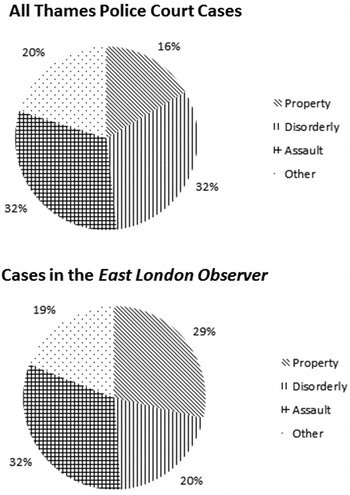
Just as the courts handled only a small portion of law-breaking activity in society,Footnote 34 the newspaper reported on only a small proportion of cases that came before the courts. The East London Observer, a weekly published on Saturday, regularly covered proceedings at the Thames Police Court and occasionally from other nearby police courts. In two months of 1884, the paper reported on 9 percent of the cases heard in the Thames Police Court. Reports of disorderly conduct accounted for nearly a third of the court cases but only about a fifth of the published reports. Property crimes were less than a fifth of the court's activity, but were overrepresented in the newspaper reports, accounting for more than a quarter of the accounts in the paper. Assaults and other offenses appeared in the newspaper reports in similar proportions to their presence in the court cases. Assaults represented about a third of the descriptive stories in the East London Observer (See figure 1).Footnote 35 Coverage varied from brief notices to detailed accounts that provide insights into incidents and trials unavailable elsewhere. Often, the paper outlined the incident, location, and precipitating events. Many of the reports described participants and their relationships to one another. They offer highly mediated versions of participants' accounts of incidents as well as subjective descriptions of appearance, comportment, and respectability, providing valuable, albeit mediated, access to events. Their narratives tell us much about attitudes toward gender and criminality in late Victorian London.
Much of the East London Observer material included in this study was likely written by D. J. Fox, the paper's reporter assigned to the Thames Police Court until his death in November 1884. Little is known about this man; a notice of his death focused mostly on his ability to transcend the loss of the use of his right arm and leg.Footnote 36 Fox and the staff at the East London Observer chose the cases they would include in the paper and generated narratives of both events on the ground and the proceedings in court. Readers sought entertainment from these narratives, and newspapers appealed to this market by emphasizing the sensational, extraordinary, or comic. Reporters tried to evoke emotions in readers such as shock, outrage, amusement, and a sense of superiority. At times, the paper tapped into and reinforced widespread anxieties about brutality and sexual degradation rampant in poor districts. Through their selection and narration, newspapers shaped the understanding of crime in the district, reinforcing dominant values through stories of deviance and narratives of crime receiving due punishment.Footnote 37 D'Cruze, Godfrey, and Cox argue that newspaper reports in Crewe in the same period functioned similarly, and “helped fill the back page on a slow news day, reinforced the prejudices and assumptions of the normative class and gender order, but also claimed authenticity and produced reader pleasure through their specificities and ‘localness.’”Footnote 38
Selection of Cases in the East London Observer

EVERYDAY VIOLENCE ON THE GROUND
Historians have recognized that women in working-class neighborhoods in late Victorian cities resorted to violence in conflicts with their neighbors, identifying a distinctly female pattern of assaults. Conflicts inevitably developed within crowded and intimate neighborhoods. Dense networks of female sociability, interdependence, and mutual aid led to conflict as well as cooperation. Long-running tensions flared into violent confrontations that ended in police courts.Footnote 39 D'Cruze identified four triggers to these conflicts among neighborhood women: property, children, husbands, and space. The resulting altercations often played out in public through ritualized contests over reputation and respectability, in which women sought to reinforce their status, often by insulting, as well as physically defeating, their antagonists.Footnote 40 A recent study by Michelle Abraham of assaults in Northampton and Nottingham suggests that female assaults typically had their origin in female networks of neighbors: “the confined shared spaces of cramped courtyards and living conditions coupled with individual and public pride linked to cleanliness and standards could spill over into physical disputes.”Footnote 41 In cases reported in the East London Observer, women were somewhat more likely to be accused of assaulting friends or neighbors than were men.
This account of the causes of female violence suggests that assaults by women were quite different from violence perpetrated by men. Conflicts between women developed out of domestic concerns and often took place before an audience of other women. Men did get into fights with neighbors and acquaintances over reputation and respectability, but these often occurred within distinct male networks of sociability and leisure. According to Jerry White, in Islington after World War I, “contests of strength between men provided a hierarchy of esteem which no other value-structure offered.”Footnote 42 Men also commonly assaulted their wives, and historians have analyzed the prevalence of spousal violence against women in working-class districts in this period.Footnote 43 The police suffered frequent violence at the hands of working-class men; as Clive Emsley observed, “many of these assaults were simply men … resisting arrest or obstructing the police in their duty.”Footnote 44 Men assaulted their wives, fought other men in public contests over status and reputation or in attacks on the police; and women fought one another in shared domestic spaces or in public within close-knit networks of neighborhood women.
Details in the East London Observer reveal that gender differences were far less pronounced than this analysis suggests. Most men accused of violence in cases reported on by the East London Observer assaulted other men (62 percent of victims in cases with male defendants were male). What is more surprising, though, is that most women in such cases also assaulted men, as 55 percent of victims of female assailants were men.Footnote 45 A partial explanation for this pattern lies in the relationship between accused women and their victims. In violent incidents with female defendants, 38 percent of the victims with a known relationship to the accused were police, nearly as high as the rate for male assaults, which was 42 percent.Footnote 46 Another 11 percent of known victims of female assailants were their spouses, compared to 14 percent of victims of male assaults.Footnote 47 Thus, just under half of these women were accused of assaulting either their husbands or the police. This proportion is quite similar to the pattern for men; 56 percent of men's known victims were their spouses or the police.
Recent studies have emphasized the preponderance of mature women among those charged in summary courts in the late nineteenth century.Footnote 48 Age is typically recorded in the police court documents; among assault cases with defendants' ages in the Thames Police court data, the mean ages of men and women accused of assaults were the same, at thirty years old. The peak age bracket for both was between twenty and twenty-nine. Violent incidents covered in the East London Observer also reveal similar age distributions for men and women accused of interpersonal violence in the local police court. Men averaged 28.5 years, while women averaged 31.3 years old.
Other characteristics of these cases reinforce the similarity between assaults committed by women and by men. In most cases, the injuries suffered by victims did not merit mention in the East London Observer; the paper did not discuss the injuries suffered by 67 percent of victims of men and 55 percent of victims of women. The vast majority of injured victims of both men and women suffered mild or moderate injuries that did not involve broken bones or hospital stays.Footnote 49 The proportion of significantly injured victims in cases with male or female assailants was nearly identical, at 11 percent for men and 12 percent for women. The role of drink for those accused of assault was also similar for men and women; the newspaper described 27 percent of accused men and 26 percent of accused women as drunk.
Newspaper accounts also provide rare insight into the settings in which violent incidents occurred, which tended to be either domestic spaces or public areas such as streets. Here the differences between male and female assaults appear less than expected. Most men and women whose cases appeared in the East London Observer committed assaults in public outdoor spaces, usually in streets. This should not be a surprise, as the police were most likely to intervene in altercations in public, and most assaults on the police themselves took place in the streets. Jennifer Davis has argued that Victorian policing occurred “almost exclusively in the streets.”Footnote 50 In cases where the location was described, 54 percent of accused women were involved in incidents in public spaces, compared with 60 percent of accused men. One crucial difference regarding the prevalence of assaults in domestic settings bears noting. A higher proportion of accused women than accused men allegedly committed violent acts in domestic spaces: 31 percent of women were accused of violence in domestic spaces compared with 18 percent of accused men. This reflects a toleration of men's violence against their wives that persisted even as the late Victorian state increasingly intervened in working-class homes.Footnote 51
Despite this difference, the overwhelming picture here is of similarity. Men and women accused of assault were similar in age, and victims were usually men, many of whom were police constables. Their assaults were mostly committed in public spaces such as the streets, and most times the resultant injuries did not merit mention in the paper. Ellen Collins's case was more typical of the incidents in the East London Observer than the conflict between Elizabeth Dixon and Emma Griffiths mentioned previously. On a Saturday evening in January 1881, Police constable Albert Stevens approached Collins, whom he described as “very drunk” and “using obscene language.” The constable claimed that he repeatedly asked Collins to go away. Refusing to leave the scene, Collins, according to the East London Observer, kicked the constable “violently in a dangerous part of the body, causing him great pain for some time.” Charged with assault at the Thames Police Court, Collins was sentenced to seven days in prison with hard labor.Footnote 52
The newspaper data provide insight into a subset of violent incidents involving women as only those cases deemed most worthy of coverage appeared in more detailed newspaper descriptions. It may be that in the police court cases not chosen for inclusion in the newspaper, and in those incidents that did not result in police or court action, gender distinctions were more prevalent. It is likely that most fights between women in hallways or stairs or even in the courts and alleys of working-class neighborhoods never made it to court, much less into the newspaper.Footnote 53 It is impossible to generalize from evidence based on newspaper reports and draw conclusions about all assaults that made it to the summary records. We know even less about the incidents that did not result in arrests and court appearances, but what is clear from the evidence we do have is that many women committed remarkably similar assaults as men. Women also targeted police and other men in public spaces, were sometimes driven by drunkenness, and committed assault that usually resulted in minimal injury. In the reportage of these cases, we can see that just as new notions of masculinity justified a crackdown on violent men, there was a similar campaign against women who failed to live up to prevailing notions of feminine behavior.
VIOLENT WOMEN IN COURT
Middle-class ideals of femininity as developed through the nineteenth century expected women to be dependent, passive, and frail, as well as chaste, pious, and virtuous. Many women accused of crime, particularly violent crime, failed to live up to these models and threatened to destabilize the gendered order of society. Some have suggested that responses to female criminality, particularly violent women, were harsh precisely because of the violation of these gender norms.Footnote 54 In 1878, the Women's Suffrage Journal complained of the “remarkable excess of severity in treating offences by women against men, compared to that exercised towards men for offences against women.”Footnote 55 In this view, women accused of violent crimes were “doubly deviant,” and the courts enforced both the law and gender norms in punishing them harshly.
Despite the fact that female violence disturbed dominant gender norms, historians have found a pattern of lighter sentences for women than for men in the late Victorian period. Godfrey, Farrall, and Karstedt discovered that, while differences in conviction rates between men and women reflected the variation in contexts in which offenses occurred, sentencing differences revealed gender bias. They explain that authorities didn't take violence by women seriously, considering female violence and disorder to be less threatening to the social order than male misbehavior.Footnote 56 Some observers, particularly those interested in contemporary sentencing discrepancies, have explained the differences as the result of sympathy for female defendants, with arguments for leniency “perhaps hitting a particularly soft spot if the defendant is a woman or a girl rather than a man or a boy.”Footnote 57 Trivialization of female violence and sympathy for female defendants could explain lighter sentencing patterns.
However, neither the “double deviancy” approach nor arguments that female violence was dismissed or trivialized adequately explains the treatment of women accused of petty violence. The apparent contradiction between a culture that viewed offending women as “doubly deviant” and a court system that treated them more leniently than offending men, makes sense when we recognize the way gendered expectations shaped individual court decisions amidst concerns about violence and disorder. Accused women faced magistrates who made judgments about their level of culpability and their danger to the community. These decisions involved more than just leniency toward women or dismissive attitudes toward female violence and did not apply a “doubly deviant” approach to female criminality. Magistrates judged the severity and threat to order of each offense. They evaluated defendants, witnesses, and the often confusing narratives of events. Just as the civilizing offensive enforced a version of masculinity less threatening to the social order and punished men who did not conform to this newly dominant masculinity, women who violated hegemonic notions of orderly femininity attracted more severe punishment than those who seemed less threatening. Women whose alleged crimes violated gender norms most boldly and whose performance in court failed to meet expectations of female behavior met punishments analogous to those applied to unruly men. Those whose crimes seemed less threatening to gender order or to society overall or who successfully performed acceptable feminine roles in court saw more lenient treatment than either “improper” women or violent men. This may extend the reach of Anette Ballinger's argument that for the twentieth century, “women who conform to dominant expectations of femininity and acceptable standards of womanhood may benefit from the gendered nature of law by being treated with leniency as long as those who fail to conform to such expectations pay the full punitive price.”Footnote 58
The data set from court notebooks, encompassing all Thames Police Court cases during a brief period in 1884, does reveal somewhat shorter sentences for women than for men. In most cases where decisions were listed in the court notebooks, prisoners were either released outright, released with some restriction (usually bound over to maintain good behavior), or fined (at times with a brief prison threat if the prisoner did not pay the fine). Nearly four out of five people sentenced at Thames Police Court in these months fell into these categories, 83 percent of women and 78 percent of men. The distinction between men and women was greater in assault cases, as 86 percent of women and 71 percent of men were released or merely fined; 9 percent of men accused of assault were sent to prison for longer than fourteen days compared with 5 percent of women. The distinction between men's and women's sentences does not appear in the cases reported in the East London Observer, as the paper was less interested in cases in which the accused was released. In violent incidents from the police courts covered by the newspaper, 36 percent of men and 37 percent of women were released or fined, compared with 76 percent in assault cases listed in the court notebooks. Only slight differences mark the prison sentences of men and women reported on in the East London Observer, as 13 percent of men received fourteen days or less compared with 16 percent of women. In contrast, 37 percent of men and 34 percent of women accused of violence in the cases that made the newspaper received prison sentences longer than fourteen days. Thus, women were sentenced more leniently in the cases that were ignored by the newspaper, but they received similar punishment to men in the cases publicized by the East London Observer. Details provided in the newspaper reports offer insight into which women were able to win lenient or dismissive treatment by the courts and which were punished similarly to disorderly, violent men.
Shani D'Cruze has argued that summary “decisions had a good deal to do with assessments of character.”Footnote 59 To a great extent, such assessments relied upon a particular set of gendered expectations. Given their backgrounds, the magistrates who decided these cases applied standards of women's behavior based on middle-class norms.Footnote 60 Women were expected to be tender, delicate creatures, obedient to men, and focused on the domestic sphere; this “angel in the house” became a hegemonic form of femininity projected on to all women.Footnote 61 Proper women devoted themselves to the home and family. They did not perform paid work, though certain philanthropic activities were respectable extensions of the maternal in the public sphere.Footnote 62 Urban streets were not open to respectable middle-class women, as these public spaces represented disorder and sexuality in opposition to proper domestic life.Footnote 63 Medical experts argued that women's bodies were weak and infirm.Footnote 64 Biological differences between men and women dictated that women be passive, without interest in sex, and incapacitated by maternity and supposed physical limitations. Susie Steinbach sums up this view: “Femininity meant dependence, subordinate status, domesticity, and sexual modesty.”Footnote 65
Working-class women adopted their own notions of femininity and respectability that varied from the dominant, middle-class view. Maternal roles played an important, albeit different, part in working-class expectations of women, and women's reputations reflected judgments about their efforts as housekeepers and mothers. Women and girls scrubbed their front steps and other public areas to prove their cleanliness. Before giving birth, women exhausted themselves cleaning their homes in order to impress midwives and visitors. Working-class mothers were expected to control their children and feed their families adequately.Footnote 66 Children whose behavior went unregulated reflected badly on mothers.Footnote 67 Working-class femininity departed from dominant ideals in some ways. Working-class women sought paid employment when they could, given the demands of their families and duties at home.Footnote 68 They understood their bodies as capable of such work, unless disrupted by illness.Footnote 69 Many were “stout, and their very heavy domestic labor developed their shoulders and biceps.”Footnote 70 Women asserted themselves in public spaces in their neighborhoods. They were forceful and aggressive and fought one another publicly in defense against perceived insults or slights of their physical prowess and willingness to fight supported, rather than undermined, their status.Footnote 71 According to Ellen Ross, many working-class women “were neither ladylike nor deferential.”Footnote 72 Expectations of women's behavior differed in various working-class communities. For example, in some places women could drink in pubs without violating community norms; elsewhere such behavior would undermine a woman's reputation.Footnote 73 Working-class ideas about proper female behavior differed significantly from the hegemonic middle-class femininity that shaped magistrates' attitudes.
Obviously, it was a challenge for any woman accused of violence to live up to middle-class notions of proper women's behavior, but the conditions of their cases make it clear that some accused women violated these norms more dramatically than others. Newspaper accounts offer insights into some of these conditions, and we can trace characteristics of accused assailants that highlight their violation of gendered norms. Lucia Zedner's observation that female offenders violated both legal and gender norms rings more true for some defendants than for others.Footnote 74 Women who committed assaults in public spaces, appeared drunk, kicked victims or caused significant injury, assaulted police constables, and were prosecuted previously in the court system attracted the condemnation of magistrates and observers. They were the objects of a civilizing offensive that enforced prevailing notions of female behavior and condemned overly aggressive and violent women. These women were not generally punished more severely than violent men; they were not more “doubly deviant” than men accused of assault. The response to their disorderly behavior and failure to conform to gender expectations echoed the treatment of the men who violated the law and defied new notions of masculinity enforced in the civilizing offensive.
“Unfeminine” characteristics did lead to more severe sentences. Women accused of committing assaults in public spaces received stiffer punishments than those accused of assaults in domestic spaces. In newspaper cases, while 32 percent of women accused of public assaults were merely released or fined, 43 percent of women accused of assaults in domestic space received these favorable outcomes. In contrast, 38 percent of women accused of public assaults were sentenced to more than fourteen days in prison, compared with 27 percent of those accused of assaults in domestic spaces. Similarly, women described by the newspaper as drunk were punished more severely than those for whom no mention of drunkenness appears. Drunk women accused of assault were less likely to be released or just fined (31 percent compared to 41 percent) and more likely to receive prison sentences longer than two weeks (41 percent compared to 31 percent).Footnote 75
Similar sentencing patterns appear for other criteria linked to the violation of hegemonic gender norms. Women who kicked their victims more frequently received more than fourteen days in prison (55 percent compared with 31 percent) and were less likely to be released or just fined (18 percent compared to 40 percent).Footnote 76 Women who assaulted police officers faced more significant punishment than those whose victims were not constables. Only 28 percent of women accused of assaulting the police were released or fined, compared with 40 percent of those who did not assault police, while 47 percent of those charged with assaulting police spent more than two weeks in prison (compared to 29 percent of those whose victims did not include police). In some cases, the East London Observer commented that the accused had previously been involved in the justice system. Some were characterized as “known to the police,” while in other cases prior prosecutions or convictions received mention in the newspaper accounts. The female defendants described in these ways were much less likely to be released (15 percent compared with 41 percent whose previous criminal activities were not mentioned) and more likely to be sent to prison for longer than a fortnight (53 percent compared to 31 percent).Footnote 77
In the summer of 1882, the East London Observer described Emma Evans as “well known to the police.” When Constable Thompson found her apparently drunk outside a pub, he attempted to take her into custody, but she tried to strike and kick him, then spit in his face. When Constable Woodcock tried to help Thompson, Evans kicked him in the thigh and issued “a dreadful threat” to him. Evans appeared in court charged with assault along with being drunk and disorderly. The magistrate, Franklin Lushington, sentenced her to two months imprisonment with hard labor. Mary Stephen, in contrast, came before the court accused of assaulting Jane North. According to the East London Observer, North was living with Stephen's husband. North alleged that, while she lay in bed in the evening, Stephen came into her room, threatened her, struck her with a basin and bit her finger. Lushington bound the prisoner over to keep the peace for six months with a surety of £10 and released her. While Stephen's behavior was hardly “ladylike,” it can be argued that her attack on a woman who threatened her family's well-being violated dominant gender norms in far less egregious ways than did the drunken, constable-kicking Emma Evans, who was well known to the police. The magistrates treated Evans' crime as a far more serious offense.Footnote 78
Men and women who violated dominant gender expectations most severely were met with stringent sentencing. The characteristics of assaults described previously as violating middle-class ideals of female behavior also made accused men seem more threatening. As research on the civilizing offensive directed at working-class men has demonstrated, long-standing working-class notions of masculinity tended to accept violence as a legitimate form of conflict resolution and as part of working-class leisure, but a new conception of manliness built on middle-class ideals demanded self-control and criticized the violence associated with working-class men. Increased anxiety about violent men led the courts to discipline men who resorted to force.Footnote 79 Men who committed assaults in the streets, particularly with their feet, were drunk, assaulted police constables, or had previous contact with legal authorities suffered harsher punishments. For example, men accused of assaulting police constables were less likely to be released or fined (26 percent compared to 42 percent) and more likely to spend more than two weeks in prison (50 percent compared to 31 percent). Working-class men and women occupied public spaces in working-class districts. Much of women's public activity put them at odds with middle-class ideals of female domesticity. When this transgression was compounded with acts of violence, the courts often responded in ways that echoed the “civilizing” crackdown on unruly men.Footnote 80 Some women, those whose alleged assaults were less directly at odds with dominant notions of female behavior, were treated more leniently by the police courts than were men. Many of these women's alleged crimes did not attract the attention of the newspaper, so we know little about them. The cases reported on by the East London Observer, though, reflect parallel campaigns to discipline unruly working-class masculinities and femininities.
THE EAST LONDON OBSERVER AND FEMALE OFFENDERS
Historians have noted the public, even theatrical, nature of police court proceedings.Footnote 81 Witnesses, victims, and defendants played to the assembled crowd and the magistrate. Because some of these proceedings were described in the press, newspaper readers constituted an additional audience for the performances in police courts. Police court reporters mediated and recast these performances. Newspapers shaped readers' understandings by selecting certain cases for coverage. The paper frequently bypassed assault cases in which female defendants were released, and focused instead on more sensational, and perhaps more “serious,” cases. The East London Observer used descriptions of accused men, women, and sometimes victims, to titillate and entertain readers but also reinforce dominant values. While defendants and victims used the courtroom as a venue in which to perform versions of themselves and of events, the newspaper and, to some extent, the magistrates, often retold these narratives, “as moral tales for broader public edification in ways that might undermine working women's own agendas.”Footnote 82 Gender played a crucial role in this process, particularly in generating approval of or hostility toward defendants. By casting some accused women as unfeminine, the newspaper marginalized them, cultivating fear or disgust in the reader, while women accused of assault who demonstrated appropriate female roles and behaviors received more favorable coverage. Descriptions of women's bodies were central to this process, as both proper and deformed versions of femininity were inscribed through portrayals of women's bodies. In other cases, gendered descriptions were ambiguous and contradictory, and reflect the complexities of the performance and reporting of gender.
Newspaper accounts frequently described female defendants' bodies as masculine or powerful. In March 1882, twenty-eight-year-old Margaret Sullivan was confronted by Constable George Matthews, who reported that she was very drunk and used “vile language.” When she refused his request to “go away,” he took her into custody. She resisted, biting and winding her hairpins around her hand and striking him; she kicked another constable who came to his aid. The East London Observer reported her use of language “of the worst possible kind” when she was brought to the station. Its narrative of the event emphasized Sullivan's inappropriateness by describing her as “a masculine-looking woman.”Footnote 83 Similarly, the East London Observer describing Emma Evans, who also hit and kicked a constable, observed the “prisoner, who is a tall masculine woman.”Footnote 84 In July 1883 Constable Bevan was called to the Magpie and Stump public house in Cable Street to eject Mary Ann Regan. Once outside, she tried to throw him down and bit him in the knee and the thumb. It took four men to bring her to the station where she was charged with drunkenness and disorderly conduct, and assaulting the constable. The East London Observer noted that she had been convicted “a number of times for assault and other offences.” In building its unflattering portrait of Regan, the newspaper described her as “a tall, powerfully-built woman.”Footnote 85 A similar description characterized an altercation between Elizabeth Gale and Susan Wilson in late summer 1884. According to Wilson, Gale attacked her by pulling her hair, pouring dirty water on her, beating her with the pail, and then biting her in the thigh and elsewhere. The newspaper mentioned that Gale had been convicted previously. As it did with Regan, the paper described Gale as “a powerfully-built woman.”Footnote 86 This description was also often used to describe violent men, but when it fell upon women's bodies, it helped define these defendants as not properly feminine.Footnote 87
By linking these women to masculinity, the reporter tapped into well-established conventions in attributing masculine characteristics to working-class women. Masculine women, or “toms,” were associated with prostitution from midcentury.Footnote 88 Beyond the link to sexual transgression, masculinity in women reflects the complexity of gender definitions. Judith Halberstam discusses strong women engaged in physical labor as an example of gender variance.Footnote 89 Their muscles are not incompatible with their own definitions of proper behavior, just as physical strength was consistent with working-class versions of femininity in the nineteenth century. In some cases, women embraced masculinity as a challenge to established gender boundaries and limitations. Some middle-class women adopted masculine dress and inhabited other masculine roles.Footnote 90 It is difficult to know the extent to which the women described in the East London Observer saw themselves as adopting well-accepted working-class forms of femininity or as inhabiting a more transgressive female masculinity. What is clear, though, is that the paper intended to define these defendants as abnormal and threatening.
Other descriptors marginalized accused women by comparing them with animals or by using racial descriptors. Sarah Gilbert, a sixty-five-year-old woman, faced charges of assaulting her husband by pulling out his whiskers, kicking him, and pelting him with stones. The paper described her as “like a tigeress [sic]” and its heading read “A BRUTAL WIFE.”Footnote 91 Gilbert appears here as an animalistic brute. The paper also used language signifying racial difference to castigate some violent women. The story of Mary Ann McCarthy, accused of assaulting Eliza Moore and her sister, appeared under the heading “A SAVAGE WOMAN.”Footnote 92 In addition to describing Mary Ann Regan, discussed above, as “powerfully built,” the paper put her story under the heading “A CANNIBAL.”Footnote 93 The latter term appeared frequently to describe those accused of biting their alleged victims, and it called to mind the far reaches of the empire, linking these East London women to allegedly uncivilized and inferior peoples. These descriptions are not explicitly gendered, as men were described as brutal and uncivilized; comparing women to brutes or savages helped distance them from proper womanhood and echoed discourses of racial hierarchy and degeneration.Footnote 94
Descriptions of some women's bodies emphasized dirt and disorder. Filth represented a well-established marker of slum life, both repulsive and fascinating to middle-class observers.Footnote 95 In early summer 1880, Sarah Davis faced charges of being disorderly, drunk, and assaulting Dr. John James Rygate, the Medical Officer of Health for the parish of St. George's-in-the-East. The newspaper reported that she “had thrown a quantity of fish offal and other filth over his clothes and down his neck.” Davis claimed no wish to offend or assault the doctor, but she said she had been so drunk that “she didn't really know what she was about.” The paper reported the magistrate's reprimand—that her conduct had been “disgraceful.” It added its own judgment, describing Davis as “a dissipated-looking woman.”Footnote 96 Similarly, in August 1882, school board officer Francis Brown appeared in court and complained that Mary McCarthy, who was probably not the same person as Mary Ann McCarthy discussed herein, assaulted him twice while he was performing his duties in Well Street, Poplar. The East London Observer described the defendant, who lived in Well Street, as “a dirty-looking woman.”Footnote 97 The gendered significance of these criticisms of women's appearance becomes clear in the account of Margaret Kane, who was accused of being disorderly, drunk, and assaulting Constable Richard Hart. The constable noted that some men complained to him about Kane's behavior in the street, and he told her to “go away.” When he took her into custody, she assaulted him. The newspaper described Kane as “a horrible looking woman” and added, apparently drawing on the constable's testimony, that “[s]he was a disgrace to her sex.”Footnote 98 These narratives linked women accused of assaults to a wider anxiety about sexual degradation. Their physical presence, filthy and “horrible,” revealed their moral failings, “disgrace,” and dissipation, while also serving to draw readers to the paper's accounts.
In these cases, the interaction between accused women's alleged crime, their appearance, and the reporter's evaluation and description led to their objectification as threatening and disorderly. Using the courtroom as their theater, however, some women performed femininity more acceptably, attracting the approval of the paper and lenience from the magistrates. In late summer of 1882, Elizabeth Roberts alleged that her sister-in-law Harriett Roberts stabbed her and threatened her life during a quarrel at the accused's house in St. George's. The defendant denied the charge entirely, explaining that the alleged victim's wounds were self inflicted. The paper appeared convinced of the defendant's good faith, noting that the defendant “carried a baby in her arms,” and printing the story under the skeptical heading “ALLEGED DESPERATE STABBING AFFRAY.” The magistrate, likewise convinced, discharged Harriett Roberts.Footnote 99
Despite accusations of violent behavior, women like Harriet Roberts successfully appealed to dominant ideals of femininity. They did so by emphasizing the shared aspects of middle-class and working-class femininity. Thus, women accentuated their status as wives and mothers, as did Harriet Roberts in this case. They emphasized their domestic duties and respectability as household managers.Footnote 100 Women who were physically attractive and performed respectable femininity by emphasizing their weakness, vulnerability, and even instability while also appearing as good wives and managers of their households won approbation in the press and sometimes at court.
Marital status was a critical element in determining respectable femininity: in court, married women were viewed differently than their unmarried counterparts. Alice Castle lived with George Grace in Poplar, though the two were not legally married. She was accused of attacking him with a knife and throwing a saucer at him, which she claimed to be in self-defense, also arguing that Grace was lazy and would not work. Despite her violent acts, the paper described her as “a respectable-looking woman” and reproduced Grace's description that Castle lived with him “as his wife.” Despite her cohabitation and alleged attack with a knife, his failed masculinity (not working or supporting her) and her successful performance of femininity, in her appearance and claim to respectable married status, combined to win the approval of the newspaper.Footnote 101 Though Castle was not married to Grace, she claimed the equivalence of marital status.Footnote 102 The newspaper endorsed the claim by reproducing testimony that Castle lived with Grace “as his wife,” which bolstered her claim to respectability. In other cases, simply mentioning an accused woman's status as a married woman could help make her seem more respectable. In September 1884, Mary George appeared in court accused of unlawfully wounding Henry Rowlett. She successfully deflected blame onto Rowlett, though apparently she had struck him in the head with a chopper. Rowlett had come to George's home and started a row with her. George, “a married woman,” claimed that she had acted in self-defense. The magistrate agreed that Rowlett was to blame and discharged George.Footnote 103 By claiming respectable status as married women (or the equivalent), these women sought to perform proper femininity to win the approval of the court and observers.
In middle-class culture, vulnerable and frail women exemplified notions of proper femininity. Mental instability, often ascribed by medical experts as the consequence of women's reproductive biology, also fit middle-class gendered expectations.Footnote 104 Descriptions of women in court as “weak” also signified respectable middle-class femininity. When Maria Knight was charged with assaulting her nine-month-old son William, the paper described her as a married woman, aged twenty-six, and also as “a small, weakly-looking young woman.” On 8 August 1884, Knight came to the police station in Bethnal Green saying that she had struck her baby on the head with a hammer and tried to kill it. The baby was found insensible with a wound at his left temple and taken to a hospital. A surgeon gave evidence in court that the baby would be fine. He also suggested, based on another surgeon's examination of the accused, that Maria Knight was “suffering from a recent confinement, and was not at times accountable for what she did.”Footnote 105 The magistrate (requiring sureties to make sure she behaved in the future) released her despite the fact she admitted to attempting infanticide. As a married mother of weak constitution, suffering mental frailty due to her reproductive functions, Knight appeared to fit with dominant Victorian gendered assumptions of femininity. These characteristics were enough to win over the surgeons and the magistrate. Knight's infirmity and her status as a married mother provided an explanation and excuse for her violent behavior in the eyes of the middle-class authorities. The legal system worked in her favor, because she appeared properly feminine.Footnote 106 The newspaper appeared to share the magistrate's sympathy with Knight, emphasizing her frailty and vulnerability. The paper introduced a significant note of ambivalence, though, as the heading under which this account appeared read “A DANGEROUS MOTHER.”Footnote 107
Newspaper reports presented relatively simple narratives and used gendered descriptions to encourage readers' hostility or approval. In other cases, it presented conflicting descriptions, perhaps for dramatic effect. Thus, the paper described Margaret Coakley, accused of assaulting a constable and another man in the street, as both “a rather good-looking girl” and “A FEMALE SAVAGE.”Footnote 108 Mary Ann Sullivan, a nineteen-year-old woman, also impressed the reporter from the East London Observer as “a rather good-looking girl,” and was also described as “a most violent character” who attacked a constable “like a tigress.”Footnote 109 The paper described Elizabeth Foote as “A FEMALE SAVAGE,” but it noted that she carried a young baby in her arms. Foote was accused of stabbing another woman in the neck, and striking and biting her.Footnote 110 Mary Banks stood accused of assaulting police constable John Marchant by biting him on his hands, and of being drunk and disorderly. The paper made a point of describing her as a married woman, but headlined the story, “CANNIBAL.”Footnote 111 Depictions of women consistent with hegemonic feminine expectations—“good-looking,” married, carrying a baby—contrast with the language of uncivilized, unfeminine behavior. This tension created drama and even humor in these accounts, though the paper's attitude toward the accused was less clear than in many of the narratives.
Perhaps one unintended source of ambiguity in the East London Observer's discussion of violent women was its use of the common euphemism for prostitutes, “unfortunates.”Footnote 112 This term implied victimhood and bad luck, rather than immorality or responsibility. It does not appear that the newspaper created this ambiguity purposefully.Footnote 113 Thus the paper described Margaret Burke as “‘an unfortunate.’” The account of Burke, accused of being drunk and disorderly and assaulting constable William Smith, tells of a dangerous drunk who struck the constable violently, seized his clothing “close to a dangerous part of the body,” and tried to bite him there. Burke received two months of hard labor, and the paper's story appeared under the heading “A VIOLENT WOMAN.”Footnote 114 In a similar case, Matilda Andrew, described as “an unfortunate,” was charged with assaulting Constable Samuel Dutch. In this case, the paper reported that Andrew, along with “three other loose women,” fought with a man in the street. Andrew refused to move along when the constable intervened. When she was taken into custody, she bit the constable severely, then pretended to succumb to a fit. When the constable got her some water, she jumped up and tried to bite him again. The paper reported that she had been charged repeatedly for assaulting constables, and introduced her tale with the heading “A FEMALE CANNIBAL.”Footnote 115 These narratives clearly describe immoral, violent, and dangerous women, hardly consistent with the sympathetic implications of the term “unfortunate.”
When Sarah Beckett stood accused of stabbing her brother-in-law, Florence McCarthy, the East London Observer reported that Beckett came before Thomas William Saunders at Thames Police Court twice, being remanded the first time and then committed for trial at the Old Bailey. She likely appeared at least once in the interim, but the court records for February and March 1880 have not survived. The historical record of this event is not, however, limited to the East London Observer reports, as the Standard published an account of the last appearance at Thames Police Court. In addition, the record of her trial at the Old Bailey survives. These three sources agree on some basic details. Beckett and McCarthy had an altercation shortly after midnight on Tuesday, 17 February 1880, that resulted in McCarthy needing medical attention at London Hospital. The three accounts all reference a history of animosity between the two and include testimony from Constable James Kelly who reported witnessing the alleged assault.
The two newspaper accounts describe Beckett's appearances at the police court, where she sought to perform a version of femininity that might appeal to the magistrate. In the East London Observer, she appears before Saunders as “a married woman, who carried a baby in her arms.” The Standard also noted that she “carried an infant in her arms.” Both newspapers presented explicit details of McCarthy's wounds for sensational effect and added observations about the victim and accused that undermined the latter's claims. The “unfortunate young man,” according to the Standard, had returned home around midnight from his work as a potman to find that his wife was not home. He went out “in search of his wife” when the prisoner assaulted him; the East London Observer added the constable's observation that the man “was walking quietly home” when attacked and presented the constable's testimony that “blood commenced to flow freely from the man's temple.” According to the Standard, “the blood rushed from his neck,” as McCarthy “fell down insensible.” The victim's “life was in danger for a week from great loss of blood and extreme excitement.” The paper also presented the victim's allegations that the accused had “frequently quarreled with him, and had several times threatened to take his life.”Footnote 116 In these accounts, the quarrelsome sister-in-law who attacked her quiet, neglected brother-in-law contrasts with the image of a proper married woman and mother presented by the accused.
The record of the Old Bailey trial preserves some of the victim's narrative and the constable's account. Alongside this, through the questions put to the victim and the defendant's own statement, a clear counternarrative appears seeking to undermine the case against Beckett by impugning the victim's performance of masculine roles and emphasizing the defendant's appropriate female behavior. McCarthy alleged that Beckett had interfered with his wife, created problems in his marriage, and threatened him. In response to questions, though, he admitted that he frequently fought with his wife “when she don't get up and get my grub ready” upon his arrival from work around midnight. He denied a suggestion that he had deserted his wife and family and rejected the idea that Beckett had provided help to his family, but he did acknowledge that he had been away for a week. In Beckett's statement, she described the context of the incident: “I was going to cut some bread—and—butter. I heard my sister scream. I ran out … He struck me, and I struck him back.” She held the knife in her hand only because she had been engaged in the domestic task of cutting bread. She denied threatening McCarthy and accused him of causing unhappiness in her marriage by claiming to be the father of her children. Finally, she claimed that she interfered with McCarthy only to help her sister.Footnote 117 In this narrative, Beckett appears appropriately domestic, preparing food until pulled from her work by her sister's screams. She claims a history of assisting her sister, both when the family needed help due to McCarthy's neglect and when his abuse justified her intervention. In Beckett's version of events, McCarthy failed to live up to standards of masculinity. He abused and neglected his family. He made sexually inappropriate claims about the accused and struck her first when she intervened to assist her sister. At the Thames Police Court (according to newspaper descriptions) and at the Old Bailey, Beckett attempted to claim appropriate femininity. She carried a baby into the police court and generated a narrative of domesticity and family responsibility at the Old Bailey. In the end, this performance of femininity did not convince the court in the face of McCarthy's wounds, the constable's apparent assertion that McCarthy was without blame, and his own claims of Beckett's disorderly interventions in his marriage. Beckett was condemned as guilty of wounding McCarthy and sentenced to eighteen months imprisonment.Footnote 118
CONCLUSION
Female defendants faced complex and varied gendered expectations. In the streets, physical prowess and public demonstrativeness were consistent with a form of working-class femininity. When they appeared in court, however, these women confronted a starkly different set of expectations. Some were not able, or perhaps not willing, to perform to this standard. They appear in the newspaper records as marginalized objects of disgust and fear. Others warmed to the challenge and acted the part, adopting attitudes and appearances that allowed magistrates and newspaper reporters to see them as less threatening. Paraphrasing an 1837 parliamentary report, Jennifer Davis described the metropolitan police courts as “A Poor Man's System of Justice.”Footnote 119 Poor women used the courts for their own purposes as well, but some found themselves before the magistrates charged with violent crimes. In this situation, many defendants adopted the cloak of respectable femininity. They deployed the trappings of femininity appropriate to the context of a court run by middle-class magistrates, such as motherhood, respectable dress and appearance, and vulnerability. Gender performances in court exemplify what Peter Bailey described as “calculative or instrumental adoptions of respectability by working people.”Footnote 120 Female defendants who succeeded in performing the kind of feminine behavior that attracted approval from magistrates and observers could win lenient treatment and favorable descriptions in newspaper reports. Those who could or would not do so represented a threatening and disorderly form of female behavior that, like its masculine equivalent, became a target for the instruments of “civilization.”
In her study of responses to prostitution in Victorian Kent, Catherine Lee lamented that “the routine reporting of local magistrates' court hearings has yet to be fully explored as a journalistic genre in its own right.” She argued that coverage of prostitutes contributed to the civilizing offensive, and “this civilizing process was often implemented by holding law-breakers together with offenders against codes of public decency up for disapproval, and by representing them in terms of recognizable social categories, or excluded groups.”Footnote 121 Often newspaper reports did present one-dimensional images of either depraved and threatening transgression against the gender order or passive, respectable women worthy of approval. Many cases, though, involved ambiguities and mixed messages. In these cases, newspaper reports reflect the complexity of understandings of crime and gender and the difficulty of slotting individuals into these stock categories. When female defendants performed femininity in ways that resonated with the reporter's expectations, yet stood accused of violent crimes that the court could not ignore, the newspaper's accounts revealed and reinforced ambivalent responses. Applying the civilizing offensive to women generated these interactions of gender, class, and power in both local courts and the local press.