Introduction
The United States and other nations have experienced disasters and public health emergencies due to wildfires, pandemics, hurricanes, floods, terrorist attacks, and other catastrophic events that result in loss of life, damage to property, and consumption of resources that significantly affect the economy. Devastation and loss of life occur when response and recovery is ineffective. Challenges cited include real-time situational awareness, integration within incident command, interoperable communications, rapid medical triage, field stabilization of victims, and rapid transport to definitive medical care.Reference Marcozzi, Sanders and Vanderwagen 1 Beyond the initial impact, reports of disaster-linked disease and illness may continue for years beyond the initial event, contributing to the overall burden of adversity on human lives.Reference Armenian, Meldonian and Hovanesian 2 , Reference Noji 3
Despite the documented need for a more competent disaster health workforce,Reference MacFarlane, Joffe and Naidoo 4 there is a lack of literature to explain or predict what community-based capabilities affect disaster response and recovery outcomes so as to inform health care providers and health systems on the role that they play in the development of these capabilities. Additionally, recent literature reflects on the need to develop and validate mass-casualty models so that disaster response remains coordinated and effective.Reference Culley and Effken 5 Understanding the capability gaps at the community level will inform model development as well as support hospital and health system involvement in preparedness efforts moving forward.
Disaster response and recovery failures following Hurricane Katrina (USA, 2005) resulted in loud public outcry for change and renewed focus on the creation of disaster-resilient communities.Reference Berke and Campanella 6 According to the Federal Emergency Management Agency (FEMA), resilient communities are created by supporting and strengthening the institutions, assets, and networks that are already at work within the community. 7 This translates into the building of core capabilities to confront disaster, and to measure and track progress in the development of these capabilities. 8 These core community disaster readiness capabilities appear essential to the concept of resilience; however, there is a lack of research at the community level related to actual capability development and its relationship to response and recovery outcomes. Local entities within defined jurisdictions carry out the majority of disaster response activities.Reference Mothershead 9 A better understanding of what capabilities a local community uses in support of disaster response and recovery, and how this informs an understanding of the outcomes produced, will provide a better picture of what resiliency looks like following disaster.
The purpose of this study was to determine if a relationship exists between the development of core capabilities at the community level and disaster response and recovery outcomes. Specifically, the first objective involves identifying the adaptive capacity (ie, both community disaster readiness capabilities and other variables influencing capacity) that exists within local communities at the time of major disaster. The second objective involves measuring the impact of adaptive capacity on disaster response and recovery within communities.
Methods
Study Design
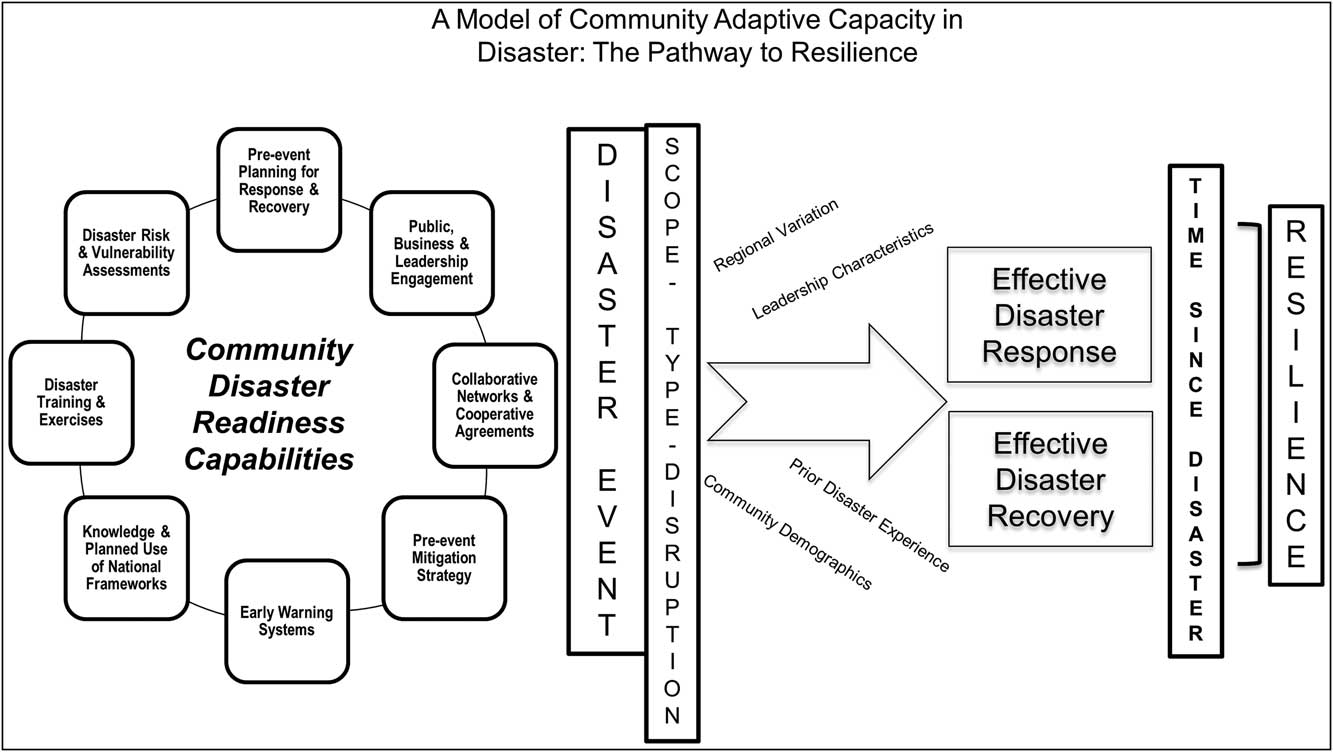
This study employed a quantitative approach using responses from a national cross-sectional survey and community demographic data from the 2010 United States Census to address the research questions. Conceptually, the building of community resilience to improve outcomes related to disaster response and recovery has wide support.Reference Boin 10 - Reference Rose 13 Resilience begins with predisaster preparedness and planning, and ends with the ability of a community to recover effectively following disaster. The conceptual framework for this study delineated elements associated with community resilience, as identified in the literature, that sustain and enhance the social-ecological system to adapt, cope with, resist, and recover from disaster impact.Reference Adger, Hughes, Folke, Carpenter and Rockstrom 14 , Reference Wisner, Blaikie, Cannon and Davis 15 The framework aligns with the earlier theoretical discussion linking resilience to a set of adaptive capacities that create a positive trajectory of function and adaptation after a disturbance.Reference Norris, Stevens, Pfefferbaum, Wyche and Pfefferbaum 16 Using current national frameworks for response and recovery, 17 , 18 a set of community disaster readiness capabilities were identified, and their relationship to other study variables was identified. Figure 1 illustrates the conceptual framework for this research.
Resilience as an Outcome of Adaptive Capacity
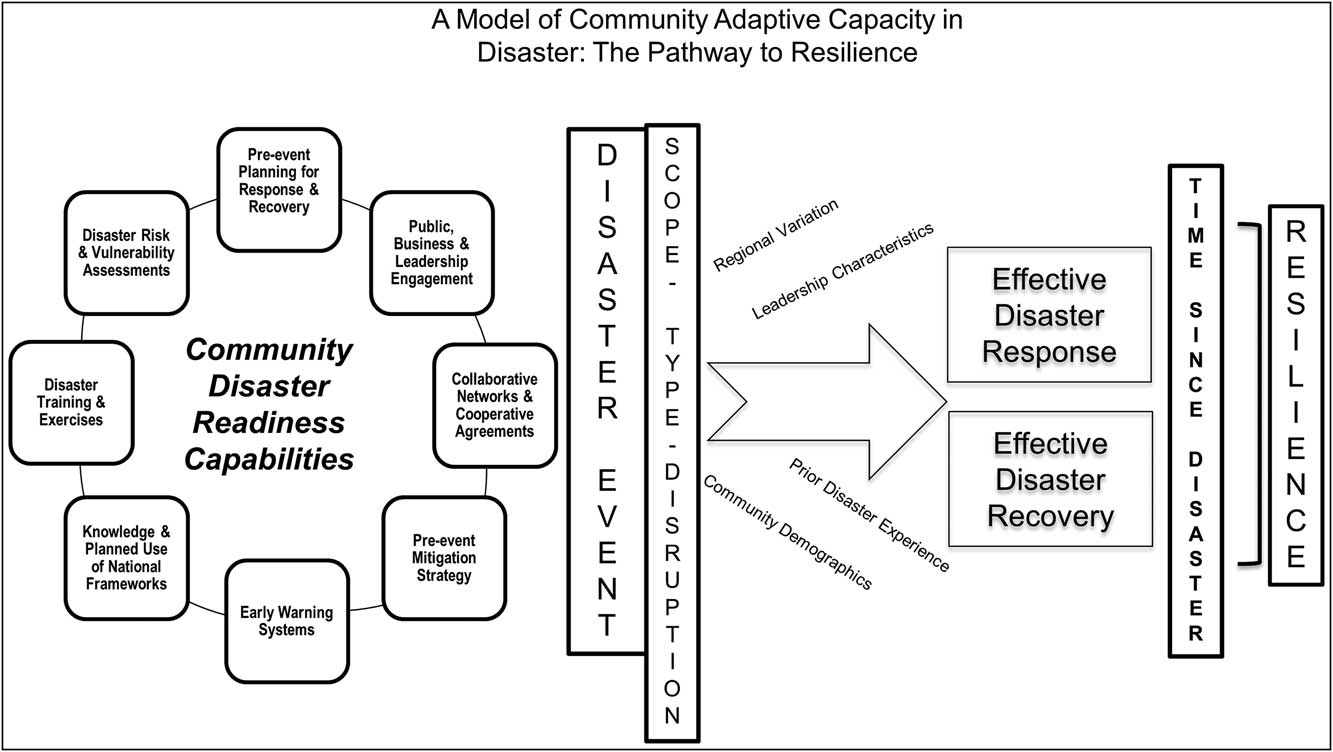
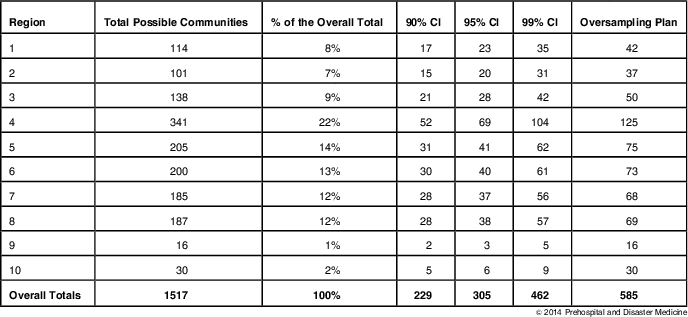
The sampling frame for this study included counties or parishes within the US affected by major disaster in 2011, as defined by the Robert T. Stafford Disaster Relief and Emergency Assistance Act. 19 Local emergency management directors were targeted to obtain information about the county or parish. As supported by the literature, emergency managers play key roles in local response and have knowledge, skills, and abilities in all aspects of the disaster cycle.Reference McEntire 20 Stratified proportionate random sampling was employed, placing all counties and parishes impacted by disaster in 2011 into strata by FEMA region. The FEMA regions provide a method to stratify the sample in a way that will account for regional variations in geography, disaster type, and disaster prevalence, along with leadership approaches and decision making related to capability development that may differ. Stratified sampling accounted for these differences and reduced the chance of sampling error. A web-based random number generator was used to select a proportionate to size sample from each region. Since some communities appeared on the list more than once, exclusion criteria allowed only the inclusion of the most recent disaster as the eligible unit. Additionally, US territories were excluded due to access barriers that may have confounded the data. Oversampling in all regions was completed in order to control for nonresponse bias. A final sample of 585 disaster-affected communities was obtained. Table 1 describes the sample size determination and sampling plan.
Sample Size Determination and Sampling Plan (excludes disasters occurring in US territories)

Data collection procedures allowed both telephone and Internet-based surveys to collect data. An introductory letter was followed by a series of email or postal mail reminders before an eligible participant was deemed to be nonresponsive. A final sample of 333 communities obtained by stratified proportionate random sampling provided a 95% confidence interval with a 5% margin of error. There was an overall survey completion rate of 56.9%.
The researcher received institutional review board (IRB) approval for this study from the Indiana University of Pennsylvania. Participants were informed that they could withdraw from participation at any time, or refuse to answer the survey. They were assured of confidentiality and anonymity.
Instrument
A 24-item questionnaire was developed using the constructs of the conceptual framework, disaster response and recovery literature, and expert opinion. The instrument was pretested within three disaster-affected communities not selected for inclusion in this study. Expert review of the questions allowed further assessment of content, as appropriate for measuring the dimensions of adaptive capacity and response and recovery outcomes.
The survey contained Likert-type response items designed to form indices measuring the conceptual constructs. Factor analysis and Cronbach's α (alpha) provided measures of internal consistency for each set of questions by dimension. Final analysis of the instrument provided evidence of construct validity and clearly identified the predictor and outcome variables measured by the survey. The independent variables and their corresponding alpha coefficients are: 1) preplanning for response and recovery (α = .91); 2) community engagement (α = .86); 3) training and exercise (α = .84); and 4) use of national frameworks (α = .86). The alpha coefficient for the dependent variable, response and recovery performance outcome was .94. Alpha was not calculated for recovery progression as it represents a single measure.
Data Analysis
Study data were analyzed using Stata 12 SE (StataCorp LP, College Station, Texas USA) and descriptive and inferential statistics to explore the frequencies of community disaster readiness capability at the local level, as well as the significance of the capability in relation to the response and recovery outcome. Multiple regression analysis was used to test the effects of the independent and control variables on the outcome variable. However, in order to examine the potential impact of counties or parishes nesting within states, as well as FEMA regions, multilevel linear modeling employing random intercepts was explored. Evaluation of the random effects at both the state and FEMA region were not substantial as the random effects model was not significantly better than a fixed effects model. While it was originally thought that practices and other organizational differences might vary across counties, states, and FEMA regions, it seems that no significant variation was gained by adding a random component to the model. It was therefore concluded that an ordinary, least squares multiple regression model was the best statistical approach for exploring relationships among the variables used in this study.
Results
A total of 355 surveys were completed; 22 surveys were excluded based upon study criteria due to incomplete data or the respondent not being in an emergency management role during the disaster. The final survey sample was 333 counties or parishes, placing this above the 95% confidence interval overall with a 5% margin of error.
Research Question 1
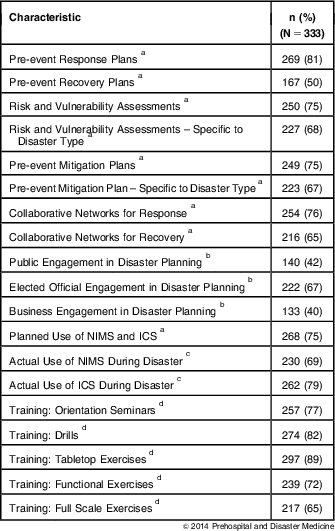
The first research question was exploratory in nature and asked the following: Did communities that experienced major disaster declaration (per Stafford Act criteria) evidence adaptive capacity? The data collectively indicate that 50% or more of all communities surveyed indicated a highly or completely developed capability in the following areas: response and recovery planning; risk and vulnerability assessments; mitigation plan development; and collaborative network establishment. The percentage of communities reporting full engagement of the public, elected officials, and local business in disaster planning was 42%, 67%, and 40%, respectively. More than 75% had planning in place for use of NIMS and ICS, and the majority of these communities reported the actual use of the frameworks during actual disaster response. Training within the community prior to the disaster event was documented with 65% of communities reported having at least one full-scale exercise in the year leading up to the actual event. Table 2 illustrates frequencies and percentage of the responses for each characteristic.
Community Disaster Readiness Capabilities: Characteristics and Frequencies

Abbreviations: ICS, Incident Command System; NIMS, National Incident Management System.
a Highly or completely developed capability.
b Highly or somewhat engaged.
c Strongly or somewhat agree.
d One or more time(s).
Research Question 2
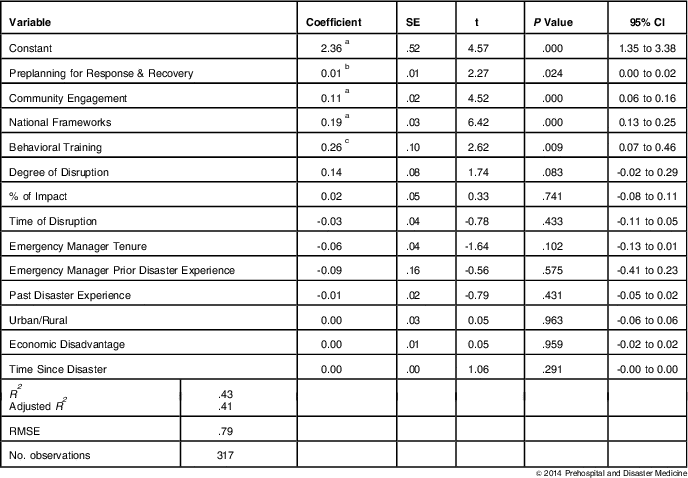
The second research question asked if improved response and recovery outcomes were predicted by adaptive capacity development. Two hypotheses were formulated to address this research question. The first hypothesis argued that counties or parishes that developed adaptive capacity through pre-event planning, community engagement, training, and the use of national response frameworks would have improved response and recovery performance outcomes. Pre-event planning, community engagement, behavioral training, and the use of national response frameworks predicted response and recovery outcomes while controlling for other variables (R 2 = .43; F 13, 303 = 13.34; P < .001). No other variables were significant. Multiple regression analysis was used to test the effects of the independent and control variables on the outcome variable. Regression diagnostics were used to confirm results. Due to the heteroskedastic pattern in the errors and the outliers observed, robust standard errors were used. The calculation involved estimating standard errors without reliance on the assumption of independent, identically distributed errors, which is sometimes referred to as the Huber-White sandwich estimator of variance.Reference Hamilton 21 Results are shown in Table 3.
Regression of Response and Recovery Outcome Variable Using Huber-White Sandwich Estimator of Variance (VCE Robust)

Abbreviations: CI, confidence interval; RMSE, root-mean-square error; SE, standard error.
a Indicates significance at the P < .001 level.
b Indicates significance at the P < .05 level.
c Indicates significance at the P < .01 level.
The second hypothesis argued that adaptive capacity, along with response and recovery performance outcomes, predict the trajectory of recovery progression. The findings suggest that approximately 15% (R 2 = .15; F 14, 302 = 4.53; P < .001) of the variation in recovery progression was a function of initial response and recovery performance outcome, pre-event planning, total time of disruption, and percentage of the population falling below poverty.
Discussion
Resilience to disaster remains a complex phenomenon. Scholars have argued that disaster research has focused primarily on the consequences of disaster rather than on evidence surrounding actual response practice.Reference Britton 22 The findings from this study may begin to better inform this field of interest and provide a basis from which to expand research and thinking.
Evidence of Adaptive Capacity
Some inferences can be drawn from the descriptive data reflecting the percentage of counties or parishes that have either highly or completely developed capability. It appears that there have been efforts made toward capability development. However, no benchmark data exists from past research in order to make comparison regarding when, why, or how this capability was developed, and what the progression of the development has been. However, it remains important data as past case studies have illustrated severe challenges in regional planning and preparation that resulted in chaotic efforts in local coordination during Hurricane Katrina.Reference Kahn and Barondess 23
Pre-event Planning for Response and Recovery
Findings indicate that pre-event planning predicts increased response and recovery outcome. This provides support for the national level emphasis that has been placed on mitigation strategies, risk assessment, and written plans for response and recovery. This finding is theoretically supported by literature indicating that pre-event planning reduces some of the stress that a community may experience by eliminating the surprise or unexpectedness of the event.Reference Paton and Johnston 12 , Reference Comfort 24 , Reference Longstaff 25
Overall Community Engagement
Overall community engagement, to include the public, local businesses, and elected officials, also was significant. This reinforces the need for local consensus-building efforts and the building of a common agenda at the local level.Reference Paton and Johnston 12 It also further validates the inclusion of “community capital” variables suggested in recent research.Reference Cutter, Burton and Emrich 26 Continued emphasis at the local level on communication strategies to involve the public is critical to ongoing preparedness efforts.
Use of National Frameworks
Theoretically, the National Incident Management System (NIMS) and the Incident Command System (ICS) are deemed best practices in the US for disaster preparedness and response. The NIMS standardizes incident management and the ICS provides guidance for planning the organizational structure used in response. Despite continued emphasis on these systems as best practices, limited empirical data regarding their outcomes are available. Findings from this research indicate that use of these national frameworks does result in improved response and recovery outcomes (P < .001). This knowledge may support community efforts to maintain NIMS and ICS capability at the local level.
Education and Training
Training and exercise of response and recovery plans are cited as key activities in providing communities with the knowledge, skills, and abilities needed when disaster strikes. 27 It was anticipated that overall training at the local level would have a strong relationship with response and recovery outcomes. However, somewhat surprisingly, the frequency of overall training (ie, cumulative number of orientation seminars, drills, tabletop exercises, functional exercises, and full-scale exercises) was not significant. When tested individually within the model, only full-scale exercises demonstrated significance in relation to response and recovery outcomes. In this study, only 34% of the counties or parishes affected by major disaster had a full-scale exercise in the year leading up to the disaster. Overall, the most frequently-used training activity was the tabletop exercise. Findings suggest that this training method does not adequately prepare counties or parishes for maximizing response and recovery outcomes.
Recovery Progression
The results indicate the critical importance of pre-event planning and its relationship with the progression of recovery as measured by: return of residents and re-establishment of permanent housing; repair of transportation systems and damaged businesses; rebuilding of infrastructure; and re-engagement of social systems. Response and recovery performance lays the foundation for recovery progression as outlined in national level response and recovery frameworks. 17 , 18 Demonstrating a positive relationship between overall response and recovery performance and the progression of recovery provides encouragement to communities that question the importance of investing time and effort into these national level frameworks supporting disaster recovery. The only demographic variable demonstrating significance was the positive relationship between economic disadvantage and positive progression of recovery. Specifically, findings suggest that as the percentage of people who fall below the poverty line increases, recovery progression increases. While initially this result seems contrary to logic, prior research has suggested that neighborhoods in the mid-range of social vulnerability lagged more than those in either the high or low categories of social vulnerability.Reference Finch, Emrich and Cutter 28 Findings suggest that this may be attributed to the availability of resources, both private and government, to help groups in these categories. It is possible that this phenomenon was also at play within this study. It also seems logical to conclude that the baseline conditions relative to infrastructure, businesses, social structures, and transportation play a role. Just how much did the community move from baseline due to the disaster? If the community was doing extremely well from an economic standpoint prior to this disaster, and a significant shift from baseline occurred, it seems plausible that they would take a longer period of time to recover. More research is needed to explore the concept in depth.
The final variable that was significant related to progression of recovery was total time of disruption. The data indicate that as the time of disruption increases, the progression of recovery decreases. These findings are theoretically congruent. As argued by others, the greater the scope and scale of disruption, the more likely the time for recovery will be extended, and the more likely the community and social structures will be affected.Reference Fischer 29
Based upon the current findings, a revised conceptual framework is recommended to reflect the impact of response and recovery performance on recovery progression. Developing the theoretical foundation and nuances for the revised framework will require more research. Replication of the current study, combined with qualitative case study research, would further inform and provide an extended basis for theory development.
While the model for predicting response and recovery performance outcomes was relatively strong, exploring additional variables might prove particularly beneficial for better conceptualizing and strengthening the weaker model addressing recovery progression. For example, prior research explored baseline characteristics of resilience in communities and provided a rank ordering of communities based upon resilience levels.Reference Cutter, Burton and Emrich 26 This research allowed for the identification of 36 variables for analysis that reflected the underlying subcomponents of a resilience model. Replicating the current study using these additional variables might provide useful results and strengthen the model.
Preplanning for response and recovery remains a critical need within communities. It has been argued that resilience must take into consideration the disaster management capabilities that create an effective strategy for risk reduction and response.Reference Comfort 24 This study validates the outcomes that can be predicted when preplanning for disaster response and recovery occurs. Hospitals and health care systems are a critical element in community planning for response and recovery, and they must engage in these efforts on a sustained basis. According to the literature, the Joint Commission's hospital emergency preparedness standard impels health care facilities to participate actively in community-wide planning, rather than confining planning exclusively to a single health care facility, so that strategies exist to effectively coordinate the allocation of community resources and expertise across all local response agencies.Reference Paturas, Smith, Smith and Albanese 30
Training for disaster response should involve continual re-evaluation. This is especially relevant to hospitals and health systems. The findings from this study suggest that only full-scale exercises were significant in improving response and recovery outcomes. More collaborative research from an interdisciplinary perspective seems warranted. Other researchers found that regional exercises served to build relationships among various partners, including hospitals, emergency management, and law enforcement, while promoting the visibility of public health.Reference Hegel, Markiewicz, Benson, Horney, Rosselli and MacDonald 31 Training and exercise of response and recovery plans provides communities with the knowledge, skills, and abilities needed to perform. 27
Although a full-scale exercise was the only training variable that was statistically significant in this study, such training is costly and possibly unrealistic for most communities. It is suggested that further research is needed into ways that training can elicit behavioral outcomes in a high-fidelity environment that predominantly benefits from experiential learning. With the technological advances being made in computer science and systems engineering, this area remains open for investigation into how to best prepare local communities for response and recovery. The use of simulation to augment training in nursing and medicine may provide valuable insight into potential solutions to this challenge.
Use of the NIMS and the ICS is accepted as a best practice in response to disaster. Study results reinforce the importance of their actual use in disaster situations. Hospitals and health care systems must continue to support these frameworks and ensure that hospital-based planning is aligned with community efforts supporting their use.
The literature suggests that emergency managers should be trained and prepared to anticipate the need for collaboration and develop a role in local consensus-building efforts.Reference Paton and Johnston 12 Hospitals and health systems must be an integral component of this effort, especially in the event of mass-casualty events requiring surge capacity. Building a common agenda during preplanning activities with other community institutions and leaders is one way to accomplish this goal.
Although the model for progression of recovery explains only about 15% of the variability in the dependent variable, it does offer support relative to the national level doctrine that was released to guide communities in the recovery process. However, more research is required in this area to better understand disaster recovery progression.
Limitations
Since this is an early attempt to quantitatively measure the impact of adaptive capacity on response and recovery outcomes in a national-level study of communities impacted by major disaster declaration, it is not without shortcomings. Reliance on the local emergency manager as the sole informant for county or parish data is clearly a limitation, as other individuals within a community also could inform the research questions and offer valuable perspective. If the study were repeated and funding resources were available, additional informants from the local level should be included. Data collection may further benefit by including qualitative as well as quantitative data.
A second limitation stems from relying primarily on national data sources, such as the US Census and the FEMA databases, for disaster declarations. These data sources may not provide a full measure of demographic and disaster-specific data used to explore response and recovery outcomes. Again, qualitative data may prove advantageous in forming a better understanding, clarification, and differentiation of the data sources.
Conclusion
Disasters continue to affect the United States and other nations. Since this research was initiated, a number of high-profile disasters have occurred in the US, including Hurricane Sandy (2012), the massacre of children and adults at the Sandy Hook Elementary School (2012), and a series of tornadoes in Oklahoma. These events continue to underscore the critical nature of preparedness, response, and recovery. Findings from this study validate the critical importance of pre-event planning, community engagement, use of national frameworks (NIMS and ICS), and training (in a high-fidelity environment) to affect response and recovery outcomes. Collection of empirical data provides communities with reinforcement to continue “resilience-building” activities at the local level. More research, however, is needed to continue to inform policy makers, professionals, and responders in the field.
The conceptual model of community adaptive capacity presented for this study has value. However, much remains unknown. Despite the vulnerability to disaster, United States counties and parishes have made advancements in building core capabilities to confront disaster and to measure and track progress. Results from this study underscore suggestions from FEMA that a whole of community effort is necessary. Communities become more resilient, as evidenced by effective response and recovery, when adaptive capacity exists at the local level.
Acknowledgements
The author thanks Dr. John A. Anderson, Dr. Willard Radell, and Dr. William Donner for serving as dissertation committee members and providing mentorship during this research. Additionally, the author was a participant in the 2013 National League for Nursing Scholarly Writing Retreat, sponsored by the National League for Nursing Foundation for Nursing Education. She thanks Dr. Leslie Nicoll and Dr. Leslie Block for their assistance in manuscript development during this retreat.