Introduction
A roundtable was hosted by The World Association for Disaster and Emergency Medicine (WADEM; Madison, Wisconsin USA) World Congress on Disaster and Emergency Medicine in Toronto 2017 to explore prehospital spinal immobilization (SI) best practices. The panel objectives were to:
Identify and review emerging evidence and changes in prehospital SI practice; and
Consider implementation of a WADEM member working party to develop guidance and inform best practice.
Prior to the World Congress on Disaster and Emergency Medicine, the International Liaison Committee on Resuscitation (ILCOR; Niel, Belgium) released an updated recommendation related to out-of-hospital spinal immobilization (SI) practice: “We suggest against the use of cervical collars by first aid providers (weak recommendation, very-low-quality evidence).”Reference Singletary, Zideman and De Buck1
The roundtable participants queried the practice of prehospital SI in resource-scarce environments (RSEs), specifically after a mass-casualty incident, in a complex humanitarian event or conflict zone, in low-to-middle income countries, or with a prolonged transport time; expressed confusion as to which prehospital providers were referred to in that ILCOR statement; and identified challenges in maintaining appropriate application of SI in RSE. A specific call was requested as an output of the roundtable for WADEM to provide leadership and guidance in this area of practice. An application was endorsed by the then elected WADEM Board of Directors (2017-2019) for the development of an organizational position paper on prehospital SI. This systematic review was developed to inform and support a subsequent modified Delphi study to develop prehospital guidelines for SI in RSE.
Systematic Review Protocol
Spinal immobilization in the context of RSE: a systematic review was conducted.
Systematic Review Objective
The objective of this systematic review is to determine if SI evidence-based guidelines (EBGs) in RSE have been published.
Systematic Review Question
What is appropriate SI in RSE?
Methodology
A systematic review of SI published research literature in RSE was conducted. Systematic review methodology is of value where the subject material is developing and diverse in knowledge and publication. Disaster management practice is of its own volition multi-disciplinary; as a consequence, various operational and academic disciplines contribute to the knowledge and evidence base in a variety of forums and databases. This breadth and range of literature is well-suited to systematic review methodology. In particular, there is great diversity of the disaster peer-reviewed literature, and more information can be found in the “grey literature” and in humanitarian practice than in peer-reviewed literature. This is evidenced by a study conducted by Smith, et al in 2009, whom identified nearly 2,000 peer-reviewed, event-specific publications that have been published in seven hundred eighty-nine (789) journals.Reference Smith, Wasiak, Sen, Archer and Burkle2
Literature Search Criteria
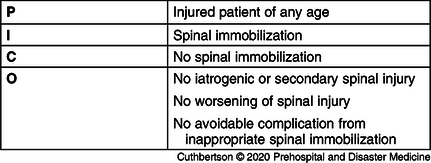
A research question was developed using the Patient, Intervention, Control, Outcome (PICO) standard to frame the search strategy (Table 1).
PICO Search Strategy

Abbreviation: PICO, Patient, Intervention, Control, Outcome.
Literature Search Methods
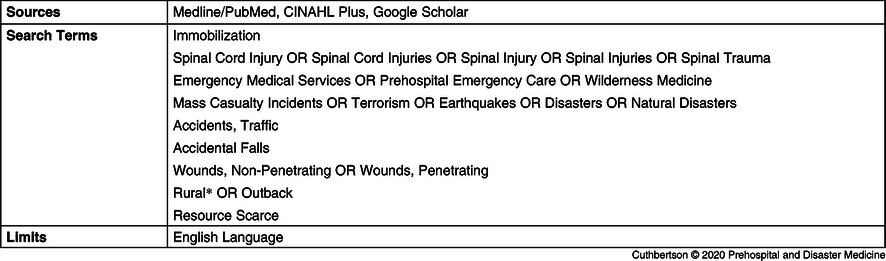
The search strategy included only terms relating to or describing the intervention (Table 2). The review included English-language papers published from January 2000 through July 2019 in the PubMed (National Center for Biotechnology Information, National Institutes of Health; Bethesda, Maryland USA); Medline (US National Library of Medicine, National Institutes of Health; Bethesda, Maryland USA); and Google Scholar (Google Inc.; Mountain View, California USA) databases. Finally, an ancestry search was also performed to identify additional papers on the reference section of the articles.
Search Terms

A review of the “grey literature” in Google Scholar was conducted using the same search terms (Table 2). This literature review was informed by a consideration of policy and non-peer-review professional journals or publications and non-medical media.
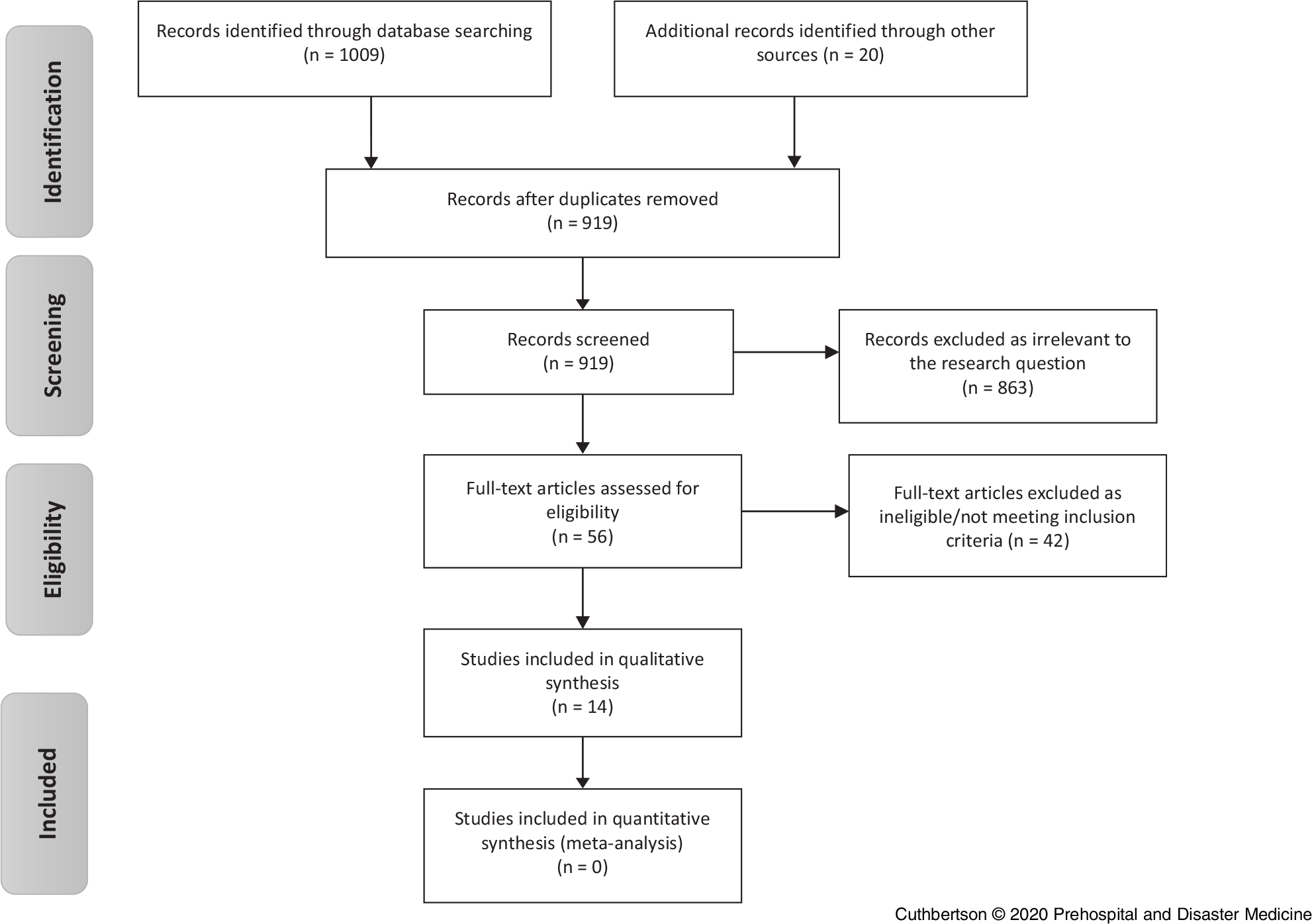
A systematic review was conducted according to the Preferred Reporting Items for Systematic Reviews and Meta-Analyses (PRISMA) checklist (Figure 1).Reference Moher, Liberati, Tetzlaff and Altman3
Literature Search Flow Diagram (PRISMA).

Inclusion Criteria
All peer-reviewed statistical studies/reports detailing management of potential traumatic spinal injury in RSE, civilian, and military environments; as well as consensus guidelines, protocols, or other policy statements; statistical analysis; and subsequent management of injuries after sudden onset disasters, natural or man-made, in complex humanitarian events or conflict zones, low-to- middle-income countries, or prolonged transport times published by government and non-government organizations were included.
Exclusion Criteria
Non-English speaking literature, abstracts, citations, thesis, unverified or unsubstantiated press or news media reports, articles that are not related to a patient with a potential traumatic spinal injury in a sudden onset disaster, mass-casualty incident, or trauma after sudden onset disasters, natural or man-made, in complex humanitarian events or conflict zones, in low-to middle-income countries, or prolonged transport times were excluded.
A secondary hand search of bibliographies was conducted to identify further outputs.
Quality Assessment
Two review authors independently assessed all included studies for risk of bias; any disagreement was resolved by discussion. The quality of the evidence was classified into four categories according to the Grading of Recommendations Assessment, Development, and Evaluation approach.Reference Guyatt, Oxman and Akl4
Key data extracted into an Excel spreadsheet (Microsoft Corp.; Redmond, Washington USA) included: year; sample size; gender, variables assessed; study design; assessment schedule and follow-up period; analysis used; main findings and conclusions; and limitations.
Results
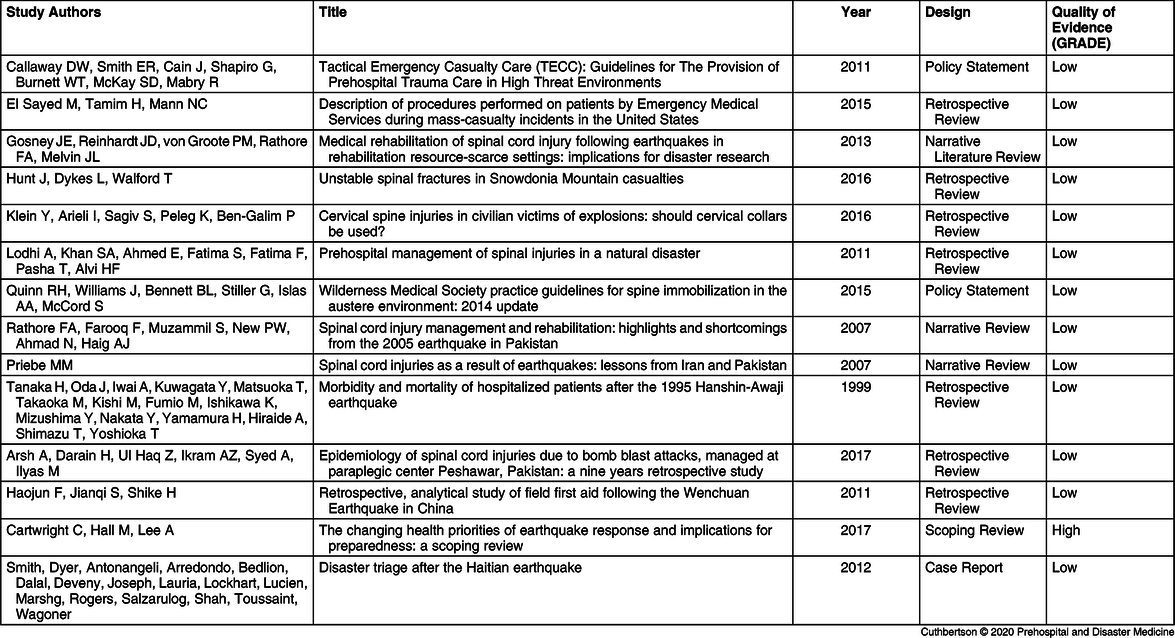
The search strategy yielded a total of one thousand twenty-nine (1029) references. After exclusion of duplicates, nine hundred nineteen (919) titles were identified for further screening. After applying exclusion criteria, eight hundred sixty-three (863) articles were removed. Fifty-six (56) full-text articles were assessed for eligibility, forty-two (42) of these papers were excluded either due to lack of epidemiological data on prehospital spinal cord injury or because they cited earlier publications. A total of fourteen (14) references underwent evaluation (Table 3). The reviewed articles comprised six (6) types of studies and represented research from institutions in seven (7) different countries (Israel, United States, Haiti, Wales, Pakistan, China, and Iran). Thirteen (13) references were case reports/narrative reviews, policy statements, retrospective observational studies, narrative literature reviews, and one scoping review.
Studies Included in Qualitative Synthesis

This systematic review identified a lack of definitive evidence on the utility or effect of spinal motion restriction or immobilization on patient outcomes in disasters. The majority of literature identified in this systematic review described spinal cord injury predominantly associated with earthquakes and blast-related events. The clinical benefit of spinal restriction or immobilization in disasters and across disaster types is unknown and requires further research and evaluation to enable recommendations for SI in RSEs after a mass-casualty incident, in low-middle income countries, complex humanitarian events, conflict zones, and with prolonged transport times.
Discussion
First responders in RSE may not have commercially available products at their disposal to utilize when treating a trauma patient with potential spinal injury, or have not had robust training through accredited programs in the use of such equipment to facilitate safe and effective practice. Application of evidence-based prehospital guidelines from resource-rich environments (RREs) to overcome the challenges in the RSE will enable first responders to achieve maximal care. Current EBGs assume multiple levels of commercially available products and well-established training programs to treat the injured in RRE that are not applicable in RSE. Evidence limiting SI in RRE has been slow to be applied in these environments, despite wide promulgation of guidelines and education, due to inappropriate medico-legal fear and lack of an integrated approach amongst prehospital first responders and receiving hospitals. In RSEs, these factors have been proven to be even more difficult to overcome due to old habits and limited education. Under- or over-treatment of potential spinal injuries can lead to: worse clinical outcomes; avoidable complications related to inappropriate application of SI; and avoidable iatrogenic or secondary spinal injuries. Thus, EBGs will enable first responders in RSE to achieve maximal protection from further injury while avoiding unnecessary SI-related complications or consumption of precious resources.
Prehospital SI is recommended in the World Health Organization’s (WHO; Geneva, Switzerland) publication Coping with Natural Disasters: The Role of Local Health Personnel and the Community. Working Guide.5 A guideline developed by the Wilderness Medicine Society (WMS; Salt Lake City, Utah USA) based on expert panel review currently advocates for the use of SI in austere environments, but notes the lack of evidence supporting this recommendation.Reference Quinn, Williams and Bennett6
A retrospective review of sixty-four (64) patients requiring mountain rescue with unstable spinal injuries in Snowdonia (Wales, United Kingdom) found that 60% of casualties were not immobilized at-scene; of the cohort not immobilized, no neurological deterioration or exacerbation of spinal cord injury occurred.Reference Hunt, Dykes and Walford7 A retrospective cohort study of two thousand two hundred sixty-seven (2267) blast victims conducted by Klein, et al found that 0.083% suffered cervical spine injuries and 0.088% had unstable cervical spine fractures, with all but one presenting with irreversible neurological deficit. The authors concluded that scene application of cervical spine collars provided no benefit and risked obscuring penetrating neck injuries.Reference Klein, Arieli, Sagiv, Peleg and Ben-Galim8 A narrative review of spinal cord injury following blast in Pakistan by Arsh, et al noted that penetrating injury was the predominate cause of spinal cord injury resulting in neurological deficit.Reference Arsh, Darain and Ul-Haq9 Irrespective of these findings, published policies of tactical emergency care recommend immobilization following blast without penetrating injury.Reference Callaway, Smith and Cain10
Narrative reviews examining acute care of spinal cord injury following earthquake recommend immobilization.Reference Gautschi, Cadosch, Rajan and Zellweger11-Reference Singletary, Zideman and De Buck1Reference Moher, Liberati, Tetzlaff and Altman3 A retrospective review of field first-aid reports from the 2008 Wenchuan Earthquake by Fan, et al reported the use of doors as stretchers for carrying of patients at-scene suffering presumed spinal cord injury and the immobilization of patient head using tape.Reference Haojun, Jianqi and Shike14 This practice was also noted in a case report of the response to the Haitian earthquake of 2010.Reference Singletary, Zideman and De Buck15 A narrative review of the 2005 Pakistan earthquake reported adverse neurological outcomes following poor prehospital handling of survivors suffering spinal cord injury,Reference Singletary, Zideman and De Buck1Reference Quinn, Williams and Bennett6 and a scoping review by Cartwright, et al reported pressure injuries of survivors suffering spinal cord injury due to inappropriate prehospital care.Reference Singletary, Zideman and De Buck15 In a systematic review conducted by Kwan, et al contained in the Cochrane Library Cochrane Evidence Aid: resources for earthquakes (Cochrane; London, United Kingdom) found no evidence from randomized controlled trials on the effectiveness of spinal mobilizations on neurological injury, spinal stability, mortality, and adverse effects in trauma patients.Reference Jones and Bagnall17 Moreover, the findings of a narrative literature review by Gosney, et al examining spinal cord injury across three international earthquakes noted the lack of evidence base to support spinal cord injury management following earthquake in RSEs.Reference Gosney, Reinhardt, von Groote, Rathore and Melvin18
Limitations
This review was limited to qualitative analysis of studies from the literature; due to the scarcity and heterogeneity of reporting, meta-analysis was not possible.
It should be noted that the majority of literature describing spinal cord injury was predominantly associated with earthquakes and blast-related disasters.
Conclusion
There is a lack of high-level evidence on the utility or effect of spinal motion restriction or immobilization on patient outcomes in disasters. There is a need for robust research to determine the clinical benefit of spinal restriction or immobilization in disasters and across disaster types. This systematic review will inform a subsequent Delphi study to develop recommendations and guidance for practice related to prehospital SI in disaster and humanitarian settings.
Conflicts of interest
none