Introduction
Historically, duration of clinical signs such as loss of consciousness (LOC) or amnesia were thought to be reliable markers of concussion severity and important predictors of outcome from injury, as they are for moderate to severe traumatic brain injury (Jennett & Bond, Reference Jennett and Bond1975). Accordingly, systems for grading the severity of sports-related concussion emphasized the presence or longer duration of LOC and/or amnesia as indicative of a more severe injury (Cantu, Reference Cantu2001; Guskiewicz, Reference Guskiewicz2001). However, the role of LOC and amnesia as markers of concussion severity has since been challenged on several grounds (Collins et al., Reference Collins, Iverson, Lovell, McKeag, Norwig and Maroon2003; Lovell, Iverson, Collins, McKeag, & Maroon, Reference Lovell, Iverson, Collins, McKeag and Maroon1999) and, consequently, deemphasised in contemporary definitions of concussion in favour of individualised management of concussive injury informed by neuropsychological assessment and post-concussion symptom reports (e.g., McCrory et al., Reference McCrory, Meeuwisse, Aubry, Cantu, Dvorak, Echemendia and Turner2013).
However, the occurrence (rather than duration) of LOC or amnesia remains a potentially useful, objective, and specific marker to guide clinical decision-making when neuropsychological assessment is unavailable; compared to the subjective and non-specific nature of self-reported symptoms which are susceptible to underreporting or minimisation by athletes motivated to reengage in sport as soon as possible (McCrea, Hammeke, Olsen, Leo, & Guskiewicz, Reference McCrea, Hammeke, Olsen, Leo and Guskiewicz2004). The occurrence of LOC and amnesia is quantifiable and reported with reasonable consistency throughout the sports concussion literature. However, given the relatively low incidence of LOC and amnesia (Cantu, Reference Cantu2006b), a single study is unlikely to achieve a sufficient sample size to reliably evaluate these injury markers. Thus the value of the occurrence of LOC and amnesia as predictors of concussion severity requires assessment via meta-analysis.
Previous meta-analyses of research on sports-related concussion have described the mechanisms of injury, the incidence of LOC or amnesia, and the use of several diagnostic and severity grading criteria within the sampled literature (Belanger & Vanderploeg, Reference Belanger and Vanderploeg2005; Broglio & Puetz, Reference Broglio and Puetz2008; Comper, Hutchison, Magrys, Mainwaring, & Richards, Reference Comper, Hutchison, Magrys, Mainwaring and Richards2010). However, these reviews have not quantified the contribution of these variables to the prediction of post-concussion neurocognitive impairment. While Binder, Rohling, and Larrabee (Reference Binder, Rohling and Larrabee1997) reported a significant correlation between “time to follow commands” and post-injury neuropsychological impairment, this finding was derived from a single study conducted more than 1 year following mild to severe traumatic brain injury.
The aim of the present study, therefore, was to apply meta-analytic techniques to quantify the extent to which the presence of LOC or amnesia following a sports-related concussion predicts worse neuropsychological deficits in the acute post-injury period.
Methods
Samples included in the current analysis were drawn from a meta-analytic database of 92 independent empirical samples which directly investigated the acute effect and recovery from sports-related concussion in adolescent and adult athletes. The database has previously been interrogated (Dougan, Horswill, & Geffen, Reference Dougan, Horswill and Geffenin press) to replicate the finding that assessment-specific variables (time since injury, repeat assessment, comparison group) are significant moderators of post-concussion outcomes (Belanger & Vanderploeg, Reference Belanger and Vanderploeg2005; Broglio & Puetz, Reference Broglio and Puetz2008), and to evaluate whether premorbid athlete characteristics (in particular, athlete age) modify the severity of acute post-concussion outcomes.
The current analysis applied the same general procedures and inclusion criteria described in detail in Dougan et al. (Reference Dougan, Horswill and Geffenin press). Briefly, published empirical studies (January 1970 to August 2011) were eligible for inclusion if at least one neuropsychological test, measure of postural stability, or symptom severity checklist was used to quantify the effect of sports-related concussion in athletes, relative to a pre-injury baseline and/or an uninjured control group.Footnote 1 Effect sizes (d) were calculated using the pooled standard deviation of the concussed and uninjured group means as the denominator. All effects were coded such that a post-injury decline in athletes’ neurocognitive function would produce a negative effect size. Multiple effects within a single sample were aggregated by arithmetic mean, corrected for small-sample bias and weighted by the inverse of the sampling error variance, before aggregation across samples to produce an independent set of effects per analysis.
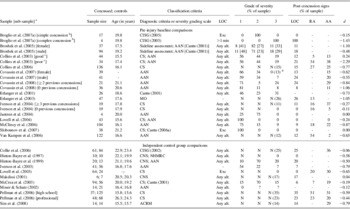
In the current study, independent variables selected for categorical analysis (analogue-to-ANOVA) were the severity grading of concussive injuries (distinguished by the inclusion vs. exclusion of LOC). Independent variables selected for fixed-effect regression analyses were the sample incidence of LOC, retrograde amnesia and anterograde amnesia. Accordingly, in addition to the above inclusion criteria, to be included in the present analysis sample rates of LOC, retrograde amnesia or anterograde amnesia, or sample rates of each grade of injury severity, must have been reported by study authors (see Table 1).
Injury characteristics of the 31sports-related concussion samples eligible for inclusion in analyses, arranged by comparison group

Note. d = weighted mean effect size calculated using the pooled standard deviations of the concussed group and the uninjured comparison group as the denominator - neuropsychological assessments first conducted 1-10 days post-injury only. AA = anterograde amnesia; AAN = Quality Standards Subcommittee of the American Academy of Neurology (1997); Any alt. = any alteration in level of consciousness; CISG = Concussion in Sport Group (Aubry et al., 2002; McCrory et al., 2005); CNS = Congress of Neurological Surgeons (Committee on Head Injury Nomenclature of the Congress of Neurological Surgeons, 1966); CS = clinical signs; Exc = concussion with LOC or Grade 3 AAN (1997) injuries excluded; LOC = loss of consciousness; MO = diagnosed by medical officer; N = a system of grading injury severity was not used; NHMRC = National Health and Medical Research Council (1994); RA = retrograde amnesia.
aFor full reference, see the complete list of citations provided in the online Supplementary Materials. bSimple concussion = no loss of consciousness, symptom resolution <10 days; Complex concussion = loss of consciousness, symptom resolution >10 days. cGood post-injury presentation = no change in neuropsychological function pre- to post-injury, asymptomatic; Poor post-injury presentation = 10≤point decline in memory score, 10≤ point increase in symptom severity from pre- to post-injury. dInconsistency between AAN grading and incidence of LOC as per published paper.
Furthermore, to control for time since injury and repeat assessment while ensuring adequate sample size for analysis, only neuropsychological outcomes first assessed 1–10 days post-injury (dependent variable) were included in the current analyses. Additionally, to establish whether observed variation in outcome according to injury characteristics may be better explained by differences in athlete age (adolescent vs. adult), comparison group (pre-injury baseline vs. uninjured control), or cognitive domain assessed, follow-up analyses were also conducted while holding each of these variables constant.
Results
The athlete and assessment characteristics of the 92 sports-related concussion samples included in the meta-analytic database have been described in detail elsewhere (Dougan et al., Reference Dougan, Horswill and Geffenin press). Table 1 presents the injury characteristics of the 31 samples drawn from this database and included in current analyses.Footnote 2
As shown in Table 1, a variety of diagnostic criteria and injury severity grading criteria were used to classify concussive injuries. The clinical definition and grading scales published by the American Academy of Neurology (AAN, 1997) were adopted with the greatest frequency. Alternatively, many authors relied upon the presence of common signs and symptoms of concussion and/or a diagnosis from an experienced medical officer; authors rarely reported the specific mechanism or biomechanics of concussive injuries. Given the range of severity grading systems used, and the lack of comparability across grading scales,Footnote 3 studies that reported either AAN (1997) graded injuries or rates of LOC within the concussed sample were re-classified for analysis as either Grades 1 and 2 (i.e., no LOC) or mixed grades including Grade 3 (i.e., including instances of unconsciousness).
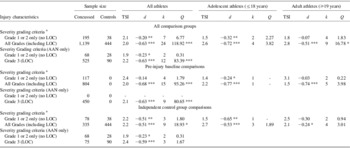
As shown in Table 2, at first assessments conducted within 1–10 days of injury, samples including only Grade 1 and 2 concussions demonstrated smaller neuropsychological deficits, on average, than samples including Grade 3 concussions (d = -0.20 and -0.63, respectively). This pattern of results was consistent with the sub-sample of studies that explicitly applied the AAN (1997) grading scale to classify concussive injuries: samples of Grade 1 and 2 concussions demonstrated smaller neuropsychological deficits, on average, than samples of Grade 3 concussions (d = -0.23 and -0.63, respectively). This finding was not better accounted for by differences between groups in average time since injury (M = 2.1 and 2.0 days, and M = 1.9 and 2.2 days, respectively), and was replicated in both adolescent (d = -0.32 and -0.72, respectively) and adult samples (d = ns and -0.51, respectively), across all pre-injury baseline comparisons (see Table 2), and when only measures of speed of information processing were included in the analysis.Footnote 4 In contrast, when only control group comparisons were included in the analysis, only adult samples demonstrated marginally worse neuropsychological deficits in the presence of Grade 3 relative to Grade 1 and 2 concussions (d = -0.24 and ns, respectively).
Effect size presented as a function of injury characteristics and athlete age group: neuropsychological outcome measures administered at first post-injury assessments conducted 1-10 days following concussion

Note. AAN = Quality Standards Subcommittee of the American Academy of Neurology (1997); d = weighted mean effect size. k = number of independent sample effect sizes; LOC = loss of consciousness; Q = test of homogeneity of effect size variance; TSI = average time elapsed since injury (in days).
a Reported injury severity reclassified according to AAN (1997) criteria on the basis of the presence or absence of LOC within the concussed sample. Any sample included in ‘Grade 1 or 2 only’ was not included in ‘All Grades’. Please refer to the Results section for further details.
*p < .05, **p < .01, ***p < .001.
Regression analyses confirmed that a higher sample incidence of concussion accompanied by LOC, anterograde amnesia or retrograde amnesia corresponded to significantly worse neuropsychological deficits at assessments first conducted 1–10 days post-injury. The relationship between LOC, retrograde amnesia, anterograde amnesia, and concussion effect was stronger than would be expected by chance (QM (1) = 14; p < .001; QM (1) = 7; p < .01, and QM (1) = 4; p < .05, respectively), although residual between-study variability remained unexplained by each model (QR (27) = 139; p < .001, QR (10) = 88; p < .001; and QR (16) = 108; p < .001, respectively). The relationship between LOC and neuropsychological deficits within the first 10 days of injury was also demonstrated by adolescent (QM (1) = 5; p < .05; QR (3) = 10; p < .05) and adult samples (QM (1) = 4; p < .05; QR (12) = 25; p < .05).Footnote 5
Extrapolating from the regression models, athletes who did not experience LOC, retrograde amnesia, or anterograde amnesia could be expected to demonstrate moderate decrements in neuropsychological functioning upon first assessment within 1–10 days post-concussion (d = -0.39, -0.45, -0.47, respectively), while athletes who experienced LOC, retrograde amnesia or anterograde amnesia could be expected to demonstrate large decrements in neuropsychological functioning within the same interval (d = -1.67, -1.07, -1.02, respectively). Similarly, adolescent athletes who did not experience LOC could be expected to demonstrate a moderate decrement in neuropsychological functioning upon first assessment within 1–10 days post-concussion (d = -0.45), while adolescents who experienced LOC could be expected to demonstrate a large decrement in neuropsychological functioning within the same interval (d = -1.79). In contrast, adult athletes who did not experience LOC could be expected to demonstrate a small decrement in neuropsychological functioning upon first assessment within 1–10 days post-concussion (d = -0.21), although adults who experienced LOC could be expected to demonstrate a large decrement in neuropsychological functioning within the same interval (d = -1.28).
This pattern of results was replicated across all pre-injury baseline comparisons, when all neuropsychological outcome measures were included in the analysis, and also when only measures of speed of information processing were included in the analysis.Footnote 6 However, when only control group comparisons were included in the analysis, the only regression model to reach statistical significance was retrograde amnesia (QM (1) = 5; p < .05, QR (3) = 1, ns). Extrapolating from this model, athletes who did not experience retrograde amnesia could be expected to demonstrate small decrements in neuropsychological functioning upon first assessment within 1–10 days post-concussion (d = -0.23), while athletes who experienced retrograde amnesia could be expected to demonstrate large decrements in neuropsychological functioning within the same interval (d = -1.03). However, sample incidence of retrograde amnesia did not significantly predict greater decrements in performance on measures of speed of information processing upon first assessment within 1–10 days post-injury.
Discussion
The current study applied meta-analytic techniques to quantify the injury characteristics that predict a more adverse impact of sports-related concussion on the neuropsychological functioning of athletes within the acute post-injury period. It is the first meta-analytic review of the sports-related concussion literature to examine the association between LOC, amnesia, and acute post-concussion outcomes.
The results of this meta-analysis demonstrate that the presence of loss of consciousness or amnesia is potentially indicative of a more severe concussive injury in athletes within 1–10 days of injury. These relationships were maintained when time elapsed since injury, the confounding effect of repeat assessments, and athlete age group were taken into account; and when only pre-injury baseline studies and measures of information processing speed were included in analyses. In contrast, when only studies using independent control groups were included in the analysis, retrograde amnesia significantly predicted worse acute post-concussion neuropsychological outcomes, although did not predict slowed information processing speed specifically.
It must be emphasised that our findings apply to the acute recovery interval only. There were insufficient studies reporting outcomes beyond 10 days from injury to support analysis of whether or not markers of acute neuropsychological dysfunction also predict post-acute neuropsychological deficits or the subgroup of athletes (10–15%) who experience delayed recovery (McCrory et al., Reference McCrory, Meeuwisse, Aubry, Cantu, Dvorak, Echemendia and Turner2013). Further research assessing the predictive relationship between injury markers and post-acute rates of recovery from concussion is needed.
Moreover, small samples prevented our assessment of the likely interrelationships among injury variables and limit the conclusions that may be drawn from these results. Every effort was made to identify all eligible samples for analysis, and to report only those outcomes supported by adequate sample size. However, we note that small samples sizes, and disparate sample sizes across cells of analysis, are issues common to this field of research and also to previously published meta-analyses of sports-related concussion (Belanger, Spiegel, & Vanderploeg, Reference Belanger, Spiegel and Vanderploeg2010; Belanger & Vanderploeg, Reference Belanger and Vanderploeg2005; Broglio & Puetz, Reference Broglio and Puetz2008), highlighting the continued need for further research in this field.
Restriction of the meta-analytic sample to only those studies that compared post-injury performance to both an independent control group and pre-injury baseline could potentially improve the sensitivity of analysis to the modifying role of injury markers; this was not possible due to the dearth of studies in the literature adopting a rigorous prospective research design. Moreover, continued diversity in the application of injury classification criteria and irregular documentation of the sample incidence of post-concussion clinical signs resulted in a substantially reduced subset of the sampled literature from which to derive our conclusions. This subset may differ systematically from those samples that did not report these variables. For example, while the average incidence of anterograde amnesia was consistent with epidemiological reports, there was a higher than normal incidence of LOC and retrograde amnesia in this meta-analytic sample (Cantu, Reference Cantu2001; Guskiewicz, Weaver, Padua, & Garrett, Reference Guskiewicz, Weaver, Padua and Garrett2000). Concussions accompanied by LOC or retrograde amnesia may have been more conspicuous and hence more likely to be recruited to empirical samples, while more subtle concussions without LOC/amnesia or only transient post-concussion symptoms may have been overlooked. This suggests that the current sample may represent an unusually severe collection of sports-related concussions and our results may, therefore, be systematically unrepresentative of concussive injuries that failed to be identified and recruited to these studies; an issue common to this field of research (McCrea et al., Reference McCrea, Hammeke, Olsen, Leo and Guskiewicz2004).
Nonetheless, these findings are consistent with the few previous studies that have specifically addressed the question of LOC and amnesia as markers of severity of concussion and suggest that the presence (cf., duration) of retrograde amnesia may be a useful indicator of the severity of acute post-concussion neuropsychological dysfunction, particularly during the first 10 days post-injury. For example, Collins and colleagues (Reference Collins, Iverson, Lovell, McKeag, Norwig and Maroon2003) found that athletes who were symptomatic and demonstrated significant memory deficits at 48 hr post-injury were 10 times more likely to have experienced retrograde amnesia at the time of injury. Similarly, Asplund, McKeag, and Olsen (Reference Asplund, McKeag and Olsen2004) reported that both retrograde amnesia and LOC were associated with delayed recovery in athletes. Moreover, our finding that the presence (cf., duration) of retrograde amnesia is a more reliable indicator of acute neuropsychological dysfunction than the presence (cf., duration) of anterograde amnesia, may be explained by the early findings of Russell and Nathan (Reference Russell and Nathan1946; specifically, Tables IV and V). Russell and Nathan (Reference Russell and Nathan1946) found that duration of anterograde amnesia is a better predictor of traumatic brain injury severity than duration of retrograde amnesia. However, Tables IV and V demonstrate that as duration of anterograde amnesia increases, a corresponding increase in the presence and duration of retrograde amnesia is observed. Conversely, only patients demonstrating brief anterograde amnesia demonstrated no retrograde amnesia. Therefore, when considering only the presence/absence (cf., duration) of retrograde and anterograde amnesia, as per the current analysis: mild traumatic brain injuries may be associated with the presence of anterograde amnesia in the absence of retrograde amnesia, while more severe injuries are associated with the presence of both anterograde amnesia and retrograde amnesia. Accordingly, when information pertaining to the duration of amnesia is unavailable, the mere presence/absence of retrograde amnesia may be considered the defining marker of a more severe injury. A meta-analysis of the predictive relationship between duration of clinical signs of injury and post-concussion neuropsychological impairment may nonetheless find duration of anterograde amnesia to be a better predictor of injury severity than duration of retrograde amnesia, as per Russell and Nathan (Reference Russell and Nathan1946). The duration of injury markers was infrequently documented within the current meta-analytic sample (possibly for the reasons suggested) and, therefore, the association between duration of LOC/amnesia and neuropsychological outcome could not be assessed in the current analysis.
The target population and controls for internal validity used in the current meta-analytic sample differ systematically from that of previous research reporting contrary results. Many studies refuting the predictive capacity of LOC recruited hospital attendees with mild traumatic brain injury or compared the post-injury impairment associated with concussions with LOC to concussions without LOC in the absence of comparison to a pre-injury baseline or an uninjured control group (Hanlon, Demery, Martinovich, & Kelly, Reference Hanlon, Demery, Martinovich and Kelly1999; Iverson, Lovell, & Smith, Reference Iverson, Lovell and Smith2000; Leininger, Gramling, Farrell, Kreutzer, & Peck, Reference Leininger, Gramling, Farrell, Kreutzer and Peck1990; Lovell et al., Reference Lovell, Iverson, Collins, McKeag and Maroon1999). Therefore, the predictive role of LOC and amnesia may have been obscured in the past by (1) subjective and imprecise reporting of incidence and/or duration (i.e., retrospective self-report), (2) restriction of range when correlating brief duration with concussion severity, and (3) a lack of pre-injury assessment to control for premorbid differences between patients who do or do not experience a loss of consciousness with concussion.
Additionally, the recording of on-field and early post-concussion markers of injury severity may be more accurate in the field of sports concussion than in samples of the general population, given that sports-related concussions are more likely to be witnessed and immediately assessed by medical officers at the sideline. Indeed, the presence/absence of markers of injury may be a more accurate indicator of acute neuropsychological dysfunction than measures of duration which are potentially subject to higher levels of measurement error; particularly when LOC or amnesia may last for only seconds or minutes (Cantu, Reference Cantu2006a) and subjective post-concussion symptoms may be unreported or minimised (McCrea et al., Reference McCrea, Hammeke, Olsen, Leo and Guskiewicz2004).
In conclusion, the presence of loss of consciousness and amnesia are potentially important indicators of a more severe concussive injury in both adolescent and adult athletes within 1–10 days of injury. The relationship between the duration of these injury characteristics and outcome beyond the first 10 days after concussion requires further research.
Acknowledgments
This research was supported by an Australian Postgraduate Award and forms part of the doctoral thesis of the first author, submitted to the University of Queensland in December 2012. This research received no specific grant from any other funding agency, commercial or not-for-profit sectors. We confirm that the information in this manuscript and the manuscript itself has never been published either electronically or in print and that none of the authors has any financial or other conflict of interest affecting this manuscript. We acknowledge the help of John Guimelli in checking the data for accuracy.