Introduction
Clinical studies have linked certain morphological features to human behavior; however, the relevance of these associations in the general population remains unclear.Reference Rook1–Reference Williamson, Quatieri and Helfer5 The link likely stems, at least in part, from early development, when the brain and face share a common embryonic origin.Reference Betts, Desaix and Johnson6 As the embryo matures, part of the ectoderm differentiates into a specialized neuroectoderm, the precursor to the nervous system tissues.Reference Betts, Desaix and Johnson6,Reference LaMantia7 The neuroectoderm is essential not only for forming the nervous system but also for the development of craniofacial cartilage and bone. Furthermore, intricate interactions among neural crest cells, craniofacial primordia, and cranial placodes create a “mirror-like” pattern: early brain organization is reflected in the structures, sensory organs (eyes, nose, ears), and cranial nerves.Reference LaMantia7 Thus, the formation of the face significantly relies on proper brain development, whereas occurrences and disturbances in brain development can instigate “minor physical abnormalities”.Reference Marcucio, Hallgrimsson and Young8 These neuroanatomical features have been suggested as risk markers and may serve as sensitive physical indicators of embryonic development, aiding in the detection of neurodevelopmental conditions.Reference Waldrop, Pedersen and Bell9,Reference Ozgen, Hop, Hox, Beemer and Van Engeland10 Minor physical abnormalities manifest as distinctive craniofacial or physiological morphological features often become apparent in the early stages of fetal development and are commonly observable during extended periods of life after birth.Reference Ozgen, Hop, Hox, Beemer and Van Engeland10,Reference Maniscalco, Frédérique, Roccella, Matranga and Tripi11 These manifestations are consistently associated with biological, psychosocial, and cognitive vulnerabilities.Reference Maniscalco, Frédérique, Roccella, Matranga and Tripi11 In a study of 19,644 individuals of European ancestry, Naqvi et al. found a significant overlap between the brain shape and the human face through specific genetic regions not just in cases of malformations but also in normal variations of typical development.Reference Naqvi, Sleyp and Hoskens12
These findings prompt the question of whether facial morphology could serve as an indicator of early embryonic brain development alterations that impact behavior. Emotional and behavioral health is a cornerstone of child development. Difficulties in these areas can interfere with a child’s ability to learn, form meaningful relationships, and maintain harmony within the family, often leading to long-term impacts on their overall well-being.Reference Ogundele13,14 We hypothesize that facial morphology and behavioral alterations co-occur. To test this hypothesis, we explored whether an association between facial morphology and behavioral problems exists in children. Further, the prenatal period represents a critical window for the developing brain and face, during which environmental exposures can exert lasting effects on structure and function. We examined whether population-common prenatal exposures to alcohol, tobacco, vitamin D, and folic acid are associated with the respective facial traits. Substances such as alcohol and tobacco can disrupt key neurodevelopmental pathways,Reference Wells and Lotfipour15,Reference Khoury, Jamieson and Milligan16 while essential nutrients like vitamin D and folic acid support normal cellular differentiation, DNA methylation, and tissue formation.Reference Crider, Bailey and Berry17–Reference Rodgers, Mead and McWhorter19 Together, these exposures capture risk and protective influences that shape both early morphogenesis and behavioral trajectories.Reference Wells and Lotfipour15,Reference Khoury, Jamieson and Milligan16,Reference Saidi, Hammou, Sicard, Landrier and Mounien18–Reference Suttie, Foroud and Wetherill22 Investigating these modifiable prenatal factors alongside facial morphology and child behavior allows for a more comprehensive understanding of how early environmental impacts become biologically embedded and manifest in observable developmental outcomes (Figure S1).
Method
Data came from the Generation R Study, a population-based birth cohort investigating the development, health, and lifestyle of children from fetal life onwards, situated in Rotterdam, the Netherlands.Reference Hofman, Jaddoe and Mackenbach23 The women who enrolled during pregnancy (N = 9,778) had delivery dates ranging from April 2002 to January 2006. The cohort has conducted extensive craniofacial features data collection with 3D imaging (N = 3,149; Figure S2).Reference Kooijman, Kruithof and van Duijn24 Our analytic sample consisted of 2,779 children after excluding those who did not meet the inclusion criteria of European descent, available 3D facial imaging data, and assessment of behavioral outcomes at age 9–10 years (Figure S2).
The study was approved by the Medical Ethics Committee (MEC) of the Erasmus Medical Center Rotterdam, the Netherlands (MEC 198.782/2001/31). Written informed consent was obtained from all participants.
Measures
The main variables of interest are facial characteristics, behavioral problems in children, and prenatal exposures.
Facial characteristics were assessed with 3D face images collected with the 3dMD (Atlanta, GA, USA) camera system, with fixed distance and angle between the participants and cameras. The 3D morphology registration pipelines were adopted to transform the raw data into a template-based dataset,Reference Booth, Roussos, Ponniah, Dunaway and Zafeiriou25 in which each facial shape was represented by a 3D graphReference Hsu and Jain26 with consistent vertex counts and edge connectivity. Details on the construction of facial trait variables in the Generation R Study have been published.Reference Liu, Kayser and Kushner27 Facial traits variables were derived with a 3D graph convolutional autoencoder, which performed non-linear dimensionality reduction on facial imaging, condensing the high-dimensional images into 200 distinct facial traits (i.e., Z0, Z1,…Z199) that effectively represent facial morphology. The derived facial traits were expressed as continuous variables with higher absolute values indicating more pronounced features.
Outcome
Internalizing, externalizing, and attention problems were assessed with the school-age Child Behavior Checklist (CBCL/6-18) version, utilizing parental reports.Reference Pandolfi, Magyar and Norris28,Reference Ivanova, Dobrean and Dopfner29 Internalizing behavior was expressed as the sum score of anxiety/depression, somatic complaints, and withdrawn symptoms. Externalizing behavior – as the sum score of rule-breaking and aggressive behavior. Attention problems in this age group comprise their own domain. Higher scores in every domain indicated more behavioral problems. Behavioral variables were square root-transformed to approach the normality of the residual distribution.
Prenatal exposures
Alcohol use and tobacco smoking
These variables were developed based on established assessments outlined in studies investigating prenatal alcohol and tobacco exposures.Reference Sawada Feldman, Lyons Jones and Lindsay30,Reference El Marroun, Schmidt and Franken31 Maternal alcohol consumption was self-reported, covering frequency, quantity, and type over the previous month. Those reporting any drinking selected from six average consumption levels: <1 drink per week; 1–3 per week; 4–6 per week; 1 per day; 2–3 per day; >3 per day. We constructed binary and categorical variables. Maternal smoking habits were assessed through postal questionnaires at different stages of pregnancy. The first questionnaire asked about smoking six months before pregnancy, quitting before pregnancy, and smoking in early pregnancy. Follow-up questionnaires in mid- and late pregnancy assessed continued smoking. We constructed a categorical variable marking a) nonsmokers who never smoked/ceased smoking more than six months before pregnancy, (b) those who quit after becoming aware of the pregnancy, and (c) smokers who continued smoking after pregnancy occurred/smoked during mid- or late pregnancy.
Folic acid and vitamin D
Folic acid concentrations were measured in early pregnancy (median = 13.2 weeks; 90% range 10.5–17.2 weeks) in venous blood samples (described in detail elsewhere)Reference Jaddoe, Bakker and van Duijn32,Reference Djordjevic, Zhurov and Richmond33 using an immunoelectrochemiluminescence assay. The between-run coefficients of variation for plasma folate varied between 1.5 and 8.9%, with an analytic range of 1.8–45.3nmol/L (0.8–20.0ng/mL). Maternal vitamin D blood concentration was measured by analyzing 25 hydroxyvitamin D (25(OH)D) concentrations from maternal blood samples collected at 18–25 weeks of gestation using isotope dilution liquid chromatography-tandem mass spectrometry (see Vinkhuyzen et al.Reference Vinkhuyzen, Eyles and Burne34 for details). The accuracy of the assay was evaluated using certified reference materials obtained from the National Institute of Standards and Technology.Reference Vinkhuyzen, Eyles and Burne35 Folic acid and vitamin D concentrations (nmol/L) were expressed as continuous variables.
Covariates
Based on the subject-matter knowledge and literature review, we controlled for the child’s sex, age, and parent-reported national origin (categorized as Dutch, North American of European Descent, Non-Dutch European) when applicable. Maternal age at birth, self-reported national origin (categorized as Dutch, North American of European Descent/Non-Dutch European, Other), and education measured at baseline were additionally included in the analysis involving prenatal exposures.
Approach
Aggregate missingness in the covariates was below 5%, allowing for a complete case analysis. We utilized LASSO regression to explore the association between all 200 facial traits and each behavior problem within a single model, controlling for child’s and mother’s parameters. LASSO identifies the most important variables contributing to outcomes and minimizes prediction errors when many predictors are considered, addressing potential biases in individual estimates. In parallel, we conducted linear models to associate 200 facial traits with internalizing, externalizing, and attention problems in children individually, running 200 models (one for each facial trait as exposure) per behavior type. Models were adjusted for the child’s sex, age, and maternal national origin. To account for multiple comparisons, we applied a false discovery rate (FDR) correction. Combining these complementary approaches allowed us to evaluate the association between facial morphology and behavioral problems from two analytic perspectives, providing a more robust assessment. While LASSO regression highlighted the relative importance of each trait, linear models complemented these results by providing information on the direction and magnitude of the associations.
Next, for evidence triangulation, we tested the association of prenatal exposures with facial morphology. We used the pre-filtered facial traits – those significantly associated with behavioral problems in the analysis (top hits from the LASSO regression along with the results from linear models at FDR-corrected p-value <0.05). We ran linear models with prenatal exposures to alcohol, smoking, vitamin D, and folic acid, and the pre-selected facial trait as the outcome. We applied linear regressions with each prenatal exposure as an independent variable and facial traits as the outcome. Bivariate and adjusted models were run, controlling for child’s national origin, maternal age, education, and national origin. Additionally, we tested whether folic acid was associated with facial traits independent of smoking while controlling for socioeconomic and demographic confounders. We conducted statistical analyses using R36 version 4.3.1, and all p-values reported are two-tailed.
Results
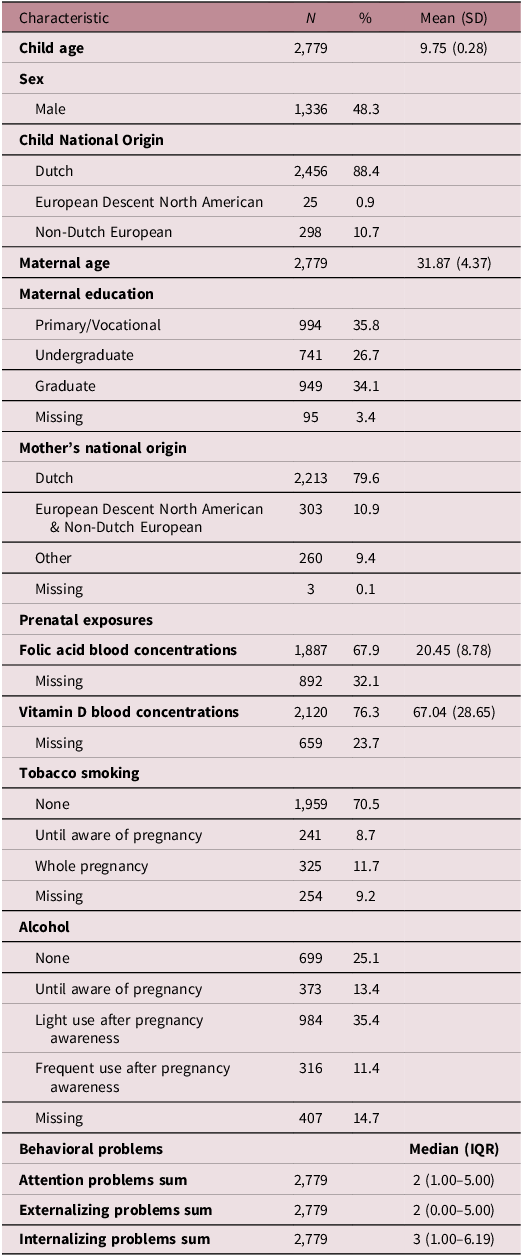
The analytic sample included 2,779 children (mean age = 9.75 years; 48.3% male, Table 1). Most were of Dutch descent (88.4%), followed by non-Dutch European (10.7%). Maternal descent showed a similar pattern: 79.6% Dutch and 10.9% non-Dutch European/North Americans of European descent. Many mothers had primary or vocational education only (35.8%), with the mean age at birth being 31.9 years.
Characteristics of the study participantsa (N = 2,779)

a Sample restricted to children of European descent.
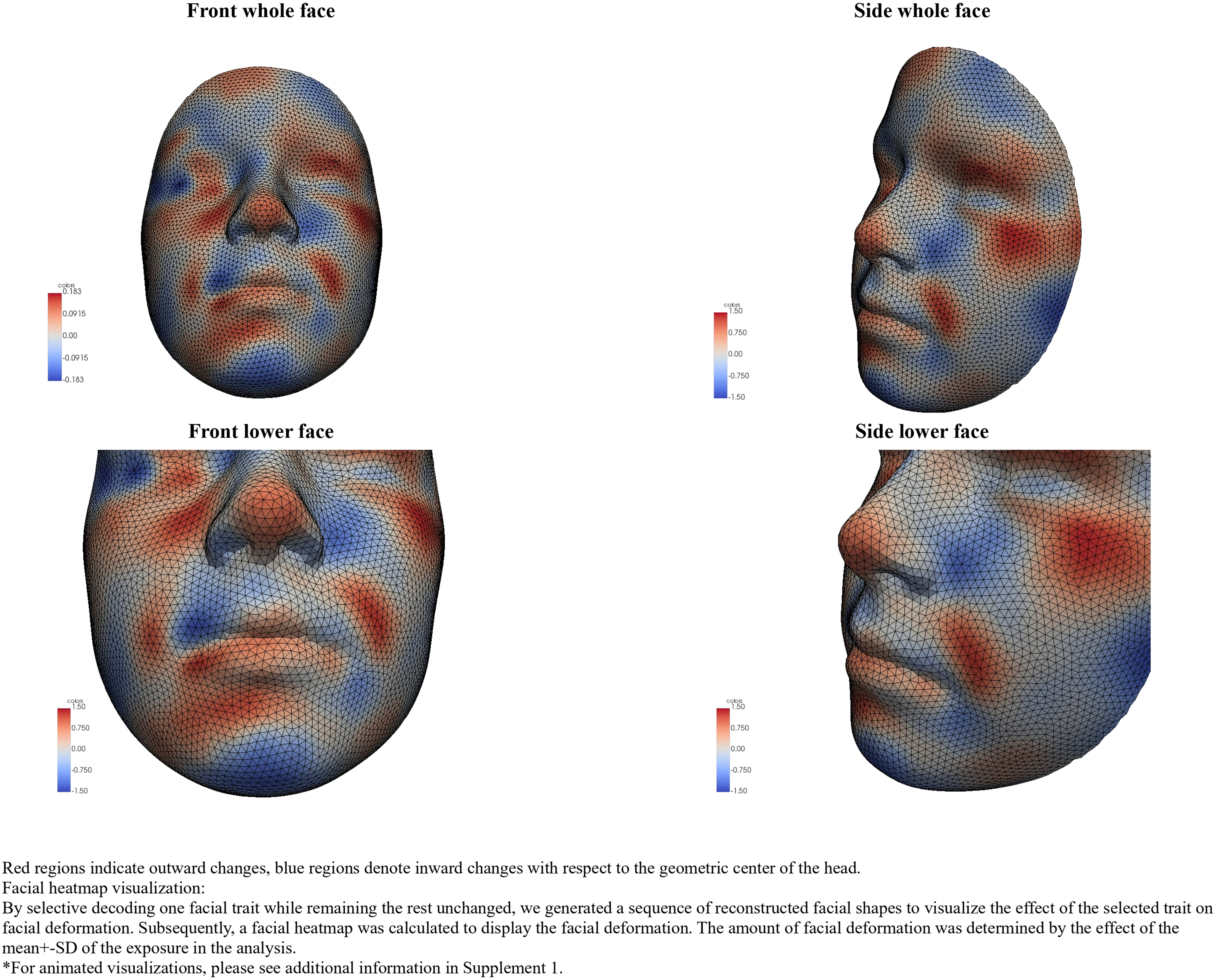
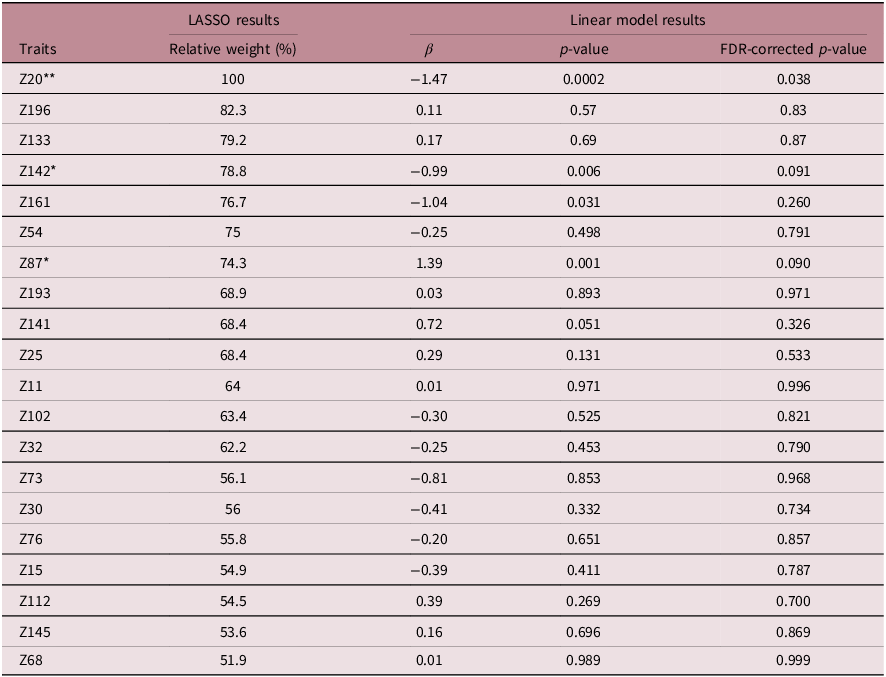
In the LASSO model, Z20 emerged as the most important predictor of attention problems, achieving the highest weight (100.00) among 200 traits (Table 2). In the linear models, after FDR correction, 14 facial traits were associated with attention problems at a p-value of <0.1 (Table S1), but a robust association was observed only with trait Z20 (β = −1.471, p < 0.001, FDR-corrected p = 0.0376; Table 2, Figures 1 & S3). Facial trait Z20 is characterized by chin retrusion, mild nasal contour variation, nose tip protrusion, and overall facial asymmetry. Two additional traits, Z142 and Z87, were also identified in both the top 20 LASSO traits and linear models at FDR corrected p-value < 0.01. Trait Z142 is characterized by longer nose, protrusion of the nasal contour and superciliary arch regions, and retrusion of the eyes and lower lip. Trait Z87 is characterized by protrusion of the upper lip, nasal contour, and superciliary arch regions, along with retrusion of the lower lip. The LASSO weights for Z87 and Z142 were below 80%, and their linear model estimates were less precise than those for Z20 (Z87: β = 1.39, p = 0.001, FDR-corrected p = 0.09; Z142: β = –0.99, p = 0.006, FDR-corrected p = 0.09; Table 2). We did not observe robust associations of facial traits with internalizing or externalizing problems.
Heatmaps of the facial trait Z20 (exposure) indicating associated changes in the mean square-rooted CBCL attention score (outcome).

Top 20 facial traits associated with attention problems in 9–10-year-old children: LASSO regression weights and overlapping linear regression estimates (N = 2,779)

aModels adjusted for maternal national origin, child’s sex and child’s age.
**FDR-corrected p-value < 0.05.
*FDR-corrected p-value < 0.1.
Further linear model output for facial traits associated with attention problems can be found in the Supplement (Table S1).
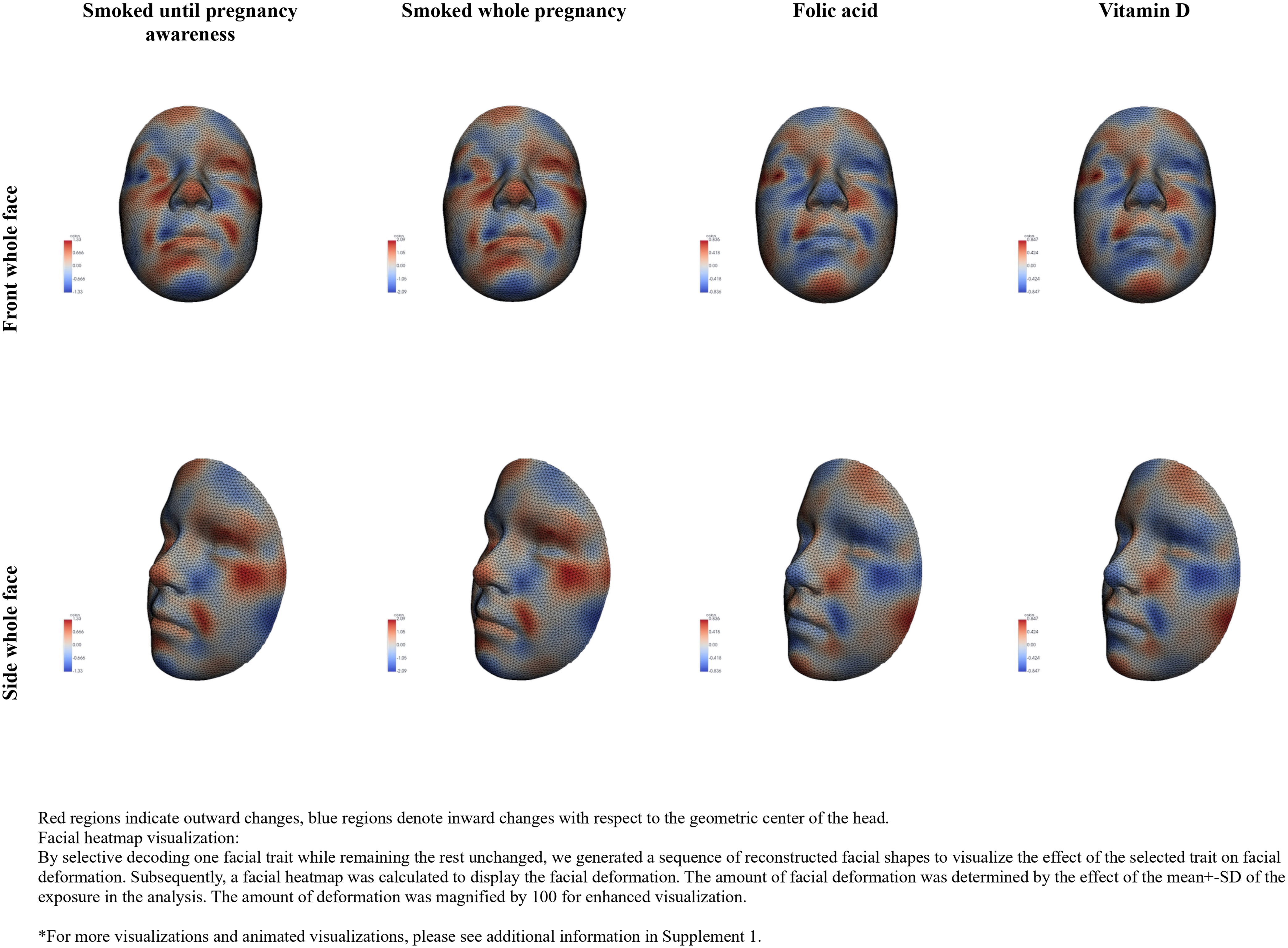
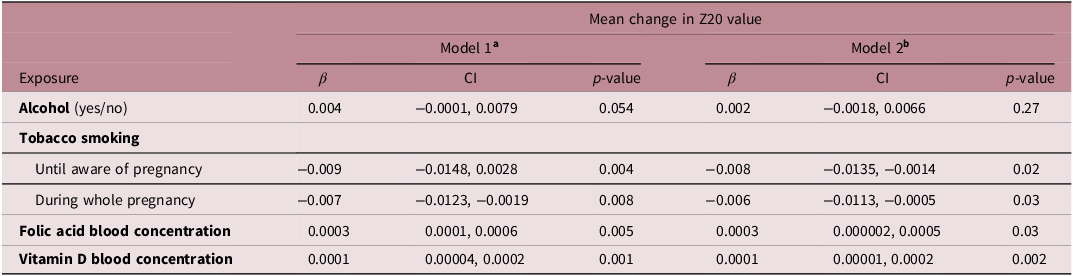
Next, we examined the associations between common prenatal exposures and Z20 (Table 3, Figure 2). In bivariate analyses, smoking and maternal vitamin D and folic acid concentrations were independently associated with Z20, but not alcohol use. Maternal vitamin D blood concentrations, measured continuously, were positively associated with Z20 (β = 0.0001, 95%CI: 0.00004 to 0.0002, p = 0.001). Similarly, continuous folic acid blood concentrations showed a positive association with Z20 (β = 0.0003, 95%CI: 0.0001 to 0.0006, p = 0.005). A categorical measure of smoking (non-smokers, quitters and continued smokers) was negatively associated with Z20: smoking both before awareness of pregnancy (β = −0.009, 95%CI: −0.0148 to 0.0028, p = 0.004) and throughout pregnancy (β = −0.007, 95%CI: −0.0123 to 0.0019, p = 0.008) were associated with less facial curvature. After adjusting for maternal age, education, and maternal and child national origin, the associations remained. Maternal vitamin D blood concentrations showed a significant positive association with Z20 (β = 0.0001, 95%CI: 0.00001 to 0.0002, p = 0.002). Likewise, folic acid blood concentrations were positively associated with Z20 (β = 0.0003, 95%CI: 0.00002 to 0.0005, p = 0.03). Smoking remained negatively associated with Z20, with a larger effect size observed for smoking until pregnancy awareness (β = −0.008, 95%CI: −0.0135 to −0.0014, p = 0.02) than throughout pregnancy (β = −0.006, 95%CI: −0.0113 to −0.0005, p = 0.03). As a sensitivity analysis, we examined the association between folic acid blood concentrations and Z20 while additionally controlling for smoking during pregnancy and found that the association remained (β = 0.0003, 95%CI: 0.00004 to 0.0005, p = 0.03). Effect estimates for smoking showed the same pattern: smoking until pregnancy awareness (β = −0.01, 95%CI: −0.0026 to −0.016, p = 0.007) and throughout pregnancy (β = −0.006, 95%CI: −0.0127 to 0.0002, p = 0.05) were associated with less facial curvature.
Heatmaps representing the observed associations between prenatal exposures and facial trait Z20.

Association between prenatal exposures to smoking, vitamin D, and folic acid and facial trait Z20 in 9-10-year-old children

a Bivariate.
b Adjusted for child’s national origin, maternal age, education and national origin.
Discussion
The study investigated whether facial morphology serves as a neuroectodermal risk indicator of behavioral problems in children. We also examined whether prenatal exposures instigate the subtle facial morphological differences related to behavior. Strong evidence, consistently confirmed by two analytical approaches, linked facial trait Z20 to attention problems, suggesting that facial morphology may be a useful, though not diagnostic, indicator of altered neurodevelopment. Notably, children exposed to tobacco smoking, low concentrations of vitamin D, or low folic acid were more likely to have facial traits characterized by chin retrusion, mild nasal contour variation, nose tip protrusion, and overall facial asymmetry.
The lack of association with internalizing or externalizing behaviors suggests that this indicator of impaired neuroectodermal development may be specific to attention difficulties. This aligns with the underlying hypothesis that facial morphology reflects neurodevelopmental processes; attention deficits are recognized as a neurodevelopmental disorder in the latest editions of the Diagnostic and Statistical Manual of Mental Disorders (DSM-5).Reference Rubia, Alegría and Brinson37 Research has identified reduced volume and cortical thickness, altered patterns of cortical folding, and disruptions in white matter integrity in individuals with attention difficulties, highlighting the neurodevelopmental basis of these deficits.Reference Rubia, Alegría and Brinson37
The association between Z20 and attention deficit in children is likely an expression of the underlying link between brain and facial development. Previous research has established that the processes governing their formation are closely interconnected, such that alterations in one often lead to consequential changes in the other.Reference Marcucio, Hallgrimsson and Young8 A few mechanisms explain this: Firstly, as reviewed in the Introduction, the joint development of the brain and face, rooted in early embryonic processes, suggests a shared embryonic origin.Reference LaMantia7 Secondly, the brain and face evolve in close physical proximity, enabling structural interactions: the brain functions as a structural foundation that exerts physical forces on neighboring tissues, influencing the position and directional growth.Reference Rook1 Thirdly, reciprocal molecular signaling, such as epigenetic processes, regulates the cellular processes responsible for the development of facial structures.Reference Rook1,Reference Suttie, Wozniak and Parnell3,Reference Gallup, Frederick and Pipitone4 Therefore, the association between facial morphology and attention problems is biologically plausible.
The associations between exposures to maternal smoking, vitamin D, and folic acid concentrations during pregnancy and Z20 provide insight into pathways influencing the neurodevelopmental origins of attention problems. Facial morphology, like all physical growth, results from the interplay between genetic and environmental influences. The observed associations with facial traits suggest that prenatal exposures to tobacco and insufficient concentrations of folic acid and vitamin D during pregnancy can lead to subtle deviations in neuroectodermal processes. Vitamin D regulates calcium levels and maintains bone health.Reference Sonuga-Barke and Taylor38 Recent studies also confirm its importance for neurodevelopmental processes: higher early-life 25(OH)D concentrations and supplementation during pregnancy positively influence neurodevelopmental outcomes.Reference Saidi, Hammou, Sicard, Landrier and Mounien18,Reference Rodgers, Mead and McWhorter19,Reference Wagner, Taylor, Johnson and Hollis39 Prenatal folic acid intake is essential for fetal development, with deficiencies linked to reduced brain mass and neurological impairments.Reference Hofman, Jaddoe and Mackenbach20,Reference Zou, El Marroun and Cecil21,Reference Eyles, Burne and McGrath40 Gestational tobacco exposure is associated with a wide spectrum of effects, including epigenetic alterations, and poor somatic, physiological, and cognitive outcomes.Reference Wells and Lotfipour15 It may alter brain development in regions such as the prefrontal cortex, ventral tegmental area, nucleus accumbens, and caudate nucleus, potentially contributing to attention deficit and hyperactivity disorder.Reference Wells and Lotfipour15,Reference Julvez, Fortuny, Mendez, Torrent, Ribas-Fitó and Sunyer41
The absence of an independent association between prenatal alcohol use and facial traits in our cohort was not in line with our hypothesis. Prior research established a link between prenatal alcohol exposure and specific facial morphological features such as a smooth philtrum, turned-up nose tip, short palpebral fissures, and others.Reference Suttie, Foroud and Wetherill22 While previous studies used different facial quantification methods, which may account for the discrepancies, we attribute the findings to cohort characteristics. Over 60% of women reported drinking during pregnancy, but most described it as very light or occasional. Evidence on the effects of very occasional prenatal alcohol exposure remains mixed,Reference Khoury, Jamieson and Milligan16 and residual confounding by socioeconomic factors likely attenuates the association.Reference Benowitz42 In the Netherlands, moderate alcohol use often correlates with good health and higher functioning (“healthy drinker effect”),Reference Benowitz42,Reference Pfinder, Kunst, Feldmann, van Eijsden and Vrijkotte43 likely diluting or flipping any negative associations. Furthermore, the effects of prenatal alcohol exposure depend not only on the dose but also on the timing and duration of exposure.Reference Marmot44 Sporadic, low-level consumption in mid- or late pregnancy may produce subtle effects not detectable by facial morphology imaging, particularly when these traits are selected based on their correlation with attention problems.
We aimed to examine whether subtle, non-syndromic variation in facial morphology, a product of early neurodevelopmental processes, may serve as an early phenotypic signal of altered neurodevelopment in the general population rather than try to identify genetic mechanisms that determine facial traits and behavior. Most prior research has focused on (syndromal) genetic contributions to facial and neurobehavioral development.Reference Naqvi, Sleyp and Hoskens12,Reference Maier, Chen and West45,Reference Claes, Roosenboom and White46 However, growing evidence from developmental biology and epigenetics underscores a role of prenatal environmental factors.Reference Djordjevic, Zhurov and Richmond33,Reference Adhikari, Fuentes-Guajardo and Quinto-Sánchez47,Reference Marsit48 These exposures can influence the tightly orchestrated processes that guide brain and craniofacial formation, resulting in morphological signatures detectable with high-resolution imaging. Our study leveraged advanced 3D facial imaging and nonlinear dimensionality reduction to capture this variation with precision and sensitivity beyond traditional clinical tools. Identifying phenotypic features associated with behavioral outcomes in population-based cohorts may ultimately support the development of early non-invasive markers of neurodevelopment.
The study has notable strengths and limitations. The advanced facial imaging technology is suited for studying neurodevelopment, as it avoids many artifacts and motion-related noise that often affect brain imaging, particularly in children with attention deficits.Reference Han, Yuan, Guo, Shen, Gao and Bi49 We identified a strong association between a particular facial trait, Z20, attention problems, and prenatal exposures, highlighting underexplored early-life determinants of behavioral health. The study design strengthened our ability to robustly test associations between prenatal exposures and facial morphology by first excluding traits unrelated to attention problems. Testing all 200 facial traits against the four exposures would likely have obscured these findings by a high multiple testing burden. Additionally, the blood measures for folic acid and vitamin D concentrations, obtained early in pregnancy, provided objectively measured data to test our hypotheses.
The findings, however, should be interpreted considering several limitations. The Generation R cohort is a mono-city cohort with relatively high socioeconomic status, which may limit generalizability. This concern is mitigated by the population-based nature of the cohort, with a baseline response rate of 68% among individuals of European national origin and follow-up rates of approximately 80% by age ten.Reference Kooijman, Kruithof and van Duijn24 Nevertheless, future research should examine more diverse populations to assess whether these findings generalize across different ethnic, geographic, and socioeconomic contexts. Behavioral outcomes were assessed using parental reports. Although this introduces some subjectivity, prior research supports the validity of parental assessments for this age group.Reference Epstein, Casey and Tonev50 Another limitation is the concurrent assessment of facial morphology and attention problems, raising temporality concerns. We consider the reverse causality in the association between Z20 and attention problems unlikely. Evidence suggests that facial morphology reflects underlying neurodevelopmental processes, including neural crest contributions that shape craniofacial structures.Reference LaMantia7 Attention deficits are more likely symptoms of disruptions in these processes, occurring later in development.Reference Piper, Gray, Raber and Birkett51 Lastly, the observational design precludes causal interpretations. Nevertheless, the findings are consistent with our hypothesis grounded in the brain-face interconnection postulate. This study contributes to the emerging evidence supporting the utility of facial morphology for investigating early-life determinants of behavioral health.
Conclusion
Childhood and adolescent behavioral problems carry notable public health implications, elevating the risk of academic failure, substance abuse, mental health disorders, and social adversity.Reference Ogundele13,Reference Insel52 Our findings underscore the value of incorporating indicators of neuroectodermal development, such as facial morphology, to explore potential pathways between early-life exposures, including substance and micronutrient exposures, and neurodevelopment in children.
Supplementary material
The supplementary material for this article can be found at https://doi.org/10.1017/S2040174425100391.
Acknowledgments
The Generation R Study is conducted by the Erasmus Medical Center in close collaboration with the School of Law and Faculty of Social Sciences of the Erasmus University Rotterdam, the Municipal Health Service Rotterdam area, Rotterdam, the Rotterdam Homecare Foundation, Rotterdam, and the Stichting Trombosedienst & Artsenlaboratorium Rijnmond (STAR-MDC), Rotterdam. We gratefully acknowledge the contribution of children and parents, general practitioners, hospitals, midwives, and pharmacies in Rotterdam.
Author contribution
The authors of the manuscript made the following contributions to this study:
A.S. contributed to the conceptualization and design of the study, conducted the initial analyses, drafted the manuscript, and critically reviewed and revised it.
X.L. assisted with the initial analyses, contributed to writing the manuscript, created the visualizations, and critically reviewed and revised the manuscript.
N.S. and C.C. contributed to the conceptualization of the study, critically reviewed, and revised the manuscript.
M.K. and E.W. critically reviewed and revised the manuscript.
G.R. contributed to the conceptualization and design of the study, supervised the initial analyses and visualizations, and critically reviewed and revised the manuscript.
H.T. conceptualized and designed the study, coordinated and supervised the analyses, and critically reviewed and revised the manuscript.
Financial support
H.T. was supported by a European Union Horizon-Staying-Healthy-2021 Grant (EU grant number 101057529). There are no other conflicts of interest or financial support to disclose.
Competing interests
None.