Introduction
The Scedosporium genus is a group of saprophytic moulds recognised as opportunistic pathogens of increasing importance because of the rising global incidence of associated infections.Reference Geddes-McAlister and Shapiro1,Reference Mello, Bittencourt, Liporagi-Lopes, Aor, Branquinha and Santos2 Multiple factors are thought to contribute to the increasing rates of Scedosporium-related infections, which are now among the most common mould infections in humans.Reference Giraud and Bouchara3 The species’ preference for growing in human-impacted environments facilitates human transmission.Reference Mello, Bittencourt, Liporagi-Lopes, Aor, Branquinha and Santos2 Immunosuppression may predispose to infection, and an increase in immunosuppression prevalence in the general population may be contributing to the rise in infections, though immunocompetent individuals are also at risk.Reference Geddes-McAlister and Shapiro1,Reference Mello, Bittencourt, Liporagi-Lopes, Aor, Branquinha and Santos2 In the past, the prevalence of these infections were likely underestimated given the lack of specific features on histological examination.Reference Giraud and Bouchara3
Scedosporium infections of the middle ear and mastoid regions are rare but potentially life-threatening, with a significant proportion of mortalities recorded despite directed antifungal treatment.Reference Yao and Messner4–Reference Fuster-Escrivá, Chanzá-Aviñó and Concepción6 In an Australian population-based surveillance study, Scedosporium apiospermum was the most commonly identified species from various body sites, with most being isolated from the ear on swab and tissue cultures.Reference Heath, Slavin, Sorrell, Handke, Harun and Phillips7 This species was largely recorded as a commensal organism rather than a pathogen.Reference Heath, Slavin, Sorrell, Handke, Harun and Phillips7 However, S apiospermum is increasingly being regarded as a cause of disease.Reference Geddes-McAlister and Shapiro1,Reference Mello, Bittencourt, Liporagi-Lopes, Aor, Branquinha and Santos2 The difficulty in establishing a diagnosis of an S apiospermum infection of the middle ear or mastoid leads to delays in appropriate treatment.
In order to improve the management for this form of infection, there is a need to better understand the clinical presentation and risk factors for developing it. This paper presents our experience and examines the current literature regarding otological Scedosporium infections, with the aim of improving patient outcomes.
Materials and methods
The medical records of patients treated for S apiospermum middle ear and mastoid infections at the Royal Victorian Eye and Ear Hospital, between 2009 and 2019, were reviewed. De-identified information related to the patients’ clinical presentation, investigations, management and outcomes was obtained.
A literature review was conducted using PubMed, Medline and Cochrane Library databases, with the following Boolean search strategy: (‘scedosporium’) AND ((‘middle ear’) OR (‘mastoid’) OR (‘malignant otitis externa’) OR (‘necroti* otitis externa’) OR (‘skull base osteomyelitis’)). For PubMed and Medline databases, the search included abstracts and full text articles. References cited in the reviewed studies were examined for articles that were not generated from the search strategy.
Articles included cases describing Scedosporium infections involving the middle ear and mastoid regions in all age groups. Articles were excluded when the primary site of infection was not related to the ear or temporal bone, and where there were absent or insufficient details on the clinical presentation, the management and the outcomes of the infection.
The following data were analysed: patient demographics, year of study, past history related to immunosuppression and previous otological surgical procedures, clinical symptoms, examination findings, management details (medical and surgical therapy, duration of medical therapy), time delay in commencing antifungals, outcomes, and complications.
Results
Case one
A 62-year-old woman presented to our institution with a 2-week history of left-sided otalgia, otorrhoea and hearing loss. She had been seen in the outpatient clinic one month previously when she was found to have a deep retraction pocket in the posterosuperior aspect of her left tympanic membrane, and investigations for a suspected left middle ear cholesteatoma were pending. Significant medical history included type II diabetes mellitus requiring insulin.
On examination, the left external auditory canal was inflamed and coated with thick, yellow debris. The left tympanic membrane was myringitic, with granulation tissue involving the area of the tympanic membrane where the retraction pocket was previously located. Middle ear effusion was also noted on that side. Cranial nerve examination findings were normal.
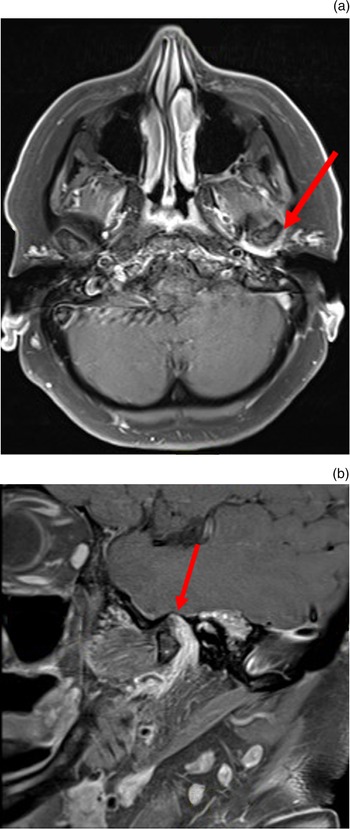
Microbial culture from a swab of the left external auditory canal revealed light growths of S apiospermum and Propionibacterium acnes. Computed tomography (CT) revealed opacification of the left middle ear and mastoid air cells, with bony dehiscence of the posterior wall of the left temporomandibular joint. Magnetic resonance imaging (MRI) demonstrated contrast-enhanced soft tissue involving the left middle ear, with an inflammatory phlegmon within the ipsilateral condylar fossa (Figure 1a and b). Nuclear imaging, including technetium-99m and gallium-67 scans, confirmed left-sided skull base osteomyelitis.
(a) Axial and (b) sagittal views of inflammatory phlegmon in left condylar fossa (red arrows) on contrast-enhanced T1-weighted magnetic resonance imaging scans.

The patient was commenced on systemic treatment for skull base osteomyelitis. She was initially started on intravenous piperacillin/tazobactam and topical ciprofloxacin drops. However, her otalgia worsened despite one week of antibiotic therapy. Following discussion with the infectious disease team, oral voriconazole was commenced and her topical therapy was changed to flumetasone/clioquinol drops. She also underwent left-sided myringotomy and tympanostomy tube insertion to drain the middle ear effusion.
Symptoms improved with the addition of antifungal therapy. A repeat MRI scan conducted after three weeks demonstrated interval improvement with decreased areas of inflammation, especially in the left condylar fossa. The patient was subsequently discharged on a three-month course of oral voriconazole and amoxicillin/clavulanate, with clinical resolution of her symptoms. There were no permanent complications.
Case two
A 12-year-old boy was referred for chronic left-sided purulent otorrhoea refractory to several courses of topical antibiotic therapy. He had multiple tympanostomy tubes inserted previously for otitis media with effusion, with the last tube insertion occurring two years previously.
On initial examination, the left tympanic membrane was bulging and myringitic, with purulent discharge from the tympanostomy tube, but no fungal elements. The right tympanic membrane was normal and intact.
A working diagnosis of left-sided chronic suppurative otitis media (CSOM) was made. Swabs of the left ear canal were taken, which demonstrated moderate growth of mixed skin flora and light growth of S apiospermum. The latter was thought to be of uncertain significance, given that there was no clinical evidence of fungal infection on examination.
Over the next six months, multiple courses of topical flumetasone/clioquinol ear drops were prescribed, in addition to topical ciprofloxacin ear drops and oral amoxicillin/clavulanate. The patient subsequently underwent replacement of the current tympanostomy tube. However, there was no improvement in his symptoms.
A CT scan was performed to assess the middle ear and mastoid areas. This demonstrated a well-pneumatised left temporal bone, with soft tissue density in the left mastoid air cells extending to the aditus ad antrum and Prussack's space.
One week after the CT scan, the patient developed left-sided deep otalgia. On repeat examination, the left tympanic membrane remained myringitic with purulent discharge in the external auditory canal, and the tympanostomy tube could no longer be visualised. Given the clinical changes, a decision was made to proceed with a left tympanomastoidectomy to treat either an occult primary or secondary acquired cholesteatoma, or medication-refractory CSOM.
Intra-operatively, a fungal mycetoma was identified, involving the mastoid air cells of the left temporal bone, with associated granulation tissue. No cholesteatoma was found. Swabs and tissue samples were obtained for culture and histopathological purposes, prior to surgical debridement and washout. The left tympanostomy tube was still present and patent in the tympanic membrane, and as such was left in place.
The histopathology and culture results of the intra-operative samples both confirmed chronic inflammation and the presence of S apiospermum. The patient was subsequently diagnosed with fungal CSOM. He was placed on oral voriconazole following consultation with the infectious diseases team.
Serial interval MRI scans demonstrated improving inflammatory changes of his left middle ear and mastoid. The chronic otorrhoea resolved following 10 weeks of antifungal therapy, with no complications.
Literature review
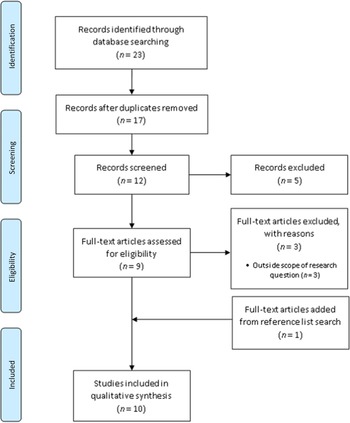
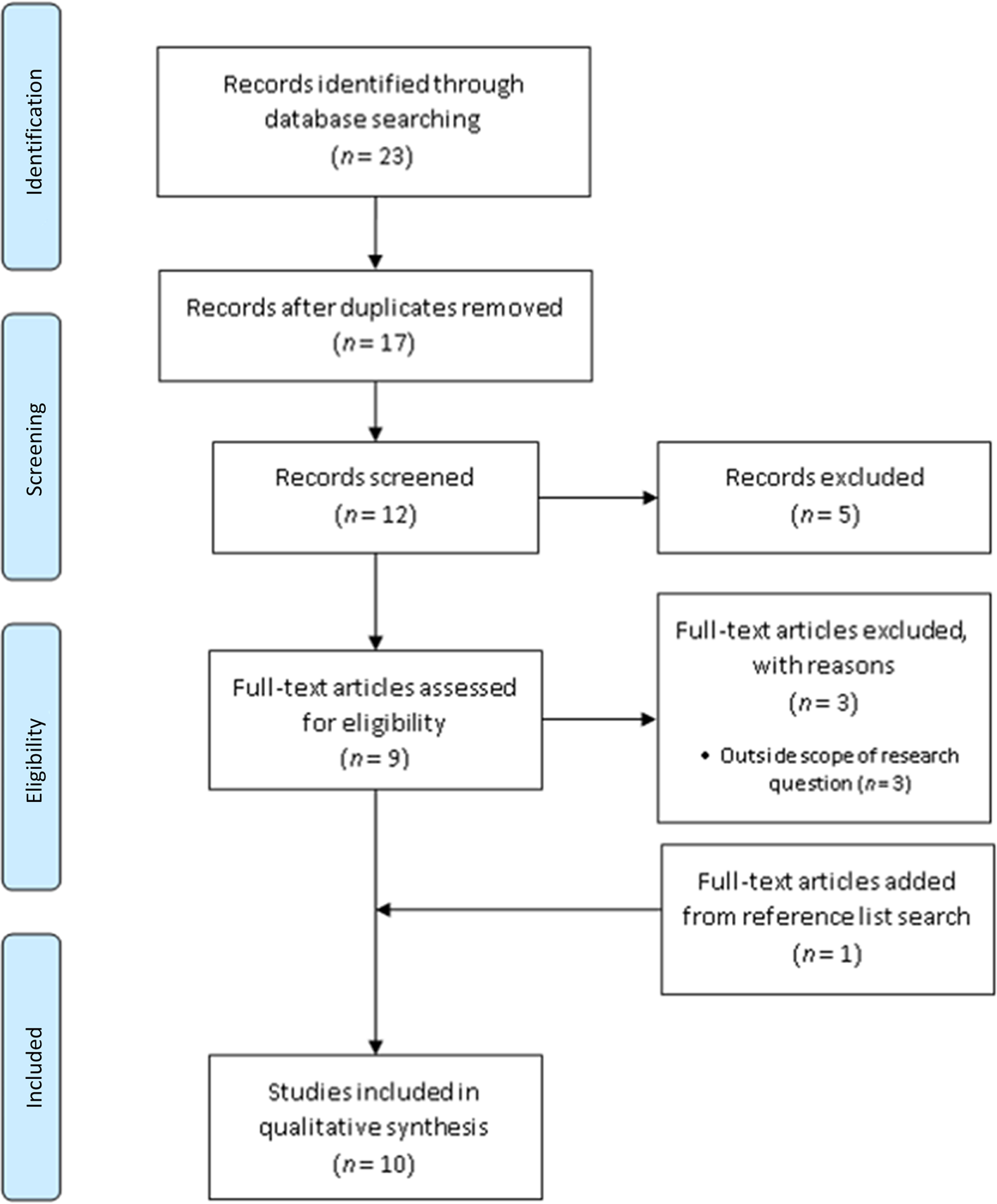
The PubMed, Medline and Cochrane Library database searches yielded 23 studies (15 from PubMed, 8 from Medline and 0 from the Cochrane Library). Nine studies were considered relevant in this literature review, with one additional study included after a search of the reference lists of studies from the initial search. The literature review process is described in a Preferred Reporting Items for Systematic Reviews and Meta-Analyses (‘PRISMA’) diagram (Figure 2).
Preferred Reporting Items for Systematic Reviews and Meta-Analyses (‘PRISMA’) diagram used for literature review.
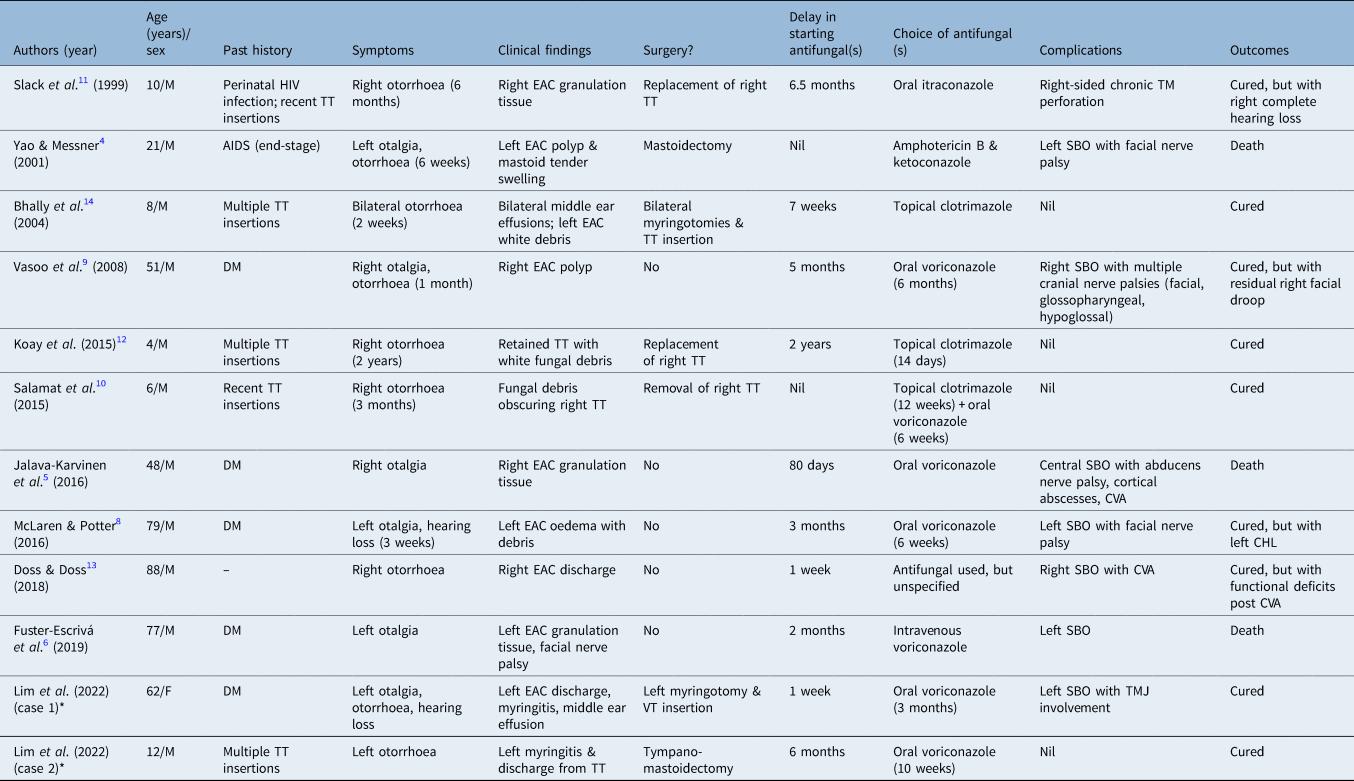
The 10 case studies found in the literature,Reference Yao and Messner4–Reference Fuster-Escrivá, Chanzá-Aviñó and Concepción6,Reference McLaren and Potter8–Reference Bhally, Shields, Lin and Merz14 along with our 2 cases, are summarised in Table 1. The review below describes the 10 case studies only.
Summary of cases in existing literature of S apiospermum infections involving middle ear and mastoid

* New cases of S apiospermum infections involving middle ear and mastoid reported in this paper. M = male; HIV = human immunodeficiency virus; TT = tympanostomy tube; EAC = external auditory canal; TM = tympanic membrane; AIDS = acquired immunodeficiency syndrome; SBO = skull base osteomyelitis; DM = diabetes mellitus; CVA = cerebrovascular accident; CHL = conductive hearing loss; F = female; VT = ventilation tubes; TMJ = temporomandibular joint
All 10 cases were male. The age range was 4–88 years, with a bimodal distribution reflecting a paediatric and an adult group. The median ages for the paediatric group (n = 4) and adult group (n = 6) were 7 years and 51 years respectively.
All paediatric cases involved previous or recent tympanostomy tube insertion, with one case also having a history of perinatal human immunodeficiency virus (HIV) infection. Five out of the six adult cases (83%) had an existing medical condition predisposing them to immunosuppression: four had diabetes mellitus, and one had end-stage acquired immunodeficiency syndrome (AIDS).Reference Yao and Messner4–Reference Fuster-Escrivá, Chanzá-Aviñó and Concepción6,Reference McLaren and Potter8,Reference Vasoo, Yeo, Lim, Ang and Lye9
The most common examination finding in the paediatric cases involved the presence of debris (whitish or fungal) in the canal and around the tympanostomy tube (n = 3, 75%). The most common finding in the adult cases was the presence of an external auditory canal polyp or granulation tissue (n = 4, 67%).
The predominant symptom in all paediatric cases was otorrhoea (n = 4, 100%). Median duration of symptoms in the paediatric group was 18 weeks. In the adult cases, the most common symptom was otalgia (n = 5, 83%), followed by otorrhoea (n = 3, 50%). The duration of symptoms was described for three out of six adult cases, with a median duration of four weeks.Reference Yao and Messner4,Reference McLaren and Potter8,Reference Vasoo, Yeo, Lim, Ang and Lye9
Topical antifungals were only used in the paediatric cases, with 75% (n = 3) receiving topical clotrimazole. Systemic antifungals were used in all six adult cases (100%) and in two paediatric cases (50%) (one case was treated with concurrent topical clotrimazole and one with systemic antifungal alone).Reference Salamat, Archer, Basarab, Eren, Batty and Patel10,Reference Slack, Watson, Abzug, Shaw and Chan11 Voriconazole was the most commonly used systemic antifungal (n = 5, 63%).
Duration of therapy was mentioned in two paediatric and two adult cases, all of whom achieved disease resolution. For topical clotrimazole therapy (two paediatric cases), Koay et al.Reference Koay, Johnson, Patel and Aigbivbalu12 described a 14-day course, while Salamat et al.Reference Salamat, Archer, Basarab, Eren, Batty and Patel10 described a 12-week course. For systemic antifungal therapy (one paediatric and two adult cases), the median duration of treatment was six weeks.Reference McLaren and Potter8–Reference Salamat, Archer, Basarab, Eren, Batty and Patel10
In three out of four paediatric cases (75%), there was a delay in commencing antifungal therapy (range, 7 weeks – 2 years). A similar delay occurred in 83% of the adult cases (n = 5), with a median delay of 11 weeks (range, 1–20 weeks).
Regarding surgical management, all paediatric cases underwent removal or placement of tympanostomy tubes (n = 4, 100%). Only one adult case (17%) underwent mastoidectomy, but did not survive, despite both surgical and medical treatment.Reference Yao and Messner4
All paediatric cases were cured of infection, with one case (25%) – the child with perinatal HIV infection – suffering a complication of chronic tympanic membrane perforation and complete hearing loss in the affected ear.Reference Slack, Watson, Abzug, Shaw and Chan11 All six adult cases (100%) were diagnosed with skull base osteomyelitis, with 67% (n = 4) having cranial nerve palsies and 33% (n = 2) having intracranial complications (cortical abscesses, cerebrovascular accident). Three of the six adult cases did not survive treatment (mortality rate 50%).Reference Yao and Messner4–Reference Fuster-Escrivá, Chanzá-Aviñó and Concepción6 The remaining three patients were cured but had permanent complications (morbidity rate 50%; one case each of hearing loss, facial nerve palsy and functional deficits following cerebrovascular accident).Reference McLaren and Potter8,Reference Vasoo, Yeo, Lim, Ang and Lye9,Reference Doss and Doss13
Discussion
Scedosporium apiospermum
In the immunocompetent population, S apiospermum infections are often localised, and occur as a result of direct inoculation via trauma or surgery.Reference Lackner and Guarro15,Reference Ramirez-Garcia, Pellon, Rementeria, Buldain, Barreto-Bergter and Rollin-Pinheiro16 Commonly affected sites include skin, muscle, joints, bone and the cornea.Reference Lackner and Guarro15,Reference Ramirez-Garcia, Pellon, Rementeria, Buldain, Barreto-Bergter and Rollin-Pinheiro16 In addition, the presence of S apiospermum as a coloniser and pathogen in the aforementioned body sites has been significantly associated with diabetes mellitus.Reference Heath, Slavin, Sorrell, Handke, Harun and Phillips7
Mortality rates for scedosporiosis vary based on the underlying disease and site of infection. The main patient group of concern is the immunocompromised, in which the mortality rate can rise up to 95% in those with disseminated disease.Reference Mello, Bittencourt, Liporagi-Lopes, Aor, Branquinha and Santos2,Reference Lackner and Guarro15
Scedosporiosis is difficult to treat given its inherent multi-drug resistance profile and the limited choices of appropriate antifungals. Scedosporium species are highly resistant to many available antifungals, including amphotericin B, first-generation azoles and echinocandins.Reference Geddes-McAlister and Shapiro1,Reference Mello, Bittencourt, Liporagi-Lopes, Aor, Branquinha and Santos2 Particularly in immunocompromised patients, the antifungal choice is also influenced by significant drug interactions with immunosuppressive and chemotherapy agents, which may negatively impact treatment outcomes.Reference Geddes-McAlister and Shapiro1,Reference Mello, Bittencourt, Liporagi-Lopes, Aor, Branquinha and Santos2
Clinical characteristics
Regarding the clinical characteristics of middle ear and mastoid S apiospermum infections, the literature revealed a bimodal distribution of ages, with paediatric and adult cases. This may be related to surgery in the otological paediatric population and immunosuppression in adults. All paediatric cases had undergone previous or recent tympanostomy tube insertion, suggesting possible inoculation of fungal material into the middle ear through the tube. Almost all adult cases had medical conditions predisposing them to immunosuppression (diabetes mellitus, HIV or AIDS), increasing the probability for developing opportunistic fungal infections.
The initial clinical presentation of S apiospermum ear infection is indistinguishable from that of bacterial otitis externa or CSOM, with symptoms including otalgia and otorrhoea. Clinical signs suggestive of fungal infection, such as fungal debris or tympanic membrane perforation, were uncommon based on existing cases. In both our cases, the patients had thick yellow purulent discharge, without classic fungal elements.
The six adult cases in the literature were initially treated as bacterial skull base osteomyelitis, given the presence of external auditory canal polyp or granulation tissue.Reference Yao and Messner4–Reference Fuster-Escrivá, Chanzá-Aviñó and Concepción6,Reference McLaren and Potter8,Reference Vasoo, Yeo, Lim, Ang and Lye9,Reference Doss and Doss13 While on systemic antibiotics, these patients had intractable symptoms with gradual progression of infection, leading to cranial nerve palsies and intracranial complications. This ultimately prompted further investigation, which eventually uncovered a fungal infection. All cases, except the patient with end-stage AIDS,Reference Yao and Messner4 experienced delays in commencing antifungal therapy, as S apiospermum was only identified in cultures obtained from middle ear fluid or deep tissue. From the time of the initial encounter, there was a median delay of 11 weeks before antifungal therapy was commenced.Reference Yao and Messner4–Reference Fuster-Escrivá, Chanzá-Aviñó and Concepción6,Reference McLaren and Potter8,Reference Vasoo, Yeo, Lim, Ang and Lye9,Reference Doss and Doss13
The immunosuppressed state of the adult patients may also account for the overall higher morbidity and mortality rates seen in this subgroup, compared to the paediatric cases. As such, there appears to be a better prognosis of infection in the paediatric cases, compared to their adult counterparts.
In view of the delays in commencing antifungal treatment, and the high morbidity and mortality rates (50% each) observed in these adult cases, there may be a need to consider the early institution of broad antimicrobial therapy in the immunosuppressed, including treatment for both bacterial and fungal infections if both organisms are found on culture testing.
In both our cases, S apiospermum was isolated from initial culture results early during management, but were considered as colonisers. This decision to ignore S apiospermum as a pathogen was because of a lack of evidence of fungal infection on examination, and only light growth of fungus on swabs. The progression of symptoms in our cases despite prolonged antibiotic therapy prompted further investigation, and led to diagnoses of Scedosporium-related infection. In our series, the adult patient was transitioned to antifungal therapy and had a tympanostomy tube inserted, resulting in gradual improvement of infection. The paediatric patient underwent mastoid exploration, as it was deemed necessary to distinguish between a fungal infection or cholesteatoma. Though systemic antifungal therapy was delayed in our paediatric patient compared to our adult patient, both patients experienced good treatment outcomes.
The main difference observed between our cases and those in the literature is that our adult case (Case one) was a female, and had good outcomes without complications. In contrast, the adult cases in the literature were all male.
• S apiospermum infections of the middle ear and mastoid are difficult to diagnose given the lack of typical clinical features
• Children with a past history of ventilation tube insertion and immunosuppressed adults are the main groups at risk of this infection
• A middle ear or mastoid infection unresponsive to systemic antibiotics in an immunosuppressed patient should raise suspicion of underlying fungal infection
• Systemic antifungals are typically used to treat S apiospermum infections of the middle ear and mastoid; the role of surgery remains unclear
Diagnosis and management
Regarding the diagnosis and management of otological S apiospermum infection, when patients with middle ear and mastoid infections are not clinically responding to a standard duration of topical or systemic antibiotic treatment, a fungal process should be considered. Swabs may be repeated, though tissue cultures should be obtained as they are more likely to isolate the responsible fungal species.Reference Baumgartner, Rakita and Backous17
There are no current guidelines on the management of S apiospermum infection of the middle ear and mastoid. Topical clotrimazole may be a suitable treatment option when infection is limited to the middle ear and a communication is present between the external and middle ear (pre-existing perforation or tympanostomy tube).Reference Salamat, Archer, Basarab, Eren, Batty and Patel10,Reference Koay, Johnson, Patel and Aigbivbalu12,Reference Bhally, Shields, Lin and Merz14 When systemic antifungal therapy is required, the local infectious diseases team should be involved to determine the most appropriate antifungal, based on the minimum inhibitory concentration values for the isolated fungal species.Reference Geddes-McAlister and Shapiro1 In general, the first-line systemic treatment of Scedosporium-associated infections is voriconazole, as these infections are rarely resistant to it and the treatment is generally well-tolerated.Reference Geddes-McAlister and Shapiro1,Reference Mello, Bittencourt, Liporagi-Lopes, Aor, Branquinha and Santos2 The duration of therapy (topical or systemic) should be guided by clinical response, with or without serial radiological assessment of the temporal bone and surrounding regions.
For infections in the setting of a recent tympanostomy tube insertion, removal of the tube may be considered, to reduce fungal load and colonisation.Reference Salamat, Archer, Basarab, Eren, Batty and Patel10 In the setting of a CSOM refractory to medical therapy, a mastoidectomy may be considered to facilitate pathogen identification and exclude cholesteatoma, though its therapeutic benefits are unclear.
For extensive involvement of the middle ear and mastoid, surgical debridement of necrotic tissue via a mastoidectomy has been reported, though the outcomes of surgery on reducing mortality cannot be accurately determined in light of the limited case numbers.Reference Yao and Messner4 The use of systemic antifungals alone for achieving disease resolution in extensive S apiospermum skull base osteomyelitis has been described.Reference McLaren and Potter8,Reference Vasoo, Yeo, Lim, Ang and Lye9,Reference Doss and Doss13
Conclusion
S apiospermum infections of the middle ear and mastoid are rare; however, clinicians should be aware of this pathogen as it can be fatal. Early identification of this species through culture specimens is important to guide targeted antifungal therapy. All patients with skull base osteomyelitis, especially those who are immunocompromised, should have tissue samples obtained at the earliest opportunity for culture and histopathology purposes.
The presence of fungal growth on culture samples should not be assumed to be a contaminate. A middle ear or mastoid infection that is unresponsive to systemic antibiotics in an immunosuppressed patient should prompt clinicians to consider an underlying fungal infection.
Competing interests
None declared