Introduction
Birth defects, also known as congenital abnormalities, are defined as structural or functional abnormalities occurring during the development of the embryo or fetus. According to the World Health Organization (WHO), an estimated 6% of babies are born with birth defects, and 303,000 newborns worldwide die from birth defects each year 1 . Birth defects can cause serious complications and even contribute to long-term disability, thereby significantly impacting individuals, families, and societies. They have become one of the main causes of the global burden of disease. China is a populous country with a high incidence of birth defects. The report on Prevention and Treatment of Birth Defects in China According to the report on prevention and treatment of birth defects in China (2012), the estimated incidence of birth defects was about 5.6%, and the annual number of new birth defect cases was approximately 900,000 2 .
Unfortunately, the fundamental causes of birth defects are still unclear; however, there are some genetic and environmental risk factors related to the occurrence of birth defects. Examining environmental exposure factors that could be prevented and controlled is very important for the prevention of birth defects. Epidemiological studies have found that maternal exposure to tobacco during pregnancy might increase the risk of birth defects Reference Hackshaw, Rodeck and Boniface3-Reference Nicoletti, Appel, Siedersberger Neto, Guimarães and Zhang6 . However, most studies focused on active smoking in mothers due to the high rate of smoking among women in western countries. According to the report by WHO 7 , the smoking rates in 2016 (with age standardized) of women over 15 years old in Europe and America were as high as 20.7% and 12.4%, respectively. Unlike western countries, women in China have an extremely low active smoking rate but a high second-hand tobacco smoke (SHS) rate. For instance, the smoking rate in 2016 of women in China was only 1.9% 7 . Nevertheless, a study based on a large population indicated that the rate of SHS exposure among Chinese adult women was as high as 53.4% Reference Chun, Limin, Zhengjing, Zhenping, Mei and Xiao8 , indicating that Chinese women are more affected by SHS than active smoking.
SHS includes sidestream smoke produced directly by burning cigarettes and mainstream smoke exhaled by active smokers Reference Makadia, Roper, Andrews and Tingen9 . SHS contains many noxious compounds Reference Raghuveer, White and Hayman10 such as nicotine, carbon monoxide (CO), hydrocarbons, polycyclic aromatic hydrocarbons, carbonyls, nitrosamines, and tar. For instance, nicotine, CO, and polycyclic aromatic hydrocarbons are dangerous teratogens Reference Raghuveer, White and Hayman10 . Nicotine is easily transferred to the fetus, which could induce vasoconstriction to possibly cause fetal hypoxia. CO could also result in fetal hypoxemia and have a toxic effect on the development of the nervous system of the fetus. Furthermore, the concentrations of certain toxins in sidestream smoke are higher than those in mainstream smoke, indicating that SHS may be more dangerous than active smoking Reference Schick and Glantz11 . Hoyt et al. reported moderate positive associations between periconceptional second-hand smoke and several types of birth defects based on the National Birth Defects Prevention Study of America Reference Hoyt, Canfield and Romitti12 . A meta-analysis indicated that the exposure of pregnant women to SHS was more likely to associate with neural tube defects compared with those who smoked actively Reference Meng, Sun, Duan and Jia13 . Considering the high SHS exposure among Chinese women and its potentially serious hazards, it is important to determine what influence SHS has on birth defects, which would add new evidence to field of maternal smoking and adverse birth outcomes. Our study aimed to explore the association between maternal exposure to SHS and birth defects in offspring among Chinese women. Given that the data were derived from a large-scale population survey on birth defects with many confounding factors, we adopted the propensity score matching (PSM) method to match the SHS group and the no-SHS group, so as to balance the distribution of confounders between the two groups.
Methods
Data and participants
The data were based on a large-scale cross-sectional survey conducted in Shaanxi Province, China, from August to December 2013. The women aged 15-49 who had been pregnant between January 2010 and December 2013 as well as their children born in this period were recruited as the participants. Stratified multistage random sampling method was used to obtain the sample. According to the proportion of rural to urban residents, population size and fertility rate in Shaanxi of China, twenty counties in rural areas and ten districts in urban areas were randomly sampled. In each sampled county, six villages each from six townships were randomly selected; in each sampled district, six communities each from three streets were randomly selected. In all, 30 and 60 participants were randomly selected in each sampled village and community, respectively. Initially, 32,400 participants were approached and 30,027 participants agreed to be recruited in the survey, and 29,224 participants were investigated finally. In our study, we excluded those who failed to fill out the questionnaire (n = 293), those without clear pregnancy outcomes (n = 86), and those with relevant information missing (n = 1962). As the purpose of our study was to investigate the effects of SHS, a few participants actively smoking were also excluded (n = 186). After exclusion, 26,697 participants constituted the total sample size of our study.
The uniformly trained staff from the Xi’an Jiaotong University was responsible for face-to-face field survey with a structured questionnaire designed by the research team and examined in pilot survey. The field-work quality was controlled based on three-level checking as self-inspection, cross-inspection and inspection by the person in charge, in order to ensure the accuracy and effectiveness of the data. The questionnaire included questions on birth defects, socio-demographic characteristics, life behavioral habits during pregnancy (including smoking and drinking), history of childbearing, family history, pesticide exposure, occupational exposure, existing illnesses, prescribed medicines, and dietary foods consumed from 3 months before pregnancy to the entire pregnancy period. This study has been approved by the Medical Bioethics Committee of Xiʼan Jiaotong University Health Science Center (No. 2012008). All participants were informed of the study’s content and provided written informed consent before the survey.
Exposure variable and outcome
The main exposure variable was maternal exposure to SHS, indicating that pregnant women did not smoke actively but were exposed to SHS from their family members or others who often stay with them from 3 months before pregnancy to the entire pregnancy period. The frequency of exposure was further defined as the number of days pregnant women were exposed to SHS for more than 15 minutes/day per week. The information on SHS was recalled by the participants and collected based on the question of “pregnant women did not smoke actively but were exposed to SHS from their family members or others who often stay with them from 3 months before pregnancy to the entire pregnancy period” and corresponding frequency question of SHS exposure.
The main outcome was birth defects happened during 2010–2013. The children with birth defects were reported by their mothers, and then the trained doctors from township hospitals in rural areas or community health centers in urban areas reviewed their medical records including clinical diagnosis, physical examination, ultrasound imaging report and medical history, which were referred to ascertain birth defects under the supervision of senior medical technicians from obstetrics and gynecology ultrasound and pathology department of the First Affiliated Hospital of Xi’an Jiaotong University. The birth defects were diagnosed and confirmed by the hospitals which are part of a national birth defect surveillance system. Birth defects information was collected with the pre-code structured questionnaire according to the International Classification of Diseases (ICD-10). When analyzing the association between exposure and outcome, we defined two types of outcome. One was overall birth defects (binary variable, “yes” vs “no”), and the other was systematic birth defects (multi-categorical variable) based on main systematic birth defects. Due to low overall incidence of birth defects, the number of cases with defects found in our cross-sectional surveys was limited. Therefore, we only generated a general systematic classification based on main birth defects. Such three selected systematic birth defects as “circulatory system defects (Q20-Q28)”, “eyes, ears, face, and neck defects (Q10-Q18)”, and “musculoskeletal system defects (Q65-Q79)” were analyzed
Confounding factors
According to previous studies Reference Yang, Carmichael, Canfield, Song and Shaw14-Reference Patrick, Schneeweiss and Brookhart19 , some socio-demographic and environmental exposure factors might affect the occurrence of birth defects. Combining the literature and the content of our survey, we included 14 confounding factors as adjustment variables which were from three aspects: 1) socio-demographic characteristics, including maternal age (continuous variable), maternal residence (binary variable, “urban” vs “rural”), maternal occupation (binary variable, “peasantry” vs “others”), maternal education (three-categorical variables variable, “ ≥ College” vs “Senior high” vs “≤ Junior high”), and paternal education (three-categorical variables variable, “ ≥ College” vs “Senior high” vs “≤ Junior high”); 2) reproductive and family history, including history of parturition (binary variable, “yes” vs “no”), history of abortion (binary variable, “yes” vs “no”), and family history of birth defects (binary variable, “yes” vs “no”); 3) maternal health and exposure factors from 3 months before pregnancy to the entire pregnancy period, including suffering from illness (binary variable, “yes” vs “no”), taking medicine (binary variable, “yes” vs “no”), taking folic acid (binary variable, “yes” vs “no”), environmental risk exposure (binary variable, “yes” vs “no”), occupational risk exposure (binary variable, “yes” vs “no”), and exposure to pesticides (binary variable, “yes” vs “no”). Among them, “history of abortion” included history of spontaneous, induced, and medical abortion; “suffering from illness” was defined as pregnant women suffered from colds, fever, genital tract infections, urinary system infections, pregnancy-induced hypertension, diabetes, anemia, hyperthyroidism, hypothyroidism, viral hepatitis, acute fatty liver of pregnancy, cholestasis, TORCH infection or other diseases from 3 months before pregnancy to the entire pregnancy period; “taking medicine” meant that pregnant women had taken antibiotics, antidepressants, anticancer drugs, hormone drugs, antituberculosis drugs, antithyroid drugs, antihypertensive drugs, hypoglycemic drugs and other drugs from 3 months before pregnancy to the entire pregnancy period; “taking folic acid” indicated that pregnant women had taken folic acid during at least one of the following periods: hree months before pregnancy, first trimester of pregnancy, second trimester of pregnancy, or third trimester of pregnancy; “environmental risk exposure” meant that there were collieries, paper mills, cement plants, chemical fertilizer plants, power plants, and other factories and mines within 2 km near the residence from 3 months before pregnancy to the entire pregnancy period; “occupational risk exposure” was defined as occupational exposure to biological risk (pathogenic microorganism or parasite), physical risk (high temperature environment, low temperature environment, high humidity environment, high pressure environment, high/low pressure environment, noise, ultraviolet, infrared, radiation, microwave, etc), chemical risk (lead, mercury, benzene, chlorine, carbon monoxide, productive dust) and other harmful factors from 3 months before pregnancy to the entire pregnancy period. “exposure to pesticides” meant that pregnant women had been exposed to pyrethroids, carbamates, organophosphorus, organochlorine, organofluorine, carbendazim, herbicides, rodenticides, and other pesticides from 3 months before pregnancy to the entire pregnancy period.
Statistical analysis
Mean and standard deviation were employed for the description of continuous variables and the percentage for categorical variables. The χ2 test or t-test was used to compare the values of categorical or continuous variables between the groups of interest. The propensity score (PS) indicated the conditional probability that one subject was assigned to a specific treatment/exposure group or control group under the given covariate conditions 20 . It represents the joint effect of multiple covariates. Based on the PS value, stratification, matching, regression (PS-adjusted), or weighted analysis was conducted to balance the distribution of covariates between groups Reference Hullsiek and Louis21 . Among them, PSM is widely used in medical research, which selects individuals from the control group with same or similar PS values as the treatment/exposure group for matching. In our study, PS of each participant was estimated using a multivariable logistic regression model, in which the SHS group (SHS vs no-SHS) was modeled using 14 selected covariates because they were regarded to be associated with the occurrence of birth defects Reference Yang, Carmichael, Canfield, Song and Shaw14-Reference Patrick, Schneeweiss and Brookhart19 . Next, nearest neighbor matching of PSM without replacement was performed to balance the distribution of covariates between the SHS group and the no-SHS group. The matching ratio was 2, that is, one individual from the SHS group matched with two individuals from the no-SHS group with the nearest PS value. Meanwhile, the caliper width was set to 0.03 to optimize the performance for effect estimation Reference Austin22 . Subsequently, we calculated absolute standardized differences to compare the balance of covariates between the groups before and after matching Reference Flury and Riedwyl23 to check matching performance. It is generally believed that the balance of covariates between groups is good when the absolute standard difference is less than 0.1 Reference DʼAgostino24 . After matching, conditional logistic regression was employed to estimate the odds ratio (OR) and 95% confidence interval (CI) for the effect of exposure – both the main effect of occurrence and dose-effect based on frequency of occurrence. Considering that PSM only involved the matched sample, sensitivity analysis with a series of other statistical methods for the total sample was conducted to confirm the key findings. Firstly, several other methods based on the PS, i.e., PS-adjusted, inverse probability treatment weighting (IPTW), and standardized mortality ratio weighting (SMRW), were employed as supplementary analyses of the PS methods. Secondly, traditional logistic regression with confounders unadjusted and adjusted was performed as a conventional method for comparison with the key findings. Furthermore, given that folic acid supplementation has been identified as having a protective effect on birth defects, we performed PSM between the two subgroups – either taking folic acid or not and then estimated the effects again to assess whether the effects remained robust in the subgroups.
Epidata version 3.1 (EpiData Association, Denmark) was used for the double-entry of data and the establishment of databases. R version 3.6.2 (R Development Core Team, Vienna, Austria) was used for PSM and subsequent analysis. It should be noted that PSM was carried out by the “MatchIt” package of R Reference Ho, Imai, King and Stuart25 . The differences were considered statistically significant at p < 0.05.
Results
Participants and characteristics
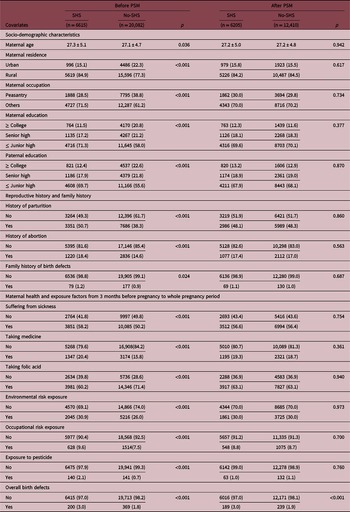
A total of 26,697 participants constituted the total sample size for analysis in our study. Among them, 6,615 subjects (24.78%) were exposed to SHS, while the remaining 20,082 (75.22%) subjects were not. Incidence of overall birth defects was 3% for the participants with SHS and 1.8% for those without SHS. After nearest neighbor matching of PSM with a ratio of 2 and a caliper width of 0.03, 6,205 participants remained in the exposure group and 12,410 participants remained in the control group. Table 1 shows the covariate characteristics between the two groups before and after PSM. Every characteristic varied significantly between the two groups of the total sample before matching. After PSM, there were no statistical differences in each characteristic between the two groups of the matched sample. As shown in Fig. 1, the absolute standardized differences of each covariate were far less than 0.1 after matching, indicating that all covariates reached a balance between the two matched groups. The specific distribution of PS between the two groups before and after matching is demonstrated in Fig. S1.
Absolute standardized differences of the covariates before and after matching.

Covariate characteristics between the two groups before and after PSM

Exposure to SHS and birth defects
Among the matched sample of 18,615 subjects, there were 428 cases (2.30%) suffering from birth defects. In the system classifications based on the ICD-10, the systems defect with the top three incidence rates involved the circulatory system; eyes, ears, face, and neck; and the musculoskeletal system, whose numbers of cases were 141 (0.76%), 53 (0.28%), and 50 (0.27%), respectively. The results of effects estimated by conditional logistic analysis are displayed in Table 2. Pregnant women exposed to SHS were 1.58 times more likely to have birth defects in offspring than those not exposed (OR = 1.58, 95% CI: 1.30–1.91). As for the three types of birth defects, the estimated effect of circulatory system defects was statistically significant, that is, the risk of circulatory system defects in offspring of women exposed to SHS was 1.75 times that of those not exposed (OR = 1.75, 95% CI: 1.26–2.44). Although the other two types had no statistical significance, their effects still had the same risk trend. Regarding the association between frequency of exposure and birth defects, we observed a trend of a dose–response relationship, which showed an increasing trend as the frequency of exposure increased.
Associations between exposure to SHS and birth defects after PSM

* The matched sample size was 18,615.
# The ORs and 95%CIs were estimated by conditional logistic regression.
Sensitivity analysis
Among 26,697 participants, there were 569 participants (2.13%) having children with birth defects in the last pregnancy. The three most common system defects were the same as those mentioned previously, and the numbers of occurrence were 190 (0.71%), 67 (0.25%), and 64 (0.24%). Table 3 shows the sensitivity analyses conducted by different methods for the total sample. The results of association between the exposure to SHS and overall birth defects were similar to our main analysis, indicating good robustness. As for the effect of frequency, the sensitivity analyses had an unclear dose–response relationship. The OR of the 4–6 days/week group was a low, which might have been related to the structural characteristics of the total sample. In terms of subgroup analysis, it was found that the direction of effects between the two subgroups was consistent with our main analysis (Table S1). Based on different sensitivity analyses, our results were robust.
Sensitivity analyses/associations between exposure to SHS and birth defects by logistic regression and other methods of PS with the total sample

* The total sample size was 26,697.
# Adjusted by maternal age, residence, occupation, maternal education, paternal education, history of parturition, history of abortion, family history of birth defects, taking folic acid, illness during periconception, taking medicine during periconception, environmental risk exposure, occupational exposure, and exposure to pesticides.
Discussion
Our analysis based on the PSM method revealed that maternal exposure to SHS could increase the risk of giving birth to infants with overall birth defects, and the risk effect was more obvious for circulatory system defects. Furthermore, the risk effect of SHS exposure on overall birth defects tended to increase with the frequency of exposure. In addition, sensitivity analyses using both traditional logistic regression and other PS methods demonstrated a robust association between maternal exposure to SHS and birth defects. The exploratory analysis between the two subgroups also illustrated the stability of the association. Therefore, such analysis based on a large-scale population survey further confirmed adverse impact of maternal exposure to SHS on birth defects among Chinese to great extent.
Based on previous studies, it has been well-established that active smoking is one of the major environmental risk factors leading to birth defects Reference Hackshaw, Rodeck and Boniface3-Reference Nicoletti, Appel, Siedersberger Neto, Guimarães and Zhang6 . By contrast, there are few studies focusing on SHS. The National Birth Defects Prevention Study of America observed moderate positive associations between periconceptional second-hand smoke and several types of birth defects Reference Hoyt, Canfield and Romitti12 . A meta-analysis exploring SHS and adverse birth outcomes found that pregnant women exposed to SHS were estimated to be 13% more likely to have children with congenital malformations Reference Leonardi-Bee, Britton and Venn26 . Another meta-analysis also found that SHS exposure can increase the risk of overall and several organ-system malformations Reference Zheng, Xie, Yang and Qin27 . Our findings were consistent with the aforementioned studies and added new evidence based on a different population. The risk of Chinese pregnant women exposed to SHS having offspring with overall birth defects increased to 58% compared with those not exposed. It is worthy to note that the risk effect of SHS on circulatory system defects was significant (OR = 1.75), consistent with previous studies on congenital heart defects. Forest et al. observed a risk association between maternal tobacco exposure (both active and passive) during the periconceptional period and congenital heart defects Reference Forest and Priest28 . Deng et al. reported that periconceptional paternal smoking might increase the risk of certain subtypes of congenital heart defects Reference Deng, Liu and Lin29 . However, the results of the other two system defects, namely, eyes, ears, face and neck and the musculoskeletal system in our analysis were not statistically significant, which might have been due to the fact that their sample sizes were too small to arrive at a conclusion.
The teratogenic mechanism of SHS remains inconclusive, but there are some related studies proposing possible theoretical mechanisms. An early animal study reported that intrauterine exposure to SHS could increase the sensitivity of the aortic ring to phenylephrine but reduce the sensitivity to acetylcholine and nitroglycerin, indicating that SHS has a detrimental role on neonatal vascular smooth muscle function Reference Hutchison, Glantz and Zhu30 . Another study observed that passive exposure to side stream could cause widespread ossification retardation in newborn rats, adversely affecting the fetal development of skeletal system Reference Nelson, Jodscheit and Guo31 . In addition, some components contained in SHS, e.g., nicotine and CO, are believed to have certain teratogenic effects. Nicotine is easily transferred to the fetus and considered to have the following possible teratogenic impacts: 1) it can cause structural changes in the lungs, such as hypoplasia, reduce elastin in the parenchyma, and change lung function such as increase airway resistance and decrease expiratory flow rate Reference Hafström, Milerad, Sandberg and Sundell32 ; 2) it can induce vasoconstriction and decrease the placental blood flow, possibly causing fetal hypoxia, which may have a negative effect on vascular development in the fetus Reference Lambers and Clark33 ; 3) it can behave as a developmental neurotoxicant, leading to long-term alterations in brain development such as brain cell damage, apoptosis, and synaptic activity impairment Reference Slotkin34 . CO was also found to have a toxic effect on the development of the nervous system in the fetus Reference Garvey and Longo35 . Furthermore, CO can easily cross the placenta and combine with hemoglobin to form carboxyhemoglobin, resulting in fetal hypoxemia Reference Longo36 . In addition to these two compounds, other harmful chemical components in SHS might also have varying degrees of detrimental influence Reference Bhatnagar37 .
Our study had several strengths. The data was based on a multi-stage stratified sampling survey of birth defects with a large sample size, which increased the results reliability and extrapolative value. In terms of the analysis strategy, we used the PSM method to balance the covariates, so that the observation data could be close to the randomized data, thereby making the estimated effect more accurate. Additionally, abundant sensitivity analyses were conducted to verify the main results. On the one hand, we adopted different analysis methods to re-evaluate the effects. On the other hand, we performed PSM between the two subgroups taking folic acid or not and then estimated the effects again, given that folic acid supplementation had a relatively certain protective effect on birth defects. Nevertheless, there remained some limitations in our research. Firstly, the survey was retrospective, and there inevitably remained a certain degree of recall bias, especially for such life behaviors as second-hand smoking. Secondly, the exposure time of SHS in the questionnaire was from 3 months before pregnancy to the entire pregnancy period. The specific exposure period was not subdivided, and the cumulative exposure time was not collected, probably making our analysis insufficiently detailed. Besides, due to the limitation of the questionnaire items, we did not distinguish the indoor and outdoor exposure in the SHS measure. Thirdly, in the questionnaire some covariates were regarded as categorical variables rather than quantitative ones, such as “environmental risk factors”, which would affect the accuracy of indicators inevitably. Fourthly, although considerable efforts had been made to control the impact of the confounders, there were still some uncollected potential confounding variables that were not considered. For instance, environmental pollutants during the pregnancy period, such as particulate matter and nitric oxide, were not monitored, so we did not include them in our analysis. Moreover, maternal BMI was not controlled in data analysis due to lack of data on maternal weight so we are limited to assess how maternal obesity or leanness influences the effects of SHS on the fetus. The previous study in China implied that maternal periconceptional obesity may increase risk of spina bifida but the underweight may increase risk of anencephaly. Reference Zhang, Zhang, Li, Ren, Liu and Ye38 Therefore, our results could be potentially confounded by the bias of such uncollected covariates and should be interpreted with caution. Finally, due to the low total incidence of birth defects, the sample size found by our cross-sectional surveys was small, which had limited power to explore the various types of birth defects. Therefore, we only generated a general systematic classification of birth defects and analyzed several categories with higher incidence among them. Further, because of nature of retrospective survey, not all affected fetuses such as abortion that did not survive were included in the study. And some birth defects are only found with sufficient follow-up time but the duration of follow-up of the children varied in our study. Consequently, the incidence of birth defects would be underestimated and selection bias may occur.
In conclusion, maternal exposure to SHS likely increases the risk of overall birth defects, especially circulatory system defects, in Chinese offspring. Our study provides data to suggest that avoiding exposure to SHS during pregnancy should be recommended in the practice of maternal and child health care.
Supplementary material
For supplementary material accompanying this paper visit https://doi.org/10.1017/S2040174421000714
Acknowledgments
We would like to express sincere thanks to all participants and investigators contributing to this project. We are especially grateful for the support of relevant hospitals, the health administration, and the Ministry of Health in Shaanxi Province. We also thank International Science Editing (http://www.internationalscienceediting.com) for editing this manuscript.
Financial Support
The study was funded by the Birth Defect Control and Prevention Project of Shaanxi Commission of Health and Family Planning (No. Sxwsjswzfcght2016-013), the National Natural Science Foundation of China (No. 81230016), and the National Key Research and Development Program of China (2017YFC0907200, 2017YFC0907201).
Conflict of Interest
None.
Ethical Standards
The research was approved by Helsinki Committee and the Human Research Ethics Committee of Xiʼan Jiaotong University Health Science Center (No. 2012008). All participants gave written informed consent.